Eva Ejerhad and Hank Bromlay
A SELF-EX1ENDING LEXICON: DESCRIPTION OF A WORD LEARNING
PROGRAM
1. Introduction.
This paper d e s c r i b e s the curr en t i m pl e m en t a ti o n of the lexical an aly zer (MORPH)» of a fi ni t e st ate parser for S wed is h (S U E D I S H - S Y N T A X ). The M O RP H p r o g r a m was d e v e l o p e d by the au th o r s in Augus t 1985» and it is i m pl e men te d in Z LIS P on an LMI CADR Lisp machine. M O RP H is a c o m p u t at i o na l model of the r e c o g n i t i o n and a n a l y s is of w r i t t e n words» with the f o l l o w in g brief c h ar a c te r i s t i c s :
M O RP H is a word an aly zer only» it does not s y n t h e s i z e or g e n e r a t e word forms.
- M O RP H wo rk s left to right through a word» withou t p r e p r o c e s s i n g it in the form of suffix or prefi x stripping.
- M O RP H m o de l s both the p r oc e s s of word r e c o g n i t i o n /ana 1ysis and the p r o c e s s of word a c qu i sit io n.
- M O R P H w o rks by c o m b i n in g the a d v a n t a g e s of the two general m e th o d s for word r e c o g n i t i o n that are availa ble : m a tc h i ng input w ord s with words, and p a rs i n g input m o r p h e m e s into words. By c o mb i n i n g these me thods» the d i s a d v a n t a g e s of using either m e tho d al on e are avoided.
2. Considarationm in daaigning MORPH.
The v e rs i o n of SUIEDISH-SYNT AX that I d e s c r i b e d in 1983 had a full form lexicon which listed each inflected form' of a word along with its part of speech and m o r p h o - s y n t a c t i c features? e.g .
(defslex flicka noun -*-utr -pi -def) (defslex fl ic k a n noun +utr -pi + d e f ) (defslex flicker noun -*-utr -*-p 1 -def) (defslex f l ic k o rn a noun -♦-utr -*-p 1 + d e f )
The parser uses the part of speech in for m at i o n of a word in d e ci d i ng c o n s t i t u t e n t s t r u c t u r e for an input string, and it uses fe at u r e i n f o r m at i o n w hen c h ec k i ng that ag re e m en t c o n s t ra i n ts are satisf ied . A g re e m en t in gender, number and d e f i n i t e n e s s b e t w e e n a d ja c e nt w o rd s in a noun p h r a s e was and still is ha nd l e d in S UED ISH-SY NTA X by a m e c h a n i s m that filt er s out any c o m b i n a t i o n s of n o n - a g r e e i n g w o r d s , l i k e
* ett /acker - u t r - « - u t r -pi -pi -def -def
f 1 i c kan + u tr -pi -fr-def
This e n su r e s that all noun p h r a s e s that are well form ed with respect to c o n s t i t u e n t s t r u c t u r e c o n s t r a i n t s (e.g. NP — DET A D JE C T I V E NOUN), are also well fo rme d with resp ec t to a g re em ent co ns t r ai n t s. The way this wo rk s in S U E D I S H - S Y N T A X is not te ch n i ca l l y by u n if i c at i o n, but by imposing the r e qu i rem en t that for im me d i at e c o n s t i t u e n t s of a noun p h ra s e in Swed is h no c o n f l i c t s of va lu e s are al lo w e d for the f e at u r es of gender, number and d e f i n i te n e ss . In the e x am p l e above, there is both a gender co nf l i ct and a d e f i n i t e n e s s co nf l i ct For a atore d e ta i l ed te chnical d e s c r i p t i o n of the general p r op e r t i e s of the a g re e m en t me cha n is m , see C h urc h 1903, and for its a p p l i c a t i o n to Sw ed i s h syntax, see Ej er h e d 1903.
We wa nte d to i n cre ase by a large amoun t the number of wo rds that could be s u c c e s s f u l l y dealt with by S W E D I S H - S Y N T A X , b e ca u s e a very large, and p r ef e r a b l y s e l f - e xt e n di n g , lexicon
In d e si g n i n g MORPH, there we re c o n s i d e r a t i o n s of a theor eti ca l as well as a p r ac ti cal nature. They w ere the f o 1 l o w i n g .
First, we wa nte d to test the h y po t h es i s , that the proper role, and the only role, of m o rp h o l o g y in word p e r c e p t i o n is in the p r oc e s si n g and learning of u n k n o w n words. U n kn o w n word p r o c e s s i n g p r oc e e ds by " d e c o m p o s i t i o n first, retrieval second", to use the theor eti ca l t e rm i n o l o g y of Job Sartori 190^ in c h a r a c t e r i2ing a p o s s i b l e model of word p roc es sin g. The p r o c e s s i n g of known words, by co nt r a st and on our hypothesis' , p r o c e e d s by retrieval of the e n t i r e word and its a s so c i at e d p r o p e r t i e s (part of speech, features, and m o r p h o lo g i ca l d e c o m p os i t io n ) from a list ("retrieval first, d e c o m p o s i t i o n second"). The so ur c e of this hy pot h es i s , and the hybri d model of word p r oc es sin g, was re se a i ch on speech s y nt h e si s (Byrd &- C h o d o r o w 1985. Ch ur c h 1985). A s s o c i a t i n g p r o n u n c i a t i o n s with w r it t e n words is g e n e r a l l y c o n s i d e r e d to be m e di a t ed by two pr oce sse s, one that r e t r i e v e s the stored p r o n u n c i a 11 on of a word, another that de> ives it fi om general
letter to sound rules. Chijrch 1985 g i s/es a good argu me nt wh> the task of a s so c i a t i n g p r o n u n c i a t i o n s with wo rd s cannot be r edu ce d e n t i r e l y to either listing them or d e ri v i ng them:
"Both a p p r o a c h e s h a ve their a d v a n t a g e s and d i s ad van tag es ; the d i c t i o n a r y ap pr o a ch fails for u n kn o w n wo rds
(e.g. proper names) and the letter to sound ap pr o a ch fails when the word does not fo ll o w the rules, which h a pp e n s all too of te n in English. Most speech s y n t h e s i z e r s adopt a hybrid strategy, using the d i ct i o n a r y when a p p r o p r i a t e and letter to sound for the rest."
c o m p u ta t i o n a 1 l i ng u ist ic s (e.g. W e h r 1 i 1985). For an o v e r v i e w of psycl\o1 ingui st i c work on m o rph olo gy , see H e n d e r s o n 1905, and fot a set of recent st ud i e s of m o r p h o lo g i ca l c o n s t r a i n t s on word i-ecogn i t i o n , see Jarvella, Job, S a n d s t r ö m 8. Sc hreuder
(fortticomi ng ) .
Second, we wa nte d a ps ych o 1 i n g u i s t i c a 11y and c o m p u t a t i o n a l l y p l a u s i bl e model of how w ord s are e nte re d into the lexicon of ^nown words of a la nguage user, as a f u nc t i on of langua ge use. Most e.;isting c o mp u t a t i o n a l m o de l s of natural la nguage deal with the p r o c e s s i n g of s e n t e n ce s r e l a t i v e to a fixed body of language knowledge, rather than with the a c q u i s i t i o n of that knowledge. P e o p l e a c qu i r e new k n ow l e dg e about a language as part of the p r oc e s s of using it, and we h ave to try to si mu l a te at least some as pe c t s of language learning b e hav ior on comput ers , it we want to shed fu rther light on learning by people, and if we want to make c o m p u t e r s more useful,
1a n g u a g ew i s e .
Third, we wanted a u n i d i r ec t i on a l model of word r e co g n i t i o n only, and not a b i d i r e c t i o n a 1 model of both word r e c o g n i t i o n and genera tio n. There was a p e r f o r m a n c e theoretic r e as o n for this, as well as a p rac ti cal one. In s tud ie s of language p r oc e s si n g (e.g. De uts ch &< J a rv e l la 198^), tasks involving p e r c e p t i o n and tasks in volving p r o d u c t i o n of the same linguistic s t ru c t ur e s have s how n in ter est in g d i ff e ren ce s, which u n d e r m i n e s the idea that it is ex ac t l y the same k n ow l e dg e of langu age (linguistic c o mp et enc e) that is at work in both p e r f o r m a n c e pr oce sse s. The p r act ica l c o n s i d e r a t i o n in mo de l i ng only word a n al y s is was that it m i ni m i ze d the problem. Fourth, and another p rac ti cal c o n s i d e r a t i o n , was the limited time a v a i l a bl e for desig nin g, i m pl e men ti ng and testing the new lexical comp on ent , a total of four weeks.
and mo rph o s y nt ac tic f e atu res w ere al re a d y e s ta b l is h e d, and p r ev e n t e d us from using d i r e c t l y any p r e - e x i s i t i n g mo rp h o lo g i ca l analy zer , such as B l a b e r g ’s two-level m o r p h o l o g y for Sw ed i s h (Blaberg 190^), or H e l l b e r g ’s S w edi sh m o r p h o l o g y in the i m pl e m e n t a t i o n of Doherty, R a nk i n 8». W i r é n (this v o 1u m e ).
3. Description of the morphological analyzer.
3.1. Overview.
The two lexicon model of word p r o c e s s i n g that we a r riv ed at has the fo ll o w in g technical c h a r a c t e r i s t i c s . There are two lexica, one of full words, c a lle d
word-lex icon,
and one of m orp he mes , ca ll e dmorpheme-lex icon
. We will d e s c r i b e the (norpheme lexicon first.3.2. The morpheme-lexicon.
The m o r p h e m e - 1 e x i c o n is a le xicon of known morph eme s, c o r r e s p o n d i n g to the m o r p h o 1ogica 1 d e c o m p o s i t i o n s of words g ive n in the word lexicon. The iiioi p h em e lex i-oi. is a h ash
t a b l e (a ss o c ia t i on list) with m o r p h e m e s as keys -itid features
as
values.
The a d v a n t a g e of this r e p r e s e n t a t i o n over other r e p r e s e n t a t i o n s ( d is c r im i n at i o n ne tworks, or tr eating words as Lisp atoms) is that the hash table e n ab l e s a group of values to be a s so c i at e d with a si ng l e key and r e tr i e ve d all at once. Si nce m o r p h e m e and word a m b i g u i t y is common, that is useful. Further, the m o r p h e m e - 1e x i c o n is so rte d by values, me an i n g that m o r p h e m e s with the same f e at u r es are gr oup ed together. The f o l l o w i n g is an e x a m p l e of the s t r u c t u r e of en tr i e s in the m o r p h e m e - l e x i c o n (note that “flick" h ere is a morphe me, not what H e l l b e r g 1970 and o t he r s ( Käl lg ren 1906) have c a lle d a technical stem):KEY
"flick"
VALUE
( #
1 N
2
-WF3COMBINATORIAL FEATURES
-•-UTR)
BINARY FEATURES
We will now describe the c o m b i n a t o r i a l f e at u r es and the b i na r y
features of a morpheme. The forme r e n co d e the c o m b i n at o r ia l
possibilities of the morpheme, and the latter are s t ri c t ly
P o s i t i o n 1. The first c o m b i n at o r ia l f e at u r e e n co d e s what part of speec h the m o r p h e m e c o m b i n e s with on its left, what it
takes. The o p ti o n s are:
NIL
m o r p h e m e takes any part of speech on its left m o r p h e m e takes n o th i n g on its left
NOUN VERB ADJ PREP ADV
m o r p h e m e takes s p e c i f i e d part of speech on its left
P o s i t i o n S. The s e con d c o m b i n a t o r i a 1 f e at u r e en co d e s what part of speech a m o r p h e m e makes. The o p ti o n s are:
NOUN VERB ADJ PREP ADV
P o s i t i o n 3. The third c o mb i n a t o r i a l f e at u r e e n co d e s whet he r or not the m o r p h e me can occur in word final positi on. There are
just two options:
-UP m o r p h e me c o m b i n e s with s o m e t h in g on the right, i.e. it is non word final
-♦-UIF m o r p h e m e c o m b i n e s with n o th i n g on the right, i.e. it is word final
The w o rd- f i ria 1 i ty f e at u r e e n ab l e d us to do morphological
a n al y s is wi th o u t zero mo rph e me s , which seemed desirable. An e x am p l e of how it is used is the follow ing :
■ k o / __ #(w b) has f e at u r es ( * N O UN +WF -»-UTR -PL -DEF)
■ k o / _ _ m b) has f e a t u r e s < ♦ NOUN -WF -»-UTR) and no more.
It will get the f e a t u r e s for numbe r and definiteness from what
P o s i t i o n Bi nar y featu res . For the noun, a d j e c t i v e and verb system, they are;
+UTR +AUX
-UTR --AUX
4-PL +REAL
PL -REAL
+DEF +FIN
-DEF -FIN
fPRS -PRS
The bi nar y f e at u r es are st ric tly binary, i.e. the co mpl e me n t of -«-UTR I S -UTR, etc. Bi nar y f e a t u r es are al wa y s fully specified, thus there are no r e d u n d a n c y ru les that m e di a t e b e t w e e n p a r t i a l l y and fully s p ec i f ie d fe at u r e values (the a bse n c e of a s p e c i f i c a t i o n for a feature m ean s that the item can p ass the r e q u i r em e n t of both the va lu e + and the va lu e - for that feature) . There w ere two re as o n s for this, one being that it is do ubt ful that r e d u n d an c y rules are of any practi cal use in a p r o c e s s i n g model, the other being that the ab se n c e o f r e du n d an c y rules fac ilitates d e b u g g i n g and exten d i ng the lexicon. At any point of w ork in g with it, the fe at u r e s p e c i f i c a t i o n s you see is what the p r oc es sor gets. t o o . Be low are sa mp l e s of gr ou p s o f en tr i e s of lexical m o r p h e me s and partial e n tr i e s of some gramm ati ca l morphe mes .
"flick" ( * N -UF -«-UTR) " g r y t " ( * N -UF -«-UTR)
" k lock " ( M- N -UF + UTR) "po jk" ( » N -UF ^UTR )
"dru 1 1 " ( N -UF + UTR ) "män" ( N -UF -«-UTR) "h i m 1 " ( N -UF -«-UTR )
"a" ( (A A ■^WF -«-UTR -«-PL -«-DEF) a /' de söt-«-a tä-«-r-«-na (A A -«-UF -«-UTR ^-PL -DEF ) a / söt-«-a ta-«-r
(N N -»■WF ■»-UTR -PL -DEF ) a / f 1 ick-»-a (N N -»-WF -UTR -»-PL -»-DEF ) a / bi-»-n-»-a
( V V ^WF -AUX -»-REAL -FIN -»-PRS) a / verk-»-a (inf) ( V V -»-WF -AUX -REAL) ) a / ver k -»-a ( i mpv )
( N Ivl -»-WF -»-UTR -PL -»-DEF) n / f 1 i ck-»-a-»-n ( N N -»-WF -UTR -»-PL -DEF ) / b i -fn
( M Tvl -WF -»-UTR -»-PL ) or / f 1 i c k-»-or -»-na ( N N 4-WF -»-UTR »-PL -DEF ) ) or / flick-»-or
( V A -»-WF -»-UTR -»-PL -»-DEF) na / de druck-»-na ko-»-r-»-na ( V A -»-WF -»-UTR ^-PL -DEF ) na / druck-»-na ko-»-r
( V A -»-WF -»-UTR -PL -»■DEF ) na / den dr uc k » na ko-»n ( V A -»-WF -UTR -»-PL ^DEF ) na / de druck^-na bi-»-n-»-a ( V A -»-WF -UTR -»-PL -DEF ) na / druck-»-na bi+n ( V A -»-WF -UTR -PL -»-DEF) na / det druck-»-na bi-»-et ( N N -»-WF -»-UTR -»-PL -»-DEF ) ) na / f 1 ick-»-or-»-na
The general ap pr o a ch to s p ec i f yi n g word s t ru c t u r e in M O RP H is e x ce e d i n g l y simple. Word = m o r p h e m e “ m inu s those s e qu e n c e s of m o r p h e me s ruled out by the m o r p h o t a c t i c c o n s t r a i n t s e nco de d in the c o m b i n a t o r i a 1 features. That those fe at u r es go a long way towards s p ec i f yi n g a d m i s s i b l e s e q u e n c e s in real c a ses is illust rat ed by the f o ll o w in g e x a m p l e of three m o r p h e m e s and their sp eci fic a t io n s ;
" a v ” ( (NIL PR EP -W F ) (NIL PR EP -»-WF) )
av '' av-»-led-»-a av / av f 1 ick-»-a-»-n ” led" ( ( * V -WF ) 1 ed / 1 ed-»-er
a V-»-1 ed-»-er
bransch-»-led-»-ande V -»-WF -REAL) ) 1 ed / led 1
"n i ng " ( ('-J N -WF ) n i ng / 1 ed-»-n i ng-»-en N -»-WF -»-UTR -PL -DEF ) ) ning / led-»-ning
G i v e n this set of three m o r p h e m e s
avf ledv ning»
thi number of theoT-etically poss i b 1 e wo rds (up to trii w o r d s ) made out of them are; 3 + 3»’ -»- 3'» = 39.(in a c c o r d a n c e with a h y po t h e s i s of word p e r c e p t i o n of C a r a m a z z a et al 1905).
Below are e x am p l es of the s t r u c t u r e of e n tr i e s in the word- l e x i c o n .
“flicka" (((NOUN +WF -PL -DEF +LITR)) ("flick" "a")) "flickan" (((NOUN -»-UIF +DEF -PL -*-UTR) > ("flick" "a" "n")) "flickor" (((NOUN «-WF -*-PL -DEF + U T R ) ) ("flick" "o."))
"f lickorna" (((NOUN +WF +DEF -t-PL + U T R ) ) ("flick" "or" "na")) These are copi ed with one minor ch an g e from the curren t en tr i e s in the w o rd - l ex i c o n , and they reveal an u n n e c e ss a r y feat ur e of each entry, + W F . S i nc e ev ery word, by d e f i n i t i o n is word final, this f e at u r e shou ld be removed. The e n tr i e s ab ove are very s i mp l e and do not i l lu st rat e what the e n tr i e s of wo rds with a m b i g u o u s a n a l y s es look like. B e low are two ex amp 1e s
-"b iIdrulie'
( ( (VERB +WF --AUX -PRS + FIIM1 +REAL) ("be" "t a 1 ’' " a d e " ))
( (ADJ EC TIV E +UIF + UTR + PL -•-DEF) (ADJEC TIV E +WF +UTR +PL -DEF ) (A DJECTIVE -•-UF +UTR -PL + DEF ) (ADJ EC TIV E -•-WF -UTR + PL ■•-DEF) (ADJEC TIV E -»-WF -UTR + PL -DEF) (A D J E C T I V E + WF -UTR -PL ■»-DEF ) ("be" "tal" " a '■ "d" "e" ) ) )
( ( (NOUN -^UIF -PL -DEF 4UTR) ("bil ( (NOUN +-WF -PL -DEF +UTR) ("bil
Using
MORPH-The central fu nc t i on in the M O R P H p r o g r a m is ca ll e d lookup- word, and it has the f o l l o w in g easy to u n d e r s t a n d d e fi n iti on ;
(defun lookup-w or d (word)
(cond ((1o o k u p - w o r d - i n - l e x icon word))
( (a n a l y z e - w o r d - a n d - a d d - t o - l e x icon w o r d ) ) ((a s k - a b o u t - w o r d - a n d - a d d - t o - l e x i c o n word)) ))
internall) c o n s i s t e n t m o rp h o lo g i ca l d e c o m p o s i t i o n s of it, r e la t i ve to the curr en t m o r p h e m e - 1 e x i c o n . These a n al y s es are retur ned as the va lu e of the function, and the result i n co rp ora ted in the w o r d - 1 ex i c o n . If the f u n c t i on a n aly ze- Nord". .. is un su c c es s f ul , the p r o g r a m asks tlie use. to supply i n fo r mat io n about the word, as a last lesort. Several u t i l i t i e s for the manual e x t e n s i o n of the lexica are ir.cluded in MORPH, in order to m i n i m i z e the amount of typing done. In that sense it is a good e x a m p l e of a lexicon w r i t e r ’s workbe nch . For example, if a new m o r p h e m e is e x ac t l y like a pr ev i o us l y known one, with respect to part of sp eec h and f e at u r es (and d e gr e e and n a tur e of lexical a m big uit y) , then this in fo r m at i o n is a u t o m a ti c a ll y co pie d when typing the m o r p h e m e it is like, at the a p p r o p r i a t e point in the
in ter act iv e sequence.
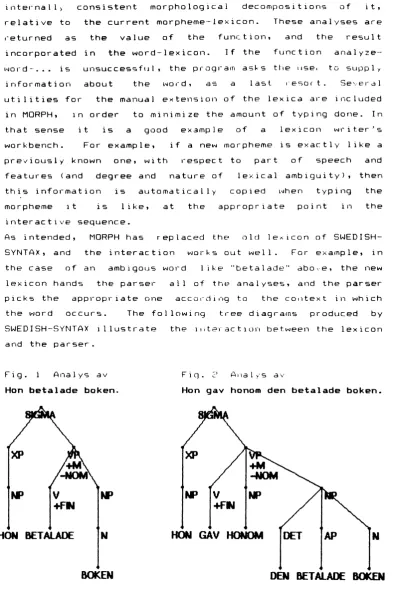
As intended, M O RP H has r e pla ced the old lexicon of S W E D I S H - SYNTAX, and the in te r a ct i o n wo rks out well. For example, in the case of an a m bi g o us word like " b e t a l a d e ” above, the new lexicon ha nds the parser all of the analyses, and the parser picks the a p p r o p r i a t e one accordi.'tg to the co nte xt in which the word occurs. The fo ll o w in g tree d i a g r a m s p r od u c ed by SUED IS H-SYNTAX i l lu st rat e the ii.teraction b e tw e e n the lexicon and the parser.
Fig. 1 Ana 1ys av
Hon betalade boken.
Fig. c’ A n a 1 y's a v'
Hon gav honom den betalade boken.
r i n a 11y » we would like to pres en t some p r e l i m i n a r y figu re s that shtow how long it takes for the p r o g r a m to do looku p-w or d by 1o o k u p - w o r d -1n - 1 e x ic o n (R = re trieval) on the one hand, and by ana 1y z e - w o r d - a n d - a d d - t o - l e x icon (A = analysis) on the other hiand . The words we tested are p r e s e n te d in d e sc e n d i n g order of m o rp h o lo g i ca l c o mp l exi ty , and the last word is an e x am p l e of an a m b i g u ou s l y d e c o m p o s a b l e word.
#kyrk+klockH
#b i b 1 1
#till-«-tal+a nd e# #f r an-» tag-»-ni ng# #kyr k -r t ag + n 1 ng#
#b i 1 -»-dr u 1 1+e# #b i I d-»-r u 1 1-»-e#
Church, K., 1985, St re s s a s si g n me n t in letter to sound rules for speech synth esi s. P r o c e e d i n g s of the 23rd Annual Me et i n g of the A s s o c i a t i o n for C o mp u t at i o na l Li ngu i st i c s, pp 2^6-253. D e u t s c h1
W.
. Jar ve11aS p r a c h p r o d u k t i o n und
H e r r m a n n (eds) , Karl ___ _____ ... A x io ma tik der S p r a c h w i s s e n s c h a f t e n Kl ost e rm a n n, pp 173-199.
el la, R., 190^, A s y m m e t r i e n zwis ch en S p r a c h v e r s t e h e n , in C.F. G r a u m a n n & T. 1 B u hl e r s Ax io m a ti k - Fu nf z i g Jahre F r an k f ur t an Main,
Doherty, P., Rankin, I. &< Wirén, M., 1986, E r fa r e n h e t e r av en i m pl e m en t e ri n g av H e l l b e r g s s y ste m för svensk morfol ogi , i F. K a r l s s o n (utg). F ö re d r ag från V N o rd i s ka D a ta 1 ingV i s 11k d a g a r n a , 11-12 dece mb er, 1985, He lsi n gf o r s.
Ejerhed, E., 1983, K o n g r u e n s i en svensk finite s tat e parser, fo re d r ag vid :e sv en s k a k o ll o k vi e t i sp rå k l ig d a t a b e h a n d l i n g - d a t o r s i m u l e r i n g av ve rbalt bete en de, 26 maj 1983, Lund.
Ejerhed, E., 1985, En y t s t r u k t u r g r a m m a t i k för svenska, i S. A l lé n et al (utg), S v e n s k a n s b e s k r i v n i n g 15, I n st i t ut i o ne n för no rd i s ka språk, G ö t e b o r g s un iv e r si t e t, s 175-192.
Ejerhed, E. Church, K., 1983, F i ni t e S tat e Pa rsing, i F. K a r l s s o n (ed). Pa pe r s f rom the S e ven th S c n a d i n a v i a n C o nf e r e n c e of L i ng u ist ic s, U n iv e r s i t y of Hels in ki, De pa r t me n t of General L i ng u ist ic s, P u b l i c a t i o n No. 10 (II), pp '^lO-^Sø.
He llberg, S., 1978, The m o rp h o l o g y of p r ese nt day Swedish, Stock hol m, Al mq v i st i Wiksell In ternational.
Hende rso n, L., 1985, To war d a p s y c h o l o g y of m orp he mes , in A.W. Elli s (e d ) , P r o g r e s s in the p s y c h o l o g y of language, Vo 1. 1, London, L a w r e n c e E r l b a u m A s so c iat es .
Jarvella, R., Job, R., Sa nds trö m, G. &< Sc hre u de r , R. (f or t h coming), M o r p h o 1o g i c a 1 c o n s t r a i n t s on word r e co gn iti on, De pa r t me n t of General L i n g u i st i c s, U n i v e r s i t y of Umeå.
Job, R. &C Sartori, G., 198^, Mor pho 1 og i ca 1 d e c o m p os i t io n : e v i d e n c e from cr os s e d p h on o l og i c al d ysl ex ia, The Q u a r t e r l y Journal of E x pe r i me n t al P s y c h o l o g y 36A, pp ^35-^50.