Towards t h e application of text g e n e r a t i o n
in an integrated p u b l i c a t i o n system*
E l k e T e i c h a n d J o h n A . B a t e m a n
I n s t i t u t e for I n t e g r a t e d P u b l i c a t i o n a n d I n f o r m a t i o n S y s t e m s ( G M D / I P S I ) G e r m a n N a t i o n a l R e s e a r c h C e n t r e f o r I n f o r m a t i o n T e c h n o l o g y ( G M D )
Dolivostrat3e 15 D-64293 D a r m s t a d t , F R G e-mail:{ reich ,bateman} ~daxTastadt. grad. d e A b s t r a c t
We describe the application of multilingual text generation in a system for assisting the process of publication. This system is an editor's work- bench for preparation of the publication of an art history encyclopedia (the Macmillan Dic- tionary of Art), which is itself part of an in- tegrated pub!ication environment being devel- oped at GMD-IPSI. We show how an editor's tasks can be facilitated by the use of NLP (nat- ural language processing) systems and suggest the important role of text generation in future electronic publications as products. In both cases, we focus on text generation as providing an essential new mode of information presen- tation. Text generation provides a quality gain in which the flexibility of the electronic product is augmented; in particular, views on knowl- edge expressed as text, possibly in different lan- guages are incorporated. The major prerequi- site for making this possible is an explicit and systematic representation of genres or text types combined with a general interfacing method for specific domain knowledge.
1 O v e r v i e w o f t h e p a p e r
The function of this paper is two fold. First, we present an example of a new application area for text genera- tion: support tools for electronic publishing. Second, we provide a brief overview of a new generation architec- ture based closely on the 'stratified context' systemic- functional linguistic model of [Martin, 1992]. The aim of the latter introduction is primarily to promote discus- sion of this kind of architecture, since the details that can be presented in the space of this paper are neces- sarily limited. The architecture is also highly experi- mental at this time. The simultaneous presentation of an application emphasizes the systemic-functional lin-
*The research described in this paper was supported in part by the European ESPRIT Basic Research Action DAN:
D E L I O N (EP6665) and by the US National Science Founda-
tion Grant IRI-9003087. John Bateman is also on indefinite leave from the Penman Project, USC/ISI, Marina det Rey, California
guistic commitment to the inseparability of theory and practise.
The background context of the work reported here is an electronic publishing support tool consisting of a workbench for assisting the tasks of an editor involved in the construction of a large encyclopedia of art his- tory, the Macmillan Dictionary of Art. This editor's workbench [MShr and Rostek, 1993, Rostek et at., 1994] is part of an integrated publication environment, which has been used as a framework for the design of an elec- tronic newspaper [Haake et al., 1993]. We are currently involved in adding natural language processing capabil- ities to this system--including most relevantly for this paper, multilingual text generation. This is being used both to further the theoretical specification and practi- cal implementation of the text generation system and to enable us to concretely propose the application of text generation both in the electronically-assisted construc- tion of encyclopedic works and in the electronic version of the electronic publication as product.
In this paper, we concentrate particularly on the use of the text generation system in order to bring a new functionality to the editor's workbench. The text gen- eration component supports a range of flexible presen- tation styles tailored to the editor's requirements. The applicability of the text generation system is supported by two crucial capabilities:
* the knowledge of genres or text types, which are taken to be the ultimate constraining factor for the realization of views on domain knowledge as text, * a methodology for building a generic interface to
domain knowledge.
We suggest how both these aspects have been strongly supported by a version of the systemic-functional lin- guistic model employing a stratified view of context.
7th International Generation Workshop • Kennebunkport, Maine • June 21-24, 1994 newly gained flexibility (views on domain knowledge ex-
pressed as text) can only be made possible in practice if the genre of the text to be produced is explicitly rep- resented. Section 4 gives an example of generation. We conclude the paper with a summary of the new oppor- tunities offered for electronic publishing and electronic and print publications when automatic text generation is made available in the way proposed (Section 5).
2
Electronic publication and N L P
Electronic publishing is an application domain in which the acquisition, representation and presentation of knowledge are major tasks which are to be fulfilled by an editor. State-of-the-art electronic publishing tech- nology offers a number of possibilities both to facilitate these tasks and to improve on the quality of print and of electronic publications. In publishing in general, the document or text plays a central role in that it is both source and product of the publication process. Many of the tasks of an editor in this process are of a highly recur- sive character and are subject to a number of publisher- specific standards an editor must use. For example, the header of a biography text usually adheres to some spec- ified standard of what information must be included and at which place. Typically, the header first gives the name or pseudonym of the artist, then his/her place and date of birth (an-d death), and possibly his/her main activity (painter, sculptor, architect etc). Such highly standard- ized information is currently automatically classified into a net of domain knowledge by applying pattern match- ing methods (see [Rostek et at., 1994] for examples and the methods employed).
The construction of a taxonomic inheritance hierar- chy that this allows already offers new opportunities for accessing the information included and can be used to assist some of the above mentioned tasks of an editor. If, however, one would like to be able to apply these methods improving information access and assisting the editor's tasks to other kinds of information that are less standardized, the question arises of how to acquire these and integrate them in an object net.. For example, in a biography article, the typical information included is the artist's education, influences on his/her work by other artists and art styles, his/her major works etc. This is information that can appear in any place in the t e x t - - or even in several texts--and can be realized linguisti- cally in various ways. Extracting such information from source texts requires more sophisticated methods and representations that reflect the facts contained in the source text. The most adequate way to acquire this knowledge is automatic NL text analysis.
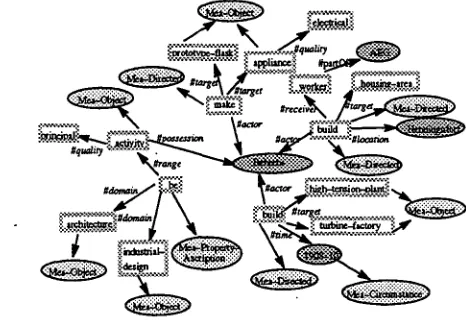
For an example of how this enriches the information represented in the object net see Figure 1, taking the ex- ample of the main activities and creations of the archi- tect Peter Behrens3 This is mostly a network obtained by the KONTEXT analysis system for German [Haenelt,
1Domain-independent 'meaning model' (see below) upper structure types are given in light grey ellipses; named, unique objects and domain-specific objects are given in dark grey ellipses; instances are given in boxes.
:.~.~::~:'...?-;~_~ ~, ,~r,~-..,.:-~:-~:,~ . . .
~ ~ j ! - ~ z ~ _ ~ - - ~
Figure h Knowledge acquired by NL text analysis
1994], although some nodes and arcs have been left out or duplicated here for presentation purposes.
We assume that information of this kind and de- gree of complexity will become increasingly common in knowledge-based systems. We also assume that sys- tems that previously worked with full-texts will increas- ingly become knowledge-based systems. However, hav- ing made available such a rich variety of potentially rel- evant information in this way, the complementary prob- lem of presenting that information again to the user be- comes the limiting factor. In our present case, the edi- tor's workbench already offers a number of presentation styles for the information contained, such as the net or parts of the net (as shown in Figure 1, internal defini- tions associated with a node, article text associated with a node and cross-references to other objects, etc. Repre- sentation of complex information in the net style, how- ever, quickly becomes too complex to be generally appro- priate (as the rather simple example of Figure 1 probably already demonstrates). With a net augmented both in types of information and in quantity, other presentation styles as views on the information contained are essential for enabling an editor to deal with such complex infor- mation. One such presentation style that can flexibly express retrieved information is automatically generated text. Information including that displayed in Figure 1 (and other information not shown) is better expressed as the following text.
S a m p l e T e x t 1
Behrens' principal activities were industrial design and architecture. He designed prototype flasks and electrical appliances. As an architect, he built the turbine factory and the high tension plant for AEG (.1908-10). For the workers of AEG he built a housing area in Henningsdorf. Behrens created a number of monumental buildings, such as the Mannesmann
administration building in Dfisseldorf and the German embassy in St. Petersburg.
[image:2.612.341.574.53.213.2]see [Teich and Bateman, 1994].
3 T h e t e x t g e n e r a t i o n a r c h i t e c t u r e
3.1 O r i g i n s
For the kind of functionality set out in the previous sec- tion to be both achievable in theory and worthwhile in practise, we consider two features of a text generation component to be decisive. First, the text generation sys- tem must achieve a high degree of domain-independence in order to maximally re-use its resources. Such re- sources are too expensive to develop to allow redesign for different applications. And second, it must make provi- sion for the systematic representation of genres and text types t h a t it will be called to generate. The representa- tion of genre not only offers a major constraint on the text generation process, including its access to domain knowledge, but also allows highly restricted fine-tuning of a system's generation capabilities.
The generation system being used in our application scenario is one under development in two continuing di- rections. First, it is multilingualin the extreme sense de- fined by [Bateman et al., 1991a, Bateman et al., 1991b]. The system thus supports extensive linguistic resource sharing on a functional basis. Second, it is intended to incorporate sensitivity to register as targetted by [Bate- man and Paris, !989, Bateman and Paris, 1991]. The system processes are based on the PENMAN generation system [Mann and Matthiessen, 1985] as extended for multilinguality by [Zeng, 1992], and includes work on multilinguality and text planning undertaken within the
KOMET project [Bateman et al., 1993]. The resulting system therefore has the working title KPML (KOMEW-
Penman multilingual).
The primary difference between the KOMET-PENMAN system and PENMAN is that KPML attempts to apply systemic-functional linguistic results at all levels of oper- ation, following through some of the proposals for inter- action between systemic linguistics and computational models made in [Bateman, 1988]. It therefore includes linguistic resources at various strata such as:
• the systemic functional grammar NIGEL for En- glish [Matthiessen, 1992] and the KOMET grammars for German [Teich, 1992] and for Dutch [Degand,
19931,
• a merged upper model [Henschel, 1993] appropriate for generation with all three grammars,
• systemic-functional networks for register, based on [Martin, 1992],
• system-functional networks for genre, also based on [Martin, 1992].
Work on discourse semantics, in the sense defined in [Martin, 1992], is also in progress 2 Realization is cap- tured in terms of relational constraints holding across features and structures defined by the networks of ad- jacent strata. These are still partially implemented in
2Particularly in the context of the DANDELION basic re- search project.
terms of Penman-style 'preselection', althoush nondirec- tional relations such as those suggested in [Bateman et al., 1992] are both necessary and under investigation.
3.2 G e n r e a n d R e g i s t e r : t h e g l o b a l - l e v e l t e x t u a l r e s o u r c e
According to systemic-functional theory (SFL), the ul- timate constraints on all linguistic expression are the extra-linguistic contexts of culture and situation. Espe- cially in a multilingual application this must be taken into account since it is only in these extra-linguistic con- texts that commonalities and differences between lan- guages can ultimately be rooted. In early work on text in context such as [Hasan, 1978], the cultural context is reflected in language in terms of text as the linguis- tic category of genre. Genre is a culture-specific cate- gory textually encoding a situation as it can typically occur in a culture or linguistic community. Thus, it is at the interface between what is linguistic and what is non-linguistic knowledge. The particular view on genre and context that we instantiate in the KOMET-PENMAN architecture 3 is t h a t proposed in [Martin, 1992]. Here context is divided into two strata, register and genre. Both are fully represented in our model.
Genre is represented in SFL by generic structure po- tential (GSP), specifying the potential typically occur- ring stages according to which a text belonging to a par- ticular genre develops [Hasan, 1978]. As a brief example of a GSP and its application, a typical field (one of the parameters of register; cf. below) in the domain of arts is information about an artist's life. A typical situation in terms of field involves all kinds of activities and events a particular artist is or was involved in in his/her career and the circumstances under which these events take or took place. It is not possible from this information alone to construct any particular text. Only when a particular text type has been selected is it possible to determine what information from the field is relevant and how it is to be presented. One genre that usefully expresses such a typical situation is the biography. A typical GSP for a biography text then has the following stages, of which not all are obligatory:
GSP stages
Names, birth and death
Education, development of career Major activities, major works Influences, analogies to other artists Impact
Uncovering such generic structures is a large empirical task that needs to be addressed in text generation: a sys- tem such as KPML can then be seen as one candidate way of noting the results of such studies in an immediately usable fashion.
7th International Generation Workshop • Kennebunkport, Maine • June 21-24, 1994 biography
( instant tat e
Particular (v / Mea-Person)) (stage Name)
( inst ant tat e
Name (v / Mea-Named
actee Particular) ) (stage Birth)
(instantiat e
Birth (v / Mea-Birth-Event actor Particular) ) ( int er-pr e s elect -feature
Birth reconstruction) (int er-Pres elect-f eature
Birth activity) (stage Education)
Figure 2: Realization statements for the genre [biogra- phy]
way that grammatical structures are constructed in our grammars--i.e., by means of the selection of grammat- ical features in system networks. The GSPs that result then condition the further realization of register selec- tions in the linguistic system proper. Thus situation types are related to the linguistic system in particular ways by the selection of particular genres. The systemi- cization of genre specifications also ensures that there can be maximal re-use of existing genre specifications when new genres, slightly differing from already treated ones, are considered.
Furthermore, as noted by [Matthiessen, 1988], generic structures are in many ways similar to [McKeown, 1985]'s rhetorical schemas. They can also be used, there- fore, in order to pre-structure the information to be ex- pressed in a text. Particular kinds of information go together with particular stages of the GSP. The specifi- cation of this information--in our case as constraints in the genre network concerning appropriate selections of field features and structures-7-provides the content for information retrieval inquiries that are passed on to the editor's workbench for instantiation. An example of such a specification is shown in the instantiate realizations for the genre-feature [biography] given in Figure 2. The re- alization constraints stage introduce generic stages in a GSP; the constraints inter-preselect-feature constrain a given generic stage to be realized by a particular register feature selection.
The use of GSPs for knowledge selection is further en- hanced by our requirement that domain information is already classified according to a general conceptual hier- archy for organizing domain information that is specified by KOMET-PENMAN internally. This guarantees that the retrieved information is in a form which can be read- ily interpreted by the other resources of the linguistic system maintained internally to KOMET-PENMAN. This provides the definitions for the semantic types used in the SPL-like second parameter to the 'instantiate' con- straints shown in Figure 2. At present, information is retrieved from the editor's workbench which matches the
these second parameters. Work in progress is exploring more sophisticated information retrieval operations.
The representation of genre therefore offers a major constraint on the text generation process, including its access to domain knowledge. As mentioned before, not all of the stages of a GsP are obligatory. This gives rise to a number of subtypes of the biography genre. For exam- ple, a short biographical entry, as it typically occurs in an encyclopedia realizes all stages and tends to be activity- focussed and timeline organized. Our sample text 1, on the other hand, did not realize all stages; it presents more the roles Behrens took on as an artist (designer, architect) and his major works in one of these roles (the text therefore focuses on activities of creation and the results of these creative processes and is not explicitly timeline organized). Both kinds of texts are, however, useful for an editor (and for an information seeker) in particular contexts and so both should be available pre- sentation styles. Unless the text generation component allows the ready definition of such genres and their lin- guistic realizations with maximal re-usablity of existing resources, such flexibility will be compromised.
The next strata in the system, register, is further de- scribed in terms of the three parameters of field, tenor and mode. Field describes the states and events and par- ticipants occurring in a particular situation. Tenor refers to the roles and statuses of the participants in a partic- ular situation. Mode refers to the symbolic organization of the situation as text, including the channel of com- munication and the rhetoric goals [Halliday and Hasan, 1989, p12]. Specific sets of values that realize field, tenor and mode bring about situation types or registers. Par- ticular situation types accordingly constrain the kind of language that may occur in those situations.
Certain aspects of register are constrained by the sit- uation that the text generator is to understand itself as being in--thus, whether the text is to be written or spoken, whether the relationship between the hearer and the speaker/writer is distant or close, etc. must be selected externally. The provision of such features in the register specification automatically provides a high degree of parameterization. Moreover, the field infor- mation provides a natural home for many aspects that would traditionally be included under 'domain knowl- edge'. This information is quite removed from its ex- pression in natural language. In order to interface with such information, however, we provide a general sub- sumption hierarchy analogous to previous usages of the upper model within PENMAN
(cf.
[Bateman, 1990]). Fur- ther details of the motivation and development of this hierarchy are given in [Bateman et al., 1994]. This (domain-independent) 'upper structure' of the domain knowledge is motivated by the semantics defined by our NLP components (e.g. [Kunze and Firzlaff, 1993, Bateman et al., 1990, Henschel, 1993]). We see exam- ples of the use of the hierarchy in Figure 1 in the net objects prefixed by Mea-. [image:4.612.71.272.43.222.2]the possible semantic and grammatical realizations that may be adopted. However, the interfacing with domain knowledge is further supported by allowing the mixing o f KOMET-PENMAN internally specified system networks and externally specified resource organizations, such as, e.g., that for domain knowledge. Most of the upper structure for the domain knowledge is therefore repre- sented externally in SFK (the 'Smalltalk FFrameKit' [Fis- cher and Rostek, 1993]), which is the implementation language for the editor's workbench. This is linked back to a KOMET-PENMAN internal portion of the hierarchy which directly attaches to the top-most field features and positions the combined field hierarchy with respect to tenor and mode. When an external field feature has consequences for linguistic realization, it is ' i m p o r t e d ' into the KOMET-PENMAN internal systemic network by means of external-system definitions. These function en- tirely analogously to internal systems as far as the con- nectivity of the network is concerned, but the selection of features in such systems is linked directly to the state of the corresponding external representation. In practice this permits modUles of external 'system networks' to be incorporated in the text generation process.
The constraints of the genre specification as G S P and register on local-level discourse organization of the text are manifold. For example, with a GSP for a biography text as sketched above, the thematic development is typi- cally taking'the person the text is about as macro-theme. Also, very often biography texts are organized along a time line - - circumstantials of time such as dates, years or time adverbials are therefore often t h e m a t i c or part of theme. We are currently extending the set of such constraints based on further analysis of text types that are useful in our application context.
Finally, as already noted, there can also be subtypes of the biography genre that do not have all of the stages listed above, but focus on one or two of them, leav- ing out others (see again sample text 2). T h e y there- fore realize only parts of the information available in the field of context (i.e. the domain knowledge). This contributes to the formation of distinct views on the information maintained in the editor's workbench and electronic p u b l i c a t i o n s : The organization of the possi- ble genres in terms of a systemic classification hierarchy then guarantees that we are able to capture similarities between related genres and to represent the constraints they share in an efficient fashion.
4
E x a m p l e of generation
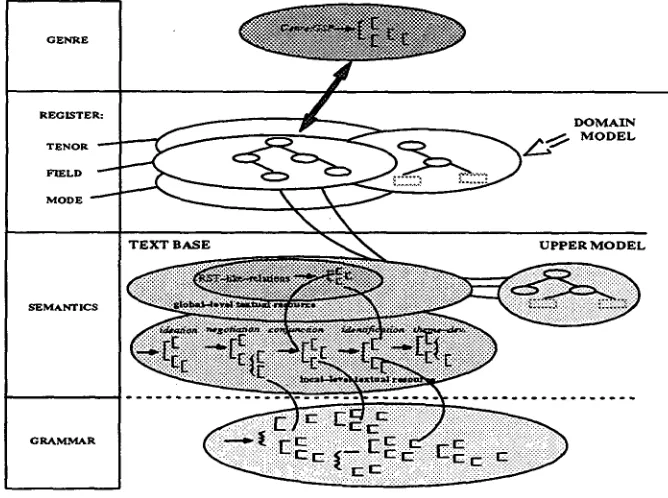
In this section we present a very brief example of gen- eration in the context of the editor's workbench. T h e system is configured according to the overall architec- ture shown in Figure 3. The requirement t h a t text be generated is embedded in the editor's interaction with the editor's workbench. A range of possible types of presentation are offered: currently these are restricted
4Other contributions are the currently focussed portion of the information net that the editor has established during his/her interaction with the system and possible user-profiles of interest.
a OrCnio : tri a
'Jr~l
(r~ :~ ~f ~tiv~Ofniont~a~Ca~:
~s' t~t m~Obj~t)
=~
ifF~: [~ d0:[:d Trar~pt
~ '*';cu t0m~tTex~r~k
Tmscript~
I g ~ l
[image:5.612.364.554.44.208.2]gmx ~ D o A ~ dlir~.
~ g ~
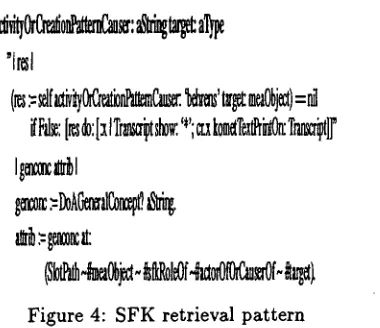
Figure 4: S F K retrieval pattern
to several subtypes of biographies. T h e text generation process is then started with the constraint that some set of genre features hold; in addition, some set of regis- ter features are also selected in order to characterize the communicative situation. T h e text generation compo- nent then constructs a full G S P specification for the text type. This sets up staged sets of constraints on knowl- edge to be selected from the domain. T h a t information is retrieved and classified according to the complete reg- ister classification network. This establishes
* a set of constraints for the semantics and grammar, • a set of pools of contextual information that are to
be realized linguistically.
The latter are then organized rhetorically, thematically, ideationally, etc. according to the constrained semantics, which results in sets of rhetorically organized seman- tic specifications t h a t can be passed to the constrained g r a m m a r for final realization.
More specifically, the text generation component car- ries out the following operations. First, the edi- tor's workbench provides a focus for the textual sum- mary t h a t is to be constructed for the internal in- formation represented and triggers generation. A specific genre must also be selected at this point: for example, one classified by the set of genre features: {activity-focused partial-biography third-person-recount particularized
f a c t u a l - g e n r e ) . These features give rise to the con- crete GSP:
(DEVELOPMENT ACTIVITIES)
Each of these stages has particular information needs, which are then instantiated with respect to the knowl- edge base. For example, for the stage ACTIVITIES, the information needed consists of events and activities the artist dealt with is involved in as actor or causer. This is specified in an SFK retrieval pattern with the artist (Behrens) as starting point and providing the slot path along which the retrieval takes place; this is shown in Figure 4.
An example of the result of this information request is as follows:
(SFK-337 / MEACREATION ACTOR
7th International Generation Workshop • Kennebunkport, Maine • June 21-24, 1994
Figure 3: Generation architecture respecting genre
MEANAMEDMEAMALE)) TARGET
(SFK-339 / (MEAOBJECT DECOMPHOUSINGAREA)) SPATIALLOCATION
(SFK-340 / (MEA-THREEDIMENSIONALOBJECT
HENNINGSDORF)) BENEFICIARY
(SFK-341 / (MEAPERSON PERWORKERMEAPARTOF) PARTOF
(SFK-342 / (AEGMEAOBJECT
MEANAbIED))))
Here a number of domain instances (SFK-337, etc.)
with particular types (e.g.,
MEACREATION, MEAOBJECT, etc.) are returned. These types are as defined in the field conceptual hierarchy. In- stances with particular types also have associated roles (e.g., ACTOR, TARGET, PARTOF). The instance specifi- cation as a whole represents a partial register-stratum structure. This partial structure is then filled out to a maximal description by traversing the register-stratum classification networks. This traversal is partially con- strained by the GSP, by the instantial domain structure, and the specified context of generation. The result of this traversal is a full set of register features, and a set of corresponding constraints on the semantic and discourse realization of the generic stage. An extract from a reg- ister 'profile' resulting from such a traversal is shown in Figure 5.
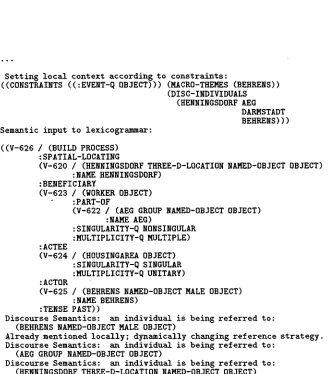
These constraints are then applied during the fur- ther lexicogrammatical expression of the information re- trieved from the knowledge base in order to construct an appropriate text. This is mediated by the local- discourse semantics that groups the information of the generic stage into rhetorically organized semantic speci-
fications. These specifications consist of a statement of the propositional content, plus discourse constraints. An example is shown in Figure 6.
The final (English) text then generated is, in this case, as follows.
" -- B e h r e n s ' s p r i n c i p a l a c t i v i t i e s w e r e a r c h i t e c t u r e a n d i n d u s t r i a l d e s i g n . -- H e m a d e e l e c t r i c a l a p p l i a n c e s a n d p r o t o t y p e f l a s k s . -- H e b u i l t t h e h i g h t e n s i o n plaxLt aa~d t h e t u r b i n e f a c t o r y f o r AEG in 1908 - 1910. -- He b u i l t a h o u s i n g a r e a f o r t h e w o r k e r s of A E G in
H e n n i n g s d o r f . -- He c r e a t e d a n u m b e r of m o n u m e n t a l b u i l d i n g s , s u c h as t h e a d m i n i s t r a t i o n b u i l d i n g of M a n n e s m a n n i n D u e s s e l d o r f a n d t h e G e r m a n e m b a s s y i n St. P e t e r s b u r g . "
The text could clearly be improved in a number of ways, many of which form active areas of research. Sim- ilar texts are created for German and Dutch.
5
C o n c l u s i o n s
[image:6.612.164.498.50.299.2]REGISTERIAL PROFILE FOR GENERIC STAGE: (ACTIVITIES)
Following general constraints hold on realizations of this stage:
((MACRO-THEME . INST-484)
(LEXICOGPAMMAR :EVENT-q OBJECT))
Semantic image created for this stage includes:
concept:WORKER is a subconcept of concept:PERSON
concept:HOUSINGAKEA is a subconcept of concept:DECOMPOSABLE-OBJECT concept:AEG is a subconcept of concept:NAMED-OBJECT concept:HENNINGSDORF is a subconcept of concept:THREE-D-LOCATION concept:BEHRENS is a subconcept of concept:PERSON
concept:BUILD is a subconcept of concept:CREATIVE-MATERIAL-ACTION
Following registerial instances selected:
U n i t w i t h :
s y n t a g m a t i c s t r u c t u r e :
(ACTOR TARGET FIELD-ACTIVITY)
w i t h r e g i s t e r f e a t u r e s s e l e c t e d :
(SPATIALLY-LOCATED TEMPORALLY-UNLOCATED HUMANITIES EXPLORATION WRITTEN-TRANSMISSION CENTRAL-PARTICIPANT
MEACREATION-REALiZATION DOA-ACTIVITIES ACTIVITY-EXPECTANCY TIMES-PAST ACTIViTY-SEQUENCE FIELD UNMARKED-AFFECT ONE-OFF UNINVOLVED-CONTACT UNEQUAL-STATUS TENOR NONPSEUDO-UNPROJECTED
UNPROJECTEDGENRE-STRUCTURED SOLIDIFIED VISUALLY-0BJECTIFIED INFORMING DOCUMENTATION PUBLIC-GENERAL PUBLIC AURAL-NONE VISUAL-NONE MODE REGISTER MEACP4~ATION START)
With substructure:
7th International Generation Workshop • Kennebunkport, Maine • June 21-24, 1994
o o ,
Setting local context according to constraints:
((CONSTRAINTS ((:EVENT-q OBJECT))) (MACR0-THEMES (BEHKENS)) (DISC-INDIVIDUALS
(HENNINGSDORF AEG DARMSTADT BEHRENS))) Semantic input to lexicogrammar:
((V-626 / (BUILD PROCESS) :SPATIAL-LOCATING
(V-620 / (HENNINGSDORF THREE-D-LOCATION NAMED-OBJECT OBJECT)
:NAME HENNINGSDORF) :BENEFICIARY
(V-623 / (WORKER OBJECT) :PART-OF
(V-622 / (AEG GROUP NAMED-OBJECT OBJECT)
:NAME AEG)
:SINGULARITY-Q NONSINGULAR :MULTIPLICITY-QMULTIPLE) :ACTEE
(V-624
:ACTOR (V-625
/ (HOUSINGARFEA OBJECT)
:SINGULARITY-Q SINGULAR :MULTIPLICITY-Q UNITARY)
/ (BEHRENS NAMED-OBJECT MALE OBJECT) :NAME BEHRENS)
:TENSE PAST))
Discourse Semantics: an individual is being referred to: (BEHRENS NAMED-OBJECTMALE OBJECT)
Already mentioned locally; dynamically changing reference strategy. Discourse Semantics: an individual is being referred to:
(AEG GROUP NAMED-OBJECT OBJECT)
Discourse Semantics: an individual is being referred to: (HENNINGSDORFTHKEE-D-LOCATION NAMED-OBJECT OBJECT)
"He built a housing area for the workers of AEG in Hezmingsdorf."
[image:8.612.77.407.144.518.2]can be taken further to apply to the overall publication scenario a n d to a possible electronic publication, offering the newly added functionality to the reader also.
Future work within the scenario described here will now include:
• expansion of the genres available,
• expansion of the discourse semantics to i m p r o v e tex- tuality,
• an investigation of the use of a genre representation for also structuring a (restricted) NL query inter- face,
• an investigation of the user of the generalized types of the domain knowledge u p p e r structure for facili- t a t i n g information retrieval,
• a coordination of the textual realization of views on domain knowledge with a graphical presentation m o d e - - t h u s other presentation styles to be auto- m a t i c a l l y generated should include graphics, tables, figures etc.; some early steps towards this in the ed- itor's workbench context are presented in [Kamps, 1993].
Acknowledgements
We gratefully acknowledge the help of Lothar Rostek of the PAVE/PUBLISH group in the work preparatory for this paper.
R e f e r e n c e s
[Bateman and Paris, 1989] John A. Bateman and C6cfle L. Paris. Phrasing a text in terms the user can understand. In Proceedings of the Eleventh International Joint Conference on Artificial Intelligence, Detroit, Michigan, 1989. IJCAI- 89.
[Bateman and Paris, 1991] John A. Bateman and C6cile L. Paris. Constraining the development of lexicogrammatical resources during text generation: towards a computational instantiation of register theory. In Eija Ventola, editor, Recent Systemic and Other Views on Language. Mouton, Amsterdam, 1991.
[Bateman and Paris, in preparation] John A. Bateman and C6cile L. Paris. Register theory: the generic basis for con- textualized natural language generation. Technical report, USC/ISI, in preparation.
[Bateman et al., 1990] John A. Bateman, Robert T. Kasper, Johanna D. Moore, and Richard A. Whitney. A gen- eral organization of knowledge for natural language pro- cessing: the PENMAN upper model. Technical report, USC/Information Sciences Institute, Marina del Rey, Cal- ifornia, 1990.
[Bateman et al., 1991a] John A. Bateman, Christian M.I.M. Matthiessen, Keizo Nanri, and Licheng Zeng. The re-use of linguistic resources across languages in multilingual gen- eration components. In Proceedings off the 1991 Interna- tional Joint Conference on Artificial Intelligence, Sydney, Australia, volume 2, pages 966 - 971. Morgan Kaufmann Publishers, 1991.
[Bateman et al., 1991b] John A. Bateman, Christian M.I.M. Matthiessen, Keizo Nanri, and Licheng Zeng. Multilingual text generation: an architecture based on functional ty- pology. In International Conference on Current Issues in Computational Linguistics, Penang, Malaysia, 1991. Also
available as technical report of the department of Linguis- tics, University of Sydney.
[Bateman et al., 1992] John A. Bateman, Martin Emele, and Stefan Momma. The nondirectional representation of Sys- temic Functional Grammars and Semantics as Typed Fea- ture Structures. In Proceedings of COLING-92, volume III, pages 916 - 920, 1992.
[Bateman et al., 1993] John A. Bateman, Liesbeth Degand, and Elke Teich. Multilingual textuality: Some experiences from multilingual text generation. In Proceedings of the Fourth European Workshop on Natural Language Gener- ation, Pisa, Italy, 28-30 April 1993, pages 5 - 17, 1993. Also available as technical report from GMD/Institut ffir Integrierte Publikations- und Informationssysteme, Darm- • stadt, Germany.
[Bateman et al., 1994] John A. Bateman, Elks Teich, and Beate Firzlaff. A linguistically oriented methodology for domain model construction in knowledge-based systems. Technical report, GMD/IPSI, 1994.
[Bateman, 1988] John A. Bateman. From Systemic- Functional Grammar to Systemic-Functional Text Gen- eration: escalating the exchange. In Eduard H. Hovy, David D. McDonald, Sheryl R. Young, and Douglas E. Appelt, editors, Proceedings of the 1988 American Asso- ciation for Artificial Intelligence Workshop on Text Plan- ning and Realization, pages 123-132, St. Paul, Minnesota, 1988. Also available as ISI Reprint Series report RR-89- 220, USC/Information Sciences Institute, Marina del Rey, California, April 1990.
[Bateman, 1990] John A. Bateman. Upper modefing: or- ganizing knowledge for natural language processing. In 5th. International Workshop on Natural Language Gen- eration, 3-6 June 1990, Pittsburgh, PA., 1990. Organized by Kathleen R. McKeown (Columbia University), Johanna D. Moore (University of Pittsburgh) and Sergei Nirenburg (Carnegie Mellon University).
[Degand, 1993] Liesbeth Degand. Towards a systemic func- tional grammar of dutch for multilingual text genera- tion. Technical report, GMD/Institut ffir Integrierte Publikations- und Informationssysteme, Darmstadt, Ger- many, 1993. (Available in abbreviated form in the Proceed- ings of the Fourth European Workshop on Natural Lan- guage Generation, Pisa, Italy, 28-30 April 1993, pp143- 147).
[Fischer and Rostek, 1993] Dietrich Fischer and Lothar Ros- tek. SFK: A Smalltalk Frame Kit. Technical report, GMD/Institut ffir Integrierte Publikations- und Informa- tionssysteme, 1993.
[Haake et al., 1993] Anja Haake, Christoph Hfiser, and Klans Reichenberger. The Individualized Electronic News- paper: An example of an Active Publication. Technical report, Arbeitspapiere der GMD No. 799, Institut ffir In- tegrierte Publikations- und Informationssysteme, 1993. [Haenelt, 1994] Karin Haenelt. Das Textanalysesystem KON-
TEXT. Sprache und Datenverarbeitung, 1994.
[Halliday and Hasan, 1989] Michael A.K. Halliday and Ruqalya Hasan. Language, Context and Text: a so- cial semiotic perspective. Oxford University Press, London, 1989.
7th International Generation Workshop * Kennebunkport, Maine • June 21-24, 1994 [Henschel, 1993] Renate Henschel. Merging the English
and the German Upper Model. Technical report, GMD/Institut ffir Integrierte Publikations- und Informa- tionssysteme, Darmstadt, Germany, 1993.
[Kamps, 1993] Thomas Kamps. Automatic visualiza- tion for Hypermedia Publications. Technical report, GMD/Institut ffr Integrierte Pubhkations- und Informa- tionssysteme, 1993.
[Kunze and Firzlaff, 1993] Jfirgen Kunze and Beate Firzlaff. Sememstrukturen und Feldstrukturen, volume XXXVI of Studia Grammatica. Akademie Verlag, Berlin, 1993. [Mann and Matthiessen, 1985] William C. Mann and Chris-
tian M.I.M. Matthiessen. Demonstration of the Nigel text generation computer program. In James D. Benson and William S. Greaves, editors, Systemic Perspectives on Dis- course, Volume 1. Ablex, Norwood, New Jersey, 1985. [Martin, 1992] James R. Martin. English text: systems and
structure. Benjamins, Amsterdam, 1992.
[Matthiessen, 1988] Christian Matthiessen. Organizing Text: Rhetorical Schemas and GSP. Technical report, USC/ Information Sciences Institute, Marina del Rey, 1988.
[Matthiessen, 1992] Christian M.I.M. Matthiessen. Lexi- cogrammatical cartography: English systems. Techni- cal report, University of Sydney, Linguistics Department, 1992. Ongoing expanding draft.
[McKeown, 1985] Kathleen R. McKeown. Text Generation: Using Discourse Strategies and Focus Constraints to Gen- erate Natural Language Text. Cambridge University Press, Cambridge, England, 1985.
[MShr and Rostek, 1993] Wiebke MShr and Lothar Rostek. TEDI: An Object-Oriented Terminology Editor. In Pro- ceedings of the Third International Congress on Terminol- ogy and Knowledge Engineering, 1993.
[Rostek et al., 1994] Lothar Rostek, Wiebke MShr, and Diet- rich H. Fischer. Weaving a web: The structure and creation of an object network representing an electronic reference network. In Proceedings of Electronic Publishing (EP) '9~, 1994.
[Teich and Bateman, 1994] Elke Teich and John A. Bate- man. Selective information presentation in an integrated publication system: an application of genre-driven text generation. Technical report, GMD/IPSI, 1994.
[Teich, 1992] Elke Teich. Komet: grammar documenta- tion. Technical report, GMD/Institut ffir Integrierte Publikations- und Informationssysteme, Darmstadt, West Germany, 1992.
![Figure 2: Realization statements for the genre [biogra- phy]](https://thumb-us.123doks.com/thumbv2/123dok_us/761760.1088222/4.612.71.272.43.222/figure-realization-statements-genre-biogra-phy.webp)