Robust Transliteration Mining from Comparable Corpora with
Bilingual Topic Models
John Richardson† Toshiaki Nakazawa‡ Sadao Kurohashi†
†Graduate School of Informatics, Kyoto University, Kyoto 606-8501 ‡Japan Science and Technology Agency, Kawaguchi-shi, Saitama 332-0012
[email protected], [email protected], [email protected]
Abstract
We present a high-precision, language-independent transliteration framework applicable to bilingual lexicon
extrac-tion. Our approach is to employ a
bilingual topic model to enhance the output of a state-of-the-art
grapheme-based transliteration baseline. We
demonstrate that this method is able to extract a high-quality bilingual lexi-con from a comparable corpus, and we extend the topic model to propose a so-lution to the out-of-domain problem.
1 Introduction
A large, high-quality bilingual lexicon is of great utility to any dictionary-based system that processes bilingual data. The ability to automatically generate such a lexicon with-out relying on expensive training data or pre-existing lexical resources allows us to find translations for rare and unknown words with high efficiency.
Transliteration1 is particularly important as new words are often created by importing words from other languages, especially En-glish. It would be an almost impossible task to create and maintain a dictionary of such words by hand, as new words appear rapidly, especially in online texts, and word usage can vary over time.
In this paper we construct a language-independent transliteration framework. Our model builds on previous transliteration work, improving extraction and generation precision by including semantic as well as purely lexical features. The proposed model can be trained
1This paper considers both ‘transliteration’ (EN–
XX) and ‘back-transliteration’ (XX–EN). For simplic-ity we refer to both tasks as ‘transliteration’.
on comparable corpora, thereby not relying on expensive or often unavailable parallel data.
The motivation behind the approach of com-bining lexical and semantic features is that these two components are largely independent, greatly improving the effectiveness of their combination. This is particularly important for word-sense disambiguation. For example, a purely lexical approach is not sufficient to transliterate the Japaneseソース(soosu), as it can mean either ‘sauce’ or ‘source’ depending on the context.
2 Previous Work
Previous work has considered various methods for transliteration, ranging from simple edit distance and noisy-channel models (Brill et al., 2001) to conditional random fields (Ganesh et al., 2008) and finite state automata (Noeman and Madkour, 2010). We construct a base-line by modelling transliteration as a Phrase-Based Statistical Machine Translation (PB-SMT) task, a popular and well-studied ap-proach (Matthews, 2007; Hong et al., 2009; Antony et al., 2010).
The vast majority of previous work on transliteration has considered only lexical fea-tures, for example spelling similarity and transliteration symbol mapping, however we build on the inspiration of Li et al. (2007) and later Hagiwara and Sekine (2012), who in-troduced semantic features to a transliteration model.
Li et al. (2007) proposed the concept of ‘semantic transliteration’, which is the con-sideration of inherent semantic information in transliterations. Their example is the influ-ence of the source language and gender of for-eign names on their transliterations into Chi-nese. Hagiwara and Sekine (2012) expanded upon this idea by considering a ‘latent class’
transliteration model considering translitera-tions to be grouped into categories, such as language of origin, which can give additional information about their formation. For exam-ple, if we know that a transliteration is of Ital-ian origin, we are more likely to recover the letter sequence ‘gli’ than if it were originally French.
While these methods consider limited se-mantic features, they do not make use of the rich contextual information available from comparable corpora. We show such contextual information, in the form of bilingual topic dis-tributions, to be highly effective in generating transliterations.
Bilingual lexicon mining from non-parallel data has been tackled in recent research such as Tamura et al. (2012) and Haghighi et al. (2008), and we build upon the techniques of multilingual topic extraction from Wikipedia pioneered by Ni et al. (2009). Previous re-search in lexicon mining has tended to focus on semantic features, such as context similar-ity vectors and topic models, but these have yet to be applied to the task of transliteration mining. We use the word-topic distribution similarities explored in Vulić et al. (2011) as baseline word similarity measures.
In some cases it is possible to use mono-lingual corpora for transliteration mining, as English is often written alongside translitera-tions (Kaji et al., 2011), however we consider the more general setting where such informa-tion is unavailable.
3 Baseline Transliteration Model
We begin by constructing a baseline transliter-ation system trained only on lexical features. This baseline system will allow us to compare directly the effectiveness of the addition of a semantic model to a traditional transliteration framework.
Our baseline model is a grapheme-based
machine transliteration system. We model
transliteration as a machine translation task on a character rather than word level, treat-ing character groups as phrases. The model is trained by learning phrase alignments such as that shown in Figure 1. The field of phrase-based SMT has been well studied and there ex-ists a standard toolset enabling the
construc-コ ン ピ ュ ー タ ー
ko n p yu u ta a
co
m p u t e r
Figure 1: Example of Japanese–English
transliteration phrase alignment.
tion of an easily reproducable baseline system. We use the default configuration of Moses (Koehn et al., 2007) to train our baseline sys-tem, with the distortion limit set to 1 (as transliteration requires monotonic alignment). Character alignment is performed by GIZA++ (Och and Ney, 2003) with the ‘grow-diag-final’ heuristic for training. We apply standard tun-ing with MERT (Och, 2003) on the BLEU (Papineni et al., 2001) score. The language model is built with SRILM (Stolcke, 2002) us-ing Kneser-Ney smoothus-ing (Kneser and Ney, 1995).
The system described above has been im-plemented as specified in previous work such as Matthews (2007) (Chinese and Arabic), Hong et al. (2009) (Korean), and Antony et al. (2010) (Kannada). We demonstrate that this standard, highly-regarded baseline can be greatly improved with our proposed method.
4 Semantic Model
Having set up the baseline system, we turn to the task of combining a semantic model with
our transliteration engine. We employ the
method of bilingual LDA (Mimno et al., 2009), an extension of monolingual Latent Dirichlet Allocation (LDA) (Blei et al., 2003) as the se-mantic model.
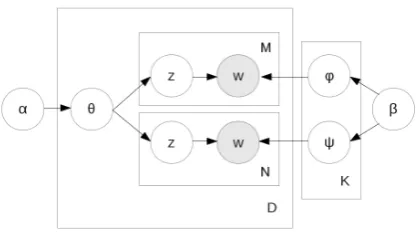
Monolingual LDA takes as its input a set of monolingual documents and generates a word-topic distribution ϕ classifying words appear-ing in these documents into semantically
sim-ilar topics. Bilingual LDA extends this by
Figure 2: Graphical model for Bilingual LDA
with K topics, D document pairs and
hyper-parametersαandβ. Topics for each document are sampled from the common distribution θ, and the two languages have word-topic distri-butionsϕand ψ.
4.1 Motivation for Bilingual LDA
We choose to employ a bilingual topic model to measure semantic similarity (i.e. topic sim-ilarity) of word pairs rather than the more in-tuitive method of comparing monolingual con-text similarity vectors (Rapp, 1995) for rea-sons of robustness and scalability.
Measuring context similarity on a word level requires a bilingual lexicon to match cross-language word pairs and such bilingual data is often expensive or unavailable. There are also problems with directly comparing collo-cations and word concurrence of distant lan-guage pairs as they do not always correspond predictably. Therefore our proposed method provides a more robust approach using coarser semantic features.
The use of topic models as a semantic sim-ilarity measure is a scalable method because document-aligned bilingual training data is growing ever more widely available. Exam-ples of such sources are Wikipedia, multilin-gual newspaper articles and mined Web data.
4.2 Semantic Similarity Measures
In order to apply bilingual topic models to a transliteration task, we must construct an ef-fective word similarity measure for source and target transliteration candidates. We improve upon three natural similarity measures, Cos, Cue and KL, based on those considered in Vulić et al. (2011), by proposing two methods of feature combination: reordering and SVM
combination.
The reranking method considers hybrid scores Base+Cos, Base+Cue and Base+KL. These are generated by reranking the top-10 baseline (Base) transliteration candidates by their respective semantic scores (Cos, Cue or KL). We used 10 candidates for filtering as we found this gave the best balance be-tween volume and accuracy in preliminary ex-periments. Approximately 75–85% of correct transliterations (depending on language pair) were within the top-10 candidates and this is therefore an upper bound for the hybrid model accuracy. As a comparison, the top-100 can-didates contained roughly 80–85% of correct transliterations, the remainder failing to be identified by the baseline.
We additionally consider the combination of all three semantic features with the base-line (Moses) transliteration scores using a Sup-port Vector Machine (SVM) (Vapnik, 1995). The SVM is used to classify candidate pairs as ‘transliteration’ (positive) or ‘not translitera-tion’ (negative), and we rerank the candidates by SVM predicted values. The features used for SVM training are baseline, Cos, Cue and KL scores.
The similarity measures Cos, Cue and KL are defined below.
4.2.1 Cos Similarity
The Cos method calculates the cosine
simi-larity of the topic distribution vectors ψk,we
and ϕk,wf for transliteration pair candidates
we and wf.
Cos(we, wf) =
∑K
k=1ψk,weϕk,wf
√∑K
k=1ψk,w2 e
√∑K k=1ϕ2k,wf
(1)
4.2.2 Cue Similarity
The Cue method expresses the mean of the
two probabilities P(we | wf) of a
translitera-tion we given some source language stringwf
and P(wf |we) of the reverse. We define:
P(we|wf) = K
∑
k=1 ψk,we
ϕk,wf
N ormϕ
normalization factors given by N ormϕ =
∑K
k=1ϕk,wfand N ormψ =
∑K
k=1ψk,we.
Finally, we consider:
Cue(we, wf) =
1
2(P(we|wf) +P(wf |we)) (2)
4.2.3 KL Similarity
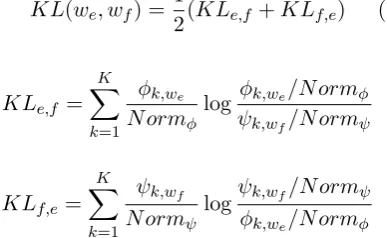
The KL method considers the averaged
Kullback-Leibler divergence:
KL(we, wf) =
1
2(KLe,f +KLf,e) (3)
KLe,f = K
∑
k=1 ϕk,we
N ormϕ
log ϕk,we/N ormϕ
ψk,wf/N ormψ
KLf,e= K
∑
k=1 ψk,wf
N ormψ
logψk,wf/N ormψ
ϕk,we/N ormϕ
using the same normalization factors as for Cue similarity.
5 Experiments
In order to demonstrate the effectiveness of our proposed model, we constructed an eval-uation framework for a transliteration ex-traction task. The language pairs English– Japanese (EN–JA), Japanese–English (JA– EN), English–Korean (EN–KO) and Korean– English (KO–EN) were chosen to verify that this method is effective for a variety of lan-guages and in both transliteration directions. Indeed, the methods introduced in this pa-per could also be applied directly to other languages with many transliterations, such as Chinese, Arabic and Hindi.
While it is possible to make language-specific optimizations, we decided only to pre-process the data minimally (such as remov-ing punctuation) in order to demonstrate that our model works effectively in a independent setting. Examples of language-specific preprocessing techniques that we did not perform include segmentation of Japanese compound nouns (Nakazawa et al., 2005) and splitting of Korean syllabic blocks (eumjeols) into smaller components (jamo) (Hong et al., 2009).
Language Pairs Train Tune Test
EN–JA/JA–EN 59K 1K 1K
[image:4.595.72.291.58.351.2]KO–EN/EN–KO 21K 1K 1K
Table 1: Number of aligned word pairs in each fold of data.
5.1 Data Set
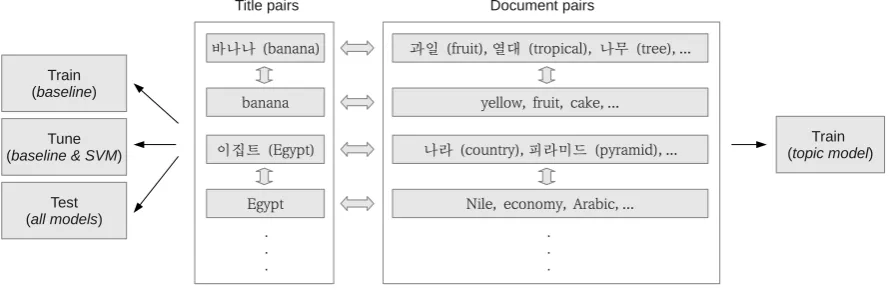
[image:4.595.314.519.62.106.2]We chose to build our data set from Wikipedia articles, as they provide document-aligned comparable data across a variety of languages. Figure 3 shows how the Wikipedia data was split.
5.1.1 Baseline Training Data
We trained our baseline system on aligned Wikipedia page titles. This data consisted of pairs of English and Japanese/Korean words extracted from the freely available Wikipedia
XML dumps. The aligned titles were
fil-tered with hand-written rules2 to extract only transliteration pairs, and the test data was verified for correctness by hand. This data will be made available to encourage comparison for future transliteration research3.
The composition of this data is shown in Table 1. Aligned word pairs were shuffled ran-domly before splitting into the three folds to ensure an even topic distribution across each of ‘Train’, ‘Tune’ and ‘Test’.
5.1.2 Bilingual Topic Model
The bilingual topic model was trained on the body text of Wikipedia articles aligned with Wikipedia inter-language links. These corre-spond to articles covering the same content, however they are rarely of similar length and not necessarily close transliterations.
We first pre-processed the most recent Wikipedia XML dumps to remove all tags and data other than plain text sentences, then aligned articles with language links to generate comparable document pairs. Words occurring fewer than 10 or more than 100K times were also removed to reduce noise and computation time.
2Heuristic rules included extraction of Japanese
katakana, a script used primarily for transliterations, and words aligned with proper nouns as defined in a name dictionary.
[image:4.595.87.281.233.352.2]과일 (fruit), 열대 (tropical), 나무 (tree), ... 바나나 (banana)
banana
Title pairs Document pairs
이집트 (Egypt)
Egypt . . .
yellow, fruit, cake, ...
나라 (country), 피라미드 (pyramid), ...
Nile, economy, Arabic, ... .
. . Train
(baseline)
Tune (baseline & SVM)
Test (all models)
[image:5.595.77.524.73.219.2]Train (topic model)
Figure 3: We extracted aligned title pairs (only transliterations) and aligned document pairs from Wikipedia using inter-language links. The baseline was trained and tuned on title pairs (‘Train’ and ‘Tune’), the topic model was trained on document pairs and the SVM was trained on the title pairs ‘Tune’ fold.
5.1.3 SVM Hybrid Model
The training data for the proposed SVM hy-brid model was built from the same data used for the baseline (tuning fold). We first generated the top-10 distinct transliteration candidates for the tuning data using the ‘n-best-list’ option in Moses. These candidates were then labeled as ‘transliteration’ or ‘not-transliteration’ and feature scores (Base, Cos, Cue, KL) were generated for each candidate. The SVM model was trained using these labels and feature scores.
5.2 LDA Implementation Details
PolyLDA++, our implementation of multilin-gual LDA, was based on GibbsLDA++ (Phan et al., 2007), a toolkit for monolingual LDA. This software is available for free4.
Each topic model was trained over 1000 iter-ations, and the standard Dirichlet prior hyper-parameters for the LDA model were set as α= 50/K forK topics andβ = 0.1.
The choice of number of topics is important, as demonstrated in Figure 4, which shows the top-1 accuracy of the SVM hybrid model us-ing various numbers of topicsK. The optimal
value of K seems to be between around 100
for this data.
The model accuracy gradually decreases with adding more than 100 topics. We be-lieve that this is because the granularity of
[image:5.595.310.529.323.488.2]4http://orchid.kuee.kyoto-u.ac.jp/~john
Figure 4: Top-1 accuracy of SVM for various K.
the topics becomes too fine to accommodate for the wide differences in semantic usage of English and Japanese/Korean transliteration pairs. A higher number of topics could be more suitable for more closely related language pairs, such as Italian and English (Vulić et al., 2011), because the higher similarity of word usage would allow for topics of more limited semantic scope. Such experiments are to be considered in future work. The results below are forK = 100.
5.3 Results
perfor-JA–EN EN–JA KO–EN EN–KO
Base 0.334 0.363 0.296 0.421
Base+Cos 0.608 0.559 0.494 0.516
Base+Cue 0.608 0.551 0.507 0.504
Base+KL 0.365 0.398 0.261 0.373
[image:6.595.170.429.60.149.2]SVM 0.610 0.572 0.504 0.551
Table 2: Top-1 accuracy of proposed model for each hybrid scoring method.
Figure 5: Precision-recall curve for SVM hy-brid model.
mance. The SVM hybrid model outperformed the baseline for every language pair, by as much as 0.276 for JA–EN. This suggests that the addition of a bilingual topic model signif-icantly improves transliteration accuracy.
In general the SVM was the most effec-tive hybrid score, outperforming Base+Cos, Base+Cue and Base+KL in all but KO–EN, where it performed very slightly worse than Base+Cue.
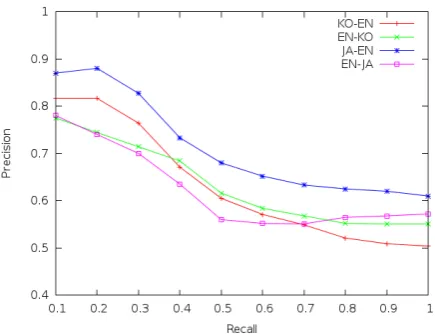
Figure 5 shows the precision-recall curve for the SVM hybrid model over the test set. We vary recall by ranking the hybrid model scores for all test pairs and selecting only the highest scoring fraction to evaluate. This simulates a lexicon extraction task where we wish to sacrifice recall for precision. The re-sults demonstrate that it is possible to im-prove significantly the precision of a set of ex-tracted transliterations by reducing the recall. This large improvement is made possible be-cause the topic similarity scores are particu-larly effective at measuring confidence in each transliteration candidate, allowing effective se-lection of the correct transliterations.
5.4 Comparison with Previous Work
The results compare favorably to the top-1 ac-curacy of similar existing systems, such as Di-recTL+(Jiampojamarn et al., 2010), which also used Wikipedia titles (EN–JA 0.398), and Hagiwara and Sekine (2012) (EN–JA 0.349).
Our baseline transliteration system can be measured against previous work using Moses and GIZA++ alignment, such as Matthews (2007) (EN–AR 0.43, AR–EN 0.39, EN–ZH 0.38, ZH–EN 0.35) and Hong et al. (2009) (EN–KO 0.45). These scores are consistent with our baseline results.
While it is difficult to compare directly the accuracy of transliteration systems across dif-ferent languages and data sets, especially since we use additional data to train the semantic model, the results above show that our model has made a considerable improvement over the state-of-the-art baseline.
6 Extension to Out-of-Domain Words
The model described in this paper revolves around the use of a bilingual topic model to
improve transliteration quality. What
hap-pens then when a source word is not covered by the topic model? This is a very important problem in a practical setting, and we show that even in such cases our model can improve considerably upon the baseline system. We de-fine ‘out-of-domain’ words as source language words that did not appear in the topic model training data and hence do not have a known topic distribution.
6.1 Model Details
Our proposed approach is to consider not the word-topic distribution of the source word we
[image:6.595.74.292.190.357.2]scores over the set of words We in the same
context as the source word.
Let S(we, wf) be a basic topic
similar-ity score Cos, Cue or KL, then we define the extended scores ExtM ean(We, wf) and
ExtW eight(We, wf)as follows:
ExtM ean(We, wf) =
∑
we∈WeS(we, wf) |We|
(4)
ExtW eight(We, wf) =
∑
we∈Wec
′
weS(we, wf)
∑
we∈Wec′we
(5) where c′we = (logcwe)
−1 for the frequency
cwe of we appearing in the semantic model
training data.
ExtMean corresponds to the mean topic similarity for each word in the context We.
ExtWeight is weighted by the inverse log fre-quency of each word, allowing consideration of their semantic importance. These extended scores are used to train the SVM in place of the original scores.
6.2 Out-of-Domain Experiment
We performed an additional experiment where we transliterated a set of 25 Japanese words unknown to the topic model into English. These words appeared in Wikipedia fewer than 10 times and therefore were not included in
our training data. We extracted the
sen-tences and documents in which these words oc-curred, and back-transliterated the Japanese words into English by hand. We considered both sentence-level and document-level con-texts for We, and evaluated each extended
metric ExtMean and ExtWeight.
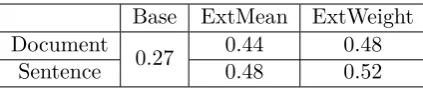
The results of the out-of-domain experiment are shown in Table 3, which gives the top-1 accuracy of the SVM hybrid model trained on the ExtMean and ExtWeight counterparts of Cos, Cue and KL similarities. Base is the top-1 accuracy using only the Moses baseline.
The most effective settings were to use Ex-tWeight on a sentence level context. There is a balance between size and relevance of con-text, with document-level context containing too many misleading words. The improvement of ExtWeight over ExtMean shows the
impor-Base ExtMean ExtWeight
Document
0.27 0.44 0.48
Sentence 0.48 0.52
Table 3: Top-1 accuracy for out-of-domain model extension (JA–EN).
tance of weighting contextual words based on their importance (i.e. inverse log frequency).
The results show a large improvement (+0.25) over the baseline scores that is compa-rable to that of the in-domain model (+0.28, see Table 2). This suggests that the proposed model is an effective solution to the out-of-domain problem.
7 Discussion and Error Analysis
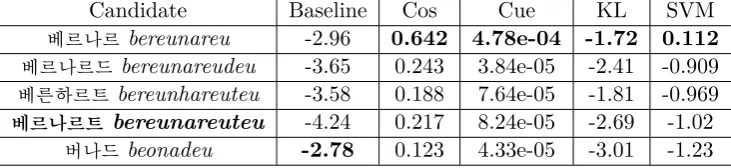
An example of the top candidates for a suc-cessful and an incorrect transliteration are given in Tables 4 and 5 respectively. We can see that the topic model has succeeded in find-ing the correct transliteration of ‘batik’, a tra-ditional Javanese fabric, however a low score was given to the Korean transliteration of the name ‘Bernard’ appearing in the training data. The benefits of the addition of a topic model is made clear with the example of ‘batik’ in Ta-ble 4. The semantic similarity measures give a higher score to ‘batik’ than ‘Batic’, a Slavic surname, despite ‘Batic’ being the more likely transliteration according to the baseline.
The improvement over the baseline for back-transliteration (XX–EN), on average +0.24, was considerably greater than that for translit-eration (EN–XX), on average +0.17. We be-lieve that this is due to the vast range of transliteration spelling variations in the non-English target languages. Since there is only one correct spelling variation defined in our test data and the topic distributions for each spelling variation are very similar, it is not pos-sible to guess correctly. For an example of this problem, see Table 5.
7.1 Topic Alignment Difficulties
[image:7.595.310.522.61.108.2]Candidate Baseline Cos Cue KL SVM
batik -1.29 0.989 2.54e-04 -0.327 1.10
baetic -1.32 0.0764 1.67e-06 -1.65 -1.39
batic -0.708 0.00 0.0 0.0 -1.48
batick -0.788 0.00 0.0 0.0 -1.53
[image:8.595.152.449.61.149.2]butic -1.09 0.00 0.0 0.0 -1.68
Table 4: A good transliteration – バティック(batikku / ‘batik’)→ batik.
Candidate Baseline Cos Cue KL SVM
베르나르bereunareu -2.96 0.642 4.78e-04 -1.72 0.112 베르나르드bereunareudeu -3.65 0.243 3.84e-05 -2.41 -0.909
베른하르트bereunhareuteu -3.58 0.188 7.64e-05 -1.81 -0.969 베르나르트 bereunareuteu -4.24 0.217 8.24e-05 -2.69 -1.02
버나드beonadeu -2.78 0.123 4.33e-05 -3.01 -1.23
Table 5: An incorrect transliteration – bernard→ 베르나르트(bereunareuteu).
Japanese バイキング (baikingu) is a transliter-ation of ‘Viking’, however it is almost always used to mean ‘buffet’, deriving from the Scan-dinavian smorgasbord. In this case, we can ex-pect the Japanese to be associated with food-related topics, quite different from ‘Viking’.
There are also many cases where words that do not clearly fit into one topic have unclear
distributions across many groups. For
ex-ample, the word 로마 (roma / ‘Rome’) could
be more strongly categorized with ‘cities’ and ‘sightseeing’ in English but ‘history’ and ‘clas-sical civilization’ in Korean, giving a low over-all topic correlation.
7.2 Effect of Word Length and Frequency
We found that our model was more success-ful at finding the correct transliteration of longer words, as smaller words tend to have more spelling variations and are orthographi-cally more similar to other words. By remov-ing words of length 5 characters or less from the test data, we were able to improve the top-1 accuracy (SVM) to 0.593 (KO–EN, +0.089) and 0.721 (JA–EN, +0.111). In a practical lexicon extraction task over the entirety of Wikipedia this would cover roughly 35–45% of words (depending on language).
There was almost no variation in transliter-ation accuracy based on word frequency. The baseline is relatively unaffected by word fre-quency, with the exception of finding very rare character phrases not in the training data, and
the topic model proved to be robust across words of both high and low frequency.
8 Conclusion and Future Work
In this paper we demonstrated that the ad-dition of semantic features can significantly improve transliteration accuracy. Specifically, it is possible to outperform the top-1 accu-racy of a state-of-the-art phrase-based SMT transliteration baseline through the addition of a bilingual topic model.
Furthermore, our extended model is able to produce a considerable improvement in accu-racy even for out-of-domain source words that have an unknown topic distribution. The ex-perimental data set was constructed to simu-late the task of extracting unknown word pairs from a comparable corpus, however our exten-sion model results suggest that it will be pos-sible to extract high-quality transliterations from larger and less comparable corpora than ever before.
In the future we would like to explore in depth the improvements to machine transla-tion made possible by this approach.
Acknowledgements
[image:8.595.116.482.182.266.2]References
P.J. Antony, V.P. Ajith, and K.P. Soman 2010. Statistical Method for English to Kannada Transliteration. BAIP 2010, CCIS 70, pp. 356– 362.
David Blei, Andrew Ng and Michael Jordan. 2003. Latent Dirichlet Allocation. In The Journal of Machine Learning Research, Volume 3.
Eric Brill, Gary Kacmarcik and Chris Brock-ett. 2001. Automatically Harvesting Katakana-English Term Pairs from Search Engine Query Logs In Proceedings of the Sixth Natural Lan-guage Processing Pacific Rim Symposium, 2001.
Surya Ganesh, Sree Harsha, Prasad Pingali, Va-sudeva Varma. 2008. Statistical Transliteration for Cross Language Information Retrieval using HMM alignment model and CRF. In2nd Inter-national Workshop on Cross Language Informa-tion Access, IJCNLP 2008.
Aria Haghighi, Percy Liang, Taylor
Berg-Kirkpatrick and Dan Klein. 2008. Learning Bilingual Lexicons from Monolingual Corpora. InACL 2008.
Masato Hagiwara and Satoshi Sekine. 2011. La-tent Class Transliteration based on Source Lan-guage Origin. In ACL 2011.
Masato Hagiwara and Satoshi Sekine. 2012. La-tent Semantic Transliteration using Dirichlet Mixture. InACL 2012.
Gumwon Hong, Min-Jeong Kim, Do-Gil Lee and Hae-Chang Rim. 2009. A Hybrid Approach to English-Korean Name Transliteration. In
Proceedings of 2009 Named Entities Workshop, ACL-IJCNLP.
Sittichai Jiampojamarn, Kenneth Dwyer, Shane Bergsma, Aditya Bhargava, Qing Dou,
Mi-Young Kim and Grzegorz Kondrak. 2010.
Transliteration Generation and Mining with Limited Training Resources. In Proceedings of the 2010 Named Entities Workshop, ACL 2010.
Nobuhiro Kaji and Masaru Kitsuregawa. 2011. Splitting Noun Compounds via Monolingual and Bilingual Paraphrasing: A Study on Japanese Katakana Words. InEMNLP 2011.
Reinhard Kneser and Hermann Ney. 1995. Im-proved backing-off for m-gram language model-ing. In Proceedings of the IEEE International Conference on Acoustics, Speech, and Signal Processing, Volume 1.
Philipp Koehn, Hieu Hoang, Alexandra Birch, Chris Callison-Burch, Marcello Federico, Nicola Bertoldi, Brooke Cowan, Wade Shen, Christine Moran, Richard Zens, Chris Dyer, Ondrej Bojar, Alexandra Constantin and Evan Herbst. 2007.
Moses: Open Source Toolkit for Statistical Ma-chine Translation. InACL 2007.
Haizhou Li, Khe Chai Sim, Jin-Shea Kuo, Minghui Dong. 2007. Semantic Transliteration of Per-sonal Names. In ACL 2007.
David Matthews. 2007. Machine Transliteration of Proper Names. Masters Thesis, School of In-formatics, University of Edinburgh.
David Mimno, Hanna Wallach, Jason Naradowsky,
David Smith and Andrew McCallum. 2009.
Polylingual topic models. In EMNLP 2009.
Toshiaki Nakazawa, Daisuke Kawahara and Sadao Kurohashi. 2005. Automatic Acquisition of Ba-sic Katakana Lexicon from a Given Corpus. In
IJCNLP 2005.
Xiaochuan Ni, Jian-Tao Sun, Jian Hu, Zheng Chen. 2009. Mining Multilingual Topics from Wikipedia. In WWW 2009.
Sara Noeman and Amgad Madkour. 2010. Lan-guage independent transliteration mining sys-tem using finite state automata framework. In
Proceedings of the 2010 Named Entities Work-shop.
Franz Och. 2003. Minimum Error Rate Training in Statistical Machine Translation. In ACL 2003.
Franz Och and Hermann Ney. 2003. A System-atic Comparison of Various Statistical Align-ment Models. In Computational Linguistics 2003.
Kishore Papineni, Salim Roukos, Todd Ward, and Wei-Jing Zhu. 2001. BLEU: A method for auto-matic evaluation of Machine Translation. Tech-nical Report RC22176, IBM.
Xuan-Hieu Phan and Cam-Tu Nguyen. 2007.
GibbsLDA++: A C/C++ implementation of la-tent Dirichlet allocation (LDA).
Reinhard Rapp. 1995. Identifying Word Transla-tions in Non-Parallel Texts. InACL 1995.
Andreas Stolcke. 2002. SRILM – An Extensible Language Modeling Toolkit. In Proceedings of ICSLP, Volume 2.
Akihiro Tamura, Taro Watanabe and Eiichiro Sumita. 2012. Bilingual Lexicon Extraction from Comparable Corpora Using Label Propa-gation. InEMNLP-CoNLL 2012.
Vladimir Vapnik. 1995. The Nature of Statistical Learning Theory. Springer-Verlag, New York.