Semantic Document Distance Measures and
Unsupervised Document Revision Detection
Xiaofeng Zhu, Diego Klabjan
Northwestern University, USA
[email protected] [email protected]
Patrick N Bless
Intel Corporation, Chandler, AZ, USA
Abstract
In this paper, we model the document revi-sion detection problem as a minimum cost branching problem that relies on comput-ing document distances. Furthermore, we propose two new document distance mea-sures, word vector-based Dynamic Time Warping (wDTW) and word vector-based Tree Edit Distance (wTED). Our revision detection system is designed for a large scale corpus and implemented in Apache Spark. We demonstrate that our system can more precisely detect revisions than state-of-the-art methods by utilizing the Wikipedia revision dumps1and simulated data sets.
1 Introduction
It is a common habit for people to keep several versions of documents, which creates duplicate data. A scholarly article is normally revised sev-eral times before being published. An academic paper may be listed on personal websites, digital conference libraries, Google Scholar, etc. In major corporations, a document typically goes through several revisions involving multiple editors and authors. Users would benefit from visualizing the entire history of a document. It is worthwhile to develop a system that is able to intelligently iden-tify, manage and represent revisions. Given a col-lection of text documents, our study identifies re-vision relationships in a completely unsupervised way. For each document in a corpus we only use its content and the last modified timestamp. We assume that a document can be revised by many users, but that the documents are not merged to-gether. We consider collaborative editing as revis-ing documents one by one.
1https://snap.stanford.edu/data/wiki-meta.html
The two research problems that are most rele-vant to document revision detection are plagiarism detection and revision provenance. In a plagiarism detection system, every incoming document is compared with all registered non-plagiarized doc-uments (Si et al.,1997;Oberreuter and Vel´aSquez, 2013;Hagen et al.,2015;Abdi et al.,2015). The system returns true if an original copy is found in the database; otherwise, the system returns false and adds the document to the database. Thus, it is a to-n problem. Revision provenance is a 1-to-1 problem as it keeps track of detailed updates of one document (Buneman et al.,2001; Zhang and Jagadish, 2013). Real-world applications in-clude GitHub, version control in Microsoft Word and Wikipedia version trees (Sabel,2007). In con-trast, our system solves an n-to-n problem on a large scale. Our potential target data sources, such as the entire web or internal corpora in corpora-tions, contain numerous original documents and their revisions. The aim is to find all revision doc-ument pairs within a reasonable time.
Document revision detection, plagiarism detec-tion and revision provenance all rely on compar-ing the content of two documents and assesscompar-ing a distance/similarity score. The classic document similarity measure, especially for plagiarism de-tection, is fingerprinting (Hoad and Zobel, 2003; Charikar, 2002;Schleimer et al.,2003;Fujii and Ishikawa,2001;Manku et al.,2007;Manber et al., 1994). Fixed-length fingerprints are created us-ing hash functions to represent document features and are then used to measure document similar-ities. However, the main purpose of fingerprint-ing is to reduce computation instead of improv-ing accuracy, and it cannot capture word seman-tics. Another widely used approach is comput-ing the sentence-to-sentence Levenshtein distance and assigning an overall score for every docu-ment pair (Gustafson et al., 2008).
less, due to the large number of existing docu-ments, as well as the large number of sentences in each document, the Levenshtein distance is not computation-friendly. Although alternatives such as the vector space model (VSM) can largely re-duce the computation time, their effectiveness is low. More importantly, none of the above ap-proaches can capture semantic meanings of words, which heavily limits the performances of these approaches. For instance, from a semantic per-spective, “I went to the bank” is expected to be similar to “I withdrew some money” rather than “I went hiking.” Our document distance measures are inspired by the weaknesses of current doc-ument distance/similarity measures and recently proposed models for word representations such as word2vec (Mikolov et al., 2013) and Paragraph Vector (PV) (Le and Mikolov,2014). Replacing words with distributed vector embeddings makes it feasible to measure semantic distances using ad-vanced algorithms, e.g., Dynamic Time Warping (DTW) (Sakurai et al.,2005;M¨uller, 2007; Ma-tuschek et al.,2008) and Tree Edit Distance (TED) (Tai,1979;Zhang and Shasha,1989;Klein,1998; Demaine et al.,2007;Pawlik and Augsten, 2011, 2014,2015,2016). Although calculating text dis-tance using DTW (Liu et al.,2007), TED (Sidorov et al., 2015) or Word Mover’s Distance (WMV) (Kusner et al., 2015) has been attempted in the past, these measures are not ideal for large-scale document distance calculation. The first two al-gorithms were designed for sentence distances in-stead of document distances. The third measure computes the distance of two documents by solv-ing a transshipment problem between words in the two documents and uses word2vec embeddings to calculate semantic distances of words. The biggest limitation of WMV is its long computa-tion time. We show in Seccomputa-tion5.3that our wDTW and wTED measures yield more precise distance scores with much shorter running time than WMV. We recast the problem of detecting document revisions as a network optimization problem (see Section2) and consequently as a set of document distance problems (see Section4). We use trained word vectors to represent words, concatenate the word vectors to represent documents and combine word2vec with DTW or TED. Meanwhile, in or-der to guarantee reasonable computation time in large data sets, we calculate document distances at the paragraph level with Apache Spark. A distance
score is computed by feeding paragraph represen-tations to DTW or TED. Our code and data are publicly available.2
The primary contributions of this work are as follows.
• We specify a model and algorithm to find the optimal document revision network from a large corpus.
• We propose two algorithms, wDTW and wTED, for measuring semantic document distances based on distributed representa-tions of words. The wDTW algorithm calcu-lates document distances based on DTW by sequentially comparing any two paragraphs of two documents. The wTED method rep-resents the section and subsection structures of a document in a tree with paragraphs being leaves. Both algorithms hinge on the distance between two paragraphs.
The rest of this paper is organized in five parts. In Section 2, we clarify related terms and explain the methodology for document revision detection. In Section 3, we provide a brief background on ex-isting document similarity measures and present our wDTW and wTED algorithms as well as the overall process flow. In Section 4, we demonstrate our revision detection results on Wikipedia revi-sion dumps and six simulated data sets. Finally, in Section 5, we summarize some concluding re-marks and discuss avenues for future work and im-provements.
2 Revision Network
The two requirements for a document D¯ being a revision of another document D˜ are that D¯ has been created later than D˜ and that the content of
¯
D is similar to (has been modified from) that of
˜
D. More specifically, given a corpusD, for any two documents D,¯ D˜ ∈ D, we want to find out the yes/no revision relationship ofD¯ andD˜, and then output all such revision pairs.
We assume that each document has a creation date (the last modified timestamp) which is read-ily available from the meta data of the document. In this section we also assume that we have aDist
method and a cut-off thresholdτ. We represent a corpus as network N0 = (V0, A), for example
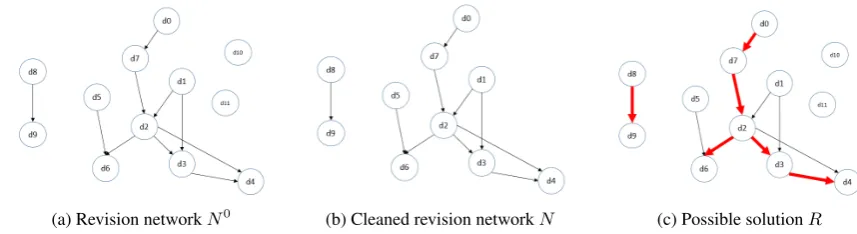
(a) Revision networkN0 (b) Cleaned revision networkN (c) Possible solutionR Figure 1: Revision network visualization
Figure1a, in which a vertex corresponds to a doc-ument. There is an arc a = ( ¯D,D˜) if and only if Dist( ¯D,D˜) ≤ τ and the creation date of D¯
is before the creation date of D˜. In other words,
˜
Dis a revision candidate forD¯. By construction,
N0is acyclic. For instance,d2is a revision candi-date ford7 andd1. Note that we allow one docu-ment to be the original docudocu-ment of several revised documents. As we only need to focus on revision candidates, we reduceN0 toN = (V, A), shown in Figure 1b, by removing isolated vertices. We define the weight of an arc as the distance score between the two vertices. Recall the assumption that a document can be a revision of at most one document. In other words, documents cannot be merged. Due to this assumption, all revision pairs form a branching inN. (A branching is a subgraph where each vertex has an in-degree of at most 1.) The document revision problem is to find a mini-mum cost branching inN (see Fig1c).
The minimum branching problem was earlier solved by Edmonds (1967) and Velardi et al. (2013). The details of his algorithm are as follows.
– For each node select the smallest weighted incoming arc. This yields a subgraph.
– If cycles are present in the selected subgraph, then recursively find the replacing arc that has the minimum weight among previously non-selected arcs to eliminate cycles.
In our case,N is acyclic and, therefore, the sec-ond step never occurs. For this reason, Algorithm 1solves the document revision problem.
The essential part of determining the minimum branchingRis extracting arcs with the lowest dis-tance scores. This is equivalent to finding the most similar document from the revision candidates for every original document.
Algorithm 1Find minimum branchingRfor net-workN = (V, A)
1: Input:N 2: R=∅
3: forevery vertexv∈V do
4: Setδ(u)to correspond to all arcs with head
u.
5: Select a = (v, u) ∈ δ(u) such that
Dist(v, u)is minimum 6: R=R∪a
7: end for
8: Output:R
3 Distance/similarity Measures
In this section, we first introduce the classic VSM model, the word2vec model, DTW and TED. We next demonstrate how to combine the above com-ponents to construct our semantic document tance measures: wDTW and wTED. We also dis-cuss the implementation of our revision detection system.
3.1 Background
3.1.1 Vector Space Model
VSM represents a set of documents as vectors of identifiers. The identifier of a word used in this work is the tf-idf weight. We represent documents as tf-idf vectors, and thus the similarity of two doc-uments can be described by the cosine distance between their vectors. VSM has low algorithm complexity but cannot represent the semantics of words since it is based on the bag-of-words as-sumption.
3.1.2 Word2vec
uses the current word to predict context words in a surrounding window to maximize the average log probability. Words with similar meanings tend to have similar embeddings.
3.1.3 Dynamic Time Warping
DTW was developed originally for speech recog-nition in time series analysis and has been widely used to measure the distance between two se-quences of vectors.
Given two sequences of feature vectors: A =
a1, a2, ..., ai, ..., am andB = b1, b2, ..., bj, ..., bn,
DTW finds the optimal alignment forAandBby first constructing an (m + 1)×(n+ 1) matrix in which the(i, j)thelement is the alignment cost
ofa1...ai andb1...bj, and then retrieving the path
from one corner to the diagonal one through the matrix that has the minimal cumulative distance. This algorithm is described by the following for-mula.
DT W(i, j) =Dist(ai, bj) +min(
DT W(i−1, j), //insertion DT W(i, j−1), //deletion DT W(i−1, j−1))//substitution
3.1.4 Tree Edit Distance
TED was initially defined to calculate the minimal cost of node edit operations for transforming one labeled tree into another. The node edit operations are defined as follows.
– DeletionDelete a node and connect its chil-dren to its parent maintaining the order.
– InsertionInsert a node between an existing node and a subsequence of consecutive chil-dren of this node.
– SubstitutionRename the label of a node. Let L1 and L2 be two labeled trees, and Lk[i]
be theith node inLk(k = 1,2). M corresponds
to a mapping fromL1 toL2. TED finds mapping
M with the minimal edit cost based on
c(M) =min{ X (i,j)∈M
cost(L1[i]→L2[j])
+X
i∈I
cost(L1[i]→ ∧)
+X
j∈J
cost(∧ →L2[j])}
whereL1[i] → L2[j]means transferringL1[i]to
L2[j] based on M, and ∧ represents an empty node.
3.2 Semantic Distance between Paragraphs
According to the description of DTW in Section 3.1.3, the distance between two documents can be calculated using DTW by replacing each element in the feature vectorsAandBwith a word vector. However, computing the DTW distance between two documents at the word level is basically as expensive as calculating the Levenshtein distance. Thus in this section we propose an improved algo-rithm that is more appropriate for document dis-tance calculation.
In order to receive semantic representations for documents and maintain a reasonable algorithm complexity, we use word2vec to train word vectors and represent each paragraph as a sequence of vec-tors. Note that in both wDTW and wTED we take document titles and section titles as paragraphs. Although a more recently proposed model PV can directly train vector representations for short texts such as movie reviews (Le and Mikolov, 2014), our experiments in Section 5.3 show that PV is not appropriate for standard paragraphs in general documents. Therefore, we use word2vec in our work. Algorithm2describes how we compute the distance between two paragraphs based on DTW and word vectors. The distance between one para-graph in a document and one parapara-graph in another document can be pre-calculated in parallel using Spark to provide faster computation for wDTW and wTED.
Algorithm 2DistPara
Replace the words in paragraphspandqwith word2vec embeddings:{vi}ei=1and{wj}fj=1
Input:p= [v1, .., ve]andq= [w1, .., wf]
Initialize the first row and the first column of
(e+ 1)×(f+ 1)matrixDT Wpara+∞
DT Wpara(0,0) = 0
foriin range(1, e+ 1)do forjin range(1, f + 1)do
Dist(vi, wj) =||vi−wj||
calculateDT Wpara(i, j)
end for end for
4 wDTW and wTED Measures
4.1 Word Vector-based Dynamic Time Warping
As a document can be considered as a sequence of paragraphs, wDTW returns the distance between two documents by applying another DTW on top of paragraphs. The cost function is exactly the DistPara distance of two paragraphs given in Al-gorithm2. Algorithm3and Figure2describe our wDTW measure. wDTW observes semantic in-formation from word vectors, which is fundamen-tally different from the word distance calculated from hierarchies among words in the algorithm proposed by Liu et al. (2007). The shortcomings of their work are that it is difficult to learn seman-tic taxonomy of all words and that their DTW al-gorithm can only be applied to sentences not doc-uments.
Algorithm 3wDTW
Represent documentsd1 andd2 with vectors of paragraphs:{pi}mi=1and{qj}nj=1
Input:d1 = [p1, .., pm]andd2 = [q1, .., qn]
Initialize the first row and the first column of
(m+ 1)×(n+ 1)matrixDT Wdoc+∞
DT Wdoc(0,0) = 0
foriin range(1, m+ 1)do forjin range(1, n+ 1)do
Dist(pi, qj) =DistPara(pi, qj)
calculateDT Wdoc(i, j)
end for end for
Return:DT Wdoc(m, n)
Figure 2: wDTW visualization
4.2 Word Vector-based Tree Edit Distance
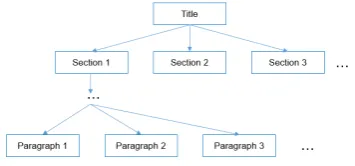
TED is reasonable for measuring document dis-tances as documents can be easily transformed to tree structures visualized in Figure3. The docu-ment tree concept was originally proposed by Si et al. (1997). A document can be viewed at mul-tiple abstraction levels that include the document title, its sections, subsections, etc. Thus for each document we can build a tree-like structure with title→sections→subsections→...→paragraphs being paths from the root to leaves. Child nodes are ordered from left to right as they appear in the document.
Figure 3: Document tree
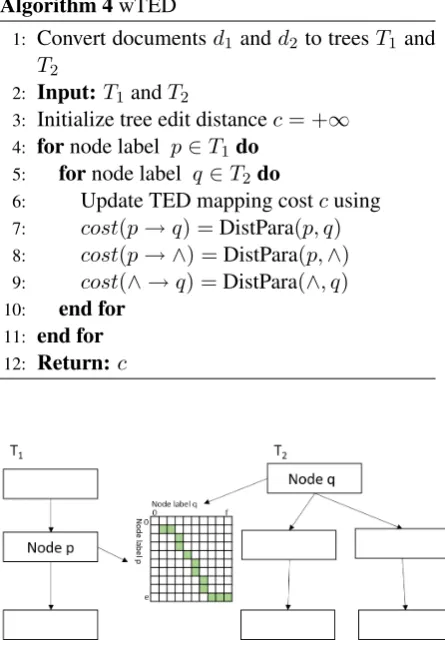
We represent labels in a document tree as the vector sequences of titles, sections, subsec-tions and paragraphs with word2vec embeddings. wTED converts documents to tree structures and then uses DistPara distances. More formally, the distance between two nodes is computed as fol-lows.
– The cost of substitution is the DistPara value of the two nodes.
– The cost of insertion is the DistPara value of an empty sequence and the label of the in-serted node. This essentially means that the cost is the sum of the L2-norms of the word vectors in that node.
– The cost of deletion is the same as the cost of insertion.
Algorithm 4wTED
1: Convert documentsd1andd2 to treesT1 and
T2
2: Input:T1andT2
3: Initialize tree edit distancec= +∞
4: fornode label p∈T1do 5: fornode label q∈T2do
6: Update TED mapping costcusing 7: cost(p→q) =DistPara(p, q) 8: cost(p→ ∧) =DistPara(p,∧) 9: cost(∧ →q) =DistPara(∧, q)
10: end for 11: end for 12: Return:c
Figure 4: wTED visualization
4.3 Process Flow
Our system is a boosting learner that is composed of four modules: weak filter, strong filter, revision network and optimal subnetwork. First of all, we sort all documents by timestamps and pair up doc-uments so that we only compare each document with documents that have been created earlier. In the first module, we calculate the VSM similar-ity scores for all pairs and eliminate those with scores that are lower than an empirical threshold (τ˜ = 0.5). This is what we call the weak filter. After that, we apply the strong filter wDTW or wTED on the available pairs and filter out docu-ment pairs having distances higher than a thresh-oldτ. For VSM in Section5.1, we directly filter out document pairs having similarity scores lower than a threshold τ. The cut-off threshold esti-mation is explained in Section 4.4. The remain-ing document pairs from the strong filter are then sent to the revision network module. In the end, we output the optimal revision pairs following the minimum branching strategy.
4.4 Estimating the Cut-off Threshold
Hyperprameter τ is calibrated by calculating the absolute extreme based on an initial set of docu-ments, i.e., all processed documents since the mo-ment the system was put in use. Based on this set, we calculate all distance/similarity scores and cre-ate a histogram, see Figure5. The figure shows the correlation between the number of document pairs and the similarity scores in the training process of one simulated corpus using VSM. The optimalτ
in this example is around 0.6 where the number of document pairs noticeably drops.
As the system continues running, new docu-ments become available andτ can be periodically updated by using the same method.
Figure 5: Settingτ
5 Numerical Experiments
This section reports the results of the experiments conducted on two data sets for evaluating the per-formances of wDTW and wTED against other baseline methods.
5.1 Distance/Similarity Measures
We denote the following distance/similarity mea-sures.
– wDTW: Our semantic distance measure ex-plained in Section4.1.
– wTED: Our semantic distance measure ex-plained in Section4.2.
– WMD: The Word Mover’s Distance intro-duced in Section1. WMD adapts the earth mover’s distance to the space of documents.
– PV-DTW: PV-DTW is the same as Algorithm 3except that the distance between two para-graphs is not based on Algorithm2but rather computed as ||P V(p1) − P V(p2)|| where
P V(p)is the PV embedding of paragraphp.
– PV-TED: PV-TED is the same as Algorithm 4except that the distance between two para-graphs is not based on Algorithm2but rather computed as||P V(p1)−P V(p2)||.
Our experiments were conducted on an Apache Spark cluster with 32 cores and 320 GB total memory. We implemented wDTW, wTED, WMD, VSM, PV-DTW and PV-TED in Java Spark. The paragraph vectors for PV-DTW and PV-TED were trained by gensim.3
5.2 Data Sets
In this section, we introduce the two data sets we used for our revision detection experiments: Wikipedia revision dumps and a document revi-sion data set generated by a computer simulation. The two data sets differ in that the Wikipedia re-vision dumps only contain linear rere-vision chains, while the simulated data sets also contains tree-structured revision chains, which can be very com-mon in real-world data.
5.2.1 Wikipedia Revision Dumps
The Wikipedia revision dumps that were previ-ously introduced by Leskovec et al. (2010) con-tain eight GB (compressed size) revision edits with meta data.
We pre-processed the Wikipedia revision dumps using the JWPL Revision Machine (Fer-schke et al., 2011) and produced a data set that contains 62,234 documents with 46,354 re-visions. As we noticed that short documents just contributed to noise (graffiti) in the data, we eliminated documents that have fewer than three paragraphs and fewer than 300 words. We re-moved empty lines in the documents and trained word2vec embeddings on the entire corpus. We used the documents occurring in the first 80%of the revision period for τ calibration, and the re-maining documents for test.
5.2.2 Simulated Data Sets
The generation process of the simulated data sets is designed to mimic the real world. Users open 3https://radimrehurek.com/gensim/models/doc2vec.html
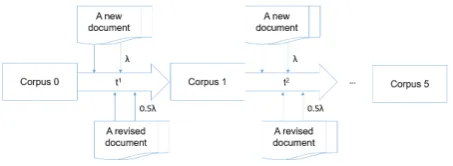
Figure 6: Corpora simulation
some existing documents in a file system, make some changes (e.g. addition, deletion or re-placement), and save them as separate documents. These documents become revisions of the original documents. We started from an initial corpus that did not have revisions, and kept adding new doc-uments and revising existing docdoc-uments. Similar to a file system, at any moment new documents could be added and/or some of the current docu-ments could be revised. The revision operations we used weredeletion, additionandreplacement
of words, sentences, paragraphs, section names and document titles. The additionof words, ..., section names, and new documents were pulled from the Wikipedia abstracts. This corpus gener-ation process had five time periods{t1, t2, ..., t5}. Figure6illustrates this simulation. We set a Pois-son distribution with rate λ = 550 (the number of documents in the initial corpus) to control the number of new documents added in each time pe-riod, and a Poisson distribution with rate0.5λto control the number of documents revised in each time period.
We generated six data sets using different ran-dom seeds, and each data set contained six cor-pora (Corpus 0 - 5). Table1summarizes the first data set. In each data set, we name the initial corpus Corpus 0, and defineT0 as the timestamp when we started this simulation process. We set
Tj = Tj−1 + tj, j ∈ [1,5]. Corpus j corre-sponds to documents generated before timestamp
Tj. We extracted document revisions from
Cor-pus k ∈ [2,5] and compared the revisions gen-erated in (Corpus k - Corpus (k−1)) with the ground truths in Table1. Hence, we ran four ex-periments on this data set in total. In every exper-iment, τk is calibrated based on Corpus (k−1).
doc-uments. The word2vec model shared in the four experiments was trained on Corpus5.
Table 1: A simulated data set
Corpus Number ofdocuments Number ofnew documents Number ofrevision pairs
0 550 0 0
1 1347 542 255
2 2125 520 258
3 2912 528 259
4 3777 580 285
5 4582 547 258
5.3 Results
We use precision, recall and F-measure to evalu-ate the detected revisions. A true positive case is a correctly identified revision. A false positive case is an incorrectly identified revision. A false nega-tive case is a missed revision record.
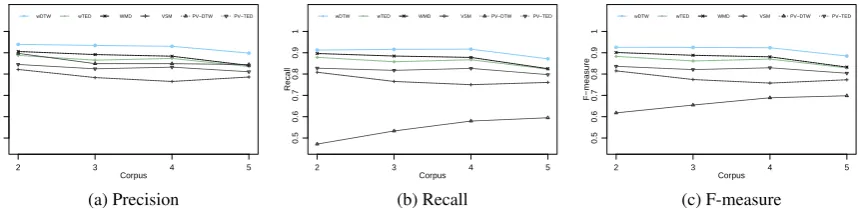
We illustrate the performances of wDTW, wTED, WMD, VSM, PV-DTW and PV-TED on the Wikipedia revision dumps in Figure7. wDTW and wTED have the highest F-measure scores compared to the rest of four measures, and wDTW also have the highest precision and recall scores. Figure8 shows the average evaluation results on the simulated data sets. From left to right, the corpus size increases and the revision chains be-come longer, thus it bebe-comes more challenging to detect document revisions. Overall, wDTW con-sistently performs the best. WMD is slightly bet-ter than wTED. In particular, when the corpus size increases, the performances of WMD, VSM, PV-DTW and PV-TED drop faster than wPV-DTW and wTED. Because the revision operations were ran-domly selected in each corpus, it is possible that there are non-monotone points in the series.
wDTW and wTED perform better than WMD especially when the corpus is large, because they use dynamic programming to find the global opti-mal alignment for documents. In contrast, WMD
relies on a greedy algorithm that sums up the min-imal cost for every word. wDTW and wTED per-form better than PV-DTW and PV-TED, which in-dicates that our DistPara distance in Algorithm2is more accurate than the Euclidian distance between paragraph vectors trained by PV.
We show in Table2the average running time of the six distance/similarity measures. In all the ex-periments, VSM is the fastest, wTED is faster than wDTW, and WMD is the slowest. Running WMD is extremely expensive because WMD needs to solve anx2 sequential transshipment problem for every two documents wherexis the average num-ber of words in a document. In contrast, by split-ting this heavy computation into several smaller problems (finding the distance between any two paragraphs), which can be run in parallel, wDTW and wTED scale much better.
Combining Figure 7, Figure8 and Table 2we conclude that wDTW yields the most accurate re-sults using marginally more time than VSM, PV-TED and PV-DTW, but much less running time than WMD. wTED returns satisfactory results us-ing shorter time than wDTW.
6 Conclusion
This paper has explored how DTW and TED can be extended with word2vec to construct semantic document distance measures: wDTW and wTED. By representing paragraphs with concatenations of word vectors, wDTW and wTED are able to cap-ture the semantics of the words and thus give more accurate distance scores. In order to detect revi-sions, we have used minimum branching on an ap-propriately developed network with document dis-tance scores serving as arc weights. We have also assessed the efficiency of the method of retriev-ing an optimal revision subnetwork by findretriev-ing the minimum branching.
Furthermore, we have compared wDTW and
(a) Precision (b) Recall (c) F-measure
2 3 4 5
● wDTW wTED WMD VSM PV−DTW PV−TED
(a) Precision
● wDTW wTED WMD VSM PV−DTW PV−TED
(b) Recall
● wDTW wTED WMD VSM PV−DTW PV−TED
(c) F-measure Figure 8: Average precision, recall and F-measure on the simulated data sets Table 2: Running time of VSM, PV-TED, PV-DTW, wTED, wDTW and WMD
VSM PV-TED PV-DTW wTED wDTW WMD Wikipedia revision dumps 1h 38min 3h 2min 3h 18min 5h 13min 13h 27min 515h 9min corpus 2 2 min 3 min 3 min 7 min 8 min 8 h 53 min corpus 3 3 min 4 min 5 min 9 min 11 min 12 h 45 min corpus 4 4 min 6 min 6 min 11 min 12 min 14 h 34 min corpus 5 7 min 9 min 9 min 14 min 16 min 17 h 31 min
wTED with several distance measures for revision detection tasks. Our results demonstrate the effec-tiveness and robustness of wDTW and wTED in the Wikipedia revision dumps and our simulated data sets. In order to reduce the computation time, we have computed document distances at the para-graph level and implemented a boosting learning system using Apache Spark. Although we have demonstrated the superiority of our semantic mea-sures only in the revision detection experiments, wDTW and wTED can also be used as semantic distance measures in many clustering, classifica-tion tasks.
Our revision detection system can be enhanced with richer features such as author information and writing styles, and exact changes in revision pairs. Another interesting aspect we would like to ex-plore in the future is reducing the complexities of calculating the distance between two paragraphs. Acknowledgments
This work was supported in part by Intel Corpora-tion, Semiconductor Research Corporation (SRC).
References
Asad Abdi, Norisma Idris, Rasim M Alguliyev, and Ramiz M Aliguliyev. 2015. Pdlk: Plagiarism de-tection using linguistic knowledge. Expert Systems with Applications, 42(22):8936–8946.
Peter Buneman, Sanjeev Khanna, and Tan Wang-Chiew. 2001. Why and where: A characterization of data provenance. InDatabase Theory ICDT 2001, pages 316–330. Springer.
Moses S Charikar. 2002. Similarity estimation tech-niques from rounding algorithms. InProceedings of the thiry-fourth annual ACM symposium on Theory of computing, pages 380–388. ACM.
Erik D Demaine, Shay Mozes, Benjamin Rossman, and Oren Weimann. 2007. An optimal decomposition algorithm for tree edit distance. InAutomata, Lan-guages and Programming, pages 146–157. Springer.
Jack Edmonds. 1967. Optimum branchings. Journal of Research of the National Bureau of Standards B, 71(4):233–240.
Oliver Ferschke, Torsten Zesch, and Iryna Gurevych. 2011. Wikipedia revision toolkit: Efficiently access-ing wikipedias edit history. InProceedings of the ACL-HLT 2011 System Demonstrations, pages 97– 102. ACL.
Atsushi Fujii and Tetsuya Ishikawa. 2001. Japanese/english cross-language information retrieval: Exploration of query translation and transliteration. Computers and the Humanities, 35(4):389–420.
Nathaniel Gustafson, Maria Soledad Pera, and Yiu-Kai Ng. 2008. Nowhere to hide: Finding plagia-rized documents based on sentence similarity. In
Matthias Hagen, Martin Potthast, and Benno Stein. 2015. Source retrieval for plagiarism detection from large web corpora: recent approaches. Working Notes Papers of the CLEF, pages 1613–0073. Timothy C. Hoad and Justin Zobel. 2003. Methods for
identifying versioned and plagiarized documents.
Journal of the American Society for Information Sci-ence Technology, 54(3):203–215.
Philip N Klein. 1998. Computing the edit-distance be-tween unrooted ordered trees. InEuropean Sympo-sium on Algorithms, pages 91–102. Springer. Matt J Kusner, Yu Sun, Nicholas I Kolkin, and
Kil-ian Q Weinberger. 2015. From word embeddings to document distances. InProceedings of the 32nd In-ternational Conference on Machine Learning, pages 957–966.
Quoc V Le and Tomas Mikolov. 2014. Distributed representations of sentences and documents. arXiv preprint arXiv:1405.4053.
Jure Leskovec, Daniel P Huttenlocher, and Jon M Kleinberg. 2010. Governance in social media: A case study of the wikipedia promotion process. In
International Conference on Weblogs and Social Media.
Xiaoying Liu, Yiming Zhou, and Ruoshi Zheng. 2007. Sentence similarity based on dynamic time warping. In International Conference on Semantic Comput-ing, pages 250–256. IEEE.
Udi Manber et al. 1994. Finding similar files in a large file system. InUsenix Winter, volume 94, pages 1– 10.
Gurmeet Singh Manku, Arvind Jain, and Anish Das Sarma. 2007. Detecting near-duplicates for web crawling. In Proceedings of the 16th interna-tional conference on World Wide Web, pages 141– 150. ACM.
Michael Matuschek, Tim Schl¨uter, and Stefan Con-rad. 2008. Measuring text similarity with dynamic time warping. InProceedings of the 2008 interna-tional symposium on Database engineering & appli-cations, pages 263–267. ACM.
Tomas Mikolov, Ilya Sutskever, Kai Chen, Greg S Cor-rado, and Jeff Dean. 2013. Distributed representa-tions of words and phrases and their compositional-ity. InAdvances in Neural Information Processing Systems, pages 3111–3119.
Meinard M¨uller. 2007. Dynamic time warping. Infor-mation Retrieval for Music and Motion, pages 69– 84.
Gabriel Oberreuter and Juan D Vel´aSquez. 2013. Text mining applied to plagiarism detection: The use of words for detecting deviations in the writing style.
Expert Systems with Applications, 40(9):3756– 3763.
Mateusz Pawlik and Nikolaus Augsten. 2011. Rted: a robust algorithm for the tree edit distance. Proceed-ings of the VLDB Endowment, 5(4):334–345. Mateusz Pawlik and Nikolaus Augsten. 2014. A
memory-efficient tree edit distance algorithm. In
Database and Expert Systems Applications, pages 196–210. Springer.
Mateusz Pawlik and Nikolaus Augsten. 2015. Efficient computation of the tree edit distance. ACM Trans-actions on Database Systems, 40(1):3.
Mateusz Pawlik and Nikolaus Augsten. 2016. Tree edit distance: Robust and memory-efficient. Information Systems, 56:157–173.
Mikalai Sabel. 2007. Structuring wiki revision history. InProceedings of the 2007 International Symposium on Wikis, pages 125–130. ACM.
Yasushi Sakurai, Masatoshi Yoshikawa, and Chris-tos Faloutsos. 2005. Ftw: fast similarity search under the time warping distance. In Proceed-ings of the twenty-fourth ACM SIGMOD-SIGACT-SIGART Symposium on Principles of Database Sys-tems, pages 326–337. ACM.
Saul Schleimer, Daniel S Wilkerson, and Alex Aiken. 2003. Winnowing: local algorithms for document fingerprinting. In Proceedings of the 2003 ACM SIGMOD International Conference on Management of Data, pages 76–85. ACM.
Antonio Si, Hong Va Leong, and Rynson WH Lau. 1997. Check: a document plagiarism detection sys-tem. InProceedings of the 1997 ACM Symposium on Applied Computing, pages 70–77. ACM. Grigori Sidorov, Helena G´omez-Adorno, Ilia Markov,
David Pinto, and Nahun Loya. 2015. Computing text similarity using tree edit distance. InFuzzy In-formation Processing Society (NAFIPS) held jointly with 2015 5th World Conference on Soft Comput-ing, 2015 Annual Conference of the North American, pages 1–4. IEEE.
Kuo-Chung Tai. 1979. The tree-to-tree correction problem.Journal of the ACM, 26(3):422–433. Paola Velardi, Stefano Faralli, and Roberto Navigli.
2013. Ontolearn reloaded: A graph-based algorithm for taxonomy induction. Computational Linguistics, 39(3):665–707.
Jing Zhang and HV Jagadish. 2013. Revision prove-nance in text documents of asynchronous collabora-tion. In 2013 IEEE 29th International Conference on Data Engineering, pages 889–900. IEEE. Kaizhong Zhang and Dennis Shasha. 1989. Simple