Updating Rare Term Vector Replacement
Tobias Berka†
†Department of Computer Sciences
University of Salzburg
{tberka,marian}@cosy.sbg.ac.at
Marian Vajterˇsic†‡ ‡Department of Informatics
Mathematical Institute Slovak Academy of Sciences
Abstract
Rare term vector replacement (RTVR) is a novel technique for dimensionality reduc-tion. In this paper, we introduce an up-dating algorithm for RTVR. It is capable of updating both the projection matrix for the reduction and the reduced corpus ma-trix directly, without having to recompute the expensive projection operation. We in-troduce an effective batch updating algo-rithm, and present performance measure-ments on a subset of the Reuters newswire corpus that show that a 12.5% to 50% split of the documents into corpus and update vectors leads to a three to four fold speed-up over a complete rebuild. Thus, we have enabled optimized updating for rare term vector replacement.
1 Introduction
Rare term vector replacement (RTVR) is a re-cently developed linear dimensionality reduction technique for term frequency vectors (Berka and Vajterˇsic, 2011). It is easily and rapidly computed, patent-free, and produces a semantically meaning-ful multivariate space with a significantly reduced dimensionality. Furthermore, the method has been parallelized for data and task parallelism (Berka and Vajterˇsic, 2013).
The construction of this representation is based on document-scope term cooccurrences. Rare terms that occur only in δ documents or fewer are eliminated by replacing them with the average vectors of the documents that contain them. The replacement vectors of the rare terms are added to the original document vectors. Then, all rows for rare terms are dropped from all vectors. Only the common terms remain of the original term frequency vector space. By Zipf’s law (Powers, 1998), we know that this operation will eliminate
a high number of terms and lead to a highly con-densed representation. The performance of the re-placement now depends on the applicability of the cluster hypothesis(Raiber and Kurland, 2012; Ri-jsbergen, 1979), i.e., that documents in close prox-imity are semantically related. If the cluster hy-pothesis holds, then the centroid of the containing documents will act as a succint representation of all documents containing the replacement term.
The most prominent techniques for dimension-ality reduction of text data in published litera-ture are latent semantic indexing (LSI), see (Deer-wester et al., 1990) and the related COV ap-proach (Kobayashi et al., 2002). These two methods are applications of a principal compo-nent analysis to text using unbiased and biased correlation measures. Factor analysis based on the SVD applied to automated indexing has been reported as probabilistic latent semantic analy-sis (PLSA) (Hofmann, 1999). Updating opera-tions for LSI are well understood (Zha and Si-mon, 1999), and are also being developed for PLSA (Bassiou and Kotropoulos, 2011), or other dimensionality reduction methods such as the ker-nel PCA (Mastronardi et al., 2010).
Through the connection between PLSA and La-tent Dirichlet Allocation (LDA) (Girolami and Kab´an, 2003), topic models are also related to di-mensionality reduction. Positive matrix factoriza-tion methods are also used in various text analysis tasks (Zhang, 2010). Structurally, the generalized vector space model (GVSM) (Wong et al., 1985), is similar to RTVR because of the construction of index vectors by linear combination. The random index vector representation (Kanerva et al., 2000) is also based on cooccurrences, but operates on random initial vectors. Random projections can be used to further accelerate it (Sakai and Imiya, 2009), but this approach should be seen as comple-mentary because it can be applied to other meth-ods as well.
Our contribution is the following. In this pa-per, we rigorously define an algorithm for updat-ing rare term vector replacement. Usupdat-ing our ap-proach, both the replacement vectors and the re-duced corpus matrix are updated directly. It is not necessary to explicitly recompute the projection into the reduced-dimensional space.
The remainder of this paper is structured as thus. Our main contribution is the updating algo-rithm in Section 2. Section 3 contains a theoretic and empirical performance evaluation. Lastly, we summarize our findings in Section 4.
2 Updating RTVR
Updating RTVR has to support the three basic op-erations of content management: (1) adding new documents, (2) changing existing documents, and (3) deleting obsolete documents.
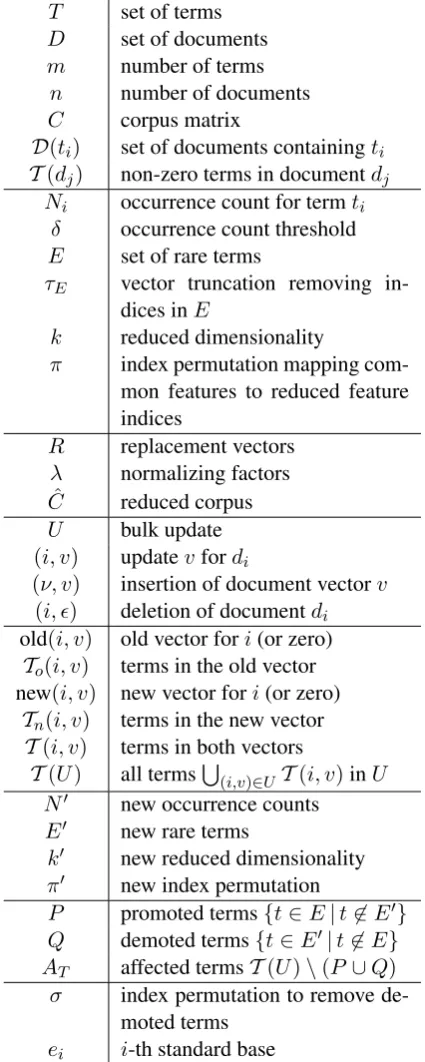
The replacement vectors are weighted cen-troids, or weighted average vectors, of the docu-ment vectors containing their terms. The reduced document vectors are also linear combinations of the truncated original document vectors and the replacement vectors. At its core, the update al-gorithm is therefore a running average computa-tion. We will use the mathematical notation sum-marized in Table 1 to describe the algorithm.
A key complication lies in the fact that the occurrence counts of the terms change. This means that some rare terms may become common terms, and therefore become part of the reduced-dimensional, projected term space. Dually, some common terms may become rare terms, and drop out of the projected space. We will refer to these terms as promoted anddemoted termsP andQ. For demoted terms, we need to compute the re-placement vectors from scratch during the update. But for all rare terms that are involved in an up-date, in the old or new vector, we need to change the replacement vector. These terms are called af-fected(rare)termsAT.
We can represent changing a document by a tuple (i, v) containing a corpus matrix column
i ∈ {1, ..., n} and a new term frequency vector
v ∈ Rm0
, wherem0 is the new number of terms. The other two updating operations can be cast into the same form by introducing two abstract symbols. We letν denote the pseudo-column for adding new documents, i.e., (ν, dn+1) denotes a
new document that will be added as a new column of the corpus matrix. For deletions, we letdenote
T set of terms
D set of documents
m number of terms
n number of documents
C corpus matrix
D(ti) set of documents containingti T(dj) non-zero terms in documentdj
Ni occurrence count for termti δ occurrence count threshold
E set of rare terms
τE vector truncation removing
in-dices inE
k reduced dimensionality
π index permutation mapping com-mon features to reduced feature indices
R replacement vectors
λ normalizing factors ˆ
C reduced corpus
U bulk update (i, v) updatevfordi
(ν, v) insertion of document vectorv
(i, ) deletion of documentdi
old(i, v) old vector fori(or zero)
To(i, v) terms in the old vector
new(i, v) new vector fori(or zero)
Tn(i, v) terms in the new vector
T(i, v) terms in both vectors
T(U) all termsS
(i,v)∈UT(i, v)inU N0 new occurrence counts
E0 new rare terms
k0 new reduced dimensionality
π0 new index permutation
P promoted terms{t∈E|t6∈E0} Q demoted terms{t∈E0|t6∈E} AT affected termsT(U)\(P∪Q) σ index permutation to remove
de-moted terms
ei i-th standard base
Table 1: Mathematical Notation
an empty pseudo-vector for the deletion of an old document, i.e., (i, ) signifies the deletion of the document in columni.
We associate every updateu= (i, v)∈U with two term frequency vectors. If the update is not an add document request, i.e.,i6= ν, it is associated with an old document vector old(i, v) = C1:m,i.
Algorithm 1:Preparing the Update
delete or append terms inT,C,N,R,λ;
N0 :=N; E0 :=E;
foru∈U do
Used:=Used∪ T(u);
forti ∈(To(u)\ Tn(u))do Ni0- -; forti ∈(Tn(u)\ To(u))do Ni0++;
forti∈T do
if(Ni0 > δ)∧ti ∈Ethen
P :=P∪ {ti};E0:=E0\ {ti}; else if(Ni0 ≤δ)∧ti6∈Ethen
Q:=Q∪ {ti};E0 :=E0∪ {ti}; else if(Ni0 ≤δ)∧ti∈Usedthen
AT :=AT ∪ {ti};
k00 :=k− kQk; k0 :=k00+kPk;
σ := 1k0;j:= 1;l:=k00+ 1;
forti∈T do
ifti∈Pthen π0(i) :=l++; else ifti ∈AT then
σ(j) :=π(i);
π0(i) :=j++;
else π0(i) :=−1;
will need to identify the terms in the old vector
To(i, v), in the new vector Tn(i, v), and the joint setT(i, v). All terms in the old and new vectors for the entire updateU is defined asT(U).
Our updating algorithm proceeds in three phases: (1) preparing the update, (2) downdating the reduced corpus and updating the replacement vectors, and (3) updating the reduced corpus. In Algorithm 1, we analyze a batch update and pre-pare the required sets of features and an index per-mutationσto compact the reduced space.
Let us assume that we have a procedure Compact(A,m0,n,σ), which applies the permuta-tion σ to the row indices of a matrix. If we have a matrix A ∈ Rm×n and compute A0 :=
Compact(A, m0, n, σ) ∈ Rm0×n, it holds that A0i,j =Aσ(i),j. Let us further assume that trunca-tion of the new eliminatrunca-tion termsτE0 respects the new index order established withσ, i.e., the im-plementation uses the global index permutationπ0
mapping all new features to indices in{1, ..., k0}. We downdate the reduced corpus and update the replacement vectors with Algorithm 2. For exist-ing documents, we downdate the reduced corpus by subtracting any terms that will change in the course of the update in Line 1. We then update
the replacement vectors by adding the new docu-ment vector to any affected or demoted features in Line 2. Documents that do not change contribute to the construction of replacement vectors for de-moted terms, which need to be built from scratch, in Line 3. These have to be inserted into rowsk00
tok0 of the reduced space, as done in Line 4. We add in any new documents in Line 5 and normalize the resulting replacement vectors.
Algorithm 3 updates the reduced vectors by adding all replacement vectors that have changed in Line 1. The exception are the promoted terms on rowsk00tok0, which must be added for all rare terms that were otherwise unaffected by the up-date in Line 2. We then handle all deletions and insertions in Lines 3 and 4.
3 Performance Evaluation
Regarding the asymptotic complexity of our up-dating algorithm, we note the following. Assum-ing amortized constant time for set testAssum-ing and insertion (Sedgewick, 2002), that the update is smaller than the corpus, i.e., kUk < kDk, and that the number of documents is greater than the number of terms, i.e., n > m, the update al-gorithm can be executed with a complexity of
O((kDk+kUk)nnz k0+mk0), where nnz is the expected number of non-zero elements in any doc-ument vector.
Since the performance is heavily dependent on the actual distribution of the non-zero elements, the observed performance may differ somewhat from this formal analysis. We have conducted performance measurements using an Intel i5-2557 with 4 GB or RAM running Max OS X 10.7.5. We have used the first 23,149 documents with 47,236 terms of the Reuters Corpus Volume I, version 2, in the pre-vectorized form (Lewis et al., 2004).
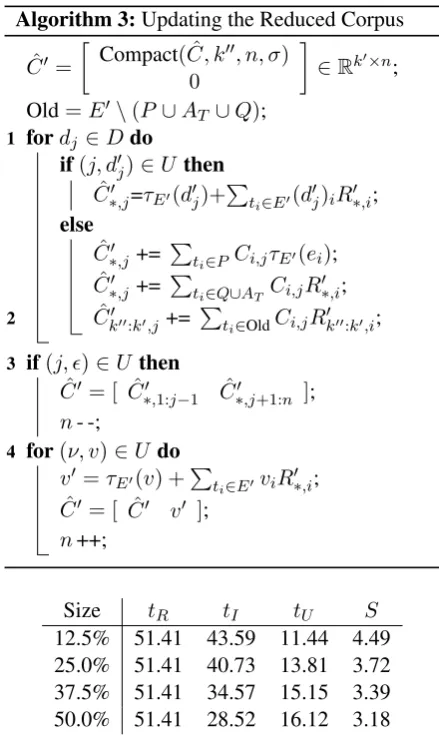
We randomly selected between 12.5% and 50% of all vectors for the batch update, using the re-maining documents for the initial build. Table 2 summarizes our performance measurements aver-aged across ten runs per row.
Algorithm 2: Downdating the Reduced Cor-pus and Updating the Replacement Vectors
forti∈AT do R∗,i*=λi;
Algorithm 3:Updating the Reduced Corpus
ˆ
12.5% 51.41 43.59 11.44 4.49 25.0% 51.41 40.73 13.81 3.72 37.5% 51.41 34.57 15.15 3.39 50.0% 51.41 28.52 16.12 3.18
Table 2: Performance evaluation (rebuild timetR,
build timetI, update timetUand speed-upS).
4 Summary & Conclusions
In this paper, we have introduced an algorithm for updating rare term vector replacement. Our em-pirical performance evaluation demonstrates that batch updating is faster than a complete rebuild by a factor of three to four for our experiments. In our future research, we intend to develop hy-brid updating algorithms similar to (Tougas and Spiteri, 2008). These algorithms initially com-pute fast, approximate updates, which are only later replaced by exact updates for efficiency. The final PCA of the augmented corpus Cˆ reported in (Berka and Vajterˇsic, 2011) remains an open problem in updating RTVR.
Acknowledgements
References
N. Bassiou and C. Kotropoulos. 2011. RPLSA: A Novel Updating Scheme for Probabilistic La-tent Semantic Analysis. Comput. Speech Lang., 25(4):741–760.
T. Berka and M. Vajterˇsic. 2011. Dimensionality duction for Information Retrieval using Vector Re-placement of Rare Terms. InProc. TMW.
T. Berka and M. Vajterˇsic. 2013. Parallel Rare Term Vector Replacement: Fast and Effective Dimension-ality Reduction for Text. J. Parallel Distr. Com., 73(3):341–351.
S. C. Deerwester, S. T. Dumais, T. K. Landauer, G. W. Furnas, and R. A. Harshman. 1990. Indexing by Latent Semantic Analysis. JASIS, 41(6):391–407.
M. Girolami and A. Kab´an. 2003. On an Equivalence Between PLSI and LDA. In Proc. SIGIR, pages 433–434, USA. ACM.
T. Hofmann. 1999. Probabilistic Latent Semantic In-dexing. InProc. SIGIR, pages 50–57, USA. ACM.
P. Kanerva, J. Kristoferson, and A. Holst. 2000. Ran-dom Indexing of Text Samples for Latent Seman-tic Analysis. InProc. CogSci, pages 103–106. Erl-baum.
M. Kobayashi, M. Aono, H. Takeuchi, and H. Samukawa. 2002. Matrix Computations for Information Retrieval and Major and Out-lier Cluster Detection. J. Comput. Appl. Math., 149(1):119 – 129.
D. D. Lewis, Y. Yang, T. G. Rose, and F. Li. 2004. RCV1: A New Benchmark Collection for Text Cat-egorization Research. JMLR, 5:361–397.
N. Mastronardi, E. E. Tyrtyshnikov, and P. Van Dooren. 2010. A Fast Algorithm for Updating and Down-sizing the Dominant Kernel Principal Components.
SIAM J. Matrix Anal. Appl., 31(5):2376–2399.
D. M. W. Powers. 1998. Applications and Explana-tions of Zipf’s Law. In Proc. NeMLaP3/CoNLL, pages 151–160, USA. ACL.
F. Raiber and O. Kurland. 2012. Exploring the Clus-ter Hypothesis, and ClusClus-ter-Based Retrieval, Over the Web. InProc. CIKM, pages 2507–2510, USA. ACM.
C. J. van Rijsbergen. 1979. Information Retrieval. Butterworths, London.
T. Sakai and A. Imiya. 2009. Fast Spectral Clustering with Random Projection and Sampling. InMachine Learning and Data Mining in Pattern Recognition, LLNCS, pages 372–384. Springer.
R. Sedgewick. 2002. Algorithms in C++. Addison Wesley, 3rd edition.
J. E. Tougas and R. J. Spiteri. 2008. Two Uses for Updating the Partial Singular Value Decomposition in Latent Semantic Indexing. Appl. Numer. Math., 58(4):499–510.
S. K. M. Wong, W. Ziarko, and P. C. N. Wong. 1985. Generalized Vector Spaces Model in Information Retrieval. In Proc. SIGIR, pages 18–25, USA. ACM.
H. Zha and H. D. Simon. 1999. On Updating Problems in Latent Semantic Indexing. SIAM J. Sci. Comput., 21(2):782–791.