175
Abstract—LLNs (Low Power and Lossy Networks) are becoming hot research topics due to challenges posed by their limited battery life, computing power, memory and transmission power. LLNs require a routing protocol which can perform efficiently with their limitations. IETF has come up with RPL as standard routing protocol for LLNs. It builds energy efficient network. But it also has major limitations and several research have happened to overcome the same. This paper is survey of RPL challenges and recent research on RPL extensions. Major RPL limitations include packet loss under noisy scenario, increased DODAG depth causing high energy consumption. TTA (Trickle Timer Algorithm) is importantpart of RPL. It is used to manage control messages flow. Limitation of trickle algorithm results in problem of short time for listeningand it can make few nodes crave for delay and higher latency. E-Trickle is proposed to overcome the listen only period, improve convergence time and energy consumption. QOI (Quality of Information) aware RPL reduces the energy consumption with less data transmission. RPL operates under one sink. Entire data flows towards the single sink. RPL doesn’t specify when, where and how more number of sinks need to be used. Dynamic rescue sink is RPL enhancement built with real timetracking of nodes’ performance in RPL networks to propose new sinks when required. AMI (Advanced metering infrastructure) is one of the application in smart grid for connecting smart metering devices at homes. It is critical to have efficient routing protocol for AMI as the smart meter nodes are resource constrained. AMI with high density networks suffer from high packet loss, network congestion retransmissions, increased latency, control traffic overhead and power consumption. LQE (Link Quality Estimation) influences quality of selected route and energy consumption. RL-probe measures link quality precisely with small overhead and energy consumption. RL-probe reduces packet loss by reacting to link quality variations and link failures due to mobility. Communication overhead needs to be as minimal as possible inLLNs with limited resources. Adaptive timing model uses dynamic method to decide frequency of executing objective function to construct DODAG based on degree of surrounding changes and reduces the control messages overhead. Objective is to bring down the PLR
Manuscript revised May 13, 2019 and published on June 5, 2019
Savitha M M, Research Scholar, School of Electronics and Communication, Reva University, Bengaluru, India
Dr P I Basarkod, Professor, School of Electronics and Communication, Reva University, Bengaluru, India
(packet loss ratio), overhead of control messages and battery usage. RPL doesn’t give good results for high throughput and changes in network conditions. This prevents use of RPL in high speed sensors and mobile sensing applications. BRPL is extension to RPL which combines RPL objective function (OF) with backpressure routing to handle dynamic traffic load and mobility.
IndexTerms— Low Power and lossy networks (LLNs),
Routing Protocol for LLNs (RPL), DODAG, Advanced Metering Infrastructure (AMI), Internet of Things (IOT).
I. INTRODUCTION
Wireless sensor networks (WSN)is one of the interesting subjectin research. Recently many efforts have been taken for standardization of LLNs. LLNs consists of devices with fixedmemory,serving capacity and energy. LLNs have less data rates, more packet loss rate and imbalance [4]. LLNs include a great range of link layer technologies that is IEEE 802.15.4, power line communication (PLC), less power WiFi and Bluetooth. The nodes collect information from sensors and send it to sinks in WSN which are type of LLNs. During remote data collection WSNs play a very significant function. The range of application is carried to the position, vehicle networking and other concernedareas [4]. Presently researches focus on energy consumption [8], nodes density [6], packet loss [3, 9], mobility [3, 8, 9], convergence time [1], routing overhead [8, 10] and high traffic [9].
ROLL processing group in internet engineering task force (IETF) proposes routing protocol for LLNs. It is designed to adapt TCP/IP to trade off networking performance and energy efficiency [4]. In WSNs the node energy consumption is a huge challenge,due to most of the data are sent on to the root. Nodes utilize more energy when they are towards the sink. RPL is a compromising protocol thatprovides the interconnection of heavy scale communicating devices of good heterogeneity.
RPL protocol is a distance vector for LLNs which gives a strategy for building a topology named as DODAG [5]. The main goal ofRPL is to build a standard routing protocol that is applicable for dissimilar domains and applications. It has 4 main types control messages. (1) DODAG Information Object (DIO): It is a multi casted message downwards by a node to inform other nodes to know about it. This is an announcement message to inform rest of the interested nodes to join the DAG. (2) DODAG Information Solicitation (DIS): A DIS control message is sent by the node to search if any DODAGs exist when no
A Comprehensive Survey on RPL : Evolution and
Challenges
176 announcement is received. This is very similar to the IPv6
Neighbor Discovery Router Solicitation (RS). (3) DODAG Advertisement Object (DAO): This message is sent by a child to a parent or sink to enable the child to join the already built DODAG. A DAO message can be acknowledged by a Destination Advertisement Acknowledgment (DAO-ACK) message back to the sender. (4) DAO-ACK: This is a response sent by the parent or sink after a DAO message that allows or denies a child to join the DODAG [6]. Sample DODAG and its formation flow diagram are depicted in Figures 1 and 2
Figure 1: Sample RPL network.
Figure 2: DODAG formation process flow diagram
The commonly used open sources for implementing RPL are tiny RPL and Contiki RPL within tiny OS and Contiki OS respectively [2]. Several applications in IOT and WSN are designed by RPL to meet the demands and it is believed as a vital element that links the connectivity of application layer to low power network in IETF. Various examines have proved that RPL is impacted by effects of reliability. The main reason for unreliability is the lack of responsiveness to changes in environmental elements such asirregular radios, multipath issue, real life scenarios due to mobility of node and disturbance [3].
WSNs will be the key facilitator to secure rapid deployment and lessvalue for IOT devices. Sensor networks have a number of sensors to find the data and pass this data to
a sink node so that it can give a conclusion. The better routeamong the nodes is given by the routing protocol based on the algorithm used for routing [1]. The metric of routing is important because it indicates the best path while making the decision of routing. The critical challenge in AMI networks is due to routing because of constrained resources and lossy nature. RPL is believed as the most important IPv6 protocol for routing in LLNs. RPL is designed originally for sensor networks such as AMI [7]
II. BACKGROUND AND RELATED WORK
Lot of research is happening on overcoming RPL limitations in terms of reducing energy consumption, packet loss, convergence time, control messages, congestion and latency. There is also research happening on enhancing RPL to support mobility, high node density, high traffic and network stability under link quality variations. This section summarizes RPL and various research on its limitations.
RPL
RPL builds logical network topology based on distance vector called destination oriented directed acyclic graph (DODAG). Square represent sink and circles represent nodes. DODAG is initiated by sink node by sending DODAG information object (DIO). Nodes other than sink listen for DIOs and use it to join a DODAG. Post joining DODAG, nodes start informing their presence by sending DIO message. Rank in the DIO message indicates sender’s distance from the sink. Rank must decrement towards upward path towards sink. RPL uses a trickle based strategy to reduce overhead associated with signaling RPL, an adaptive beginning system that increases exponentially the transmission timers when the condition of the network is stationary [10]. In this way rate of trickle communication is not periodic. The ability of RPL to discover topology modifications using routing control packets may be affected negatively.
RPL supports three different directions of traffic. (1) Multipoint to point: It is known as inward unicast traffic or many to one traffic. It is a pattern of communication from multiple nodes towards sink which givesrightconfirm for data accumulation applications. (2) Point to multipoint: It is known as outward unicast traffic or one to many traffic. It is a communication pattern that represents downward traffic flow from sink to multiple nodes. (3) Point to point: The pattern of traffic thatgives a link to broadcast the data among two nodes in DODAG [8].
The quality of service (QOS) metrics offered by RPL are: They are (1) Link color object. (2) Node energy object. (3) Node state and attribute object. (4) Link throughput object. (5) Hop count (HC) object. (6) Link reliability object. (7) Link latency object.
RL probe link quality estimation
177 cluster neighbors into the groups and give different probing
priorities to each group. The priority selectionand the clustering are based on importance of every node in RPL recovery procedure and route maintenance. Asynchronous LQE technique is designed to handle efficiently the disruptive and sudden variations in link. Asynchronous probing could provide the separation of fault nodes/links or the detection of preferred parent inaccessibility due to mobility. Based on demand asynchronous probing must be activated when it is mostly involveddue to its cost in terms of consumption of bandwidth and energy. RL probe is designed specifically for one channel MAC protocol. How to carry out effective unicast and broadcast probing devices changes periodically between channels is aclear issue in research. .
Elastic trickle timer algorithm (ETTA)
TTA which is defined as part of RPL is to manage control messages flow in the network. The reason behind the TTA is circulate the code and keeping all the nodes up to date within the WSNs. The main goal of trickle algorithm is to keep the convergence time to its minimum. Same is achieved by bringing down the amount of routing updates broadcast as the network stabilizes. Study has shown that STA has limitation of listen only period where nodes are in silent mode for longer duration causing them to be undetected. ETTA operates in elastic mode with dynamic choice of listen only duration considering neighbors count. Finding number of neighbors is performed each time when nodes start working.
Adaptive timing model
The operation of aggregation requires three main components. The first component is to design a suitable protocol for networking. Usual strategy of routing protocols is to select the next hop based on defined metric for routing. For data aggregation (DA) procedure, network protocol has to route data packets on the basis of type of content and application. It is also known as content centric routing. The second component is to put into action the powerful aggregation functions. A powerful aggregation function should ensure the original information is intact and rebuild them at the destination perfectly. The third component is to demonstrate an efficient mechanism to represent the data.
It can be fairly assumed that the sink node which receives data from individual nodes is having more resources than constrained nodes in terms of network resources. The sink node is powered on mains whereas other nodes are battery powered and have access to only limited resources. A data collection based approach is implemented which is built with upward routes to collect and aggregate the data along path to sink based on simple aggregation procedure applied as regular intervals. Adaptive timing model algorithm minimizes the volume of control packets in RPL network.
Backpressure RPL
Backpressure RPL (BRPL) is a routing protocol that is applicable for multi topology network which routes traffic smartly based on influence of both differential backlog of queue and Objective functions (OF) supplied by users. When load of traffic is high in the network, BPRL can be applied to
attain high throughput by making use all available resources to manage the high data traffic. However, when the network traffic reduces and is very light in all nodes, at that time BRPL switches to objective function based optimal routing and behaves as RPL. BRPL takes benefits of both RPL and BRPL. BRPL implements smooth and smart switching between RPL and BRPL routing to improve the handling of mobility. It is resulting in having light weight solution which does not need any assumption of mobility pattern of the network.
The key components for the software architecture of BRPL are internal ICMP, timers, public API, Quickbeta, Quicktheta, OF, neighbor manager, queue manager, rank façade and DAG. Quicktheta is an algorithm which actively tunes the parameter values of BRPL depending on current dynamics of network. Quickbeta holds the implementation details for mobility awareness indicator. Quicktheta and quickbeta do not depend on historical data or statistics or training/learning to function. The implementation of quick beta can easily adjust to deal with other mobility based on Kalman and Corona metrics. BRPL does not rely on movement of queue meta data in paths having multi hops. The V parameter [9] is used to set the tradeoff between objective/penalty function and queue backlogs optimization. Users have to set the V parameter based on expected traffic level from the application layer.
BRPL supports large scale networks. New nodes joining the network add more traffic with more packets to the network. BRPL adjusts Ɵ value based on the traffic. When network faces bottleneck, BRPL resolves it by allocating additional resources. When nodes detach from network BRPL releases resources.
QoI aware DODAG construction
QoI aware routing protocol measures the message QoI while forwarding and aggregating the data. In standard RPL, messages are forwarded by nodes without worrying about QoI of those messages. In a WSN with event detection, for making a decision there is no need to collect sensor data. In sequential probability ratio test (SPRT), obtained data sequence is used for making a decision. The power consumption by routing algorithm is composed of two portions namely (1) power usage for transmission of control messages (2) power usage for data calculation. The increase of power usage is related to noise level of network environment. Our goal is to form DODAG which is aware of QoI and can detect event by the nodes which are activated nodes. Collected data when handled in the network instead of handling at the sink helps reduce the overhead of forwarding complete data to the sink.
QOS routing
178 for routing of nodes and selection of preferred parent to build
the structure of DODAG. The steps used are (1) Proposed objective function. (2) Calculation of relative metrics. (3) Route re-inforcement. (4) Calculation of rank.
Dynamic sink augmentation (DSA)
A sink rescue RPL mechanism is introduced in large scale constrained networks for improving lifetime of network and congestion problem of RPL by enclosing devices that are more powerful than deployed nodes. These devices can take part in dissimilar deployed networks and RPL cases to globalize the proposition, many RPL instances with different OFs are introduced. DSAextends RPL which turns ON or turns OFFpre-deployed sinks dynamically based on the need. Addition or removalof sinks givesbetter quality and
extendslifetime of the network.
ETX vs OF0
The objective function (OF) is collection of metrics which are key for RPL nodes to calculate the ranks. OF is key for choosing and optimizing the routes. Choice of rank is done based on OF metrics like connectivity, quality of link and latency. Node's rank is measure of distance of node from sink. Default OF is not recommended by RPL standard. The OF0 (Objective Function 0) is regarded as the preferred function, which is widely used for most of the deployments. The two mainly used OFs implementations are (1) HC (Hop Count) (2) ETX (Expected Transmission Count).
III. EVALUATION OF PERFORMANCE
This portion summarizes and compares the results of research work explained in section II.
RL probe link quality estimation
Implementation and evaluation of RL probe is done by operating system Contiki. The reason behind selection of Contiki OS are (1) Cooja simulator is used easily which provides to port the software on real hardware. (2) Standard RPL implementation that is useable is widely used. Several plugins used to implement probing techniques, mobility models and interference model that are available. The three main performance metrics are (1) packet loss ratio (PLR) is measured at the sink defined as the ratio of packet transmissionsfailed to the number of packets sent by a node in total. (2) The overhead of packet is calculated as the overall probe packets and RPL control messages. (3) Normalized usage of energy per successfully received packet at the sink.
As depicted in Table 1, experimental results show that PLR increases with mobility speed due to change in network topology when RPL is used. Passive monitoring doesn’t keep up to date with network changes resulted by mobility causing PLR in the range of 35% to 65%. RPL with unicast based probing reduces PLR but marginally in the range of 18% - 55%. RL probe shows much better performance with PLR ranging from 2% -12%.
There is a drastic growth in overhead of packet with active probing. More speed will result in more control messages (mRPL). mRPL generates more overhead compared to RL probe. RPL and mRPL consume 30% more
energy than RL probe. Non usage of lossy links reduce retransmissions and reduce power consumption. RPL passivelymonitors connection and changes the preferred parent more often. Butmany times it doesn’t select the best parent due to lack of knowledge of link quality. RL probe analyzes link trends to predict link quality changes and switch to preferred parent on time.
Table 1: PLR comparison of RPL and RL-Probe for mobile node
Velocity (m/s)
PLR
RPL RL-Probe Percentage points improvement
0.02 50% 2% 48
0.05 70% 5% 65
0.1 70% 8% 62
B. Elastic trickle timer algorithm
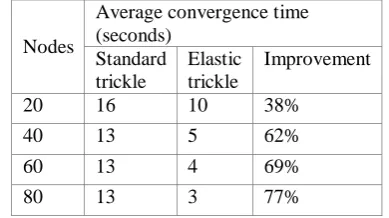
[image:4.595.308.533.196.295.2]Convergence time for STA to build DODAG is longest. Best convergence time was found using elastic algorithm with reception success (RX) measures at percentage of 100 and 80. When RX measures of 60%, 40%, 20%, are used the elastic achieves optimal power consumption. Packet Delivery Ratio (PDR) seems to perform better for the ETTA when RX values are 60%, 40% and 20%. The elastic algorithms nodes integrate with the DODAG faster by 75% when compared to standard. When the network consists ofnodes of 40, 60 or 80 the algorithm of elastic builds the DODAG quicker as shown in below Table 2.
Table 2: Average convergence time with standard and elastic trickle algorithm
Nodes
Average convergence time (seconds)
Standard trickle
Elastic trickle
Improvement
20 16 10 38%
40 13 5 62%
60 13 4 69%
80 13 3 77%
C. Adaptive timing model
Adaptive RPL (ARPL) loses less packets compared to RPL and mRPL mainly in congestion scenario. PDR improvement is a result of reduction in data and control packets. This reduction in communication overhead also saves power consumption. ARPL applieslighter and less congested multi hop routes which reduces network congestion, routing failures and increases aggregation rate which in turn reduce retransmissions. Parent changes are much higher in mRPL due to network instability. But parent changes in ARPL are much less than mRPL. ARPL has much less DIO messages than RPL and mRPLas shown in Table 3 which reduces control over it. ARPL decreases data packets and controls the DIO transmission range in line with changes in topology.
[image:4.595.328.523.476.585.2]179 Nodes Average DIOs per node
RPL A-RPL Improvement
20 25 2 92%
30 30 5 83%
D. Backpressure RPL
RPL drops many packets when burst of traffic is encountered whereas BRPL adapts to dynamic traffic pattern. The algorithm of Quicktheta sets the parameter of Ɵ during the execution time based on congestion level and uses resources to deal the burst of high packets per second (PPR). BRPL shows 4.5 times lower packet loss when compared to RPL under traffic burst and varying traffic load.
In BRPL, when network has high data traffic it uses suboptimal paths. This reduces packet loss by almost 100% but with increased latency and communication overhead. RPL has highest packet loss during high data traffic as it always chooses optimal OF path as shown in Table 4.
[image:5.595.79.256.83.146.2]BRPL supports hybrid networks as it is backward compatible with RPL. In same network BRPL supported nodes and RPL supported nodes can co-exist and are fully interoperable. The network will give less packet loss when more BRPL nodes are used.
Table 4: PLR vs PPR
PPR
PLR
RPL B-RPL Percentage points improvement
4 60% 30% 30
3 38% 18% 20
2 5% 2% 3
1 0% 0% 0
E. QOI aware DODAG construction
With result ofsensing probability of 0.9 and false alarm probability as 0.001, decision can be made that event occurs when cumulative probability of the event occurrence is greater than 0.9. Fused data can be transmitted to the data without continuing to collect the data when the cumulative probability of an event will not occur is less than 0.001. Average hop count increase with reducing PDR results in higher energy consumption and data traffic, due to loss of some DIO messages are causing it. QoI aware RPL is less impacted by the randomness compared to standard RPL.
[image:5.595.317.525.242.357.2]Increase of distance between sink and event center results in major increase of traffic by RPL as there is no data accumulation and mergeraction. Whereas QoI aware RPL forwards only aggregated data on the path to the sink reducing data traffic as shown in Table 5.
Table 5: Network overhead with increase in distance from sensor to sink
Distance (m) Packets transmitted RPL QoI RPL Improvement
100 30 10 66%
200 60 15 75%
300 85 18 78%
400 110 20 81%
F. QOS routing
QoS RPL consumes 15% less energy compared to RPL-ETX increasing network lifetime by 10%. If complete battery is exhausted by the nodes then holes will be formed in the network affecting network integrity
The time required for packet to reach from sensor to sink node is known as end to end delay. Interms of end to end delay QoS RPL does better than RPL. Even though the routing path can be longer than RPL, packets are routed on the way that meets QoS demands such as low latency. QoS RPL approximately demonstrates 40% reduction in end to end delay as shown in Table 6.
Table 6: End to end delay from sensors to sink
Node IDs End to end delay (ms) ETX QoS RPL Improvement
4 0 0 0%
8 275 190 30%
12 700 400 42%
16 260 190 26%
20 300 200 33%
G. Dynamic sink augmentation
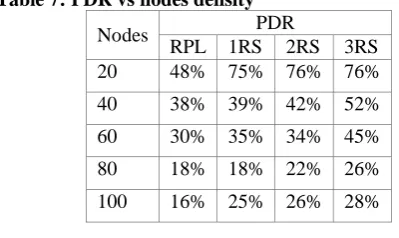
[image:5.595.59.277.361.471.2]The load of traffic is divided among the dissimilar sinks. This indicates the data packets run in unlike ways, and the collisions are less potential to occur. From the Table 7, packet loss ratio decreases up to 34%, independent of the size of network, topology and number of rescue sinks as result it gains PDR in all tested simulations. Answers reveal that deploying rescue sinks (RS), reduces the total average energy consumption, which gains the lifetime of network and attains up to 42% of gained energy.
Table 7: PDR vs nodes density
Nodes PDR
RPL 1RS 2RS 3RS 20 48% 75% 76% 76%
40 38% 39% 42% 52%
60 30% 35% 34% 45%
80 18% 18% 22% 26%
100 16% 25% 26% 28%
H. ETX vs OF0
Hop Count (HC) and Expected Transmission Count (ETX) when used as routing metrics for path selection with medium and high density networks, results show that ETX based routes perform better than HC based routes in low and medium network density. The performance was tested by using several scenarios and network parameters like physical topologies, routing metrics and network density. ETX is outperforming HC as it improves PDR as shown in Table 8 with a bit of increase in latency, power consumption and traffic overhead than HC. For large scale networks, ETX introduces higher latency than hop count.
Table 8: PDR for ETX and OF0
[image:5.595.307.507.497.616.2]180 OF0 ETX Percentage points
improvement 200 68% 80% 12
400 54% 76% 22
600 42% 70% 28
800 40% 64% 24
1000 36% 56% 20
IV. CONCLUSION AND FUTURE SCOPE
RL probe gives balance between minimal probing overhead and reacting to network changes by active probing, it handles changes to network topology caused by mobility. ETTA gives better PDR, time to converge and consumption of energy. It takes 35% lower time to converge with 20 nodes network. It takes 71% lower time to converge with 40 nodes network. It takes 70% lower time to converge with 60 nodes network. It takes 76% lower time to converge with 80 nodes network. ARPL uses aggregation on path to the sink and reduces DIO messages and data packets which results in optimized control and data traffic avoiding congestion. BPRL is compatible with RPL both type of nodes can coexist in the same network. BRPL automatically keeps switching between backpressure routing and RPL based on the conditions in the network to support mobility and high data traffic. QoI aware RPL reduces depth of DODAGs links and forms DODAG based on Quality of Information resulting in 70% reduction in power consumption. QoS RPL performs better than RPL with respect to power consumption and enhanced end to end delay. Sink rescue RPL mechanism gives a scalable and energy effective protocol that improves the execution of RPL protocol. RPL routing protocol in Smart Grid (SG) is tested in different configuration parameters and network environments using simulated and practical implementation.
Further research work is needed to improve network performance in cases, where link variations triggered by interference of external sources and dealing with asymmetric links for RL probe. Results of ETTA should be verified with long and short Imin and Imax intervals. Its results should also be verified for changes to doubling value, dynamic checking period of the neighbor and hop count in place of neighbor count. Resource fairness needs to be evaluated for DAGs coexisting in BRPL and RPL.QoS RPL needs to be tested in real time scenarios. Sink rescue RPL mechanism will not
focus on optimization and do not identify nodes with more prominent traffic load and distributing rescue sinks with behavior of mobility. RPL routing protocol in Smart Grid should be used in power line communications (PLC) technologies under new configuration and modification of basic RPL parameters to participate in standardization process of RPL in Smart Grid applications.
REFERENCES
[1] Muneer Bani Yassein, Shadi Aljawarneh, Esraa Masdeh – ―A new elastic trickle timer algorithm for IOT‖, Journal of network and computer applications, Elsevier, Jan 2017, pp.38-47
[2] Hyung Sin Kim, Jeonggil Ko, David E Culler, Jeongyeup Paek – ―Challenging the IPv6 routing protocol for low power and lossy networks (RPL): A survey‖, IEEE communications surveys & tutorials, vol 19, No 4, Oct 2017, pp 2502-2525.
[3] Emilio Ancillotti, Carlo Vallati, Raffaele Bruno, Enzo Mingozzi – ―A reinforcement learning based link quality estimation strategy for RPL and its impact on topology management‖, Computer communication journal, Aug 2017, pp.1-17.
[4] Hongliang Tian, Zhihong Qian, Xue Wang and Xiao Liang - ―QOI aware DODAG construction in RPL based event detection Wireless sensor networks‖- Journal of Sensors, Hindawi, Vol. 2017, March 2017, pp.1-9.
[5] Belghachi Mohamed and Feham Mohamed – ―QoS routing RPL for Low Power and Lossy Networks - International Journal of Distributed Sensor Networks‖, Hindawi, Vol.2015, Oct 2015, pp.1-10.
[6] Nesrine Khelifi, Emmanuel Nataf, Sharief Oteafy, Habib Youssef – ―Rescue sink-Dynamic Sink augmentation for RPL in the Internet of Things‖– Trans Emerging Tel Tech, Dec 2017, pp.1-16.
[7] Shimaa A. Abdel Hakeem, Anar A Hady and Hyungwon Kim – ―RPL routing protocol performance in Smart grid applications based wireless sensors: Experimental and Simulated analysis‖ - Electronics Journal (MDPI), Feb 2019, pp.1-23.
[8] Ainaz Bahramlou, Reza Javidan – ―Adaptive timing model for improving routing and data aggregation in internet of things networks using RPL‖, IET journals, Jan 2018, pp.1-7.
[9] Yad Tahir, Shusen Yang, and Julie Mccann -―BPRL: Backpressure RPL for high- throughput and Mobile IOT’s‖, IEEE Transactions on mobile Computing, 2016, pp.1-14.