295
Image Compression Using Type-2 Fuzzy Vector
Quantization with Biometric Images
A.Ananda Gopi
Assistant Professor
Department of Computer Applications Ayya Nadar Janaki Ammal College
Sivakasi
Abstract- Today information technology has been emerged and entered into each and every field of information processing system. Instead of text or character processing, image processing has a rapid growth in present scenario. Digital image processing has been a growing and dynamic field for more than a decade. Image compression is a technique which is introduced for reducing the occupancy of the storage. Now a days with all the improved technologies the image pixels are too high and the image is of high resolution and so it requires more space for storage. Due to this reason image compression is applied to the images and thereby we can reduce the storage space and can store with more images. The main purpose of compression is to reduce the size of the image without any loss in its quality. The proposed system focused on compression of the given biometric images, With median filter for pre-processing and then compress the images based on type-2 fuzzy vector quantization algorithm. This compression algorithm is also applied for decompression. Finally, the Peak Signal to Noise Ratio (PSNR) and Mean Square Error (MSE), are computed and the proposed work is compared with the existing method.
Keywords: Lossless compression, Lossy Compression, Vector Quantization, Wavelet transform .
I. INTRODUCTION
Image compression as a specialized discipline of electronic engineering has been gaining considerable attention on account of its applicability to various fields. Compressed image transmission economizes bandwidth and therefore, ensures cost effectiveness during transmission.[1]. Image compression addresses the problem of reducing the amount of data required t represent a digital image. It is a process intended to yield a compact representation of an image, thereby reducing the image storage/transmission requirements. Compression is achieved by the removal of one or more of the three basic type of data redundancies:
1. Coding Redundancy 2. Interpixel Redundancy 3. Psychovisual Redundancy
Coding redundancy is present when less than optimal code words are used. Interpixel redundancy results from correlations between the pixels of an image. Psychovisual redundancy is due to data that is ignored by the human visual system (i.e. visually superfluous information)[2].
Image compression can be accomplished in two categories lossy or lossless. Lossless compression is sometimes preferred for artificial images such as technical drawings, icons or comics. This is
because lossy compression methods, especially when used at low bit rates, introduce compression artifacts. Lossless compression methods may also be preferred for high value content, such as medical imagery or image scans made for archival purposes. Lossy methods are especially suitable for natural images such as photos in applications where minor loss of fidelity is acceptable to achieve a substantial reduction in bit rate. The lossy compression that produces imperceptible differences can be called visually lossless. Run-length encoding and entropy encoding are the methods for lossless image compression. Transform coding, where a Fourier-related transform such as DCT or the wavelet transform are applied, followed by quantization and entropy coding can be cited as a method for lossy image compression.
Available online at www.ijrat.org
296 decoder is noise free, the channel encoder and
decoder are omitted, and the general encoder and decoder is noise free, the channel encoder and decoder are omitted, and the general encoder and decoder become the source encoder and decoder, respectively.[3]
Fig 1 : General Compression Models
II. REVIEW OF LITERATURE
Tushar Jadhav et al., Introduced thee
mean removed and Multistage Vector quantization In wavelet domain. The mean removed vector quantization is a modified or advanced version of the scheme. Multistage vector quantization reduces storage and computational complexity as the size of codebook reduces. [5].
Gurjar et al., introduced medical image compression using wavelets and vector quantization for telemedicine application. Analyzing and Implementing wavelet transform in lossless compression, a new method of combining vector quantization with wavelet transform to compresss medical images [6].
Sivakumar et al, introduced the vector quantization based Image compression. First up all three level DWT applied into the image then Vector quantization is also applied. It gives the better compression ratio and PSNR values [7].
Jibanananda Mishra et al, proposed an intelligent method based medical image compression. Apply subband decomposition using wavelet transform then use vector quantization application.Codebook formation using SOFM, is a neural network concept. Then apply mapping and transmission of index vector with code vector. Finally arranging the subband in proper order. The image construct from compressed into uncompressed image.[8]
Prarthana Bhattacharya et al., developed Vector quantization based Image Compression using Generalized improved Fuzzy Clustering. This technique does not depend on codebook initialization, and is easy to implement[9].
III. IMAGE COMPRESSION METHODS
A ) Lossless Image Compression :
Lossless Compression System aims at reducing the bit rate of the comp ressed output without any distortion of the image. The bit-stream
after decompression is identical to the original bit stream. Lossless compression compresses the image by encoding all the information from the original file, so when the image is decompressed, it will be exactly identical to the original image.
B) Lossy Image Compression :
Lossy compression as the name implies leads to loss of some information. The compressed image is similar to the original uncompressed image but not just like the previous as in the process of compression some information concerning the image has been lost. They are typically suited to images. The most common example of lossy compression is JPEG. An algorithm that restores the presentation to be the same as the original image is known as lossy techniques. Reconstruction of the image is an approximation of the original image, therefore the need of measuring of the quality of the image for lossy compression technique. Lossy compression technique provides a higher compression ratio than lossless compression.[4]
IV. TYPE-2 FUZZY VECTOR QUANTIZATION
The given image is partitioned into a set of non-overlapping image blocks X={ x1,x2,…xm-1} of size 4 x 4 pixels.The uncertainty typically associated with clustering tasks is formulated in this approach by allowing the assignment of each training vector to multiple clusters for designing codebook.
A training vector assignment strategy is also proposed for the transition from the fuzzy mode, where each training vector can be assigned to multiple clusters, to the crisp mode, where each training vector can be assigned to only one cluster. Such a strategy reduces the dependence of the resulting codebook on the random initial codebook selection.
After fixing the rate and dimension, to compute the number of code vectors in the codebook.The code vectors are determining by the centroid method.Mapping of the input vector into the code vector using Type-2 Fuzzy .The input vector is adjusted so as to fall into one of the nearest code vectors.The indices corresponding to the code vectors are transmitted.
Finally the reconstruction of the image from the transmitted indices this is done by the defuzzification phase.Finally get the compressed image. Then doing the reverse process then gets the reconstruction of the image.
297 Fig 2: Block diagram of methodology
V. RESULTS AND DISCUSSION Algorithm :
Input Image : Preprocessed Image Output Image : Compressed Image
Step 1 : Start
Step 2 : Select an Input Biometric Image
Step 3 : Preprocess the Image by the Following
1.Noise elimination using Median filter
2.Estimate MSE and PSNR
Step 4 : Apply type-2 Fuzzy Vector quantization
method for preprocessed image for Compressing the biometric image.
Step 5 :: Estimates MSE and PSNR.
Step 6: Repeat the Step 2 to 5 for all biometric
images Step 7 : End
Fig 3: Sample Images
[image:3.595.338.575.65.634.2]
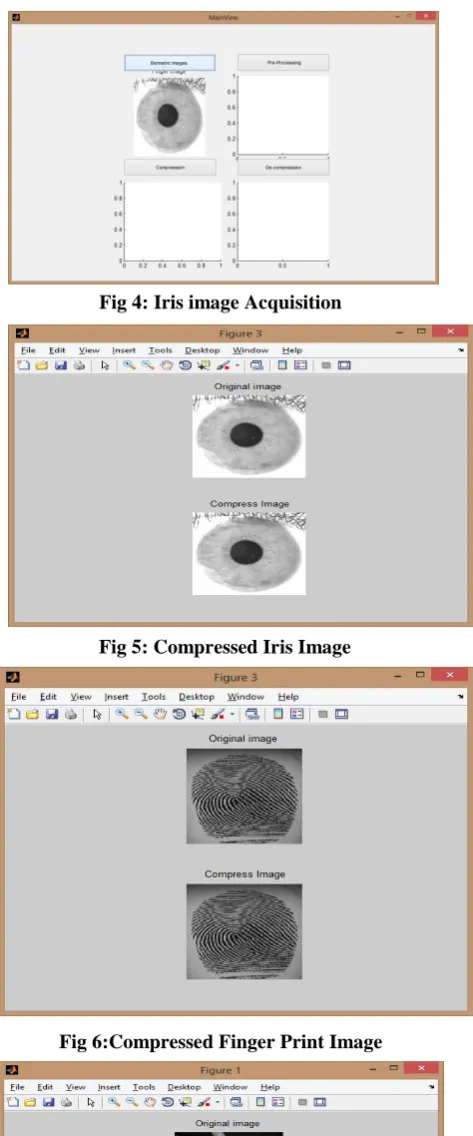
Fig 4: Iris image Acquisition
Fig 5: Compressed Iris Image
[image:3.595.72.262.70.275.2]
Fig 6:Compressed Finger Print Image
[image:3.595.334.566.395.755.2]Available online at www.ijrat.org
298 The experimented values of the Iris image compression
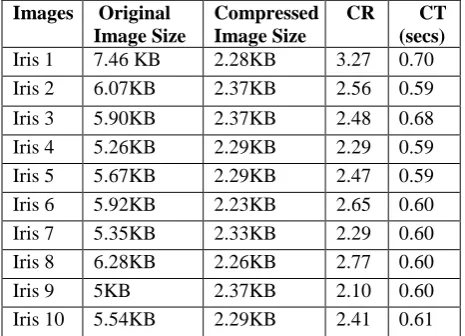
with the proposed model original image size, compressed image size, Compression Ratio (CR), Compression Time (CT), PSNR and MSE values are tabulated in the following tables 4.1 and 4.2.
Images Original Image Size
Compressed Image Size
CR
CT (secs) Iris 1 7.46 KB 2.28KB 3.27 0.70 Iris 2 6.07KB 2.37KB 2.56 0.59
Iris 3 5.90KB 2.37KB 2.48 0.68 Iris 4 5.26KB 2.29KB 2.29 0.59
Iris 5 5.67KB 2.29KB 2.47 0.59 Iris 6 5.92KB 2.23KB 2.65 0.60
Iris 7 5.35KB 2.33KB 2.29 0.60 Iris 8 6.28KB 2.26KB 2.77 0.60
Iris 9 5KB 2.37KB 2.10 0.60
Iris 10 5.54KB 2.29KB 2.41 0.61
Table 4.1 Performance measures of Iris Image Compression
[image:4.595.317.569.72.276.2]Table 4.2 PSNR and MSE values of Iris
The PSNR values are represented in db(decibel) values.The experimented values of the Finger Print image compression with the proposed model original image size, Compressed image size, Compression Ratio(CR), Compression Time(CT) , PSNR and MSE values are tabulated in the following tables.
Images Original Image Size
Compressed Image Size
CR
CT (secs)
Finger 1 12 KB 3.74 KB 3.21 0.61
Finger 2 12.2 KB 3.32 KB 3.67 0.62
Finger 3 13.2 KB 3.61 KB 3.66 0.62
Finger 4 11.5 KB 3.45 KB 3.33 0.63
Finger 5 11.9 KB 4.45KB 2.67 0.63
Finger 6 10.9 KB 2.94 KB 3.71 0.63
Finger 7 14.7 KB 4.61 KB 3.19 0.62
Finger 8 10.7 KB 2.82 KB 3.79 0.63
Finger 9 11.1 KB 3.85 KB 2.88 0.62
[image:4.595.44.277.153.321.2]Finger 10 11.4 KB 3.80 KB 3.0 0.62
Table 4.3 Performance measures of Finger Print Image Compression
Table 4.4 PSNR & MSE values for
Finger Print Image compressionThe experimented values of the Finger Print image compression with the proposed model original image size, Compressed image size, Compression Ratio(CR), Compression Time(CT), PSNR and MSE values are tabulated in the following tables.
Image
Compression
PSNR(db) MSE
Iris 1 28.10 0.00154
Iris 2 27.78 0.00167
Iris 3 27.45 0.00179
Iris 4 29.64 0.00108
Iris 5 29.78 0.00105
Iris 6 29.83 0.00103
Iris 7 28.02 0.00157
Iris 8 28.91 0.00128
Iris 9 27.94 0.00160
Iris 10 29.18 0.00120
Image
Compression
PSNR MSE Finger 1 30.5717 0.00047
Finger 2 31.3722 0.00039
Finger 3 32.1561 0.00032
Finger 4 31.3370 0.00041
Finger 5 31.4366 0.00038
Finger 6 30.7232 0.00052
Finger 7 29.7918 0.00063
Finger 8 29..8170 0.00062
Finger 9 31.8096 0.00066
299 Table 4.5 Performance measures of Palm Print Image
Compression
Image
Compression
PSNR MSE
Palm 1 30.2470 0.00057
Palm 2 30.5877 0.00055
Palm 3 30.44337 0.00057
Palm 4 28.6682 0.00104
Palm 5 28.7141 0.00104
Table 4.6 PSNR & MSE values for Palm Print Imag
e
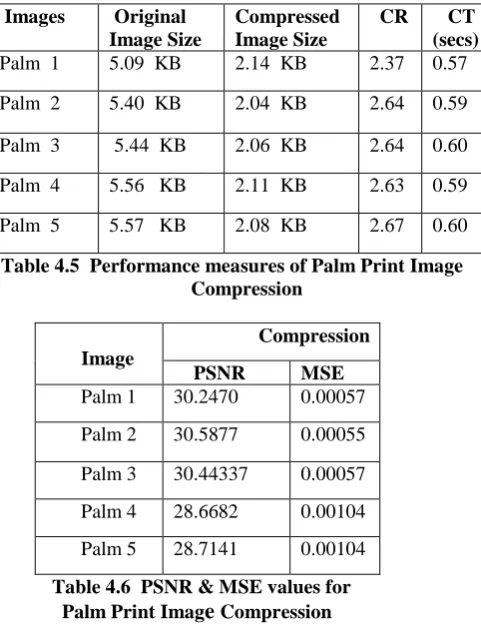
CompressionFrom the above tables 4.2, 4.4, 4.6 gives the PSNR and MSE values for compression of Iris, Finger print and Palm Print images. There is small difference between both compression and decompression PSNR and MSE values. The proposed method, gives the better and efficient values for compression process.
VI. CONCLUSION
The proposed work of compression is an efficient idea that is been implemented. Here, the proposed algorithm for both compression and decompression. Here reducing the space occupancy of the stored biometric images without any reduction in its quality and its resolution of the image. And hence with this any number of biometric images can be stored for security verification purpose. The compatibilities among adjacent patches are enforced both locally and globally. A new compression algorithm adapted to fingerprint images, iris images and palm images is introduced. Despite the simplicity of the proposed algorithms they compare favorably with existing more effective, especially at high compression ratios. The
Performance analysis is done by calculating the PSNR value.Peak Signal To Noise Ratio PSNR is an approximation to human perception of reconstruction quality. It is calculated based on the Mean Square Error (MSE).PSNR value is high for enhanced Image.
REFERENCES
[1] Jayavrinda Vrindavanam, Saravanan Chandran, and Gautam Mahanti K, “ A Survey of Image Compression Methods”, International Conference & Workshop on
Recent Trends in Technology, (TCET) 2012, pp 12-17.
[2] Abdul Kader Nihal, K.N., and Mohamed Shanavas, A.R., “A Survey and Study of Image Compression Methods”, IOSR Journal of Computer Engineering(IOSR-JCE), Vol.16, Issue 4, Aug-2014,pp.11-16.
[3] Gaganpreet Kaur and Sandeep Kaur , “Comparative Analysis of Various Digital Image Compression Techniques”, International Journal of Advanced Research in Computer Science and Software Engineering , Vol.3. Issue.4. April 2013.
[4] Neelam, Ashu Bansal, “Image Compression a learning approach : Survey” , International Journal of Computer Science Trends and Technology (IJCST) – Vol. 2 Issue 4, Jul-Aug 2014, pp 60 – 66.
[5] Tushar Jadhav, Manorama Patil, Yogesh Dandawate, “Image Compression using Mean Removed and Multistage Vector Quantization In Wavelet Domain”, International Journal of Modern Trends in Engineering and Research, July 2015, pp 1299 – 1306.
[6] Gurjar, A.A., and Korde, N.S., “Medical Image Compression Using Wavelets and Vector Quantization For Telemedicine Application”, IOSR Journal of Electronics and Communication Engineering(IOSR-JECE), Vol.9, Issue 2, Apr 2014, pp. 76-81.
[7] Sivakumar, P., and Ravi, S., “Vector Quantization Based Compression”, International Journal of Innovative Technology and Exploring Engineering(IJITEE), Vol.1, Issue 1, June 2012, pp. 89 – 94.
[8] Jibanananda Mishra, Soumya Ranjan Parida, Mohanty, M.N., and Ranjan Kumar Jena, “An Intelligent Method Based Medical Image Compression”, International Journal of Computer & Communication Technology(IJCCT), Vol.2, Issue VI, 2011, pp. 43 – 48.
[9] Prarthana Bhattacharyya , Aritra Mitra and Amitava Chatterjee, “ Vector Quantization based Image Compression using Generalized improved Fuzzy Clustering”, International Conference on Control, Instrumentation, Energy & Communication(CIEC), 2014,pp.662-666.
[10] Gopi, K., and Rama Shri, T., “Medical Image Compression Using Wavelets”, IOSR Journal of VLSI and Signal Processing (IOSR-JVSP)Vol. 2, Issue 4 (May. – Jun. 2013), PP 01-06 e-ISSN: 2319 – 4200, p-ISSN No. : 2319 – 4197.
[11] Mukesh Mittal, and Ruchika Lamba,, “Image Compression Using Vector Quantization Images Original
Image Size Compressed Image Size CR CT (secs) Palm 1 5.09 KB 2.14 KB 2.37 0.57
Palm 2 5.40 KB 2.04 KB 2.64 0.59
Palm 3 5.44 KB 2.06 KB 2.64 0.60
Palm 4 5.56 KB 2.11 KB 2.63 0.59
Available online at www.ijrat.org
300 Algorithms: A Review”, International Journal
of Advanced Research in Computer Science and Software Engineering 3(6), June - 2013, pp. 354-358.
[12] Amir Asif and Jose, “Image Coded by Noncousal Prediction , Residual, Mean-Removed and Cascaded Vector Quantization”, IEEE Transactions on Circuits and Systems for Video Technology, Vol.6, No.1,Feb-1996.
[13] Jyoti Singhai et al., “MSVQ : A Data Compression Technique for Multimedia Application”, Journal of Scientific an Industrial Research , Vol.65, Dec 2006, pp.982-985.
[14] S.Esakkirajan et al., “Image compression Using Adaptive Wavelet Packet and Multistage Vector Quantization”, IEEE Region 10 Colloquium and the Third ICIIS, Kharagpur, India, Dec 2008,No.306.