Processing Unknown Words in HPSG
Petra Barg and Markus Walther*
S e m i n a r ftir A l l g e m e i n e S p r a c h w i s s e n s c h a f t Heinrich~Heine-Universit~it Dfisseldorf Universit:dtsstr. 1, D-40225 Dtisseldorf, G e r m a n y
{barg, walther}@ling.uni-.duesseldorf, de
Abstract
The lexical acquisition system presented in this pa- per increlnenlally updates linguistic properties of un- known words inferred lrom their surrounding con- lexI by parsing senlences wilh an liPSG gramnmr for Gerlmm. We employ a gradual, infornmtion- based concept of "tlnknowntless" providing a uni- form treatment for the range oi completely known to maximally unknown lexical entries. "Unknown" in- formation is viewed as revisable inR)rmation, which is either generalizable or specializable. Updating takes place after parsing, which only requires a mod- ified lexical lookup. Revisable pieces of informa- lion are idenlilied by grammar-specilied declaralions which provide access pmhs into lhe parse feature slructure. The updating nlechanism revises the c o l responding places in the lexical lcalure stmclures iff the conlext actually provides new information. For revising generalizable inlbrmalioi< (ype union is re- quired. A worked-out example demonstrates the in- Iercntial capacily of our implemented system.
1 Introduction
It is a ,emarkable fact thai humans can often un- derstand sentences containing unknown words, in- let their grammatical properties and incrementally refine hypotheses aboul these words when encoun- tering laler instances. In conlrasl, many current NLP systems still prestlppose a complele lexicon. Notable exceptions include Zernik (1989), Erbach (199()), Hastings & Lylinen (1994). See Zernik lot an intro- duction to the general issues involved.
11fis paper describes an HPSG-based system which can incrementally learn and reline proper- lies of unknown words after parsing individual sen-
*This work was tan'ted out within the ,S'onde@)rschungs- bereich 282 '77worie des Lexikol~s' (project B3), funded by the German Federal Research Agency DFG. We thank James Kil- bury and lnembers of the B3 group for fruitful discussion.
tences. It focusses oll extracting linguislic proper- ties, as compared to e.g. general concept learning (Hahn, Klenner & Schnatiinger 1996). Unlike Er- bach (1990), however, it is not conlined to siul- pie morpho-synlactic information but can also han- (lie selectional reslriciions, senianlic types and argu- ment slructure. Finally, while statistical approaches like Brenl (1991) can gather e.g. valence inloruia- lion lioni large corpora, we rote more interested in full gralmnatical processing of individual sentences to maximally exploil each context.
The following three goals serve to struclure our model. It should i) incorporate a gradual,
informalion-based conceptualization of "unknown- ness". Words are not u n k n o w n as a whole, but may contain ux~k~mw~t, i.e. revisable pieces of b(for- ,la*iom Consequently, even known words can un- der(,o> revision 1o e.>.<) acquire new senses. This view replaces the binm-y distinclion belween open and closed class wordx. 1l should it) maxinmlly exph)il lhe rich represeniaiions and nlodelling convenlions of IiPSG and associaled formalisnls, wiih essen- iially the same grammar anti lexicon as compared (o closed-lexicon approaches. This is important bolh lo facilitate reuse of existing grammars and li) en- able meaningful feedback for linguistic theorizing. Finally, it should iii) possess donlain-independenl in- ference and lexicon-updating capabililies. The gram- mar writer must be able to fully d e c l a e which pieces of inlbrmalion are open to revision.
The system was implemenled using MicroCUF, a simplilied version of the CUF typed unification lormalisin (D6rre & Dorna 1993) thai we imple- mented in SICStus Prolog. It shares both the feature logic and the definite clause extensions with ils big brother, but substitutes a closed-world type system li)r CUF's open-world regime. A fealure of our lype system impletnenlation lhaI will be signilicant later on is (hat type infornmtion in internal IEalure sittic-
tures (FSs) can be easily updated.
The HPSG grammar developed with MicroCUF models a fragment of German. Since our focus is on the lexicon, the range of syntactic variation treated is currently limited to simplex sentences with canon- ical word order. We have incorporated some recent developments of HPSG, esp. the revisions of Pol- lard & Sag (1994, ch. 9), Manning & Sag (1995)'s proposal for an independent level of argument struc- ture and Bouma (1997)'s use of argument structure to eliminate procedural lexical rules in *:avour of re- lational constraints. Our elaborate ontology of se- mantic types - useful for non-trivial acquisition of selectional restrictions and nominal sorts - was de- rived from a systematic corpus study of a biological domain (Knodel 1980, 154-188). The grammar also covers all valence classes encountered in the corpus. As for the lexicon format, we currently list full forms only. Clearly, a morphology component would sup- ply more contextual information from known affixes but would still require the processing of unknown stems.
2 I n c r e m e n t a l L e x i c a l A c q u i s i t i o n
When compared to a previous instance, a new sen- tential context can supply either identical, more spe- cial, more general, or even conllicting inIormation along a given dimension. Example pairs illustrating the latter three relationships are given under (1)-(3) (words assumed to be unknown in bold face).
(1) a. hn Axon tritt ein Ruhepotential auf. 'a rest potential occurs in the axon'
b. Das Potential wandert tiber das Axon. 'the potential travels along the axon'
(2) a. Das Ohr reagiert auf akuslische Reize. 'the ear reacts to acoustic stimuli'
b. Ein Sinnesorgan reagiert auf Reize. 'a sense organ reacts to stimuli'
a. Die Nase ist ftir Gertiche sensibel.
'the nose is sensitive to smells'
b. Die sensible Nase reagiert auf Gertiche. 'the sensitive nose reacts to smells'
(3)
In contrast to (la), which provides the inff)rmation that the gender of Axon is not feminine (via ira), the context in (lb) is more specialized, assigning neuter gender (via das). Conversely, (2b) differs from (2a) in providing a more general selectional restriction for the subject of reagiert, since sense organs include
ears as a subtype. Finally, the adjective sensibel is used predicatively in (3a), but attributively in (3b). The usage types must be formally disjoint, because some German adjectives allow for just one usage
(ehemalig 'former, attr.', schuld 'guilty, pred.'). On the basis of contrasts like those in (1)-(3) it makes sense to statically assign revisable informa- tion to one of two classes, namely specializable or
generalizable, l Apart from the specializable kinds 'semantic type of nouns' and 'gender', the inllec- tional class of nouns is another candidate (given a morphological component). Generalizable kinds of information include 'selectional restrictions of verbs and adjectives', 'predicative vs attributive usage of adjectives' as well as 'case and lbrm of PP argu- ments' and 'valence class of verbs'. Note that spe- cializable and generalizable inlbrmation can cooccur in a given lexical entry. A particular kind of intbrma- tion may also figure in both classes, as e.g. seman- tic type of nouns and selectional restrictions of verbs are both drawn from the same semantic ontology. Yet the former must be invariantly specialized- indepen- dent of the order in which contexts are processed -, whereas selectional restrictions on NP complemenls should only become more general with further con- texts.
2.1 Representation
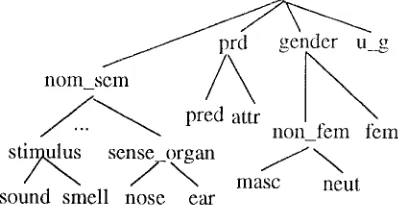
We require all revisable or updateable information to be expressible as formal types. 2 As relational clauses can be defined to map types to FSs, this is not much of a restriction in practice. Figure 1 shows a rele- vant fragment. Whereas the combination of special-
/ ~ S r d geI~der u_g
nom seln / ~ I ~
~ . . . ~ - pred attXr !
_ _ _ _ n o n
masc neut
sound smell nose ear
Figure 1: Excerpt from t)7)e hierarchy
izable information translates into simple type unifi- cation (e.g. nora_fern A ~,eut = rteut), combining
1The different behaviour underlying this classification has previously been noted by e.g. Erbach (1990) and Hastings & Lytinen (1994) hut received either no implementational status o1' no systematic association with arbitrary kinds of information.
[image:2.612.324.523.501.604.2]~:eeneralizable inlormalion requires 0'Pe union (e.~,,.
pred V (Lttr = prd). qqle latter might pose problems tot type systems requiring the explicit delinition el all possible unions, corresponding to least common supertypes. However, type union is easy lot (Mi- cro)CUF and similm: systems which allow for arbi- trary boolean combinations of types. Generalizable inlormation exhibits another peculiarity: we need a disjoint auxiliary type u_g Io colTectly mark the initial unknown inlormalion slate. 3 This is because 'content' types like prd, pred, atlr are to be inter- preted as recording whal contextual information was encountered in the past. Thus, using any of lhese to prespecify the initial value--, either as the side-effect of a feature appropriateness declaration (e.g. prd) or through gramlnar-conlrolled specification (e.g. pred, attr) -- would be wrong (of. prdi,,ti, l V al:l,r == prd,
b u t tt-.(,lir~iti,l V aLl, r" : : lt_.q V a,l,l,r).
Generalizable inlormalion evokes another ques- lion: can we simply have types like those in fig. 1 within HPSG signs and do in-place type union, just like type unification? The answer is no, li)r essen- tially two reasons. First, we slill want to rule out ungran]malicaI constructions through (type) unifica- lion failure of coindexed wdues, so lhat generalizable types cannot always be combined by nonfailing type union (e.g. *tier sensible Geruch 'the sensitive smell'
must be ruled out via
,~c'n:~,:_org.';~ A a m c l l - - Z.). We would ideally like to order all type tmilicalions pertaining Io a value before all unions, but this vi- olates the order independence of constraint solv- ing. Secondly, we already know that a given inlbr- mational token can ,vimulta~wously be generalizable and specializable, e.g. by being coindexed through HPSG's valence principle, tlowever, silnullaneous in-place union and unilication is conlradiclory.To avoid these problems and keep the declarative monotonic setting, we employ two independent fea- tures gen and ctxt. ctxt is the repository of contex- tually unified inlbrmation, where conllicts result in ungrammalicality, gen holds generalizable informa- tion. Since all gen values contain u_g as a type dis- junct, they are always unifiable and lhus not restric- live during the parse. To nevertheless get correct gen values we perform type union after parsing, i.e. dur- ing lexicon update. We will see below how this works out.
3Actually, the situatkm is more symmetrical, as we need a dual type uor t(} con'ectly m a r k " u n k n o w n " sT)ecializable infl)r- marion. This In'events incon'cct updating i~t k n o w n inforlmition. ltowever, uov is tlnllccessaly li~i' the examples presented below.
ql~e last representalional issue is how to identify revisable infornlation in (subslrnctures el) tile parse FS. D)r this purpose lhe grammar delines revisabilily clauses like the following:
(4) a. generalizable([j], [23) :=
g e n
s> omllooloa, lhead
[ot×,
b. specializable(W):=
[cat lhead noun ]]
[synseml
OC[centlind J gend[~J]
2.2 Processing
The firsl step in processing sentences wflh unknown or revisable words consists of conventional parsing. Any HPSG-compalible parser may be used, subject to the obvious requiren]ent that lexical lookup must not lail
if
a word's phonology is unknown. A canon- ical entry for such unknowil words is delined as lhe disjunction of maximally underspecilied generic lex- ical entries for nottns, adjectives anti verbs.The actual updating of lexical enlries consists of lout major steps. Step 1 projects the parse FS derived from the whole sentence onto all parlicipaling word lokens. This resulls in word FSs which are conlexlu- ally enriched (as compared to their original lexicon state) and disambiguated (choosing the compatible disjuncl per parse solution if the entry was disjunc- tive). It then filters the set of word FSs by unification with the right-hand side of revisability chmses like in (4). The oulput of step 1 is a list of update candidates for those words which were unifiable.
Slop 2 determines concrete update values lor each word: for each matching generalizable chmse we lake the type tmion oflhe gen value of the old, lexical state of the word (Lca:Cc~ 0 with lhe ctxt value of its parse projection (Ctzt): 5l'17 = Lcz(;eTzuCt:c~. For each matching specializabIe(Spec) chmse we take the parse value Spec.
Step 3 checks whether updating would make a dif- ference w.r.t, the original lexical entry of each word. The condition to bc met by generalizable information is that 7'U D L :xGeu, lot specializal~le inlormation we similaly require Spec C l, exSpcc.
tion according to the values determined in step 2, at the places in a word FS pointed to by the revis- ability clauses. Tiffs is easy in MicroCUE as types are implemented via the attributed variable mecha- nism of SICStus Prolog, wlffch allows us to substi- tute the type in-place. In comparison, general updat- ing of Prolog-encoded FSs would typically require the traversal of large structures and be dangerous if structure-sharing between substituted and unaffected p',u-ts existed. Also note that we currently assume DNF-expanded entries, so that updates work on the contextually selected disjunct, qTtis can be motivated by the advantages of working with presolved struc- tures at run-time, avoiding description-level opera- tions and incremental grammar recompilation.
2.3 A Worked-Out Example
We will illustrate how incremental lexical revision works by going through the examples under (5)-(7).
(5) Die Nase ist ein Sinnesorgan. 'the nose is a sense organ'
(6) Das Ohr perzipiert. 'the ear perceives'
(7) Eine verschnupfte Nase perzipiert den Gestank.
'a bunged up nose perceives the stench'
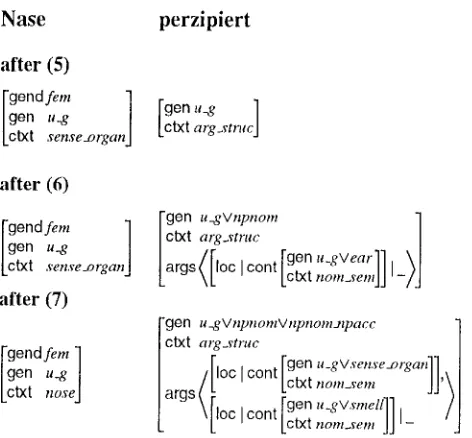
The relevant substructures corresponding to the lex- ical FSs of the unknown noun and verb involved are depicted in fig. 2. The leading feature paths
synsemlloc[eont for Nase and synsemlloclcatlarg-st
for perzipiert have been onfftted.
Afler parsing (5) the gender of the unknown noun
Nase is instantiated to fern by agreement with the determiner die. As the special&able clause (4b) matches and the gend parse value differs from its lexical value gender, gender is updated to fern. Fur- thermore, the object's semantic type has percolated to the subject ]Vase. Since the object's sense~grgan
type differs from generic initial nora_rein, Nase's ctxt value is updated as well. In place of the still nonex- isting entry for perzipiert, we have displayed the rel- evant part of the generic unknown verb entry.
Having parsed (6) the system then knows thai
perzipiert can be used intransitively with a nomi- native subject referring to ears. Formally, an HPSG mapping principle was successful in mediating be- tween surface subject and complement lists and the argument list. Argument list instantiations are them- selves related to corresponding types by a further
Nase
after (5)
gendfem ]
gen u.g [
ctxt sense~organJ
perzipiert
ctxt arg~rtntcJ
after (6)
gend/em ]
gen u..g I ctxt sense~grgan[
alter (7)
gend fern ] gen u_g / ctxt
noseJ
gen
u~,Vnpnom
I]
ctxt
arg.vtrue
.rg../[,oo I cont [ gen
It-gVear]] 1_
\ L L taxt n°m"renuJgen
l,t_gVttpnornVnpnom~lpacc
1
ctxt
arg_rtruc
I
r, , . r g e n u_gVsense~vrgan]] I
/[,oo loom [ot~t.,o,,,_~.,
JJ'\/
args
I \[Ioccont rgenu-gvs'ellTl'
/)|
[image:4.612.311.547.77.296.2]L
L
[~t~t,,o.,_,~,,, JJ I_
J
Figure 2: Updates on Iexical FSs
mapping. On the basis of tiffs type classification of argument structure patterns, the parse derived the
clxt value npnom. Since gen values are generaliz- able, this new value is unioned with the old lexi- cal gen value. Note that ctxt is properly unaffected. The first (subject) element on the args list itself is targeted by another revisability clause. Tiffs has the side-effect of further instantiating the underspecified lexical FS. Since selectional restrictions on nominal subjects must become more general with new con- textual evidence, the union of ear and the old value
u_g is indeed appropriate.
Sentence (7) first of all provides more specific evi- dence about the semantic type of partially known
3 D i s c u s s i o n
The inccemenlal lexical acquisition approach de- scribed above attains the goals stated earlier. It re- alizes a gradual, infornmtion-based conceptualiza~ lion of unknownness by providing updateable lbrmal types - classilied as either generalieable or special- <able - logelher with grammar-delined revisability clauses, it maximally exploits standard HPSG r e d resenlalions, requiring moderate rearrangements in grammars at best wtfile keeping with the standard
assumptions of typed unification formalisms. One noteworlhy demand, however, is the need for a type union operation. Parsing is conventional modulo a modilied lexical lookup. The actual lexical revision is done in a domain-independent poslprocessing step guided by lhe revisability clauses.
Of course Ihere are areas requiring furlher consid- eration. In conlrasl to humans, who seem to leap to conclusions based on incomplete evidence, our ap- proach employs a conservalive form of generaliza- lion, taking file disjunction of actually observed val- ties only. While this has the advantage of not leading lo overgeneralization, lhc requirement of having to encounter all subtypes in order lo infer their con> men superlype is not realistic (sparse-da|a problem). In
(2)
se~zse_orgatt as lhe senlanlic type of lhe tirsl argument olperzil)iert is only acquired because tile siulplilied hierarchy in lig. l has ~to.s'e and ear as its only subtypes. Here lhe work of Li & Abe (1995) who use the MDL principle to generalize over the slots of observed case frames nfight prove li-uitful.An important question is how to administrate allernative parses and lheir update hypotlteses. In
Dax Aktiot~Sl)Oterttial erreicht del~ l)ettdt'itelt 'the aclion polenlial reaches lhe dendrite(s)', l)endriten
i s ' alnblguous between acc.sg, and dat.pl., giving '
rise to lwo wtlence bYt)olheses Itpzlomotpacc anti tqmomatpdat for errz'.ic:ht. Details relnain to be worked out on how to delay the choice between such alternative hypoll~eses until flmher contexts provide enough inforulation.
Another topic concerns the treatment of 'cooc- currence reslriclions'. In lig. 2 llle system has in- depettdetttly generalized over the selectional reslric- lions for subject and object, yet there are clear cases
where this overgenerales (e.g. *Das Ohr perzipiert de~ Ge.rtcmk 'the ear perceives the stench'). An idea worth exploring is to have a partial, extensible list of lype reoccurrences, which is traversed by a recursive principle at parse lime.
A molc gcnct-al
issue is the
al)parenlantagonism
between the desire 1o have both sharp grammatical predictions and continuing openness to contextual revision. If after parsing (7) we transler the fact that smells are acceptable objects toper~ipiert into tile re- stricting ctxt feature, a later usage with an objecl of type sound fails. The opposite case concerns newly
acquired specializable values. If in a later context these are used to update a 9en value, tile result may be too general. It is a topic of future research when to consider inR~rmation oct-lain and when to make re- visable information restrictive.
R e f e r e n c e s
Bouma, G. (1997). Valmme Alternation without LexL cal Rules. in: Papers from the seventh CLIN Meet- ing 1996, Emdhoven, 25-40.
Brent, M. R. (1991). Automatic Acquisilion of Subcat- egorization Fr~unes From Untagged Text. in: Pro-
ceedings of 29th ACL, Berkeley, 209-214. Dt~rre, J. & M. Doma (1993). C U F - A Formalism for
Linguistic Knowledge Representation. In: J. D(~rre tEd.), Computational A.v~ects of Constraint-llased Linguistic Description. IMS, Universit~it Stuttgart. Deliverable R 1.2.A, DYANA-2 - ESPRIT Project 6852.
Erbach, G. (1990). Syntactic Processing of Un- known Words. IWBS Report 131, Institute for Knowledge-Based Systems (IWBS), IBM S tuttg~ut.
Hahn, U., M. Klenner & K. Schnattinger (1996). Learning from Texts - A Terminological Meta- Reasoning Perspective. In: S. Wennter, E. Riloff & G. Scheler tEd.), Connectiotzist, Statistical, and Symbolic Approaches to Learning.for Natural Lazz- guage Processing, 453-468. Berlin: Springer. Hastings, E M. & S. L. Lytinen (1994). The Ups ~md
Downs of Lexical Acquisition. in: Ptv¢'eediltgs oJ' AAAI'94, 754-759.
Knodel, ft. (1980). Linder Biologie - Lehrbuch fiir die Oberstufe. Stuttgart: J.13. Metzlersche Verlags- buchhandlung.
Li, H. & N. Abe (1995).
Generalizing
C~tse Fr~unes Us- ing a ~lllesaurus ;rod the MDL Principle. in: Pro-ceedings qf Recent Advantages in Natural Lan- guage Processing, Velingrad, Bulgaria, 239-248. Manning, C. & I. Sag (1995). Dissociations between
argument structure and grammatical relations. Ms., Stanford University.
Pollard, C. & l. Sag (1994). Head-Driven Phrase Slructure Grammar. Chicago University Press. Zemik, U. (1989). Paradigms in Lexical Acquisition.