Learning Correlations between Linguistic Indicators and Semantic
Constraints:
Reuse of C o n t e x t - D e p e n d e n t Descriptions of Entities
D r a g o m i r R. R a d e v
D e p a r t m e n t of C o m p u t e r Science C o l u m b i a U n i v e r s i t y N e w York, N Y 10027 r a d e v @ c s . c o l u m b i a . e d u
A b s t r a c t
This paper presents the results of a s t u d y on the semantic constraints imposed on lexical choice by certain contextual indicators. We show how such indicators are c o m p u t e d and how correla- tions between them and the choice of a noun phrase description of a named entity can be au- tomatically established using supervised learn- ing. Based on this correlation, we have devel- oped a technique for a u t o m a t i c lexical choice of descriptions of entities in text generation. We discuss the underlying relationship between the pragmatics of choosing an appropriate descrip- tion that serves a specific purpose in the auto- matically generated text and the semantics of the description itself. We present our work in the framework of the more general concept of reuse of linguistic structures t h a t are automati- cally extracted from large corpora. We present a formal evaluation of our approach and we con- elude with some thoughts on potential applica- tions of our method.
1
I n t r o d u c t i o n
H u m a n writers constantly make deliberate deci- sions a b o u t picking a particular way of express- ing a certain concept. These decisions are m a d e based on the topic of the text and the effect that the writer wants to achieve. Such contextual and pragmatic constraints are obvious to ex- perienced writers who p r o d u c e context-specific text w i t h o u t much effort. However, in order for a c o m p u t e r to p r o d u c e text in a similar way, either these constraints have to be added man- ually by an expert or the system must be able to acquire t h e m in an a u t o m a t i c way.
An example related to the lexical choice of an appropriate nominal description of a person should make the above clear. Even though it seems intuitive t h a t Bill Clinton should always
be described with the N P "U. S. president" or a variation thereof, it turns out t h a t m a n y other descriptions appear in on-line news stories that characterize him in light of the topic of the arti- cle. For example, an article from 1996 on elec- tions uses "Bill Clinton, the democratic pres- idential candidate", while a 1997 article on a false b o m b alert in Little Rock, Ark. uses "Bill Clinton, an Arkansas native".
This paper presents the results of a s t u d y of the correlation between named entities (people, places, or organizations) and noun phrases used to describe them in a corpus.
Intuitively, the use of a description is based on a deliberate decision on the part of the a u t h o r of a piece of text. A writer is likely to select a description that p u t s the entity in the context of the rest of the article.
It is known t h a t the distribution of words in a d o c u m e n t is related to its topic (Salton and McGill, 1983). We have developed related tech- niques for approximating pragmatic constraints using words that a p p e a r in the immediate con- text of the entity.
We will show that context influences the choice of a description, as do several other lin- guistic indicators. Each of the indicators by it- self doesn't provide enough empirical d a t a that distinguishes among all descriptions t h a t are re- lated to a an entity. However, a carefully se- lected combination of such indicators provides enough information in order pick an a p p r o p r i a t e description with more t h a n 80% accuracy.
Section 2 describes how we can automatically obtain enough constraints on the usage of de- scriptions. In Section 3, we show how such con- structions are related to language reuse.
In Section 6 we discuss some possible exten- sions to our s t u d y and we provide some thoughts about possible uses of our framework.
2 P r o b l e m D e s c r i p t i o n
Let's define t h e relation DescriptionOf(E) to be the one between a n a m e d entity E and a noun phrase, D, describing the n a m e d entity. In t h e example shown in Table 1, there are two entity-description pairs.
DcscriptionOf ("Tareq Aziz") --- "Iraq's
D e p u t y P r i m e Minister"
DescriptionOf ("Richard Butler") = "Chief
U.N. arms inspector"
Chief U.N. arms inspector R i c h a r d B u t l e r
met Iraq's Deputy Prime Minister T a r e q Aziz
Monday after rejecting Iraqi attempts to set deadlines for finishing his work.
Figure 1: Sample sentence containing two entity-description pairs.
Each entity appearing in a text can have mul- tiple descriptions (up to several dozen) associ- ated with it.
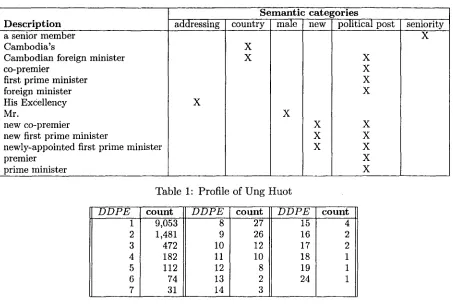
We call the set of all descriptions related to the same entity in a corpus, a profile of t h a t entity. Profiles for a large n u m b e r of entities were compiled using our earlier system, PRO- F I L E (Radev and McKeown, 1997). It turns out t h a t there is a large variety in the size of the profile (number of distinct descriptions) for different entities. Table 1 shows a subset of the profile for Ung Huot, the former foreign minister of Cambodia, who was elected prime minister at some point of time during the run of our exper- iment. A few sample semantic features of the descriptions in Table 1 are shown as separate columns.
We used information extraction techniques to collect entities a~d descriptions from a corpus and analyzed their lexical and semantic proper- ties.
We have processed 178 MB 1 of newswire and analyzed the use of descriptions related to 11,504 entities. Even t h o u g h P R O F I L E ex- tracts other entities in addition to people (e.g.,
1 T h e c o r p u s c o n t a i n s 1 9 , 4 7 3 n e w s s t o r i e s t h a t c o v e r t h e p e r i o d O c t o b e r 11 1 9 9 7 - J a n u a r y 9, 1 9 9 8 t h a t w e r e a v a i l a b l e t h r o u g h P R O F I L E .
places and organizations), we have restricted our analysis to names of people only. We claim, however, t h a t a large portion of our findings re- late to the other types of entities as well.
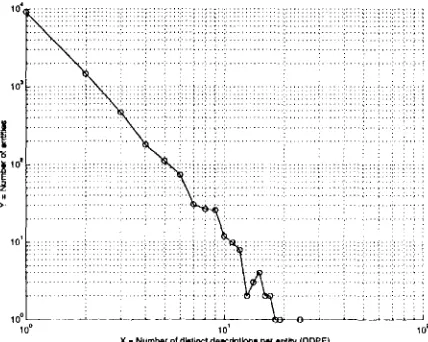
We have investigated 35,206 tuples, consist- ing of an entity, a description, an article ID, and the position (sentence number) in the arti- cle in which the entity-description pair occurs. Since there are 11,504 distinct entities, we had on average 3.06 distinct descriptions per entity
( D D P E ) . Table 2 shows the distribution of
D D P E values across the corpus. Notice t h a t a
large n u m b e r of entities (9,053 out of the 11,504) have a single description. These are not as in- teresting for our analysis as the remaining 2,451 entities t h a t have D D P E values between 2 and 24.
~ , : i i i i : i i i : i :
~o'::::::::::::i::::: :: ::: ::::::::::: : ::::: : :::::::..: ... ;
I0 ° 10' I0 z
X • Number of dt=t~nct delcrlpl ~ns p~ el~lty (ODPE)
Figure 2: N u m b e r of distinct descriptions per entity (log-log scale)
3 Language R e u s e in Text;
G e n e r a t i o n
Text gcneration usually involves lexical choice - t h a t is, choosing one way of referring to an en- tity over another. Lexical choice refers to a vari- ety of decisions t h a t have to m a d e in text gener- ation. For example, picking one among several equivalent (or nearly equivMent) constructions is a form of lexical choice (e.g., "'.FILe Utah Jazz
handed the Boston Celtics a defeat" vs. "The
Utah Jazz defeated the Boston Celtics" (Robin,
[image:2.612.320.534.296.467.2]Description
a senior member Cambodia'sCambodian foreign minister co-premier
first prime minister foreign minister His Excellency Mr.
new co-premier
new first prime minister
newly-appointed first prime minister premier
prime minister
addressing
X
S e m a n t i c c a t e g o r i e s
country male new political post
X X
X
Table 1: Profile of Ung H u o t
D D P E c o u n t D D P E
9,053 1,481 472 182 112 74 31
X X X
c o u n t D D P E c o u n t
8 27 15 4
9 26 16 2
10 12 17 2
11 10 18 1
12 8 19 1
13 2 24 1
14 3
seniority X
X X X X
X X X X X
Table 2: N u m b e r of distinct descriptions per entity ( D D P E ) .
context.
To be feasible and scaleable, a technique for solving a particular case of the problem of lex- ical choice must involve a u t o m a t e d learning. It is also useful if the technique can specify enough constraints on the text to be generated so t h a t the n u m b e r of possible surface realizations t h a t match the semantic constraints is reduced sig- nificantly. The easiest case in which lexical choice can be m a d e is when the full surface s t r u c t u r e can be used, and when it has been au- tomatically extracted from a corpus. Of course, the constraints on the use of the structure in the generated text have to be reasonably similar to the ones in the source text.
We have found t h a t a natural application for the analysis of entity-description pairs is lan-
guage reuse, which includes techniques of ex-
tracting shallow s t r u c t u r e from a corpus and applying t h a t s t r u c t u r e to computer-generated texts.
Language reuse involves two components: a
source text written by a h u m a n and a target
text, t h a t is to be automatically generated by a computer, partially making use of structures
reused from the source text. T h e source text is the one from which particular surface struc- tures are extracted automatically, along with the appropriate syntactic, semantic, and prag- matic constraints under which they are used.
Some examples of language reuse include col- location analysis (Smadja, 1993), the use of entire factual sentences extracted from cor- p o r a (e.g., "'Toy Story' is the Academy Award winning animated film developed by Pixa~'),
and summarization using sentence extraction (Paice, 1990; Kupiec et al., 1995). In the case of summarization through sentence extraction, the target text has the additional p r o p e r t y of being a s u b t e x t of the source text. Other tech- niques that can be broadly categorized as lan- guage reuse are learning relations from on-line texts (Mitchell, 1997) and answering natural language questions using an on-line encyclope- dia (Kupiec, 1993).
Stydying the concept of language reuse is re- warding because it allows generation systems to leverage on texts written by humans and their deliberate choice of words, facts, structure.
[image:3.612.78.531.67.373.2]place, the generation system has to use the same surface s t r u c t u r e in the same syntactic~ seman- tic, and pragmatic context as the source text from which it was extracted. Obviously, all of this information is typically not available to a generation system. T h e r e are some special cases in which most of it can be automatically com- puted.
Descriptions of entities are a particular in- stance of a surface s t r u c t u r e t h a t can be reused relatively easily.
Syntactic
constraints related to the use of descriptions are modest - since de- scriptions are always noun phrases t h a t appear as either prc-modifiers or appositions 2, t h e y are quite flexibly usable in any generated text in which an entity can be modified with an ap- propriate description. We will show in the rest of the paper how the requisitesemantic
(i.e.,"what is the meaning of the description to pick")
andpragmatic
constraints (i.e.,"what purpose
does using the description achieve?")
can be ex- tracted automatically.Given a profile like the one shown in ~l~nble 1, and an appropriate set of semantic constraints (columns 2-7 of the table), the generation com- ponent needs to perform a profile lookup and select a row (description) t h a t satisfies most or all semantic constraints. For example, if the se~ mantle constraints specify t h a t the description has to include the c o u n t r y and the political po- sition of Ung Huot, the most appropriate de- scription is
"Cambodian foreign minister".
4 E x p e r i m e n t a l S e t u p
In our experiments, we have used two widely available tools - WordNet and Ripper.
WordNet (Miller et al., 1990) is an on-line hierarchical lexical database which contains se- mantic information about English words (in- cluding h y p e r n y m y relations which we use in our system). We use chains of h y p e r n y m s when we need to approximate the usage of a particu- lar word in a description using its ancestor and sibling nodes in WordNet. Particularly useful for our application are the
synset offsets
of the words in a description. T h esynset offset
is a n u m b e r t h a t uniquely identifies a concept node(synset)
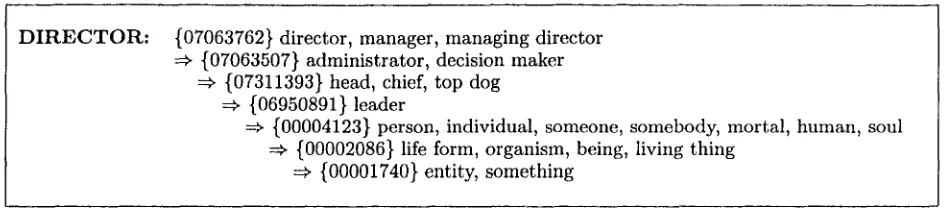
in the WordNet hierarchy. Figure 3 shows t h a t the synset offset for the concept"ad-
ministrator, decision maker"
is"{07063507} ",
2We haven't included relative clauses in our study.
while its h y p e r n y m ,
"head, chief, top dog" has
a synset offset of"{ 07311393} ".
Ripper (Cohen, 1995) is an algorithm t h a t learns rules from example tuples in a relation. Attributes in the tuples can be integers (e.g., length of an article, in words), sets (e.g., se- mantic features), or bags (e.g., words t h a t ap- pear in a sentence or document). We use Rip- per to learn rules t h a t correlate context and other linguistic indicators with the semantics of the description being e x t r a c t e d and subse- quently reused. It is i m p o r t a n t to notice t h a t Ripper is designed to learn rules t h a t classify d a t a into atomic classes (e.g.,
"good", "aver-
age",
and"bad").
We had to modify its al- gorithm in order to classify d a t a intosets of
atoms.
For example, a rule ca~l have the form"if CONDITION then [{ 07063762} { 02864326}
{0001795~}] "3.
This rule states t h a t if a certain " C O N D I T I O N " (which is a function of the in- dicators related to the description) is met, then the description is likely to contain words t h a t are semantically related to the three WordNet nodes [{07063762 } {02864326 } {00017954 }].T h e stages of our experiments are described in detail in the remainder of this section.
4.1 S e m a n t i c t a g g i n g o f d e s c r i p t i o n s
Our system, P R O F I L E , processes W W W - accessible newswire on a round-the-clock basis and extracts entities (people, places, and orga- nizations) along with related descriptions. T h e extraction g r a m m a r , developed in C R E P (Du- ford, 1993), covers a variety of pre-modifier and appositional n o u n phrases.
For each word wi in a description, we use a version of WordNet to extract the
synset offset
of the immediate parent of wi.4.2 F i n d i n g l i n g u i s t i c c u e s
Initially, we were interested in discovering rules manually and then validating t h e m using the learning algorithm. However, the task proved (nearly) impossible considering the sheer size of the corpus. One possible rule t h a t we hy- pothesized and wanted to verify empirically at this stage was
parallelism.
This linguistically- motivated rule states t h a t in a sentence with a parallel s t r u c t u r e (consider, for instance, the3These offsets correspond to the WordNet nodes
D I R E C T O R : {07063762} director, manager, managing director ::~ {07063507} administrator, decision maker
=* {07311393} head, chief, top dog =:~ {06950891} leader
:=~ {00004123} person, individual, someone, somebody, mortal, human, soul :=~ {00002086} life form, organism, being, living thing
:=~ {00001740} entity, something
Figure 3: H y p e r n y m chain of "director" in WordNet, showing synset offsets.
sentence fragment
"... Atija Izetbegovic, a Mus-
lim, Kresimir Zubak, a Croat, and Momeilo
Krajisnik, a Serb... ")
all entities involved have similar descriptions. However, rules at such a detailed syntactic level take too long to process on a 180 MB corpus and, further, no more t h a n a handful of such rules can be discovered manu- ally. As a result, we m a d e a decision to extract all indicators automatically. We would also like to note t h a t using syntactic information on such a large corpus doesn't appear particularly fea- sible. We limited therefore our investigation to lexical, semantic, and contextual indicators only. T h e following subsection describes the at- tributes used.4.3 E x t r a c t i n g l i n g u i s t i c c u e s a u t o m a t i c a l l y
T h e list of indicators t h a t we use in our system are the following:
• C o n t e x t : (using a window of size 4~ ex- cluding the actual description used, b u t not the entity itself) e.g.,
"['clinton'
'clinton' 'counsel' 'counsel' 'decision' 'deci-
sion' 'gore' 'gore' 'ind' 'ind' 'index' 'news'
'november' 'wednesday']"
is a bag of words found near the description of Bill Clinton in the training corpus.• L e n g t h o f t h e a r t i c l e : - an integer.
• N a m e o f t h e e n t i t y : - e.g., "Biil Clin- ton".
• P r o f i l e : T h e entire profile related to a per- son (all descriptions of t h a t person t h a t are found in the training corpus).
• S y n s e t O f f s e t s : - t h e WordNet node num- bers of all words (and their parents)) t h a t appear in the profile associated with the entity t h a t we want to describe.
4.4 A p p l y i n g m a c h i n e l e a r n i n g m e t h o d
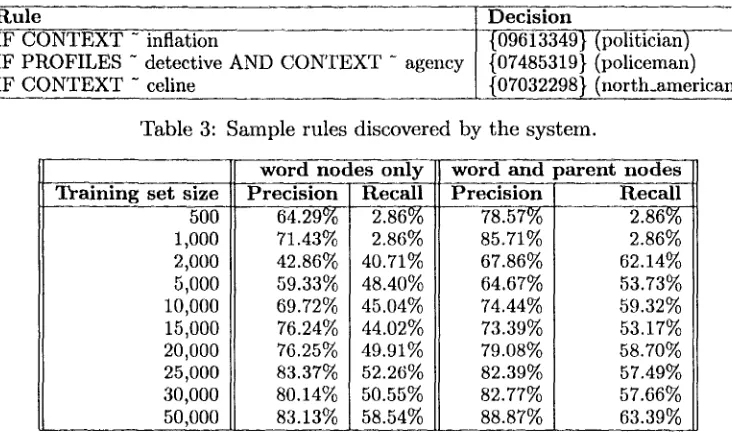
To learn rules, we ran Ripper on 90% (10,353) of the entities in the entire corpus. We kept the remaining 10% (or 1,151 entities) for evaluation. Sample rules discovered by the system are shown in Table 3.
5 R e s u l t s a n d E v a l u a t i o n
We have performed a s t a n d a r d evaluation of the precision and recall t h a t our system achieves in selecting a description. Table 4 shows our re- sults under two sets of parameters.
Precision and recall are based on how well tile system predicts a set of semantic constraints. Precision (or P ) is defined to be the n u m b e r of matches divided by the n u m b e r of elements in the predicted set. Recall (or R) is the n u m b e r of matches divided by the n u m b e r of elements in the correct set. If, for example, the system predicts
[,4] [B] [C], b u t the set of constraints
on the actual description is[B] [D], we would
c o m p u t e t h a t P = 33.3% and R = 50.0%. Ta- ble 4 reports the average values of P and R for all training examples 4.Selecting appropriate descriptions based on our algorithm is feasible even t h o u g h the val- ues of precision and recall obtained m a y seem only m o d e r a t e l y high. T h e reason for this is t h a t the problem t h a t we are trying to solve is underspecified. T h a t is, in the same context, more t h a n one description can be potentially used. Mutually interchangeable descriptions in- elude s y n o n y m s and near s y n o n y m s ("leader" vs.
"chief)
or pairs of descriptions of different generality( U.S. president
vs.president).
This [image:5.612.65.539.77.186.2]i s i o n . . . . 13349} ( p o i i t i c i a n ~ - - - - 85319} (policeman) I
32298} (north_anmrican) I
R u l eIF CONTEXT - inflation
IF PROFILES ~ detective AND CONTEXT ~ agency IF CONTEXT - celine
Table 3: Sample rules discovered by the system.
T r a i n i n g s e t s i z e 500 1,000 2,000 5,000 10,000 15,000 20,000 25,000 30,000 50,000
w o r d n o d e s o n l y P r e c i s i o n
64.29% 71.43% 42.86% 59.33% 69.72% 76.24% 76.25% 83.37% 80.14% 83.13%
Recall 2.86%-0 2.86% 40.71% 48.4O% 45.O4% 44.02% 49.91% 52.26%
50.55%
58.54%
w o r d a n d ) a r e n t P r e c i s i o n
78.57~, 85.71%
67.86% 64,67% 74,44% 73.39% 79.08% 82.39% 82.77% 88.87%
Table 4: Values for precision and recall using word nodes only (left) and nodes (right).
n o d e s R e c a l l
2.86 0v~ --
2.86%
62.14% 53.73% 59.32% 53.17%
58.70%
57.49% 57.66% 63.39%
b o t h word and parent
type of evaluation requires the availability of hu- m a n judges.
T h e r e are two parts to the evaluation: how well does the system performs in selecting se- mantic features (WordNet nodes) and how well it works in constraining the choice of a descrip- tion. To select a description, our system does a lookup in the profile for a possible description t h a t satisfies most semantic constraints (e.g., we select a row in Table 1 based on constraints on the columns).
Our system depends crucially on the multiple components t h a t we use. For example, the shal- low C R E P g r a m m a r t h a t is used in extracting entities and descriptions often fails to extract good descriptions, mostly due to incorrect P P attachment. We have also had problems from the part-of-speech tagger and, as a result, we occasionally incorrectly extract word sequences t h a t do not represent descriptions.
6 A p p l i c a t i o n s a n d F u t u r e W o r k
We should note t h a t P R O F I L E is part of a large system for information retrieval and sum- marization of news t h r o u g h information extrac- tion and symbolic text generation (McKeown and Radev, 1995). We intend to use P R O F I L E to improve lexical choice in the s u m m a r y gem eration component, especially when producing user-centered summaries or s u m m a r y updates
(Radev and McKeown, 1998 to appear). T h e r e are two particularly appealing cases - (1) when the extraction c o m p o n e n t has failed to extract a description and (2) when the user model (user's interests, knowledge of the entity and personal preferences for sources of information and for ei- ther conciseness or verbosity) dictates t h a t a de- scription should be used even w h e n one doesn't appear in the texts being summarized.
A second potentially interesting application involves using t h e d a t a and rules extracted by P R O F I L E for
language regeneration.
In (Radev and McKeown, 1998 to appear) we show how tile conversion of extracted descriptions into components of a generation g r a m m a r allows for flexible (re)generation of new descriptions t h a t don't appear in the source text. For example, a description can be replaced by a more general one, two descriptions can be combined to form a single one, or one long description can be de- constructed into its components, some of which can be reused as new descriptions. [image:6.612.128.494.74.291.2]egory that doesn't match any of the descriptions in a specific profile, two things can be done: (1) if there is a single description in the profile, to pick that one, and (2) if there is more than one description, pick the one whose semantic vector is closest to the predicted semantic vector.
Finally, the profile extractor will be used as part of a large-scale, automatically generated
Who's who site which will be accessible both
by users through a Web interface and by NLP systems through a client-server API.
7 C o n c l u s i o n
In this paper, we showed that context and other linguistic indicators correlate with the choice of a particular noun phrase to describe an en- tity. Using machine learning techniques from a very large corpus, we automatically extracted a large set of rules that predict the choice of a description out of an entity profile. We showed that high-precision automatic prediction of an appropriate description in a specific context is possible.
8 A c k n o w l e d g m e n t s
This material is based upon work supported by the National Science Foundation under Grants No. IRI-96-19124, IRI-96-18797, and CDA-96- 25374, as well as a grant from Columbia Uni- versity's Strategic Initiative Fund sponsored by the Provost's Office. Any opinions, findings, and conclusions or recommendations expressed in this material are those of the author(s) and do not necessarily reflect the views of the Na- tional Science Foundation.
The author is grateful to the following people for their comments and suggestions: Kathy McKeown, Vasileios Hatzivassiloglou, and Hongyan Jing.
R e f e r e n c e s
William W. Cohen. 1995. Fast effective rule induction. In Proc. 12th International Con-
ference on Machine Learning, pages 115-123.
Morgan Kaufmann.
Darrin Duford. 1993. CREP: a regular expression-matching textual corpus tool. Technical Report CUCS-005-93, Columbia University.
Julian M. Kupiec, Jan Pedersen, and Francine Chen. 1995. A trainable document summa-
rizer. In Proceedings, 18th Annual Interna- tional A CM SIGIR Conference on Research and Development in Information Retrieval,
pages 68-73, Seattle, Washington, July. Julian M. Kupiec. 1993. MURAX: A robust
linguistic approach for question answering us- ing an on-line encyclopedia. In Proceedings, 16th Annual International ACM SIGIR Con- ference on Research and Development in In- formation Retrieval.
Kathleen R. MeKeown and Dragomir R. Radev. 1995. Generating summaries of multiple news articles. In Proceedings, 18th Annual Interna- tional ACM SIGIR Conference on Research and Development in Information Retrieval,
pages 74-82, Seattle, Washington, July. George A. Miller, Richard Beckwith, Christiane
Fellbaum, Derek Gross, and Katherine J. Miller. 1990. Introduction to WordNet: An on-line lexical database. International Jour-
nal of Lexicography (special issue), 3(4):235-
312.
Tom M. Mitchell. 1997. Does machine learning really work? A I Magazine, 18(3).
Chris Paice. 1990. Constructing literature abstracts by computer: Techniques and prospects. Information Processing and Man-
agement, 26:171-186.
Dragomir R. Radev and Kathleen R. McKe- own. 1997. Building a generation knowledge source using internet-accessible newswire. In
Proceedings of the 5th Conference on Ap-
plied Natural Language Processing, Washing-
ton, DC, April.
Dragomir R. Radev and Kathleen R. McK- eown. 1998, to appear. Generating natu- ral language summaries from multiple on-line sources. Computational Linguistics.
Jacques Robin. 1994. Revision-Based Gener- ation of Natural Language Summaries Pro-
viding Historical Background. Ph.D. the-
sis, Computer Science Department, Columbia University.
G. Salton and M.J. McGill. 1983. Introduction
to Modern Information Retrieval. Computer
Series. McGraw Hill, New York.
Frank Smadja. 1993. Retrieving collocations from text: Xtract. Computational Linguis-