P R O B A B I L I S T I C T A G G I N G W I T H FEATURI~ STR,UCTUR,I;3S
n trc I ( e m p e
University of Stuttgart, Institute for (?omputational Linguistics, Azenbergstrage 12, 70174 Stuttgart, (lerniany, kellipe~_)ims.uni-stuttgart.de
Abstract
The described tagger is b,'used on a hidden Markov model and uses tags composed of features such as part- o f speech, gender, etc. 'l?he contextual probability of a tag (state transition probability) is deduced from the contextual probabilities of its feature--value-pairs.
This approach is advantageous when the available training corpus is small and the tag set large, which can be the case with morphologically rich languages.
1
I N T R O D U C T I O N
'l'he present article describes it probabillstic tagger based on a
hidden Marl(or model
(IIMM) (Rabiner, 1990) and employs tags which are fe,'iture structures. Their features concern part-of-speech (POS), gel,der, number, etc. and tlave only atouiie vahles.Usually, the contextual probability of a tag
(state
transition probability) is estimated dividing a trigrain frequency by a bigram frequency (second order II MM). With a large tag set resulting froin tire fact that the tags colitain besides or the POS a lot of lnorphologi- cal information, and with only a slnall training corpus available, most of these frequencies are too low for an exact estimation of contextual probabilities.Our feature structure tagger esthnates these prob- abilities by connecting contextual probabilities of the single
fealvre-wdue-pai,'s
(rv-pairs) of the tags (cf. sec.2).
Starting point for the iulph;nientation of the ['ea- ture structure tagger was a second-order-li'IvlM tagger (trigrams) b~med on a modilied version of the Viterbi algorithm (Viterbi, 1967; Chllrch, 1988) which we had earlier implemented in C (l(empe ,1994). 'Flier{: we modified tim calculus of the contextual probabilities of the tags in the above-described way (cf see. 4).
A test of both t a t t e r s under the sanle conditions Oli a French corpus 1 has shown that tile feature structure tagger is clearly better when tim available training c o l pus is small and the tag set is large but the tags are decomlmsable into relatively few fv-pairs. 'l'he hitter can be the case with morphologically rich languages when the tags contain a lot of morphological infornia- tion (cf. see. 5).
11 inll n m c h o b l i g e d to A c h i m Stein a n d Leo W,tuner, lto- nl~.UC~: l ) e p t . , U n i v . S t u t t g l i r t , Gel'lll&liy, for t~rovidlng the cor-
ptlS a n d it d i c t i o n a r y .
2
M A T H E M A T I C A L
B A C K -
G R . O U N D
In order to ~Lssign tags to a word sequence, a IIMM can be used where tim tagger selects among all possible tag sequences tile most probable one (Garside, Leech and Saulpson, 1987; (Tlnlrch, 1988; Brown e.t al., 1989; Rabiner, 1990). The joint probability of a tag sequence l - - I 0 . . . t N _ 1 given a word s e q u e n c e lg., : ~v0...lON_-l is hi the case of a second order IIMM:
*'(l, ,Z,) := ~t,, ,, • p(,v0lZ0). J,(ivl lZ,) '
N - 1
l-{ (p(,.,I',),(l,I
(1)
i = 2
The term rqo t, stands for tim initial slate probabil- ity, i.e. the probability that the sequence begins with the first two tags. N is tim nunlber of words in the sequence, i.e. the corpus size. "Phe term
p(w¢]ll)
is the probability of a word w¢ in the context of the assigned tag tl. it is called observation symbol prolmbility (lex- ical probability) and can be estimated by:f(wl ll)
t,(,,,~lt~) -- f(t~) (2)
The second order state transition probability (contex- tual probability) 1,(t~ I t~-2 re-.t) in formula ( l ) ex- presses how probable it; is that the tag tl appears in the context of its two preceding tags li-', all(] t i - ] . It is usually esthnate.d as the ratio of the frequency of the trigram
(ll-'2, t~-l,t;)
in a given training corpus to the. I'requency of the higram(li_2,li~l}
ill {,lie sallie corpllS:f(ti-.~ ti-~
ti)
With a large tag set and a relatively small hand- tagged training corpus forinula (3) has an iinl)ortant disadvantage: The maioril,y of transition probabilities cannot be estimated exactly because most of the possi- ble trigrams (sequences of three consecutive tags) will not appear at all or only a few tilnes a.
|I10llr exarrlple we have a 1,'rencli training corplls of 10,000 words tagged with a set of 386 different tags whMl could forrn a 8 a a = 57,512,450 different trigrams, but because of the corpus size no more than 10,000-2 trigranrs can appear. Actually, their nuinber was only 4,8[5, i.e. 0.008 % of all possible
'2 A d e t a i h M d e s c r i l l t l o n o f p r o ] ileli/S egnlsed b y sniall a n d ,.4el'O
ones, because some of them appeared m o r e than once
(table 1).
frequency number and percentage
range of trigrams in the range
> 128 1 (0.021%)
64 - 127 2 (0.042 %)
32
-63
13
(0a6
%)
16 - 31 43 (0.89 %)
8 - 15 119 (2.5 %)
4-7 282 (5.9 %)
2~3 860 (18 %)
1 3,495 (73 %)
sum 4,815 (100 %)
Table 1: Trigram count from a French train- ing corpus of 10,000 words
When we divide e.g. a trigram frequency 1 by a bigram frequency 2 according to formula (3) we gel tbe probability p=0.5 b u t we cannot trust it to be exact because the frequencies it is based on are too small.
We can take advantage of the fact that the 386 tags are constituted by only 57 different fv-pairs concerning POS, gender, number, etc. If we consider probabilistic relations between single fv-pairs then we get higher frequencies (fig. 2) and tbe resulting probabilities are more exact.
From the equations
n--[ 1
(t,} = {e,0 n c , , ... h e , , . _ , } = /
N
~,~ (4)]
kk=0 )
where tl means a tag and the elk symbolize its D-pairs and
(
\ k = 0 I / \ ~=0
( c d . p(e,olC,),
p(~, IC~ n e,0).
. . . . p e~ . . . . I elk (5)
k=0
whe~ Ci means the context of/~ and contains tile tags t;_.~ and ti-1 follows
p(tilCi) = p(clolCi) " ~ [ p elk Ci 0 elj (6) k=t \ I j=0
Tire latter formula 3 describes the relation between the contextual probability of a tag and the contextual probabilities of its fv-pairs.
The unification of morphological features inside a noun phrase is accomplished indirectly, hr a given context of D-pairs the correct fv-pair obtains the probability p = l and therefore will not influence tim probability of the tag to which it belongs (e.g. p~( 0num:SG [...) = 1 in fig. 2). A wrong fv-pair would obtain p=0 and make the whole tag impossible.
asugg ested bY Mats Rooth, IMS, Unlv.Stuttgart, Germany
3
T R A I N I N G
A L G O R I T H M
In the training process we are not interested in analysing and storing the contextual probabilities (state transition probabilities) of whole tags but of single fv-pairs. We note them in terms of probabilistic feature relations (PFI:~):
Vr'l~:
(
e,
I c,'"~ ; p(~,Ic~ "~)
) (7)which later, in the Lagging process, will be combined in order to obtain the contextual tag probabilities.
The term el in formula (7) is a fv-pair. G~ "~ is a
reduced context which contains only a subset of the fv-pairs of a really appearing context Ci (fig. 1). C / ~ is obtained from Ci by eliminating all fv-pairs which do not influence the relative frequency of e,', according to the condition:
P(e,'lC~ '"b) / p(e, lC~) C [1 - e, 1 + ~] (8) The considered D-pair has nearly 4 the same prob- ability in the complete and in the reduced contexts, i.e. Ci does not supply more information abont the probability of el than C/~''b does.
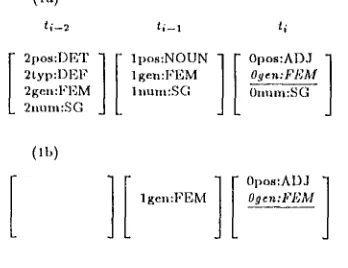
ti--2 ti--1 tl
2typ:l)l'3F I gen:FEM Ogen:FEM
2geu:FEM h m m : S ( l 0m~m:SG
2nu In :S G
(,,)
Figure 1: (a) Complete context Ci and (b) reduced context C/'"b of the feature-value-pair
el = Ogen:FEM
In the example (fig. la) we consider tile fv-pair
Ogen:l,'EM. Within the given training corpus, its prob- ability ill tile complete context Ci, i.e. in the context of all tile other fv-pairs of figure la, is p ~ = 4 4 / 4 4 = I
(of. p~ in fig. 2).
The presence of inum:SG in tag ti-1 does not influ- ence the probability of Ogen:FEM in tag I i. Therefore
lnum:SG eau be eliminated. Only fv-pairs which re- ally have an influence remain in the context. The re- duced context C~ "b with less D-pairs, which we obtain this way, is more general (fig. lb).
In the given training corpus, the probability of
Ogen:FEM in the context CZ "b is p0=170/174=0.997 (el. P0 in PFR0 in fig. 2), which is near to p ~ = l . The reduced context C~ ''~ is used to form a P F R which will be stored.
[image:2.612.109.291.86.251.2] [image:2.612.330.504.325.459.2]We. see in the use of reduced contexts instead of complete ones two advantages:
(1) A great n u m b e r of complete contexts containing m a n y fv-pairs can lead after eliminatim, of irrelevant fv-pairs to the same P F R , which makes the n m n b e r of all possible PFlks much smaller t h a n the n u m b e r of all possible t r i g r a m s (cf. sec.
2).
(2) "['he p r o b a b i l i t y of a fv-pair can be estimated more exactly in a reduced context t h a n in a complete one because of the higher frequencies in the first case.
T h e G e n e r a t i o n o f Pl.,'l{s
In the t r a i n i n g process we first extract from a train- ing corpus a set of t r i g r a m s where the tags are split up into their fv-pairs. From these trigrams a set of PFILs is generated separately ['or every fvqmlr ei. We e x a m i n e d four difl'erent m e t h o d s for this procedure:
M e t h o d 1-3: For every trigram we generate all possible subsets of its fv-pairs. Many trigrams, e.g. if they dillk'.r in only one fv-pair, have most of their subsets of fv-pairs in coil,IliOn. Both the complete trigrams and the subsets, constitute together the set, of contexts and subcontexts (Ci and C/'''~) wherein a fv-pair couhl appear. To generate Pl:lLs for at giw'.n fv-pair, we preselect and m a r k those (sub-)contexts which are supposed to have an intluence on the con- textual probability of the. fv-pair. A (sub-)context will not be preselected if its frequency is smaller t h a n a defined threshold. We use dilferent ways for the pres- election:
Melhod 1: A (sub-)context will be preseleeted if the considered D - p a i r itself or all fv-p;dr l)etong- ing to the same feature type ew'.r appears in this (sul)-)context. E.g., if gen:MAS appears in a certain (sub-)context the,, this (sub-)context will l,e prese- lected for gen:l:EM too. Furthermore, it is possible to impose special conditions on the preselection, e.g. t h a t a (sub-)context can only be preselected if it con- tains a POS feature in tag tl and ti-1 (cf. lit. l;t: Opos and Ipos).
Method 2: In order to preselect (sub-)contexts for an fv-pair, we generate a decision tree r' (Quinlan, I983) where the feature of the fv-pair, e.g. ten, hum el.e, serves to classify all existing (sub-)contexts. E.g., hum prodt, ces three classes of contexts: those containing the f w p a i r Onum:SG, those with Onum:PL and those w i t h o u t a Onum feature. We assign to tile tree nodes other features t h a n this upon which the cl~ussification is based. T h e root node is labeled with the feature from which we expect most information al)out the proba- bility of the currently considered feature. T h e values of the rout node feature are assigned to the I)ranches s t a r t i n g at the root node. ~,h.~ continue the. branch- ing until there remain no features will, an expected i n f o r m a t i o n gain and a frequency higher t h a n defined
Ssuggestedlw lIehnut Schmld, [MS, Univ. Stuttgart, Ger- Ilk, lilly, lear reasolls of space we explain only how we etnploy decision trees for our purposes. For details about the automatic generation of such trees see Quinhm (1983).
threshohls. To ever), leaf of the tree corresponds a (sul>)context which will be marked and thus prese- letted for further analysis.
Method 3: For each fvq)air concerning POS we pre- select every (sub-)context containing only I'OS fea- tures ht tag tl-2 ;t,,d ti-1 (classical I'OS trigram), e.g.
2pos:PREP lpos:DET tbr Opos:NOUN. For the other
fv-p;tirs we mark every (sub-)conl;ext containing any fv-pair of the same type in the previous tag ti-1 and ally POS features in tag li_ 1 alld Ii, e.g. lpos:DET
Igen:FL'M Opos:NOUN for @en:I:EM.
Witl, the m e t h o d s
1-3,
we next eliminate frolll ev~ cry preselected (sul>)context all fv-pairs which in the above described sense do not intluenee the relative fre- quency of the currently considered fv-pair (eq. 8).M e t h o d 4: l:ronl the set of t r i g r a m s extracted from a t r a i n i n g corpus we generate separately for every fv- pair, a binaryd>ranched decision tree which shall tie- scribe wtrious contextual probabilities of this fv-pair. T h e tree is generated on a modi[ied version of the II)3 algorithm (Quildan, 1983) and is similar to the one desr.rlbed by Schmid (1994).
We start with a binary classification of all trigrams based on the considered D-palr. l'].g., a classification for
:len:l"EM
will divide the set of trigrams in two subsets, one where the t r i g r a m s contain Ogen:l"EM in the tag Ii and one where they do not.[ Igen:MAS ]
- - F ~
ge,,:l:EM
y c s ~ - ~ y e s / /
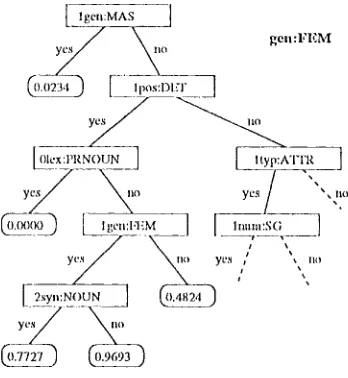
Figure 3: l)ecision tre.e for the fv-pair Ogen:l,'EM (Every n u m b e r is a probability of Ogeu:l"ltM in the context described by the p a t h from the root node to the node labeled with the munl>er.)
[image:3.612.321.495.381.570.2]p( 0gen:FEM 0num:SG 0pos:ADJ I lgen:FEM lnum:SG lpos:NOUN
2gen:FEM 2num:SG 2pos:DET 2typ:DEF) = 44/298 = 0.148
p~( 0gen:FEM [ 0num:SG 0pos:ADJ lgen:FEM hmm:SG lpos:NOUN
2gen:FEM 2num:SG 2pos:DET 2typ:DEF) = 44/44 = 1.0 P F R o • ( 0gen:l"EM ] 0pos:A1)J lgen:FE'M ; p0 = 170/174 = 0.977)
p~'( 0num:SG [ 0gen:FEM 0pos:Al)J lgen:FEM lnum:SG Ipos:NOUN
2gen:FEM 2num:SG 2pos:l)ET 2typ:DEF) = 44/44 = 1.0 P F l l q : ( 0num:SG [ 0pos:Al)J lnurn:SG 2pos:l)ET ; p~ = 90/96 = 1.0)
p~( 0pos:ADJ [ lgen:FEM lnum:SG lpos:NOUN
2gen:PEM 2num:SG 2pos:DET 2typ:DEF) = 44/298 --= 0.148
P F R ~ : ( 0pos:ADJ [ lgen:FEM liras:NOUN 2pos:DET ; p2 = 69/465 = 0.148)
2
H
pi "~ 0 . 1 4 5The position index at the beginning of every feature-v',due-pair indicates the tag to which it belongs; e.g. Ogen:FEM belongs to t~tg li and 2num:SG to ll-2.
Figure 2: Decomposition amt reconstruction of a contextual tag probability (state transition probability) using probabilislic feature relations (PFH,)
tain the D-pair, the other branch concerns tim tri- grams which do not contain it. The recursive expan- sion of the tree stops if either the information gained by consulting further fv-pairs or the frequencies upon which the calculus is based are smaller than defined thresholds.
4
T A G G I N G
A L G O R I T H M
Starting point for the implementation of a feature structure tagger was a second-0rdcr-IIMM tagger (tri- grams) based on a modified version of the Viterbi al- gorithm (Viterbi, 1967; Church, 1988) which we had earlier implemented in C (Kempe ,1994). There we replaced the function which estimated the contextual probability of a tag (state transition probability) hy dividing a trigram frequency by a bigram frequency (eq. 3) with a flmction which accomplished this cal- culus either using PF1Ls in the above-described way (eq.s 6, 7) or by consulting a decision tree (fig. 3).
To estimate the contextual probability of a tag we have to know the contextual probabilities of its fv- pairs in order to multiply them (eq. 6).
Using P F R s generated by roof:hod 1 o r 2, when e.g looking for the probability p~(0pos:ADJ I...) from Ilgure 2, we may find in the list of PFRs, instead of a PFR, which would directly correspond (but is not stored), the two P F R s
(0pos:ADJ [ lgen:FEM lpos:NOUN 2pos:Dl;;T; Pl --- 0.148) (0pos:ADJ [ 0num:SG ll|llln:S(~ lsyn:NOUN 2syn:l)ET;
p~ = 0.414>
Both of them contain subsets of tile fv-pairs of the required complete context and could therefore both be
applied. In such c;*se we laced to know how to combine Pl and p2 in order to gel; p (=p.~ in fig. 2).
As there exists no mathematical relation between these three probabilities, we simply average Pt and P2 to get p l)ecause this gives as good tagging results as a nmnber of other more complicated approaches which we examined.
P F R s generated by m e t h o d 3 do not create this problem. For every complete context only one PFIL is stored.
When we use the set of decision trees generated by m e t h o d 4, we obtain for every fv-palr in every pos- sible context only one probability by going down on the relevant branches until a probability information is reached.
In opposition to tile P F R s of tile other methods, the decisiou trees also contain negative information al)ont the contexL of an fv-l)air, i.c. not only which fv-llairs have to be in the context but also which ones nmst bc absent.
5
T A G G I N G
R E S U L T S
In tile training arm tagging process we experimented with different values for parameters like: minimal ad- mitted frequency for preselection, admitted percentua] difference c between probabilities considered to bc equal, etc. (cf. see. 3).
The feature structure tagger was trained on the French 10,000 words corpus already mentioned ill ta- ble 1, with the fonr different training methods (see. 3). When tagging a 6,000 words corpus 6 with an average ambiguity of 2.63 tags per word (after the dictionary
look-up)
88.89 % (table 2).
t'ag- training corpus tag set
of words I guage
2,000,000 English 47 - - 2~00,000 English 47' - -
t'l' 10,000 French 386 57
t T 10,000 French 386 57
lpT 10,000 French 386
fsT1 10,000 French 386
fsT2 10,000 French 386
fsT3 10,000 French 386
fsT4 10,000 l~rench 386
we obtained in the best case an accuracy of
IIMM tagging order accuracy
1 94.93 %
2 96.16 %
1 56.39 %
2 8 3 . 2 3 %
57 2 8 3 . 8 1 %
57 --- 8 8 . 5 3 %
57 - - ] 8 8 . 8 9 %
57 - - ~ ~
57 --- 1 8 8 . 1 4 (Z)
tT--4 "traditional" tlMM-tagger,
IpT--+ "Tagger" considering ~nly lexical prohahilitles,
]sTl..4
---* feature structure tagger trMned with method 1..,1, HMM order I ~ blgrams, 2 ~ trigramsTable 2: Comparison of the tagging accuracy with different taggers, corpora, tag sets and IIMM orders
Comparatively, we used a "traditional" II/VlM- tagger (cf. see. 4) on the same training and test corpora and got an accuracy of 83.23 % 7, i.e. the error rate was about 50 % higher than with the fea- ture structure tagger (table 2).
When we used a tool which always selects the lexi- tally most probable tag without considering the con- text we obtained an accuracy of 83.81%, which is even better than with the "traditional" IIMM-tagger.
Provided with enough training data and working on a small tag set, our "traditional" tagger got an accuracy of 96.16 % (Kempe ,1994), which is usual in tiffs case (Cutting et a1.,1992). The English test cori)us we used here had an average amt)iguity of 2.61 tags per word which is amazingly similar to the aml)iguity o[" the French corpus.
The feature structure tagger is clearly bel, l.er when the available training corpus is small and the tag set large but the tags are decomposal)le into few fv-pairs.
6
F U R T H E I ~
R E S E A R C H
We intend to search for other similar models while keeping in mind the basic idea described above: Split- ring up a tag into D-pairs and deducing it, s contextual probability from the contextual probabilities of its fv- pairs.
Furthermore, it may be preferable to split up the tags only when tim frequencies are too small s .
7 For a similar experiment for Q e r m a n (20,000 words training corpus, 689 tags, trigrams) an accuracy of 72.5 % has been
reported (Wothke et al., 1993, p.
21).
Ssuggestcd by 'red Briscoe, R a n k Xerox Research Centre, Grenoble, France
R e f e r e n c e s
Brown, P.F. et al. (1989). A Statistical Approach to Machine q~ranslation. Technical l/.epo,'t, I/.C 14773 (~//-66226) 7/17/89, IBM Research l)ivision.
Church, K.W. (1988). A Stochastic Parts Program and Noun Phra.se Parser for Unrestricted Text. In Proc. 2rid Conference on Applied Natural Language Processing, ACL., pp. I36-143.
Cutting, I). et al. (1992). A Practical Part-of-Sl)eech Tagger. In Pwc. 3rd Conference on Applied Natural Language Processing, ACL. Trento, Italy.
Gale, W.A. and Church, K.W. (1989). W h a t ' s Wrong with Adding One?. Statistical Research Reports, No. 90, AT&T Bell Laboratories, Murray Ilill.
Garside, IL, Leecll, CI. and Sampson, (I. (1987). The. Computational Analysis of English: A Corpus-based Approach. London: I,ongman.
Kempe, A. (1994). A Prol)abilistic Tagger aud an Analysis of Tagging Errors. Research Report. IMS, Univ. of Stuttgart.
Quinlan, J.R. (1983). Learning Efficient Classi[ica- tion Procedures and Their Application to Chess End Qames. In Michalski, R., Carbonell, J. and Mitchell T. (Eds.) Machine Learning: An arlificial inlelli- gence approach, pp. 463-482. San Mateo, California: Morgan l(aufmann.
Rablner, L.R.. (1990). A 'Bltorial on llidden Markov Models and Selected Applications in Speech Recog- nition. In Waibel, A and Lee, K.F. (Eds.) Readings in Speech Recognition. San Mateo, California: M o f gas Kanfinann.
Schmid, 1[. (19!14). l'robabilistic Part-of-Speach Tag- ging llsing ])eeision Trees. Research I/.eport. IMS, Univ. of Stuttgart.
Viterbi, A.J. (1967). Error Bounds for Convolutional Codes and an Asymptotieal Optimal l')ecoding Algo- rithm. In Proceedings oflEEE, vo]. 61, pp. 268-278.
[image:5.612.92.297.105.291.2]