48
Detection of Defect on Fruit using Computer Vision
Technique
Ashish Kumar
1, Ali HaiderPatheria
2, PoojaBhor
3, ShrutiJathar
4, Prof.Chaya Jadhav
5 (Dept. of Computer Engineering, D.Y.P.I.E.T., SavitribaiPhule Pune University, Pune)Email:
[email protected],[email protected],[email protected],[email protected],chaya12
Abstract- Nowadays, quality evaluation of fruits is important and it plays vital role for the food and agricultural
industry. The fruits in the market satisfy the consumer preferences.So, to maintain the quality, detection of defect on fruits is necessary. Before few years this task completed by manually. But manual sorting shows inconsistency and inaccuracy in result. This paper presents the three dimensional color grading technique for sorting the fruits and detecting defects on it. This work presents a novel defect detection of fruits based on color features with K-means clustering unsupervised algorithm. We used color images of fruits for defect detection. Defect detection in different stages. Initially, the feature extraction is performed, and then classifier is uses to classify the fruits according of their maturity level. In feature extraction we exacted the color, edge, texture feature. Although the color is not commonly used for defect detection, it produces a high distinctions power for different regions of image. This approach thus provides a feasible robust solution for defect detection of fruits.Also, in these paper uses the automatic color grading system to determine the color quality by directly comparing fruit color against the predefined and set of reference color or by using set of color separation parameter.
Index Terms-Machine Vision, Visual Inspection, color space conversion, k-means, fruit sorting, fruit grading,
image processing
1. INTRODUCTION
The agrarian country - like India , agro-industrial companies are the major and vital sectors which drive the economic growth of that country. Before few years the sorting and grading of fruits is performed manually according to maturity level of fruits.This manual sorting by visual inspection is labor intensive, time consuming, and suffers lot of problem of inconsistency and inaccuracy because of supervision is done by different human.[2]So to avoid this problem and improving fruit’s quality and production throughput,reduce labor efforts and costs, it is necessary to research non- destructive automatic detection of defect on fruits technology. Fruit nondestructive detection is the process of detecting fruits outside quality without any damage[2], using some detecting technology., the quality of fruit shape, default, color and size and so on cannot evaluated by the Nowadays traditional methods.[1] With the development of image processing technology and computer software, it becomes more attractive to detect defect on fruits and improving the quality of its. At present, most existing fruit quality
detecting or defect detecting and grading system have the disadvantage of low efficiency, low speed of grading, high cost and complexity[4]. So it is significant to develop high speed and low cost fruit defect detecting and gradation system.
49
•Feature Extraction
In image processing, feature extraction works from an initial set data and builds derived values (features) intended to be instructive and non-redundant, facilitating the subsequent learning and generalization steps, and in some cases leading to better human rendition. Feature extraction is related to dimensionality reduction.
When the input data to an algorithm is complicated to be processed and it is suspected to be redundant (e.g. the same measurement in both feet and meters, or the tedium of images presented as pixels), then it can be transformed into a reduced set of features (also named a features vector). This method is called feature extraction. The extracted features are expected to contain the useful information from the input data, so that the required task can be performed by using this reduced representation instead of the complete initial data.
•Color Extraction
Color extraction is the pre-processing technique used for color image processing. In this process, specific colors are separated from different colors of the color image (original image) obtained from a color camera. the original image has information about the content of 256 tones (8 bits) x 3 colors (RGB) x number of pixels, while the extracted image has information about the content of 2 tones (1-bit monochrome) x number of images, which is equivalent to one 24th the above information about the content, which puts less load on the post-processing stage.
•Texture Extraction:
Object defines by colors, texture or shape. Shape means graphical data that contains location, size and rotational effects are filtered out. Grading applied on many fruits and vegetables. In this section review is made on how different parameters can be used for automatic fruit grading system. An image texture is a set of attribute calculated in image processing designed to find Surface finish of an image. Image texture gives us information about the image color or intensity. Image
textures are the measure key to calculate segmentation classification of images. To analyze an image texture in computer graphics, this issue can be handled in two ways : Structured Approach and Statistical Approach.
•k-Mean Clustering Algorithm:
The fruit image processing using clustering is an efficient method. Using clustering technique classifies the fruits or objects into different groups, or more specifically, partitioning of a data set into clusters or small subset, so that the data in each cluster shares some common attribute. The task of partitioning the set of fruits into k subsets is often referred to unsupervised learning. K-means is generally used to determine the natural groupings an fruits. It straight forward and generally very fast method. It partitions the input dataset of fruits into k clusters. Each cluster is represented by an changing center, starting from some initial values named seed-points. K-means clustering computes the distances between the inputs and centersThe K-mean Algorithm can work for our project as follow:
Step 1: Compute the distribution of set of fruits according to the no of defected values on each fruit.
Step 2: Using k random algorithm initialize the Centroid for each cluster.
Step 3: Cluster the images based on the distance from their centroid values
Step 4:Step 2&3 perform continuously till the centroid can be constant. Numbering and spacing
2. RELATED WORK
2.1 A Survey on Detection of Disease and Fruit Grading
50
2.2 Infected Fruit Part Detection using K-Means Clustering Segmentation Technique
This paper presents a defected part of fruits using segmentation and based on color features with K-means clustering unsupervised algorithm. In this technique we uses a color images of fruits for defect segmentation. Defect segmentation is carried out into two parts. At first, the pixels are clustered based on their color and spatial features, where the clustering process is completed. Then the clustered blocks are merged to a specific number of regions. Using this two step procedure, it is possible to increase the efficiency by avoiding the feature extraction for every pixel in the image of fruits. However the color is not commonly used for defect segmentation, it produces a high discriminative power for different regions of image. This technique provides a feasible robust solution for defect segmentation of fruits. The experimental results clarifies the effectiveness of proposed approach to improve the defect segmentation quality in aspects of precision and computational time. The simulation results provides that the proposed approach is promising.
2.3. A Fruit Size Detecting and Grading System Based on Image Processing
In this technique, a fruit size detecting and grading system based on image processing. After capturing the fruit side view image, various fruit characters is extracted by using detecting algorithms. In this paper uses technique or algorithm for detection and grading of fruit are the edge detection, fruit size detection algorithm. The fruit size detecting algorithm is based on mainly two parts that is finding the center coordinate of fruit’s shape in image .Fruit’s axis in image. According
to these characters, algorithms and various technique of grading, we performed the actual grading . The experiments show that this embedded grading system has the advantage of providing high accuracy of grading, high speed and low cost.
3. EXISTING SYSTEM
Earlier system are working with RGB technique which work on the principle of color image segmentation. The attainment of the maximum threshold value will be the setting value for the system to distinguish the ripe from the unripe fruit values, These systems have been extensively implemented by replacing manual inspection by computer vision technology. In this particular paper, a review of prior studies and schemes for sorting and grading of fruits is accomplished. The various machine vision and optimization system
technology are performed to have automate
fruit grading.
4. PROPOSED SYSTEM
In our system we used different techniques like color extraction, texture extraction and K-means algorithms to detect fruit quality by providing fruit images. Each image stored in image database is represented efficiently by extracting various characterstics. The other parameters like size, shape, hardness, softness, day light, day temperature, colorization can also be included in this project for future extension. These parameters will play valuable role for quality analysis process, further this approach work can be used for grading and sorting of fruits for agricultural products with the help of digital images captured from camera which involve image analysis, visual examination and inspection of color. The embedded grading system has the advantage of high accuracy of sorting and grading, high speed and low cost.
[image:3.595.290.522.602.729.2]Fig1:
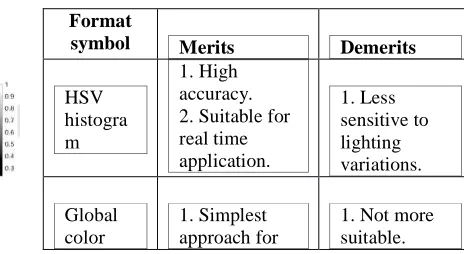
RGB color images and concentration images of six mangoes ranging from raw to overripeTable 1. Summary of different color techniques
Format
symbol Merits Demerits
HSV histogra m
1. High accuracy. 2. Suitable for real time application.
1. Less sensitive to lighting variations.
Global color
1. Simplest approach for
51 histogra
m
distinct color.
Domina nt color method
1. It’s very close to human vision.
1. It’s a complex method.
Color intensity
1.Easy for implementatio n but required gray
conversion.
1. Required high contrast image.
5. SYSTEM ARCHITECTURE
6. CONCLUSION
In this paper, a Image Processing technique is used for detecting defect on fruits for sorting and grading of fruit is proposed. The input image is first pre-processed, then its features are extracted on three parameters namely- color, edge, and texture then, training and classification of the same are done. The proposed system provides two methods for the user to check the defect for the captured input image of fruit using image feature extraction and clustering technique. Experimental results display different accuracy levels of defect detection based on the input
image quality and the quality of fruit. The overall system accuracy is measured to be 82%. Thus, this system takes one step towards promoting the farmers and industries depends on farm and allowing them to take decisions for a sortingand grading of fruit and improved the accuracy of grading and sorting . In future, the systemcan be improved with the new features incorporated as- training the system to detect defect for other fruits, increase dataset size to improve the overall system performance to detect defect more accurately.
Acknowledgments
Our team wishes to acknowledge Prof. ChayaJadhav for helping us understanding complex technical problems and solving our doubts. We are also grateful to Dr. R. K. Jain and Dr. PromodPatil for their wholehearted support, guidance and for providing us with required a menities and infrastructure. We would like to thank to all the above authors for their research in this field. It helped us in understanding the understanding the algorithms and various techniques in detail
REFERENCES
[1] HadhaAfrisal, Muhammad Faris, Guntur UtomoP ,LafionaGrezelda, Indah Soesanti, MochammadAndriF“Portable Smart Sorting and Grading Machine for fruits Using Computer Vision”2013 International Conference on Computer science
[2]Ms.RupaliS.Jadhav, PROF. S.S.Patil “A Fruit Quality Management System Based On Image Processing” IOSR Journal, Volume 8, Issue 6 (Nov. - Dec. 2013), PP 01-05
52 Processing”2010 Second InternationalConference
paper
[4] J.Ramprabhu and S.NandhiniDepartment of EEE “ EnhancedTechnique for Sortingand Grading the Fruit Quality Using Controller”,International Journal of Advances in Engineering & Technology, Nov., 2014
[5]UravashiSolankia, Udesang K. Jaliya b and Darshak G. Thakore “ A Survey on Detection of Disease and Fruit Grading”,International Journal of Innovative and Emerging Reasearch in Engineering
[6] P. Vimala Devi and K.Vijayarekha “Machine Vision Applications to locate fruits,detect defects and remove noise” rasayan journal
[7]ManishChhabra,Rohan Gaur Parminder Singh Reel.”Detection of Fully and Partially Riped Mango by Machine Vision.”(ICRTITCS - 2012) [8] VikramAppanna”Detection and discrimination of
two fungaldiseases of mango (cv. Keitt) fruits based onvolatile metabolite profiles using GC/MS” ResearchGate 2012
[9]Veena.T,D.V.Chidanand”Quality analysis of mango fruit with fruit fly insect by non-destructive soft x-ray method” IJASR