Collocation Extraction: Needs, Feeds and Results of an Extraction System
for German
Julia Ritz
Institut für Maschinelle Sprachverarbeitung (IMS) Universität Stuttgart
Azenbergstr. 12 70174 Stuttgart
Germany
Abstract
This paper provides a specification of re-quirements for collocation extraction sys-tems, taking as an example the extraction of noun + verb collocations from German texts. A hybrid approach to the extrac-tion of habitual collocaextrac-tions and idioms is presented, aiming at a detailed descrip-tion of collocadescrip-tions and their morphosyn-tax for natural language generation sys-tems as well as to support learner lexicog-raphy.
1 Introduction
Since Firth first described collocations as habit-ual word combinations in the 1950ies (cf. Firth, 1968), a number of papers focusing on collocation extraction have been published (see the overviews in (Evert, 2004; Bartsch, 2004)). Most studies concentrate on the extraction from English. How-ever, the procedures proposed in these studies can-not necessarily be applied to other languages as English stands out, e.g. with respect to configu-rationality. They rely on the fact that the syntax of English (and of all configurational languages) provides positional clues to the grammatical func-tion of noun phrases, and they exploit this con-cept by means of window-based, adjacency-based or pattern-based extraction, combined with associ-ation measures to identify co-occurrences that are more frequent than statistically expectable. What these procedures do not cover is semantic-oriented definitions like (a) and (b).
a. A collocation is a combination of a free (’au-tosematic’) element (thebase) and a lexically determined (’synsemantic’) element (the col-locate, which may lose (some of) its meaning
in a collocation) (adapted from (Hausmann, 1979; Hausmann, 1989; Hausmann, 2003)).
b. A collocation is a word combination whose semantic and/or syntactic properties cannot be fully predicted from those of its compo-nents, and which therefore has to be listed in a lexicon (Evert, 2004).
We argue that linguistic knowledge could not only improve results (Krenn, 2000b; Smadja, 1993) but is essential when extracting colloca-tions from certain languages: this knowledge pro-vides other applications (or a lexicon user, respec-tively) with a fine-grained description of how the extracted collocations are to be used in context.
Additional requirements resulting from the needs of dictionary users are described in (Haus-mann, 2003; Heid and Gouws, 2005) and are of interest not only in lexicography but can also be transferred to the field of natural language gener-ation. These requirements influence the develop-ment of collocation extraction systems, which mo-tivates this paper.
The structure of the paper is as follows: In chap-ter 2, the requirements, depending on factors like the targeted language, are presented. We then dis-cuss and suggest methods to meet the given needs. A documentation of ongoing work on the extrac-tion of noun + verb collocaextrac-tions from German texts is given in chapter 3. Chapter 4 gives a con-clusion and an outlook on work still to be done.
2 Collocation Extraction Tools: Requirements
The development of a collocation extraction tool depends on the following conditions:
2. the targeted application
3. the kinds of collocations to be extracted
4. the degree of detail
Whereas issues 1 to 3 deal with the collocation itself, issue 4 is focused at the collocation in con-text, i.e. its behaviour (from a syntagmatic analy-sis point of view) or, respectively, its use (from a generation perspective).
2.1 Language factors
One of the most important factors is, of course, the targeted language and its main characteristics with respect to word formation and word order. De-pending on word and constituent order, the pros and cons of positional vs. relational extraction patterns need to be considered. Positional pat-terns (based on adjacency or a ’window’) are ad-equate for configurational languages, but in lan-guages with rather free word order, words belong-ing to a phrase or collocation do not necessarily occur within a predefined span1.
Extracting word combinations using relational patterns (represented by part of speech (PoS) tags or dependency rules) offers a higher level of ab-straction and improves the results (cf. (Krenn, 2000b; Smadja, 1993)). However, this requires part of speech tagging and possibly partial parsing. A system extracting word combinations by apply-ing relational patterns, obviously profits from lan-guage specific knowledge about phrase and sen-tence structure and word formation. One example is the order of adjective + noun pairs: in English and German, the adjective occurs left of the noun, whereas in French, the adjective can occur left or right of the noun. Another example is compound-ing, handled differently in different languages: noun + noun in English, typically separated by a white space (e.g. death penalty) vs. noun + prepositional phrase in French (e.g.peine de mort) vs. compound noun in German (e.g. Todesstrafe). Consequently, language specific word formation rules need to be considered when designing ex-traction patterns. For languages with a rich in-flectional morphology where the individual word forms are rather rare, frequency counts and results
1In German, e.g., in usual verb second constructions with a full verb in the left sentence bracket (topological field the-ory see (Wöllstein-Leisten et al., 1997)), particles of particle verbs appear in the right sentence bracket. The middle field (containing arguments and possibly adjuncts of the verb) is of undetermined length.
of statistical analyses are little reliable. To allow a grouping of words sharing the same lemma, lem-matisation is crucial.
2.2 Application factors
Other important factors are the targeted applica-tion (i.e. analysis vs. generaapplica-tion) and, to some ex-tent resulting from it, factors (3.) and (4.), above. Depending on the purpose of the tool (or lexicon, respectively), the collocation definition chosen as an outline may vary, e.g. including transparent and regular collocations (cf. (Tutin, 2004)) for genera-tion purposes, but excluding them for analysis pur-poses. In addition, a more detailed description of the use of collocations in context (e.g. information about preferences with respect to the determiner, etc.) is needed for generation purposes than for text analysis.
2.3 Factors of collocation definition
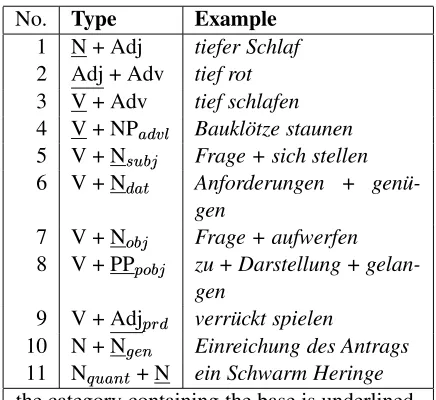
Collocations can be distinguished on two levels: the formal level and the content level. On the for-mal level, a collocation can be classified accord-ing to the structural relation between its elements. Typical patterns are shown in table 12(taken from
(Heid and Gouws, 2005)).
On the content level, there are regular, transpar-ent, and opaque collocations (according to (Tutin, 2004)) and, taking definition (b) into account, id-ioms as well. However, as a classification at the content level needs detailed semantic description, we see no means of accomplishing this goal other than manually at the moment.
2.4 Contextual factors
(Hausmann, 2003; Heid and Gouws, 2005; Evert et al., 2004) argue that collocations have strong preferences with respect to their morphosyntax (see examples (1) and (2)) and may be combined (see example (3)). The collocation in example (1) (’to charge somebody’) is restricted with respect to the determiner (null determiner) of the base, whereas the same base shows a strong preference for a (definite or indefinite) determiner when used
2Abbreviations in table 1: advl - adverbial
prd - predicative subj - subject obj - object
pobj - prepositional object dat - dative case
No. Type Example
10 N + N Einreichung des Antrags
11 N
+ N ein Schwarm Heringe
the category containing the base is underlined.
Table 1: Collocational patterns
with a different collocate (example (2), ’to drop a lawsuit’). Example (3) shows two collocations sharing the base can form a collocational sequence (example taken from (Heid and Gouws, 2005)).
(1) ø Anklage erheben
(2) die/eine Anklage fallenlassen (3) Kritiküben + scharfeKritik
scharfeKritiküben
For both natural language generation systems and lexicography, such information is highly rel-evant. Therefore, the extraction of contextual in-formation (called ’context parameters’ in the fol-lowing) should be integrated into the collocation extraction process.
3 Extracting noun + verb collocations from German
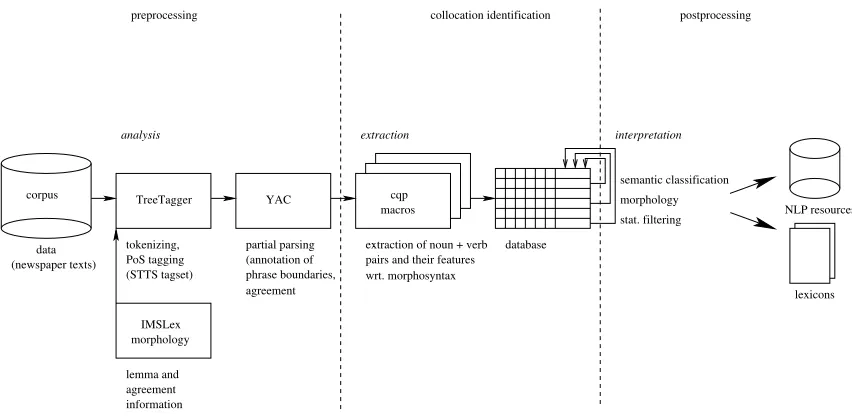
The standard architecture for collocation extrac-tion systems contains three stages (cf. (Krenn, 2000)): a more or less detailed linguistic analysis of the corpus text (preprocessing), an extraction step and a statistic filtering of the extracted word combinations. We follow this architecture (see fig-ure 1). However, our hypothesis differs from other approaches. Collocations are often restricted with respect to their morphosyntax. We test to what ex-tent they can be identified via these restrictions.
3.1 Approach
In an experiment, we extracted relational word combinations (verb + subject/object pairs) from
German newspaper texts.
The syntactic patterns for the extraction of these combinations concentrate on verb-final construc-tions as in example (4) and verb second con-structions with a modal verb in the left sentence bracket according to the topological field theory (see (Wöllstein-Leisten et al., 1997)) as in exam-ple (5). The reason is that, in these constructions, the particle forms one word with the verb (see ex-ample (6)), as opposed to usual verb second con-structions (see example (7)). Thus, we need not recombine verb + particle groups that appear sep-aratedly.
(4) ... wenn Wien einenAntragauf Vollmitglied-schaftstellt.
(’if Vienna an application for full member-shipputs’)
(if Viennaappliesfor full membership)
(5) ... kann Wien einenAntragauf Vollmitglied-schaftstellen.
(’might Vienna an applicationfor full mem-bershipput.’)
(Vienna mightapplyfor full membership.)
(6) ..., daß er ein Schildaufstellt. (’that he a signupputs’) (that he puts up a sign)
(7) Er stellt ein Schildauf. (’He puts a signup.’) (He puts up a sign.)
Preprocessing
As data, we used a collection of 300 million words from German newspaper texts dating from 1987 to 1993. The corpus is tokenized and PoS-tagged by the Treetagger (Schmid, 1994), then chunk annotated by YAC (Kermes, 2003). The chunker YAC determines phrase boundaries and heads, and disambiguates agreement information as far as possible. It is based on the corpus query language cqp (Christ et al., 1999)3, which can in
turn be used to query the chunk annotations.
Data Extraction
The syntactic patterns used to extract verb + subject/object combinations are based on PoS tags and chunk information. These patterns are repre-sented using cqp macros (see figure 2). The cqp syntax largely overlaps with regular expressions.
3
cqp (newspaper texts) PoS tagging
tokenizing, stat. filtering NLP resources corpus
data
lemma and IMSLex
wrt. morphosyntax pairs and their features
extraction of noun + verb database
morphology
Figure 1: Tool architecture
( 1) MACRO n_vfin(0)
( 2) (
( 3) [pos = "(KOUS|VMFIN)"]
( 4) []*
( 5) np
( 6) [!pp
( 7) & _.np_f not contains "ne"
( 8) & _.np_f not contains "pron"
( 9) & _.np_f not contains "meas"
(10) & _.np_h != "@card@"]+
(11) /np
(12)[pos != "($.|KOUS|VMFIN)"]*
(13)[pos = "V.*"]+
(14)[pos = "($.|KON)"]
(15))
(16);
Figure 2: sample macro
Line (1) of figure 2 contains the name of the macro and the number of its parameters. In line (3), a word PoS taggedKOUS(subordinating con-junction) or VMFIN (finite modal verb) is re-quested, followed by an arbitrary number (’*’) of words without any restrictions (line (4)). Line (5) indicates the start of a nominal phrase (np), line (11) its end. The elements within this np (one or more words, as indicated by ’+’) must not be part of a prepositional phrase (pp) to avoid the extrac-tion of pp + verb (line (6), see example (8)). In ad-dition, the np must be neither a named entity (ne, see line (7)) nor a pronoun (pron, line (8)) nor an
np of measure (meas, line (9), see example (9)), nor must its head be a cardinal number (card, line (10), see example (10)). An arbitrary number of words may follow the np (punctuation marks (PoS tagged$.), subordinating conjunctions and finite modal verbs excluded). At least one verb is re-quired (line (13), all PoS tags for verbs start with a capital ’V’4). Line (14) indicates the end of the
subclause or sentence.
(8) ... kann [zurVerfügung] gestellt werden.
(9) ... weil davon jährlich [3,5 Tonnen] ! #"$
eingeführt werden.
(10) ... obwohl er [1989] &% "'( noch dort
arbeitete.
By applying the macro to the corpus, all se-quences of words matching the pattern are ex-tracted.
From these sequences, the following informa-tion is made explicit (cf. (Heid and Ritz, 2005)):
)
lemma of the noun (potential base)
)
lemma of the verb (potential collocate)
)
number of the noun (singular, plural)
)
case of the noun
*
determination of the noun (definite, indefi-nite, null, demonstrative, quantifier)
*
modification of the noun (adjective, cardinal number, genitive np, compound noun etc.)
*
negation (yes/no)
*
auxiliaries and modal verbs
*
original phrase from the corpus
For each instance found, the lemmas of noun and verb along with all the context parameters mentioned above are stored as feature value pairs in a relational data base. The database can be queried via SQL. See figure 3 for a sample query asking for distinct lemma pairs, ordered by fre-quency (in descending order), and figures 5 and 4 for more specific queries and some of their results.
SELECT COUNT(*) AS f, n_lemma, v_lemma FROM comfea1
GROUP BY n_lemma, v_lemma ORDER BY f DESC;
Figure 3: sample query
Filtering
The instances extracted in the previous step are grouped according to noun and verb lemmas, i.e. instances of the same lemma pair form one group. Within these groups, a relative frequency distribu-tion is computed for each of the features. For que-riability reasons, the results of this postprocessing are also stored in the database, as shown in figure 1. A word combination is chosen as a collocation candidate if a preference (specified by a threshold of e.g. 60% of the occurrences) for a certain fea-ture value (singular / plural, presence / absence of a determiner, definite / indefinite / demonstrative / possessive / quantifying determiner, presence of modifying elements) is discovered.
3.2 Results
From 300 million words, we extracted more than 1.3 million noun + verb combinations, the in-stances of 726,488 different lemma pairs. 10,934 of these lemma pairs appeared with a minimum
SELECT COUNT(*) AS f, n_lemma, v_lemma FROM comfea1 WHERE neg = ’+’
GROUP BY n_lemma, v_lemma ORDER BY f DESC;
f | n_lemma | v_lemma
1152 | Rede | sein
748 | Angabe | machen
322 | Einigung | erzielen
228 | Chance | haben
217 | Forderung | erfüllen
188 | Problem | lösen
151 | Rolle | spielen
131 | Auskunft | geben
127 | Stellungnahme | abgeben
120 | Alternative | geben
110 | Interesse | haben
110 | Angabe | bestätigen
102 | Geld | haben
Figure 4: sample query: word combinations from negated phrases
frequency of 10. Sample results are shown in fig-ure 65.
We evaluated collocation candidates with a quency of at least 100. Within the 323 most fre-quent collocation candidates, we found 213 collo-cations (including 11 idioms). This corresponds to a precision of 66% (see table 26). As a
compari-son, a window-based study was carried out on the same (PoS-tagged) data. In this study, the window was defined in a way that up to two tokens (exclud-ing sentence boundaries and finite full verbs) were allowed to appear between a noun (PoS tagged
NN) and a finite full verb (PoS tagged VVFIN). Log-likelihood7 was used as an association
mea-sure. The precision of this approach is 41%8.
5Abbreviations in figure 6: c - rated as a collocation in evaluation i - rated as an idiom in evaluation.
For chosing collocation candidates, a threshold of 60% is used. However, additional preferences are displayed for val-ues greater than 50%.
6Abbreviations in table 2:
log-l - window-based approach using log-likelihood feat - pattern-based approach using morphosyntactic features
7www.collocations.de
SELECT COUNT(*) AS f, n_lemma, v_lemma FROM comfea1 WHERE cas = ’Akk’
GROUP BY n_lemma, v_lemma ORDER BY f DESC;
f | n_lemma | v_lemma
507 | Beitrag | leisten
237 | Antrag | stellen
173 | Eindruck | erwecken
173 | Weg | finden
167 | Umsatz | steigern
145 | Hut | nehmen
140 | Bericht | vorlegen
135 | Betrieb | aufnehmen
121 | Sprung | schaffen
120 | Ausschlag | geben
116 | Mut | haben
111 | Sitz | haben
106 | Weg | ebnen
105 | Zuschlag | erhalten
104 | Platz | finden
100 | Anspruch | haben
94 | Tod | feststellen
93 | Zusammenhang | geben
90 | Vertrag | unterzeichnen
90 | Riegel | vorschieben
Figure 5: sample query: verb + accusative object
However, the evaluation criteria from defini-tions (a) and (b) remain vague or even contradic-tory for some of the results. First, there is the problem of semantic equivalence: does the com-bination express more than its elements (consider example (11))? Secondly, definitions (a) and (b) may judge the same example differently: Anteil nehmen (example (12)) is usually agreed upon to be a support verb construction, but the distinction of the noun Anteilas the base (making the main contribution to the meaning) is questionable. On the other hand, its unpredictable syntactic proper-ties (e.g. null determiner) and semantics (partial loss of meaning of the collocate nehmen) make it clear that this combination has to be listed in a lex-icon.
(without the corresponding preposition), have been treated as correct matches in 72 cases.
log-l feat
collocation candidates 700 323
collocations (manually verified) 290 213
precision 41% 66%
Table 2: evaluation results
For evaluation purposes, combinations judged collocations by either (or both) of the definitions were marked as correct matches. In cases like ex-ample (11), combinations were marked as correct matches if no alternative collocate existed for de-scribing the denoted situation or event.
(11) Chance + haben(’to have a/the chance’)
(12) Anteil + nehmen(’to commiserate’)
4 Conclusion and Outlook
We presented a system for collocation extraction that takes into account the behaviour or use of collocations in context. Profiting from linguis-tic information (PoS tagging, chunking), the tool reaches a precision of 66% on the top 323 candi-dates by frequency. On the same data, a window-based approach relying only on PoS information reached a precision of 41%.
As the extracted word combinations as well as their context parameters (including the original ev-idence from the corpus) are stored in a database, the tool also supports explorative research in lexi-cography.
However, there are some enhancements worth doing: Especially when dealing with low frequen-cies, relative frequencies lack reliability. There-fore, we suggest computing a confidence interval as proposed in (Evert, 2004b; Heid and Ritz, 2005; Ritz, 2005).
As indicated in figure 1, several postprocessing steps can be added to the system, e.g. enabling a sorting of collocation candidates with compound nouns by the morphological heads of their base.
n_lemma | v_lemma | total | restrictions
- | Polizei | mitteilen | 5689| sg(100%), det(99.49%), def(99.49%), modif(53.84%)
c | Rede | sein | 2144| sg(99.81%), det(99.16%), quant(53.59%)
- | Sprecher | mitteilen | 1401| sg(94.15%), det(99.21%), indef(93.36%), modif(68.31%)
c | Fall | sein | 1233| sg(99.03%), det(97.32%), def(96.03%)
- | Kantonspolizei | mitteilen | 1094| sg(99.82%), det(59.60%), def(59.60%), modif(100%)
- | Behörde | mitteilen | 952 | pl(82.14%), det(99.89%), def(99.37%), modif(63.13%)
c | Stellung | nehmen | 831 | sg(99.88%), no_det(88.21%)
c | Angabe | machen | 802 | pl(98.50%), det(93.64%), quant(93.27%)
- | Polizeisprecher | mitteilen | 737 | sg(90.91%), det(92.67%), indef(90.77%), modif(100%)
i | Rolle | spielen | 724 | sg(98.62%), det(97.93%), indef(65.61%)
c | Problem | lösen | 690 | det(89.13%), def(64.06%), modif(51.88%)
- | Zeitung | berichten | 670 | sg(94.78%), det(94.78%), def(91.79%), modif(83.28%)
- | Nachrichtenagentur| melden | 667 | sg(98.95%), det(98.20%), def(97.90%), modif(100%)
c | Rechnung | tragen | 661 | sg(100%), no_det(98.94%)
- | Unternehmen | mitteilen | 655 | sg(98.16%), det(98.32%), def(98.32%), modif(66.26%)
c | Chance | haben | 614 | sg(85.67%), det(86.31%)
c | Beitrag | leisten | 575 | sg(96.70%), det(95.65%), indef(52.70%), modif(62.54%)
- | Polizei | berichten | 564 | sg(100%), det(98.40%), def(98.40%)
c | Einigung | erzielen | 551 | sg(99.82%), det(92.20%), quant(58.26%)
- | Sprecher | sagen | 508 | sg(76.38%), det(97.83%), indef(76.18%), modif(56.69%)
c | Arbeit | aufnehmen | 492 | sg(98.37%), det (98.37%), poss(76.62%)
c | Ziel | erreichen | 476 | sg(78.78%), det(96.22%)
- | Nachrichtenagentur| berichten | 454 | sg(100%), det(98.90%), def(98.90%), modif(100%)
c | Druck | ausüben | 451 | sg(100%), no_det(88.70%), modif(74.72%)
c | Erfolg | haben | 438 | sg(99.32%), no_det(78.54%)
- | Frau | sein | 425 | sg(54.59%), det(50.12%), modif(61.41%)
- | Land | verlassen | 421 | sg(99.76%), det(98.57%), def(86.70%)
c | Frage | stellen | 419 | sg(71.60%), det(79.00%), def(68.26%)
References
Sabine Bartsch. 2004.Structural and functional prop-erties of collocations in English. A corpus study of lexical and pragmatic constraints on lexical co-occurrence Narr, Tübingen.
Oliver Christ, Bruno M. Schulze, Anja Hofmann and
Esther König. 1999. The IMS Corpus Workbench:
Corpus Query Processor (CQP). User’s manual. In-stitut für maschinelle Sprachverarbeitung, Univer-sität Stuttgart.
Jonathan Crowther, Sheila Dignen and Diana Lea.
2002. Oxford Collocations Dictionary for students
of English. Oxford University Press.
Stefan Evert. 2004. The Statistics of Word
Cooc-curences - Word Pairs and Collocations. PhD thesis. Institut für Maschinelle Sprachverarbeitung (IMS), Universität Stuttgart.
Stefan Evert, Ulrich Heid and Kristina Spranger. 2004.
Identifying morphosyntactic preferences in colloca-tions. In M. T. Lino, M. F. Xavier, F. Ferreira, R. Costa and R. Silva (eds.):Proceedings of the 4th In-ternational Conference on Language Resources and Evaluation (LREC 2004), p. 907 - 910. Lisbon, Por-tugal.
Stefan Evert. 2004. The statistical analysis of
mor-phosyntactic distributions. In M. T. Lino et al. (eds.): Proceedings of the 4th International Confer-ence on Language Resources and Evaluation (LREC 2004), p. 1539 - 1542. Lisbon, Portugal.
John R. Firth. 1968. F.R. Palmer (ed.):Selected Papers of J.R. Firth 1952-59. Longman, London.
Franz Josef Hausmann. 1979. Un dictionnaire de
col-locations est-il possible? Travaux de Linguistique et de Litterature XVII(1), p. 187-195. Centre de philologie et de littérature romanes de l’université de Strasbourg.
Franz Josef Hausmann. 1989. Le dictionnaire de
col-locations. In F. J. Hausmann et al. (eds.): Wörter-bücher, Dictionaries, Dictionnaires, p. 1010 - 1019. De Gruyter, Berlin.
Franz Josef Hausmann. 2003. Was sind eigentlich
Kollokationen? In K. Steyer (ed.): Wortverbindun-gen - mehr oder weniger fest. Jahrbuch des Instituts für Deutsche Sprache 2003:309 – 334. De Gruyter, Berlin.
Ulrich Heid and Rufus H. Gouws. 2005. A model
for a multifunctional electronic dictionary of col-locations. Institut für Maschinelle Sprachverar-beitung (IMS), Universität Stuttgart, submitted to EURALEX 2006.
Ulrich Heid and Julia Ritz. 2005. Extracting
colloca-tions and their contents from corpora. F. Kiefer et
al. (eds.): Papers in Computational Lexicography:
Complex 2005. Hungarian Academy of Sciences, Budapest.
Hannah Kermes. 2003. Off-line (and On-line) Text
Analysis for Computational Lexicography. Ar-beitspapiere des Instituts für Maschinelle Sprachver-arbeitung (AIMS):9(3). Stuttgart.
Brigitte Krenn. 2000. The Usual Suspects: Data
Ori-ented Models for the Identification and Representa-tion of Lexical CollocaRepresenta-tions. PhD thesis. DFKI und Universität des Saarlandes, Saarbrücken.
Brigitte Krenn. 2000. Collocation Mining:
Ex-ploiting Corpora for Collocation Identification and Representation. W. Zühlke and E. G.
Schukat-Talamazzini (eds.):Proceedings of KONVENS 2000,
p. 209-214. Ilmenau, Deutschland.
Julia Ritz. 2005. Entwicklung eines Systems zur
Extraktion von Kollokationen mittels morphosyn-taktischer Features. Diploma Thesis. Institut für Maschinelle Sprachverarbeitung (IMS), Universität Stuttgart.
Helmut Schmid. 1994. Probabilistic part-of-speech
tagging using decision trees. D. Jones and H.
Somers (eds.): Proceedings of the International
Conference on New Methods in Language Process-ing (NeMLaP). Manchester, U.K.
Frank Smadja. 1993. Retrieving Collocations from
Text: Xtract. Computational Linguistics (19), p. 143-177. Manchester, U.K.
Agnès Tutin. 2004.Pour une modélisation dynamique
des collocations dans les textes. G. Williams and
S. Vessier (eds.): Proceedings of the Eleventh
EU-RALEX International Congress. Lorient, France.
Angelika Wöllstein-Leisten, Axel Heilmann, Peter
Stepan and Sten Vikner. 1997. Deutsche