Graph Based Semi-Supervised Approach for Information Extraction
Hany Hassan Ahmed Hassan Sara Noeman
IBM Cairo Technology Development Center Giza, Egypt
P.O. Box 166 Al-Ahram
[email protected] [email protected] [email protected]
Abstract
Classification techniques deploy supervised labeled instances to train classifiers for various classification problems. However labeled instances are limited, expensive, and time consuming to obtain, due to the need of experienced human annotators. Meanwhile large amount of unlabeled data is usually easy to obtain. Semi-supervised learning addresses the problem of utilizing unlabeled data along with supervised la-beled data, to build better classifiers. In this paper we introduce a semi-supervised approach based on mutual reinforcement in graphs to obtain more labeled data to en-hance the classifier accuracy. The approach has been used to supplement a maximum entropy model for semi-supervised training of the ACE Relation Detection and Charac-terization (RDC) task. ACE RDC is con-sidered a hard task in information extraction due to lack of large amounts of training data and inconsistencies in the available data. The proposed approach pro-vides 10% relative improvement over the state of the art supervised baseline system.
1 Introduction
Classification techniques use labeled data to train classifiers for various classification problems. Yet they often face a shortage of labeled training data. Labeled instances are often difficult, expensive,
and /or time consuming to obtain. Meanwhile large numbers of unlabeled instances are often available. Semi-supervised learning addresses the problem of how unlabeled data can be usefully employed, along with labeled data, to build better classifiers.
In this paper we propose a semi-supervised ap-proach for acquiring more training instances simi-lar to some labeled instances. The approach depends on constructing generalized extraction patterns, which could match many instances, and deploying graph based mutual reinforcement to weight the importance of these patterns. The mu-tual reinforcement is used to automatically identify the most informative patterns; where patterns that match many instances tend to be correct. Similarly, instances matched by many patterns also tend to be correct. The labeled instances should have more effect in the mutual reinforcement weighting proc-ess. The problem can therefore be seen as hubs (instances) and authorities (patterns) problem which can be solved using the Hypertext Induced Topic Selection (HITS) algorithm (Kleinberg, 1998 ).
HITS is an algorithmic formulation of the notion of authority in web pages link analysis, based on a relationship between a set of relevant “authorita-tive pages” and a set of “hub pages”. The HITS algorithm benefits from the following observation: when a page (hub) links to another page (author-ity), the former confers authority over the latter.
unsu-pervised data matched with the highly weighted patterns are then used in retraining the system.
The paper proceeds as follows: in Section 2 we discuss previous work followed by a brief defini-tion of our general notadefini-tion in Secdefini-tion 3. A detailed description of the proposed approach then follows in Section 4. Section 5 discusses the application of the proposed approach to the problem of detecting semantic relations from text. Section 6 discusses experimental results while the conclusion is pre-sented in Section 7.
2 Previous Work
(Blum and Mitchell, 1998) proposed an approach based on co-training that uses unlabeled data in a particular setting. They exploit the fact that, for some problems, each example can be described by multiple representations. They develop a boosting scheme which exploits conditional independence between these representations.
(Blum and Chawla, 2001) proposed a general approach utilizing unlabeled data by constructing a graph on all the data points based on distance rela-tionships among examples, and then to use the known labels to perform a graph partitioning using the minimum cut that agrees with the labeled data. (Zhu et al., 2003) extended this approach by pro-posing a cut based on the assumption that labels are generated according to a Markov Random Field on the graph , (Joachims, 2003) presented an algorithm based on spectral graph partitioning. (Blum et al., 2004) extended the min-cut approach by adding randomness to the graph structure, their algorithm addresses several shortcomings of the basic mincut approach, yet it may not help in cases where the graph does not have small cuts for a given classification problem.
3 Background
In graph theory, a graph is a set of objects called vertices joined by links called edges. A bipartite graph, also called a bigraph, is a special graph where the set of vertices can be divided into two disjoint sets with no two vertices of the same set sharing an edge.
The Hypertext Induced Topic Selection (HITS) algorithm is an algorithm for rating, and therefore ranking, web pages. The HITS algorithm makes use of the following observation: when a page
(hub) links to another page (authority), the former confers authority over the latter. HITS uses two values for each page, the "authority value" and the
"hub value". "Authority value" and "hub value" are
defined in terms of one another in a mutual recur-sion. An authority value is computed as the sum of the scaled hub values that point to that authority. A hub value is the sum of the scaled authority values of the authorities it points to.
A template, as we define for this work, is a se-quence of generic forms that could generalize over the given training instance. An example template is:
COUNTRY NOUN_PHRASE PERSON
VERB_PHRASE
This template could represent the sentence:
“American vice President Al Gore visited ...”.
This template is derived from the representation of the Named Entity tags, Part-of-Speech (POS) tags and semantic tags. The choice of the template rep-resentation here is for illustration purpose only; any combination of tags, representations and tag-ging styles might be used.
A pattern is more specific than a template. A pattern specifies the role played by the tags (first entity, second entity, or relation). An example of a pattern is:
COUNTRY(E2) NOUN_PHRASE(R) PERSON(E1) VERB_PHRASE
This pattern indicates that the word(s) with the tag COUNTRY in the sentence represents the sec-ond entity (Entity 2) in the relation, while the word(s) tagged PERSON represents the first entity (Entity 1) in this relation. Finally, the word(s) with the tag NOUN_PHRASE represents the relation between the two previous entities.
A tuple, in our notation during this paper, is the result of the application of a pattern to unstructured text. In the above example, one result of applying the pattern to some raw text is the following tuple:
Entity 1: Al Gore Entity 2: United States Relation: vice President
4 The Approach
mutual reinforcement techniques. Patterns derived from the supervised training instances should have a superior effect in the reinforcement weighting process. This duality in patterns and tuples relation could be stated that patterns could match different tuples, and tuples in turn could be matched by dif-ferent patterns. The proposed approach is com-posed of two main steps namely, pattern extraction and pattern weighting or induction. Both steps are detailed in the next subsections.
4.1 Patterns Extraction
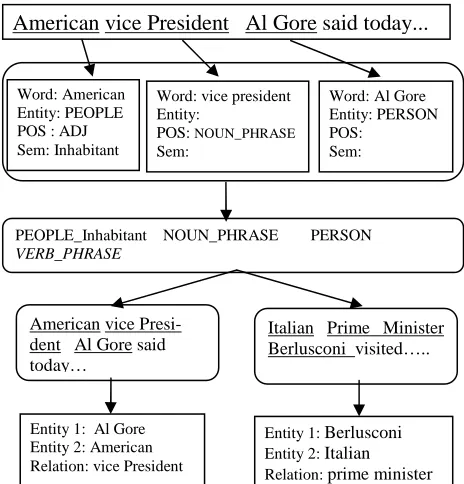
[image:3.612.71.303.335.577.2]As shown in Figure 1, several syntactic, lexical, and semantic analyzers could be applied to the training instances. The resulting analyses could be employed in the construction of extraction pat-terns. Any extraction pattern could match different relations and hence could produce several tuples. As an example let’s consider the pattern depicted in figure 1:
Figure 1: An example of a pattern and its possible tuples.
PEOPLE_Inhabitant(E2) NOUN_PHRASE(R)
PERSON(E1) VERB_PHRASE
This pattern could extract the tuple:
Entity 1: Al Gore Entity 2: American Relation: vice President
Another tuple that could be extracted by the same pattern is:
Entity 1: Berlusconi Entity 2: Italian
Relation: Prime Minister
On the other hand, many other patterns could ex-tract the same information in the tuple from differ-ent contexts. It is worth mdiffer-entioning that the proposed approach is general enough to accommo-date any pattern design; the introduced pattern de-sign is for illustration purposes only.
To further increase the number of patterns that could match a single tuple, the tuple space might be reduced i.e. by grouping tuples conveying the same information content together into a single tuple. This will be detailed further in the experi-mental setup section.
4.2 Pattern Induction
The inherent duality in the patterns and tuples rela-tion suggests that the problem could be interpreted as a hub authority problem. This problem could be solved by applying the HITS algorithm to itera-tively assign authority and hub scores to patterns and tuples respectively.
Figure 2: A bipartite graph representing patterns and tuples
Patterns and tuples are represented by a bipartite graph as illustrated in figure 2. Each pattern or tu-ple is represented by a node in the graph. Edges represent matching between patterns and tuples.
The pattern induction problem can be formu-lated as follows: Given a very large set of data D containing a large set of patterns P which match a
P
P
P P
P
T
T
T T
T P
P
T
T
Patterns Tuples
American vice President Al Gore said today...
Word: American Entity: PEOPLE POS : ADJ Sem: Inhabitant
Word: vice president Entity:
POS: NOUN_PHRASE
Sem:
Word: Al Gore Entity: PERSON POS:
Sem:
PEOPLE_Inhabitant NOUN_PHRASE PERSON VERB_PHRASE
Entity 1: Al Gore Entity 2: American Relation: vice President
American vice Presi-dent Al Gore said today…
Italian Prime Minister Berlusconi visited…..
Entity 1: Berlusconi
Entity 2: Italian
[image:3.612.376.479.387.567.2]large set of tuples T, the problem is to identifyP~, the set of patterns that match the set of the most
correct tuplesT~. The intuition is that the tuples matched by many different patterns tend to be cor-rect and the patterns matching many different tu-ples tend to be good patterns. In other words; we want to choose, among the large space of patterns in the data, the most informative, highest confi-dence patterns that could identify correct tuples; i.e. choosing the most “authoritative” patterns in analogy with the hub authority problem. However,
bothP~andT~are unknown. The induction process proceeds as follows: each pattern p in P is associ-ated with a numerical authority weight av which
expresses how many tuples match that pattern. Similarly, each tuple t in T has a numerical hub weight ht which expresses how many patterns were
matched by this tuple. The weights are calculated iteratively as follows:
( )
( )( )
=
+ = T p
u i i i H u h p
a 1 ()
) ( ) 1 ( (1)
( )
( )( )
= + = Ptu i i i A u a t h
1 () ) ( ) 1 ( (2)
where T(p) is the set of tuples matched by p, P(t) is the set of patterns matching t, a(i+1)
( )
p is the au-thoritative weight of pattern p at iteration (i+1), and h(i+1)( )
t is the hub weight of tuple t at itera-tion (i+1) . H(i) and A(i) are normalizationfac-tors defined as:
( )
( ) = = = | | 1 1 ) ( ) ( P p p T u i i u h H (3)( )
( ) = ==
| | 1 1 ) ( ) ( T v t P u i iu
a
A
(4)Patterns with weights lower than a predefined threshold are rejected, and examples associated with highly ranked patterns are then used in unsu-pervised training.
It is worth mentioning that both T and P contain supervised and unsupervised examples, however the proposed method could assign weights to the correct examples (tuples and patterns) in a com-pletely unsupervised setup. For semi-supervised data some supervised examples are provided, which are associated in turn with tuples and pat-terns.
We adopt the HITS extension introduced in (White and Smyth, 2003) to extend HITS with
Pri-ors. By analogy, we handle the supervised
exam-ples as priors to the HITS induction algorithm. A prior probabilities vector pr ={pr1, . . . , prn}
is defined such that the probabilities sum to 1, where prv denotes the relative importance (or
“prior bias”) we attach to node v. A pattern Pi is
assigned a prior pri=1/n if pattern Pi matches a supervised tuple, otherwise pri is set to zero, n is
the total number of patterns that have a supervised match. We also define a “back probability” , 0
1 which determines how often we bias the su-pervised nodes:
( ) (
)
( )( )
p p T u i i ipr
H
u
h
p
a
1
1 ()*
) ( )
1
(
=
−
β
+
β
= + (5)
( ) (
)
( )( )
t t P u i i ipr
A
u
a
t
h
1
1 ()*
) ( )
1
(
=
−
β
+
β
= +
(6)
where T(p) is the set of tuples matched by p , P(t) is the set of patterns matching t, and H(i) and A(i) are normalization factors defined as in equations (3) and (4)
Thus each node in the graph (pattern or tuple) has an associated prior weight depending on its super-vised data. The induction process proceeds to itera-tively assign weights to the patterns and tuples. In the current work we used
β
=0.5.5 Experimental Setup
5.1 ACE Relation Detection and
Characteri-zation
peo-ple, organizations, geo-political entities (countries, cities …etc), locations, or facilities. On the other hand, entities are objects containing all mentions to the same object.
Type Subtype Number of
Instances User-Owner
Inventor ART
Other
331
DISC DISC 143
Employ-Exec Employ-Staff Employ-Undetermined
Member-of-Group Subsidiary EMP-ORG
Other
1673
Ethnic Ideology Other-AFF
Other
153
Citizen-Resident Based-in GPE-AFF
Other
695
Business Family PER-SOC
Other
358
Located Near PHYS
Part-Whole
[image:5.612.80.292.124.452.2]1411
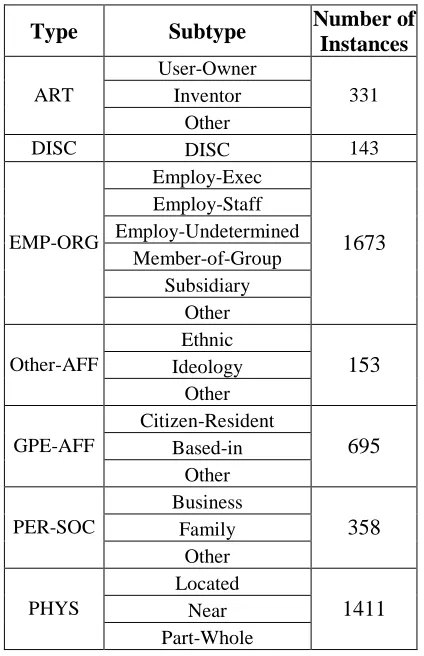
Table 1. Types and subtypes of ACE relations
Table 1 lists the types and subtypes of relations for the ACE RDC task. Here, we present an exam-ple for those relations:
Spain’s Interior Minister an-nounced this evening the ar-rest of separatist
organization Eta’s presumed leader Ignacio Garcia Ar-regui. Arregui, who is con-sidered to be the Eta
organization’s top man, was arrested at 17h45 Greenwich. The Spanish judiciary sus-pects Arregui of ordering a failed attack on King Juan Carlos in 1995.
In this fragment, all the underlined phrases are mentions to Eta organization, or to “Garcia
Ar-regui”. There is a management relation between leader which references to “Garcia Arregui” and Eta.
5.2 Baseline System
The base line system uses a Maximum Entropy model that combines diverse lexical, syntactic and semantic features derived from text, like the sys-tem described in (Nanda, 2004). The syssys-tem was trained on the ACE training data provided by LDC. The training set contained 145K words, and 4764 instances of relations, the number of instances cor-responding to each relation is shown in Table 1.
The test set contained around 41K words, and 1097 instances of relations. The system was evalu-ated using standard ACE evaluation procedure. ACE evaluation procedure assigns the system an ACE value for each relation type and a total ACE value. The ACE value is a standard NIST metric for evaluating relation extraction. The reader is referred to the ACE web site (ACE, 2004) for more details.
5.3 PatternConstruction
We used the baseline system described in the pre-vious section to label a large amount of unsuper-vised data. The data comes from LDC English Gigaword corpus, Agence France Press English Service (AFE). The data contains around 3M words, from which 80K instances of relations have been extracted.
We start by extracting a set of patterns that rep-resent the supervised and unsupervised data. We consider each relation type separately and extract a pattern for each instance in the selected relation. The pattern we used consists of a mix between the part of speech (POS) tags and the mention tags for the words in the training instance. We use the men-tion tag, if it exists; otherwise we use the part of speech tag. An example of a pattern is:
Text: Eta’s presumed leader Arregui …
5.4 Tuples Clustering
As discussed in the previous section, the tuple space should be reduced to allow more matching between pattern-tuple pairs. This space reduction could be accomplished by seeking a tuple similar-ity measure, and constructing a weighted undi-rected graph of tuples. Two tuples are linked with an edge if their similarity measure exceeds a cer-tain threshold. Graph clustering algorithms could be deployed to partition the graph into a set of ho-mogeneous communities or clusters. To reduce the space of tuples, we seek a matching criterion that group similar tuples together. Using WordNet, we can measure the semantic similarity or relatedness between a pair of concepts (or word senses), and by extension, between a pair of sentences. We use the similarity measure described in (Wu and Palmer, 1994) which finds the path length to the root node from the least common subsumer (LCS) of the two word senses which is the most specific word sense they share as an ancestor. The similar-ity score of two tuples, ST, is calculated as follows:.
2 2 2
1 E
E
T S S
S = + (9)
where SE1, and SE2 are the similarity scores of the
first entities in the two tuples, and their second en-titles respectively.
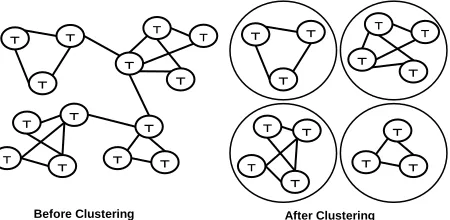
The tuple matching procedure assigns a similarity measure to each pair of tuples in the dataset. Using this measure we can construct an undirected graph G. The vertices of G are the tuples. Two vertices are connected with an edge if the similarity meas-ure between their underlying tuples exceeds a cer-tain threshold. It was noticed that the constructed graph consists of a set of semi isolated groups as shown in figure 3. Those groups have a very large number of inter-group edges and meanwhile a rather small number of intra-group edges. This im-plies that using a graph clustering algorithm would eliminate those weak intra-group edges and pro-duce separate groups or clusters representing simi-lar tuples. We used Markov Cluster Algorithm (MCL) for graph clustering (Dongen, 2000). MCL is a fast and scalable unsupervised cluster algo-rithm for graphs based on simulation of stochastic flow.
A bipartite graph of patterns and tuple clusters is constructed. Weights are assigned to patterns and tuple clusters by iteratively applying the HITS with Priors’ algorithm. Instances associated with highly
[image:6.612.317.542.126.236.2] [image:6.612.312.547.275.478.2]ranked patterns are then added to the training data and the model is retrained. Samples of some highly ranked patterns and corresponding matching text are introduced in Table 2.
Figure 3: Applying Clustering Algorithms to Tuple graph
Pattern Matches
GPE PERSON PERSON PERSON
Zimbabwean President Robert Mugabe GPE POS PERSON
PERSON
Zimbabwe 's President Robert Mugabe
GPE JJ PERSON American diplomatic
per-sonnel
PERSON IN JJ GPE candidates for local gov-ernment
ORGANIZATION
PERSON Airways spokesman
ORGANIZATION
PERSON Ajax players
PERSON IN DT JJ ORGANIZATION
chairman of the opposition parties
ORGANIZATION
PERSON parties chairmans
Table 2: Examples of patterns with high weights
6 Results and Discussion
We train several models like the one described in section 5.2 on different training data sets. In all experiments, we use both the LDC ACE training data and the labeled unsupervised data induced with the graph based approach we propose. We use the ACE evaluation procedure and ACE test cor-pus, provided by LDC, to evaluate all models.
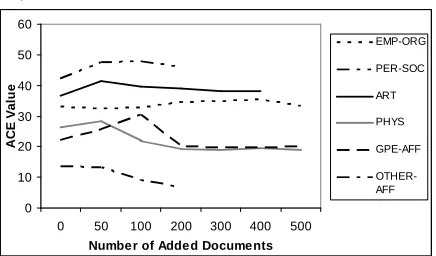
We incrementally added labeled unsupervised data to the training data to determine the amount of data after which degradation in the system per-formance occurs. We sought this degradation point separately for each relation type. Figure 4 shows the effect of adding labeled unsupervised data on
T
T T
T T
T
T T
T
T
T
T
T T
T
T T
T T
T
T T
T
T
T
T
T T
the ACE value for each relation separately. We notice from figure 4 and table 1 that relations with a small number of training instances had a higher gain in performance compared to relations with a large number of training instances. This implies that the proposed approach achieves significant improvement when the number of labeled training instances is small but representative.
.
0 10 20 30 40 50 60
0 50 100 200 300 400 500
Number of Added Documents
A
C
E
V
a
lu
e
EMP-ORG PER-SOC ART PHYS GPE-AFF OTHER-AFF
Figure 4: The effect of adding labeled unsuper-vised data on the ACE value for each relation. The average number of relations per document is 4.
From figure 4, we determined the number of training instances resulting in the maximum boost in performance for each relation. We added the training instances corresponding to the maximum boost in performance for all relations to the super-vised training data and trained a new model on them. Figure 5 compares the ACE values for each relation in the base line model and the final model
The total system ACE value has been improved by 10% over the supervised baseline system. All relation types, except the DSC relation, had sig-nificant improvement ranging from 7% to 30% over the baseline supervised system. The DISC relation type had a small degradation; noting that it already has a low ACE value with the baseline sys-tem. We think this is due to the fact that the DISC relation has few and inconsistent examples in the supervised data set.
To assess the usefulness of the smoothing method employing WordNet distance, we repeated the experiment on EMP-ORG relation without it. We found out that it contributed to almost 30% of the total achieved improvement. We also repeated the experiment but with considering hub scores instead of authority scores. We added the examples associated with highly ranked tuples to the training set. We noticed that using hub scores yielded very
little variation in the ACE value (i.e. 0.1 point for EMP-ORG relation).
0 10 20 30 40 50
A
C
E
V
a
lu
e
BaseLine 36.7 6 33.1 22.3 23.6 42.2 26.4 30.5 Final Model 39.6 4.2 35.8 24.7 30.8 46.6 28.2 33.5
ART DISC EMP-ORG
GPE-AFF
OTHE R-AFF
PER-SOC PHYS TOTAL
Figure 5: A comparison of base line ACE values, and final ACE values for each relation.
To evaluate the quality and representativeness of the labeled unsupervised data, acquired using the proposed approach, we study the effect of replac-ing supervised data with unsupervised data while holding the amount of training data fixed. Several systems have been built using mixture of the su-pervised and the unsusu-pervised data. In Figure 6, the dotted line shows the degradation in the system performance when using a reduced amount of su-pervised training data only, while the solid line shows the effect of replacing supervised training data with unsupervised labeled data on the system performance. We notice from Figure 6 that the un-supervised data could replace more than 50% of the supervised data without any degradation in the system performance. This is an indication that the induced unsupervised data is good for training the classifier.
26 27 28 29 30 31 32 33 34
0% 25% 50% 75%
100% 75% 50% 25%
Percentage of Unsupervised/Supervised Data
A
C
E
V
a
lu
e Sup + Unsup
Data Sup Data Only
[image:7.612.74.292.174.302.2]Unsupervised Supervised
of replacing portions of the supervised data with labeled training data.
7 Conclusion
We introduce a general framework for semi-supervised learning based on mutual reinforcement in graphs. We construct generalized extraction pat-terns and deploy graph based mutual reinforcement to automatically identify the most informative pat-terns. We provide motivation for our approach from a graph theory and graph link analysis per-spective.
We present experimental results supporting the applicability of the proposed approach to ACE Re-lation Detection and Characterization (RDC) task, demonstrating its applicability to hard information extraction problems. Our approach achieves a sig-nificant improvement over the base line supervised system especially when the number of labeled in-stances is small.
8 Acknowledgements
We would like to thank Nanda Kambhatla for pro-viding the ACE baseline system. We would also like to thank Salim Roukos for several invaluable suggestions and guidance. Finally we would like to thank the anonymous reviewers for their construc-tive criticism and helpful comments.
References
ACE. 2004. The NIST ACE evaluation website.
http://www.nist.gov/speech/tests/ace/
Avrim Blum, and Tom Mitchell. 1998. Combining
La-beled and UnlaLa-beled data with Co-training.
Proceed-ings of the 11th Annual Conference on
Computational Learning Theory.
Avrim Blum and Shuchi Chawla. 2001. Learning From
Labeled and Unlabeled Data Using Graph Mincuts.
Proceedings of International Conference on Machine Learning (ICML).
Avrim Blum, John Lafferty, Mugizi Rwebangira, and Rajashekar Reddy. 2004. Semi-supervised Learning
Using Randomized Mincuts. Proceedings of the
In-ternational Conference on Machine Learning (ICML).
Stijn van Dongen. 2000. A Cluster Algorithm for
Graphs. Technical Report INS-R0010, National
Re-search Institute for Mathematics and Computer Sci-ence in the Netherlands.
Stijn van Dongen. 2000. Graph Clustering by Flow
Simulation. PhD thesis, University of Utrecht
Radu Florian, Hany Hassan, Hongyan Jing, Nanda Kambhatla, Xiaqiang Luo, Nicolas Nicolov, and Salim Roukos. 2004. A Statistical Model for
multi-lingual entity detection and tracking. Proceedings of
the Human Language Technologies Conference (HLT-NAACL’04).
Dayne Freitag, and Nicholas Kushmerick. 2000.
Boosted wrapper induction. The 14th European
Con-ference on Artificial Intelligence Workshop on Ma-chine Learning for Information Extraction
Taher Haveliwala. 2002. Topic-sensitive PageRank. Proceedings of the 11th International World Wide Web Conference
Thorsten Joachims. 2003. Transductive Learning via
Spectral Graph Partitioning. Proceedings of the
In-ternational Conference on Machine Learning (ICML).
John Kleinberg. 1998. Authoritative Sources in a
Hy-perlinked Environment. Proceedings of the. 9th
ACM-SIAM Symposium on Discrete Algorithms.
Nanda Kambhatla. 2004. Combining Lexical, Syntactic,
and Semantic Features with Maximum Entropy Mod-els for Information Extraction. Proceedings of the
42nd Annual Meeting of the Association for Compu-tational Linguistics
Ted Pedersen, Siddharth Patwardhan, and Jason Mich-elizzi, 2004, WordNet::Similarity - Measuring the
Relatedness of Concepts. Proceedings of Fifth
An-nual Meeting of the North American Chapter of the Association for Computational Linguistics (NAACL-2004)
Scott White, and Padhraic Smyth. 2003. Algorithms for
Discoveing Relative Importance in Graphs.
Proceed-ings of Ninth ACM SIGKDD International Confer-ence on Knowledge Discovery and Data Mining.
Zhibiao Wu, and Martha Palmer. 1994. Verb semantics
and lexical selection. Proceedings of the 32nd
An-nual Meeting of the Association for Computational Linguistics.
Xiaojin Zhu, Zoubin Ghahramani, and John Lafferty. 2003. Semi-supervised Learning using Gaussian
Fields and Harmonic Functions. Proceedings of the