Effective Structural Inference for Large XML Documents
Jason Sankey
Raymond K. Wong
School of Computer Science & Engineering
University of New South Wales
Sydney 2052, Australia
Abstract
This paper investigates methods to automatically infer structural information from large XML doc-uments. Using XML as a reference format, we ap-proach the schema generation problem by applica-tion of inductive inference theory. In doing so, we re-view and extend results relating to the search spaces of grammatical inferences for large data set. We evaluate the result of an inference process using the concept of Minimum Message Length. Comprehen-sive experimentation reveals our new hybrid method to be the most effective for large documents. Finally tractability issues, including scalability analysis, are discussed.
1
Introduction
Given the recent emergence of XML, there are many problems that must be solved to facilitate its most effective use. Amongst the most important of these involves addressing the differences between the new, loosely formatted data and traditional, structured data. Clearly, the ability to infer the structure of XML documents would be a very powerful tool for bridging the gap. Given such a method of infer-ence, XML information may be handled in more ef-fective ways without loosing the advantage of flex-ibility. There are still many possible approaches to the problem, and correspondingly many suitable outcomes. For this reason it is best to firstly de-rive a suitable measure for the quality of an inferred DTD. As will be seen in section 3.1, determining the relative utility of content models is a task in itself. This paper extends the hybrid method from our pre-vious work (Sankey & Wong 2001) to automatically infer structural information from large XML docu-ments. Comprehensive experimentation reveals the proposed method to be the most effective for large documents.
The paper is presented in the following fashion. Section 2 provides details of previous work in this and related fields. Section 3 provides an overview of our solution method, followed by details of the inference algorithms in section 4. Section 5 includes comprehensive testing for large models and section
6 discusses the tractability considerations, followed by conclusions in section 7.
2
Previous Work
gen-eralisation and factoring of regular expressions, with information theoretic principles used to choose a fi-nal result from a pool of candidates. In contrast, we propose a hybrid method which employs various principles throughout the inference process, with the aim of producing a more general method.
3
Overview of Solution
The major grammatical inference methods fall into a few general categories. One of these categories in-cludes a family of algorithms known as state merging methods. A state merging method typically begins by constructing what is known as a Prefix Tree Automaton (PTA) from the positive examples of the language to be inferred. If we let the set of pos-itive examples be R+, then the prefix tree forR+
(P T A(R+)) may be constructed as follows. We
be-gin with an automaton that simply accepts the first string in R+. Then we iterate over the rest of the strings in R+ and for each one follow transitions in the automaton for as many symbols as possible. When a symbol is found that does not match a valid transition, the PTA is augmented with a new path to accept the rest of the string. In particular, a Probabilistic Finite State Automaton(PFSA) is merely an automaton with probabilities associated with each transition and final state. This is impor-tant both for some of the inference methods and for evaluating the quality of solutions.
3.1 Evaluating a Solution
To measure the quality of the inferred DTD, we use the concept of Minimum Message Length (MML) (Georgeff & Wallace 1984). In particular, we adapt the formula developed for PFSA (Raman 1997) as below:
M M L(A) =
N
X
j=1
log2 (tj−1)! (mj−1)!Qmj
i=1(nij−1)!
+M(log
2V + 1) +M0log2N
−log2(N−1)!
where:
• N is the number of states in the PFSA
• V is the cardinality of the alphabet plus one
• tj is the number of times the jth state is visited
• mj is the number of arcs from the jth state (plus
one for final states)
• m0j is the number of arcs from the jth state (no
change for final states)
• nij is the frequency of the ith arc from the jth state
• M is the sum of allmj values and
• M0is the sum of allm0j values
3.2 Implementation
One of the goals of this work was to both pro-duce new inference methods and make comprehsive comparisons with existing techniques. This en-tailed a significant amount of implementation that consists of several modules to perform stages of the inference process. The most important stage in-volves PTA generalisation using the inference meth-ods. These methods fall into two broad categories, which are labelled generalisation and optimisation in the implementation. The first of these consists of the Merge methods with its pseudo-code shown in algorithm 1.
Algorithm 1GeneralisePTA
Input: A PTA A to be generalised, a merge crite-rioncriterion
Output: The generalised form ofA
Method: 1. repeat
2. forall pairs (s1, s2) of states inA do
3. if criterion(s1, s2)then
4. A.merge(s1, s2)
5. criterion.f orcedM erges(A)
6. if criterion.determinise()then
7. determinise(A)
8. end if
9. end if 10. end for
11. untilno more merges are possible 12. if not criterion.determinise()then 13. determinise(A)
14. end if 15. returnA
4
Inference Algorithms
4.1 Reference Methods
Several previously applied methods were imple-mented to evaluate their relative performance. Two such algorithms are those applied by Ahonen in (Ahonen 1996), the first known paper to address DTD generation using tradition grammatical infer-ence methods. These methods are theoretically ap-pealing, as they guarantee to infer languages falling within certain language classes. These classes are termed k-contextual and (k, h)-contextual, so named as they assume the structure to be inferred to have limited context. It is not clear whether this assump-tion is valid in practice, however. Another method applied to DTD generation ((Young-Lai 1996)), is derived from more recent work in grammatical in-ference. The base algorithm is known as Alergia, introduced in (Carrasco & Oncina 1994b). The cri-terion for state equivalence in Alergia is based upon observed frequencies of transitions and finalities of a pair of states. As with the methods of Ahonen, Aler-gia has strong theoretical appeal. Again, though, we are interested in practical performance. Further to the methods described above, we devised two ba-sic optimisation strategies against which to bench-mark the results of our main algorithm. The first of these, termed the Greedy method, is a straight-forward steepest-descent algorithm which employs incremental MML calculation to optimise a PTA. Along with this a weighted stochastic hill-climbing method was implemented, which also used incremen-tal MML calculation. These two methods illustrate the need for more sophisticated optimisation algo-rithms.
4.2 The sk-strings Method
The sk-strings method actually consists of a family of algorithms, described in (Raman & Patrick 1997) and in more detail in (Raman 1997), of which five were implemented. The basis of these algorithms is an extension upon the k-tails heuristic of Biermann and Feldman (Biermann & Feldman 1972), which in turn is a relaxed variant of the Nerode equiva-lence relation. Under the Nerode relation, a pair of states are equivalent if they are indistinguishable in the strings that may be accepted following them. The k-tails criterion relaxes this to only considering these strings (tails) up to a given length (k.) The sk-strings method is extended using stochastic au-tomata, and considers only the topspercent of the most probable k-strings. The k-strings differ from k-tails in that they are not required to end at a fi-nal state, unless they have length less than k. The probability of a k-string is calculated by taking the product of the probabilities of the transitions exer-cised by that k-string.
The Ant Colony Optimisation (ACO) meta-heuristic is a relatively new optimisation technique. First de-scribed in (Dorigo et al. 1991), the method uses a positive feedback technique for searching in a simi-lar manner to actual ants. In biological experiments it was revealed that insect ants cooperated in find-ing shortest paths by leavfind-ing pheromone trails as they walked. An ant traveling back and forth along a short path increases the pheromone level on that path more rapidly than an ant using a longer path, thus influencing more ants to take the shorter route. The effect is then self-reinforcing until eventually all ants will choose the shorter path. ACO algorithms mimic this technique using artificial ants to search out good solutions to optimisation problems.
The ACO heuristic operates over several iterations to allow the positive feedback of the pheromones to take effect. In each iteration, the artificial ants nav-igate the search space using only a simple heuris-tic, but as they move they leave pheromones on the trail they follow. In some variants, including the one used in this work, the pheromone placement is de-layed until the end of an iteration, when all ants have completed a full walk. At this point the amount of pheromone assigned to each ant is weighted with re-spect to the quality of the solution it found. Thus moves involved in higher quality solutions are more likely to be chosen by ants in future iterations. Al-though ants acting by themselves are only capable of finding relatively poor solutions, working in cooper-ation they may approach higher quality ones. After a certain number of iterations without improvement to the best solution found the algorithm terminates.
4.4 The Proposed Hybrid Method
The new method thus incorporates both the sk-strings and ACO heuristics at each step of the infer-ence process. It is most easily described as a mod-ified version of the ACO technique with the ants guided by an sk-strings criterion. The guiding is made progressively weaker as the model becomes smaller, to allow the advantages of the ACO method for smaller models to take effect. The key of this new method is a new algorithm for the ant move selec-tion as shown in algorithm 2. In particular in line 4, a merge must pass the sk-strings criterion to be con-sidered. The outer while loop on line 2 and if state-ment on line 11 combine to progressively weaken the sk-strings criterion when it has become too strict. Eventually the criterion will be weak enough to let all merges pass, and the algorithm will behave iden-tically to the original version.
Algorithm 2sk-antMoveSelector
Input: A set of all state pairs merges, an ant heuristic heuristic, an ant weighting function
weighting, a pheromone tablepheremonesand
an sk-strings criterionskCriterion.
Output: A state pair representing the chosen merge.
Method:
1. choices←[ ]
2. whilechoices.size() = 0do
3. formergein mergesdo
4. if skCriterion(merge)then
5. h←heuristic(merge)
6. p←pheremones[merge]
7. value←weighting(h, p)
8. choices.add((value, merge))
9. end if
10. end for
11. if choices.size() = 0then
12. skCriterion.weaken()
13. end if 14. end while
15. returnstochasticChoice(choices)
5
Experimental Results
To fulfill our goal of comprehensive testing, we ap-plied three sets of tests. The first two of these used generated data, which allowed systematic experi-mentation on widely varied input. The other test set consisted of a few models chosen from real data, to illustrate the nature of the models inferred by the sk-ANT method. In each test the algorithms were run with a range of input parameters, and the results from each run combined.
0 20 40 60 80 100
ACO Alergia Greedy k-con k-h-con sk-ANT sk-ALL sk-AND sk-LAX sk-OR sk-STRICT sk-XEN Stochastic
Algorithm
[image:4.612.339.514.73.236.2]Frequency from 100 Trials Best Average Best Overall
Figure 1: Success rates for large models
5.1 Inference of Large Models
The larger data set also consisted of 100 sample files generated from random PFSA. In this case the PFSA had a maximum of 20 states with an alpha-bet cardinality of 8. For each of these a total of 25 strings were generated giving an average PTA size of 143.38 states. On average the inferred models were larger than for the small data set, though they ranged from an average of 1.23 to 142.74 states for differing algorithms.
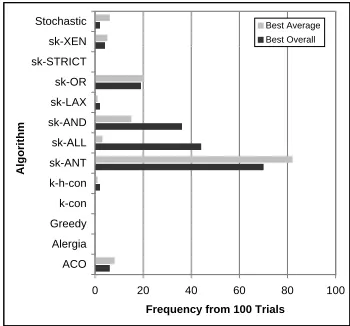
Figure 1 shows the success rates of each algorithm in inferring models with the lowest MML values. For each algorithm, two results have been shown. The first is the frequency of inferring the best model over-all, by choosing the best of the algorithm’s attempts. The second is the frequency of obtaining the best average performance, derived by averaging all of the algorithm’s attempts before ranking. The best over-all performance is most important, whilst the best average indicates stability across different input pa-rameters. In particular, sk-ALL denotes the imple-mentation of sk-strings with five variants from its family (refer to (Raman 1997) for details of different variants). The results show the poor performance of both the Stochastic and ACO methods, and the clear dominance of the sk-ANT heuristic. The poor performance of the ACO and Stochastic methods is likely due to the large search space. The heuris-tic guidance used in the sk-ANT method clearly overcomes this difficulty, producing the best results. Other poor algorithms are desirable due to their sim-plicity and efficiency, but are lacking in quality of solutions found.
Deviation (%) Deviation (%) ACO 31.57 154.87 Alergia 32.44 86.58 Greedy 173.46 574.48 k-contextual 30.39 84.15 (k, h)-contextual 21.57 58.57 sk-ANT 2.81 28.52 sk-ALL 3.15 20.51 Stochastic 36.40 159.11
Table 1: Deviation from the best model inferred (large data set)
proved to be the best in terms of average devia-tion at 2.81%. Thus the newer method is preferable if only one choice is allowed. On the other hand, the sk-ALL heuristic was better in terms of worst-case performance, though the deviation is still rather high. Again, some applications may need to employ a combination of difference methods to achieve bet-ter worst-case results.
The experiments have revealed many interesting points. Firstly, the k-contextual, (k, h)-contextual and Alergia methods previously applied to this prob-lem have been shown to perform poorly. Although the papers describing their use extend the algo-rithms and employ refining operations, it appears that other methods are a more appropriate starting point. We have also seen that the simple Greedy and Stochastic methods cannot match the performance of more complicated techniques. This highlights the difficulties inherent in the search space of grammat-ical inference. The sk-strings method developed in (Raman 1997) has proven to be much more effective, provided combined results from all of the heuristics are used. A major contribution to its success may lie in its use of statistical data in the inference process. The ACO algorithm’s failure on large testing data led to a new method which we have named sk-ANT. This new hybrid algorithm proved to be the most effective by a considerable margin, and is thus the algorithm of choice. Where worst case guarantees are required, we recommend using combined results of both the sk-ANT and sk-ALL methods.
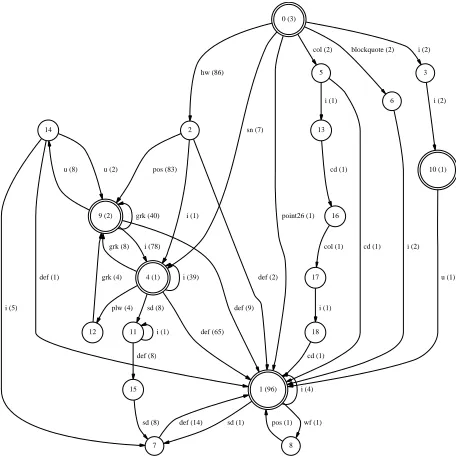
5.2 Real Data Set: Webster’s p Element The real data set we used was an extract of the dig-ital form of the 1913 Webster Unabridged Dictio-nary. The dictionary format is almost compatible with SGML, and after some preprocessing we were able to extract the structural information in XML format. Only a small subset of the entire dictionary was used, due to its overwhelming size. We selected the paragraph element ‘p’, which is used to group to-gether the information pertaining to each dictionary word, for the experiment. This particular element was chosen as it exhibits a rather complex and vari-able structure. This is in contrast to the structure
17
18 i (1)
1 (96) cd (1)
i (4)
7
sd (1)
8 wf (1) def (14) pos (1) 14
def (1)
i (5)
9 (2) u (2)
def (9) u (8)
grk (40)
4 (1) i (78)
5
cd (1) 13
i (1)
16 cd (1)
11 i (1)
15 def (8)
sd (8) 2
def (2) pos (83)
i (1)
def (65) grk (8)
sd (8) i (39)
12 plw (4)
6
i (2) point26 (1)
col (2)
hw (86)
sn (7)
blockquote (2)
3 i (2)
10 (1) i (2)
grk (4) u (1)
[image:5.612.319.547.71.299.2]col (1)
Figure 2: Best model for the ‘p’ element
of the other models chosen from real data sets, with the intent being to stretch the capabilities of the sk-ANT method.
The inferred model is shown in figure 2. Observe the dominant path through states 0, 2, 9, 4 and 1. It is most important that this path is preserved, with the rest of the structure accounting for exceptions and noise in the data. Such irregularity is a fact of life when dealing with semi-structured data such as XML.
6
Tractability Considerations
The goals of grammatical inference such as the struc-tural inference presented in this paper require not only that our methods be effective, but also that they are useful in practice. For this reason, we inves-tigate the complexity of our new algorithm of choice, namely sk-ANT. Coverage of the tractability of the other algorithms may be found in the original papers in which they are presented ((Ahonen 1996), (Car-rasco & Oncina 1994b) and (Raman 1997).) In our testing, we found that the sk-ANT method was the most expensive in terms of running time. This did not provide an obstacle for the experimental data, but may become important when working with very large PTA (several thousand states) or under tight time constraints. Fortunately, in practice, a model for typical large XML documents would be normally fewer than one hundred states.
[image:5.612.81.289.72.172.2]0 20 40 60 80 100 120 140
0 20 40 60 80 100 120 140 160
CPU time (secs)
PTA size
[image:6.612.74.301.75.236.2]sk-ANT cubic
Figure 3: Empirical measure of sk-ANT complexity
the PFSA being inferred has r states, there are (r 2) such merges. This may be expanded to give:
r(r−1)
2
merges considered. As the algorithm proceeds from the full number of states, say n, until there is just one state, the total number of merges considered is:
2
X
r=n
r(r−1)
2
These merges are considered by all ants, introducing an extra constant factor. This factor does not influ-ence the asymptotic complexity, however, which is clearly O(n3
). Although not unmanageable, there are applications for which this complexity may be too great.
6.1 Measured Scalability
To complement the theoretical analysis, we also formed a simple empirical test to measure the per-formance of the algorithm in practice. The test was performed on PTA with sizes ranging from 10 to 150 states, with several of each size. Keeping in line with the experimental results shown earlier, we used the same range of parameters and averaged the results for each PTA size.
Figure 3 shows a graph of the obtained timing val-ues. The points give the actual values for each PTA size, with a bezier approximation shown using a solid line. For comparison, we have also included a cubic function, shown with the dotted line. Clearly the analytical result corresponds well to the empirical measurement, with the cubic function proving to be a reasonable approximation of the points. Note that the individual CPU times shown are not of partic-ular interest, as the primary goal of the implemen-tation was not efficiency. Profiling has shown that there is scope for improvement, though of course the asymptotic growth will remain the dominant factor.
6.2 Discussion
The analytical and empirical analysis of the sk-ANT algorithm have both shown it to have asymptotic complexity of O(n3
). In practice, this is quite ac-ceptable for a wide range of applications. Where it is not acceptable, there are several alternatives. A simple one would be to employ one of the more ef-ficient algorithms until the PFSA inferred reaches a small enough size to seed the sk-ANT method. A more complicated method may use a modified sk-ANT heuristic that employs approximations, and perhaps limits the size of the neighbourhood exam-ined by each individual ant. Such a method may be able to reduce the complexity to O(n2
), though it has not been thoroughly investigated. Cases where large amounts of data are involved can often be bro-ken down into several sub-problems to make them manageable. For instance, in a database where doc-uments are drawn from many sources, it may be ap-propriate to treat each data source separately. In-deed, this is a requirement for many applications. In other cases, it is feasible to take a sample of the data to use for inference, as the sk-ANT algorithm has been shown to perform well on sparse examples.
7
Conclusion
We have addressed the problem of structural infer-ence for large XML documents. In doing so we began by motivating the research and reviewing the litera-ture. The use of Minimum Message Length as a mea-sure for the quality of inferred content models has been introduced, adapted from work in related fields. This measure has proven to be an appropriate and a vast improvement over previous subjective tech-niques. We have also presented the first wide spread comparison of different grammatical inference tech-niques. This involved the implementation of the ex-isting Alergia, k-contextual, (k, h)-contextual and sk-strings methods, as well as the creation of new algorithms. The new methods include the Greedy strategy, the ACO meta-heuristic, Stochastic Hill Climbing and our proposed, hybrid sk-ANT heuris-tic. Comprehensive experimental data revealed that our proposed method was the most effective and most stable of the methods, followed by the sk-strings heuristic. From this work we may conclude that the problem of structural inference is both im-portant and tractable. For current applications we recommend use of the sk-ANT technique. The use of MML as a quality measure is also recommended, due to its generality and objectivity.
References
finite-state machines from samples of their behaviour. IEEE Transactions on Computers, 21:591–597, 1972. R C Carrasco and J Oncina (editors).Grammatical
In-ference and Applications. Proceedings of the Second International Colloquium on Grammatical Inference (ICGI-94), Lecture Notes in Artificial Intelligence 862, Springer-Verlag 1994.
R C Carrasco and J Oncina.Learning Stochastic Regu-lar Grammars by Means of a State Merging Method. In R C Carrasco and J Oncina (editors) (Carrasco & Oncina 1994a).
J Chen.Grammar Generation and Query Processing for Text Databases. Research proposal, University of Wa-terloo, January 1991.
M Dorigo, V Maniezzo and A Coloni.Positive Feedback as a Search Strategy. Technical Report 91–016, Di-partmento di Elettronica, Politecnico di Milano, Italy, 1991.
P Fankhauser and Y Xu.Markitup! An Incremental Ap-proach to Document Structure Recognition. Electronic Publishing - Origination, Dissemination and Design, 6(4):447–456, 1994.
M Garofalakis, A Gionis, R Rastogi, S Seshadri and K Shim.XTRACT: A System for Extracting Document Type Descriptors from XML Documents. In Proceed-ings of SIGMOD 2000, pages 165–176, Dallas, TX, 2000.
M P Georgeff and C S Wallace.A General Selection Cri-terion for Inductive Inference. In T O’Shea (editor), ECAI-84: Advances in Artificial Intelligence, pages 473–481. Dordretch: Elsevier, 1984.
L Pitt. Inductive Inference, DFA’s and Computational Complexity. In J Siekmann (editor), Proceedings of the International Workshop AII ’89, Lecture Notes in Artificial Intelligence 397, pages 18–44, Springer-Verlag 1989.
A V Raman and J D Patrick. The sk-strings method for inferring PFSA. In Proceedings of the 14th Inter-national Conference on Machine Learning, ICML’97, 1997.
A V Raman.An Information Theoretic Approach to Lan-guage Relatedness. PhD Thesis, Massey University, 1997.
Y Sakakibara. Recent Advances in Grammatical In-ference. Theoretical Computer Science Volume 185, Number 1, October 1997.
J Sankey and R K Wong. Structural Inference for Semistructured Data. In Proceedings of the ACM In-ternational Conference on Information and Knowledge Management, CIKM’01, 2001.
K Shafer. Creating DTDs via the GB-engine and Fred. Available athttp://www.oclc.org/fred/, 1995. M D Young-Lai. Application of a Stochastic