Structured and Extended Named Entity Evaluation
in Automatic Speech Transcriptions
Olivier Galibert1 Sophie Rosset2 Cyril Grouin2 Pierre Zweigenbaum2 Ludovic Quintard1
1LNE, Trappes, France 2 LIMSI–CNRS, Orsay, France
[email protected] [email protected]
Abstract
The evaluation of named entity recogni-tion (NER) methods is an active field of research. This includes the recognition of named entities in speech transcripts. Evaluating NER systems on automatic speech recognition (ASR) output whereas human reference annotation was prepared on clean manual transcripts raises difficult alignment issues. These issues are empha-sized when named entities are structured, as is the case in the Quaero NER challenge organized in 2010. This paper describes the structured named entity definition used in this challenge and presents a method to transfer reference annotations to ASR out-put. This method was used in the Quaero 2010 evaluation of extended named entity annotation on speech transcripts, whose results are given in the paper.
1 Introduction
Named Entity Detection has been studied since the MUC conferences in 1987. The notion has been extended to deal with mono- or multi-word ex-pressions that belong to a potentially interesting class for an application. Given a set of entity defi-nitions and a natural language corpus, systems try to extract and categorize all the relevant occurring entities. These entities can be used to feed further systems such as Information Retrieval, Question-Answering, Distillation, Terminology studies, etc. Traditional Named Entity Recognition (NER) is a task where proper nouns and numerical ex-pressions are extracted from documents and clas-sified into categories (person, location, organiza-tion, date, etc.). As shown by Voorhees and Har-man (2000), it is a key technology of Information Extraction (IE) and Open-Domain Question An-swering. NER is also used as a fundamental
com-ponent in a variety of language processing appli-cations such as text clustering, topic detection, and summarization.
While significant progress has been reported on the NER task, most of these approaches have gen-erally focused on clean textual data such as Sang and Meulder (2003). In the mean time, Kubala et al. (1998), Palmer et al. (1999), Turmo et al. (2009) and many others have focused on speech data. Named Entity detection evaluation over French spoken data has been proposed within the Ester II project, as described by Galliano et al. (2009).
Within the framework of theQuaeroproject,we proposed an extended named entity definition with compositional and hierarchical structure. This ex-tension raises new issues and challenges in NER evaluation. First, as we shall explain below in more detail, the usual evaluation methods can-not compute the Slot Error Rate (SER) metric when named entities are compositional and recur-sive. Second, following Burger et al. (1998) and Hirschman et al. (1999), we consider that the eval-uation of named entity recognition on noisy text output by automatic speech recognition (ASR) systems should take as reference the named enti-ties found in the human annotation of a human-transcribed text: what should have been there in the ASR output. This requires to project the clean reference to the noisy text, which is made all the more difficult because of the compositional and hi-erarchical structure of the named entities.
The remainder of the paper is structured as fol-lows. We first present the extended named entities in Section 2, then the evaluation protocol in Sec-tion 3 with specific metrics adapted to the structure of the evaluated objects and data. Section 4 illus-trates their use in a challenge and discusses system results in this challenge. Finally in Section 5 we conclude and draw perspectives for further work.
2 Extended Named Entities
In this section, we present our extension to named entities, starting with related work (Section 2.1) and specifying their scope (Section 2.2). Our en-tities are hierarchical (Section 2.3) and composi-tional (Section 2.4). Section 2.5 provides a dis-cussion of the issues they raise in the evaluation of named entity recognition from speech transcripts.
2.1 Named Entity Types
Named Entity recognition was initially defined as recognizing proper names (Coates-Stephens, 1992). Since MUC-6 (Grishman and Sundheim, 1996), named entities are proper names catego-rized into three major classes: persons, loca-tions and organizaloca-tions. Proposals have been made to sub-divide these entities into finer-grained classes. For example, politicians for the person class by Fleischman and Hovy (2002) or cities for the location class by Fleischman (2001) as well as Lee and Lee (2005).
The CONLL conference added a miscellaneous type which includes proper names outside the pre-vious classes. Some classes are sometimes added, e.g. product by Bick (2004). Some numerical types are also often described and used in the lit-erature: date, time, and amounts (money and per-cents in most cases).
Specific entities have been proposed and han-dled for some tasks, e.g. language and shape by Rosset et al. (2007), or email address and phone number (Maynard et al., 2001). In specific do-mains, entities such as gene, protein, DNA etc. are also addressed (Ohta, 2002) and campaigns are organized for gene/protein detection (Kim et al., 2004; Galibert et al., 2010)). More recently larger extensions have been proposed: Sekine (2004) de-fined a complete hierarchy of named entities con-taining about 200 types.
2.2 Scope
Named Entities often include four major groups: name, quantity, date and duration. The overall task in which we frame information extraction is the extraction of entities and relations to build a fact base from news sources. We thus decided to start from the traditional named entities used in in-formation extraction from newspaper corpora. We then included named entities extensions proposed by Sekine (2004) for products and Galliano et al. (2009) for functions, and we extended the
defini-tion of named entities to some expressions which are not composed of proper names (e.g., phrases built around substantives).
In this work, we decided to extend the cover-age of the named entities rather than sub-dividing the existing classes as it has been done in previ-ous work. As we aimed to build a fact database from news data, we chose to support new kinds of entities (time, function, etc.) in order to ex-tract a maximum of information from the corpus we processed. Compared to existing named entity structuration, our approach is more general than the extensions that have been done for specific do-mains, and is simpler than the complete hierarchy defined by Sekine (2004). This structure allows us to cover a large amount of named entities with a basic categorization so as to be quickly suitable for all further annotation work. The extended named entities we defined are both hierarchical and com-positional (Grouin et al., 2011). This hierarchical and compositional nature of the extended named entities imply a specific method when evaluating system outputs (see Section 3).
2.3 Hierarchy
We used two kinds of elements: types and com-ponents. The types with their subtypes categorize a named entity. While types and subtypes were used previously, we consider that structuring the contents of an entity (its components) is important too. Components categorize the elements inside a named entity.
Types and subtypes refer to the general cate-gory of a named entity. They give general infor-mation about the annotated expression. The tax-onomy is composed of 7 types and 32 sub-types:
• Person: pers.ind (invidual person), pers.coll
(collectivity of persons);
• Location: administrative (loc.adm.town,
loc.adm.reg, loc.adm.nat, loc.adm.sup) and physical (loc.phys.geo, loc.phys.hydro, loc.phys.astro);
• Organization: org.ent (services), org.adm
(administration);
• Amount: quantity (with unit or general
ob-ject), duration;
• Time: date time.date.abs (absolute date:
time.hour.abs (absolute hour), time.hour.rel
(hour relative to the discourse);
• Production: prod.object (manufactury
ob-ject),prod.art(artistic products),prod.media
(media products), prod.fin (financial
prod-ucts), prod.soft (software), prod.award,
prod.serv (transportation route), prod.doctr
(doctrine),prod.rule(law);
• Functions: func.ind (individual function),
func.coll(collectivity of functions).
Types and subtypes constitute the first level of annotation. They refer to a general segmentation of the world into major categories. Within these categories, we defined a second level of annotation we callcomponents.
Components can be considered as clues that help the annotator (human or system) to produce an annotation: either to determine the named en-tity type (e.g. a first name is a clue for thepers.ind
named entity subtype), or to set the named entity boundaries (e.g. a given token is a clue for the named entity, and is within its scope, while the next token is not a clue and is outside its scope). Components are second-level elements, and can never be used outside the scope of a type or sub-type element.
An entity is thus composed of components that are of two kinds: transverse components that can fit each type of entity, and specific components only used for a reduce set of components:
1. Transverse components
• name(the entity name),
• kind(hypernym of the entity),
• qualifier(a qualifying adjective), • demonym (inhabitant or ethnic group
name),
• val(a number),
• unit(a unit),
• object(an object),
• range-mark (a range between two val-ues).
2. Specific components
• name.last, name.first, name.middle, title
for “pers.ind" (Figure 1),
• address.number, po-box,
zip-code, other-address-component for “loc.add.phys",
• andweek, day, month, year, century, mil-lenium, reference-era, time-modifierfor “time.date" (Figure 3).
2.4 Composition
During the Ester II evaluation campaign, there was an attempt to use compositionality in named en-tities for two categories (persons and functions) where a person entity could contain a function en-tity.1Nevertheless, the evaluation did not take into
account this inclusion and only focused on the en-compassing annotation.2
In the present work, we also considered the compositional nature of those extended named en-tities. Entities can be compositional for three rea-sons:
1. a type contains a component: the pers.ind
type is composed of several components such asname.firstandname.last(Figure 1);
pers.ind
name.first
Jacques
name.last
Chirac
Figure 1: Basic type and component inclusion.
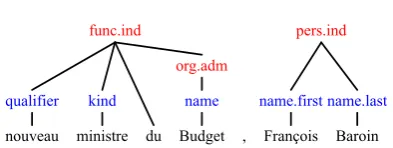
2. a type includes another type, used as a com-ponent. Cases of inclusion can be found in the function type (Figure 2), where type
func.ind, which spans the whole expression, includes typeorg.adm, which spans the sin-gle wordBudget:
nouveau qualifier
ministre kind
du Budget name
org.adm func.ind
, François name.first
Baroin name.last
[image:3.595.318.515.553.627.2]pers.ind
Figure 2: Multi-level annotation of entity types (red tags) and components (blue tags): new min-ister of budget , François Baroin.
1Example of compositionality in Ester II campaign:
<pers.hum> <func.pol> président </func.pol> <pers.hum> Chirac </pers.hum> </pers.hum>
2Final annotation: <pers.hum> président Chirac
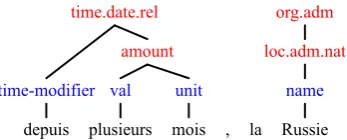
3. in cases of metonymy (a term is substituted for another one in a relation of contiguity) and antonomasia (a proper name is used as a substantive and vice versa), where a type of entity is used to refer to another entity type (Figure 3). The type to which the entity in-trinsically belongs is annotated. This entity is over-annotated with the type to which the expression belongs in the considered context:
depuis time-modifier
plusieurs val
mois unit
amount time.date.rel
, la Russie name
loc.adm.nat org.adm
Figure 3: Annotation with types (red tags) and components (blue tags) including metonymy:
since several months , Russia. . .
2.5 Discussion
Due to its non-flat structure, the representation of compositionality in extended named entities is richer than that used so far in spoken language un-derstanding, compared with Bonneau-Maynard et al. (2006) and Mori et al. (2008); due to its ex-tended definition, it is also richer than that used in named entity detection, in contrast with Galliano et al. (2009) or Nadeau and Sekine (2007). This calls for novel ways to evaluate named entity de-tection systems.
A consequence of the representation’s richer structure is an increased complexity in the eval-uation methodology. The 1:1 comparisons applied to traditional, flat named entities must give way to the mapping-based approaches we will present in the next section.
Moreover, when working on speech, evaluating the results of systems applied to automatic speech transcriptions is central to real-world use cases. This leads us to the issue of evaluating named en-tity detection systems applied to noisy inputs (pro-duced by automatic speech recognition systems) using references built on clean data (manual tran-scriptions). The reference projection approach we propose will be described in the second half of the next section.
3 Evaluation methodology
We now come to the issues raised by the evaluation of automatically annotated extended named enti-ties in speech transcripts. We first lay out the basic evaluation metrics (Section 3.1), then address the issues raised by compositionality (Section 3.2) and by ASR output errors (Section 3.3).
3.1 Metrics
The metrics used in Named Entity extraction eval-uation are precision (P), recall (R), and their
weighted mean F-measure (F) (van Rijsbergen,
1979). They are easy to use, since they only re-quire to determine whether a hypothesized entity element is correct or not.
LetRef =total number of elements in the
ref-erence, Hyp = total number of elements in the
hypothesis, andC =number of correct elements
in the hypothesis. Precision is defined as the ob-served probability for a hypothesized element to be correct:
P = C
Hyp
In the same way, recall is the observed probability for a reference element to have been found:
R= C
Ref
F-measure is the weighted harmonic mean of P
andR, generally balanced withβ= 1:
F = (1 +β
2)RP
β2P+R
The main issue in these metrics lies in their bi-nary decision process: either an entity element is correct, or it is not, whereas we generally want finer control.
Errors in named entities are in fact bidimen-sional: their span or their type can be incorrect. It is interesting to count only “half an error” if one of the two is correct. Within each category, some errors can be considered as less severe than others (e.g., presence of a determiner in span errors, en-tity types with fuzzy boundaries in the annotation guide).
for a simple weighting scheme where insertions (I), deletions (D) and elements with errors both
in span and in type (SST) cost 1, while elements with errors only in either span (SS) or type (ST) cost 0.5. Span or type errors are substitutions (SS, ST, andSST).
We chose our final score as:
SER= D+I+SST + 0.5×(SS+ST)
Ref
Dividing byRef normalizes the result, allow-ing us to compare results more easily across dif-ferent files. This value is traditionally expressed as a percentage.
3.2 Evaluation on manual transcriptions
For simple annotation guides with no composi-tionality, enumerating all errors is easy: a word can only be associated with at most one entity in the reference, and likewise in the hypothesis, so entities can be directly compared when they have common words without any ambiguity.
In our case, the annotation compositionality makes things harder. Entity elements (entities or components) can be nested, and words are usually associated to at least two elements: one entity and one component, and sometimes more. The enu-meration phase needs to establish explicitly which hypothesis element should be compared with each reference element.
Building on methodologies used in speech di-arization evaluation (Didi-arization Error Rate), we defined amappingas a set of 1–1 associations be-tween reference and hypothesis elements. Each el-ement from one side can be associated to at most one from the other side, and a number of elements can remain unassociated on both sides. From a given mapping, an error list can be built, where as-sociated elements result in either correct matches or substitutions, and unassociated elements result in insertions and deletions. Hence given a map-ping, a score can be computed. The final score of a system is then defined as the minimal error rate attainable over all possible mappings.
Enumerating all possible mappings is unthink-able. Since the score is additive, and restricting the acceptable associations to elements with at least one common word, it becomes possible to apply a dynamic programming approach. We thus use a variant of the Viterbi algorithm where “time” is the word stream, “probability” the score and “hidden state” the associations.
The text is split into a series of segments cut where reference or hypothesis entities start or end. An empty association hypothesis is first created, then segments are handled in the text order.
Two phases are applied for each segment: the first one,opening, expands the association hypoth-esis set by combining each one with every pos-sible association choice for each of the entities beginning at the segment start. Two constraints are applied at this level: an entity can only have zero or one association, and associations must not cross one another (i.e. parent-descendant links be-tween entities must not be inverted when projected through the association set).
Once all hypotheses are built, theclosurephase follows where ending entities are taken into ac-count. The post-segment state of each associa-tion hypothesis is computed, including its score, and for every set of equivalent hypotheses in a dy-namic programming sense, only the best score is kept.
Two association hypotheses are considered equivalent if, for every entity present in both clos-ing and followclos-ing segments, the specific hypothe-sized associations are identical. We underline that where no entity is present in the text (reference or hypothesis), only one association hypothesis is left. The same happens at the end of the text where the remaining association is the optimal one.
3.3 Generalization to automatic transcriptions
The main issue when evaluating a Named Entity extraction system over Automatic Speech Recog-nition (ASR) systems output is: what must be eval-uated first? We can either evaluatewhat is there
(the system annotation) orwhat should have been there.
A system should not be penalized for missing things that have been lost earlier in the pipeline, or extracting entities that were not actually said but are present in ASR output. This leads us to an evaluation methodology equivalent to that of man-ual transcriptions.
sig-nificantly for an application, ASR is a step in the document handling pipeline where the end user is only interested in the final result.
We thus decided to evaluate system perfor-mance compared towhat should have been there, expecting the systems to find the entities present in the manual transcriptions whatever the quality of the ASR output. There is room thus for develop-ers to try methodologies to cope with ASR errors using a higher-level understanding of annotations.
Reference projection. To evaluate system out-put from noisy text with a reference built from a clean text, we followed Burger et al. (1998) and Hirschman et al. (1999) who proposed to project
the clean reference on the noisy text in order to build a new reference. That new reference then allows us to apply the clean text methodology.
This projection method consists in finding new positions for the frontiers through either a dy-namic programming alignment (standard sclite-type ASR evaluation alignment) or a phone-level dynamic programming alignment using canoni-cal phonetizations. They noticed the result was too strict frontier-wise and required reducing the weight of frontier errors to obtain significant re-sults.
In Question Answering from speech transcripts evaluation, Moreau et al. (2010) required that QA systems extract answers to natural language ques-tions from ASR outputs of broadcast news shows. The inherent application was to replay the sound segment containing the answer, with a time inter-val as an answer; it tolerated a time interinter-val around the boundaries. The results were satisfactory.
We thus decided to project the clean reference on the noisy text following five steps:
1. Build a forced alignment of the reference text to the speech signal;
2. Extract the start and end times from the ref-erence annotations using the alignment;
3. Select a tolerance time interval;
4. Find the ASR word frontiers within the toler-ance intervals placed around the frontiers of reference entity elements;
5. Build a fuzzyreference when multiple fron-tiers are possible.
A fuzzy reference means that each reference el-ement can have multiple frontiers, which is equiv-alent to having multiple references, and choosing the one that gives the best score for the system. The number of possible references is way too large and the enumeration has to be done locally and coupled with the Viterbi alignment to reduce the search space to tolerable limits.
Apart from the alignment algorithm, the main difficulty is that a structurally correct reference post-projection does not always exist. Indeed, the ASR system may not output words where an en-tity element is supposed to be, or may merge small words into a larger one, preventing from fitting all reference elements to the available words. Such colliding elements have to be handled and we de-cided when encountered to remove one arbitrarily. They are rare enough for that decision to have a minor impact on the scores.
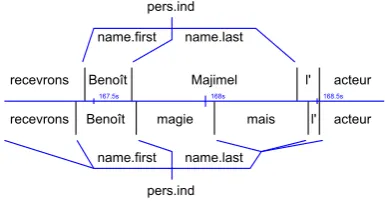
A more satisfactory method would be to merge the colliding elements into one when possible, cre-ating reference elements with multiple acceptable types. Figure 4 illustrates the results of building a fuzzy reference.
recevrons Benoît Majimel l' acteur
recevrons Benoît magie mais l' acteur
167.5s 168s 168.5s
pers.ind
name.first name.last
name.first name.last
[image:6.595.319.512.403.505.2]pers.ind
Figure 4: Example of a fuzzy reference built by temporal alignment of clean reference and noisy transcript
The top part of the figure shows the manual reference (clean reference), with apers.indentity “Benoït Magimel” which is decomposed into two
components name.first “Benoït” and name.last
“Magimel”. In the middle, the temporal line shows the results of the forced alignment of these words on the audio signal.
“re-cevrons” or just after, the name.first—name.last
transition still happens after “Benoït”, and the
name.last and complete entity can stop either af-ter “magie”, “mais” or “l”’.
In our case, all systems gave the same hypothe-sis with “Benoït” as bothpers.indandname.first, which gave them one correct (the name.first), one bad frontier (the pers.ind) and one miss (the
name.last). A more advanced system could have used “Benoït” as a trigger to search for “Mag-imel”, and other last names associated with that specific first name, in a phonetic representation of the following words, or in the signal itself. Then, it may have output “magie mais” or “magie mais l”’ as the last name. It is interesting to note that either hypothesis would have ended with a perfect score for the system. That example shows how the fuzzy projection methodology opens the door to the evaluation of more advanced systems that try to use higher-level knowledge to see through the ASR system errors.
An interesting and useful side effect of the ping methodology we used is that the chosen map-ping is human-readable. One can check what as-sociations were chosen and in the ASR case what frontiers were selected among the possible ones. This is useful for both error analysis and convinc-ing oneself of the quality of the evaluation mea-sure. It also makes it possible to merge all of the systems outputs in an evaluation and collate the errors in order to help correct the references more efficiently where needed.
4 Quaero evaluation results
As an illustration of the use of the extended named entities and of the evaluation methods introduced above, we present here an evaluation of extended named entity recognition from speech transcripts, which we organized in the context of the project Quaero. The task consisted in extracting and cat-egorizing a large number of named entities in transcriptions of broadcast spoken data in French. Three teams participated, each with one NER sys-tem.
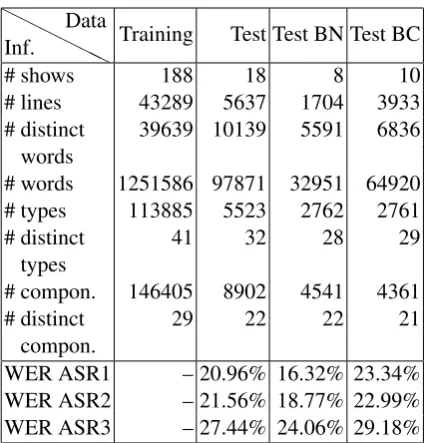
The training data were those of the Ester II evaluation campaign: 188 shows from various sources have been manually transcribed and an-notated given this new definition of extended
named entities (Table 1, Training). The test
data were composed of test and development data from the Quaero 2010 ASR evaluation (Table 1,
Test) (Lamel, 2010). Several test data versions were provided:
• a manual transcription prepared by a human expert,
• three different ASR outputs (ASR1, ASR2,
ASR3) with a word error rate (WER) ranging from 20.96% to 27.44% (Table 1, last three rows), and
• an improved version of the ASR1 output,
where punctuation and capitalization have been automatically added (ASR1+).
The training data consisted of Broadcast News data (BN) while the test data included Broadcast News data and more varied data including talk shows and debates (Broadcast Conversations, BC; see Table 1, last two columns). One of the objec-tives of this work was to measure the robustness of the NER systems against different types of data and unknown types of data.
HH
HHHH
Inf.
Data
Training Test Test BN Test BC
# shows 188 18 8 10
# lines 43289 5637 1704 3933
# distinct 39639 10139 5591 6836
words
# words 1251586 97871 32951 64920
# types 113885 5523 2762 2761
# distinct 41 32 28 29
types
# compon. 146405 8902 4541 4361
# distinct 29 22 22 21
compon.
WER ASR1 – 20.96% 16.32% 23.34%
WER ASR2 – 21.56% 18.77% 22.99%
[image:7.595.310.523.380.602.2]WER ASR3 – 27.44% 24.06% 29.18%
Table 1: Data description.
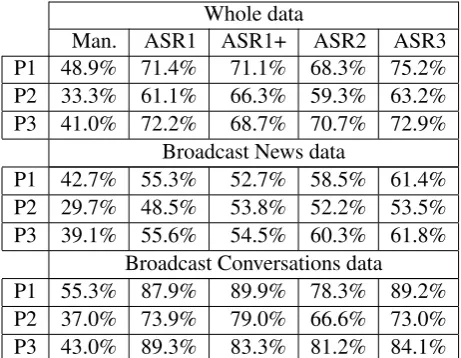
Table 2 shows the results of the three participat-ing NER systems, with a breakdown into broad-cast news and broadbroad-cast conversations.
Whole data
Man. ASR1 ASR1+ ASR2 ASR3
P1 48.9% 71.4% 71.1% 68.3% 75.2%
P2 33.3% 61.1% 66.3% 59.3% 63.2%
P3 41.0% 72.2% 68.7% 70.7% 72.9%
Broadcast News data
P1 42.7% 55.3% 52.7% 58.5% 61.4%
P2 29.7% 48.5% 53.8% 52.2% 53.5%
P3 39.1% 55.6% 54.5% 60.3% 61.8%
Broadcast Conversations data
P1 55.3% 87.9% 89.9% 78.3% 89.2%
P2 37.0% 73.9% 79.0% 66.6% 73.0%
[image:8.595.71.302.63.242.2]P3 43.0% 89.3% 83.3% 81.2% 84.1%
Table 2: SER results for the overall data, broadcast news data and broadcast conversations data. The ASR1+ column is a version of the ASR1 with au-tomatically added punctuation and capitalization.
Obviously, the SER worsened when dealing with ASR outputs, which are all true case (i.e., up-per and lower case are those expected in normal text). The loss ranged from 19.4% (P1 on ASR2 with a 21.56% WER) to 33% (P2 on ASR1+ with 20.96% WER). It is interesting to note that the ASR1+ system, which is ASR1 with automatically added punctuation and capitalization at the begin-ning of sentences, hindered system P2.
Another interesting point is that the ASR2 out-put with a higher WER than the ASR1 system on the whole data allowed better performance for en-tity detection than the ASR1 output.
5 Conclusion and perspectives
In this paper, we presented a representation of structured named entities, and methods to evaluate the recognition of such structured named entities. We contributed a mapping between reference and hypothesis elements which allows us to enumer-ate errors and compute the value of the slot error rate. We also provided a projection of extended named entities from a clean reference to noisy texts produced by automatic speech transcription systems, which allows us to compute the slot er-ror rate against what was actually said rather than against what was recognized by the ASR systems. These extended named entities and evaluation algorithms have been used in the Quaero Named Entities on Spoken Data evaluation. Evaluation results are consistent with expectations, which is
a first test of the validity of the method. Indeed, further work is planned to study more closely and more systematically the obtained alignments.
Compared to the recognition of standard named entities, this new task is harder for systems, but this new structuring will be useful to make in-formation extraction more precise. Moreover, the evaluation methodology we proposed is very flex-ible and should be usable for other tasks such as syntactic analysis on spoken data. An interesting and useful side-effect of this mapping methodol-ogy is its human readability. This makes it easier to check the chosen associations, as well as the se-lected frontiers in the ASR case.
This work is useful for both error analysis and convincing oneself of the evaluation measure qual-ity. It also makes it possible to merge all systems outputs in an evaluation and collate the errors to help correct the reference more efficiently where needed.
Due to the scarcity of annotated corpora in named entities, we plan to provide both guide-lines and annotated corpora for free to the scien-tific community.
Acknowledgments
This work was partly realized as part of the Quaero Programme, funded by OSEO, French State agency for innovation and by the French ANR ETAPE project.
References
Eckhard Bick. 2004. A named entity recognizer for Danish. InProc. of LREC, Lisbon, Portugal.
Hélène Bonneau-Maynard, Christelle Ayache, Frédéric Bechet, Alexandre Denis, Anne Kuhn, Fabrice Lefèvre, Djamel Mostefa, Mathieu Quignard, So-phie Rosset, Christophe Servan, and Joanne Vil-laneau. 2006. Results of the French Evalda-Media evaluation campaign for literal understanding. In
Proc. of LREC, pages 2054–2059, Genoa, May.
John D. Burger, David Palmer, and Lynette Hirschman. 1998. Named entity scoring for speech input. In
Proc. of COLING, pages 201–205.
Sam Coates-Stephens. 1992. The analysis and acqui-sition of proper names for the understanding of free text. Computers and the Humanities, 26:441–456.
Michael Fleischman and Eduard Hovy. 2002. Fine grained classification of named entities. InProc. of
COLING, pages 1–7. Association for Computational
Michael Fleischman. 2001. Automated subcategoriza-tion of named entities. In Proc. of the ACL 2001
Student Research Workshop, pages 25–30.
Olivier Galibert, Ludovic Quintard, Sophie Ros-set, Pierre Zweigenbaum, Claire Nédellec, Sophie Aubin, Laurent Gillard, Jean-Pierre Raysz, Del-phine Pois, Xavier Tannier, Louise Deléger, and Do-minique Laurent. 2010. Named and specific en-tity detection in varied data: The Quaero named entity baseline evaluation. In Nicoletta Calzolari, Khalid Choukri, Bente Maegaard, Joseph Mari-ani, Jan Odijk, Stelios Piperidis, Mike Rosner, and Daniel Tapias, editors, Proc. of LREC, Valletta, Malta, may. European Language Resources Associ-ation (ELRA).
Sylvain Galliano, Guillaume Gravier, and Laura Chaubard. 2009. The ESTER 2 evaluation cam-paign for the rich transcription of French radio broadcasts. InProc. of InterSpeech.
Ralph Grishman and Beth Sundheim. 1996. Mes-sage Understanding Conference - 6: A brief history.
InProc. of COLING, pages 466–471, Copenhagen,
Denmark, August.
Cyril Grouin, Sophie Rosset, Pierre Zweigenbaum, Karën Fort, Olivier Galibert, and Ludovic Quintard. 2011. Proposal for an extension of traditional named entities: From guidelines to evaluation, an overview. InProc. of the Fifth Linguistic Annotation Workshop
(LAW-V), Portland, OR, june. Association for
Com-putational Linguistics.
Lynette Hirschman, John Burger, David Palmer, and Patricia Robinson. 1999. Evaluating content ex-traction from audio sources. InECSA, ETRW
Work-shop: Accessing Infomation in Spoken Audio.
Uni-versity Press.
Jin-Dong Kim, Tomoko Ohta, Yoshimasa Tsuruoka, and Yuka Tateisi and. Nigel Collier. 2004. Introduc-tion to the Bio-Entity task at JNLPBA. In
BioCre-ative Challenge Evaluation Workshop, Granada,
Spain.
Francis Kubala, Richard Schwartz, Rebecca Stone, and Ralph Weischede. 1998. Named entity extraction from speech. In Proc. of the DARPA Broadcast
News Transcription and Understanding Workshop.
Lori Lamel. 2010. Quaero Program CTC Project -Progress Report on Task 5.1: Speech to Text. Tech-nical Report CD.CTC.5.6, Quaero Program.
Seungwoo Lee and Gary Geunbae Lee. 2005. Heuris-tic methods for reducing errors of geographic named entities learned by bootstrapping. In Proc. of IJC-NLP, pages 658–669.
John Makhoul, Francis Kubala, Richard Schwartz, and Ralph Weischedel. 1999. Performance measures for information extraction. In Proc. of DARPA
Broad-cast News Workshop, pages 249–252.
Diana Maynard, Valentin Tablan, Cristian Ursu, Hamish Cunningham, and Yorick Wilks. 2001. Named entity recognition from diverse text types. In
Proc. RANLP, Tzigov Chark.
Nicolas Moreau, Olivier Hamon, Djamel Mostefa, So-phie Rosset, Olivier Galibert, Lori Lamel, Jordi Turmo, Pere R. Comas, Paolo Rosso, Davide Bus-caldi, and Khalid Choukri. 2010. Evaluation proto-col and tools for question-answering on speech tran-scripts. In Nicoletta Calzolari (Conference Chair), Khalid Choukri, Bente Maegaard, Joseph Mari-ani, Jan Odijk, Stelios Piperidis, Mike Rosner, and Daniel Tapias, editors, Proc. of LREC, Valletta, Malta, may. European Language Resources Associ-ation (ELRA).
Renato De Mori, Frédéric Bechet, Dilek Z. Hakkani-Tür, Michael McTear, Giuseppe Riccardi, and Gokhan Tur. 2008. Spoken language
understand-ing. IEEE Signal Processing Magazine, 25(3):50–
58, May.
David Nadeau and Satoshi Sekine. 2007. A survey of named entity recognition and classification. Lin-guisticæ Investigationes, 30(1):3–26.
Tomoko Ohta. 2002. The GENIA corpus: An anno-tated research abstract corpus in molecular biology domain. InProc. of the Human Language
Technol-ogy Conference, pages 73–77.
David D. Palmer, John D. Burger, and Mari Ostendorf. 1999. Information extraction from broadcast news speech data. InProc. of the DARPA Broadcast News
Workshop.
Sophie Rosset, Olivier Galibert, Gilles Adda, and Eric Bilinski. 2007. The LIMSI participation to the QAst track. InWorking Notes for the CLEF 2007 Work-shop, Budapest, Hungary, September.
Erik Tjong Kim Sang and Fien De Meulder. 2003. Introduction to the CoNLL-2003 shared task: Language-independent named entity recognition. In
Proc. of CoNLL.
Satoshi Sekine. 2004. Definition, dictionaries and tag-ger of extended named entity hierarchy. InProc. of LREC, Lisbon, Portugal.
Jordi Turmo, Pere R. Comas, Sophie Rosset, Olivier Galibert, Nicolas Moreau, Djamel Mostefa, Paolo Rosso, and Davide Buscaldi. 2009. Overview of QAST 2009 - question answering on speech tran-scriptions. In CLEF 2009 Working Notes, Corfu, Greece.
Cornelis Joost van Rijsbergen. 1979. Information
Re-trieval. Butterworths, London. http://www.
dcs.gla.ac.uk/Keith/Preface.html.
Ellen M. Voorhees and Donna Harman. 2000. Overview of the ninth text retrieval conference. In