Functional Elements and POS Categories
Qiuye Zhao Mitch Marcus
Dept. of Computer & Information Science University of Pennsylvania
qiuye, [email protected]
Abstract
We propose a bootstrapping algorithm which successfully resolves two funda-mental tasks: morphology acquisition and the acquisition of a subset of functional words. Given the outputs of these funda-mental tasks, we build a nearly state-of-art morphology analyzer performing with a F1-score of 80.94%; also, we can improve the baseline model for acquiring func-tional words by an absolute error reduction of 26%. Furthermore, with these acquisi-tion outputs, a minimally supervised tag-ging system proposed before can be turned into a totally unsupervised one, achieving a tagging accuracy of 85.26% for open-class words.
1 Introduction
Studies of child language acquisition have shown that functional elements as distinctive categories are available to the child from very early on. These include both functional words (closed class items) such as determiners (Valian et al., 2009), and func-tional bound morphemes such as verbal inflec-tions (Yang, 2002). Motivated by such studies, we propose that functional categories, including both functional words and functional morphemes, should be identified first in the process of acquir-ing syntactic categories automatically from lan-guage input. Further motivation comes from the experimental results of the minimally supervised tagging system in (Zhao and Marcus, 2009)1, which, given only seven functional features, in-cluding four contextual features, whether modal
1The tagging system in (Zhao and Marcus, 2009) was re-ferred to as ’unsupervised’ in their paper, because back then, a lexicon was a common input to so-called unsupervised POS tagging systems. We classify their system as minimally su-pervised here, so as to differentiate it from this work which requires only raw text as input.
verbs or determiners are left or right neighbours, and three specific morphological features, whether ’-ing’, ’-ed’, or’-s’are observed as endings, per-forms clustering in order to generate the two fun-damental open class categories, verbal vs. nomi-nal. This work suggests that functional elements are highly useful in further classification of open class items.
This is quite different from most other POS in-duction systems in the Natural Language Process-ing (NLP) field for inducProcess-ing Part-of-Speech (POS) tags, which, instead of generating clusters com-plying with the common understanding of ’syn-tactic’ categories, such as distinct clusters of de-terminers, nouns or inflections of verbs, tend to output scattered clusters consisting words of inter-esting similarities on many different dimensions (Christodoulopoulos et al., 2010). This is because, in these clustering-based systems, a vector space over the words is spanned by lexical features and suffix/prefix features, so that the generated clus-ters mix semantic and syntactic similarities (Clark, 2000).
In this work, we explore an alternative ’top-down’ view of deriving categories, as opposed to the ’bottom-up’ view adopted by these earlier dis-tributional clustering methods. Here, we report on experiments which acquire functional elements first and integrate the acquisition output into a full unsupervised POS tagging system later. Since we are not aware of previous work to acquire func-tional elements, we approach the problem by seek-ing answers for the followseek-ing two questions: 1) What are the special properties of the distribu-tion of funcdistribu-tional elements that enables the child to distinguish them easily from other categories at a very early stage of acquisition? 2) What might the acquisition processes of the two forms of func-tional elements (bound vs. free) have in common, reflecting some deeper distributional property of functional elements in general?
We believe that answers to these questions be-gins to emerge from the success of a single boot-strapping algorithm proposed here to the acquisi-tion of both bound and free funcacquisi-tional elements, i.e. closed class words and bound morphemes. This bootstrapping algorithm explores a particular simple contextual property of functional elements, which we call thediversity property, and resolves both fundamental acquisition tasks without any in-put beyond raw written text:
1)Bound morphemesSeparating func-tional elements in the form of bound morphemes from contentful elements. As for English, the two output sets are a list of productive endings such as’-ed’, and’-s’, and a list of base stems such as ’consist-’and’bootstrapp-’.
2) Free morphemes Separating ’first-order’ functional elements in form of free morphemes (words) from content-ful elements. As for English, the two output sets are a list of modal verbs and determiners (in a general sense2), and a list of nominal elements as well as verbs in bare forms.
The bootstrapping algorithm we propose here operates by iteratively generating two complemen-tary sets, (e.g. base stems and productive end-ings for the bound morpheme task); in these way, it reflects the intuition behind co-training (Abney, 2004), but in a greatly reduced form and requiring no seeds for initialization. For both tasks, the boot-strapping algorithm generates highly reliable out-puts, with barely any errors and requires no task-specific parameter settings. For example, it dis-covers 26 modal verbs and determiners (in a gen-eral sense) from raw text of WSJ Treebank (Mar-cus et al., 1993) with only a single noisy term.
We validate these outputs on a range of use-ful applications. Given the two sets output by the bound morpheme task, we can straightfor-wardly build an unsupervised morphology ana-lyzer which achieves an F1-score of 80.94 eval-uated on the CELEX corpus, comparable to a state-of-art morph analyzer (Lignos, 2010) which achieves 82.21 F1 on the same task. Next, given this new morphology analyzer and the two out-put sets from the free morpheme task, we give
2In this paper, we refer to determiners in a general sense which includes determiners, possessive determiners and demonstratives.
a new very simple algorithm for acquiring the full set of functional/closed class words, improv-ing on a reasonable baseline model for acquirimprov-ing functional/closed-class words by an absolute error reduction of 26%, from 63% to 89% type accu-racy as evaluated on the WSJ Treebank3. Finally, we plug this newly acquired closed-class lexicon into a minimally supervised tagging system, (Zhao and Marcus, 2009), which requires as input ex-actly such a lexicon. The resulting system, now completely unsupervised, achieves a tagging ac-curacy of 85.26% for tagging open-class words as evaluated on the whole WSJ Treebank. Al-though the evaluation is done over 6 open-class tags only, and thus is not directly comparable to related works, the tagging performance reported here is still satisfying given that recently reported unsupervised tagging accuracy vary among 50%-70% e.g. (Abend et al., 2010), (Reichart et al., 2010) and (Moon et al., 2010).
2 Acquiring Functional Elements
Functional elements are those elements that pro-vide structural clues in expressions, which form a complementary set to the contentful elements that provide semantic content of the expressions. Two forms of elements in languages come into our attention, bound morphemes and free mor-phemes (words). As for English, functional ele-ments of bound morphemes are inflectional end-ings or derivational endend-ings/prefixes, for exam-ple, in a word ’runs’ the contentful part ’run-’ provides us with some contentful information, whereas, the functional part’-s’ provide us with some grammatical specification which are spe-cially important when the word is used in con-text. On the other hand, functional elements of free morphemes, generally refer to those closed-class words that don’t fall into lexical categories, i.e. those words that are not nouns, verbs, ad-jectives or adverbs; however, the functional roles these closed-class words play in context are more complicated.
The algorithm described in section 2.2 solves two tasks on acquiring functional elements: 1) identifying productive endings/prefixes vs. base stems (the contentful parts of words), and 2) iden-tifying determiners (possessive determiners and
demonstratives as well) and modal verbs vs. nouns and verbs. Given these acquisition outputs, we can acquire a full set of closed-class words, falling in all functional categories, with a simple extra step. The subset of functional words that are acquirable by the bootstrapping algorithm is referred as ’first-order’ functional words in this work, since they include determiners and modal verbs only which don’t project to other functional words.
Before introducing the bootstrapping algorithm in section 2.2, we discuss the diversity property of functional elements first, in section 2.1, which is an important concept to be explored in the algo-rithm.
2.1 Diversity Property
Our algorithm is built upon a distributional prop-erty of functional elements well-known to lin-guists: they occur in diverse contexts. For exam-ple, determiner’the’in English is observed every-where in text and inflectional ending’-ed’can be concatenated to most verbs to derive past forms. As discussed above, functional elements provide structural clues to compose expressions and are basically independent to the meanings conveyed by the expressions; therefore, they are not bound to co-occur with specific contentful elements and are natively expected to occur in diverse contexts. In the NLP field, a more popular property known for distinguishing functional elements is that they occur more often. Although frequency can be used to approximate ’diversity’, the high frequency of functional elements is only a reflec-tion of their high degree of contextual diversity, which, following the definition, is more accurately approximated by the types of contexts that an ele-ment occurs in.
There are few previous works that quantitatively demonstrate that ’contextual’ diversity is a better diversity measurement than frequency regarding experimental results. In this work, we are going to explicitly compare these two options for measur-ing diversity within the bootstrappmeasur-ing algorithm. As shown in all applications (section 3), measur-ing contextual diversity for diversity brought in a consistent improvement as compared to measuring frequency.
Proper Contexts
We haven’t define in what occurrences two el-ements may form a contextual relationship, and let’s consider the case for bound morphemes first.
Given a type of word, e.g. ’laughing’, several ways of dividing it can yield a pair of possible morphemes with either one beingas/in-context of the other morpheme: for the division’laugh-ing’, ’laugh-’can be consideredin-context of’-ing’and ’-ing’ considered as-context of ’laugh-’ or vice verse; or for the division ’laughin-g’, ’laughin-’ in-context of’-g’and’-g’ as-context of ’laughin-’, or vice verse.
For words, ideal scopes to define contextual relationships should be phrases/phases, from a linguistic point of view, such as N(ominal)P, V(erbal)P and so on. However, it is not easy to detect boundaries of phases in unannotated in-put; therefore, we only consider contextual rela-tionships between two words in adjacency. For the sake of coherence, we consider the preceding wordas-context of the following word and the fol-lowing wordin-context of the preceding one, how-ever, it could also be vice verse, though with worse experimental results.
As one may have noticed, without any further constraints on the concept of contexts, the top 3 bound morphemes with the highest contextual di-versity will be ’-d’, ’-e’ and ’-t’, which do not comply with our understanding of functional mor-phemes in English. In other words, for acquir-ing inflectional or derivational suffix/prefixes, we want to compute contextual diversity of bound morphemes according to properly justified contex-tual relations only, instead of from all arbitrary di-visions of words. The most simple way of justify-ing one element as proper contexts for other ele-ments is to check whether it can serveas-context of more than one type of element, by which cri-teria’laughin-’ is not justified, since it cannot be concatenated by other suffixes than ’-g’to form a legal word. It is first noticed in (Chan, 2008) that morphological transformations should be dis-covered with respect to ’base forms’, i.e. prop-erly justified contentful stems; and we generalize this idea for a better measurement of diversity to acquire both forms of functional elements in this work.
diversity should be determiners. More formally, given a set B of justified contexts, we can de-fine two measurements of diversity for an element e, frequency or contextual diversity as discussed above:
2.2 The Bootstrapping Algorithm
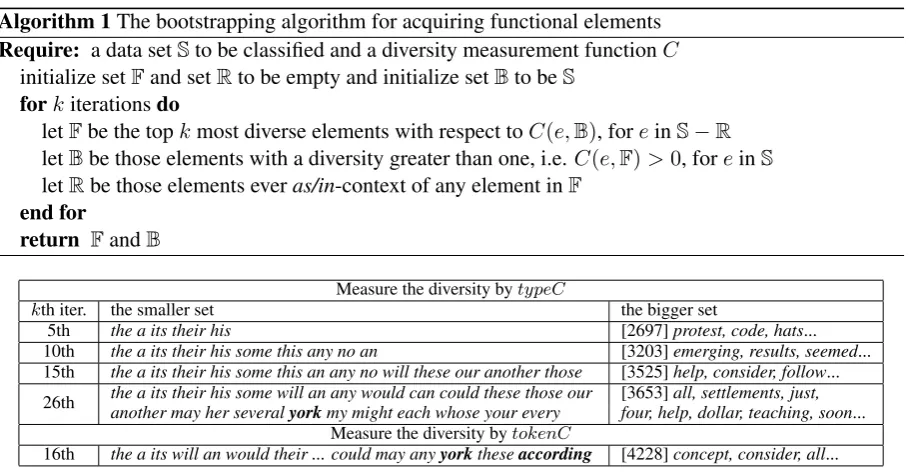
The proposed bootstrapping algorithm in Algo-rithm 1 generates two complementary sets during the bootstrapping process, both of which justify proper contexts for each other. As the two sets up-dated during bootstrapping, the diversity measure-ment of the other set is expected to be more and more accurate. This strategy reflects the intuition behind co-training (Abney, 2004), but in a greatly reduced form and requiring no seeds for initializa-tion.
Given a specific form of elements (bound or free morphemes), inputs to this algorithm are a datasetS4containing all the elements of this form in some corpus and a choice of diversity measure-ment,tokenCortypeCas defined in section 2.1. Assuming that functional elements can be dis-tinguished by higher diversity degree, as discussed in section 2.1, we explicitly let a setFcontain the most diverse elements as computed by the diver-sity measurement function with respect to its com-plementary setB; and at each bootstrapping itera-tion, we increase the size ofFby one.
On the other hand, setB, which is generated to provide proper contexts for F, contain those ele-ments of a diversity degree greater than one with respect to F, implementing our understanding of properly justified contexts in section 2.1. Since the order of diversity ranking of elements inSvaries over iterations with respect toB, which is also up-dated at each iteration according to currentF, an element classified into Fat some iteration is not guaranteed to show up inFin the following itera-tions.
In addition to the update of F and B, we also introduce a special ’filtering’ step to prevent those elements that are ever seen as/in-context of ele-ments inFfrom being classified intoF. This fil-tering idea is implemented through a set R con-taining elements to be excluded fromF, which is
4For each elementeinS, the number of its occurrences
in/as-context of other elements are also provided.
also updated at each iteration after the update of
F. This filtering step guarantees that there is no element in F ever occurring as/in-context of any other element inF. We will explain more about the linguistic motivation behind this filtering step in section 4.
2.3 The Acquisition Output
We run the bootstrapping algorithm introduced in Section 2.2 for two acquisition tasks: acquiring functional morphemes and acquiring ’first-order’ functional words. The outputs of both tasks, which are done separately, are depicted in Table 1 and 2 respectively. For each task, we experiment with two options of diversity measurement:tokenC or typeC as defined in section 2.1. If any element classified to be functional is of a diversity degree lower than a threshold, the bootstrapping process stops.
First of all, as clearly shown by the quality of acquisition outputs, this algorithm is sensitive to the choice of diversity measurement, andtypeC, which measures the contextual diversity of an el-ement in proper contexts, is always a better op-tion compared totokenC, which measures the fre-quency of an element in proper contexts. tokenC produces better outputs in the sense that fewer noisy elements are acquired and if acquired, they are acquired later in the bootstrapping process.
In both Table 1 and 2, functional elements are shown ordered by diversity in the second column, which order varies over the bootstrapping itera-tions, corresponding to the update of its comple-mentary set, which is shown at the last column.
Algorithm 1The bootstrapping algorithm for acquiring functional elements Require: a data setSto be classified and a diversity measurement functionC
initialize setFand setRto be empty and initialize setBto beS
forkiterationsdo
letFbe the topkmost diverse elements with respect toC(e,B), foreinS−R
letBbe those elements with a diversity greater than one, i.e. C(e,F)>0, foreinS letRbe those elements everas/in-context of any element inF
end for
return FandB
Measure the diversity bytypeC
kth iter. the smaller set the bigger set
5th the a its their his [2697]protest, code, hats...
10th the a its their his some this any no an [3203]emerging, results, seemed... 15th the a its their his some this an any no will these our another those [3525]help, consider, follow... 26th the a its their his some will an any would can could these those ouranother may her severalyorkmy might each whose your every [3653]four, help, dollar, teaching, soonall, settlements, just, ...
Measure the diversity bytokenC
16th the a its will an would their ... could may anyyorktheseaccording [4228]concept, consider, all... Table 1: The acquisition outputs at each iteration of the bootstrapping algorithm running for words.
Measure the diversity bytypeC
kth iter. the smaller set the bigger set
5th -$, -s, -ing, -ed, -e [2616]degree-, cook-, topp-, excit-... 10th -$, -s, -ing, -ed, -e, -er, -es, -ion, -ers, -ly [3343]comply-, drink-, opt-, devot-,... 15th -$, -s, -ing, -ed, -e, -er, -ly, -ion, -es, -ers, -al, -y, -or, -ive, -ity [3496]poor-, recept-, arriv-, mot-... 26th --ive, -ity, -ist, -man, -ic, -est, -on, -en, -ism, -ors, -ant, -ial$, -s, -ing, -ed, -e, -er, -ly, -ion, -es, -y, -ers, -al, -ies, -or, [3772]produc-, buri-, specifi-, impress-, good-shell-, deliver-, comparabl-, juni-...
Measure the diversity bytokenC
15th -$, -s, -e, -ed,-t, -ing, -ion, -y, -er, -al,-n, -ly, -ic, -or, -th [9576]diploma-, conduc-, begin-, leg-... Table 2: The acquisition outputs at each iteration of the bootstrapping algorithm running for morphemes.
notable noisy item for acquiring functional words is’york’, which is classified as functional because 1) we lowercase all texts and 2) in WSJ articles, there are a lot complex NPs composed of’York’, i.e’York’is seen in many occurrences followed by nominal elements that may have already been clas-sified as contentful during the bootstrapping pro-cess. On the other hand, with the diversity mea-surementtokenC,’York’has showed up as noisy much earlier in the bootstrapping process, as well as other noisy items.
It is even clearer in table 2 that the contex-tual diversity is a better measurement to distin-guish functional elements than frequency. While measuring the diversity bytokenC, there are two noisy items show up as early as 15th iteration, ’-t’and’-n’, which are successfully excluded from the output with diversity measurement typeC. While measuring the diversity bytypeC, a possi-bly noisy item is’-ers’, which can be decomposed into’-er’and’-s’.
3 Applications
tagger for open-class words (section 3.3). The bootstrapping algorithm runs over the WSJ Tree-bank, which contains 1173766 words, with raw text input only for both tasks. And all experiments described below are trained over the same corpus.
3.1 Morphological Analysis
Those syntactic related morphological features, such as’ended with -ed’or’ended with -ing’have already been proven useful in syntactic related tasks such as POS tagging, parsing and so on; therefore, accomplishing such a morph analysis in an unsupervised way is meaningful for related un-supervised works.
Given an acquired set B of base stems, e.g.
B = { ’laugh-’, ’analyz-’ and ’-define’}, and a setFof functional morphemes , e.g. F ={’-ed’, ’-s’and’pre-’}, we can divide a wordwinto mor-phemesb- and -ewhereb+e==w, ifb- inBand -einF; or if vice verse, i.e. b- inFand -einB. If such a divisionb+ecan be successfully performed on the wordwwith -einF, we specify thatwhas a morph feature’ended with -e’. For instance, given the above examples ofBandF,’laughed’has an ending’-ed’but not ending’-ing’, and’analyzed’ has an ending’-ed’, but’red’doesn’t have such an ending’-ed’as its morph feature. Overall, given two lists of morphemes, we can build a morph analyzer implementing this constrained stemming strategy for detecting morph features of interest.
For evaluating the morph analyzer composed by our acquisition outputs from WSJ Treebank, we use the CELEX corpus (Baayen et al., 1996) pro-viding gold annotations of 6 syntactic related mor-phological features:{’-s’,’-es’,’-ed’,’-ing’,’-er’, and’-est’}. Among the 20058 types of words seen
in both WSJ and CELEX corpus, 8789 types are annotated with these features. The precision num-ber reported in Table 3 is the percentage of cor-rect predictions out of all predictions the analyzer makes about the 6 morph features; and the recall is calculated by the percentage of correctly-predicted featured words out of all types of words with these features (8789).
We report the performance of two morph ana-lyzers: one is composed by the acquired outputs with the diversity measurement tokenC; and the other one acquired withtypeC. We also compare our results against a state-of-art morphology ana-lyzer, (Lignos, 2010), which is adapted for this ex-periment. As shown in Table 3, our general
boot-Algorithm Precision Recall F-score bootstrap-tokenC 77.89 82.38 80.07
bootstrap-typeC 78.71 83.31 80.94 (Lignos, 2010) 80.16 84.37 82.21
Table 3: The performance of morph analyzers evaluated for syntactic related morphological fea-tures.
strapping algorithm, which is designed for various applications, is able to generate useful outputs for building a morph analyzer that performs compara-bly well as the stat-of-art achievements.
3.2 Acquiring Closed-class Words
The bootstrapping algorithm is not designed to generate closed-class words falling in all func-tional categories, instead, it acquires those ’first-order’ functional words, including only determin-ers and modal verbs. Given this acquired subset of closed-class words and the morph analyzer built in section 3.1, it is only a step away from acquiring all closed-class words falling in various functional categories.
We are not aware of previous work that acquires closed-class words in an automatic process, and in the NLP field, they are often approximated by the most frequent words. In other words, as a baseline model, we can acquire closed-class words by selecting k top words of the highest diversity measured bytokenC. Given discussion of diver-sity measurement in section 2.1, we also experi-ment with another baseline model, which acquires closed-class words by selectingktop words of the highest diversity measured by typeC. As shown in Table 4, with a better approximation of diver-sity, the type accuracy of predicting closed-class words is improved by an absolute error reduction of 11%, from 63% to 74% (k=100).
topk words 20 40 80 100 baseline-tokenC 90.00 80.00 68.75 63.00
baseline-typeC 100.0 90.00 76.25 74.00 bootstrap-tokenC 95.00 95.00 90.00 86.00 bootstrap-typeC 100.0 97.50 93.75 89.00
Table 4: The percentage of correctly predicted closed-class word types out ofkpredictions
items in the output of the baseline models, ’bil-lion’and’say’, can be successfully filtered by the output set shown in Table 1.
In addition, since we have already built an un-supervised morph analyzer as described in section 3.1, which is acquired by the same bootstrapping algorithm, we would like to make use of them as well, in a straightforward way: as long as a word can be analyzed by the acquired morph analyzer, it should not be output as closed-class items.
Models ’bootstrap-tokenC’ and ’bootstrap-typeC’ implement the above idea using diversity measurement tokenC and typeC respectively. For example, the model ’bootstrap-typeC’ uses the diversity measurementtypeC to both acquire the morph analyzer and to acquire the set of ’first-order’ functional words, and it uses these acqui-sition outputs to filter the baseline model that uses typeCas diversity measurement as well. The gold lexicon we use to evaluate the acquired list con-tains 288 closed-class words as described in (Zhao and Marcus, 2009).
With the help of acquisition outputs by a single algorithm running for different tasks, we can sig-nificantly improve the baseline model for acquir-ing closed-class words. As shown in Table 4, the performance of the baseline models drops rapidly as the sizekgrows; however, by taking acquired categories as constraints, we achieve quite reli-able models. For example, ’bootstrap-typeC’ im-proves ’baseline-tokenC’ by an absolute error re-duction of 26% (k=100), from 63% to 89%. So as to show how the models perform askkeeps grow-ing, we provide more results in Figure 1, which plots the percentage of correctly predicted closed-class word types out ofkpredictions.
3.3 Unsupervised POS Tagging
Finally, to demonstrate the value of such a highly pure list of closed-class words, which previously could not be acquired through unsupervised learn-ing, we plug the acquired list into a previously ex-isting minimally supervised tagging system, (Zhao
Figure 1: The percentage of correctly predicted closed-class word types out ofkpredictions
and Marcus, 2009), which only requires a closed-class lexicon for tagging all words. The resulting system now provides a totally unsupervised sys-tem for tagging open-class words, inducing both the categorical information itself and also the dis-ambiguation rules for tagging open-class words.
Following (Zhao and Marcus, 2009), the six open-class POS categories to be predicted are verbs, nouns, past participles, present participles and numbers. The tagging predictions for open-class words (any word not in the closed-open-class list) are evaluated by the percentage of correct predic-tions on all tokens in the open-class set. Although all tagging experiments are done over the whole WSJ Treebank, the total number of tagging predic-tions may vary according to different input closed-class lists.
We experiment with four lists of closed-class words of the top 200 words acquired by the ’baseline-typeC’, ’baseline-tokenC’, ’bootstrap-typeC’ and ’bootstrap-tokenC’ respectively, as introduced in section 3.2. We evaluate against a gold-standard closed-class lexicon containing 288 words, also used for evaluation in section 3.2.
closed-class input accuracy totally tagged baseline-tokenC 81.68 536535
baseline-typeC 75.51 554012 bootstrap-tokenC 77.30 627803 bootstrap-typeC 85.26 612997 gold lexicon 91.03 611028
Table 5: The percentage of correctly tagged tokens out of all predictions. The system tags open-class words only and distinguishes 6 POS categories.
more than half of all the tokens in the WSJ Tree-bank, with an accuracy of 85.26%. In recent work on unsupervised tagging, tagging accuracys are re-ported in the range of 50-70%, e.g. (Abend et al., 2010), (Reichart et al., 2010), (Moon et al., 2010) and so on. Compared to these results, the tag-ging performance reported here, even though only on open-class words for six categories, is quite promising.
Because most previous work distinguishes be-tween more categories than we do here, our results may be misleading, in that we appear to be report-ing on a simpler task. However, these previous systems operate by clustering over a vector space of lexical features and suffix/prefix features, re-sulting in a large number of scattered clusters with similarities on different semantic and syntactic di-mensions. As a result, it has proven difficult for them to use further agglomerative processing to induce simple distinct syntactic categories which map to POS tags naturally (Christodoulopoulos et al., 2010), and thus operating in a mode which achieves a higher tagging accuracy with coarser categories is not available to those systems at all. Therefore, achieving high accuracy with a smaller tag set is the harder, not easier, task for those sys-tems.
4 Discussion
We propose a bootstrapping algorithm which suc-cessfully resolves two fundamental acquisition tasks: acquiring functional morphemes and ac-quiring ’first-order’ functional words. We have shown that the outputs of these two fundamental acquisition tasks are very useful for more gener-alized tasks: they can be directly used to built a nearly state-of-art morph analyzer and they can be used to acquire a full set of closed-class words with high accuracy. Furthermore, the acquired list of closed-class words allows us to turn a mini-mally supervised tagging system into a totally un-supervised tagger for tagging open-class words. As a completely unsupervised tagger, the resulting system performs at a satisfying tagging accuracy above 85%.
The bootstrapping algorithm proposed here also gives us cause to think about the connection be-tween functional categories in two forms: bound morphemes and words. As shown in this work, identically the same computational process that acquires functional morphemes also can be used
to acquire the subset of functional words that in-cludes modal verbs and determiners. All these elements share the property that, from the point of view of modern generative grammar, they only project locally, in other words, the elements that are acquired by this algorithm project to content-ful elements directly most of the time but not through any other functional elements. Since all productive bound morphemes project mainly lo-cally, they can all be acquired by the algorithm; in contrast, those functional words that project in larger scopes quite often, rather than in local con-texts (i.e. not determiners and modal verbs), will not be acquired by this algorithm directly. This un-derstanding of viewing local contexts as first-order functional projections motivates the filtering step in the bootstrapping algorithm. This overall un-derstanding was motivated for us by the strict lo-cality constraints assumed in phase theory (Chom-sky, 2006).
References
Omri Abend, Roi Reichart, and Ari Rappoport. 2010. Improved unsupervised pos induction through pro-totype discovery. InACL.
S. Abney. 2004. Understanding the yarowsky algo-rithm. Computational Linguistics, 30(3):365–395.
R.H. Baayen, R. Piepenbrock, and L. Gulikers. 1996. Celex2. Linguistic Data Consortium, Philadelphia.
E. Chan. 2008. Structures and distributions in mor-phology learning. Ph.D. thesis, University of Penn-sylvania.
N. Chomsky. 2006. Approaching UG from below.
C. Christodoulopoulos, S. Goldwater, and M. Steed-man. 2010. Two decades of unsupervised pos in-duction: How far have we come? InEMNLP.
A. Clark. 2000. Inducing syntactic categories by context distribution clustering. In Proceedings of the Computational Natural Language Learning and the Second Learning Language in Logic Workshop (CoNLL-LLL).
C. Lignos. 2010. Learning from Unseen Data. In Pro-ceedings of Morpho Challenge 2010, pages 35–38, Helsinki, Finland, September 2–3. Aalto School of Technology.
T. Moon, K.Erk, and J. Baldridge. 2010. Crouch-ing dirichlet, hidden markov model: unsupervised pos tagging with context local tag generation. In EMNLP.
R. Reichart, R. Fattal, and A.Rappoport. 2010. Im-proved unsupervised pos induction using intrin-sic clustering quality and a zipfian constraint. In CoNLL.
V. Valian, S. Solt, and J. Stewart. 2009. Abstract categories or limited scope formulae: The case of children’s determiners. Journal of Child Language, 36:743–778.
C. Yang. 2002. ”Knowledge and Learning in Natural Language”. Oxford University Press.