Multilingual Multi-class Sentiment Classification Using Convolutional Neural
Networks
Mohammed Attia
∗, Younes Samih
†, Ali Elkahky
∗, Laura Kallmeyer
† ∗Google Inc.;†University of D¨usseldorfNew York, USA; D¨usseldorf, Germany {attia,alielkahky}@google.com {samih,kallmeyer}@phil.hhu.de
Abstract
This paper describes a language-independent model for multi-class sentiment analysis using a simple neural network architecture of five layers (Embedding, Conv1D, GlobalMaxPooling and two Fully-Connected). The advantage of the proposed model is that it does not rely on language-specific features such as ontologies, dictionaries, or morphological or syntactic pre-processing. Equally important, our system does not use pre-trained word2vec embeddings which can be costly to obtain and train for some languages. In this research, we also demonstrate that oversampling can be an effective approach for correcting class imbalance in the data. We evaluate our methods on three publicly available datasets for English, German and Arabic, and the results show that our system’s performance is comparable to, or even better than, the state of the art for these datasets. We make our source-code publicly available.
Keywords:sentiment analysis, sentiment detection, multi-class
1.
Introduction
The social media has revolutionized the web by transform-ing users from betransform-ing passive recipients of information into contributers and influencers. This has a direct impact on businesses, products and governance. Many of the users’ posts are opinions about products and brands that impact other consumers’ buying decisions and affect brand trust-worthiness. Negative reviews circulated online may cause critical problems for the reputation, competitive power, and survival chances of any business. This in turn has led to some fundamental changes in how businesses approach their customers, gauge satisfaction, provide support and manage risks.
Sentiment analysis is formally defined as the task to iden-tify and analyze subjective information of people’s opin-ions in social media sources (Pham and Le, 2016; Yang et al., 2017). This field of study has recently attracted a lot of attention due to its implications for businesses and govern-ments. The challenges of this task can be summarized in the following points:
• There is a large variety of expressions to denote a range of sentiments. Therefore a sentiment dictionary, no matter how large it could be, cannot list all the pos-sible ways people can express their attitudes.
• Words change meaning depending on the context and the domain. For example, a “short cord” mostly in-dicates a negative opinion, while a “short boot time” signifies a positive one.
• There could be long-distance dependencies between different constituents of a sentence, and without know-ing, for example, the scope of negation, the polarity of an adjective cannot be determined.
• People do not always reveal their opinion in an explicit way, as they could be indirect, subtle or ironical.
Users generally express a broad variety of sentiments with a wide range of degrees, but to simplify the task, sentiment analysis approaches have traditionally classified sentiments into either positive, negative or neutral.
This paper describes our system for multilingual, multi-class sentiment multi-classification using Convolutional Neu-ral Networks (CNNs). We evaluate our system on three datasets in three different languages, and we find that state-of-art results can be achieved without language-specific features or pre-trained word embeddings. We also find that data imbalance has a detrimental effect on multi-class clas-sification. We use over-sampling to balance datasets by re-peating instances to increase the size of minority classes, which generally led to significant improvements.
Our methods are language-independent in the sense that we do no rely on ontologies, lists of polarity lexical terms, morphological or syntactic information, thus avoid-ing the need to deal with out-of-vocabulary opinion words and language-specific features. Our source-code publicly available at https://github.com/SamihYounes/ senti-cnn.
2.
Related Work
The different approaches to sentiment analysis share the common theme of mapping a piece of text to a given label from a predefined set (Pang and Lee, 2008). This in essence is similar to some other NLP tasks, such as text categoriza-tion (a.k.a. document classificacategoriza-tion) and language identifi-cation. There exists, however, some research on the use of unsupervised methods (Lin and He, 2009).
Research on sentiment analysis is broadly categorized into two paradigms (Cambria, 2016), knowledge-based and statistics-based, depending on whether external language-dependent information and structured resources (such as POS taggers ans polarity lexicons) are included as features in the model or not.
knowledge-based features (Mullen and Collier, 2004; Boiy and Moens, 2009; Godbole et al., 2007; Gamon, 2004). Within this domain, work could include a massive amount of prior lin-guistic knowledge and feature engineering. For example, Wilson et al. (2005) compiled a prior-polarity lexicon of 8,000 subjectivity clues (with around 33% positive, 60% negative and 7% neutral clues) and used 27 linguistic fea-tures, including the existence of prior-polarity clues, POS tags, context, use of intensifiers and pronouns, and docu-ment topic. This method, however, is unscalable, resource-intensive, and will be hard to adapt to different domains or less-resourced languages.
Some dedicated resources were also created for aiding with this task including the SentiWordNet (Esuli and Sebastiani, 2006; Baccianella et al., 2010) which annotates WordNet synsets according to their degrees of positivity, negativ-ity, and neutralnegativ-ity, and SenticNet (Cambria et al., 2016), which provides the semantic, cognitive and affective infor-mation for over 14,000 concepts. Similar lexicons of vary-ing scales were built for some other languages, includvary-ing, for instance, German (Remus et al., 2010), Arabic (Badaro et al., 2014), and Spanish (Perez-Rosas et al., 2012). In the second paradigm, using pure statistical methods for sentiment analysis was also successfully applied (Neethu and Rajasree, 2013; Maas et al., 2011; Tripathy et al., 2016). A pioneering work within this approach is the re-search of Pang et al. (2002) who employed three machine learning methods (Naive Bayes, maximum entropy classi-fication, and support vector machines) to detect polarity in movie reviews. They relied on corpus-driven features using the bag-of-features framework which assumes f1, ..., fm
as a predefined set ofmfeatures (word unigrams and bi-grams),ni(d)as the number of timesfioccurred in a
doc-ument d, and then each documentdis represented by the vector: d~:= (n1(d), ..., nm(d)). This method is a
precur-sor to the relatively recent word2vec word representation (Mikolov et al., 2013b; Mikolov et al., 2013a; Pennington et al., 2014).
Deep learning for sentiment analysis has also been pre-sented in a number of papers such as (Glorot et al., 2011; Poria et al., 2016; dos Santos and Gatti, 2014). The ba-sic idea with deep learning is to use hidden layers of neu-ral nets to automatically capture the underlying factors that lead from the input to the output, eliminating the need for feature engineering.
3.
Convolutional Neural Networks
Convolutional Neural Networks (CNNs) (LeCun et al., 1995) are a powerful deep learning technique because they preserve the spatial structure of the data. They have been shown to produce state-of-the-art results in image process-ing, computer vision (Krizhevsky et al., 2012) and speech recognition (Graves et al., 2013). In recent years, CNNs have been successfully applied to NLP and document clas-sification problems (Kim, 2014; Johnson and Zhang, 2014). The input to CNNs is a feature map which corresponds to the pixels in an image or words in a sentence or docu-ment, or characters in words. This feature map is scanned in CNNs one area at a time by filters, assuming that fil-ters slide, or convolve, around the feature map. The way
CNNs adjust their filter weights is through backpropaga-tion, which means that after the forward pass, the network is able to look at the loss function and make a backward pass to update the weights.
The CNN layer is followed by a pooling layer that com-presses or generalizes over the CNN representations. It re-duces the dimensionality of the CNN layer by downsam-pling the output and taking the maximum value as the fea-ture corresponding to each filter.
The pooling layer is typically followed by a feed-forward fully connected layer that takes the features from the pool-ing layer and makes new combinations for further learnpool-ing or final predictions.
4.
Data Description
4.1.
English - The Sanders Twitter Sentiment
Corpus
The Sanders Twitter Sentiment dataset1 (Sanders, 2011) consists of 5,513 tweets related to the products of four com-panies: Apple, Google, Microsoft, and Twitter. Tweets have been manually tagged as either positive, negative, neu-tral, or irrelevant with respect to the topic. The distribution of the tagset is in Table 1. We could not find information on how this dataset was annotated, e.g. annotation guide-lines, number of annotators involved and whether it was annotated in-house or through crowd-sourcing.
positive negative neutral irrelevant Total
570 654 2,503 1,786 5,513
Table 1:The Sanders Twitter Sentiment dataset
4.2.
German - Deutsche Bahn
The data of the GermEval shared task2 (Wojatzki et al.,
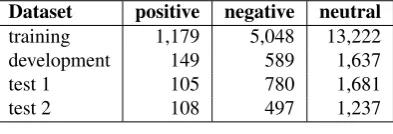
2017) consists of 21,824 messages from various social me-dia and web sources intended for analyzing customer re-views about “Deutsche Bahn”, the German public train op-erator with about two billion passengers annually. The data is split roughly into 90% for training and 10% for develop-ment as shown in Table 2. They also provide two test sets. The shared task’s Subtask-B is on multi-class document-level polarity, which is about identifying whether the cus-tomer’s opinion of “Deutsche Bahn” or travel is positive, negative or neutral. The sentence length in the training set ranges between 182 words and just two words. Test set 1 contains larger articles reaching up to 4,666 words in length.
Dataset positive negative neutral
training 1,179 5,048 13,222 development 149 589 1,637
test 1 105 780 1,681
test 2 108 497 1,237
Table 2:Deutsche Bahn Dataset
The data was annotated by a team of six annotators (Wo-jatzki et al., 2017), and each document was annotated by
1
http://www.sananalytics.com/lab
2
positive negative mixed objective Total
799 1,684 832 6,691 10,006
Table 3:ASTD Dataset
two annotators using WebAnno’s curation interface. The documents were checked for consistency by a supervisor who decided on divergences and new issues.
4.3.
Arabic - ASTD
The Arabic Sentiment Tweets Dataset (ASTD)3 (Nabil et
al., 2013) consists of 10,006 tweets which are classified as ‘positive’, ‘negative’, ‘mixed’, and ‘objective’. The dis-tribution of the tagset is shown in Table 3. The tweets were collected from EgyptTrends and were not related to any particular topic, but generally included comments on diverse political issues. The tweets were annotated through the Amazon Mechanical Turk by three annotators. Tweets that were assigned the same rating by at least two annota-tors were accepted, otherwise rejected.
A key observation in the three datasets is the noticeable im-balance between the labels as shown in Figure 1, where the “positive” label shows the most disproportionate distribu-tion.
Figure 1: Tagset Distribution
5.
System Description
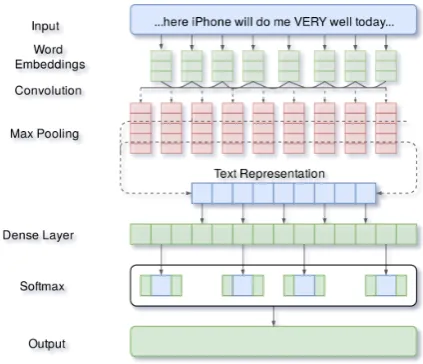
We use a deep neural network model for predicting sen-timent polarity. The architecture of our model, shown in Figure2, is straight-forward. The first layer in our model is a randomly-initialized word embedding layer that turns words in sentences into a feature map and preserves the spatial (contextual) information for each word. This is fol-lowed by a convolution neural network (CNN) layer that scans the feature map. This CNN layer has 300 filters and a width of 7, which means that each filter is trained to detect a certain pattern in a 7-gram window of words. Global max-pooling is applied to the output of each filter to take the maximum score of each pattern we search for though the text. The main function of the pooling layer is reduce the dimensionality the CNN representations by down-sampling the output and taking the maximum value as the feature cor-responding to each filter. Those score are then supplied to a
3
http://www.mohamedaly.info/datasets/astd
Figure 2: The Architecture of our sentiment detection model applied to an example tweet, best viewed in color. Here the model takes a tweet as its current input to predict its sentiment polarity.
single feed-forward (fully-connected) layer of size 600 and Relu activation to make further learning. Finally, the output of that layer goes through a Softmax layer that predicts the output classes. Table 4 and Figure 2 show the layer config-uration and architecture of our model.
Layer Output Shape Params
embedding (None, 300, 300) 10960800 conv1d (None, 294, 300) 630300 glob max pool 1d (None, 300) 0 dense 1 (None, 600) 180600 dense 2 (None, 3) 2404
Table 4:Neural Network Architecture
For processing the data, we perform manual tokenization on the data by inserting a space between words and punc-tuation marks. Then we ignore the long tail of the low-frequency words (heuristically setting the threshold at 3, i.e. ignoring words that occur three times or less), and remove URL addresses.We tried ignoring the top three most fre-quent words, assuming that they are semantically-irrelevant function words (e.g. punctuations, determiners and prepo-sitions), but this led to lowering the performance.
6.
Experiments and Results
We compare our system to the best scores published in the literature for each dataset. We consider the comparison meaningful only when there is a test set provided. Other-wise, we create our own splits of the data, and the compar-ison with previously published results are only indicative.
6.1.
Results on Sanders Dataset
and SVM), and reported an accuracy of 70.1%. Da Silva et al. (2014) used the Ensemble method (training multi-ple learners to solve the same problem) and reported an ac-curacy score of 76.25%. Similarly Hassan et al. (2013) used a stack of learning models and a voting mechanism and obtained an accuracy of 76.30%. Using our system we achieved a significantly higher accuracy score of 78.3%. However, as there were no dedicated test set for this dataset we tested our system on a randomly selected subset of 20% of the data, which makes the comparison with the other sys-tems not conclusive.
It is to be noted that Johansson and Lilja (2016) reported a higher score for the Sanders dataset of 84.38% using a lex-icon, but they reported that the method did not scale well to other datasets including IMDB and Sentiment140. It is also not clear to us whether their experiments were limited to the binary polarity of positive and negative or they pre-dicted the full range of classes.
6.2.
Results on Deutsche Bahn
The Deutsche Bahn dataset has been used in the GermEval-2017 Shared Task on Aspect-based Sentiment in Social Me-dia Customer Feedback. The best results on Test 1 were reported by Naderalvojoud et al. (2017), H¨ovelmann and Friedrich (2017) and Sidarenka (2017) who achieved ac-curacy scores of 74.94%, 74.786% and 74.47% respec-tively. H¨ovelmann and Friedrich (2017) used three Ger-man lexicons (combined in what they called the GerGer-man SentiWordNet Lexicon) and fed them to a deep recurrent neural network (RNN) classifier to discover context-based sentiments. H¨ovelmann and Friedrich (2017) on their turn used a fastText classifier (the Facebook open-source library for text representation), enhanced with pretrained vectors and gradient boosted trees (GBTs) trained on bag-of-words (BOWs). Sidarenka (2017) used a hybrid approach by join-ing an SVM module trained on user-specified attributes with a bi-directional LSTM network.
We fine tune the hyper parameters of our system on the de-velopment set of the GermEval shared task. Our system gives an accuracy of 75.45% on Test 1 which is slightly above the results of the best system. We consider the com-parison here meaningful as we are testing against the same benchmark set.
6.3.
Results on the ASTD Dataset
The ASTD dataset has been used in (Nabil et al., 2013) and the best reported accuracy score is 69.1% using an SVM classifier. They tried to balance the data using undersam-pling which did not perform as well. Our system gives an accuracy of 67.93%, which is slightly below their results, but the evaluation is not conducted on the same set. As no test set was provided we randomly selected a 20% subset from the available data.
7.
Dealing with Data Imbalance
We notice that the prediction results favor the majority classes at the expense of the minority classes as the sys-tem atsys-tempts to achieve high accuracy scores. Trying to resolve this issue, we need first to find an evaluation met-rics that gives equal weight to the classes in the labelset,
and second find a way to balance the data. For the eval-uation measure, we choose the F1 score with a macro av-erage as it calculates the f-score for each label, and out-puts their unweighted mean, allowing each class to have the same weight as the other classes regardless of the number of instances.
To balance out the training data, we apply manual oversam-pling by repeating records of the minority classes. It is to be noted that SMOTE (Synthetic Minority Over-Sampling Technique) is sometime successfully applied to numerical data, but it is not applicable to textual data as is case with the data here. We compare the results using the macro F1 before and after oversampling for the three datasets. For the English dataset, Tables 5 and 6 show the confusion matrix for the model’s predictions without and with over-sampling respectively. In overover-sampling we repeated the records for ‘Positive’ and ‘Negative’ three-folds. The over-sampling technique works in improving the performance raising both the accuracy (from 78.60% to 79.57%) and the macro F-measure scores (from 69.13% to 70.23%).
Negative Positive Neutral irrelevant
Negative 56 12 39 0
Positive 10 50 36 5
Neutral 29 37 384 23
irrelevant 3 1 24 314
Accuracy 78.60
F1 Macro 69.13
Table 5:Confusion Matrix for the Sanders Dataset without Over-sampling
Negative Positive Neutral irrelevant
Negative 55 4 46 2
Positive 11 47 39 4
Neutral 25 21 404 23
irrelevant 3 1 30 308
Accuracy 79.57
F1 Macro 70.23
Table 6: Confusion Matrix for the Sanders Dataset with Over-sampling
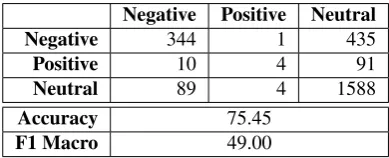
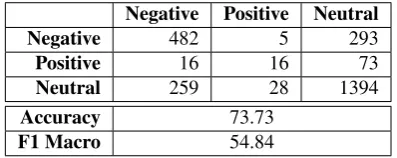
For the German dataset, Table 7 show the confusion matrix for the model predictions for the test set without oversam-pling. Table 8 shows the results after oversampling ‘Posi-tive’ and ‘Nega‘Posi-tive’ three folds. The oversampled model shows a better confusion matrix with an increase in the macro F1 score (from 49.00% to 45.84%) despite the de-crease in Accuracy.
Negative Positive Neutral Negative 344 1 435
Positive 10 4 91
Neutral 89 4 1588
Accuracy 75.45
F1 Macro 49.00
Negative Positive Neutral Negative 482 5 293
Positive 16 16 73
Neutral 259 28 1394
Accuracy 73.73
F1 Macro 54.84
Table 8: Confusion Matrix for the Deutsche Bahn Dataset with Oversampling
For the Arabic dataset, Table 9 show the confusion matrix without oversampling, and Table 10 shows the results af-ter oversampling by repeating ‘Positive’ and ‘Mixed’ three folds, and double sizing the ‘Negative’. The oversampled model again shows a better macro F1 score with an increase from 29.82% to 35.32%.
Negative Positive Objective Mixed
Negative 111 0 233 0
Positive 6 0 167 0
Objective 73 0 1249 0
Mixed 43 0 120 0
Accuracy 67.93
F1 Macro 29.82
Table 9:Confusion Matrix for the ASTD Dataset without Over-sampling
Negative Positive Objective Mixed
Negative 89 2 237 16
Positive 10 16 145 2
Objective 30 73 1191 28
Mixed 24 4 118 17
Accuracy 65.58
F1 Macro 35.32
Table 10: Confusion Matrix for the ASTD Dataset with Over-sampling
Oversampling the data, simply by replicating records, only tricks the model into giving greater weight to a certain class, but does not provide any essentially useful information to the system to base it’s judgment on. Therefore, we recom-mend data annotation to selectively target more data to in-crease the size of the minority classes to allows the system to better understand and predict these classes.
8.
Conclusion
In this paper we have presented our systems for multi-class sentiment classification and we found that the deep neural network model can outperform traditional methods that rely on language-specific feature engineering. We show that the class imbalance in the data can lead to degradation in the system performance, and point out that oversampling can be a helpful workaround for handling this imbalance. Further we note that the system performs better on the Sanders dataset, followed by the Deutsche Bahn and the ASTD datasets. This could be connected to the observation that the ASTD dataset has the largest number of classes (5
classes compared to 4 in Sanders and 3 in Deutsche Bahn) and there could be an inverse correlation between the in-creased number of classes and the system performance. Beside the class balance and the granularity of classes, we assume that the system performance could be also im-pacted by the quality of the annotation (in-house vs. crowd-sourced) and whether the polarity is related to a specific or general topic.
9.
Bibliographical References
Baccianella, S., Esuli, A., and Sebastiani, F. (2010). Senti-wordnet 3.0: an enhanced lexical resource for sentiment analysis and opinion mining. InLREC, volume 10, pages 2200–2204.
Badaro, G., Baly, R., Hajj, H., Habash, N., and El-Hajj, W. (2014). A large scale arabic sentiment lexicon for arabic opinion mining. In Proceedings of the EMNLP 2014 Workshop on Arabic Natural Language Processing (ANLP), pages 165–173.
Boiy, E. and Moens, M.-F. (2009). A machine learning ap-proach to sentiment analysis in multilingual web texts.
Proceedings of the 49th Annual Meeting of the Associa-tion for ComputaAssocia-tional Linguistics, 12:526–558. Bravo-Marquez, F., Mendoza, M., and Poblete, B. (2013).
Combining strengths, emotions and polarities for boost-ing twitter sentiment analysis. InProceedings of the Sec-ond International Workshop on Issues of Sentiment Dis-covery and Opinion Mining, Chicago, USA.
Cambria, E., Poria, S., Bajpai, R., and Schuller, B. (2016). Senticnet 4: A semantic resource for sentiment analysis based on conceptual primitives.In Proceedings of COL-ING 2016, the 26th International Conference on Com-putational Linguistics: Technical Papers, pages 2666– 2677.
Cambria, E. (2016). Affective computing and sentiment analysis.IEEE Intelligent Systems, 31:102–107. Da Silva, N. F., Hruschka, E. R., and Hruschka, E. R.
(2014). Tweet sentiment analysis with classifier ensem-bles.Decision Support Systems, 66:170–179.
dos Santos, C. N. and Gatti, M. (2014). Deep convolu-tional neural networks for sentiment analysis of short texts. In Proceedings of COLING 2014, the 25th In-ternational Conference on Computational Linguistics: Technical Papers, pages 69–78.
Esuli, A. and Sebastiani, F. (2006). Sentiwordnet: A pub-licly available lexical resource for opinion mining. In Proceedings of the 5th Conference on Language Re-sources and Evaluation (LREC’06), pages 417–422. Gamon, M. (2004). Sentiment classification on customer
feedback data: noisy data, large feature vectors, and the role of linguistic analysis. In Proceedings of the 20th International Conference on Computational Linguistics (COLING’04).
Glorot, X., Bordes, A., and Bengio, Y. (2011). Domain adaptation for large-scale sentiment classification: A deep learning approach. In Proceedings of the Twenty-eight International Conference on Machine Learning, ICML.
ICWSM 2007 - International Conference on Weblogs and Social Media.
Graves, A., Mohamed, A.-r., and Hinton, G. (2013). Speech recognition with deep recurrent neural networks. In Acoustics, speech and signal processing (icassp), 2013 ieee international conference on, pages 6645– 6649. IEEE.
Hassan, A., Abbasi, A., and Zeng, D. (2013). Twitter sen-timent analysis: A bootstrap ensemble framework. In
Social Computing (SocialCom), 2013 International Con-ference on, pages 357–364. IEEE.
H¨ovelmann, L. and Friedrich, C. M. (2017). Fasttext and gradient boosted trees at germeval-2017 tasks on rele-vance classification and document-level polarity. In Pro-ceedings of the GermEval 2017 Shared Task, Berlin, Ger-many.
Johansson, H. and Lilja, A. (2016). Method perfor-mance difference of sentiment analysis on social media databases: Sentiment classification in social media. Johnson, R. and Zhang, T. (2014). Effective use of word
order for text categorization with convolutional neural networks. arXiv preprint arXiv:1412.1058.
Kim, Y. (2014). Convolutional neural networks for sen-tence classification. arXiv preprint arXiv:1408.5882. Krizhevsky, A., Sutskever, I., and Hinton, G. E. (2012).
Imagenet classification with deep convolutional neural networks. InAdvances in neural information processing systems, pages 1097–1105.
LeCun, Y., Bengio, Y., et al. (1995). Convolutional net-works for images, speech, and time series.The handbook of brain theory and neural networks, 3361(10):1995. Lin, C. and He, Y. (2009). Joint sentiment/topic model
for sentiment analysis. In Proceedings of the 18th ACM Conference on Information and Knowledge Manage-ment, pages 375–384.
Maas, A. L., Daly, R. E., Pham, P. T., Huang, D., Ng, A. Y., , and Potts, C. (2011). Learning word vectors for senti-ment analysis. Proceedings of the 49th Annual Meeting of the Association for Computational Linguistics, pages 142–15.
Mikolov, T., Chen, K., Corrado, G., and Dean, J. (2013a). Efficient estimation of word representations in vector space. In In Proceedings of International Conference on Learning Representations (ICLR) 2013. arXiv:1301.3781v3, pages 746–751, Scottsdale, AZ. Mikolov, T., tau Yih, W., and Zweig, G. (2013b).
Linguis-tic regularities in continuous space word representations. In Proceedings of NAACL-HLT 2013, pages 746–751, Atlanta, Georgia.
Mullen, T. and Collier, N. (2004). Sentiment analysis us-ing support vector machines with diverse information sources. Proceedings of EMNLP-04, 9th Conference on Empirical Methods in Natural Language Processing. Nabil, M., Aly, M., and Atiya, A. (2013). Astd: Arabic
sentiment tweets dataset. In Proceedings of the 2015 Conference on Empirical Methods in Natural Language Processing (EMNLP 2015), pages 2515–2519, Lisbon, Portugal.
Naderalvojoud, B., Qasemizadeh, B., and Kallmeyer, L.
(2017). Hu-hhu at germeval-2017 sub-task b: Lexicon-based deep learning for contextual sentiment analysis. In
Proceedings of the GermEval 2017 Shared Task, Berlin, Germany.
Neethu, M. S. and Rajasree, R. (2013). Sentiment analysis in twitter using machine learning techniques. pages 1–5, July.
Pang, B. and Lee, L. (2008). Opinion mining and senti-ment analysis. Foundations and Trends in Information Retrieval, 2:1–135.
Pang, B., Lee, L., and Vaithyanathan, S. (2002). Thumbs up? sentiment classification using machine learning techniques.EMNLP 2002, 10:79–86.
Pennington, J., Socher, R., and Manning, C. D. (2014). Glove: Global vectors for word representation. In Pro-ceedings of the 2014 Conference on Empirical Methods in Natural Language Processing (EMNLP), pages 1532– 1543, Doha, Qatar.
Perez-Rosas, V., Banea, C., and Mihalcea, R. (2012). Learning sentiment lexicons in spanish. InLREC, vol-ume 12, page 73.
Pham, D.-H. and Le, A.-C. (2016). A neural network based model for determining overall aspect weights in opinion mining and sentiment analysis. Indian Journal of Sci-ence and Technology, 9:1–6.
Poria, S., Chaturvedi, I., Cambria, E., and Hussain, A. (2016). Convolutional mkl based multimodal emotion recognition and sentiment analysis. In Proceedings of the Twenty-eight International Conference on Machine Learning, ICML, pages 439–448.
Remus, R., Quasthoff, U., and Heyer, G. (2010). Sentiws-a publicly Sentiws-avSentiws-ailSentiws-able germSentiws-an-lSentiws-anguSentiws-age resource for senti-ment analysis. InLREC.
Sanders, N. J. (2011). Sanders-twitter sentiment corpus.
Sanders Analytics LLC.
Sidarenka, U. (2017). Potts at germeval-2017 task b: Document-level polarity detection using hand-crafted svm and deep bidirectional lstm network. In Proceed-ings of the GermEval 2017 Shared Task, Berlin, Ger-many.
Tripathy, A., Agrawal, A., and Rath, S. K. (2016). Clas-sification of sentiment reviews using n-gram machine learning approach. In Expert Systems With Applications, 57:117–126.
Wilson, T., Wiebe, J., and Hoffmann, P. (2005). Recogniz-ing contextual polarity in phrase-level sentiment analy-sis. pages 347–354.
Wojatzki, M., Ruppert, E., Holschneider, S., Zesch, T., and Biemann, C. (2017). Germeval 2017: Shared task on aspect-based sentiment in social media customer feed-back. In Proceedings of the GermEval 2017 Shared Task, Berlin, Germany.