FRANK G. PAGAN
CONSTRUCTIBLE REPRESENTATIONS FOR T W O SEMANTIC RELATIONS
1. INTRODUCTION
This paper is concerned with semantic (or lexical) structures of the type used in programs which involve natural language processing, such as question-answering systems. These structures, which generally take the form of graphs representing semantic relations defined on word senses, must satisfy some rather self-evident requirements re- lating to their linguistic significance and adequacy and to their suita- bility for computational implementation. In addition, if the lexical subsets in question are to be nontrivial in size, the structures must be constructible in some systematic, consistent way, preferably with the aid of a computer. The structures which have been used in existing experim.ental systems, such as those reported in M. R. QUILLIAN (1969) and K. M. SCaWARCZ, J. F. BtraGrR, K. F. SIMMONS (1970), have gene- rally been very restricted, and it has been argued (S. Y. S~D~OW, 1972) that it is their lack of constructibility which has precluded the possibility of extending them.
30 F R A N K G. P A G A N
It is far beyond the scope of the paper tO consider the development and implementation of practical programs for building large semantic structures. It should also be emphasized that the aim is not the de- velopment of linguistic theories or the presentation of
particular
lexical structures. While the linguistic positions adopted in the following section are consistent with much of the existing literature, they are primarily intended to provide a sample context in which the role of constructibility may be illustrated.2. HYPONYMY AND COMPATIBILITY
The term
hyponymy
has been used by J. LYoNs (1968) to denote the common but somewhat vague notion of "semantic inclusion"A hyponymy p
of a word sense q is a word sense whose meaning is a "subset " of the meaning of q; for example,scarlet
is a hyponym ofred,
andtulip
is a hyponym offlower.
Intuitively, ifp is a hyponym of q, then it makes sense to say that p is a kind of q. Synonymy of word senses may be defined in terms of hyponymy: p is a synonym of q if and only if p is a hyponym of q and q is a hyponym of p. The hyponymy relation is evidently reflexive and transitive.The importance of hyponymy has been generally recognized by workers in computational semantics (see, for example, M. 1~. QuII.- I.IAN, 1969, and P,.. M. SCHWARCZ, J. F. BrinGeR, 1~. F. SIMMONS, 1970). Quillian's system (M. R. QUILI.IAN, 1969) is a generalization of a scheme for representing lexical
definitions
of word senses in terms ofsupersets
and
properties,
where the superset relation is simply the inverse of hypo- nymy. When the superset of some sense is modified by the relevant properties, an expression is obtained which is a definitionof paraphrase
of the given sense. As a highly simplified example, suppose that the superset of
bachelor
isman,
with the corresponding propertyunmar-
ried,
and that the superset ofyouth
is alsoman,
with the corresponding propertyyoung.
A simple calculation would then mark the expressionsCONSTRUCTIBLE REPRESENTATIONS FOR TWO SEMANTIC RELATIONS 31
Turning to the
compatibility
relation, the simplest case involves combinations o f adjective senses and noun senses to form expressions which may be either meaningful(hungry man)
or meaningless(hungry
theory).
The two senses may be said to be compatible if their combina- tion is meaningful. It turns out that little can be done with regard to the representation of this relation unless its definition is extended as follows: two adjective senses are compatible if and only if there are noun senses compatible with both. It is useful here to think o f noun senses as "atoms " or "constants " and adjective senses as "predicates " which take noun senses as arguments (this is similar to Fillmore's approach [C.J. FII.LMOI~, 1969]). The second definition o f compatibility then involves the intersections o f the domains o f predicates. This re- lation, which is reflexive and symmetric, will be the more important as far as constructibility is concerned.• As for the
use
of compatibility, on the other hand, t h e first defini- tion is the important one. First, in a linguistic or computational system involving the generation or analysis o f sentences, it would be useful in excluding meaningless constructions o f word senses, and it can be argued that this capability is a fundamental one for any such system. Secondly, the relation provides the ability todisambiguate
words in the context o f their combination with other words. For example, suppose thathard-has
two senses written ashard (difficult)
andhard (not
soft), and thatball
has the two sensesball (round object)
andball (social event).
Suppose further thathard (di~cult)
is compatible withquestion
and incompatible with both senses ofball,
and thathard (not soft)
is incom- patible withquestion
andball (social event)
but compatible withball
(round object).
Then, in the expression•hard question, hard
must meanhard (diffcult).
Similarly, in the expressionhard ball, hard
must meanhard (not soft)
andball
must meanball (round object),
since the other three combinations are all incompatible.3. STRUCTURES. FOR HYPONYMY
32 F R A N K G. P A G A N
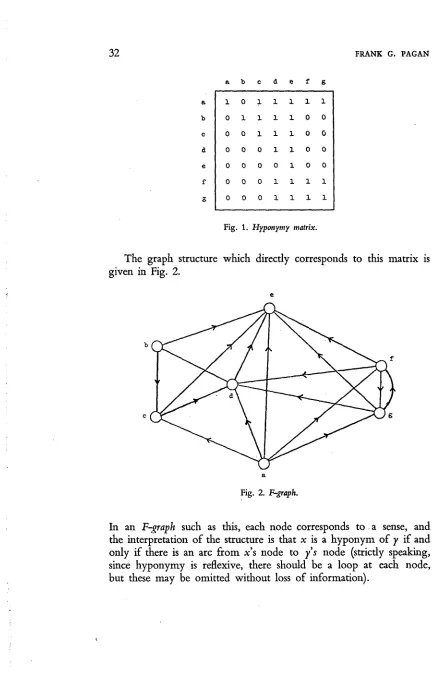
a b c d e f g
1 0 1 1 1 1 1
0 1 1 1 1 0 0
0 0 1 1 1 0 0
0 0 0 1 1 0 0
0 0 0 0 1 0 0
0 0 0 1 1 1 1
0 0 0 1 1 1 1
F i g . 1. Hyponymy matrix.
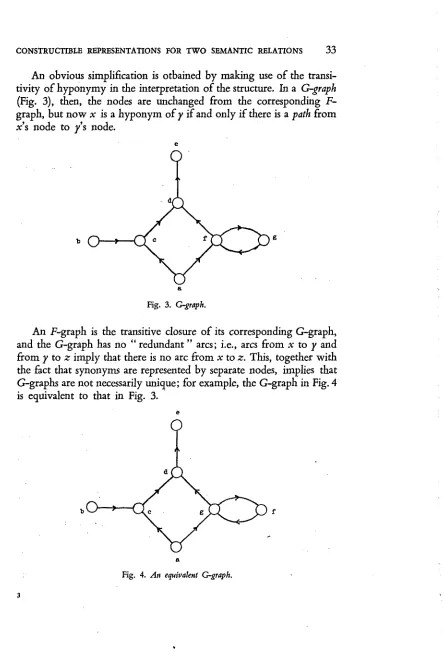
The graph structure which directly corresponds to this matrix is given in Fig. 2.
e
b
4 •
ct
I
o.
F i g . 2 . F-graph.
[image:4.612.66.503.69.743.2] [image:4.612.200.464.360.565.2]CONSTRUCTIBLE REPRESENTATIONS FOR T W O SEMANTIC RELATIONS 33
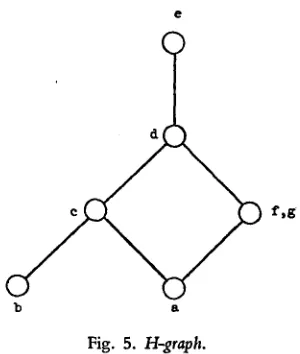
An obvious simplification is otbained by making use of the transi- tivity of hyp0nymy in the interpretation of the structure. In a
G-graph
(Fig. 3), then, the nodes are unchanged from the corresponding F- graph, but now x is a hyponym of/, if and only if there is apath
from x's node t o / s node.e
I~ G ~ g
Fig. 3. G-graph.
An F-graph is the transitive closure of its corresponding G-graph, and the G-graph has no "redundant " arcs; i.e., arcs from x to y and from y to z imply that there is no arc from x to z. This, together with the fact that synonyms are represented by separate nodes, implies that G-graphs are not necessarily unique; for example, the G-graph in Fig. 4 is equivalent to that in Fig. 3.
@
I -
- f
[image:5.612.101.546.71.727.2] [image:5.612.121.433.203.383.2]34 FRANK G. P A G A N
This non-uniqueness may be avoided by transforming the G-graph into an
H-graph,
in which synonyms are associated with the same node but the interpretation is otherwise unchanged. All H-graphs are acydic, since all the senses on a cycle would have identical hyponymy relation- ships with all other senses, i.e., they would be synonyms. Thus the nodes form a partially ordered set, and/-/-graphs may be represented by lattice-like Hasse diagrams (D. E. P,.OTr~RrORD, 1965) where each edge is assumed to be directed towards the top of the page, although the arrows are not explicitly present (Fig. 5).e
b a
f , g
Fig. 5. H-graph.
[image:6.612.259.409.264.441.2]CONSTRUCTIBLE REPRESENTATIONS FOR T W O SEMANTIC RELATIONS 35
The class of structures so obtained may be termed
H-forests,
since they are a proper subset of the/-/-graphs.Although it has been generally adopted in existing models, the restriction to H-forests is not without its dit~iculties. The H-graph in Fig. 6 represents an intuitively correct set of hyponymy relationships which is inconsistent with the H-forests.
c h i l d
VOllllin
~other faBher
Fig. 6. Apparent inadequacy of H-forests.
An interesting but open question is whether such examples can be considered to be rare in natural language, occurring only in very special cases such as kinship terminology. A related question concerns the validity of the assumption that a given sense is
necessarily
an immediate hyponym of at most one other sense, so that hyponymy, defined on this basis, must be tree-structured. It is clear that with the present state of our knowledge a linguistic case can be made for both H-graphs and /-/-forests as the appropriate class of structures for the hyponymy re- lation. [image:7.612.133.360.230.413.2]36 FRANK G. PAGAN
This "basic data " would consist of judgments of the relationships between particular pairs of senses: either the first is a hyponym of the second, the second is a hyponym of the first, they are synonyms, or they are related in none of these ways.
The H-graph or H-forest would be constructed by a process of monotonic refinement; i.e., after the incorporation of each additional word sense, the new structure would be a recognizable generalization of the previous structure. More specifically, suppose that Hi and Hi+l are the current structures after i and i + 1 senses, respectively, x and y are any two senses previously processed, and the
distance
between two senses on the same path is the number of arcs separating them. Then the following statements would hold:a) If x and y are at the same node in H i, then they are at the same node in Hi+l;
b) x and y are not at the same node in H i iff they are not at the same node in H~+I;
c) x is above y in Hi iff x is above y in Hi+l;
d) if x is a distance d above y in Hi, then x is a distance d or d q-1 above y in Hi+l.
e) if x is a distance d above y in Hi+l, then x is a distance d or d-1 above y in Hi;
f ) x and y are not on the same path in Hi iff they are not on the same path in Hi+l.
The remaining requirements for constructibility are those of input efficiency and consistency maintenance. An obvious point of reference for efficiency is the maximum number of inputs which would be re- quired irrespective of the algorithm and the set of word senses used. 1 N 2, where N is the number o f senses, This is approximately given by
and would be reached in cases where inputs must be obtained for all pairs of senses. The transitivity of hyponymy would allow H-graphs to be constructed with better efficiency than this; for example, if a sense z were found to be a hyponym of y, and y were known to be a hyponym of x, then it could be inferred or
predicted
that z is a hyponym of x with no additional input. H-forests could be constructed with better efficiency than H-graphs since they are a much more predictive class of structures; for example, if z were found to be " unrelated" at the root of a tree, then it would be predicted to be " u n r e l a t e d " everywhere in the tree.CONSTRUCTIBLE REPRESENTATIONS FOR TWO SEMANTIC RELATIONS - 37
a violation of transitivity, and the procedure could check for such occurences automatically. In the case of H-forests, there is more scope for inconsistency, since any valid H-graph which is not also an H- forest represents a set of information which is inconsistent with H- forests. The procedure would have to obtain redundant inputs in order to maintain a consistency check in this case. The details of testing for and correcting inconsistencies would depend upon the properties of the particular discovery procedure used.
To summarize this section, I have attempted to place in perspective the plausible classes of structures for hyponymy. Both H-graphs and H-forests satisfy the basic requirement for constructibility. The con- struction of the latter, however, would be more efficient, so that it would be disadvantageous to use a discovery procedure for H-graphs in general if H-forests alone are linguistically adequate.
4. STRUCTURES FOR COMPATIBILITY
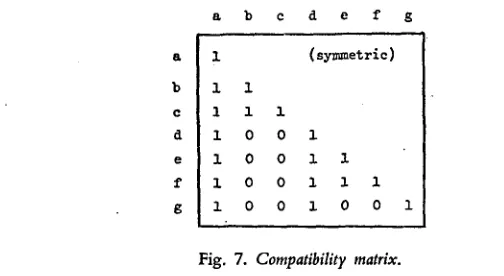
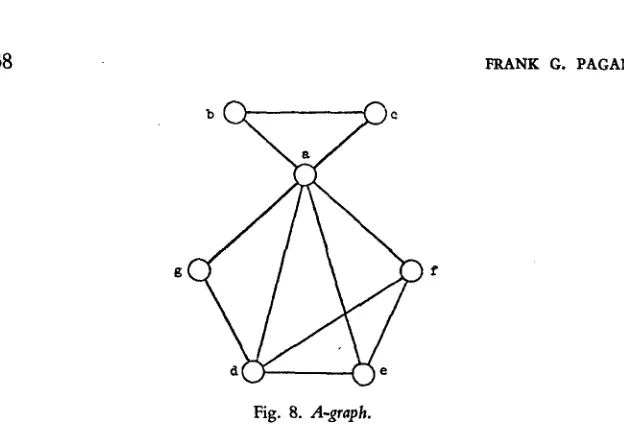
The variety of structure classes for the compatibility relation turns out to be richer than in the case of hyponymy. To illustrate some of these representations, suppose that the compatibility relationships among the seven-word senses a, b ... g are as shown in the matrix of Fig. 7.
a b c d e f g
1 (symmetric)
1 1
1 1 1
1 0 0 1 1 0 0 1 1 1 0 0 1 1 1 1 0 0 1 0 0
Fig. 7. Compatibility matrix.
[image:9.612.129.381.443.581.2]38 F R A N K G. P A G A N
b
Fig. 8. A-graph.
For large sets of senses, A-graphs would clearly be unwieldy and uneconomic, and a more compact representation would be highly desirable. One particularly interesting transformation of the matrix or A-graph is obtained by grouping senses with the same compatibility properties with respect to all the other senses and placing them at the same node. The interpretation of such a
C-graph
is that two senses are compatible if and only if they are associated with the same or adja- cent nodes. The C-graph for the present example is given in Fig. 9. It can be easily shown that every C-graph is unique and that this class of structures is fully general.b , c
T
e,f g
tl
[image:10.612.177.489.89.304.2]CONSTRUCTIBLE REPRESENTATIONS FOR TWO SEMANTIC RELATIONS 39
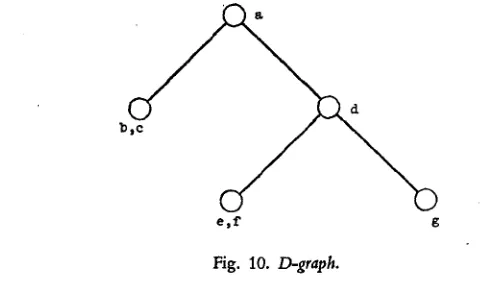
Turning now to more restrictive structures, a more compact rep- resentation can sometimes be obtained by transforming the undi- rected C-graph into a directed
D-graph
with the same set of nodes but with the interpretation that two senses are compatible if and only if either they are at the same node or there exists a path between their nodes. In analogy to the situation for/-/=graphs, the nodes of a D- graph are partially ordered. Fig. 10 shows a D-graph for the example in the form of a Hasse diagram. The D-graphs are not a fully general class of structures; i.e., there are C-graphs with no corresponding D-graphs. Neither are they necessarily unique: it can be shown that some C-graphs have more than one equivalent D-graph.• ' ~" d
b
e,f g
Fig. 10. D-graph.
The linguistic significance of these structures lies in their strong similarity to systems of semantic
markers
orfeatures
(corresponding to nodes) related byredundancy rules
(corresponding to edges) (J. J. KATZ, J. A. FODOR, 1963). In this case, a feature isdefined
as the set of senses which, in other formulations, would be said tohave
the feature. The relationships among features, and hence the compatibility properties of word senses, have often been represented by structures similar to/9= graphs; moreover, a survey of the relevant theoretical and computa- tional literature (e,g., tL. C. SCHANK, 1969; F. SOMMF.RS, 1963) would reveal that tree-like structures have nearly always been considered to be adequate for this purpose. The graph of Fig. 10 is in fact such aD-forest.
A given set of compatibility relationships can be representedby at most one D-forest.
[image:11.612.140.381.298.441.2]4 0 F R A N K G. P A G A N
may easily be shown that this class satisfies all the requirements of con- structibility except the crucial one of effciency. Assuming the availa- bility of basic data in the form of yes-or-no judgments of the compati- bility of unordered pairs of word senses, a C-graph could be built by a monotonic refinement process: at each stage the current sense would either be added to an existing node or form a new node, possibly in conjunction with the "splitting " of other nodes. Efficiency, however, is the worst possible because the class of structures is fully general, and the judgements obtained for the compatibility of the current sense with some subset of the previous senses have no predictive value for its com- patibility with any of the other senses in the graph.
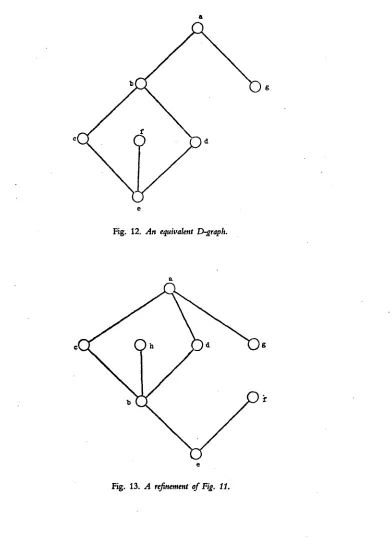
The lack of effciency in constructing C-graphs can be regarded as a corollary of the fact that inconsistencies are impossible2 They are pos- sible in the case of D-graphs, however, and thus the assumption that they would not arise would make some judgments unnecessary after others became known. But D-graphs fail to be constructible because of their non-uniqueness. The D-graphs shown in Fig. 11 and Fig. 12 are equivalent,
8.
c g
f
e
Fig. 11. A non-unique D-graph.
[image:12.612.171.532.382.604.2]CONSTRUCTIBLE REPRESENTATIONS FOR TWO SEMANTIC RELATIONS 41
&
e cl
e
Fig. 12. An equivalent D.-£raphl
a
:r
e;
[image:13.612.111.503.142.697.2]42 FRANK G. PAGAN
The latter graph is a simple modification of Fig. 11 but not of Fig. 12, and there is no graph equivalent to Fig. 13 which is easily obtained from Fig. 12. Since a given discovery procedure could construct either of the first two graphs depending upon the order in which the senses were incorporated, the process would in general involve complete reconstruction rather than monotonic refinement.
The D-forests, finally, are constructible in all respects. Monotonic refinement is characterized in this case by the following statements, where x and y again are any two senses previously processed and D~ and D~+ 1 are the current forests after i and i q- 1 senses, respectively:
a) if x and y are at the same node in D,., then they are at the same or adjacent nodes in Di+l;
b) if x is a distance d above y in Di, then x is a distance d or d -q- 1 above y in D~+I;
c) if x is a distance d above y in Di+l, then x is a distance d or d - - 1 above y in D~;
d) x and y are not on the same path in Di iff they are not on the same path in Di+l.
A D-forest is a highly predictive structure; i.e., a judgment involving one of its word senses will in general predict the outcome of many other judgments. A detailed estimation of the efficiency of construction would involve the order of the senses, the configuration of the final structure, and the node-scanning strategy used in the discovery al- gorithm. It is sufficient here to recall, however, that nodes correspond to linguistic features, and hence one would expect that if the number of senses processed were very large, then the number of nodes would be much smaller. Thus all the nodes would appear relatively early in the construction process, and this leads to the conclusion that the total number of judgments would be a nearly linear function of the number of senses. In order to detect inconsistencies, however, some of this efficiency would have to be sacrificed and redundant judgments taken.
CONSTRUCTIBLE REPRESENTATIONS FOR TWO SEMANTIC RELATIONS 43
5. CONCLUSION
REFERENCES
T. G. BEvy, P. S. ILOSEN~AUM, Some Lexical Structures and their Empirical Validity, in tL. A. JACOBS, P. S. tLO- S~NBAUM (eds.), Readings in English Transformational Grammar, Weltham /Mass), 1970.
A. M. COLLINS, M. IL. QUILLIAN, Re- trieval Time from Semantic Memory, in • J. Verb. Learn. Verb. Behav. J, VIII (1969), pp. 240-247.
C. J. Fmt.MOl~, Types of Lexical Infor- mation, in F. Kmm~ (ed.), Studies in Syntax and Semantics, Dordrecht (Hog land), 1969.
j. j. KATz, J. A. FoDo~, The Structure of a Semantic Theory, in *Language~, XXXIX (1963), pp. 170-210. J. LYONS, Introduction to Theoretical Lin-
guistics, London, 1968.
M. IL. QU~LIAN, The Teachable Lan- guage Comprehender, in ~ Communica- tions of the ACM,, XII (1969) 8, pp. 459--476.
D. E. I~I.."THERFORD, Introduction to Lattice Theory, Edinburgh, 1965.
IL. C. Scare,m, A Conceptual Parser for Natural Language, in Proc. IJCAI,
Washington, 1969, pp. 569-578. tL. M. SCh'WARCZ, J. F. Bu~Gma, tZ. F.
SIMMONS, A Deductive Question-answerer for Natural Language Inference, in, Com- munications of the ACM ,, XIII (1970) 3, pp. 167-183.
S. Y. S~D~OW, Language Analysis in the
Humanities, in ~ Communications of the ACM ~, XV (1972) 7, pp. 644-647. P. SOMM~S, Types and Ontology, in, Phil.