MORRIS SALKOFF
O N USING SEMANTIC D A T A I N A U T O M A T I C S Y N T A C T I C
ANALYSIS *
O. Introduction.
A program for the syntactic analysis of French text has been devel-
oped which is used in conjunction with a string grammar o f French 1
and a dictionary o f the grammatical properties o f the words in the sen-
tences analyzed. The program has been written in fORTRAN SO that it
can be used on any computer having a rORTaAN compiler. It has been
tested on the IBM 360-91 at the Centre d'Etudes Nucl&ires in Saclay,
and on the IBM 370-165 at the computing center o f the C.N.P,.S. in
Orsay and yields satisfactory analyses o f sentences in a reasonable com-
puting time.
The analyses obtained for the first eight sentences of a text by Jacob
and Monod in molecular biology are presented in the figures o f the ap-
pendix. M y object in this paper is to discuss what semantic data have
been incorporated in the string grammar in order to produce these
analyses and to prevent other false analyses from being obtained. A
discussion of certain features of these analyses, as well as o f those ana-
lyses not obtained, will bring out the nature o f the semantic data that
I have in mind. The text analyzed is reproduced in Fig. 1, and the ana-
lyses in the figures that follow.
1.
The analyses.
Sentence J M - 1
Remarks on the analyses.
a) The sequence
quelques armies sur la structure..,
is analyzed as
a noun phrase in which
sur la structure ...
is a right adjunct (modifier)
* Ce travail a pu &re r&lis~ en partie grflce au concours apport6 par un contrat
du Comit6 de Recherche en Informatique.
398
MORRIS SALKOFFo f
ann&s.
This analysis is a possible one (akhough not correct in this
sentence), for a sentence such as
Quelques ann&s sur ce probl~me m'ont
convaincu que ...
is correct.
b) The sequence
Les connaissances ... acides nucldiques et protdines
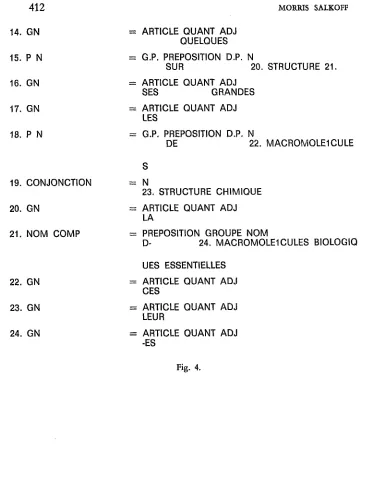
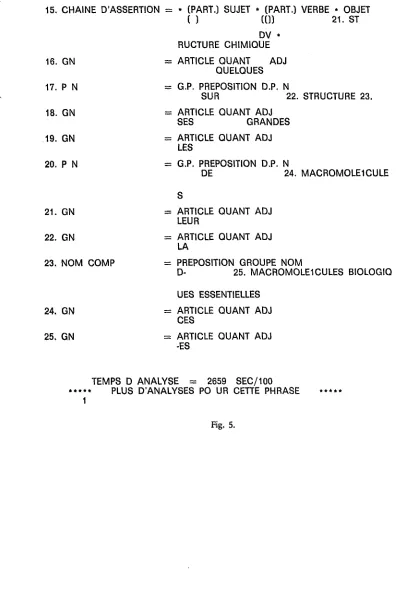
is the subject in the third and fourth analyses of JM-1 (figs. 4 and 5).
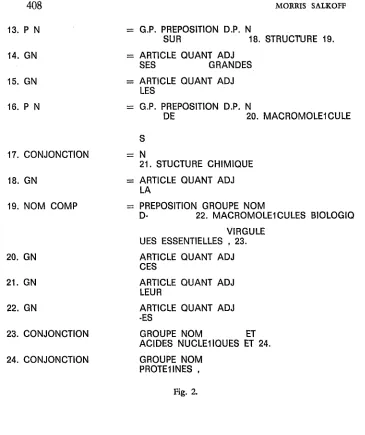
c) The pair of parentheses (), e.g. in line 7 of Fig. 2, represent a
zeroed indefinite subject of the verb
comprendre: (permettent) ?t quelqu'un
de comprendre cela ~ (permettent) ( ) de comprendre cela.
The double paren-
theses in line 13 of Fig. 3 represent an element that has been' reduced
to zero in the domain of a conjunction.
The following analyses were rejected:
d) The analysis in which the sequence
(1)
depuis quelques ann&s .... acides nucl~iques et prot~ines
would have been analyzed as a prepositional phrase consisting of
depuis
followed by a conjunction of three noun phrases. In effect, a concrete
noun, a time noun, or a nominalization is possible after
depuis:
(2)
a)
Depuis le coin de la rue, (je vous dis cela)
b)
Depuis ftuelques ann&s, (je vous dis cela)
but two different types cannot be conjoined after
depuis:
(3)
* Depuis le coin de la rue et quelques ann~es, (ie vous dis cela)
Since (1) is similar to (3) in this respect, this analysis was rejected.
Sentence JM-2
Remarks
a)
bien
is analyzed as a sentence adjunct only when it occurs to
the right of a form of
~tre,
as in this sentence, or in such sentences as
(4)
c'est bien lui; rid& ~tait bien a moi,
b) The sequence a
la suite de
should be analyzed as a complex
preposition, but the appropriate mechanism to accomplish this has not
yet been added to the analyzer.
R.ejected analyses.
ON USING SEMANTIC DATA IN AUTOMATIC SYNTACTIC ANALYSIS
399
(5)
*Pierre c) Paris (est mon ami) ;
mais:
Pierre de Paris (est mon
ami)
This restriction prevents the program from obtaining the incorrect ana-
lysis in which ~i
la suite ...
is a right adjunct of
Crick.~
d) the analyser rejects the analysis in which the sequence
(6)
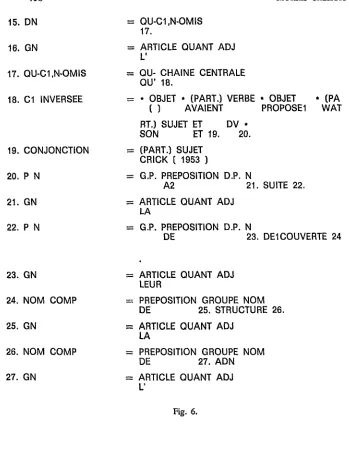
qu'avaient propos3 Watson et Crick c) la suite
is taken as similar to the sequence
(7)
qu'avaient proposd Watson et Crick au gouvernement
The verb
proposer
belongs to a subclass V15 that requires a human-like
noun in the position N~ of its object N1 ~ N~:
(8)
proposer quelque chose [au jury I ~ ce#e f~,~me I a la foulel ...]
*proposer quelque chose c) la table
The verb
apporter
also belongs to V15, and so the analyzer does not
obtain the analysis in which the sequence
(9)
apportd la preuve que ... ~ la suite
is taken as similar to
apporter un chapeau cl Marie.
Sentence J M - 3
Remarks
a) The sequence
(10)
le d&ouverte de r A R N messager
is analyzed as a "compound n o u n " This term was meant for such
groups as
(11)
lyc& d'Etat ; homme de l'espace ; bateau c~ vapeur
W h e n the mechanism for treating complex prepositions like ~ la sulte de has been added to the program, it will be specified in the grammar that the prepositional phrase
400
MOmUS SALKOPP
in which the prepositional phrase
de N
or ,~ N cannot be pronominalized
to
en
or y:
(12)
a)
Je vois un lyde d'Etat
:#~. *J'en vois un lyc~e
b)
Je vois un bateau ~ vapeur ¢:~ *J'y vois un bateau
But this pronominalization is possible for
(10):
(13)
On ddcrira la ddcouverte de r A R N messager-+ On en d&rira
la d&ouverte
and so should not be analyzed as a compound noun. However, some
technical difficulties with repeated adjuncts made it convenient to re-
tain this analysis temporarily.
Rejected Analysis.
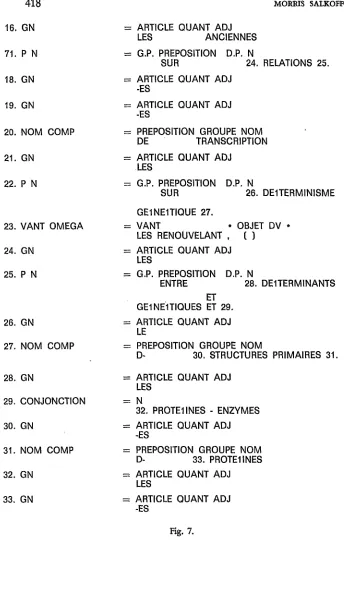
c) The analyzer rejects the analysis in which the object of
con-
firmd
is
(14)
a)
Les ... hypotheses ... et les prot3ines-enzymes
i.e., the analysis in which the sentence is understood as
b)
(Les d&ouvertes ...) ont confirm3 les hypotheses ... et (les d&ou-
vertes ont confirmS) les prot3ines-enzymes.
The verb
confirmer
cannot take a concrete noun as its object:
(15)
a)
*[Pierre / l'hypoth~se] a confirm~ les prot~ines
except for a few special cases such as
b)
Pierre a confirm¢ [sa place (dans ravion) / le rendez-vous/ ...]
Sentence J M - 4
l~emarks
ON USING SEMANTIC DATA IN AUTOMATIC SYNTACTIC ANALYSIS
401
Rejected analysis.
The analyzer rejects the analysis in which the object of
d~montr~
is
(16)
que C1 et * N,z; C1 = les propri~t~s, les ... rapport&s h la
structure
• = ~ l'activit~;
N, = des protdines que . . .
For one,
protdines
is not a correct object
ofd~montr~:
(17)
*Pierre a ddmontr~ les prot~ines
so that the restriction mentioned above in
JM-3
in connection with
confirm3
disallows the analysis. However, even if N, happened to be
a licit noun object of
d3montr3
there is still a question whether the con-
junction of a nominalized sentence and a noun phrase yields a gram-
matical object:
(is)
? Pierre a d3montrd que le probl~me est diffcile et l'impossi-
bilit~ de le rt;soudre
Such a sentence is difficult or impossible to accept; in the present gram-
mar, it is taken as ungrammatical, and a restriction prevents the con-
joining of such dissimilar objects.
Sentence JM-5
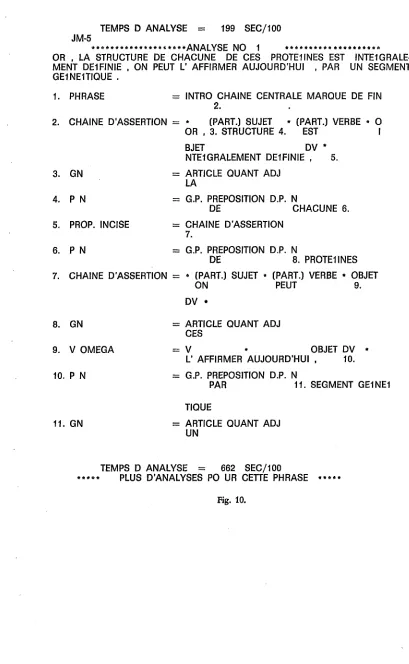
The prepositional phrase
par un segment g3n3tique
is taken as a right
adjunct of the verb
affirmer,
instead of being analyzed as an adjunct of
the participle
d3finie.
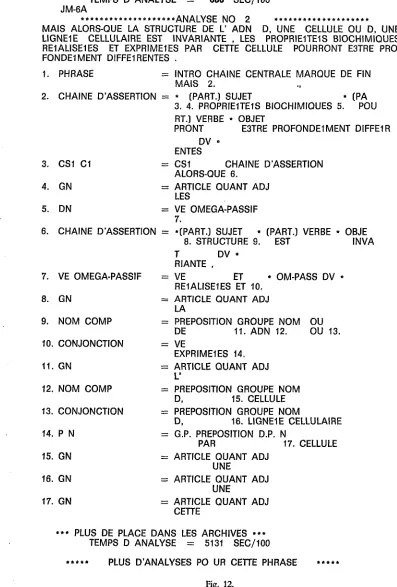
Sentence J M - 6 A
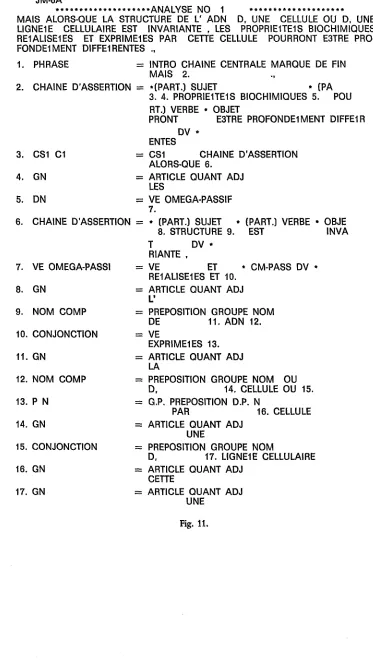
The two analyses show the alternatives for conjoining the sequence
ou d'une lign& cellulaire.
In the first analysis (Fig. 11) it is conjoined to
d'une cellule,
which yields the meaning intended by the author:
I ' A D N
d'une cellule ou (I'ADN) d'une lign& cellulaire.
In the second reading, it
is attached to
la structure: la structure de I ' A D N ... ou (la structure) d'une
402
MORRIS SALKOFF
lign~e cellulaire.
The general problem of the correct conjoining of
strings headed by a conjunction has not yet been solved.
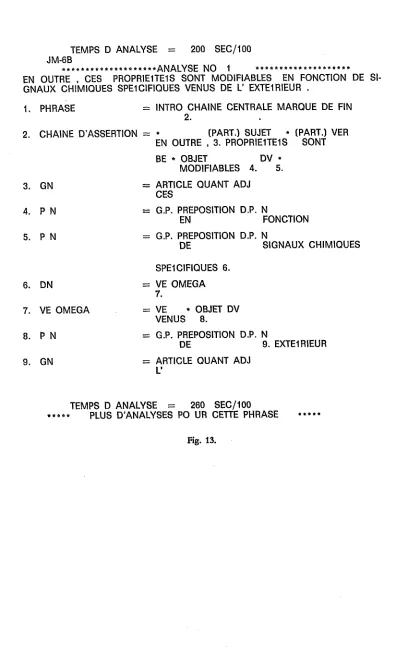
Sentence JM-6B
Because the mechanism for treating idioms has not yet been incor-
porated in the analyzer, it was not possible to treat
en fonction de
as a
complex preposition. It is therefore analyzed as a prepositional phrase
enfonction
modified by the right adjunct
de signaux ...
(cf. note 2).
Sentence JM-7A
Remarks.
a) The sequence
la conversion de son syst~me excr~toire
is analyzed
as a compound noun; remark (a) on sentence
JM-3
applies here too.
Because of this, the relative clause
qui, de semblable ...
is incorrectly at-
tached to
conversion,
instead of being analyzed as the right adjtmct of
syst~me.
b) The exact status of the sequence
de semblable ~ celui d'un poisson
is not clear. It could be analyzed as a verb adjunct (that can appear at
the beginning of a clause or sentence) for a subclass of verbs like
devenir,
se transformer,
...; or it can be treated as part of the object for these verbs.
I have chosen the second solution, and it appears as the first part of a
split object of
deviendra
in an inverted center string (line 13, Fig. 14).
c) The adjective
excr~toire,
since it is neither definitely masculine
nor definitely feminine in form, could modify either
conversion
or
syst~me.
The analysis shows it modifying
syst~me
(line 7), and further
analyses in which it would modify
conversion
are not printed by the
analyzer, since such an ambiguity is predictable from the first analysis.
The same remark applies to
thyroidienne,
which can modify either
injec-
tion
or
hormone.
The printing of these ambiguities (and of many others),
which can be predicted from the form of the structures involved, is
suppressed by the program.
Rejected analyses.
d) In fig. 14,
analogue
is taken as the adjective object of
deviendra.
However,
analogue
is also a noun:
ON USING SEMANTIC DATA IN AUTOMATIC SYNTACTIC ANALYSIS
403
but it cannot appear as the noun object of
~tre
without an article. Only
a certain subclass of nouns, called N17, can appear without the article:
(20)
Pierre est [patron / ambassadeur / professeur/ ...]
*Pierre est rocher
Since
analogue,
as a noun, does not belong to this subclass N17, the ana-
lysis is eliminated.
e) The analyzer rejects the analysis in which the object of
pro-
voque
is
(21)
N1 P N~; N1 =
la conversion ...
P N2
= ~ celui d'un mammif~re
This is analogous to the use
ofprovoquer
in sentences like
(22)
On a provoqud Pierre [~ la violence / ~ un acte d~sdspdr~/ ...]
But
provoquer
belongs to a subclass of verbs, V15, which require a hu-
man or human-like noun in the position of N1 :
(23)
*On a provoqud la table ~ une chute brutale
A restriction then disallows
la conversion..,
in the position N1 of (21).
2.
The semantic data.
From the analyses presented above, we see that two distinct types
of semantic data are incorporated in the grammar.
(1) A subclass of some major grammatical class cannot appear
in a given position. This was the case for the verb subclasses V15 and
V16, which require a human noun in one of the positions of their
N P N
object; for the noun object of
~tre,
which can drop the article only if
the noun is in the subclass N17; and for the object of verbs like
con-
firmer, ddmontrer, ...
which cannot be a concrete noun.
(2) Some sequence of conjoined strings is not possible for giv-
en values of one of the strings or of some subclass appearing in the
strings. Thus, the two conjoined nouns in the sequence (sentenceJM-1)
404
MORRIS SALKOFFAnother example was seen in the sentence
JM-4
where the conjunc-
tion of dissimilar objects of a verb is ungrammatical. These two exam-
ples illustrate the problem of the conjunction of classes and strings which
is not solved for the general case.
The interesting point is that these two types of semantic restrictions
are of the same nature as the syntactic restrictions and are incorporated
in the grammar in the same way as the latter. This means that there is
no need for a semantic component, or for semantic considerations that
are completely separate from the usual grammatical procedures. The
definition of subclasses is required in any case by the grammar, e.g.
for the syntactic subclasses (singular, plural .... ); and the specification
of the conjoinability of given sequences (strings) is required in order to
treat conjunctions. In this way, the semantic component becomes part
of the syntax and is incorporated without any special mechanism, The
same type of restriction as that which forbids
*Pierre sont ici
or
*L'homme
est courageuse
is used to prevent the analyzer from presenting a sequence
such as
*provoquer la table ~ la violence.
Hence I extend this use to semantic subclasses. Some of these sub-
classes can be defined syntactically, e.g., N17, but in any case they are
sometimes used to exclude sequences that are not necessarily syntacti-
cally forbidden. These sequences do not violate any rules of the gram-
mar, but violate what is usually called a selection rule or a semantic
constraint.
To the extent that these semantic constraints, or selection rules, can
in fact be formulated, the formulation can probably always be stated
in one of the ways (1) or (2) given above. If this is true, then the syn-
tactic analyzer based on string grammar which I have presented here
can incorporate semantics as well as syntax. Two difficulties in this
formulation via subclasses immediately present themselves:
a) The subclass itself is difficult to define, e.g., the subclass human
or human-like which is needed to define V15 and V16, or the subclass
~ concrete ~ noun.
b) The decision as to whether a given word does in fact belong
to some subclass is not always easy to make. In the discussion of JM-2,
I said that
apjoorter
belongs to the subclass V15, and this is how
apporter
is presendy coded in the dictionary. There are however well-formed
sentences in which the N1 P N~ object of
apporter
has a non-human
noun in the position N~:
ON USING SEMANTIC DATA IN AUTOMATIC SYNTACTIC ANALYSIS 4 0 5
but this seems to be limited to pairs of nouns standing in some relation-
ship to each other, as
solution
and
probl~me.
This relationship is very
hard to define, since other pairs o f nouns, seemingly related in a similar
fashion, do not yield well-formed sentences with
apporter:
(25)
,J'ai app0rtb un
pied ~ la chaise
406
M O R R I S S A L K O F FMI~CANISMES BIOCHIMIQUES ET GI~N~TIQUES
DE LA R.~GULATION DANS LA CELLULE BACTI~RIENNE
par Francois Jacob et Jacques MONOD.
Services de Gen~tique microbienne et de Biochimie cellulaire, Institut Pasteur, Paris.
I . INTRODUCTION
Les connaissances acquises depuis quelques ann~es sur la structure des macromo-
l~cules biologiques essentielles, acides nud~iques et prot~ines, permettent de comprendre,
au moins dans ses grandes lignes, le rapport entre les fonctions de ces macromol~-
cules et leur structure chimique. L'&ude de la r~plication de I'ADN
in vivo
et
in vitro
a apport6 la preuve que le m~canisme chimique fondamental de l'h&~dit~ est bien
celui qu'avaient propos6 WATSON ct CatCK (1953) ~. la suite de leur d6couverte de
la structure de I'ADN. La d~couverte de I'AKN messager et de son r61e dans la bio-
synth~se des prot~ines, l'&ude des processus de transcription, les recherches sur le
d&erminisme g6n&ique des structures primaires des prot6ines ont enti~rement con-
firm4 en les renouvelant, les anciennes hypotheses sur les relations entre les d~ter-
minants g~n&iques et les prot6ines-enzymes.
Les progr~s de la biochimie r6alisds depuis 50 ans ont, en outre, d~montr~ que
les propri&~s, les structures, les activit~s qui caract&isent une cellule doivent, en dS-
finitive, &re rapport~es ~ la structure et h l'activit~ des prot~ines que cette cellule est
capable de synth&iser. Or, la structure de chacune de ces prot~ines est int6gralement
d~finie, on peut 1'affirmer aujourd'hui, par un segment g6n&ique. Mais alors que la
structure de I'ADN d'une cellule ou d'une lign6e cellulaire est invariante, les pro-
pri&~s biochimiques r&lis~es et exprim~es par cette cellule pourront ~tre profon-
d~ment diff&entes; en outre, ces propri&~s sont modifiables en fonction de signaux
chimiques sp~cifiques venus de l'ext&ieur. L'injection d'hormone thyroidienne ~ un
t&ard provoque, avant m~me toute manifestation morphologique, la conversion de
son syst~me excr&oire qui, de semblable ~ celui d'tm poisson, deviendra chimiquement
analogue ~, celui d'un mammif~re: quelques heures apr~s rinjection, hs enzymes sp&
cifiques du cycle de l'ur~e augmenteront en proportion de 50 ~ 100 lois et l'animal
excr&era de l'ur~e alors que, jusque-l~t, il n'avait excr6t6 clue de l'ammo-
BULL. SOC, CHIM. BIOL.,
1964, 46,
N ° 1 2 .ON USING SEMANTIC DATA IN AUTOMATIC SYNTACTIC ANALYSIS 4 0 7
TEMPS D ANALYSE = 609 SEC/100
JM-1
** . . . ANALYSE NO 1 . . .
LES CONNAISSANCES ACQUISES DEPUIS QUELQUES ANNE1ES SUR LA
STRUCTURE D--ES MACROMOLE1CULES BIOLOGIQUES ESSENTIELLES , ACIDES NUCLEIlQUES ET PROTEIlNES , PERMETTENT DE COMPRENDRE , A- -U MOINS DANS SES GRANDES LIGNES , LE RAPPORT ENTRE LES FONCTIONS DE CES MACROMOLE1CULES ET LEUR STRUCTURE CHIMIQUE .
1. PHRASE =
2. CHAINE D'ASSERTION =
3. GN =
4. DN =
5. A S DE V OMEGA =
6. VE OMEGA-PASSIF =
7. CHAINE D'ASSERTION =
8. P N =
9. P N =
INTRO CHAINE CENTRALE MARQUE DE FIN 2.
* (PARTJ SUJET *(PART.) VERBE *
3. CONNAISSANCES 4. PERMETTENT
OBJET DV * 5.
ARTICLE QUANT ADJ LES
VE OMEGA-PASSIF 6.
CHAINE D'ASSERTION 7.
VE * OM-PASS DV *
ACQUISES 8.
* (PART.) SUJET * (PART.) VERBE * 0
( ) DE COMPRENDRE , 9. 1
B JET DV *
0. RAPPORT 11.
G.P. PREPOSITION D.P. N
DEPUIS 12. ANNE1ES 13.
G . P . PREPOSITION D.P. N
A- -U MOINS DANS 14. LIGNES
10. GN 11. P N
12. GN
= ARTICLE QUANT ADJ LE
= G.P. PREPOSITION D.P. N
ENTRE 15. FONCTIONS 16.
ET ET 17.
= ARTICLE QUANT ADJ
408 MORRIS SALKOFF
13. P N
14. GN
15. GN
16. P N
= G.P. PREPOSITION D.P. N
SUR 18. STRUCTURE 19.
= ARTICLE QUANT ADJ
SES GRANDES
= ARTICLE QUANT ADJ LES
= G.P. PREPOSITION D,P. N
DE 20, MACROMOLE1CULE
17. CONJONCTION
18. GN
19. NOM COMP
20. GN
21. GN
22. GN
23, CONJONCTION
24. CONJONCTION
S
N
21. STUCTURE CHIMIQUE ARTICLE QUANT ADJ LA
PREPOSITION GROUPE NOM
D- 22. MAGROMOLE1CULES BIOLOGIQ
VIRGULE UES ESSENTIELLES , 23. ARTICLE QUANT ADJ CES
ARTICLE QUANT ADJ LEUR
ARTICLE QUANT ADJ -ES
GROUPE NOM ET
ACIDES NUCLEIlQUES ET 24. GROUPE NOM
PROTE11NES,
[image:12.612.144.509.61.496.2]ON USING SI~.MANTIC DATA IN AUTOMATIC SYNTACTIC ANALYSIS 4 0 9
TEMPS D ANALYSE = 61 SEC/100
JM-1
*** . . . * . . . ****ANALYSE NO 2 . . .
LES CONNAISSANCES ACQUISES DEPUIS QUELQUES ANNE1ES SUR LA
STRUCTURE D--ES MACROMOLE1CULES BIOLOGIQUES ESSENTIELLES , ACIDES NUCLEIIQUES ET PROTEIlNES , PERMETTENT DE COMPRENDRE , A- -U MOINS DANS SES GRANDES LIGNES , LE RAPPORT ENTRE LES FONCTIONS DE CES MACROMOLE1CULES ET LEUR STRUCTURE CHIMIQUE .
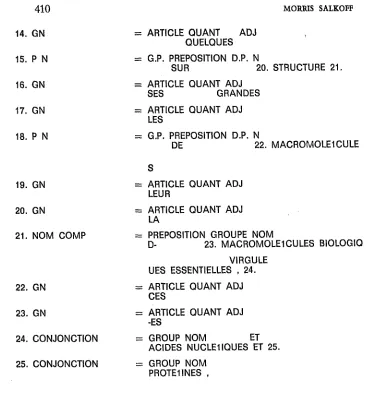
1. PHRASE = INTRO CHAINE CENTRALE MARQUE DE FIN
2.
2. CHAINE D'ASSERTION = * (PART.) SUJET * (PART.) VERBE *
3. CONNAISSANCES 4. PERMETTENT
OBJET DV * 5.
3. GN = ARTICLE QUANT ADJ
LES
4, DN = VE OMEGA-PASSIF
6.
5. A S DE V OMEGA --- CHAINE D'ASSERTION ET
7. ET 8,
6. VE OMEGA-PASSIF = VE * OM-PASS DV *
ACQUISES 9,
7. CHAINE D'ASSERTION = * (PART.) SUJET * (PART.) VERBE *
( ) DE COMPRENDRE , 10.
OBJET DV *
11. RAPPORT 12.
8. CONJONCTION = CHAINE D'ASSERTION
13,
9. P N = G.P. PREPOSITION D.P. N
DEPUIS 14. ANNE1ES 15.
10. P N = G . P . PREPOSITION D.P. N
A- -U MOINS DANS 16. LIGNES
11, GN =
12. P N =
13, CHAINE D'ASSERTION =
r
ARTICLE QUANT ADJ LE
G.P. PREPOSITION D.P. N
ENTRE 17, FONCTIONS 18.
* (PART.) SUJET * (PART.) VERBE * OBJET
( ) (()) 19. ST
410
MORRIS $ALKOFF14. GN = ARTICLE OUANT ADJ ,
QUELQUES
15. P N = G.P. PREPOSITION D.P. N
SUR 20. STRUCTURE 21.
16. GN = ARTICLE QUANT ADJ
SES GRANDES
17. GN = ARTICLE QUANT ADJ
LES
18. P N = G.P. PREPOSITION D.P. N
DE 22. MACROMOLEICULE
S
19. GN = ARTICLE QUANT ADJ
LEUR
20. GN = ARTICLE QUANT ADJ
LA
21. NOM COMP = PREPOSITION GROUPE NOM
D- 23. MACROMOLE1CULES BIOLOGIQ
VIRGULE UES ESSENTIELLES , 24.
22. GN = ARTICLE QUANT ADJ
CES
23. GN = ARTICLE QUANT ADJ
-ES
24. CONJONCTION = GROUP NOM ET
ACIDES NUCLEI lQUES ET 25.
25. CONJONCTION = GROUP NOM
PROTEIlNES,
[image:14.612.142.517.64.463.2]ON U S I N G SEMANTIC DATA I N AUTOMATIC SYNTACTIC ANALYSIS
411
TEMPS D ANALYSE = 1359 SEC/100
JM-1
* * * * * * * * * * * * * * * * * * * * * * * * * * * NO 3 . . .
LES CONNAISSANCES ACOUISES DEPUIS QUELQUES ANNE1ES SUR LA
STRUCTURE D- -ES MACROMOLE1CULES BIOLOGIOUES ESSENTIELLES , ACIDES NUCLEIlQUES ET PROTEIlNES , PERMETTENT DE COMPRENDRE , A- -U MOINS DANS SES GRANDES LIGNES , LE RAPPORT ENTRE LES FONCTIONS DE CES MACROMOLE1CULES ET LEUR STRUCTURE CHIMIQUE .
1. PHRASE =
2. CHAINE D'ASSERTION =
3. GN =
4. DN =
5. CONJONCTION =
6. A S DE V OMEGA =
7. VE OMEGA-PASSIF =
8. CONJONCTION =
9. CHAINE D'ASSERTION =
10. P N =
11. P N =
INTRO CHAINE CENTRALE MARQUE DE FIN 2.
* (PART.} SUJET VIRGULE * [PART.}
3. CONNAISSANCES 4, , 5. PERMETTE
VERBE * OBJET DV *
NT 6.
ARTICLE QUANT ADJ LES
VE OMEGA-PASSIF 7.
[PART.} SUJET ET
ACIDES NUCLEIlOUES ET 8. CHAINE D'ASSERTION 9.
VE * OM-PASS DV *
ACQUISES 10. [PART.} SUJET PROTEIlNES,
* [PART.} SUJET * (PART.} VERBE *
{ ) DE COMPRENDRE , 11.
OBJET DV *
12.RAPPORT 13.
G.P. PREPOSITION D.P. N
DEPUIS 14. ANNE1ES 15.
G . P . PREPOSITION D.P. N
A- -U MOINS DANS 16. LIGNES
12. GN =
13. P N =
w
ARTICLE QUANT ADJ LE
G.P. PREPOSITION D.P. N
ENTRE 17. FONCTIONS 18.
412
14. GN
15. P N 16. GN 17, GN
18. P N
19. CONJONCTION
20. GN
21. NOM COMP
22. GN
23. GN 24. GN
MORRIS SALKOFF
= ARTICLE QUANT ADJ OUELOUES = G.P. PREPOSITION D,P. N
SUR 20. STRUCTURE 21.
= ARTICLE QUANT ADJ
SES GRANDES
= ARTICLE QUANT ADJ LES
= G.P, PREPOSITION D.P, N
DE 22. MACROMOLE1CULE
S
= N
23. STRUCTURE CHIMIOUE = ARTICLE QUANT ADJ
LA
= PREPOSITION GROUPE NOM
D- 24. MACROMOLE1CULES BIOLOGIQ
UES ESSENTIELLES = ARTICLE QUANT ADJ
CES
= ARTICLE OUANT ADJ LEUR
= ARTICLE OUANT ADJ -ES
[image:16.612.143.511.63.565.2]ON USING SEMANTIC DATA IN AUTOMATIC SYNTACTIC ANALYSIS 4 1 3
TEMPS D ANALYSE = 34 SEC/100
JM-1
** . . . ANALYSE NO 4 . . .
LES CONNAISSANCES ACQUISES DEPUIS QUELQUES ANNE1ES SUR LA
STRUCTURE D- -ES MACROMOLE1CULES BIOLOGIQUES ESSENTIELLES , ACIDES NUCLEIlQUES ET PROTEIlNES , PERMETTENT DE COMPRENDRE , A- -U MOINS DANS SES GRANDES LIGNES , LE RAPPORT ENTRE LES FONCTIONS DE CES MACROMOLE1CULES ET LEUR STRUCTURE CHIMIQUE .
1. PHRASE =
2. CHAINE D'ASSERTION =
3. GN =
4. DN =
5. CONJONCTION =
6. A S DE V OMEGA =
7. VE OMEGA-PASSIF =
8. CONJONCTION =
9. CHAINE D'ASSERTION =
t0. CONJONCTION =
11. P N =
12. P N =
13. GN =
14. P N =
INTRO CHAINE CENTRALE MARQUE DE FIN 2.
* (PART.) SUJET VIRGULE * (PART.]
3, CONNAISSANCES 4. , 5. PERMETTE
VERBE * OBJET DV *
NT 6.
ARTICLE QUANT ADJ LES
VE OMEGA-PASSIF 7.
(PART.) SUJET ET
ACIDES NUGLEIlQUES ET 8. CHAINE D'ASSERTION ET
9. ET 10.
VE * OM-PASS DV *
ACQUISES 11. (PART.) SUJET PROTEIlNES,
* (PART.) SUJET * (PART.) VERBE *
( ) DE COMPRENDRE , 12.
OBJET DV *
13. RAPPORT 14. CHAINE D'ASSERTION 15.
G.P. PREPOSITION D.P. N
DEPUIS 16. ANNE1ES 17.
G.P. PREPOSITION D.P. N
A- -U MOINS DANS 18. LIGNES
ARTICLE QUANT ADJ LE
G.P. PREPOSITION D.P. N
16. GN 17. P N
18. GN
19. GN
20. P N
414 MORRIS SALKOI~F
15. CHAINE D'ASSERTION = * (PART.) SUJET * (PART.) VERBE * OBJET
{ ) C()) 21. ST
DV * RUCTURE CHIMIQUE
= ARTICLE QUANT ADJ
QUELOUES = G.P. PREPOSITION D.P. N
SUR 22. STRUCTURE 23.
= ARTICLE QUANT ADJ
SES GRANDES
= ARTICLE QUANT ADJ LES
= G.P. PREPOSITION D.P. N
DE 24. MACROMOLE1CULE
21. GN
22. GN
23. NOM COMP
24, GN 25, GN
S
= ARTICLE QUANT ADJ LEUR
= ARTICLE QUANT ADJ LA
= PREPOSITION GROUPE NOM
D- 25. MACROMOLE1CULES BIOLOGIQ
UES ESSENTIELLES = ARTICLE QUANT ADJ
CES
= ARTICLE QUANT ADJ -ES
TEMPS b ANALYSE = 2659 SEC/100
. . . PLUS D'ANALYSES PO UR CETTE PHRASE 1
[image:18.612.109.506.84.679.2]ON USING SEMANTIC DATA IN AUTOMATIC SYNTACTIC ANALYSIS 4 1 5
TEMPS D ANALYSE = 378 SEC/100 JM-2
. . . ***ANALYSE NO 1 . . .
L' E1TUDE DE LA RE1PLICATION DE L' ADN IN-VIVO ET IN-VITRO A APPORTE1 LA PREUVE QUE LE ME1CANISME CHIMIQUE FONDAMENTAL DE L' HE1RE1- DITE1 EST BIEN CELUI QU' AVAIENT PROPOSE1 WATSON ET CRICK [ 1953 ) A2 LA SUITE DE LEUR DE1COUVERTE DE LA STRUCTURE DE L' ADN .
1. PHRASE = INTRO CHAINE CENTRALE MARQUE DE FIN
2.
2, CHAINE D'ASSERTION = * [PART.] SUJET * [PART.] VERBE * OBJET
3. E1TUDE 4. A APPORT
DV * E1 5. PREUVE 6.
3. GN = ARTICLE QUANT ADJ
LA
4. NOM COMP = PREPOSITION GROUPE NOM
DE 7. RE1PLICATION 8. IN-VlVO E
5. G N =
6. D N =
7. GN =
8. NOM COMP =
9. CONJONCTION =
10. QUE C1/C15 =
11. GN =
12. CHAINE D'ASSERTION =
13. GN
14. NOM COMP
* [PART.] VERBE * OBJET
EST BIEN CELUI 15.
---- ARTICLE QUANT ADJ LE
= PREPOSITION GROUPE NOM
DE 16. HE1RE1DITE1
T 9 .
ARTICLE QUANT ADJ LA
PHRASE NOMINALISEE 10.
ARTICLE OUANT ADJ LA
PREPOSITION GROUPE NOM
DE 11. ADN
ADJECTIF IN-VITRO
QUE CHAINE CENTRALE QUE 12.
ARTICLE QUANT ADJ L'
* [PART.] SUJET
416
15. DN
16. GN
17. QU-C1,N-OMIS
18. C1 INVERSEE
19. CONJONCTION
20. P N
21. GN 22. P N
MORRIS SALKOFF
= QU-C1,N-OMIS 17.
= ARTICLE QUANT ADJ L'
= QU- CHAINE CENTRALE QU' 18.
= * OBJET * (PART,} VERBE • OBJET
( ] AVAIENT P R O P O S E 1
RT.] SUJET ET DV *
SON ET 19. 2O.
= (PART.} SUJET CRICK ( 1953 )
= G.P. PREPOSITION D.P. N
A2 21. SUITE 22.
= ARTICLE QUANT ADJ LA
= G,P. PREPOSITION D.P. N DE
*
(PA
WAT
23. DE1COUVERTE 24
23. GN
24. NOM COMP 25, GN
26. NOM COMP 27. GN
= ARTICLE OUANT ADJ LEUR
= PREPOSITION GROUPE NOM
DE 25. STRUCTURE 26.
= ARTICLE QUANT ADJ LA
= PREPOSITION GROUPE NOM
DE 27. ADN
= ARTICLE QUANT ADJ L'
[image:20.612.148.497.70.521.2]ON USING SEMANTIC DATA IN AUTOMATIC SYNTACTC ANALYSISI 4 1 7
TEMPS D ANALYSE = 2545 SEC/100
JM-3
. . . * * * * . . . ANALYSE NO 1 . . .
LA DE1COUVERTE DE L' ARN MESSAGER ET DE SON RO3LE DANS LA
BIOSYNTHE2SE D- -ES PROTEIlNES , L' EITUDE D- -ES PROCESSUS DE TRAN-
SCRIPTION LES RECHERCHES SUR LE DE1TERMINISME GE1NE1TIQUE D-
-ES STRUC]~URES PRIMAIRES D- -ES PROTEIlNES ONT ENTIE2REMENT GON-
FIRME1 , EN LES RENOUVELANT , LES ANCIENNES HYPOTHE2SES SUR LES
RELATIONS ENTRE LES DE1TERMINANTS GE1NE1TIQUES ET LES PROTEIlNES - ENZYMES
1. PHRASE = INTRO CHAINE CENTRALE MARQUE DE FIN
2.
2. CHAINE D'ASSERTION = * {PAR.} SUJET VIRGULE * {PART,}
3. DE1COUVERTE 4. 5. , 6. ONT VERBE * OBJET DV *
7.
3. GN = ARTICLE QUANT ADJ
LA
4. NOM COMP = PREPOSITION GROUPE NOM ET
DE 8. ARN MESSAGER ET 9.
5. P N = G.P. PREPOSITION D.P. N
DANS 10. BIOSYNTHE2SE 1
1.
6. CONJONCTION = {PART.} SUJET VIRGULE
12. E1TUDE 13. , 14.
7. VE OMEGA = VE * OBJET
ENTIE2REMENT GONFIRME1 , 15. 16. HYPOTHE DV
2SES 17.
8. GN = ARTICLE QUANT ADJ
L'
9. CONJONCTION = PREPOSITION GROUPE NOM
DE SON RO3LE
10. GN = ARTICLE QUANT ADJ
LA
11. NOM COMP = PREPOSITION GROUPE NOM
D- 18. PROTEIlNES
12. GN = ARTICLE QUANT ADJ
L'
13. NOM COMP = PREPOSITION GROUPE NOM
D- 19. PROCESSUS 20.
14. CONJONCTION = {PART.} SUJET
21. RECHERCHES 22.
15. CS3 VANT OMEGA --~ CS3 VANT OMEGA
4 1 8 MOR~ZS S^LKOFF
16. GN = ARTICLE OUANT ADJ
LES ANCIENNES
71. P N = G.P, PREPOSITION D.P. N
SUR 24. RELATIONS 25.
18. GN = ARTICLE QUANT ADJ
-ES
19. GN = ARTICLE OUANT ADJ
-ES
20. NOM COMP = PREPOSITION GROUPE NOM
DE TRANSCRIPTION
21. GN = ARTICLE QUANT ADJ
LES
22. P N = G.P. PREPOSITION D,P. N
SUR 26. DE1TERMINISME
GE1NE1TIOUE 27.
23. VANT OMEGA = VANT * OBJET DV *
LES RENOUVELANT , (
)
24. GN = ARTICLE QUANT ADJ
LES
25. P N = G.P. PREPOSITION D.P. N
ENTRE 28. DE1TERMINANTS
ET GE1NE1TIQUES ET 29.
26. GN = ARTICLE QUANT ADJ
LE
27, NOM COMP = PREPOSITION GROUPE NOM
D- 30, STRUCTURES PRIMAIRES 31.
28. GN
29. CONJONCTION 30. GN
31. NOM COMP 32, GN
33. GN
= ARTICLE QUANT ADJ LES
= N
32. PROTEIlNES - ENZYMES = ARTICLE QUANT ADJ
-ES
= PREPOSITION GROUPE NOM
D- 33. PROTE11NES
= ARTICLE QUANT ADJ LES
= ARTICLE QUANT ADJ -ES
[image:22.612.149.493.68.683.2]ON USING SEMANTIC DATA IN AUTOMATIC SYNTACTIC ANALYSIS 4 1 9
TEMPS D ANALYSE = 45 8EC/100
JM-3
. . . * * * * * * * * * * * * * A N A L Y S E NO 2 . . .
LA DE1COUVERTE DE L' ARN MESSAGER ET DE SON RO3LE DANS LA
BIOSYNTHE2SE D- -ES PROTEIlNES , L' E1TUDE D- -ES PROCESSUS DE TRAN-
SCRIPTION LES RECHERCHES SUR LE DE1TERMINISME GE1NE1TIQUE D-
-ES STRUCTURES PRIMAIRES D- -ES PROTEIlNES ONT ENTIE2REMENT CON-
FIRME1 , EN LES RENOUVELANT , LE8 ANCIENNES HYPOTHE2SES SUR LES
RELATIONS ENTRE LES DE1TERMINANTS GE1NE1TIQUES ET LES PROTEIlNES - ENZYMES
1. PHRASE = INTRO CHAINE CENTRALE MARQUE DE FIN
2.
2. CHAINE D'ASSERTION = * (PART.) SUJET VIRGULE * (PART.)
3. GN
4. NOM COMP 5. P N
6. CONJONCTION 7. VE OMEGA
8 . GN
9. CONJONCTION 10. GN
11. NOM COMP 12. GN
13. NOM COMP 14. CONJONCTION 15. CS3 VANT OMEGA
3. DE1COUVERTE 4. 5. , 6. ONT VERBE * OBJET DV *
7.
= ARTICLE OUANT ADJ LA
= PREPOSITION GROUPE NOM ET
DE 8. ARN MESSAGER ET 9.
= G.P. PREPOSITION D.P. N
DANS 10. BIOSYNTHE2SE 1
I .
-- (PART.) SUJET VIRGULE 12, E1TUDE 13. , 14.
-- VE * OBJET
ENTIE2REMENT CONFIRME1 , 15. 16. HYPOTHE DV
2SES 17.
= ARTICLE QUANT ADJ L'
= PREPOSITION GROUPE NOM
DE SON RO3LE
--- ARTICLE QUANT ADJ L'
= PREPOSITION GROUPE NOM
D- 18. PROTE11NES
--- ARTICLE QUANT ADJ LA
= PREPOSITION GROUPE NOM
D- 19. PROCESSUS 20.
-- (PART.) SUJET 21. RECHERCHES 22. = CS3 VANT OMEGA
420 MOR~S S^~KOFF
16. GN = ARTICLE OUANT ADJ
LES ANCIENNES
17. P N = G.P. PREPOSITION D.P. N
SUR 24. RELATIONS 25.
ET ET 26.
18, GN = ARTICLE QUANT ADJ
-ES
,,19. GN = ARTICLE QUANT ADJ
I I
-ES
20. NOM COMP = PREPOSITION GROUPE NOM
DE TRANSCRIPTION
21, GN = ARTICLE OUANT ADJ
LES
22. P N = G.P. PREPOSITION D.P. N
SUR 2?, DE1TERMINISME
GE1NE1TIQUE 28.
23. VANT OMEGA = VANT * OBJET DV *
LES RENOUVELANT , { )
24. GN = ARTICLE QUANT ADJ
LES
25. P N = G.P. PREPOSITION D.P. N
ENTRE 29. DE1TERMINANTS
GE1NE1TIQUES
26. CONJONCTION = N
30. PROTEIlNES - ENZYMES
2?, GN = ARTICLE QUANT ADJ
LE
28. NOM COMP = PREPOSITION GROUPE NOM
D- 31. STRUCTURES PRIMAIRES 32.
29. GN = ARTICLE QUANT ADJ
LES
30. GN = ARTICLE QUANT ADJ
LES
31. GN = ARTICLE OUANT ADJ
-ES
32. NOM COMP = PREPOSITION GROUPE NOM
D- 33. PROTEIlNES
33. GN = ARTICLE QUANT ADJ
-ES
TEMPS D ANALYSE = 1194 SEC/100
. . . PLUS D'ANALYSES PO UR CETTE PHRASE
TEMPS D ANALYSE = 772 SEC/100 JM-4
. . . ANALYSE NO 1 . . .
LES PROGRE2S DE LA BIOCHIMIE RE1ALISE1S DEPUIS 50 ANS ONT , EN
OUTRE , DE1MONTRE1 QUE LES PROPRIEITE1S , LES STRUCTURES , LES
ACTIVITElS QUI CARACTE1RISENT UNE CELLULE DOIVENT , EN DEIFINITIVE , E3TRE RAPPORTEIES A2 LA STRUCTURE ET A2 L' ACTIVITE1 D- -ES PROTEIlNES
QUE CETTE CELLULE EST CAPABLE DE SYNTHE1TISER .
1. PHRASE = INTRO CHAINE CENTRALE MARQUE DE FIN
2.
2. CHAINE D'ASSERTION = (PART.) SUJET (PART.) VERBE
3. PROGRE2S 4. 5. ONT , EN O
OBJET D.V. U T R E , 6.
3. GN = ARTICLE QUANT ADJ
LES
4. NOM COMP = PREPOSITION GROUPE NOM
DE 7. BIOCHIMIE
5. D N = VE OMEGA-PASSIF
8.
6. VE OMEGA = VE OBJET D.V.
DE1MONTRE1 9.
7. GN = ARTICLE QUANT ADJ
LA
8. VE OMEGA.PASSIF = VE OM-PASS D.V.
RE1ALISE1S 10.
9. QUE C1/C15 = QUE CHAINE CENTRALE
OUE 11.
10. P N = G.P. PREPOSITION D.P. N
DEPUIS 12. ANS
11. CHAINE D'ASSERTION -- (PART.) SUJET VIRGULE (PART.) VER
13. PROPRIE1TE1S , 14. DOIVENT ,
BE OBJET D.V. *
EN DE1FINITIVE , E3TRE 15.
12. GN = ARTICLE QUANT ADJ
50
13. GN = ARTICLE QUANT ADJ
LES
14. CONJONCTION = [PART.) SUJET VIRGULE
16. STRUCTURES , 17.
15. VE OMEGA PASSIF = VE OM PASS ET D.V.
RAPPORTE1ES 18. ET 19.
16. GN = ARTICLE QUANT ADJ
LES
17. CONJONCTION = (PART.) SUJET
20. ACTIVlTE1S 21.
18. P N = G.P. PREPOSITION D.P. N
19. CONJONCTION
20. GN
21. DN
22. GN
23. P N
24. QU-C1,N-OMIS
25. GN
26. NCM COMP
27. DN
28. CHAINE D'ASSERTION
29. GN
30. QU-C1,N-OMIS
31. GN
32. CHAINE D'ASSERTION =
33. GN
=
34. DA
35. DE V OMEGA
=
36. V OMEGA
--
PLUS DE PLACE DANS LES ARCHIVES
TEMPS D ANALYSE
=
1459 SEC/100
PLUS D'ANALYSES PO UR CETTE PHRASE
OM-PASS
23.
ARTICLE QUANT ADJ
LES
QU-C1 ,N-OMIS
24.
ARTICLE QUANT ADJ
LA
G.P. PREPOSITION D.P. N
A2
25. ACTIVITE1 26.
27.
QU CHAINE CENTRALE
QUI 28.
ARTICLE QUANT ADJ
L'
PREPOSITION GROUPE NOM
D
29. PROTEIlNES
OU-C1,N-OMIS
30.
CPART.) SUJET (PART.) VERBE
OBJET
( }
C A R A C T E 1 R I S E N T 31. C
DN.
ELLULE
ARTICLE OUANT ADJ
-ES
QU- CHAINE CENTRALE
OUE 32.
ARTICLE QUANT ADJ
UNE
(PART.) SUJET (PART.) VERBE OBJET
33. CELLULE
EST
CAPABL
D.V.
E 34.
ARTICLE QUANT ADJ
CETTE
PHRASE NOMINALISEE
35
DE V OMEGA
DE 36.
V
OBJET DN.
SYNTHE1TISER
( )
o N USING SEMANTIC DATA IN AUTOMATIC SYNTACTIC ANALYSIS 4 2 3
TEMPS D A N A L Y S E = 199 SEC/100 JM-5
. . . A N A L Y S E NO 1 . . . * . . . . * . . .
OR , LA STRUCTURE DE C H A C U N E DE CES PROTEIlNES EST INTE1GRALE- MENT DE1FINIE , ON PEUT L' AFFIRMER A U J O U R D ' H U I , PAR UN SEGMENT GE1NE1TIQUE .
1. PHRASE ---
2. CHAINE D'ASSERTION =
3. GN =
4. P N =
5. PROP. INCISE =
6. P N =
7. CHAINE D'ASSERTION =
INTRO CHAINE CENTRALE MARQUE DE FIN 2.
* (PART.) SUJET * (PART.) VERBE * O
OR , 3. STRUCTURE 4. EST I
B JET DV *
NTE1GRALEMENT DE1FINIE , 5.
ARTICLE Q U A N T ADJ LA
G.P. PREPOSITION D.P. N
DE C H A C U N E 6.
CHAINE D'ASSERTION 7.
G.P. PREPOSITION D.P. N
DE 8. PROTEIlNES
* (PART.) SUJET * (PART.) VERBE * OBJET
ON PEUT 9.
DV * 8. GN
9. V O M E G A
10. P N
= ARTICLE Q U A N T ADJ CES
= V * OBJET DV *
L' AFFIRMER A U J O U R D ' H U I , 10. = G.P. PREPOSITION D.P. N
PAR 11. SEGMENT GE1NE1
11. GN
TIOUE
- ARTICLE O U A N T ADJ UN
TEMPS D A N A L Y S E = 662 SEC/100
. . . PLUS D'ANALYSES PO UR CETTE PHRASE * . . . .
[image:27.612.50.459.78.742.2]TEMPS D ANALYSE = 313 SEC/100 JM-6A
. . . ANALYSE NO 1 . . . * . . .
MAIS ALORS-QUE LA STRUCTURE DE L' ADN D, UNE CELLULE OU D, UNE
LIGNE1E CELLULAIRE EST INVARIANTE , LES PROPRIE1TE1S BIOCHIMIQUES
RE1ALISEIES ET EXPRIME1ES PAR CETTE CELLULE POURRONT E3TRE PRO-
FONDE1MENT DIFFEIRENTES .,
1. PHRASE =
2. CHAINE D'ASSERTION =
3 . CS1 C1 =
4. GN =
5. DN =
6. CHAINE D'ASSERTION =
7. VE OMEGA-PASSI
8. GN
9. NOM COMP 10. CONJONCTION 11. GN
12. NOM COMP 13. P N
14. GN
15. CONJONCTION 16. GN
17. GN
INTRO CHAINE CENTRALE MARQUE DE FIN
MAIS 2. .,
*[PART.] SUJET * [PA
3. 4. PROPRIEITElS BIOCHIMIQUES 5. POU RT.] VERBE * OBJET
PRONT E3TRE PROFONDE1MENT DIFFE1R
DV * ENTES
CS1 CHAINE D'ASSERTION
ALORS-QUE 6. ARTICLE QUANT ADJ LES
VE OMEGA-PASSIF 7.
* [PART.] SUJET * [PART.] VERBE * OBJE
8. STRUCTURE 9. EST INVA
T DV *
R I A N T E ,
= VE ET * CM-PASS DV *
RE1ALISE1ES ET 10. = ARTICLE QUANT ADJ
L'
= PREPOSITION GROUPE NOM
DE 11. ADN 12.
= VE
EXPRIME1ES 13. = ARTICLE QUANT ADJ
LA
= PREPOSITION GROUPE NOM OU
D, 14. CELLULE OU 15.
= G.P. PREPOSITION D.P. N
PAR 16. CELLULE
= ARTICLE QUANT ADJ UNE
= PREPOSITION GROUPE NOM
D, 17. LIGNE1E CELLULAIRE
= ARTICLE QUANT ADJ CETTE
= ARTICLE OUANT ADJ UNE
[image:28.612.135.508.79.744.2]TEMPS D ANALYSE = 6 8 6 SEC/100 JM-6A
. . . ANALYSE NO 2 * * * * * * . . .
MAIS ALORS-QUE LA STRUCTURE DE L' ADN D, UNE CELLULE OU D, UNE
LIGNE1E CELLULAIRE EST INVARIANTE , LES PROPRIE1TE1S BIOCHIMIQUES
RE1ALISE1ES ET EXPRIME1ES PAR CETTE CELLULE POURRONT E3TRE PRO-
FONDE1MENT DIFFE1RENTES .
1. PHRASE --
2. CHAINE D'ASSERTION =
3. CS1 C1 =
4. GN =
5. DN =
6. CHAINE D'ASSERTION =
7. ME OMEGA-PASSIF
8. GN
9. NOM COMP
10. CONJONCTION 11. GN
12. NOM COMP 13. CONJONCTION 14. P N
15. GN
16. G N
17. G N
INTRO CHAINE CENTRALE MARQUE DE FIN
MAIS 2. .,
* (PART.} SUJET * {PA
3. 4. PROPRIE1TE1S BIOCHIMIQUES 5. POU RT.} VERBE * OBJET
PRONT E3TRE PROFONDE1MENT DIFFE1R
DV * ENTES
CS1 CHAINE D'ASSERTION
ALORS-QUE 6. ARTICLE QUANT ADJ LES
VE OMEGA-PASSIF 7.
*{PART.} SUJET * (PART.] VERBE * OBJE
8. STRUCTURE 9. EST INVA
T DV *
R I A N T E ,
= VE ET * OM-PASS DV *
REIALISE1ES ET 10. = ARTICLE QUANT ADJ
LA
= PREPOSITION GROUPE NOM OU
DE 11. ADN 12. OU 13.
= VE
EXPRIME1ES 14. = ARTICLE QUANT ADJ
L'
= PREPOSITION GROUPE NOM
D, 15. CELLULE
= PREPOSITION GROUPE NOM
D, 16. LIGNE1E CELLULAIRE
= G.P. PREPOSITION D.P. N
PAR 17. CELLULE
= ARTICLE OUANT ADJ UNE
= ARTICLE QUANT ADJ UNE
= ARTICLE QUANT ADJ CETTE
*** PLUS DE PLACE DANS LES ARCHIVES * * *
TEMPS D ANALYSE = 5131 SEC/100
. . . PLUS D'ANALYSES PO UR CEI'I'E PHRASE
[image:29.612.57.454.45.632.2]426 vioRr, IS SAI~KOlW
TEMPS D ANALYSE = 200 SEC/100
JM-6B
. . . ANALYSE NO 1 . . .
EN OUTRE , CES PROPRIE1TE1S SONT MODIFIABLES EN FONCTION DE SI-
GNAUX CHIMIQUES SPE1CIFIQUES VENUS DE L' EXTE1RIEUR .
1, PHRASE = INTRO CHAINE CENTRALE MARQUE DE FIN
2.
2. CHAINE D'ASSERTION = * (PART.) SUJET * (PART.) VER
SONT
3. GN
4. P N
5. P N
EN OUTRE , 3. PROPRIE1TE1S
BE * OBJET DV *
MODIFIABLES 4. 5.
= ARTICLE QUANT ADJ CES
= G.P. PREPOSITION D.P. N
EN FONCTION
= G.P. PREPOSITION D.P. N
DE SIGNAUX CHIMIQUES
6, 7.
8.
9.
SPE1CIFIQUES 6,
DN = VE OMEGA
7.
VE OMEGA = VE • OBJET DV
VENUS 8.
P N --- G.P. PREPOSITION D.P. N
DE 9. EXTEIRIEUR
GN = ARTICLE QUANT ADJ
L'
TEMPS D ANALYSE = 260 SEC/100
. . . PLUS DANALYSES PO UR CETTE PHRASE
[image:30.612.132.526.82.737.2]ON USING SEMANTIC DATA IN AUTOMATIC SYNTACTIC ANALYSIS 4 2 7
TEMPS D ANALYSE = 321 SEG/100
JM-7A
. . . ANALYSE NO 1 . . .
L' INJECTION D, HORMONE THYROIDIENNE A2 UN TE3TARD PROVOQUE ,
AVANT ME3ME TOUTE MANIFESTATION MORPHOLOGIQUE , LA CONVERSION
DE SON SYSTE2ME EXCRE1TOIRE QUI , DE SEMBLABE A2 CELUI D, UN
POISSON , DEVIENDRA CHIMIQUEMENT ANALOGUE A2 CELUI D, UN M A M -
MIFE2RE .
1. PHRASE =
2. CHAINE D'ASSERTION --=
3. GN =
4. NOM COMP =
5. P N =
INTRO CHAINE CENTRALE MARQUE DE FIN 2.
* (PART.} SUJET * {PART.} VERBE * OBJ 3. INJECTION 4. PROVOQUE , 5. 6.
ET DV *
CONVERSION 7. 8. ARTICLE QUANT ADJ L'
PREPOSITION GROUPE NOM
D, HORMONE THYROIDIENNE 9.
G.P. PREPOSITION D.P. N
AVANT ME3ME 10. MANIFESTATION
6. GN
7. NOM COMP
8. DN
9. NOM COMP
10, GN
11. OU-C1,N-OMIS
12. GN
13. OM-A TV S OM-B
14. C-EN OM-ETRE
MORPHOLOGIQUE , -- ARTICLE QUANT ADJ
LA
= PREPOSITION GROUPE NOM
DE SON SYSTE2ME EXCRE1TOIRE
= QU-C1,N-OMIS 11.
= PREPOSITION GROUPE NOM
A2 12. TE3TARD
= ARTICLE QUANT ADJ TOUTE
= QU- CHAINE CENTRALE
Q U I , 13.
--- ARTICLE QUANT ADJ UN
= * OBJET * {PART.} SUJET * (PART.} VERBE
14. { ) DEVIENDRA CHIM
• OBJET DV *
IQUEMENT ANALOGUE 15.
= P-ETRE OBJETS ETRE
428 15. P N
16. P N 17. P N
18. P N 19. GN
20. GN
MORRIS SALKOFF = G.P. PREPOSITION D.P. N
A2 CELUI 17.
= G.P. PREPOSITION D.P. N
A2 CELUI 18.
= G.P. PREPOSITION D,P. N
D, 19. MAMMIFE2RE
= G.P. PREPOSITION D.P. N
D, 20. POISSON ,
= ARTICLE OUANT ADJ UN
= ARTICLE QUANT ADJ UN
*** PLUS DE PLACE DANS LES ARCHIVES ***
TEMPS D ANALYSE = 1428 SEC/100
. . . PLUS D'ANALYSES PO UR CETTE PHRASE . . .
[image:32.612.159.477.75.235.2]