Speech-Based Retrieval Using
Semantic Co-Occurrence Filtering
Julian Kupiec, Don Kimber and Vijay Balasubramanian
Xerox Palo Alto Research Center
3333 Coyote Hill Road
Palo Alto, CA 94304
A B S T R A C T
In this p a p e r we d e m o n s t r a t e t h a t speech recognition can be effectively applied to information retrieval (IR) applications. Our system exploits the fact t h a t the intended words of a spo- ken query tend to co-occur in text documents in close proxim- ity whereas word combinations t h a t are the result of recogni- tion errors are usually not semantically correlated and thus do not a p p e a r together. Termed "Semantic Co-occurrence Filtering" this enables the system to simultaneously disam- biguate word hypotheses and find relevant text for retrieval. The system is built by integrating standard I R and speech recognition techniques. An evaluation of the system is pre- seated and we discuss several refinements to the functionality.
1. Introduction
In applying speech recognition techniques to retrieve infor- mation from large unrestricted text corpora, several issues immediately arise. T h e recognition vocabulary is very large (being the same size as the corpus vocabulary). Each new corpus may cover a different domain, requiring new spe- cialized vocabulary. Furthermore the constraint afforded by domain-dependent language models may be precluded due to the expense involved in constructing them.
One approach to these problems obviates the need for any word vocabulary to be defined [1, 2]. This is done by defining a phonetic inventory based on phonetically stable sub-word units which have corresponding orthographic counterparts. This scheme has the potential advantage t h a t both speech and text can be indexed in terms of the same units and thus speech might be used to access text and vice-versa. Sub- word units are considered to be independent and matching is performed using vector-space similarity measures.
Our concern in this p a p e r is to provide speech access to text and our approach differs from the former in t h a t whole words are used to constrain matching; we believe this to be more effective than splitting words into smaller independent units. We use boolean retrieval with proximity constraints rather than vector-space measures. Our approach also accommo- dates s t a n d a r d phonetic alphabets (we employ a set of 39 phones in contrast to the former technique which uses about 1000 phonetic units).
To d e m o n s t r a t e the feasibility of our approach we have im- plemented a prototype. T h e user speaks each word of a query separately and is presented with the most relevant titles, each accompanied by the relevant word hypotheses. The combina- tion of speech processing and retrieval currently takes about
373
20-30 seconds. Figure 1 shows all titles produced for the query "Maltese Falcon".
T h e IR system acts as a novel kind of language model. The text corpus is used directly; it is not necessary to pre-compute statistical estimates, only to index the text as appropriate for the retrieval system.
1. Maltese Falcon, The (maltese falcon)
2. Astor, Mary (maltese falcon)
3. film noir (maltese falcon)
4. Bogart, Humphrey (maltese falcon)
5. Huston, John (maltese falcon)
6. H a m m e t t , Dashiell (maltese falcon) 7. Louis XV, King of France (marquise faction)
8. rum (indies factor)
9. d r a m a (please fashion)
Figure I: Presentation of Search Results
2.
System Components
The overall architecture of the system is shown in Figure 2. We will first describe the IR and speech systems and then the ancillary components t h a t integrate them.
2.1.
Retrieval System
We use the Text Database [3] for indexing and for boolean search with proximity constraints. We have experimented with Grolier's encyclopedia [4] which is a corpus of modest size (SM words) spanning diverse topics. There are 27,000 ar- ticles in the encyclopedia and an uninflected word dictionary for it contains 100,000 entries. We use a stop list 1 containing approximately 100 words. T h e fact t h a t short common words are included in the stop list is fortuitous for our speech-based retrieval because they are difficult to recognize.
2.2.
Phonetic Recognizer
The phonetic recognition component of the system uses stan- dard hidden Markov model (HMM) based speech recogni- tion methods. T h e system currently operates in a speaker- dependent, isolated-word mode as this was the simplest to integrate and known to be more robust operationally. Input
[image:1.612.333.552.269.383.2]Phonetic HMM's
Speech
i
Phonetic Recognizer
I
I____J
I
I ro,s s l.__.__.J
Encycl°pedia
I
I
N-Best AlgorithmInformation Retrieval
President Kennedy
Hypothesized Phone Sequence /pehziddernU /kehneh ntiy/
I
Ranked Word Hypotheses
Ip
kennerly, kennedy, kemeny, ...) recedent, prescient, president, ...)Relevant (President Kennedy) Articles
Figure 2: System Components
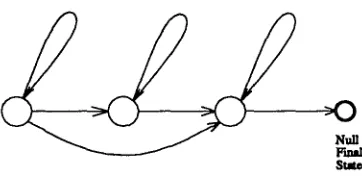
to the system was from a Sennheiser HMD-414 microphone, sampled at a rate of 16KHz. Feature vectors consisted of 14 Mel-scaled cepstra, their derivatives and a log energy deriva- tive. These were computed from 20 msec frames taken at a rate of I00 per second. Training data for each speaker was taken from 1000 words spoken in isolation. Each phonetic model is a three state HMM with Gaussian output distribu- tions having diagonal covariance matrices. The topology of the phonetic models is shown in Figure 3. Continuous train- ing was used to avoid the need for phonetically labelling train- ing data by hand. The models were initialized from speaker independent models trained on the T I M I T speech database [5]. For recognition, the models were placed in a network with probabilities reflecting the phonetic bigram statistics of the lexicon. For each spoken word, a hypothesized phone sequence was determined by the maximum likelihood state sequence through the network, computed using the Viterbi algorithm.
2 . 3 .
Phonetic Dictionary
To use the IR system with speech we construct a phonetic dictionary which is a table giving a basic phonetic spelling for each entry in the word dictionary. For example the phonetic spelling for the word "president" is the string of phonetic symbols "P R EH Z IH D EH N T ' . In our implementation we assodate a single phonetic spelling with each word. More generally, phonological variants, alternative pronunciations
Null lrmal
S t l v
Figure 3: Topology of a Phone HMM
or even translations into other languages can also be placed in the phonetic dictionary. In our arrangement the user needs to speak the uninflected word form that corresponds to the uninflected spelling that is used for indexing. (Again, we can dispense with this by including the phonetic spellings of word inflections.)
The question remains as to how we find phonetic spellings for all the entries in the word dictionary. We have sprit this prob- lem into two parts. The first is to obtain a list of words and their phonetic spellings. We have adapted a list containing phonetic spellings for 175,000 words [6]. Of the 100,000 word types in the encyclopedia, 43,000 were covered by this list. Although this is less than half of the total vocabulary size, it nevertheless does represent the majority of actual word in- stances in the encyclopedia. To cover the rest of the words we propose the application of techniques for automatically producing phonetic spellings, e.g. [7, 8]. Such techniques are prevalent in text-to-speech synthesis.
3.
N-Best Matching
For each spoken word, the recognizer outputs the most likely corresponding phone sequence. As a result of recognition er- rors, the phonetic sequence may not match any entry in the phonetic dictionary, or worse, might match an incorrect word. For example, when a speaker intended the word "president" the recognizer output "P R EH S EH D EH N T" would in- correctly match the word "precedent". We therefore employ a statistical model of the errors typically made by the recog- nizer and use it to determine what words were likely to have been said.
Given the phonetic sequence produced by the recognizer, and a statistical model of recognition errors, we want to efficiently determine the n most likely entries in the phonetic dictio- nary to have been the actual spoken word. As will become apparent, our objective is to make sure the intended word is somewhere in the list. We have investigated two methods for producing the n-best word hypotheses. T h e first follows a generate-and-test strategy and the second, more successful approach involves an HMM-based search through the pho- netic dictionary.
[image:2.612.354.535.45.133.2] [image:2.612.57.303.46.342.2]3 . 1 .
C h a r a c t e r i z i n g R e c o g n i z e r E r r o r s
Errors made by the recognizer are described by matrices con- taining probabilities of various substitution, deletion and in- sertion errors. We produce the error matrices by using an alignment program t h a t compares phonetic recognizer out- put for a set of spoken words with the correct phonetic tran- scriptions for those words. (This set comprises 1000 words). Speaker characteristics are also modelled in the error matri- ces, as axe systematic pronunciation differences between the phonetic dictionary and the speaker. For words t h a t are gen- erated automatically (as mentioned in Section 2.3) we would expect a separate distribution to be helpful because the char- acteristics of an a u t o m a t i c system are likely to have errors distributed in a different way.
The results described in this paper are based on a context independent error model. However, recognition errors are strongly correlated with context, and an improved model would use context dependent statistics. Both of the n-best methods described below are easily a d a p t e d to the use of context dependent statistics.
Given the relatively small amount of training d a t a used for estimating error statistics, some form of smoothing is desir- able. We employ a Laplacian estimator - if phone i occurs a total of Ni times and is recognized as phone j a total of Ni~ times, the estimated probability of such a substitution is
p s u s ( j l i ) _ N~j + 1 N i + M
where M is the size of the phonetic alphabet ( M ---- 39 for our phone set.)
3 . 2 .
G e n e r a t e a n d Test
Our initial m e t h o d for determining the n-best word hypothe- ses employed a best-first approach. The most likely phone s u b s t i t u t i o n s / i n s e r t i o n s / d e l e t i o n s are applied in a best-first order to the phone string produced by the recognizer. After each such modification if the resulting phone string is present in the phonetic index, it is added to the n-best list with its associated probability (being the product of the probabilities of the modifications applied to the original string in order to obtain it). Finite-state recognizers are used to determine whether a phone string is present in the index. This search method has the potential advantage t h a t it does not require matching against every entry 'in the phonetic index to pro- duce the n-best hypotheses.
3 . 3 .
H M M S e a r c h
This involves matching the recognizer o u t p u t against a spe- cial HMM network for each phonetic entry in the index (n.b. these HMM's are quite separate from those used by the pho- netic recognizer).
Let p(wlyl, y 2 , . . . , y , ) be the probability t h a t word to was spoken given t h a t the phonetic o u t p u t produced by the rec- ognizer is yl, y 2 , . . . , y , . It is necessary to find the n words for which p(to[yl, y 2 , . - . , y , ) is greatest. By Bayes law:
p(to[y,, ~2 . . . Yr,)
=
p(zta, y 2 , . . . , y , d w ) P ( w ) p(~,,y~ . . . . , y . )3 7 5
The prior probabilities P(to) are assumed uniform here and p(yl, y 2 , . . . , y , ) is independent of w, so the problem is to find the n words for which P(yl, y 2 , - . . , y,[w) is maximum.
If the phonetic dictionary entry for word to is z l , z 2 , . . . , z,~, then given the error statistics, the probability
can be computed by adding the probability of every sequence of substitutions, deletions and insertions, which when ap- plied to za, x 2 , . . . , z,n results in the sequence ya, y2, . . . . y , . Assuming t h a t these types of errors are statistically inde- pendent, the calculation can be performed efficiently using dynamic programming. By defining a discrete HMM for w, in which the o u t p u t symbols are phones, the calculation re- duces to the computation of the probability t h a t y~, y 2 , . . . , y , would be produced by the HMM (i.e. the "forward" proba- bility).
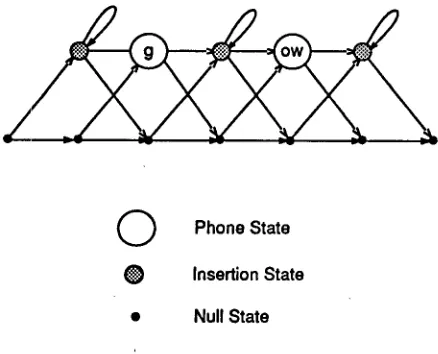
For example, the structure of the HMM for the word , g o , consisting of phonemes / g / and / o w / i s shown in Figure 4. The large states represent the phones of the word, and have o u t p u t probabilities determined from the substitution prob- abilities. The remaining o u t p u t states (smaller and gray in the figure) model possible insertions. T h e o u t p u t probabili- ties for these states are the estimated insertion probabilities, conditioned on the event t h a t an insertion occurs. Self loops on these states allow for the possibility of multiple insertions. The null s t a t e underneath each large phone s t a t e models the deletion of t h a t phone, and the null states underneath inser- tion states allow for the possibility t h a t no insertion occurs at t h a t position. The transition probabilities are determined from estimated insertion and deletion probabilities.
The HMM structure shown in Figure 4 could be replaced by a structure having no null states. However the structure chosen is preferable for two reasons. First, the computation of p ( y t , y2 . . . . , ynlza, z2 . . . zm) requires only O ( m n ) oper- ations rather than O(m2n) which would be required without null states. Second, the c o m p u t a t i o n for this structure is eas- ily implemented using the phonetic pronunciation for each word to index a table of transition and o u t p u t probabilities, so t h a t an HMM does not need to be explicitly stored for each word.
We have implemented the n-best search efficiently and a pass through 43,000 phonetic index entries takes a few seconds. Including the signal processing (also done in software) the system takes between 5-10 seconds to produce the n-best hy- potheses per spoken word (running on a Sun SPARC-10, us- ing a value of n = 30). After the HMM search is complete we have a list of the most likely matching words and their associated probabilities.
4.
S e m a n t i c C o - O c c u r r e n c e F i l t e r i n g
Let us consider an example where the user speaks the words "president" and "kennedy" into the system. These might result in the following rank ordered lists of word hypotheses:Rank N-Best After Semantic Filter
First 111 (64%) 165 (95%)
Top 5
]53 (ss%)
]74 (]00%)
Top 10 163 (94%) 174 (100%)
Top 30 174 (100%) 174 (100%)
Table 1: Effect of filtering on word rank, for successful queries
Phone State
Insertion State
• Null State
Figure 4: HMM for Word Matching
In neither case is the intended word the most likely, although both are present and near the tops of the lists. The next step effectively uses the text of the encyclopedia (accessed via the I R system) as a semantic filter. In the encyclopedia the only members of the above lists which co-occur in close proximity are =president" and "kennedy". T h e intended words of the query are semantically related and thus co-occur close to each other (many times in this example) but the hypotheses t h a t are the result of recognition errors do not.
Each spoken word is represented by an O R term containing its most likely word hypotheses. These terms are combined with an AND o p e r a t o r having a proximity constraint on its members. For our example we might have:
17 unsuccessful queries all failed because the correct word was not present in the top 30 hypotheses. For each spoken word we compared the rank of the correct phonetic hypoth- esis o u t p u t from the n-best component with t h a t produced after semantic co-occurrence filtering. Table 1 shows t h a t such filtering finds relevant documents while simultaneously improving recognition performance.
Some of the successful queries are shown below (practically all of the test queries comprise two or three words).
Example Queries:
1 first atomic b o m b 2 assassinate kennedy 3 xerox corporation 4 planet j u p i t e r 5 gecko lizard 6 chester carlson 7 solid s t a t e physic 8 discover penicillin 9 dinosaur extinct 10 m a r y queen scot
(AND 15 (OR precedent, prescient, president, r e s i d e n t . . . ) ( O R kennerty, kennedy, kemeny, r e m e d y . . . ))
This query is s u b m i t t e d to the IR system and segments of text t h a t satisfy the constraints are retrieved. The word hy- potheses involved in each text segment are then identified. T h e y are used to score the segments and also to rank the best word hypotheses. Scoring includes the phonetic likelihood of the hypotheses, the t o t a l number of occurrences of specific hypothesis combinations in all retrieved text segments, and typical IR word weighting.
5.
E v a l u a t i o n
We created 100 queries, each composed of a few words t h a t characterize a topic of interest (e.g. =Apollo space program"). To evaluate the benefit of semantic co-occurrence filtering directly, we verified t h a t the words we selected had entries in the phonetic dictionary and t h a t the encyclopedia contained at least one relevant article.
Of the 100 queries, 83 were successful (i.e. retrieved at least one r e l e w n t article in the top 25 titles). If only the top word hypotheses from the n-best component were inserted in the boolean queries, only 32 of the queries would succeed. The
In constructing the test queries, sometimes only a single word immediately came to mind for some topics. In such cases we found t h a t a useful strategy for adding another word was to use either a name, hyponym or hypernym. Thus the word =ant" was augmented by adding =insect" as a second word. Although less robust, single word queries are not precluded. Either their length may distinguish t h e m (e.g. =savonarola" and =nitroglycerin") or the IR query can be constructed by duplicating the O R term for the single word (the constraint is then word recurrence which still has value for filtering).
6.
D i s c u s s i o n
Our system demonstrates the feasibility of speech access to an information retrieval system in spite of the large vocabu- lary requirements of the task. Although the system employs a fairly basic phonetic recognizer, it is able to locate articles relevant to a multi-word query even in eases where none of the words of the query are ranked topmost. T h e applicability of semantic co-occurrence filtering is not limited to phonet- icaily oriented speech recognition. T h e technique could be used with any recognizer t h a t can produce rank ordered word hypotheses.
[image:4.612.72.291.46.223.2] [image:4.612.341.546.47.102.2]system both in terms of performance improvement and ex- tensions to the interface and functionality.
An improvement in recognition accuracy is expected by em- ploying context dependent phone models and error matri- ces. Likewise, tied Ganssian mixture output distributions generally provide better recognition accuracy than the single Ganssian distributions we are currently using [9]. We also anticipate moving from speaker dependent recognition to a speaker adaptive mode which will require far less training data for new speakers.
Concerning the interface, the necessity to speak uninflected forms is awkward. For example, a query about the film "Gone With The Wind" had to be stated as ``Go Wind". As described in Section 2.3, this can obviated by including inflected phonetic spellings in the phonetic dictionary. If the recognizer were adapted to recognize a set of command words the system would gain considerable flexibility as aspects of search and presentation could be directed by the user, partic- ularly user feedback based on the titles shown on the display screen. The small number of words involved in the display of the titles constitutes a strong constraint on their recognition. Ideally, we would like to extend the system to handle con- tinuous speech and identify function words. In this regard, integration with the MURAX system [10] would be an inter- esting development path.
Phonetic Baseforms", Proceedings of the IEEE Interna- tional Conference on Acoustics, Speech and Signal Pro- cessing, 1984, pp. 42.5.1-4.
8. Dedina, M. J. and Nusbaum, H. C., "PRONOUNCE: A Program for Pronunciation by Analogy", Computer Speech and Language, vol. 5, 1991, pp. 55-64.
9. Rabiner, L. R. and Juang, B. H., Fundamentals of Speech Recognition, Prentice-Hall, Englewood Cliffs, New Jer- sey, 1992.
10. Kupiec, J. M., ``MURAX: A Robust Linguistic Ap- proach for Question-Answering Using an On-Line En- cydopedia", Proceedings of the Sixteenth International A C M SIGIR Conference on Research and Development in Information Retrieval, June, 1993, pp. 181-190.
7 . A c k n o w l e d g m e n t s
We would like to thank our colleagues at Xerox PARC for their support and assistance, particularly Marcia Bush, Jan Pedersen and Doug Cutting. The HMM structure for word matching resulted from a conversation with David Hanssler. This work was partially funded by National Science Founda- tion grant IRI-8719595.
R e f e r e n c e s
1. Glavitsch, U. and Schguble P., "A System for Retrieving Speech Documents", Proceedings of the Fifteenth Inter- national AGM SIGIR Conference on Research and De- velopment in Information Retrieval, June 1992, pp. 168- 176.
2. Olavitsch, U. and Sch~uble P., "Assessing the Retrieval Effectiveness of a Speech Retrieval System by Simulating Recognition Errors", These Proceedings.
3. Cutting, D. R., Pedersen, J. Halvorsen P.-K., "An Object-Oriented Architecture for Text Retrieval", Con. ferenee Proceedings of RIAO'91, Intelligent Text and Image Handling, Barcelona, Spain, April 1991, pp. 285- 298.
4. The Academic American Encyclopedia, Grolier Elec- tronic Publishing, Danbury, Connecticut, 1990.
5. Lamel, L., Kassel, R. and Seneff, S., "Speech database development: Design and analysis of the acoustic- phonetic corpus.", Proceedings, DARPA Speech Recog- nition Workshop, Rpt. No. SAIC-86/1546, 1986, pp. 1- 61-68.
6. Moby Pronunciator II, Grady Ward, Arcata CA, 1993.
7. Lucassen, J. M. and Mercer, R. L., ``An Information Theoretic Approach to the automatic Determination of