Konbitzul: an MWE-specific database for Spanish-Basque
Uxoa I ˜nurrieta, *Itziar Aduriz, Arantza D´ıaz de Ilarraza, Gorka Labaka, Kepa Sarasola
IXA NLP group, University of the Basque Country*University of Barcelona
[email protected], [email protected],{a.diazdeilarraza, gorka.labaka, kepa.sarasola}@ehu.eus
Abstract
This paper presents Konbitzul, an online database of verb+noun MWEs in Spanish and Basque. It collects a list of MWEs with their translations, as well as linguistic information which is NLP-applicable: it helps to identify occurrences of MWEs in multiple morphosyn-tactic variants, and it is also useful for improving translation quality in rule-based MT. In addition to this, its user-friendly interface makes it possible to simply search for MWEs along with translations, just as in any bilingual phraseological dictionary.
1.
Introduction
Multiword Expressions (MWEs), also called Phraseologi-cal Units (PUs), are combinations of words which together express a single meaning (Sag et al., 2002). They often have irregular lexical-semantic and/or morphosyntactic fea-tures, and they are not always translated word-for-word (Examples 1-3). This means they cause challenges in vari-ous disciplines, such as Lexicography, Translation and Nat-ural Language Processing (NLP).
(1) EN:pull sb’s leg
ES:tomar el pelo (a)lit.take sb’s hair EU:adarra jolit.play the horn (to sb)
(2) EN:take steps
ES:dar pasoslit.give steps EU:urratsak eginlit.steps do
(3) EN:take off
ES:alzar el vuelolit.raise the flight EU:aireratulit.go-to-the-air
Although interest in Phraseology has a longer history, stud-ies on MWEs have multiplied considerably over the last two decades (Baldwin and Kim, 2010; Savary et al., 2015). Most of the work undertaken within the field of NLP fo-cuses on MWE candidate extraction (Ramisch, 2015) – mainly for lexicographic purposes– or identification of MWE occurrences in corpora (Savary et al., 2017). How-ever, some research has also been conducted into improving Machine Translation (MT) quality by enhancing MWE pro-cessing (Kordoni and Simova, 2014; Seretan, 2014). Mean-while, a considerable amount of resources have been cre-ated for several languages, including MWE lists, lexicons and MWE-annotated treebanks (Losnegaard et al., 2016).
Concerning Basque phraseology, research has been done both to describe some linguistic phenomena and to de-velop NLP tools (Alegria et al., 2004; Gurrutxaga and Ale-gria, 2012), but researchers have had an almost exclusively monolingual perspective. Thus, our aim is, on the one hand, to analyse how MWEs are translated, and, on the other hand, to propose a method to improve their computational treatment in bilingual tools.
In this paper, we will present Konbitzul, a database of verb+noun MWEs in Spanish and Basque. As well
as working as a bilingual phraseological dictionary, the database contains linguistic information which is useful for NLP-related tasks, notably for Parsing and MT.
We will start by introducing the database, including: the verb+noun MWEs collected (Section 2.1.), how linguistic information is included in the database (Section 2.2.), and how the interface is structured (Section 2.3.). We will then go on to explain what the database can be used for: as a helpful tool for MWE identification (Section 3.1.), or as a resource to improve MT quality (Section 3.2.). Finally, we will discuss some conclusions and ongoing and future work.
2.
The database
Konbitzul is a database which can be publicly accessed online (Section 2.3.). It currently comprises 3,195 Span-ish verb+noun MWEs (along with 7,132 translations) and 2,954 Basque noun+verb MWEs (along with 6,392 transla-tions).
The MWEs in the database were gathered from two main sources: the Elhuyar Spanish-Basque and Basque-Spanish dictionaries1 and the DiCE dictionary of Spanish colloca-tions2 (Vincze et al., 2011). However, the detabase being part of an ongoing project, additional sources will probably be used in the future, such as a list of Basque MWEs ex-tracted from corpora by using Gurrutxagaet al.’s method (Gurrutxaga and Alegria, 2011). NLP-applicable linguis-tic information was added afterwards. As this was done in several phases, the amount of linguistic data provided varies from one MWE to another. More information about the analysis will be given in the following paragraphs.
2.1.
Verb+Noun MWEs in Spanish and Basque
Whereas Spanish is a romance language, Basque is a non-indoeuropean language which does not belong to any known family. Their typological features are very different:
• Spanish is SVO-ordered, head-initial, fusional, and uses prepositions
1
http://hiztegiak.elhuyar.eus
• Basque is canonically SOV-ordered3, head-final, ag-glutinative, and uses postpositions
Thus, given that they are so dissimilar in such fundamental aspects, it is not surprising that both languages differ con-siderably in phraseology as well, as typological features di-rectly affect the way in which languages combine words. The MWEs collected in Konbitzul are all made up of a verb and a noun. The Spanish ones can have a preposition and/or a determiner in-between (Example 4), and similarly, Basque noun phrases can have case markers or postposi-tions attached (Example 5).
(4) A.tener afecto(V+N)
lit.have affection’have affection’ B.hacer un favor(V+D+N)
lit.do a favour’do a favour’ C.saber de memoria(V+P+N)
lit.know of memory’know by heart’ D.dejar a un lado(V+P+D+N)
lit.leave to one side’leave aside’
(5) A.denbora galdu(N.abs+V) lit.time lose’waste time’ B.sutan egon(N.loc+V)
lit.fire-in be’be very angry’ C.aurrera egin(N.alla+V)
lit.front-to do’move forward’ D.hutsetik hasi(N.abl+V)
lit.zero-from start’start from scratch’
In previous work, we showed that it is rare for a verb+noun MWE to be translated literally between Spanish and Basque (Example 6). As a matter of fact, out of the Spanish verb+noun combinations in a general bilingual dictionary, only 48.54% had a noun+verb translation in Basque, and only 10.58% were translated word-for-word.
(6) ES:poner en libertad(V+P+N) lit.put in liberty
EU:aske utzi(Adv+V) /askatu(V) lit.free leave/(to) free EN: ’(to) release’
As for Basque into Spanish (Example 7), the gap was even bigger: only 30.85% of the noun+verb combinations were translated by a verb and a noun, and only 8.64% of the translations were literal.
(7) EU:zin egin(N.abs+V) lit.oath do ES:jurar(V)
lit.swear EN: ’swear’
3
Note that, although Basque is classified as an SOV language, it is often said to be free-ordered, as word order can be freely altered for emphasis.
2.2.
Methodology for analysing linguistic data
As we have already mentioned, most of the linguistic in-formation in Konbitzul is analysed and structured so that it can later be used in NLP tools. The collection and analy-sis of the MWEs was done in five phases: during the first three, the annotation was mainly manual; the last two are the result of our attempt to automatize the previous manual work. We will now briefly explain the phases one by one.
Phase 1. All the entries consisting of a verb and a noun were gathered from the Elhuyar Spanish-Basque and Basque-Spanish dictionaries. Basic information about them was analysed semi-automatically: morphological structure, number and definiteness of the noun phrases (NPs), and whether the nouns and the verbs in both lan-guages were regular translations or not. This information was used to make some preliminary estimations about the irregularities which occur when translating MWEs between Spanish and Basque (Inurrieta et al., in print).
Phase 2. After having looked at the frequencies of the MWEs analysed in Phase 1, the 150 most common combi-nations in Spanish were selected for more in-depth study, which would then be used for an identification experi-ment (Section 3.1.). The combinations were classified into lexical-semantic and morphosyntactic groups, and further morphosyntactic data was examined, such as: possible de-terminers inside the NPs, variations in number and definite-ness, possibility of altering word order, etc. Detailed infor-mation about this can be found in (Inurrieta et al., 2016).
Phase 3. A Basque translation was manually given to each of the combinations analysed in Phase 2, and information about this translation was examined: lexical components, whether the number and/or definiteness needed changing between one language and the other, cases in which the translation was not made up of a noun and a verb, etc. The data obtained from this phase was later tested and evaluated in an MT system (Inurrieta et al., 2017).
Phase 4. Once having seen that the analysed informa-tion was helpful for MWE identificainforma-tion, the next step was to semi-automatize the linguistic analysis, so that our method could be useful on a bigger scale. We used both the list of Spanish verb+noun combinations from the El-huyar Spanish-Basque dictionary and a new one obtained from the DiCE collocation dictionary (Vincze et al., 2011). Some data about the features analysed in Phase 2 was au-tomatically extracted from both monolingual and parallel corpora, and this information was employed to group the MWEs according to fifteen morphosyntactic patterns: those never occurring with a determiner, those only used in the plural form, those where the pronominal form of the verb is especial, those which can be freely altered just like any other word combination, etc. We are now in the process of testing this information in MWE identification within pars-ing.
Figure 1: The Konbitzul database’s interface. The nouncuidado(care) is searched, and three combinations are shown along with their possible translations:tener el cuidado(lit. have the care, ’be careful’),tener cuidado(lit. have care, ’be careful’) anddejar bajo el cuidado(lit. leave under the care, ’leave in charge of’).
source to the target language). Then, lexical and grammat-ical information was added. This information is yet to be tested in MT.
2.3.
The interface
The database can be publicly accessed athttp://ixa2.
si.ehu.eus/konbitzul. Combinations can be found
by typing verb or noun lemmas or full combinations, and morphosyntactic structures can be filtered as well. The re-sults matching the query are listed along with one or more possible translations (Figure 1).
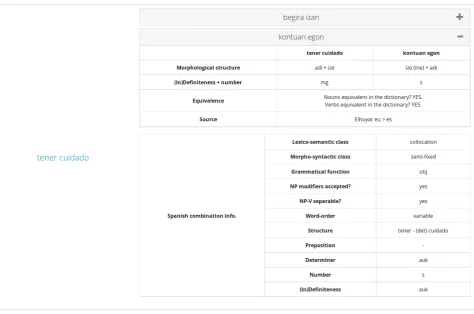
By clicking on the plus button beside each translation, the basic information analysed in Phase 1 can be seen (top table in Figure 2). When the Spanish entry is in a different colour, it means that the combination was (either manually or semi-automatically) analysed in Phase 2 or 4; this information can be seen by clicking on the entry (bottom table in Figure 2). Finally, when one of the translations is also differently coloured and clickable, it means that this translation was marked as the most appropriate for MT (Phases 3 and 5).
3.
Applications
Konbitzul was originally created as an NLP-applicable re-source. However, with its user-friendly interface, it can simply be used as a phraseological dictionary as well.
In Sections 3.1. and 3.2., two past experiments will be ex-plained, to show the potential impact of the analysed lin-guistic data on MWE identification and MT.
3.1.
MWE identification
Concerning identification, one of the major problems of MWEs is their morphosyntactic variability (Example 8). The most straightforward means of identification is to try to match word sequences against dictionary entries; how-ever, this method falls short in most cases, especially when it comes to verbal MWEs, which tend to have multiple mor-phosyntactic variants (Savary et al., 2017).
(8) dar claselit.give lecture
dar una claselit.give one lecture dar claseslit.give lectures la clase dadalit.the lecture given
In previous work (Inurrieta et al., 2016), the linguistic infor-mation in Konbitzul was used to help identify occurrences of a list of verb+noun MWEs in corpora. To be precise, the MWEs were the same ones studied during the second phase of the analysis presented in Section 2.2..
Two identification methods were compared: (A) that used by the Freeling parser (Padr´o and Stanilovsky, 2012), which only searches for non-separable occurrences of MWEs, and (B) a new one combining the linguistic data in Konbitzul with the chunking and dependency information provided by the parser. The results clearly showed that method B was considerably better, as it identified 28% more occurrences than method A, with a precision score as high as 98% (as opposed to 99%).
3.2.
Machine Translation
Likewise, another experiment was undertaken to see whether the information in Konbitzul could improve MT quality. Matxin was used for this study, a rule-based sys-tem for Spanish-Basque (Mayor et al., 2011).
As with any rule-based system, Matxin works in three phases: analysis, transfer and generation. The data gath-ered from Konbitzul was added both to the analysis and transfer phases. Firstly, identification of MWEs was carried out as explained in Section 3.1., and then, lexical and gram-matical information about the translation of each MWE (analysed in Phase 3 of Section 2.2.) was used.
The experiment resulted in an increase of 3% in BLEU score (Papineni et al., 2002). In addition, a manual eval-uation by three experts was carried out in a controlled cor-pus, and it was concluded that the new translation was bet-ter than the old one in 78.6% of the cases (Inurrieta et al., 2017). Once again, this proves that the kind of linguistic information in the database is helpful for NLP purposes.
4.
Conclusion
Konbitzul is an open-source online database of verb+noun MWEs in Spanish and Basque. It currently comprises 6,149 entries in all, which all have one or more translation and rich NLP-applicable linguistic information. Part was added manually, and the reminder is the result of a semi-automatic analysis.
Experiments have confirmed that the information in the database is helpful for NLP tools. Due to the large amount of MWEs requiring a non-regular translation, the database is of special interest for the area of MT, as well as being a useful resource to help identifying multiple morphosyntac-tic variants of MWEs in text.
As this is an ongoing project, the database is constantly be-ing updated with further MWEs, translations and lbe-inguistic information. At the same time, new experiments are being undertaken both to semi-automatize the linguistic analysis and to test the automatic information in NLP tools.
5.
Acknowledgements
Uxoa I˜nurrieta’s doctoral research is funded by the Span-ish Ministry of Economy and Competitiveness (BES-2013-066372). This work was carried out in the context of the SKATeR (TIN2012-38584-C06-02) and TADEEP (TIN2015-70214-P) projects.
6.
Bibliographical References
Alegria, I., Ansa, O., Artola, X., Ezeiza, N., Gojenola, K., and Urizar, R. (2004). Representation and treat-ment of multiword expressions in basque. In Proceed-ings of the Workshop on Multiword Expressions: Inte-grating Processing, pages 48–55. Association for Com-putational Linguistics.
Gurrutxaga, A. and Alegria, I. (2011). Automatic extrac-tion of NV expressions in Basque: basic issues on cooc-currence techniques. InProceedings of the Workshop on Multiword Expressions: from Parsing and Generation to the Real World, pages 2–7. Association for Compu-tational Linguistics.
Gurrutxaga, A. and Alegria, I. (2012). Measuring the com-positionality of NV expressions in Basque by means of distributional similarity techniques. InLREC, pages 2389–2394.
Inurrieta, U., D´ıaz de Ilarraza, A., Labaka, G., Sarasola, K., Aduriz, I., and Carroll, J. A. (2016). Using lin-guistic data for English and Spanish verb-noun combi-nation identification. InProceedings of the 26th Interna-tional Conference on ComputaInterna-tional Linguistics (COL-ING 2016): Technical Papers, pages 857–867.
Inurrieta, U., Aduriz, I., D´ıaz de Ilarraza, A., Labaka, G., and Sarasola, K. (2017). Rule-based translation of Span-ish verb+noun combinations into Basque. In Proceed-ings of the 13th Workshop on Multiword Expressions (MWE 2017), pages 149–154.
Inurrieta, U., Aduriz, I., D´ıaz de Ilarraza, A., Labaka, G., and Sarasola, K. (in print). Analysing linguistic information about word combinations for a Spanish-Basque rule-based machine translation system. In Rus-lan Mitkov, et al., editors,Multiword Units in Machine Translation and Translation Technologies, pages 41–59. John Benjamins Publishing Company.
Kordoni, V. and Simova, I. (2014). Multiword expressions in machine translation. InProceedings of the 9th Inter-national Conference on Language Resources and Evalu-ation (LREC 2014), pages 1208–1211.
Losnegaard, G., Sangati, F., Parra Escart´ın, C., Savary, A., Bargmann, S., and Monti, J. (2016). Parseme survey on MWE resources. In Proceedings of the 10th Inter-national Conference on Language Resources and Eval-uation (LREC 2016), Paris, France, pages 2299–2306. European Language Resources Association (ELRA). Mayor, A., Alegr´ıa, I., D´ıaz de Ilarraza, A., Labaka, G.,
Lersundi, M., and Sarasola, K. (2011). Matxin, an open-source rule-based machine translation system for Basque.Machine translation, 25(1):53–82.
Padr´o, L. and Stanilovsky, E. (2012). Freeling 3.0: To-wards wider multilinguality. InProceedings of the 8th International Conference on Language Resources and Evaluation (LREC 2012), pages 2473–2479.
Papineni, K., Roukos, S., Ward, T., and Zhug, W.-J. (2002). BLEU: a method for automatic evaluation of machine translation. InProceedings of the 40th Annual Meeting of the Association for Computational Linguistics, pages 311–318.
Ramisch, C. (2015). Multiword expressions acquisition. Springer.
Sag, I. A., Baldwin, T., Bond, F., Copestake, A., and Flickinger, D. (2002). Multiword expressions: a pain in the neck for NLP. InInternational Conference on In-telligent Text Processing and Computational Linguistics, pages 1–15. Springer.
Savary, A., Sailer, M., Parmentier, Y., Rosner, M.,
Ros´en, V., Przepi´orkowski, A., Krstev, C., Vincze, V., W´ojtowicz, B., Losnegaard Smørdal, G., et al. (2015). PARSEME: PARSing and Multiword Expressions within a European multilingual network. InProceedings of the 7th Language & Technology Conference: Human Lan-guage Technologies as a Challenge for Computer Sci-ence and Linguistics (LTC 2015).
Savary, A., Ramisch, C., Cordeiro, S., Sangati, F., Vincze, V., Qasemizadeh, B., Candito, M., Cap, F., Giouli, V., Stoyanova, I., et al. (2017). The PARSEME Shared Task on automatic identification of verbal multiword expres-sions. In Proceedings of the 13th Workshop on Multi-word Expressions (MWE 2017), pages 31–47.
Seretan, V. (2014). On collocations and their interaction with parsing and translation. InInformatics, volume 1, pages 11–31. Multidisciplinary Digital Publishing Insti-tute.