Evaluation of Domain-specific Word Embeddings using Knowledge Resources
Farhad Nooralahzadeh, Lilja Øvrelid, Jan Tore Lønning
Department of Informatics, University of Oslo{farhadno,liljao,jtl}@ifi.uio.no
Abstract
In this work we evaluate domain-specific embedding models induced from textual resources in the Oil and Gas domain. We conduct intrinsic and extrinsic evaluations of both general and domain-specific embeddings and we observe that constructing domain-specific word embeddings is worthwhile even with a considerably smaller corpus size. Although the intrinsic evaluation shows low performance in synonymy detection, an in-depth error analysis reveals the ability of these models to discover additional semantic relations such as hyponymy, co-hyponymy and relatedness in the target domain. Extrinsic evaluation of the embedding models is provided by a domain-specific sentence classification task, which we solve using a convolutional neural network. We further adapt embedding enhancement methods to provide vector representations for infrequent and unseen terms. Experiments show that the adapted technique can provide improvements both in intrinsic and extrinsic evaluation.
Keywords:word embeddings, intrinsic and extrinsic evaluation, domain knowledge resource, embeddings enhancement
1.
Introduction
Domain-specific, technical vocabulary presents a challenge to NLP applications. Recently, word embedding models have been shown to capture a range of semantic relations relevant to the interpretation of lexical items (Mikolov et al., 2013b) and furthermore provide useful input represen-tations for a range of downstream tasks (Collobert et al., 2011). The majority of work dealing with intrinsic evalu-ation of word embeddings has focused on general domain embeddings and semantic relations between frequent and generic terms. However, it has been shown that embed-dings differ from one domain to another due to lexical and semantic variation (Hamilton et al., 2016; Bollegala et al., 2015). Domain-specific terms are challenging for general domain embeddings since there are few statistical clues in the underlying corpora for these items (Bollegala et al., 2015; Pilehvar and Collier, 2016).
The Oil and Gas domain is a highly technical and data-intensive domain. Experts working within this domain daily investigate selected geographical areas and use rel-evant information (scientific articles, reports and other tex-tual sources) to evaluate the potential for undiscovered hy-drocarbons. The vocabulary is technical and there is a real need for NLP tools to aid the work process. In this work we investigate whether word embedding models can cap-ture specific semantic relations by training domain-specific embeddings1and evaluating these against a
termi-nological resource. We conduct a comprehensive study in-cluding a wide range of evaluation criteria, contrasting sev-eral gensev-eral and domain specific embedding models. We augment the domain-specific embeddings using a domain knowledge resource. To supply embeddings for rare words, we extend the retrofitting method by Faruqui et al. (2015). We then go on to examine the contribution of these models in the performance of a downstream classification task.
1Link to the domain-specific model: http://vectors. nlpl.eu/repository/11/75.zip
2.
Related work
Despite the pervasive use of word embedding in language technology, there is no agreement in the community on the best ways to evaluate these semantic representations of lan-guage2. There exist a variety of benchmarks which are
widely employed to assess the quality of word representa-tions and to compare different distributional semantic mod-els. Existing evaluation methods can largely be separated into two categories: ”intrinsic evaluation” and ”extrinsic evaluation”. Intrinsic evaluationtries to directly quantify how well various kinds of linguistic regularities can be de-tected with the model independent of its downstream appli-cations (Baroni et al., 2014; Schnabel et al., 2015). On the other hand, the quality of a word vector may be assessed by its performance in downstream tasks through measur-ing changes in performance metrics specific to the tasks by extrinsic evaluation. The downstream language tech-nology tasks on which the quality of a word embedding is examined, fall into syntactic (e.g. POS tagging, Chunking) and semantic (e.g. Named entity recognition, Sentiment Classification) categories (Schnabel et al., 2015; Chiu et al., 2016b). In this work we evaluate domain-specific word embedding models using both intrinsic and extrinsic evalu-ation schemes.
Although, word embeddings techniques have drawn signif-icant interest in the field, they are not well equipped to deal with unseen and infrequent words, nor do they consider word relations found in knowledge resources. Recently, different solutions have been proposed to overcome these limitations (Pilehvar and Collier, 2016; Faruqui et al., 2015; Yu and Dredze, 2014). Among these, we choose Faruqui et al. (2015) in this work since it is a post-processing approach which is straightforward to apply.
3.
Intrinsic evaluation setup
Intrinsic evaluation of word embeddings has two require-ments. First, we require a query inventory as a gold stan-dard, and second, a word embedding model that has been
Source Abbr. Description Docs Sentences
American Association of Petroleum Geologist AAPG Scientific articles 3,382 72,243 C&C Reservoirs-Digital Analogs CCR Field evaluation reports 1,140 244,017
Elsevier ELS Scientific articles, magazines 40,757 7,703,447
Geological Society, London Memoirs GSL Scientific articles 152 32,352
Norwegian Petroleum Directory NPD Norwegian Field info 514 49,426
Tellus TELLUS Basin info 1,478 179,450
Total 47,423 8,280,935
Table 1: Sources of the Oil and Gas corpus
trained on a specific corpus. In this section we describe how we build a domain specific query inventory by exploiting a domain-specific knowledge resource. Then, the domain specific corpus and the training of the embedding models will be described. We then go on to clarify the evaluation methodology.
3.1.
Domain specific query inventory
For the general domain, there exists a wide range of gold standard resources for evaluating distributional semantic models in their ability to capture semantic relations of dif-ferent types, for instance, Simlex-999 (Hill et al., 2015). However, evaluating the domain specific embeddings by applying these gold standards will not provide an adequate picture of their quality, since they do not share a common vocabulary and word meanings. For this reason, we create a domain-specific gold standard using the Schlumberger oil-field glossary (slb).3 Theslbis a reference which defines
major oilfield activities and has been created by technical experts. Terms are described by their part of speech, their discipline (e.g. Well Completions,Geology), as well as a textual definition. Terms are linked to other terms in the glossary by means of semantic and lexical relations such as Synonyms,AntonymsandAlternative forms. It provides a network of related terms that can be navigated through the glossary. We construct a domain query inventory by ex-tracting all terms and their inter-glossary relations from the relational database. The glossary consists of4,886terms. Following the symmetric nature of theSynonym,Antonym and Alternative formrelations we infer a relation if it is missing between terms. The final query inventory contains 878 synonym pairs, 284 antonym pairs and 934 alterna-tive form pairs. We observe that the majority of terms in the query inventory are multi-word units (70%) and nouns (72%). This indicates that a large portion of the domain-specific vocabulary that we want to capture in our model consists of multi-word entities. Thus we should take this into account during the training of embeddings.
3.2.
Corpora and Pre-processing
In order to train domain-specific embeddings we need a domain-specific corpus. We therefore compile a corpus consisting of technical reports and scientific articles in the Oil and Gas domain. Table 1 shows detailed information about these sources. The corpus contains 47,423 docu-ments and8,280,935sentences. It is pre-processed using
3http://www.glossary.oilfield.slb.com/
the following steps: 1) Tokenization and lemmatization us-ing StanfordCoreNLP (Mannus-ing et al., 2014). English stop words and sentences with less than three words are also removed from the corpus. 2) Shuffling: we randomly shuf-fle the text in the dataset. During the training of embed-ding models the learning rate is linearly dropped as train-ing progresses, text appeartrain-ing early has a larger effect on the model. Shuffling makes the effect of all text almost equivalent (Chiu et al., 2016a).
3.3.
Training of Word Embeddings
For training of the word embeddings, we exploit the avail-able word2vec (Mikolov et al., 2013a) implementation gen-sim ( ˇReh˚uˇrek and Sojka, 2010). The elements that have an impact on the performance of the model are the in-put corpus, model architecture and the hyper-parameters. In many works lemmatized, lowercased and shuffled input during training the word2vec are recommended; we carried out our experiments with these settings as detailed above. We employed the phrase model ofgensimwhich automat-ically detects common phrases (multi-word expressions). The phrases are collocations (frequently co-occurring to-kens) and we consider bi-grams and tri-grams in this ex-traction process. We further proceed with the domain spe-cific model generation by creating two sets of embeddings, employing both theCBOWand theSkip-gramarchitectures with default settings. In the initial evaluation step, we com-pare the outcomes of these two models to determine the better architecture.
We then go on to compare different settings for the hyper-parameters, while keeping all other settings constant. It has been shown that optimizations of hyper parameters and certain system choices constitute the main causes of differ-ences in performance rather than the algorithms themselves (Levy et al., 2015). Here we investigate the impact of vari-ous system design choices in the evaluation of domain spe-cific embeddings across the following parameters4: I)
Vec-tor size: dim ∈ 50,100,200,300,400,500,600 II) Con-text window size: win ∈ 2,3,5,10,15,20. III) Negative sampling size: neg ∈ 3,5,10,15. IV) Frequency cut off: min.count ∈2,3,5,10. V) n-most-similar: The parame-ternfor topn-most-similar as output is fixed at value5(the maximum number of terms that are involved in each rela-tion set in the query inventory). We evaluate these different system design settings based on our intrinsic benchmark. We build various embeddings models by varying values of
4
Model Synonymy Antonymy Alt. form
A R P A R P A R P
[image:3.595.60.286.68.108.2]Skip-gram 9.8 8.0 2.2 46.4 41.3 9.3 12.1 10.4 2.4 CBOW 12.7 10.2 2.7 55.3 49.2 11.1 12.8 11.0 2.6
Table 2: Evaluation results for different architectures
one hyper-parameter and keeping others as default. There-after, we perform evaluation over the domain specific query inventory.
3.4.
Evaluation
For evaluation, we assume that for each term in the in-ventory an embedding model should be able to propose similar words which are related semantically as either syn-onym,alternative formorantonym. We will measure this by looking at a target word’s relation set, for instance its synonyms, and topn-most-similar words based on the em-beddings model. Since these relations are symmetric, the pairs (ti, tj)and (tj, ti) are considered equivalent in the
evaluation. We calculate theaccuracy(A) as the number of target words for which the model provides at least one correct prediction, therecall(R) as the number of correctly predicted word pairs over all word pairs andprecision(P) as the number of correctly predicted word pairs over all pre-dicted word pairs for each relation category.
4.
Intrinsic evaluation experiments
In the following we present experiments that evaluate the domain-specific word embedding models intrinsically. We first present tuning experiments and then present an exper-imental comparison between domain-specific and general domain embedding models.
4.1.
Model architecture: Skip-gram vs. CBOW
First, we compare the models obtained using different ar-chitectures (CBOW and Skip-gram) with default values for hyper-parameters i.e.dim= 100,win= 5,min.count= 5 andneg = 5. Table 2 presents the results for the two architectures broken down by semantic relation from the query inventory. In general we find that the CBOW based model shows better results than the Skip-gram in all se-mantic relation tasks. The results show that the embedding models have higher scores for antonymy prediction than synonymy, see Table 2. This result is consistent with pre-vious studies such as van der Plas and Tiedemann (2006) and Leeuwenberg et al. (2016) in which they reported that using distributional similarity some word categories like antonyms, (co)hyponyms or hypernyms show up more of-ten than synonyms.4.2.
Hyper-parameter tuning
We explore the impact of each hyper-parameter on detec-tion of semantic reladetec-tions. We observe that the performance of the embedding models can be notably improved over the default hyper-parameters but like the findings in other stud-ies (Chiu et al., 2016a; Gladkova et al., 2016), the effects of different configurations are diverse and sometimes they are counter-intuitive. For example, different relation cat-egories benefit from different context windows size in dif-ferent ways, such as the model with larger context windows
dim Synonymy Antonymy Alt. form
A R P A R P A R P
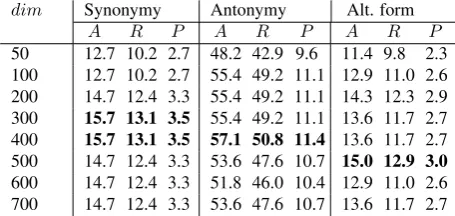
50 12.7 10.2 2.7 48.2 42.9 9.6 11.4 9.8 2.3 100 12.7 10.2 2.7 55.4 49.2 11.1 12.9 11.0 2.6 200 14.7 12.4 3.3 55.4 49.2 11.1 14.3 12.3 2.9 300 15.7 13.1 3.5 55.4 49.2 11.1 13.6 11.7 2.7 400 15.7 13.1 3.5 57.1 50.8 11.4 13.6 11.7 2.7 500 14.7 12.4 3.3 53.6 47.6 10.7 15.0 12.9 3.0
[image:3.595.309.537.69.177.2]600 14.7 12.4 3.3 51.8 46.0 10.4 12.9 11.0 2.6 700 14.7 12.4 3.3 53.6 47.6 10.7 13.6 11.7 2.7 Table 3: Evaluation results for different vector size (de-fault=100)
win Synonymy Antonymy Alt. form
A R P A R P A R P
2 12.7 10.2 2.7 55.4 49.2 11.1 13.6 12.3 2.9
3 13.7 12.4 3.3 48.2 42.9 9.6 11.4 9.8 2.3 5 12.7 10.2 2.7 55.4 49.2 11.1 12.9 11.0 2.6 10 13.1 10.9 2.9 53.6 47.6 10.7 13.6 12.3 2.9
[image:3.595.310.537.222.309.2]15 12.7 10.2 2.7 67.1 50.8 11.4 12.9 11.0 2.6 20 12.7 10.2 2.7 53.6 47.6 10.7 12.1 10.4 2.4 Table 4: Evaluation results for different context window size (default=5)
tends to capture antonymy relation while with smaller win-dows, learns synonymy relation of the words. On the other hand, negative sampling and frequency cut-off parameters have different impacts in the three relation categories.
4.2.1. Vector size (dim)
The effect of vector size on the trained models is quite sim-ilar in all tasks (Table 3). It shows a large improvement in all evaluations when the dimensionality is increased. How-ever, the improvement peaks at400for thesynonymyand antonymypredictions and500foralternative form.
4.2.2. Context window size (win)
Table 4 depicts the impact of window size per evaluation task. The embedding model can detect well the synonymy relation in low windows size (w=3) while in antonymy and alternative form tasks the model performance fluctuates be-tween lower and higher window sizes.
4.2.3. Negative sampling (neg)
Unlike the practical recommendation in Levy et al. (2015) which states that the skip-gram model prefers many neg-ative samples, the CBOW model shows contradictory re-sult with respect to this parameter in our evaluation bench-marks. As we can see in Table 5, results remain constant re-gardless of negative sampling number in the synonym pre-diction task. While its performance has correlation with an increase of this parameter in alternative form detection. For the antonym task, it reached a peak onnegequal to 5 and 10 before falling.
4.2.4. Frequency cut off (min.count)
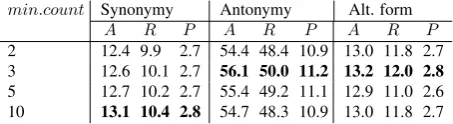
The impact of excluding words that are less frequent re-garding to themin.countparameter is summarized in Ta-ble 6. This parameter shows different impact compared to the other parameters. While, ignoring more words has bet-ter effect in synonymy detection, it stops atmin.count= 3
neg Synonymy Antonymy Alt. form
A R P A R P A R P
[image:4.595.59.285.69.133.2]3 12.7 10.2 2.7 53.6 47.6 10.7 12.1 10.4 2.4 5 12.7 10.2 2.7 55.4 49.2 11.1 12.9 11.0 2.6 10 12.7 10.2 2.7 55.4 49.2 11.1 13.0 11.7 2.7 15 12.7 10.2 2.7 51.8 46.0 10.4 13.6 12.3 2.9
Table 5: Evaluation results for different number of negative samples (default=5)
min.count Synonymy Antonymy Alt. form
A R P A R P A R P
2 12.4 9.9 2.7 54.4 48.4 10.9 13.0 11.8 2.7
3 12.6 10.1 2.7 56.1 50.0 11.2 13.2 12.0 2.8
5 12.7 10.2 2.7 55.4 49.2 11.1 12.9 11.0 2.6
10 13.1 10.4 2.8 54.7 48.3 10.9 13.0 11.8 2.7
Table 6: Evaluation results for different value for frequency cut off (default=5)
Since the context window size (win), negative sampling (neg) and frequency cut off (min.count) parameters showed inconsistent results among the relations, we selected the CBOW model with vector size (dim) equal to 400 and we fixed the other parameters to their defaults i.e. win = 5, min.count = 5andneg = 5. This configuration, here-inafter referred to as OILGAS.d400, showed the maximum improvement during the tuning experiments.
4.3.
Comparative evaluation
In order to compare the domain-specific embeddings with general domain embeddings, we select two widely used pre-trained embedding sets:Wiki+Giga5andGoogleNews 6to see how they perform in our evaluation benchmark. The
input data in theWiki+Gigahas been tokenized and lower-cased with the Stanford tokenizer, whereas theGoogleNews model is trained on a part of the Google News dataset and it contains both words and phrases. The phrases are obtained using the same approach as described in Section 3.2.. The words are not lemmatized in both models and the Google-News also contains capitalized words.
The results of the comparative evaluation of the domain-specific and pre-trained models are summarized in Table 7. Since the words in the vocabularies of both pre-trained models are not in lemma form, we consider the surface form of terms for the evaluation. We also report the pro-portion of query terms that are covered by the vocabulary of each model as coverage. We find that in spite of the large input and vocabulary size in both GoogleNews and Wiki+Gigamodels, they have less coverage than the do-main specific model. We further observe that despite the considerably smaller training data set, the OILGAS.d400 performs better across all the tasks.
It is clear that this comparison is somewhat unfair due to differences in pre-processing and hyperparameter tuning. In order to investigate the impact of these differences, we apply the same pre-processing steps and hyperparameters to train the CBOW model over the English Wikipedia dump (20 September 2016), here dubbed enwiki. Furthermore, we conduct a similar experiment with a data set
consist-5
https://nlp.stanford.edu/projects/glove/ 6
https://code.google.com/archive/p/word2vec/
ing of both the general and domain specific corpora ( en-wiki+OILGAS). However, these approaches do not show
further improvements in our evaluation benchmark, as re-ported in Table 7. Surprisingly, the mixing of Wikipedia and OILGASdoes not increase the coverage rate. It can be attributed to the fact that the phrase extraction method (Sec-tion 3.3.) is not able to capture the multi-word expressions, since in many case in mixed corpus the relative increase in the frequency of tokens individually is higher than rel-ative increase of co-occurring tokens (e.g. the relrel-ative in-crease of the word ”source” and the word ”rock” in the en-wiki+OILGASare bigger than relative increase of the word ”source rock” compared to the OILGAScorpus )
5.
Error Analysis
The results in Section 4.3. show that the domain-specific model provides better results than general domain models for a domain-specific benchmark. However, we also ob-serve that performance is low for all three tasks, in particu-lar for the synonymy detection task. In this section, we ex-plore the reasons behind these low scores and gain insight into the domain specific model predictions, in particular the synonymy detection, through an in-depth error analysis. As noted above, the primary cause of low performance is due to out of vocabulary (OOV) terms in the query inven-tory. The model vocabulary contains only 31% of the eval-uation dataset. We find that the majority of terms that par-ticipate in synonymy relations are not included in the word embeddings model, this is in particular the case for multi-word items. The majority of these terms either do not occur or have a frequency lower than the cut off threshold in the domain dataset. Excluding the OOV terms from the eval-uation tasks has an impact on the model performance for synonymy detection, recall (R) is 29% and precision (P) is 6.5%. Still these scores are low, we therefore examine the model predictions closer.
We choose randomly 100 terms from the reference inven-tory which are also in the model vocabulary and we manu-ally categorize their 10-most-similar words provided in the word embeddings. In this section, we are inspired by the work of Leeuwenberg et al. (2016), where the authors cate-gorized the result of embeddings for a synonym extraction task in the following categories (The categories with∗are added by us).
Spelling Variant: The prediction is an abbreviation or there are differences between prediction and target word because of hyphenation.
Alternative or derived form: The prediction is an alterna-tive or derived form of the target word.
Reference-Synonyms: The prediction is a synonym of the target word in the oilfield glossary.
Human-judged Synonyms: The prediction is judged as true by the expert (but is not present in the glossary). ∗Antonyms: The prediction is an antonym of a target term. Hypernyms: The prediction is a more general category of the target term.
Hyponyms: The prediction is a more specific type of the target term.
[image:4.595.58.285.179.241.2]Model Coverage dim Synonymy Antonymy Alt. form
A R P A R P A R P
Google News 26% (100B, 3M) 300 9.0 7.0 1.8 51.2 37.0 8.1 4.1 1.6 0.4 Wiki+Giga 23% (6B, 400K) 300 4.0 3.2 0.8 40.4 43.8 10.2 1.8 3.7 0.8 OILGAS.d400 31% (108M, 330K) 400 15.7 13.1 3.5 57.1 50.8 11.4 13.6 11.7 2.7
enwiki 29% (1.8B, 2M) 400 8.2 6.7 1.8 39.1 33.3 7.5 8.3 8.1 1.9
enwiki+OILGAS 31% (1.9B, 2.3M) 400 11.1 7.8 2.1 55.3 47.7 10.7 8.6 8.9 2.0
Table 7: Results from the intrinsic comparative evaluation of general domain and domain-specific embedding models.
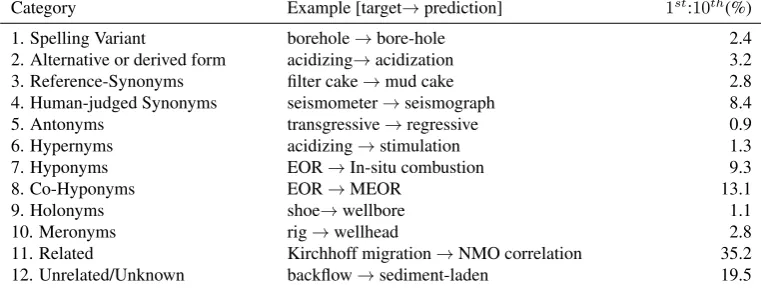
Category Example [target→prediction] 1st:10th(%)
1. Spelling Variant borehole→bore-hole 2.4
2. Alternative or derived form acidizing→acidization 3.2
3. Reference-Synonyms filter cake→mud cake 2.8
4. Human-judged Synonyms seismometer→seismograph 8.4
5. Antonyms transgressive→regressive 0.9
6. Hypernyms acidizing→stimulation 1.3
7. Hyponyms EOR→In-situ combustion 9.3
8. Co-Hyponyms EOR→MEOR 13.1
9. Holonyms shoe→wellbore 1.1
10. Meronyms rig→wellhead 2.8
11. Related Kirchhoff migration→NMO correlation 35.2
[image:5.595.90.504.68.171.2]12. Unrelated/Unknown backflow→sediment-laden 19.5
Table 8: Manual error analysis results for the 10-most-similar words
∗HolonymsThe prediction denotes a whole whose part is denoted by the target term.
∗Meronyms: The prediction is a part of the target term. Related: The prediction is semantically related to target. Unrelated/Unknown: The prediction and target terms are semantically unrelated.
Table 8 shows the result of this analysis. In general, the result of this analysis shows that the model predictions are semantically meaningful in a majority of cases and all cate-gories except theUnrelated/Unknownrepresent one type of morphosyntactic or semantic relation between terms. Less than 20% of errors are assigned to theUnrelated/Unknown category. It reveals that if we consider the count of human-judged synonymsas true positives, the actual scores for pre-cision and recall will be considerable higher than the ones that are reported in the evaluation section. Moreover, the embeddings model proposes more synonyms that are not in the reference, even though the reference is provided by manual procedure. The most frequent error type falls in the related category. The hyponym and co-hyponym lations are another frequent error type that were also re-ported in previous studies (van der Plas and Tiedemann, 2006; Leeuwenberg et al., 2016). The morphosyntactic type of relations such as Alternative forms,spelling vari-ant cover another type of errors. The error analysis fur-ther reveals several meaningful relation types such as Hy-pernyms,MeronymsandHolonymsthat are useful in many downstream applications.
6.
Embedding Enrichment Using a
Knowledge Resource
Even though the word embeddings clearly capture impor-tant semantic relations in the domain, the first experiment
shows that the domain technical vocabulary has many ele-ments which are generally disregarded by the distributional representation techniques. Since these approaches rely only on the statistics derived from textual input, they are in-capable of providing representations for words which are not seen frequently in the training process. Furthermore, they do not include the valuable information that is accom-modated in domain knowledge resources such as semantic lexicons and glossaries. In this section, we address these issues by applying the work of Faruqui et al. (2015) to ex-ploit prior domain knowledge in enhancing the embeddings model, and induce representations for OOV terms. We then go on to evaluate the impact of the refinement method over an unseen terminological resource.
6.1.
Embeddings for infrequent terms
Faruqui et al. (2015) proposed the retrofitting method as a post-processing step to apply to existing pre-trained em-beddings. The goal is to refine word vector representa-tions to capture relatedness suggested by semantic lexicons while preserving their similarity to the corresponding em-beddings. The objective of the retrofitting method is to min-imize the following:
Ψ(Q) = n
X
i=1 h
αikqi−qˆik2+
X
(i,j)∈E
βijkqi−qjk2
i
[image:5.595.105.486.205.352.2]Model Synonymy Narrower Broader Abbr. label
A R P A R P A R P A R P
[image:6.595.89.493.68.139.2]OILGAS 25.5 15.5 5.1 12.5 5.0 2.7 4.7 4.4 0.9 2.4 2.3 0.5 OILGAS.retrofitted 27.4 16.7 5.5 12.5 5.0 2.7 4.7 4.4 0.9 2.2 2.2 0.4 OILGAS.retrofitted+OOV 30.2 18.4 6.1 12.5 5.0 2.7 4.7 4.4 0.9 2.4 2.3 0.5
Table 9: Evaluation over the GeoSci knowledge resource.
efficient iterative updating method is used to solve the ob-jective function. Retrofitted embeddings Qare initialized to be equal to the observed ones Qˆ. Then by taking first derivative ofΨwith respect toqithe following online
up-date is used for 10 iterations in order to reach convergence:
qi=
P
j:(i,j)∈Eβijqj+αiqˆi
P
j:(i,j)∈Eβij+αi
(1)
The formula computes a new embedding for a termiwhich is in the pre-trained model and has relations of interest in the semantic lexicon, whereas its neighbours should be part of the pre-trained model. To provide an embedding for OOV words we extendQˆ in each iteration by adding the terms that are in semantic lexicon and connect to the terms that are inQˆvia relations of interest. Since there is no ini-tial vector for these type of words in the observed model, αis set to zero and the online update formula for the OOV terms will be as follows:
qi =
P
j:(i,j)∈Eβijqj
P
j:(i,j)∈Eβij
(2)
6.2.
Test Data
We use another domain related glossary to perform a quan-titative comparison of domain-specific word embeddings before and after the retrofitting process. We create a test query inventory using the same approach as explained in Section 3.1. using the Geoscience Vocabularies data set7,
here dubbedGeoSci. GeoSci covers the domain of geology and describes geological features, geological time, mineral occurrences, and mining-related features. It relates terms with syntactically and semantically aligned relations such as Abbreviated label, Synonym8,Broader andNarrower.
We construct a test query inventory by extracting all terms and their inter-glossary relations from the RDF files. The test set consists of1,753terms. It contains196 synonym pairs, 1,639 broader pairs, 1,584 narrower pairs and965 abbreviated label pairs. Like theslbglossary, the majority of terms are multi-word units (63%).
6.3.
Evaluation
We use the structure of the slb glossary as prior domain knowledge to enrich the OILGAS.d400 embeddings model that is evaluated as a best candidate in Section 4.. Exper-iments in Faruqui et al. (2015) showed that including all semantic relations in the retrofitting process has a better im-pact than having only one of them. We therefore consider connections of a word to its synonyms, alternative forms
7http://resource.geosciml.org/ 8
GeoSic vocabulary specifies this relation asAlternative label.
and antonyms. Moreover, similar to the origin, allαi are
set to 1 andβijto bedegree(i)−1.
The Eq.1 is used to retrofit the OILGAS.d400 model by employing the structure of the semantic lexicon (”.retrofitted”). To induce word vectors for OOV terms , we carry out the retrofitting process with Eq.2 (”.retrofitted+OOV”). Table 9 shows the performance of the model in the test dataset as well as the retrofitted mod-els with two different configurations. We observe that the retrofitting process provides improvement in the syn-onymyrelation. The improvement is highest when we con-sider the adapted version (retrofitted+OOV). Interestingly the retrofitted models have no impact in thenarrowerand broaderrelationships, this can be attributed to the fact that the employed semantic lexicons do not include these kinds of associations to lead the retrofitting process. In the abbre-viated labelrelation, there is a slightly negative effect when we apply the original retrofitting process.
7.
Extrinsic evaluation
While the intrinsic evaluations attempt to interpret the en-coding content of an embedding model in terms of lexi-cal semantic relations,extrinsicevaluation investigates the contribution of an embedding model to the performance of a specific downstream task. In this section, we investigate the influence of our domain-specific model in a domain re-lated classification task.
7.1.
Classification Data Set
The task of the exploration department in Oil and Gas in-dustry is to find exploitable deposits of hydrocarbons (oil or gas). Geoscientists in the exploration department model the subsurface geography by classifying rock layers accord-ing to multiple stratigraphic hierarchies usaccord-ing information from a wide range of different sources. The quality of the analysis depends on the availability and the ease of access to the relevant data. Previous technical studies, reports and surveys are crucial resources in this process.
We collect sentences from exploration textual documents which are then manually labeled with various geological type properties by domain experts. Example 1 shows an example sentence from the data set along with its assigned set of properties.
Example 1. Submarine fans and deltaic/estuarine facies of the San Juan Formation were deposited during the Maastrichtian regression, which gave way during the Paleocene-Eocene to black marine shales and carbonates of the Vido˜no Formation and the shelfal and pro-delta shales of the Caratas Formation.
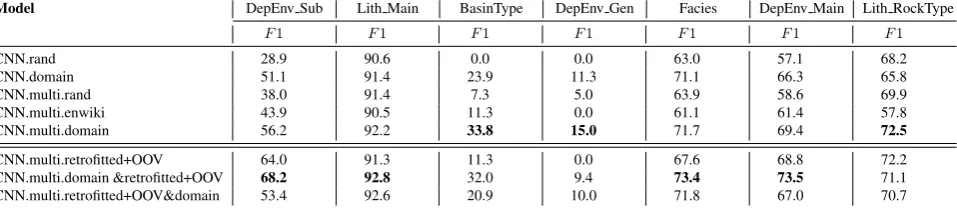
Model DepEnv Sub Lith Main BasinType DepEnv Gen Facies DepEnv Main Lith RockType
F1 F1 F1 F1 F1 F1 F1
CNN.rand 28.9 90.6 0.0 0.0 63.0 57.1 68.2
CNN.domain 51.1 91.4 23.9 11.3 71.1 66.3 65.8
CNN.multi.rand 38.0 91.4 7.3 5.0 63.9 58.6 69.9
CNN.multi.enwiki 43.9 90.5 11.3 0.0 61.1 61.4 57.8
CNN.multi.domain 56.2 92.2 33.8 15.0 71.7 69.4 72.5
CNN.multi.retrofitted+OOV 64.0 91.3 11.3 0.0 67.6 68.8 72.2
CNN.multi.domain &retrofitted+OOV 68.2 92.8 32.0 9.4 73.4 73.5 71.1
[image:7.595.59.538.69.173.2]CNN.multi.retrofitted+OOV&domain 53.4 92.6 20.9 10.0 71.8 67.0 70.7
Table 10: Results of the classification task with various configurations
Property # Sentences
Lithology Main 1,193
Lithology RockType 191
DepEnv General 38
DepEnv Main 483
DepEnv Sub 298
Facies 387
BasinType 49
Table 11: Classification data set
The resulting data set contains 1,348 sentences in which ex-perts assigned each sentence to 7 different properties. The sentences are pre-processed using the same approach as de-scribed in Section 3.2. Table 11 depicts the properties and number of sentences for each. It can be seen that the data set is unbalanced regarding to the properties and that the downstream task is a multi-label classification task.
7.2.
Multi-label Classification Model
We use a slight variant of the Convolutional Neural Net-work (CNN) architecture that is proposed by Kim (2014) for a sentence classification task. We keep the value of hyperparameters equal to the ones that are reported in the original work, however we update the dimension of the em-beddings layer according to the dimension of the domain-specific embeddings model. Furthermore, since the archi-tecture aims to assign a single label to each sentence, we update the activation function tosigmoidat the output layer, which produces a probability for each of the potential prop-erties. During training, these probabilities are used to com-pute the error, while during testing, we round each of the probabilities to 0 or 1 depending upon a set threshold (0.5).
7.3.
Extrinsic evaluation experiments
Like Kim (2014), we run experiments with several variants of the model as follows: CNN.rand: As a baseline model, where all words in the embedding layer are randomly ini-tialized and updated in the training process.CNN.domain: the embedding layer is initialized with a domain-specific model and fine-tuned for the target task.CNN.multi.rand: There are two embedding layers as a ’channel’ in the CNN architecture. Both channels are initialized randomly and only one of them is updated during training while the other remains static. CNN.multi.domain: Same as before, but the channels are initialized with domain-specific vectors. CNN.multi.enwiki:The channels consider the general do-main word vectors from section 4.3. using the English
Wikipedia data. To deal with effects of an unbalanced dataset and guarantee that each fold in 5-fold cross valida-tion will have the proporvalida-tion of same classes during train-ing and test, we apply the stratification of multi-label data proposed by Sechidis et al. (2011).
Results of the classification task with various CNN config-urations are presented in the first section of Table 10. In general, the multi-channel mode performs better than the single channel setting. The results suggest that having a sig-nificant amount of sentences per property assists the CNN model to classify better. The baseline model does not per-form well on its own. The use of the pre-trained embed-dings model helps the model in property assignment. Par-ticularly, domain-specific embeddings provide higher per-formance gain in the task-at-hand when it is used in both channels.
We also investigate the influence of the refined word embeddings model in our classification task. CNN.multi.retrofitted+OOV: We used the retrofitted domain embeddings including the OOV vectors generation for two channels. One channel is static and the other is non-static. CNN.multi.domain&retrofitted+OOV: First channel is initialized with original domain-specific embeddings with static mode and the second makes use of the retrofitted embeddings with a non-static mode. CNN.multi.retrofitted+OOV&domain: Same as previ-ous setting, but the channels swap their input. In these experiments, because of having many multi-words as OOV terms in the model, we replaced tokens in the sentences with their bi-gram and tri-gram forms if their combination occurs in the model vocabulary (e.g. ’fracture porosity’ is replaced to ’fracture porosity’ as a input unit). The experi-ment (second section of Table 10) shows that the enhanced embedding models provides better input representations for classes with a sufficient number of instances.
8.
Conclusion
9.
Bibliographical References
Baroni, M., Dinu, G., and Kruszewski, G. (2014). Don’t count, predict! a systematic comparison of context-counting vs. context-predicting semantic vectors. In Pro-ceedings of the 52nd Annual Meeting of the Association for Computational Linguistics, pages 238–247. Associa-tion for ComputaAssocia-tional Linguistics.
Bollegala, D., Maehara, T., and ichi Kawarabayashi, K. (2015). Learning word representations from relational graphs. In Proceedings of 53rd Annual Meeting of the Association for Computational Linguistics, and the 7th International Joint Conference on Natural Language Processing of the Asian Federation of Natural Language Processing, pages 730–740. Association for Computa-tional Linguistics.
Chiu, B., Crichton, G. K. O., Korhonen, A., and Pyysalo, S. (2016a). How to train good word em-beddings for biomedical NLP. In Proceedings of the 15th Workshop on Biomedical Natural Language Pro-cessing,BioNLP@ACL, pages 166–174. Association for Computational Linguistics.
Chiu, B., Korhonen, A., and Pyysalo, S. (2016b). Intrin-sic evaluation of word vectors fails to predict extrin-sic performance. In Proceedings of the 1st Workshop on Evaluating Vector-Space Representations for NLP, RepEval@ACL, pages 1–6. Association for Computa-tional Linguistics.
Collobert, R., Weston, J., Bottou, L., Karlen, M., Kavukcuoglu, K., and Kuksa, P. P. (2011). Natural lan-guage processing (almost) from scratch. Journal of Ma-chine Learning Research, 12:2493–2537.
Faruqui, M., Dodge, J., Jauhar, S. K., Dyer, C., Hovy, E. H., and Smith, N. A. (2015). Retrofitting word vec-tors to semantic lexicons. In The 2015 Conference of the North American Chapter of the Association for Com-putational Linguistics: Human Language Technologies, pages 1606–1615. Association for Computational Lin-guistics.
Gladkova, A., Drozd, A., and Matsuoka, S. (2016). Analogy-based detection of morphological and seman-tic relations with word embeddings: what works and what doesn’t. In Proceedings of the Student Research Workshop, The 2016 Conference of the North American Chapter of the Association for Computational Linguis-tics: Human Language Technologies, pages 8–15. Asso-ciation for Computational Linguistics.
Hamilton, W. L., Clark, K., Leskovec, J., and Jurafsky, D. (2016). Inducing domain-specific sentiment lexicons from unlabeled corpora. In Proceedings of the 2016 Conference on Empirical Methods in Natural Language Processing, pages 595–605. Association for Computa-tional Linguistics.
Hill, F., Reichart, R., and Korhonen, A. (2015). Simlex-999: Evaluating semantic models with (genuine) simi-larity estimation. Computational Linguistics, 41(4):665– 695.
Kim, Y. (2014). Convolutional neural networks for sen-tence classification. InProceedings of the 2014
Confer-ence on Empirical Methods in Natural Language Pro-cessing, pages 1746–1751. Association for Computa-tional Linguistics.
Leeuwenberg, A., Vela, M., Dehdari, J., and van Gen-abith, J. (2016). A minimally supervised approach for synonym extraction with word embeddings. The Prague Bulletin of Mathematical Linguistics, 105:111–142. Levy, O., Goldberg, Y., and Dagan, I. (2015). Improving
distributional similarity with lessons learned from word embeddings. Transactions of the Association for Com-putational Linguistic, 3:211–225.
Manning, C. D., Surdeanu, M., Bauer, J., Finkel, J. R., Bethard, S., and McClosky, D. (2014). The stanford corenlp natural language processing toolkit. In Proceed-ings of the 52nd Annual Meeting of the Association for Computational Linguistics, pages 55–60. Association for Computer Linguistics.
Mikolov, T., Chen, K., Corrado, G., and Dean, J. (2013a). Efficient estimation of word representations in vector space.Computing Research Repository, abs/1301.3781. Mikolov, T., Yih, W., and Zweig, G. (2013b). Linguis-tic regularities in continuous space word representations. In Human Language Technologies: Conference of the North American Chapter of the Association of Computa-tional Linguistics, pages 746–751. Association for Com-putational Linguistics.
Pilehvar, M. T. and Collier, N. (2016). Improved semantic representation for domain-specific entities. In Proceed-ings of the 15th Workshop on Biomedical Natural Lan-guage Processing, pages 12–16. Association for Com-putational Linguistics.
ˇ
Reh˚uˇrek, R. and Sojka, P. (2010). Software framework for topic modelling with large corpora. In Proceedings of LREC 2010 workshop New Challenges for NLP Frame-works, pages 46–50. European Language Resources As-sociation.
Schnabel, T., Labutov, I., Mimno, D. M., and Joachims, T. (2015). Evaluation methods for unsupervised word embeddings. In Proceedings of the 2015 Conference on Empirical Methods in Natural Language Processing, pages 298–307. Association for Computational Linguis-tics.
Sechidis, K., Tsoumakas, G., and Vlahavas, I. (2011). On the stratification of multi-label data. In Proceedings of the 2011 European Conference on Machine Learning and Knowledge Discovery in Databases, pages 145–158. Springer.
van der Plas, L. and Tiedemann, J. (2006). Finding syn-onyms using automatic word alignment and measures of distributional similarity. In 21st International Con-ference on Computational Linguistics and 44th Annual Meeting of the Association for Computational Linguis-tics, pages 866–873. Association for Computational Lin-guistics.