Learning to Model Domain-Specific Utterance Sequences for Extractive
Summarization of Contact Center Dialogues
Ryuichiro Higashinaka†, Yasuhiro Minami‡, Hitoshi Nishikawa†,
Kohji Dohsaka‡,Toyomi Meguro‡,Satoshi Takahashi†,Genichiro Kikui†
†NTT Cyber Space Laboratories, NTT Corporation
‡NTT Communication Science Laboratories, NTT Corporation
[email protected], [email protected]
[email protected], {dohsaka,meguro}@cslab.kecl.ntt.co.jp
{takahashi.satoshi,kikui.genichiro}@lab.ntt.co.jp
Abstract
This paper proposes a novel extractive summarization method for contact cen-ter dialogues. We use a particular type of hidden Markov model (HMM) called Class Speaker HMM (CSHMM), which processes operator/caller utterance sequences of multiple domains simulta-neously to model domain-specific utter-ance sequences and common (domain-wide) sequences at the same time. We applied the CSHMM to call summariza-tion of transcripts in six different con-tact center domains and found that our method significantly outperforms compet-itive baselines based on the maximum coverage of important words using integer linear programming.
1 Introduction
In modern business, contact centers are becom-ing more and more important for improvbecom-ing cus-tomer satisfaction. Such contact centers typically have quality analysts who mine calls to gain in-sight into how to improve business productivity (Takeuchi et al., 2007; Subramaniam et al., 2009). To enable them to handle the massive number of calls, automatic summarization has been utilized and shown to successfully reduce costs (Byrd et al., 2008). However, one of the problems in cur-rent call summarization is that a domain ontology is required for understanding operator/caller utter-ances, which makes it difficult to port one summa-rization system from domain to domain.
This paper describes a novel automatic sum-marization method for contact center dialogues without the costly process of creating domain
on-tologies. More specifically, given contact center dialogues categorized into multiple domains, we create a particular type of hidden Markov model (HMM) calledClass Speaker HMM(CSHMM) to model operator/caller utterance sequences. The CSHMM learns to distinguish sequences of indi-vidual domains and common sequences in all do-mains at the same time. This approach makes it possible to accurately distinguish utterances spe-cific to a certain domain and thereby has the po-tential to generate accurate extractive summaries.
In Section 2, we review recent work on auto-matic summarization, including its application to contact center dialogues. In Section 3, we de-scribe the CSHMM. In Section 4, we dede-scribe our automatic summarization method in detail. In Section 5, we describe the experiment we per-formed to verify our method and present the re-sults. In Section 6, we summarize and mention future work.
2 Related Work
In the past few decades, contact center dia-logues have been an active research focus (Gorin et al., 1997; Chu-Carroll and Carpenter, 1999). Initially, the primary aim of such research was to transfer calls from answering agents to oper-ators as quickly as possible in the case of prob-lematic situations. However, real-time processing of calls requires a tremendous engineering effort, especially when customer satisfaction is at stake, which led to recent work on the offline process-ing of calls, such as call minprocess-ing (Takeuchi et al., 2007) and call summarization (Byrd et al., 2008). The work most related to ours is (Byrd et al., 2008), which maps operator/caller utterances to an ontology in the automotive domain by using support vector machines (SVMs) and creates a structured summary by heuristic rules that assign the mapped utterances to appropriate summary sections. Our work shares the same motivation as theirs in that we want to make it easier for quality analysts to analyze the massive number of calls. However, we tackle the problem differently in that we propose a new modeling of utterance se-quences for extractive summarization that makes it unnecessary to create heuristics rules by hand and facilitates the porting of a summarization sys-tem.
HMMs have been successfully applied to au-tomatic summarization (Barzilay and Lee, 2004). In their work, an HMM was used to model the transition of content topics. The Viterbi decod-ing (Rabiner, 1990) was performed to find con-tent topics that should be incorporated into a sum-mary. Their approach is similar to ours in that HMMs are utilized to model topic sequences, but they did not use data of multiple domains in creat-ing their model. In addition, their method requires training data (original articles with their reference summaries) in order to find which content top-ics should be included in a summary, whereas our method requires only the raw sequences with their domain labels.
3 Class Speaker HMM
A Class Speaker HMM (CSHMM) is an exten-sion of Speaker HMM (SHMM), which has been utilized to model two-party conversations (Me-guro et al., 2009). In an SHMM, there are two states, and each state emits utterances of one of the two conversational participants. The states are
1:speaker1 2:speaker2 Speaker HMM for Class 1
3:speaker1 4:speaker2 Speaker HMM for Class 2
Figure 1: Topology of an ergodic CSHMM. Num-bers before ‘speaker1’ and ‘speaker2’ denote state IDs.
connected ergodically and the emission/transition probabilities are learned from training data by using the EM-algorithm. Although Meguro et al., (2009) used SHMMs to analyze the flow of listening-oriented dialogue, we extend their idea to make it applicable to classification tasks, such as dialogue segmentation.
A CSHMM is simply a concatenation of SHMMs, each of which is trained by using ut-terance sequences of a particular dialogue class. After such SHMMs are concatenated, the Viterbi algorithm is used to decode an input utterance sequence into class labels by estimating from which class each utterance has most likely to have been generated. Figure 1 illustrates the basic topology of a CSHMM where two SHMMs are concatenated ergodically. When the most likely state sequence for an input utterance sequence is
<1,3,4,2>, we can convert these state IDs into
their corresponding classes; that is, <1,2,2,1>,
which becomes the result of utterance classifica-tion.
We have conceived three variations of CSHMM as we describe below. They differ in how we treat utterance sequences that appear commonly in all classes and how we train the transition probabili-ties between independently trained SHMMs.
3.1 Ergodic CSHMM
The most basic CSHMM is the ergodic CSHMM, which is a simple concatenation of SHMMs in an ergodic manner as shown in Fig. 1. For K
classes,K SHMMs are combined with the initial
and transition probabilities all set toequal. In this CSHMM, the assignment of class labels solely de-pends on the output distributions of each class.
3.2 Ergodic CSHMM with Common States
There-3:speaker1 4:speaker2 1:speaker1 2:speaker2
5:speaker1 6:speaker2 Speaker HMM for Class 1
Speaker HMM for Class 2
Speaker HMM for All Classes (Class 0)
Figure 2: CSHMM with common states.
Copy
Mconcat If the fitting has
converged for all Mk+0
Split Mconcatinto pairs again and retrain Mk+0 of M0are redistributed between M0and Mk
Figure 3: Three steps to create a CSHMM using concatenated training.
fore, for K classes, this CSHMM has K + 1
SHMMs. Figure 2 shows the model topology. This newly added SHMM works in a manner sim-ilar to the background model (Reynolds et al., 2000) representing sequences that are common to all classes. By having these common states, common utterance sequences can be classified as ‘common’, making it possible to avoid forcefully classifying common utterance sequences into one of the given classes.
Detecting common sequences is especially helpful when several classes overlap in nature. For example, most dialogues commonly start and end with greetings, and many calls at contact centers commonly contain exchanges in which the opera-tor requests personal information about the caller for confirmation. Regarding the model topology in Fig. 2, if the most likely state sequence by the Viterbi decoding is <1,4,5,6,3,2>, we obtain
a class label sequence <1,2,0,0,2,1> where the
third and fourth utterances are classified as ‘zero’, meaning that they do not belong to any class.
3.3 CSHMM using Concatenated Training
The CSHMMs presented so far have two prob-lems: one is that the order of utterances of differ-ent classes cannot be taken into account because of the equal transition probabilities. As a result, the very merit of HMMs, their ability to model time series data, is lost. The other is that the out-put distributions of common states may be overly broad because they are the averaged distributions over all classes; that is, the best path determined by the Viterbi decoding may not go through the common states at all.
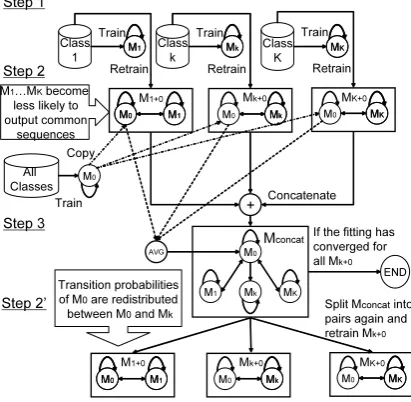
Our solution to these problems is to apply con-catenated training (Lee, 1989), which has been successfully used in speech recognition to model phoneme sequences in an unsupervised manner. The procedure for concatenated training is illus-trated in Fig. 3 and has three steps.
step 1 LetMk (Mk ∈ M,1 ≤ k ≤ K) be the
SHMM trained using dialogues Dk where
Dk = {∀dj|c(dj) = k}, and M0 be the
SHMM trained using all dialogues; i.e., D.
Here, K means the total number of classes andc(dj)the class assigned to a dialoguedj.
step 2 Connect each Mk ∈ M with a copy of
M0 using equal initial and transition
proba-bilities (we call this connected modelMk+0)
and retrain Mk+0 with ∀dj ∈ Dk where
c(dj) =k.
step 3 Merge all modelsMk+0 (1 ≤k ≤K) to
produce one concatenated HMM (Mconcat). Here, the output probabilities of the copies ofM0 are averaged overKwhen all models
are merged to create a combined model. If the fitting of allMk+0models has converged
against the training data, exit this procedure; otherwise, go to step 2 by connecting a copy of M0 and Mk for allk. Here, the transi-tion probabilities fromM0 toMl(l=k)are summed and equally distributed between the copiedM0’s self-loop and transitions to the
states inMk.
Contact Center Dialogues
Domain 1
Domain K
…
HMM for Domain 1 HMM for Domain K
HMM for All Domains
Model topic label sequences INPUT: A dialogue in Domain k
Topic Model
Topic label sequence
LSA/LDA
Assign to pic
labels
Domain label sequence OUTPUT: summary Viterbi decoding
Assign topic labels
Select utterances labeled with Domain k Class Speaker HMM …..
Utterance sequence
Feature sequence
Extract content words as utterance features
Figure 4: Overview of our summarization method.
Mk, meaning that the output probabilities of utter-ance sequences that are common and also found inMkcan be moved fromMktoM0. This makes
the distribution ofMksharp (not broad/uniform), making it likely to output only the utterances rep-resentative of a classk. As regardsM0, its
distri-bution of output probabilities can also be sharp-ened for utterances that occur commonly in all classes. This sharpening of distributions is likely to be helpful for class discrimination.
4 Summarization Method
We apply CSHMMs to extractive summarization of contact center dialogues because such dia-logues are two-party, can be categorized into mul-tiple classes by their call domains (e.g., inquiry types), and are likely contain many overlapping exchanges between an operator and a caller across domains, such as greetings, the confirmation of personal information, and other cliches in busi-ness (e.g., name exchanges, thanking/apologizing phrases, etc.), making them the ideal target for CSHMMs.
In our method, summarization is performed by decoding a sequence of utterances of a domain
DMk into domain labels and selecting those
ut-terances that have domain labels DMk. This
makes it possible to extract utterances that are characteristic of DMk in relation to other
do-mains. Our assumption is that extracting charac-teristic sequences of a given domain provides a good summary for that domain because such se-quences should contain important information ne-cessitated by the domain.
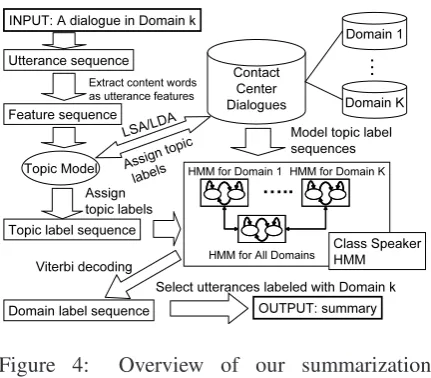
Figure 4 outlines our extractive summarization process. The process consists of a training phase and a decoding phase as described below.
Training phase: LetD(d1. . . dN) be the entire set of contact center dialogues, DMk (DMk ∈
DM,1 ≤ k ≤ K) the domain assigned to
do-main k, and Udi,1. . . Udi,H the utterances indi.
Here,H is the number of utterances indi. From
D, we create two models: a topic model (T M)
and a CSHMM.
The topic model is used to assign a single topic to each utterance so as to facilitate the training of the CSHMM by reducing the dimensions of the feature space. The same approach has been taken in (Barzilay and Lee, 2004). The topic model can be created by such techniques as prob-abilistic latent semantic analysis (PLSA) (ˇSingliar and Hauskrecht, 2006) and latent Dirichlet allo-cation (LDA) (Tam and Schultz, 2005). PLSA models the latent topics of the documents and its Baysian extension is LDA, which also models the co-occurrence of topics using the Dirichlet prior. We first derive features Fd1. . . FdN for the
dia-logues. Here, we assume a bag-of-words repre-sentation for the features; therefore,Fdi is
repre-sented as{< w1, c1 > . . . < wV, cV >}, where
V means the total number of content words in the
vocabulary and< wi, ci >denotes that a content wordwiappearsci times in a dialogue. Note that we derive the features for dialogues, not for utter-ances, because utterances in dialogue can be very short, often consisting of only one or two words and thus making it hard to calculate the word co-occurrence required for creating a topic model. From the features, we build a topic model that in-cludesP(z|w), wherewis a word andzis a topic.
Using the topic model, we can assign a single topic label to every utterance inD by finding its
likely topic; i.e.,argmax
z
w∈words(Udi)P(z|w).
After labeling all utterances inDwith topic
la-bels, we train a CSHMM that learns characteristic topic label sequences in each domain as well as common topic label sequences across domains.
Decoding phase: Let dj be the input dialogue,
DM(dj)(∈DM) the table for obtaining the do-main label of dj, andUdj,1. . . Udj,Hdj the
utter-ances indj, whereHdj is the number of the
Domain # Tasks Sentences Characters
FIN 15 8.93 289.93
ISP 15 7.20 259.53
LGU 20 9.85 328.55
MO 15 10.07 326.20
PC 15 9.40 354.07
TEL 18 8.44 322.22
ALL 98 9.01 314.46
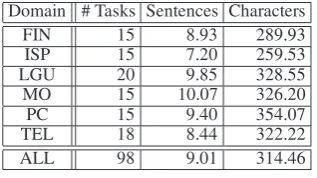
Table 1: Scenario statistics: the number of tasks and averaged number of sentences/characters in a task scenario in the six domains.
labels Tdj,1. . . Tdj,Hdj and convert them into
do-main label sequences DMdj,1. . . DMdj,Hdj
us-ing the trained CSHMM by the Viterbi decodus-ing. Then, we selectUdj,h (1≤h ≤Hdj) whose
cor-responding domain labelDMdj,hequalsDM(dj)
and output the selected utterances in the order of appearance in the original dialogue as a summary.
5 Experiment
We performed an experiment to verify our sum-marization method. We first collected simulated contact center dialogues using human subjects. Then, we compared our method with baseline sys-tems. Finally, we analyzed the created summaries to investigate what had been learned by our CSH-MMs.
5.1 Dialogue Data
Since we do not have access to actual contact cen-ter data, we recruited human subjects to collect simulated contact center dialogues. A total of 90 participants (49 males and 41 females) took the roles of operator or a caller and talked over tele-phones in separate rooms. The callers were given realistic scenarios that included their motivation for a call as well as detailed instructions about what to ask. The operators, who had experience of working at contact centers, were given manuals containing the knowledge of the domain and ex-plaining how to answer questions in specific sce-narios.
The dialogues took place in six different do-mains: Finance (FIN), Internet Service Provider (ISP), Local Government Unit (LGU), Mail Or-der (MO), PC support (PC), and Telecommuni-cation (TEL). In each domain, there were 15–20 tasks. Table 1 shows the statistics of the task sce-narios used by the callers. We cannot describe the details of each domain for lack of space, but
ex-MO task No. 3: It is becoming a good season for the Japanese Nabe (pan) cuisine. You own a Nabe restau-rant and it is going well. When you were searching on the Internet, thinking of creating a new dish, you saw that drop-shipped Shimonoseki puffer fish was on sale. Since you thought the puffer fish cuisine would become hot in the coming season, you decided to order it as a trial. . . . You ordered a puffer fish set on the Internet, but you have not received the confirmation email that you were supposed to receive. . . . You decided to call the contact center to make an inquiry, ask them whether the order has been successful, and request them to send you the confirmation email.
Figure 5: Task scenario in the MO domain. The scenario was originally in Japanese and was trans-lated by the authors.
amples of the tasks for FIN are inquiries about in-surance, notifications of the loss of credit cards, and applications for finance loans, and those for ISP are inquiries about fees for Internet access, re-quests to forward emails, and reissuance of pass-words. Figure 5 shows one of the task scenarios in the MO domain.
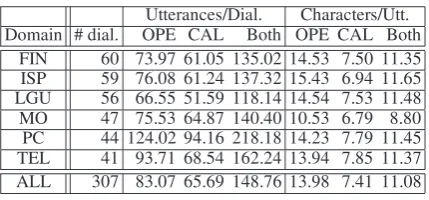
We collected data on two separate occasions us-ing identical scenarios but different participants, which gave us two sets of dialogue data. We used the former for training our summarization sys-tem and the latter for testing. We only use the transcriptions in this paper so as to avoid partic-ular problems of speech. All dialogues were in Japanese. Tables 2 and 3 show the statistics of the training data and the test data, respectively. As can be seen from the tables, each dialogue is quite long, which attests to the complexity of the tasks.
5.2 Training our Summarization System
For training our system, we first created a topic model using LDA. We performed a morphological analysis using ChaSen1 to extract content words from each dialogue and made its bag-of-words features. We defined content words as nouns, verbs, adjectives, unknown words, and interjec-tions (e.g., “yes”, “no”, “thank you”, and “sorry”). We included interjections because they occur very frequently in dialogues and often possess impor-tant content, such as agreement and refusal, in transactional communication. We use this defini-tion of content words throughout the paper.
Then, using an LDA software package2, we built a topic model. We tentatively set the number
Utterances/Dial. Characters/Utt. Domain # dial. OPE CAL Both OPE CAL Both
FIN 59 75.73 72.69 148.42 17.44 7.54 12.59 ISP 64 55.09 53.17 108.27 20.11 8.03 14.18 LGU 76 58.28 50.55 108.83 12.83 8.55 10.84 MO 70 66.39 58.74 125.13 15.09 7.43 11.49 PC 56 89.34 77.80 167.14 15.48 6.53 11.31 TEL 66 75.58 63.97 139.55 12.74 8.24 10.67 ALL 391 69.21 61.96 131.17 15.40 7.69 11.76
Table 2: Training data statistics: Averaged num-ber of utterances per dialogue and characters per utterance for each domain. OPE and CAL denote operator and caller, respectively. See Section 5.1 for the full domain names.
Utterances/Dial. Characters/Utt. Domain # dial. OPE CAL Both OPE CAL Both
FIN 60 73.97 61.05 135.02 14.53 7.50 11.35 ISP 59 76.08 61.24 137.32 15.43 6.94 11.65 LGU 56 66.55 51.59 118.14 14.54 7.53 11.48 MO 47 75.53 64.87 140.40 10.53 6.79 8.80 PC 44 124.02 94.16 218.18 14.23 7.79 11.45 TEL 41 93.71 68.54 162.24 13.94 7.85 11.37 ALL 307 83.07 65.69 148.76 13.98 7.41 11.08
Table 3: Test data statistics.
of topics to 100. Using this topic model, we la-beled all utterances in the training data using these 100 topic labels.
We trained seven different CSHMMs in all: one ergodic CSHMM (ergodic0), three variants of er-godic CSHMMs with common states (ergodic1,
ergodic2, ergodic3), and three variants of
CSH-MMs with concatenated training (concat1, con-cat2,concat3). The difference within the variants is in the number of common states. The numbers 0–3 after ‘ergodic’ and ‘concat’ indicate the num-ber of SHMMs containing common states. For example, ergodic3 has nine SHMMs (six SHMMs for the six domains plus three SHMMs contain-ing common states). Since more states would enable more minute modeling of sequences, we made such variants in the hope that common se-quences could be more accurately modeled. We also wanted to examine the possibility of creat-ing sharp output distributions in common states without the concatenated training by such minute modeling. These seven CSHMMs make seven dif-ferent summarization systems.
5.3 Baselines
Baseline-1: BL-TF We prepared two baseline
systems for comparison. One is a simple
sum-marizer based on the maximum coverage of high term frequency (TF) content words. We call this baseline BL-TF. This baseline summarizes a dialogue by maximizing the following objective function:
max
zi∈Z
weight(wi)·zi
where ‘weight’ returns the importance of a con-tent word wi andzi is a binary value indicating whether to include wi in the summary. Here, ‘weight’ returns the count of wi in a given dia-logue. The maximization is done using ILP (we used an off-the-shelf solverlp solve3) with the following three constraints:
xi, zi∈ {0,1}
xi∈X
lixi≤K
i
mijxi ≥zj (∀zj ∈Z)
wherexi is a binary value that indicates whether to include thei-th utterance in the summary,liis the length of thei-th utterance,Kis the maximum
number of characters to include in a summary, and
mij is a binary value that indicates whetherwiis included in thej-th utterance. The last constraint
means that if a certain utterance is included in the summary, all words in that utterance have to be included in the summary.
Baseline-2: BL-DD Although BL-TF should be
a very competitive baseline because it uses the state-of-the-art formulation as noted in (Gillick and Favre, 2009), having only this baseline is rather unfair because it does not make use of the training data, whereas our proposed method uses them. Therefore, we made another baseline that learns domain-specific dictionaries (DDs) from the training data and incorporates them into the weights of content words of the objective function of BL-TF. We call this baseline BL-DD. In this baseline, the weight of a content wordwiin a do-mainDMkis
weight(wi,DMk) = log(P(wi|DM
k))
log(P(wi|DM\DMk))
Metric ergodic0 ergodic1 ergodic2 ergodic3 concat1 concat2 concat3
PROPOSED
F 0.177 0.177 0.177 0.177 0.187∗e0e1
e2e3 0.198∗e+2ee30ce11 0.199∗ +e0e1
e2e3c1
precision 0.145 0.145 0.145 0.145 0.161∗ 0.191∗+ 0.195∗+
recall 0.294 0.294 0.294 0.294 0.280∗ 0.259∗+ 0.259∗+
(Same-length) BL-TF
F 0.171 0.171 0.171 0.171 0.168 0.164 0.163 precision 0.132 0.132 0.132 0.132 0.135 0.140 0.140 recall 0.294 0.294 0.294 0.294 0.270 0.241 0.240
(Same-length) BL-DD
F 0.189 0.189 0.189 0.189 0.189 0.187 0.187 precision 0.155 0.155 0.155 0.155 0.162 0.170 0.172 recall 0.287 0.287 0.287 0.287 0.273 0.250 0.248 Compression Rate 0.42 0.42 0.42 0.42 0.37 0.30 0.30
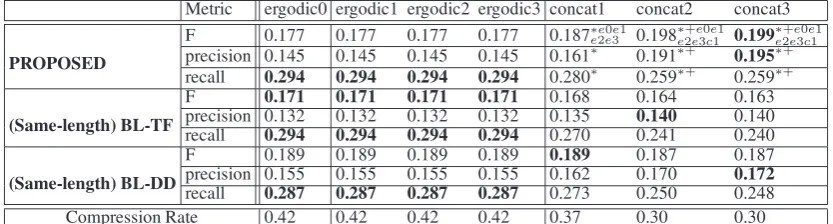
Table 4: F-measure, precision, and recall averaged over all 307 dialogues (cf. Table 3) in the test set for the proposed methods and baselines BL-TF and BL-DD configured to output the same-length summaries as the proposed systems. The averaged compression rate for each proposed system is shown at the bottom. The columns (ergodic0–concat3) indicate our methods as well as the character lengths used by the baselines. Asterisks, ‘+’, e0–e3, and c1–c3 indicate our systems’ statistical significance by the Wilcoxon signed-rank test (p<0.01) over BL-TF, BL-DD, ergodic0–3, and concat1–3, respectively.
Statistical tests for the precision and recall were only performed between the proposed systems and their same-length baseline counterparts.Bold fontindicates the best score in each row.
whereP(wi|DMk)denotes the occurrence prob-ability of wi in the dialogues of DMk, and
P(wi|DM\DMk) the occurrence probability of
wiin all domains except forDMk. This log like-lihood ratio estimates how much a word is char-acteristic of a given domain. Incorporating such weights would make a very competitive baseline.
5.4 Evaluation Procedure
We made our seven proposed systems and two baselines (BL-TF and BL-DD) output extractive summaries for the test data. Since one of the shortcomings of our proposed method is its inabil-ity to set the compression rate, we made our sys-tems output summaries first and made the baseline systems output their summaries within the charac-ter lengths of our systems’ summaries.
We used scenario texts (See Fig. 5) as reference data; that is, a dialogue dealing with a certain task is evaluated using the scenario text for that task. As an evaluation criterion, we used the F-measure (F1) to evaluate the retrieval accuracy on the ba-sis of the recall and precision of retrieved content words. We used the scenarios as references be-cause they contain the basic content exchanged between an operator and a caller, the retrieval ac-curacy of which should be important for quality analysts.
We could have used ROUGE (Lin and Hovy, 2003), but we did not because ROUGE does not correlate well with human judgments in
conversa-tional data (Liu and Liu, 2008). Another benefit of using the F-measure is that summaries of varying lengths can be compared.
5.5 Results
Table 4 shows the evaluation results for the pro-posed systems and the baselines. It can be seen that concat3 shows the best performance in F-measure among all systems, having a statistically better performance over all systems except for concat2. The CSHMMs with concatenated train-ing were all better than ergodic0–3. Here, the per-formance (and output) of ergodic0–3 was exactly the same. This happened because of the broad dis-tributions in their common states; no paths went through the common states and all paths went through the SHMMs of the six domains instead.
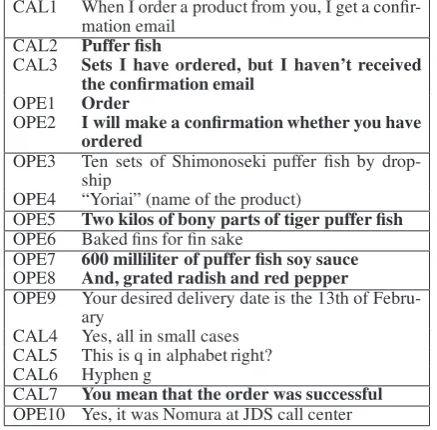
(cal-CAL1 When I order a product from you, I get a confir-mation email
CAL2 Puffer fish
CAL3 Sets I have ordered, but I haven’t received the confirmation email
OPE1 Order
OPE2 I will make a confirmation whether you have ordered
OPE3 Ten sets of Shimonoseki puffer fish by drop-ship
OPE4 “Yoriai” (name of the product)
OPE5 Two kilos of bony parts of tiger puffer fish OPE6 Baked fins for fin sake
OPE7 600 milliliter of puffer fish soy sauce OPE8 And, grated radish and red pepper
OPE9 Your desired delivery date is the 13th of Febru-ary
CAL4 Yes, all in small cases CAL5 This is q in alphabet right? CAL6 Hyphen g
CAL7 You mean that the order was successful OPE10 Yes, it was Nomura at JDS call center
Figure 6: Example output of concat3 for MO task No. 3 (cf Fig. 5). The utterances were translated by the authors. The compression rate for this dia-logue was 0.24.
culated by using summaries with no compres-sion). This means that the maximum F-measure we could attain is lower than 0.524 (when the pre-cision is ideal with 1). This is because of the dif-ferences between the scenarios and the actual di-alogues. We want to pursue ways to improve our evaluation methodology in the future.
Despite such issues in evaluation, from the re-sults, we conclude that our extractive summa-rization method is effective and that having the common states and training CSHMMs with con-catenated training are useful in modeling domain-specific sequences of contact center dialogues.
5.6 Example of System Output
Figure 6 shows an example output of concat3 for the scenario MO task No. 3 (cf. Fig. 5). Bold font
indicates utterances that were NOT included in the summary of concat3’s same-length-BF-DD coun-terpart. It is clear that sequences related to the MO domain were successfully extracted. When we look at the summary of BF-DD, we see such utterances as “Can I have your address from the postcode” and “Finally, can I have your email ad-dress”, which are obvious cliches in contact center dialogues. This indicates the usefulness of com-mon states for ignoring such comcom-mon exchanges.
6 Summary and Future Work
This paper proposed a novel extractive sum-marization method for contact center dialogues. We devised a particular type of HMM called CSHMM, which processes operator/caller utter-ance sequences of multiple domains simulta-neously to model domain-specific utterance se-quences and common sese-quences at the same time. We trained a CSHMM using the transcripts of simulated contact center dialogues and verified its effectiveness for the summarization of calls.
There still remain several limitations in our ap-proach. One is its inability to change the com-pression rate, which we aim to solve in the next step using the forward-backward algorithm (Ra-biner and Juang, 1986). This algorithm can cal-culate the posterior probability of each state at each time frame given an input dialogue sequence, enabling us to extract top-N domain-specific se-quences. We also need to find the appropriate topic number for the topic model. In our imple-mentation, we used a tentative value of 100, which may not be appropriate. In addition, we believe the topic model and the CSHMM can be unified because these models are fundamentally similar, especially when LDA is employed. Model topolo-gies may also have to be reconsidered. In our CSHMM with concatenated training, the states in domain-specific SHMMs are only connected to the common states, which may be inappropriate because there could be a case where a domain changes from one to another without having a common sequence. Applying CSHMMs to speech and other NLP tasks is another challenge. As a near-term goal, we aim to apply our method to the summarization of meetings, where we will need to extend our CSHMMs to deal with more than two participants. Finally, we also want to build a con-tact center dialogue agent by extending the CSH-MMs to partially observable Markov decision pro-cesses (POMDPs) (Williams and Young, 2007) by following the recent work on building POMDPs from dialogue data in the dynamic Bayesian net-work (DBN) framenet-work (Minami et al., 2009).
Acknowledgments
References
Barzilay, Regina and Lillian Lee. 2004. Catching the drift: Probabilistic content models, with applications to gener-ation and summarizgener-ation. InProceedings of the Human Language Technology Conference of the North American Chapter of the Association for Computational Linguistics (HLT-NAACL), pages 113–120.
Byrd, Roy J., Mary S. Neff, Wilfried Teiken, Youngja Park, Keh-Shin F. Cheng, Stephen C. Gates, and Karthik Visweswariah. 2008. Semi-automated logging of contact center telephone calls. InProceeding of the 17th ACM conference on Information and knowledge management (CIKM), pages 133–142.
Chu-Carroll, Jennifer and Bob Carpenter. 1999. Vector-based natural language call routing. Computational Lin-guistics, 25(3):361–388.
Gillick, Dan and Benoit Favre. 2009. A scalable global model for summarization. InProceedings of the Work-shop on Integer Linear Programming for Natural Lan-guage Processing, pages 10–18.
Gorin, Allen L., Giuseppe Riccardi, and Jerry H. Wright. 1997. How may I help you? Speech Communication, 23(1-2):113–127.
Hori, Chiori and Sadaoki Furui. 2003. A new approach to automatic speech summarization. IEEE Transactions on Multimedia, 5(3):368–378.
Kupiec, Julian, Jan Pedersen, and Francine Chen. 1995. A trainable document summarizer. InProceedings of the 18th annual international ACM SIGIR conference on Re-search and development in information retrieval (SIGIR), pages 68–73.
Lee, Kai-Fu. 1989. Automatic speech recognition: the de-velopment of the SPHINX system. Kluwer Academic Pub-lishers.
Lin, Chin-Yew and Eduard Hovy. 2003. Automatic evalua-tion of summaries using n-gram co-occurrence statistics. InProceedings of the 2003 Conference of the North Amer-ican Chapter of the Association for Computational Lin-guistics on Human Language Technology (NAACL-HLT), pages 71–78.
Liu, Feifan and Yang Liu. 2008. Correlation between ROUGE and human evaluation of extractive meeting sum-maries. InProceedings of the 46th Annual Meeting of the Association for Computational Linguistics on Human Language Technologies (HLT), pages 201–204.
Mani, Inderjeet. 2001. Automatic summarization. John Benjamins Publishing Company.
Meguro, Toyomi, Ryuichiro Higashinaka, Kohji Dohsaka, Yasuhiro Minami, and Hideki Isozaki. 2009. Analysis of listening-oriented dialogue for building listening agents. InProceedings of the SIGDIAL 2009 conference, pages 124–127.
Minami, Yasuhiro, Akira Mori, Toyomi Meguro, Ryuichiro Higashinaka, Kohji Dohsaka, and Eisaku Maeda. 2009. Dialogue control algorithm for ambient intelligence based on partially observable Markov decision processes. In Proceedings of the 1st international workshop on spoken dialogue systems technology (IWSDS), pages 254–263.
Murray, Gabriel, Steve Renals, and Jean Carletta. 2005. Ex-tractive summarization of meeting recordings. In Pro-ceedings of the 9th European Conference on Speech Communication and Technology (EUROSPEECH), pages 593–596.
Osborne, Miles. 2002. Using maximum entropy for sen-tence extraction. InProceedings of the ACL-02 Workshop on Automatic Summarization, pages 1–8.
Rabiner, Lawrence R. and Biing-Hwang Juang. 1986. An introduction to hidden Markov models.IEEE ASSP Mag-azine, 3(1):4–16.
Rabiner, Lawrence R. 1990. A tutorial on hidden Markov models and selected applications in speech recognition. Readings in speech recognition, 53(3):267–296.
Radev, Dragomir R., Hongyan Jing, Małgorzata Sty´s, and Daniel Tam. 2004. Centroid-based summarization of multiple documents.Information Processing & Manage-ment, 40(6):919–938.
Reynolds, Douglas A., Thomas F. Quatieri, and Robert B. Dunn. 2000. Speaker verification using adapted Gaussian mixture models. Digital Signal Processing, 10(1-3):19 – 41.
Subramaniam, L. Venkata, Tanveer A. Faruquie, Shajith Ik-bal, Shantanu Godbole, and Mukesh K. Mohania. 2009. Business intelligence from voice of customer. In Pro-ceedings of the 2009 IEEE International Conference on Data Engineering (ICDE), pages 1391–1402.
Takeuchi, Hironori, L Venkata Subramaniam, Tetsuya Na-sukawa, Shourya Roy, and Sreeram Balakrishnan. 2007. A conversation-mining system for gathering insights to improve agent productivity. InProceedings of the IEEE International Conference on E-Commerce Technology and the IEEE International Conference on Enterprise Computing, E-Commerce, and E-Services, pages 465– 468.
Tam, Yik-Cheung and Tanja Schultz. 2005. Dynamic language model adaptation using variational Bayes in-ference. In Proceedings of the 9th European Confer-ence on Speech Communication and Technology (EU-ROSPEECH), pages 5–8.
ˇSingliar, Tomas and Milos Hauskrecht. 2006. Noisy-OR component analysis and its application to link analy-sis.The Journal of Machine Learning Research, 7:2189– 2213.