A Supervised Algorithm for Verb Disambiguation into VerbNet Classes
Omri Abend1 Roi Reichart2 Ari Rappoport1 1Institute of Computer Science ,2ICNC
Hebrew University of Jerusalem {omria01|roiri|arir}@cs.huji.ac.il
Abstract
VerbNet (VN) is a major large-scale En-glish verb lexicon. Mapping verb instances to their VN classes has been proven use-ful for several NLP tasks. However, verbs are polysemous with respect to their VN classes. We introduce a novel supervised learning model for mapping verb instances to VN classes, using rich syntactic features and class membership constraints. We evaluate the algorithm in both in-domain and corpus adaptation scenarios. In both cases, we use the manually tagged Sem-link WSJ corpus as training data. For in-domain (testing on Semlink WSJ data), we achieve 95.9% accuracy, 35.1% error re-duction (ER) over a strong baseline. For adaptation, we test on the GENIA corpus and achieve 72.4% accuracy with 10.7% ER. This is the first large-scale experimen-tation with automatic algorithms for this task.
1 Introduction
The organization of verbs into classes whose mem-bers exhibit similar syntactic and semantic behav-ior has been discussed extensively in the linguistics literature (see e.g. (Levin and Rappaport Hovav, 2005; Levin, 1993)). Such an organization helps in avoiding lexicon representation redundancy and enables generalizations across similar verbs. It can also be of great practical use, e.g. in com-pensating NLP statistical models for data sparse-ness. Indeed, Levin’s seminal work had motivated
c
2008. Licensed under the Creative Commons
Attribution-Noncommercial-Share Alike 3.0 Unported
li-cense (http://creativecommons.org/licenses/by-nc-sa/3.0/). Some rights reserved.
much research aimed at automatic discovery of verb classes (see Section 2).
VerbNet (VN) (Kipper et al., 2000; Kipper-Schuler, 2005) is a large scale, publicly available domain independent verb lexicon that builds on Levin classes and extends them with new verbs, new classes, and additional information such as semantic roles and selectional restrictions. VN classes were proven beneficial for Semantic Role Labeling (SRL) (Swier and Stevenson, 2005), Se-mantic Parsing (Shi and Mihalcea, 2005) and building conceptual graphs (Hensman and Dun-nion, 2004). Levin-inspired classes have been used in several NLP tasks, such as Machine Trans-lation (Dorr, 1997) and Document Classification (Klavans and Kan, 1998).
Many applications that use VN need to map verb instances onto their VN classes. However, verbs are polysemous with respect to VN classes. Sem-link (Loper et al., 2007) is a dataset that maps each verb instance in the WSJ Penn Treebank to its VN class. The mapping has been created using a com-bination of automatic and manual methods. Yi et al. (2007) have used Semlink to improve SRL.
In this paper we present the first large-scale ex-perimentation with a supervised machine learning classification algorithm for disambiguating verb instances to their VN classes. We use rich syntactic features extracted from a treebank-style parse tree, and utilize a learning algorithm capable of impos-ing class membership constraints, thus takimpos-ing ad-vantage of the nature of our task. We use Semlink as the training set.
We evaluate our algorithm in both in-domain and corpus adaptation scenarios. In the former, we test on the WSJ (using Semlink again), ob-taining 95.9% accuracy with 35.1% error reduc-tion (ER) over a strong baseline (most frequent
class) when using a modern statistical parser. In the corpus adaptation scenario, we disambiguate verbs in sentences taken from outside the train-ing domain. Since the manual annotation of new corpora is costly, and since VN is designed to be a domain independent resource, adaptation results are important to the usability in NLP in practice. We manually annotated 400 sentences from GE-NIA (Kim et al., 2003), a medical domain cor-pus1. Testing on these, we achieved 72.4% ac-curacy with 10.7% ER. Our adaptation scenario is complete in the sense that the parser we use was also trained on a different corpus (WSJ). We also report experiments done using gold-standard (manually created) parses.
The most relevant previous works addressing verb instance class classification are (Lapata and Brew, 2004; Li and Brew, 2007; Girju et al., 2005). The former two do not use VerbNet and their ex-periments were narrower than ours, so we can-not compare to their results. The latter mapped to VN, but used a preliminary highly restricted setup where most instances were monosemous. For completeness, we compared our method to theirs2, achieving similar results.
We review related work in Section 2, and dis-cuss the task in Section 3. Section 4 introduces the model, Section 5 describes the experimental setup, and Section 6 presents our results.
2 Related Work
VerbNet. VN is a major electronic English verb lexicon. It is organized in a hierarchical struc-ture of classes and sub-classes, each sub-class in-heriting the full characterization of its super-class. VN is built on a refinement of the Levin classes, the intersective Levin classes (Dang et al., 1998), aimed at achieving more coherent classes both se-mantically and syntactically. VN was also sub-stantially extended (Kipper et al., 2006) using the Levin classes extension proposed in (Korhonen and Briscoe, 2004). VN today contains 3626 verb
lemmas (forms), organized in 237 main classes
having 4991 verb types (we refer to a lemma with an ascribed class as a type). Of the 3626 lem-mas, 912 are polysemous (i.e., appear in more than a single class). VN’s significant coverage of the English verb lexicon is demonstrated by the
1
Our annotations will be made available to the community.
2
Using the same sentences and instances, obtained from the authors.
75.5% coverage of VN classes over PropBank3 instances (Loper et al., 2007). Each class con-tains rich semantic information, including seman-tic roles of the arguments augmented with se-lectional restrictions, and possible subcategoriza-tion frames consisting of a syntactic descripsubcategoriza-tion and semantic predicates with temporal informa-tion. VN thematic roles are relatively coarse, vs. the situation-specific FrameNet role system or the verb-specific PropBank role system, enabling gen-eralizations across a wide semantic scope. Swier and Stevenson (2005) and Yi et al. (2007) used VN for SRL.
Verb type classification. Quite a few works have addressed the issue of verb type classification and in particular classification to ‘Levin inspired’ classes (e.g., (Schulte im Walde, 2000; Merlo and Stevenson, 2001)). Such work is not comparable to ours, as it deals with verb type (sense) rather than verb token (instance) classification.
Verb token classification. Lapata and Brew (2004) dealt with classification to Levin classes of polysemous verbs. They established a prior from the BNC in an unsupervised manner. They also showed that this prior helps in the training of a naive Bayes classifier employed to distinguish be-tween possible verb classes of a given verb in a given frame (when the ambiguity is not solved by knowing the frame alone). Li and Brew (2007) ex-tended this model by proposing a method to train the class disambiguator without using hand-tagged data. While these papers have good results, their experimental setup was rather narrow and used only at most 67 polysemous verbs (in 4 frames). VN includes 912 polysemous verbs, of which 695 appeared in our in-domain experiments.
Girju et al. (2005) performed the only previous work we are aware of that addresses the problem of token level verb disambiguation into VN classes. They treated the task as a supervised learning prob-lem, proposing features based on a POS tagger, a Chunker and a named entity classifier. In order to create the data4, they used a mapping between Propbank rolesets and VN classes, and took the in-stances in WSJ sections 15-18,20,21 that were an-notated by Propbank and for which the roleset de-termines the VN class uniquely. This resulted in most instances being in fact monosemous. Their
3
Propbank (Palmer et al., 2005) is a corpus annotation of the WSJ sections of the Penn Treebank with semantic roles of each verbal proposition.
4
experiment was conducted in a WSJ in-domain scenario, and in a much narrower scope than in this paper. They had 870 (39 polysemous) unique verb lemmas, compared to 2091 (695 polysemous) in our in-domain scenario. They did not test their model in an adaptation scenario. The scope and difficulty contrast between our setup and theirs are demonstrated by the large differences in the num-ber of instances and in the percentage of polyse-mous instances: 972/12431 (7.8%) in theirs, com-pared to 49571/84749 (58.5%) in our in-domain scenario (training+test). We compared our method to theirs for completeness and achieved similar re-sults.
Semlink. The Semlink project (Yi et al., 2007; Loper et al., 2007) aims to create a mapping of PropBank, FrameNet (Baker et al., 1998), Word-Net (henceforth WN) and VN to one another, thus allowing these resources to synergize. In addition, the project includes the most extensive token map-ping of verbs to their VN classes available today. It covers all verbs in the WSJ sections of the Penn Treebank within VN coverage (out of 113K verb instances, 97K have lemmas present in VN).
3 Nature of the Task
Polysemy is a major issue in NLP. Verbs are not an exception, resulting in a single verb form (lemma) appearing in more than a single class. This pol-ysemy is also present in the original Levin clas-sification, where polysemous classes account for more than 48% of the BNC verb instances (Lapata and Brew, 2004).
Given a verb instance whose lemma is within the coverage of VN, given the sentence in which it appears, given a parse tree of this sentence (see below), and given the VN resource, our task is to classify the verb instance to its correct VN class. There are currently 237 possible classes5. Each verb has only a few possible classes (no more than 10, but only about 2.5 on the average over the poly-semous verbs). Depending on the application, the parse tree for the sentence may be either a gold standard parse or a parse tree generated by a parser. We have experimented with both options.
The task can be viewed in two complemen-tary ways: class and verb type. The per-class perspective takes into consideration the small
5
We ignore sub-class distinctions. This is justified since in 98.2% of the in-coverage instances in Semlink, knowing the verb and its class suffices for knowing its exact sub-class.
number of classes relative to the number of types6. A classifier may gather valuable information for all members of a certain VN class, without seeing all of its members in the training data. From this per-spective the task resembles POS tagging. In both tasks there are many dozens (or more) of possible labels, while each word has only a small subset of possible labels. Different words may receive the same label.
The per-verb perspective takes into consider-ation the special properties of every verb type. Even the best lexicons necessarily ignore certain idiosyncratic characteristics of the verb when as-signing it to a certain class. If a verb appears many times in the corpus, it is possible to estimate its parameters to a reasonable reliability, and thus to use its specific distributional properties for dis-ambiguation. Viewed in this manner, the task re-sembles a word sense disambiguation (WSD) task: each verb has a small distinct set of senses (types), and no two different verbs have the same sense.
The similarity to WSD suggests that our task might be solved by WN sense disambiguation fol-lowed by a mapping from WN to VN. However, good results are not to be expected, due to the medium quality of today’s WSD algorithms and because the mapping between WN and VN is both incomplete and many-to-many7. Even for a perfect
WN WSD algorithm, the resulting WN synset may not be mapped to VN at all or may be mapped onto multiple VN classes. We experimented with this method and obtained results below the MF base-line we used8.
The above discussion does not rule out the pos-sibility of obtaining reasonable results through ap-plying a high quality WSD engine followed by a WN to VN mapping. However, there are much fewer VN classes than WN classes per verb. This may result in the WSD engine learning many dis-tinctions that are not useful in this context, which may in turn jeopardize its performance with re-spect to our task. Moreover, a word sense may belong to a single verb only while a VN class con-tains many verbs. Consequently, the performance
6
237 classes vs. 4991 types.
7
In the WN to VN mapping built into VN, 14.69% of the covered WN synsets were mapped to more than a single VN class.
8We used the publicly available SenseLearner 2.0, the
on a certain lemma may benefit from training in-stances of other lemmas.
Note that our task is not reducible to VN frame identification (a non-trivial task given the rich-ness of the information used to define a frame in VN). Although the categorizing criterion for Levin’s classification is the subset of frames the verb may appear in (equivalently, the diathesis al-ternations the verbal proposition may perform), knowing only the frame in which an instance ap-pears does not suffice, as frames are shared among classes.
4 The Learning Model
As common in supervised learning models, we en-code the verb instances into feature vectors and then apply a learning algorithm to induce a clas-sifier. We first discuss the feature set and then the learning algorithm.
Features. Our feature set heavily relies on syn-tactic annotation. Dorr and Jones (1996) showed that perfect knowledge of the allowable syntactic frames for a verb allows 98% accuracy in type as-signment to Levin classes. This motivates the en-coding of the syntactic structure of the sentence as features, since we have no access to all frames, only to the one appearing in the sentence.
Since some verbs may appear in the same syn-tactic frame in different VN classes, a model rely-ing on the syntactic frame alone would not be able to disambiguate instances of these verbs when ap-pearing in those frames. Hence our features in-clude lexical context words. The parse tree en-ables us to use words that appear in specific syn-tactic slots rather than in a linear window around the verb. To this end, we use the head words of the neighboring constituents. The definition of the head of a constituent is given in (Collins, 1999).
Our feature set is comprised of two parallel sets of features. The first contains features extracted from the parse tree and the verb’s lemma as a stan-dalone feature. In the second set, each feature is a conjunction of a feature from the first set with the verb’s lemma. By doing so we created a general feature space shared by all verbs, and replications of it for each and every verb. This feature selection strategy was chosen in view of the two perspec-tives on the task (per-class and per-verb) discussed in Section 3.
Our first set of features encodes the verb’s con-text as inferred from the sentence’s parse tree
(Fig-First Feature Set
The stemmed head words, POS, parse tree labels, function tags, and ordinals of the verb’s right kr siblings (kris the maximum number of right sib-lings in the corpus. These are at most5kr differ-ent features).
The stemmed head words, POS, labels, function tags and ordinals of the verb’s leftklsiblings, as above.
The stemmed head word & POS of the ‘second head word’ nodes on the left and right (see text for precise definition).
All of the above features employed on the sib-lings of the parent of the verb (only if the verb’s parent is the head constituent of its grandparent) The number of right/left siblings of the verb. The number of right/left siblings of the verb’s parent.
The parse tree label of the verb’s parent. The verb’s voice (active or passive). The verb’s lemma.
Figure 1: The first set of features in our model. All of them are binary. The final feature set includes two sets: the set here, and a set obtained by its conjunction with the verb’s lemma.
ure 1). We attempt to encode both the syntactic frame, by encoding the tree structure, and the ar-gument preferences, by encoding the head words of the arguments and their POS. The restriction on the verb’s parent being the head constituent of its grandparent is done in order to focus on the correct verb in verb series such as ‘intend to run’.
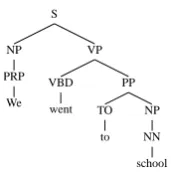
The 3rd cell in the table makes use of a ‘sec-ond head word’ node, defined as follows. Consider a left sibling (right siblings are addressed analo-gously) M of the verb’s node. Take the node H in the subtree ofM whereM’s head appears. H is a descendent of a node J which is a child of M. The ‘second head word’ node isJ’s sibling on the right. For example, in the sentence We went to
school (see Figure 2) the head word of the PP ‘to
S
NP
PRP
We
VP
VBD
went PP
TO
to NP
NN
[image:5.595.139.225.68.155.2]school
Figure 2: An example parse tree for the ‘second head word’ feature.
The current set of features does not detect verb particle constructions. We leave this for future re-search.
Learning Algorithm. Our learning task can be formulated as follows. Let xi denote the feature vector of an instancei, and letXdenote the space of all such feature vectors. The subset of possi-ble labels forxi is denoted byCi, and the correct label by ci ∈ Ci. We denote the label space by S. LetT be the training set of instances T = {< x1, C1, c1 >, < x2, C2, c2 >, ..., < xn, Cn, cn >
} ⊆ (X × 2S × S)n, wherenis the size of the training set. Let< xn+1, Cn+1>∈(X × 2S)be a new instance. Our task is to select which of the labels inCn+1is its correct labelcn+1(xn+1does not have to be a previously observed lemma, but its lemma must appear in a VN class).
The structure of the task lets us apply a learn-ing algorithm that is especially appropriate for it. What we need is an algorithm that allows us to re-strict the possible labels of each instance, both in training and in testing. The sequential model algo-rithm presented by Even-Zohar and Roth (2001) directly supports this requirement. We use the SNOW learning architecture for multi-class clas-sification (Roth, 1998), which contains an imple-mentation of that algorithm9.
5 Experimental Setup
We used SemLink VN annotations and parse trees on sections 02-21 of the WSJ Penn Treebank for training, and section 00 as a development set, as is common in the parsing community. We per-formed two parallel sets of experiments, one us-ing manually created gold standard parse trees and one using parse trees created by a state-of-the-art
9Experiments on development data revealed that for verbs
for which almost all of the training instances are mapped to the same VN class, it is most beneficial to select that class. Thus, where more than 90% of the training instances of a verb are mapped to the same class, our algorithm mapped the in-stances of the verb to that class regardless of the context.
parser (Charniak and Johnson, 2005) (Note that this parser does not output function tags). The parser was also trained on sections 02-21 and tuned on section 0010. Consequently, our adaptation sce-nario is a full adaptation situation in which both the parser and the VerbNet training data are not in the test domain. Note that generative parser adaptation results are known to be of much lower quality than in-domain results (Lease and Charniak, 2005). The quality of the discriminative parser we used did indeed decrease in our adaptation scenario (Sec-tion 7).
The training data included 71209 VN in-scope instances (of them 41753 polysemous) and the de-velopment 3624 instances (2203 polysemous). An ‘in-scope’ instance is one that appears in VN and is tagged with a verb POS. The same trained model was used in both the in-domain and adaptation sce-narios, which only differ in their test sets.
In-Domain. Tests were held on sections 01,22,23,24 of WSJ PTB. Test data includes all in-scope instances for which there is a SemLink anno-tation, yielding 13540 instances, 7798 (i.e., 57.6%) of them polysemous.
Adaptation. For the testing we annotated sen-tences from GENIA (Kim et al., 2003) (version 3.0.2). The GENIA corpus is composed of MED-LINE abstracts related to transcription factors in human blood cells. We annotated 400 sentences from the corpus, each including at least one in-scope verb instance. We took the first 400 sen-tences from the corpus that met that criterion11. After cleaning some GENIA POS inconsistencies, this amounts to 690 in-scope instances (380 of them polysemous). The tagging was done by two annotators with an inter-annotator agreement rate of 80.35% and Kappa 67.66%.
Baselines. We used two baselines, random and most frequent (MF). The random baseline selects uniformly and independently one of the possible classes of the verb. The most frequent (MF) base-line selects the most frequent class of the verb in the training data for verbs seen while training, and selects in random for the unseen ones. Conse-quently, it obtains a perfect score over the monose-mous verbs. This baseline is a strong one and is common in disambiguation tasks.
We repeated all of the setup above in two
sce-10
For the very few sentences out of coverage for the parser, we used the MF baseline (see below).
11
narios. In the first (main) scenario, scope in-stances were always mapped to VN classes, while in the second (‘other is possible’ (OIP)) scenario, in-scope instances were allowed to be tagged (dur-ing train(dur-ing) and classified (dur(dur-ing test) as not be-longing to any existing VN class12. In all cases, out-of-scope instances (verbs whose lemmas do not appear in VN) were ignored. For the OIP sce-nario, we used a different ‘other’ label for each of the lemmas, not a single label shared by them all.
6 Results
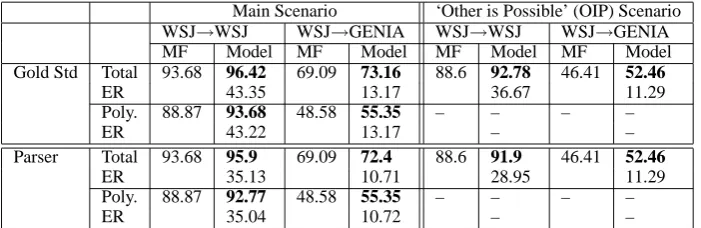
Table 1 shows our results. In addition to the over-all results, we also show results for the polysemous ones alone, since the task is trivial for the monose-mous ones. The results using gold standard parses effectively set an upper bound on our model’s per-formance, while those using statistical parser out-put demonstrate its current usability.
In-Domain. Results are shown in the WSJ→ WSJ columns of Table 1. Using gold standard parses (top), we achieve 96.42% accuracy over-all. Over the polysemous verbs, the accuracy is 93.68%. This translates to an error reduction over the MF baseline of 43.35% overall and 43.22% for the polysemous verbs. In the ‘other is possible’ scenario (right), we obtained 36.67% error reduc-tion. Using a state-of-the-art parser (Charniak and Johnson, 2005) (bottom), we experienced some degradation of the results (as expected), but they remained significantly above baseline. We achieve 95.9% accuracy overall and 92.77% for the polyse-mous verbs, which translates to about 35.13% and 35.04% error reduction respectively. In the OIP scenario, we obtained 28.95% error reduction.
The results of the random baseline for the in-domain scenario are substantially worse than the MF baseline. On the WSJ the random baseline scored 66.97% (37.51%) accuracy in the main (OIP) scenarios.
Adaptation. Here we test our model’s ability to generalize across domains. Since VN is sup-posed to be a domain independent resource, we hope to acquire statistics that are relevant across domains as well and so to enable us to automati-cally map verbs in domains of various genres. The results are shown in the WSJ→ GENIA columns of Table 1. When using gold standard parses, our model scored 73.16%. This translates to about 13.17% ER on GENIA. We interestingly
experi-12
i.e., including instances tagged by SemLink as ‘none’.
enced very little degradation in the results when moving to parser output, achieving 72.4% accu-racy which translates to 10.71% error reduction over the MF baseline. The random baseline on GE-NIA was again worse than MF, obtaining 66.04% accuracy as compared to 69.09% of MF (in the OIP scenario, 39.12% compared to 46.41%).
Run-time performance. Given a parsed cor-pus, our main model trains and runs in no more than a few minutes for a training set of ∼60K in-stances and a test set of∼11K instances, using a Pentium 4 CPU 2.40GHz with 1GB main mem-ory. The bottleneck in tagging large corpora using our model is thus most likely the running time of current parsers.
7 Discussion
In this paper we introduced a new statistical model for automatically mapping verb instances into VerbNet classes, and presented the first large-scale experiments for this task, for both in-domain and corpus adaptation scenarios.
Using gold standard parse trees, we achieved 96.42% accuracy on WSJ test data, showing 43.35% error reduction over a strong baseline. For adaptation to the GENIA corpus, we showed 13.1% error reduction over the baseline. A sur-prising result in the context of adaptation is the lit-tle influence of using gold standard parses versus using parser output, especially given the relatively low performance of today’s parsers in the adapta-tion task (91.4% F-score for the WSJ in-domain scenario compared to 81.24% F-score when pars-ing our GENIA test set). This is an interestpars-ing di-rection for future work.
In addition, we conducted some additional pre-liminary experiments in order to shed light on some aspects of the task. The experiments reported below were conducted on the development data, given gold standard parse trees.
Main Scenario ‘Other is Possible’ (OIP) Scenario WSJ→WSJ WSJ→GENIA WSJ→WSJ WSJ→GENIA MF Model MF Model MF Model MF Model Gold Std Total 93.68 96.42 69.09 73.16 88.6 92.78 46.41 52.46
ER 43.35 13.17 36.67 11.29
Poly. 88.87 93.68 48.58 55.35 – – – –
ER 43.22 13.17 – –
Parser Total 93.68 95.9 69.09 72.4 88.6 91.9 46.41 52.46
ER 35.13 10.71 28.95 11.29
Poly. 88.87 92.77 48.58 55.35 – – – –
[image:7.595.125.476.71.185.2]ER 35.04 10.72 – –
Table 1: Accuracy and error reduction (ER) results (in percents) for our model and the MF baseline. Error reduction is computed as MODEL100−MF−MF. Results are given for the WSJ and GENIA corpora test sets. The top table is for a model receiving gold standard parses of the test data. The bottom is for a model using (Charniak and Johnson, 2005) state-of-the-art parses of the test data. In the main scenario (left), instances were always mapped to VN classes, while in the OIP one (right) it was possible (during both training and test) to map instances as not belonging to any existing class. For the latter, no results are displayed for polysemous verbs, since each verb can be mapped both to ‘other’ and to at least one class.
features if there are k possible classes13. There was no improvement over the previous model. A possible reason for this is the performance of the WSD engine (e.g. 56.1% precision on the verbs in Senseval-3 all-words task data). Naturally, more research is needed to establish better methods of incorporating WSD information to assist in this task.
Second, we studied the relative usability of class information as opposed to verb idiosyncratic infor-mation in the VN disambiguation task. By mea-suring the accuracy of our model, first given the per-class features (the first set of features exclud-ing the verb’s lemma feature) and second given the per-verb features (the conjunction of the first set with the verb’s lemma), we tried to address this question. We obtained 94.82% accuracy for the per-class experiment, and 95.51% for the per-verb experiment, compared to 95.95% when using both in the in-domain gold standard scenario. The MF baseline scored 92.45% on this development set. These results, which are close in the per-class ex-periment to those of the MF baseline, indicate that combining both approaches in the construction of the classifier is justified.
Third, we studied the importance of having a learning algorithm utilizing the task’s structure (mapping into a large label space where each
in-13The mapping is many-to-many and partial. To overcome
the first issue, given a WN sense of the verb, we encoded all possible VN classes that correspond to it. To overcome the second, we treated a verb in a certain VN class, for which the mapping to WN was available, as one that can be mapped to all WN senses of the verb.
stance can be mapped to only a small subspace). Our choice of the algorithm in (Even-Zohar and Roth, 2001) was done in light of this requirement. We conducted an experiment in which we omitted these per-instance restrictions on the label space, effectively allowing each verb to take every label in the label space. We obtained 94.54% accuracy, which translates to 27.68% error reduction, com-pared to 95.95% accuracy (46.36% error reduc-tion) when using the restrictions. These results in-dicate that although our feature set keeps us sub-stantially above baseline even without the above algorithm, using it boosts our results even further. This result is different from the results obtained in (Girju et al., 2005), where the results of the un-constrained (flat) model were significantly below baseline.
As noted earlier, the field of instance level verb classification into Levin-inspired classes is far from being exhaustively explored. We intend to make our implementation of the model available to the community, to enable others to engage in further research on this task.
Acknowledgements. We would like to thank Dan Roth, Mark Sammons and Ran Luria for their help.
References
Collin F. Baker, Charles J. Fillmore and John B. Lowe, 1998. The Berkeley FrameNet Project. Proc. of the 36th Meeting of the ACL and the 17th COLING.
Coarse-to-fine n-best parsing and maxent discriminative reranking. Proc. of the 43rd Meeting of the ACL.
Michael Collins, 1999. Head-driven statistical models for natural language parsing. Ph.D. thesis, Univer-sity of Pennsylvania.
Hoa Trang Dang, Karin Kipper, Martha Palmer and Joseph Rosenzweig, 1998. Investigating regular sense extensions based on intersective Levin classes. Proc. of the 36th Meeting of the ACL and the 17th COLING.
Bonnie J. Dorr, 1997. Large-Scale Dictionary Con-struction for Foreign Language Tutoring and Inter-lingual Machine Translation. Machine Translation, 12:1-55.
Bonnie J. Dorr and Douglas Jones, 1996. Role of Word Sense Disambiguation in Lexical Acquisition: Pre-dicting Semantics from Syntactic Cues. Proc. of the 16th COLING.
Yair Even-Zohar and Dan Roth, 2001. A Sequential Model for Multi-Class Classification. Proc. of the 2001 Conference on Empirical Methods in Natural Language Processing.
Roxana Girju, Dan Roth and Mark Sammons, 2005. Token-level Disambiguation of VerbNet classes. The Interdisciplinary Workshop on Verb Features and Verb Classes.
Svetlana Hensman and John Dunnion, 2004. Automat-ically building conceptual graphs using VerbNet and WordNet. International Symposium on Information and Communication Technologies (ISICT).
Jin–Dong Kim, Tomoko Ohta, Yuka Teteisi and Jun’ichi Tsujii, 2003. GENIA corpus – a seman-tically annotated corpus for bio-textmining. Bioin-formatics, 19:i180–i182, Oxford U. Press 2003.
Karin Kipper, Hoa Trang Dang and Martha Palmer, 2000. Class-Based Construction of a Verb Lexicon. Proc. of the 17th National Conference on Artificial Intelligence.
Karin Kipper-Schuler, 2005. VerbNet: A Broad-Coverage, Comprehensive Verb Lexicon. Ph. D. the-sis, University of Pennsylvania.
Karin Kipper, Anna Korhonen, Neville Ryant and Martha Palmer, 2006. Extending VerbNet with Novel Verb Classes. Proc. of the 5th International Conference on Language Resources and Evaluation.
Judith Klavans and Min-Yen Kan, 1998. Role of verbs in document analysis. Proc. of the 36th Meeting of the ACL and the 17th International Conference on Computational Linguistics.
Anna Korhonen and Ted Briscoe, 2004. Extended Lexical-Semantic Classification of English Verbs. Proc. of the 42nd Meeting of the ACL, Workshop on Computational Lexical Semantics.
Mirella Lapata and Chris Brew, 2004. Verb Class Disambiguation using Informative Priors. Compu-tational Linguistics, 30(1):45-73
Matthew Lease and Eugene Charniak, 2005. Towards a Syntactic Account of Punctuation. Proc. of the 2nd International Joint Conference on Natural Language Processing.
Beth Levin, 1993. English Verb Classes And Alterna-tions: A Preliminary Investigation. The University of Chicago Press.
Beth Levin and Malka Rappaport Hovav, 2005. Argu-ment Realization. Cambridge University Press.
Juanguo Li and Chris Brew, 2007. Disambiguating Levin Verbs Using Untagged Data. Proc. of the 2007 International Conference on Recent Advances in Natural Language Processing.
Edward Loper, Szu-ting Yi and Martha Palmer, 2007. Combining Lexical Resources: Mapping Between PropBank and VerbNet. Proc. of the 7th Inter-national Workshop on Computational Linguistics, Tilburg, the Netherlands.
Paola Merlo and Suzanne Stevenson. 2001. Automatic Verb-Classification Based On Statistical Distribu-tion Of Argument Structure. ComputaDistribu-tional Linguis-tics, 27(3):373–408.
Rada Mihalcea and Andras Csomai 2005. Sense-Learner: word sense disambiguation for all words in unrestricted text. Proc. of the 43rd Meeting of the ACL , Poster Session.
Martha Palmer, Daniel Gildea and Paul Kingsbury, 2005. The proposition bank: A corpus annotated with semantic roles. Computational Linguistics, 31(1).
Dan Roth, 1998. Learning to resolve natural language ambiguities: A unified approach. Proc. of the 15th National Conference on Artificial Intelligence
Sabine Schulte im Walde, 2000. Clustering verbs se-mantically according to their alternation behavior. Proc. of the 18th COLING.
Lei Shi and Rada Mihalcea, 2005. Putting pieces to-gether: Combining FrameNet, VerbNet and WordNet for robust semantic parsing. Proc. of the Interna-tional Conference on Intelligent Text Processing and Computational Linguistics.
Robert S. Swier and Suzanne Stevenson, 2005. Ex-ploiting a Verb Lexicon in Automatic Semantic Role Labelling. Proc. of the 2005 conference on empirical methods in natural language processing.