Chinese Dependency Parsing with Large Scale Automatically
Constructed Case Structures
Kun Yu
Graduate School of
Infor-matics,
Kyoto University, Japan
[email protected]
to-u.ac.jp
Daisuke Kawahara
National Institute of
Informa-tion and CommunicaInforma-tions
Technology, Japan
[email protected]
Sadao Kurohashi
Graduate School of
Infor-matics,
Kyoto University, Japan
[email protected]
Abstract
This paper proposes an approach using large scale case structures, which are automatically constructed from both a small tagged corpus and a large raw cor-pus, to improve Chinese dependency parsing. The case structure proposed in this paper has two characteristics: (1) it relaxes the predicate of a case structure to be all types of words which behaves as a head; (2) it is not categorized by semantic roles but marked by the neighboring modifiers attached to a head. Experimen-tal results based on Penn Chinese Tree-bank show the proposed approach achieved 87.26% on unlabeled attach-ment score, which significantly outper-formed the baseline parser without using case structures.
1
Introduction
Case structures (i.e. predicate-argument struc-tures) represent what arguments can be attached to a predicate, which are very useful to recognize the meaning of natural language text. Research-ers have applied case structures to Japanese syn-tactic analysis and improved parsing accuracy successfully (Kawahara and Kurohashi, 2006(a); Abekawa and Okumura, 2006). However, few works focused on using case structures in Chi-nese parsing. Wu (2003) proposed an approach to learn the relations between verbs and nouns and applied these relations to a Chinese parser. Han et al. (2004) presented a method to acquire
© 2008. Licensed under the Creative Commons
Attri-bution-Noncommercial-Share Alike 3.0 Unported
license ( http://creativecommons.org/licenses/by-nc-sa/3.0/). Some rights reserved.
the sub-categorization of Chinese verbs and used them in a PCFG parser.
Normally, case structures are categorized by semantic roles for verbs. For example, Kawahara and Kurohashi (2006(b)) constructed Japanese case structures which were marked by post posi-tions. Wu (2003) classified the Chinese verb-noun relations as ‘verb-object’ and ‘modifier-head’. In this paper, we propose a new type of Chinese case structure, which is different from those presented in previous work (Wu, 2003; Han et al., 2004; Kawahara and Kurohashi, 2006(a); Abekawa and Okumura, 2006) in two aspects:
(1) It relaxes the predicate of a case structure to be all types of words which behaves as a head;
(2) It is not categorized by semantic roles but marked by the neighboring modifiers at-tached to a head. The sibling modification infor-mation remembers the parsing history of a head node, which is useful to correct the parsing error such as a verb 看 (see) is modified by two nouns 电影 (film) and 简介 (introduction) as objects (see Figure 1).
Figure 1. Dependency trees of an example sen-tence (I see the introduction of a film).
We automatically construct large scale case structures from both a small tagged corpus and a large raw corpus. Then, we apply the large scale case structures to a Chinese dependency parser to improve parsing accuracy.
The Chinese dependency parser using case structures is evaluated by Penn Chinese Tree-bank 5.1 (Xue et al., 2002). Results show that the
automatically constructed case structures helped increase parsing accuracy by 2.13% significantly. The rest of this paper is organized as follows: Section 2 describes the proposed Chinese case structure and the construction method in detail; Section 3 describes a Chinese dependency parser using constructed case structures; Section 4 lists the experimental results with a discussion in sec-tion 5; Related work is introduced in Secsec-tion 6; Finally, Section 7 gives a brief conclusion and the direction of future work.
2
Chinese Case Structure and its
Con-struction
2.1 A New Type of Chinese Case Structure
We propose a new type of Chinese case structure in this paper, which is represented as the combi-nation of a case pattern and a case element (see Figure 2). Case element remembers the bi-lexical dependency relation between all types of head-modifier pairs, which is also recognized in previ-ous work (Wu, 2003; Han et al., 2004; Kawahara and Kurohashi, 2006(a); Abekawa and Okumura, 2006). Case pattern keeps the pos-tag sequence of all the modifiers attached to a head to remem-ber the parsing history of a head node.
Figure 2. An example of constructed case structure.
2.2 Construction Corpus
We use 9,684 sentences from Penn Chinese Treebank 5.1 as the tagged corpus, and 7,338,028 sentences written in simplified Chinese from Chinese Gigaword (Graff et al., 2005) as the raw corpus for Chinese case structure construction.
Before constructing case structures from the raw corpus, we need to get the syntactic analysis of it. First, we do word segmentation and pos-tagging for the sentences in Chinese Gigaword
by a Chinese morphological analyzer
(Nakagawa and Uchimoto, 2007). Then a Chinese deterministic syntactic analyzer (Yu et al., 2007) is used to parse the whole corpus.
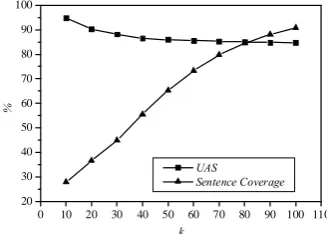
To guarantee the accuracy of constructed case structures, we only use the sentences with less than k words from Chinese Gigaword. It is based on the assumption that parsing short sentences is more accurate than parsing long sentences. The performance of the deterministic parser used for analyzing Chinese Gigaword (see Figure 3) shows smaller k ensures better parsing quality but suffers from lower sentence coverage. Referring to Figure 2, we set k as 30.
Figure 3. Performance of the deterministic parser with different k on 1,800 sentences2.
2.3 Case Pattern Construction
A case pattern consists of a sequence of pos-tags indicating the order of all the modifiers attached to a head (see Figure 1), which can be repre-sented as following.
>
=< m m− l n− n r
i pos pos pos pos pos pos
cp [ , 1,..., 1],[ 1,..., 1, ]
Here, [posm,posm−1,...,pos1]l means the pos-tag
sequence of the modifiers attached to a head from the left side, and [pos1,...,posn−1,posn]rmeans
the pos-tag sequence of the modifiers attached to a head from the right side.
We use the 33 pos-tags defined in Penn Chi-nese Treebank (Xue et al., 2002) to describe a case pattern, and make following modifications:
• group common noun, proper noun and
pronoun together and mark them as ‘noun’;
• group predicative adjective and all the other verbs together and mark them as ‘verb’;
• only regard comma, pause, colon and
semi-colon as punctuations and mark them as ‘punc’, and neglect other punctuations.
2UAS
means unlabeled attachment score (Buchholz and Marsi, 2006). The sentences used for this evaluation are from Penn Chinese Treebank with gold word segmentation and pos-tag.
0 10 20 30 40 50 60 70 80 90 100 110 20
30 40 50 60 70 80 90 100
%
k UAS
• group cardinal number and ordinal number together and mark them as ‘num’;
• keep the original definition for other pos-tags but label them by new pos-tags, such as labeling ‘P’ as ’prep’ and labeling ‘AD’ as ‘adv’.
The task of case pattern construction is to ex-tract cpi for each head from both the tagged cor-pus and the raw corcor-pus. As we will introduce later, the Chinese dependency parser using case structures applies CKY algorithm for decoding. Thus the following substrings of cpi are also ex-tracted for each head as horizontal Markoviza-tion during case pattern construcMarkoviza-tion.
]
2.4 Case Element Construction
As introduced in Section 2.1, a case element keeps the lexical preference between a head and its modifier. Therefore, the task of case element construction is to extract head-modifier pairs from both the tagged corpus and the raw corpus.
Although only the sentences with less than k (k=30) words from Chinese Gigaword are used as raw corpus to guarantee the accuracy, there still exist some dependency relations with low accuracy in these short sentences because of the non-perfect parsing quality. Therefore, we apply a head-modifier (HM) classifier to the parsed sentences from Chinese Gigaword to further ex-tract head-modifier pairs with high quality. This HM classifier is based on SVM classification. Table 1 lists the features used in this classifier.
Feature Description
Poshead/
Posmod Pos-tag pair of head and modifier
Distance Distance between head and modifier
HasComma If there exists comma between head
and modifier, set as 1; otherwise as 0
HasColon If there exists colon between head and
modifier, set as 1; otherwise as 0
HasSemi If there exists semi-colon between head
and modifier, set as 1; otherwise as 0
Table 1. Features for HM classifier.
The HM classifier is trained on 3500 sentences from Penn Chinese Treebank with gold-standard word segmentation and pos-tag. All the sentences are parsed by the same Chinese deterministic parser used for Chinese Gigaword analysis. The correct dependency relations created by the
parser are looked as positive examples and the left dependency relations are used as negative examples. TinySVM3 is selected as the SVM toolkit. A polynomial kernel is used and degree is set as 2. Tested on 346 sentences, which are from Penn Chinese Treebank and parsed by the same deterministic parser with gold standard word segmentation and pos-tag, this HM classi-fier achieved 96.77% on precision and 46.35% on recall.
3
A Chinese Dependency Parser Using
Case Structures
3.1 Parsing Model
We develop a lexicalized Chinese dependency parser to use constructed case structures. This parser gives a probability P(T|S) to each possible
dependency tree T of an input sentence
S=w1,w2,…,wn (wi is a node representing a word with its pos-tag), and outputs the dependency tree T* that maximizes P(T|S) (see equation 1). CKY algorithm is used to decode the dependency tree from bottom to up.
) two parts (see equation 2): the probability of a sentence S generating a root node wROOT, and the product of the probabilities of a node wi generat-ing a case structure CSi.
As introduced in Section 2, a case structure
CSi is composed of a case pattern cpi and a case and commaj means the number of commas be-tween wj and its head. Assuming any Dj and Dk are independent of each other when they belong to the same case element, P(cmi|wi,cpi) can be
Finally, P(wj,disj,commaj | wi,cpi) is divided as
Maximum likelihood estimation is used to es-timate P(wROOT|S) on training data set with the smoothing method used in (Collins, 1996). The estimation of P(cpi|wi), P(wj|wi,cpi), and P(disj,
commaj |wi,wj,cpi) will be introduced in the fol-lowing subsections.
3.2 Estimating P(cpi|wi) by Case Patterns
Three steps are used to estimate P(cpi|wi) by maximum likelihood estimation using the con-structed case patterns:
• Estimate P(cpi|wi) only by the case pat-terns from the tagged corpus and represent it as
) tagged cp w
P ;
• Estimate P(cpi|wi) only by the case pat-terns from the raw corpus and represent it as
)
λpattern is calculated by equation 7 to set proper ratio for the probabilities estimated by the case patterns from different corpora.
)
ηraw mean the occurrence of a back-off node
wi=<posi> generating cpi in the tagged or raw corpus. To overcome the data sparseness prob-lem, we not only apply the smoothing method used in (Collins, 1996) for a lexicalized head to back off it to its part-of-speech, but also assign a very small value to P(cpi|wi) when there is no cpi modifying wi in the constructed case patterns.
3.3 Estimating P(wj|wi,cpi) and P(disj,
com-maj |wi,wj,cpi) by Case Elements
To estimate P(wj|wi,cpi) and P(disj, commaj |wi,wj,cpi) by maximum likelihood estimation, we also use three steps:
• Estimate the two probabilities only by the case elements from the tagged corpus and repre-sent them as Pˆtagged(wj|wi,cpi) and
tagged dis comma w w cp
P ;
• Estimate the two probabilities only by the case elements from the raw corpus, and represent them as Pˆraw(wj|wi,cpi) and
The smoothing method used in (Collins, 1996) is applied during estimation.
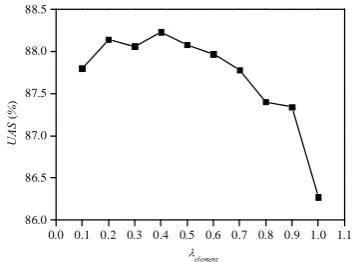
Figure 4. Parsing accuracy with different λelement on development data set.
In order to set proper ratio for the probabilities estimated by the case elements from different corpora, we use a parameter λelement in equation 8 and 9. The appropriate setting (λelement =0.4) is learned by a development data set (see Figure 4).
4
Evaluation Results
4.1 Experimental Setting
We use Penn Chinese Treebank 5.1 as data set to evaluate the proposed approach. 9,684 sentences from Section 001-270 and 400-931, which are also used for constructing case structures, are used as training data. 346 sentences from Section 271-300 are used as testing data. 334 sentences from Section 301-325 are used as development data. Penn2Malt4 is used to transfer the phrase structure of Penn Chinese Treebank to depend-ency structure. Gold-standard word segmentation and pos-tag are applied in all the experiments.
Unlabeled attachment score (UAS) (Buchholz and Marsi, 2006) is used as evaluation metric. Because of the difficulty of assigning correct head to Chinese punctuation, we calculate UAS only on the dependency relations in which the modifier is not punctuation.
4.2 Results
Three parsers were evaluated in this experiment:
• ‘baseline’: a parser not using case struc-tures, where P(T|S) is calculated by equation 11 and P(wj|wi) and P(disj, commaj |wi,wj) are esti-mated by training data set only.
∏
• ‘proposed’: the parser introduced in Sec-tion 3, which uses both case elements and case patterns.
The evaluation results on testing data set (see Table 2) shows the proposed parser achieved 87.26% on UAS, which was 2.13% higher than that of the baseline parser. This improvement is regarded as statistically significant (McNemar’s test: p<0.0005). Besides, Table 2 shows only us-ing case elements increased parsus-ing accuracy by 1.30%. It means both case elements and case pat-terns gave help to parsing accuracy, and case elements contributed more in the proposed ap-proach.
Parsing
model baseline w/ case elem proposed
UAS (%) 85.13 86.43 (+1.30) 87.26 (+2.13)
Table 2. Parsing accuracy of different parsing models.
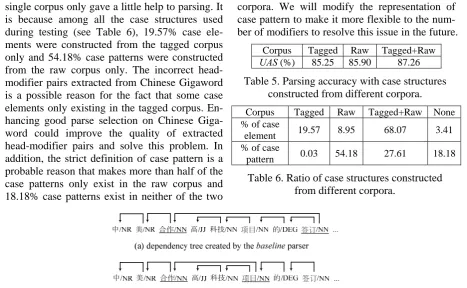
Figure 5 and Figure 6 show the dependency trees of two example sentences created by both the baseline parser and the proposed parser. In Figure 5, the baseline parser incorrectly assigned 签订/NN (signing) as the head of 合作/NN (co-operation). However, after using the case ele-ment 项目/NN (project) Æ 合作/NN, the cor-rect head of 合作/NN was found by the
pro-posed parser. Figure 6 shows the baseline parser recognized 开幕/VV (opening) as the head of 据
/P (as) incorrectly. But in the proposed parser, the probability of 开幕/VV generating the case pattern ‘[prep, punc, prep]l’ was much lower than that of 开幕/VV generating the case pattern ‘[prep]l’. Therefore, the proposed parser rejected the incorrect dependency that据/P modified开 幕/VV and got the correct head of 据/P as 展示 /VV (show) successfully.
5
Discussion
5.1 Influence of the Number of Case Struc-tures on Parsing Accuracy
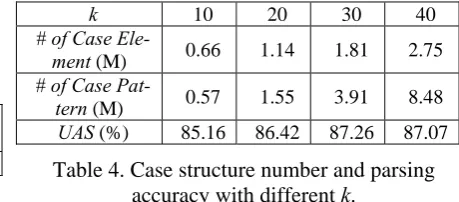
During case structure construction, we only used the sentences with less than k (k=30) words from Chinese Gigaword as the raw corpus. Enlarging k will introduce more sentences from Chinese Gi-gaword and increase the number of case struc-tures. Table 4 lists the number of case structures and parsing accuracy of the proposed parser on testing data set with different k5. It shows enlarg-ing the number of case structures is a possible way to increase parsing accuracy. But simply setting larger k did not help parsing, because it decreased the parsing accuracy of Chinese Gi-gaword and consequently decreased the accuracy of constructed case structures. Using good parse selection (Reichart and Rappoport, 2007; Yates et al., 2006) on the syntactic analysis of Chinese Gigaword is a probable way to construct more case structures without decreasing their accuracy. We will consider about it in the future.
k 10 20 30 40
Table 4. Case structure number and parsing accuracy with different k.
5.2 Influence of the Case Structure
Con-struction Corpus on Parsing Accuracy
We also evaluated the proposed parser on testing data set using case structures constructed from different corpora.
Results (see Table 5) show that parsing accu-racy was improved greatly only when using case structures constructed from both the two corpora. The case structures constructed from either of a
5
single corpus only gave a little help to parsing. It is because among all the case structures used during testing (see Table 6), 19.57% case ele-ments were constructed from the tagged corpus only and 54.18% case patterns were constructed from the raw corpus only. The incorrect head-modifier pairs extracted from Chinese Gigaword is a possible reason for the fact that some case elements only existing in the tagged corpus. En-hancing good parse selection on Chinese Giga-word could improve the quality of extracted head-modifier pairs and solve this problem. In addition, the strict definition of case pattern is a probable reason that makes more than half of the case patterns only exist in the raw corpus and 18.18% case patterns exist in neither of the two
corpora. We will modify the representation of case pattern to make it more flexible to the num-ber of modifiers to resolve this issue in the future.
Corpus Tagged Raw Tagged+Raw
UAS (%) 85.25 85.90 87.26
Table 5. Parsing accuracy with case structures constructed from different corpora.
Corpus Tagged Raw Tagged+Raw None
% of case
element 19.57 8.95 68.07 3.41
% of case
pattern 0.03 54.18 27.61 18.18
Table 6. Ratio of case structures constructed from different corpora.
Figure 5. Dependency trees of an example sentence (The signing of China-US cooperation high tech project …).
据/P 介绍/NN ,/PU 在/P 体育馆/NN 开幕/VV 的/DEC 展览会/NN 将/AD 展示/VV ...
(a) dependency tree created by the baseline parser
(b) dependency tree created by the proposed parser
据/P介绍/NN ,/PU 在/P 体育馆/NN 开幕/VV 的/DEC 展览会/NN 将/AD 展示/VV ...
Figure 6. Dependency trees of an example sentence (As introduced, the exhibition opening in the stadium will show…).
5.3 Parsing Performance with Real Pos-tag
Gold standard word segmentation and pos-tag are applied in previous experiments. However, parsing accuracy will be affected by the incorrect word segmentation and pos-tag in the real appli-cations. Currently, the best performance of Chi-nese word segmentation has achieved 99.20% on F-score, but the best accuracy of Chinese pos-tagging was 96.89% (Jin and Chen, 2008). Therefore, we think pos-tagging is more crucial for applying parser in real task compared with word segmentation. Considering about this, we evaluated the parsing models introduced in Sec-tion 4 with real pos-tag in this experiment.
Parsing model baseline proposed
UAS (%) 80.91 82.90 (+1.99)
Table 7. Parsing accuracy of different parsing models with real pos-tag.
pos-tagging into parsing and kept n-best pos-tags to reduce the effect of pos-tagging errors on parsing accuracy (Cao et al., 2007). We will also con-sider about this in our future work.
6
Related Work
To our current knowledge, there were few works about using case structures in Chinese parsing, except for the work of Wu (2003) and Han et al. (2004). Compared with them, our proposed ap-proach presents a new type of case structures for all kinds of head-modifier pairs, which not only recognizes bi-lexical dependency but also re-members the parsing history of a head node.
Parsing history has been used to improve pars-ing accuracy by many researchers (Yamada and Matsumoto, 2003; McDonald and Pereira, 2006). Yamada and Matsumoto (2003) showed that keeping a small amount of parsing history was useful to improve parsing performance in a shift-reduce parser. McDonald and Pereira (2006) ex-panded their first-order spanning tree model to be second-order by factoring the score of the tree into the sum of adjacent edge pair scores. In our proposed approach, the case patterns remember the neighboring modifiers for a head node like McDonald and Pereira’s work. But it keeps all the parsing histories of a head, which is different from only keeping adjacent two modifiers in (McDonald and Pereira, 2006). Besides, to use the parsing histories in CKY decoding, our ap-proach applies horizontal Markovization during case pattern construction. In general, the success of using case patterns in Chinese parsing in his paper proves again that keeping parsing history is crucial to improve parsing performance, no mat-ter in which way and to which parsing model it is applied.
There were also some works that handled lexi-cal preference for Chinese parsing in other ways. For example, Cheng et al. (2006) and Hall et al. (2007) applied shift-reduce deterministic parsing to Chinese. Sagae and Tsujii (2007) generalized the standard deterministic framework to prob-abilistic parsing by using a best-first search strat-egy. In these works, lexical preferences were introduced as features for predicting parsing ac-tion. Besides, Bikel and Chiang (2000) applied two lexicalized parsing models developed for English to Penn Chinese Treebank. Wang et al. (2005) proposed a completely lexicalized bot-tom-up generative parsing model to parse Chi-nese, in which a word-similarity-based
smooth-ing was introduced to replace part-of-speech smoothing.
7
Conclusion and Future Work
This paper proposes an approach to use large scale case structures, which are automatically constructed from both a small tagged corpus and the syntactic analysis of a large raw corpus, to improve Chinese dependency parsing. The pro-posed case structures not only recognize the lexi-cal preference between all types of head-modifier pairs, but also keep the parsing history of a head word. Experimental results show the proposed approach improved parsing accuracy signifi-cantly. Besides, although we only apply the pro-posed approach to Chinese dependency parsing currently, the same idea could be adapted to other languages easily because it doesn’t use any language specific knowledge.
There are several future works under consid-eration, such as modifying the representation of case patterns to make it more robust, enhancing good parse selection on the analysis of raw cor-pus, and integrating pos-tagging into parsing model.
References
T.Abekawa and M.Okumura. 2006. Japanese De-pendency Parsing Using Co-occurrence
Informa-tion and a CombinaInforma-tion of Case Elements. In
Pro-ceedings of the joint conference of the
International Committee on Computational Lin-guistics and the Association for Computational Linguistics 2006. pp. 833-840.
D.Bikel. 2004. Intricacies of Collins’ Parsing Model.
Computational Linguistics, 30(4): 479-511.
D.Bikel and D.Chiang. 2000. Two Statistical Parsing
Models Applied to the Chinese Treebank. In
Pro-ceedings of the 2nd Chinese Language Processing
Workshop. pp. 1-6.
S.Buchholz and E.Marsi. 2006. CoNLL-X Shared
Task on Multilingual Dependency Parsing. In
Pro-ceedings of the 10th Conference on Computational
Natural Language Learning.
H.Cao et al.. 2007. Empirical Study on Parsing
Chi-nese Based on Collins’ Model. In Proceedings of
the 10th Conference of the Pacific Association for
Computational Linguisitcs. pp. 113-119.
Y.Cheng, M.Asahara and Y.Matsumoto. 2006.
Multi-lingual Dependency Parsing at NAIST. In
Proceed-ings of the 10th Conference on Computational
M.Collins. 1996. A New Statistical Parser Based on
Bigram Lexical Dependencies. In Proceedings of
the 34th Annual Meeting of the Association for
Computational Linguistics. pp. 184-191.
M.Collins. 1999. Head-Driven Statistical Models for Natural Language Parsing. Ph.D Thesis. University of Pennsylvania.
D.Graff et al.. 2005. Chinese Gigaword Second Edi-tion. Linguistic Data Consortium, Philadelphia.
J.Hall et al. 2007. Single Malt or Blended? A Study in
Multilingual Parser Optimization. In Proceedings
of the shared task at the Conference on
Computa-tional Natural Language Learning 2007. pp.
933-939.
X.Han et al.. 2004. Subcategorization Acquisition and
Evaluation for Chinese Verbs. In Proceedings of
the 20th International Conference on
Computa-tional Linguistics.
G.Jin and X.Chen. 2008. The Fourth International Chinese Language Processing Bakeoff: Chinese Word Segmentation, Named Entity Recognition and Chinese Pos Tagging. In Proceedings of the 6th
SIGHAN Workshop on Chinese Language Process-ing.
D.Kawahara and S.Kurohashi. 2006 (a). A Fully-lexicalized Probabilistic Model for Japanese Syn-tactic and Case frame Analysis. In Proceedings of
the Human Language Technology conference - North American chapter of the Association for
Computational Linguistics annual meeting 2006.
pp. 176-183.
D.Kawahara and S.Kurohashi. 2006 (b). Case Frame Compilation from the Web Using High-performance Computing. In Proceedings of the 5th
International Conference on Language Resources and Evaluation.
T.Kudo and Y.Matsumoto. 2002. Japanese
Depend-ency Analysis Using Cascaded Chunking. In
Pro-ceedings of the Conference on Natural Language Learning. pp. 29-35.
R.McDonald and F.Pereira. 2006. Online Learning of Approximate Dependency Parsing Algorithm. In
Proceedings of the 11th Conference of the
Euro-pean Chapter of the Association for Computational Linguistics.
R.McDonald and J.Nivre. 2007. Characterizing the Errors of Data-driven Dependency Parsing Models.
In Proceedings of the Conference on Empirical
Methods in Natural Language Processing Confer-ence on Computational Natural Language Learn-ing 2007.
T.Nakagawa and K.Uchimoto. 2007. A Hybrid Ap-proach to Word Segmentation and POS Tagging. In Proceedings of the 45th Annual Meeting of the
Association for Computational Linguistics. pp.
217-220.
R.Reichart and A.Rappoport. 2007. An Ensemble Method for Selection of High Quality Parses. In
Proceedings of the 45th Annual Meeting of the
As-sociation for Computational Linguistics. pp. 408-415.
K.Sagae and J.Tsujii. 2007. Dependency Parsing and Domain Adaptation with LR Models and Parser
Ensembles. In Proceedings of the shared task at
the Conference on Computational Natural
Lan-guage Learning 2007. pp. 1044-1050.
Q.Wang, D.Schuurmans, and D.Lin. 2005. Strictly Lexical Dependency Parsing. In Proceedings of the
9th International Workshop on Parsing
Technolo-gies. pp. 152-159.
A.Wu. 2003. Learning Verb-Noun Relations to Im-prove Parsing. In Proceedings of the 2nd SIGHAN
Workshop on Chinese Language Processing. pp.
119-124.
N.Xue, F.Chiou and M.Palmer. 2002. Building a
Large-Scale Annotated Chinese Corpus. In
Pro-ceedings of the 18th International Conference on
Computational Linguistics.
N.Xue and M.Palmer. 2003. Annotating the
Proposi-tions in the Penn Chinese Treebank. In
Proceed-ings of the 2nd SIGHAN Workshop on Chinese
Lan-guage Processing.
N.Xue and M.Palmer. 2005. Automatic Semantic
Rule Labeling for Chinese Verbs. In Proceedings
of the 19th International Joint Conference on
Artifi-cial Intelligence.
H.Yamada and Y.Matsumoto. 2003. Statistical De-pendency Analysis with Support Vector Machines. In Proceedings of the 7th International Workshop
on Parsing Technologies.
A.Yates, S.Schoenmackers, and O.Etzioni. 2006. De-tecting Parser Errors Using Web-based Semantic Filters. In Proceedings of the 2006 Conference on
Empirical Methods in Natural Language Process-ing. pp. 27-34.
J.You and K.Chen. 2004. Automatic Semantic Role Assignment for a Tree Structure. In Proceedings of
the 3rd SIGHAN Workshop on Chinese Language
Processing.
K.Yu, S.Kurohashi, and H.Liu. 2007. A Three-step Deterministic Parser for Chinese Dependency
Pars-ing. In Proceedings ofthe Human Language