Towards Syntax-aware Compositional Distributional Semantic Models
Lorenzo Ferrone
Department of Enterprise Engineering University of Rome “Tor Vergata” Via del Politecnico, 1 00173 Roma
Fabio Massimo Zanzotto
Department of Enterprise Engineering University of Rome “Tor Vergata” Via del Politecnico, 1 00173 Roma [email protected]
Abstract
Compositional Distributional Semantics Models (CDSMs) are traditionally seen as an entire dif-ferent world with respect to Tree Kernels (TKs). In this paper, we show that under a suitable regime these two approaches can be regarded as the same and, thus, structural information and distributional semantics can successfully cooperate in CSDMs for NLP tasks. Leveraging on distributed trees, we present a novel class of CDSMs that encode both structure and distribu-tional meaning: the distributed smoothed trees (DSTs). By using DSTs to compute the similarity among sentences, we implicitly define the distributed smoothed tree kernels (DSTKs). Exper-iment with our DSTs show that DSTKs approximate the corresponding smoothed tree kernels (STKs). Thus, DSTs encode both structural and distributional semantics of text fragments as STKs do. Experiments on RTE and STS show that distributional semantics encoded in DSTKs increase performance over structure-only kernels.
1 Introduction
Compositional distributional semantics is a flourishing research area that leverages distributional seman-tics (see Turney and Pantel (2010), Baroni and Lenci (2010)) to produce meaning of simple phrases and full sentences (hereafter called text fragments). The aim is to scale up the success of word-level relatedness detection to longer fragments of text. Determining similarity or relatedness among sentences is useful for many applications, such as multi-document summarization, recognizing textual entailment (Dagan et al., 2013), and semantic textual similarity detection (Agirre et al., 2013).
Compositional distributional semantics models (CDSMs) are functions mapping text fragments to vectors (or higher-order tensors). Functions for simple phrases directly map distributional vectors of words to distributional vectors for the phrases (Mitchell and Lapata, 2008; Baroni and Zamparelli, 2010; Clark et al., 2008; Grefenstette and Sadrzadeh, 2011; Zanzotto et al., 2010). Functions for full sentences are generally defined as recursive functions over the ones for phrases (Socher et al., 2011; Socher et al., 2012; Kalchbrenner and Blunsom, 2013). Distributional vectors for text fragments are then used as inner layers in neural networks, or to compute similarity among text fragments via dot product.
CDSMs generally exploit structured representations tx of text fragments x to derive their meaning
f(tx), but the structural information, although extremely important, is obfuscated in the final vectors.
Structure and meaning can interact in unexpected ways when computing cosine similarity (or dot prod-uct) between vectors of two text fragments, as shown for full additive models in (Ferrone and Zanzotto, 2013). Smoothed tree kernels (STK) (Mehdad et al., 2010; Croce et al., 2011) instead realize a clearer interaction between structural information and distributional meaning. STKs are specific realizations of convolution kernels (Haussler, 1999) where the similarity function is recursively (and, thus, composition-ally) computed. Distributional vectors are used to represent word meaning in computing the similarity among nodes. STKs, however, are not considered part of the CDSMs family. As usual in kernel machines This work is licensed under a Creative Commons Attribution 4.0 International Licence. Page numbers and proceedings footer are added by the organisers. Licence details:http://creativecommons.org/licenses/by/4.0/
(Cristianini and Shawe-Taylor, 2000), STKs directly compute the similarity between two text fragments xandy over their tree representationstx andty, that is,ST K(tx, ty). The functionf that maps trees
into vectors is only implicitly used, and, thus,ST K(tx, ty)is not explicitly expressed as the dot product
or the cosine betweenf(tx)andf(ty). Such a functionf, which is the underlying reproducing function
of the kernel (Aronszajn, 1950), is a CDSM since it maps trees to vectors by using distributional mean-ing. However, the huge dimensionality ofRn (since it has to represent the set of all possible subtrees)
prevents to actually compute the functionf(t), which thus can only remainimplicit.
Distributed tree kernels (DTK) (Zanzotto and Dell’Arciprete, 2012) partially solve the last problem. DTKs approximate standard tree kernels (such as (Collins and Duffy, 2002)) by defining an explicit function DT that maps trees to vectors in Rm where m n and Rn is the explicit space for tree
kernels. DTKs approximate standard tree kernels (TK), that is, hDT(tx), DT(ty)i ≈ T K(tx, ty), by
approximating the corresponding reproducing function (Aronszajn, 1950). Thus, these distributed trees are small vectors that encode structural information. In DTKs tree nodesuandv(and then also words) are represented by nearly orthonormal vectors, that is, vectors →u and→v such that h→u,→vi ≈ δ(→u,→v)
whereδ is the Kroneker’s delta. This is in contrast with distributional semantics vectors whereh→u,→vi is allowed to be any value in[0,1]according to the similarity between the wordsvandu. Thus, early attempts to include distributional vectors in the DTs failed (Zanzotto and Dell’Arciprete, 2011).
In this paper, leveraging on distributed trees, we present a novel class of CDSMs that encode both structure and distributional meaning: the distributed smoothed trees (DST). DSTs carry structure and dis-tributional meaning on a 2-dimensional tensor (a matrix): one dimension encodes the structure and one dimension encodes the meaning. By using DSTs to compute the similarity among sentences with a gen-eralized dot product (or cosine), we implicitly define the distributed smoothed tree kernels (DSTK) which approximate the corresponding STKs. We present two DSTs along with the two smoothed tree kernels (STKs) that they approximate. We experiment with our DSTs to show that their generalized dot products approximate STKs by directly comparing the produced similarities and by comparing their performances on two tasks: recognizing textual entailment (RTE) and semantic similarity detection (STS). Both exper-iments show that the dot product on DSTs approximates STKs and, thus, DSTs encode both structural and distributional semantics of text fragments in tractable 2-dimensional tensors. Experiments on STS and RTE show that distributional semantics encoded in DSTs increases performance over structure-only kernels. DSTs are the first positive way of taking into account both structure and distributional meaning in CDSMs.
The rest of the paper is organized as follows. Section 2 introduces the basic notation used in the paper. Section 3 describe our distributed smoothed trees as compositional distributional semantic models that can represent both structural and semantic information. Section 4 reports on the experiments. Finally, Section 5 draws some conclusions.
2 Notation
Before describing the distributed smoothed trees (DST) we introduce a formal way to denote constituency-basedlexicalized parse trees, as DSTs exploit this kind of data structures.
Lexicalized treesare denoted with the lettertandN(t)denotes the set of non terminal nodes of tree t. Each non-terminal node n ∈ N(t) has a labelln composed of two partsln = (sn, wn): sn is the
syntactic label, whilewnis the semantic headword of the tree headed byn, along with its part-of-speech
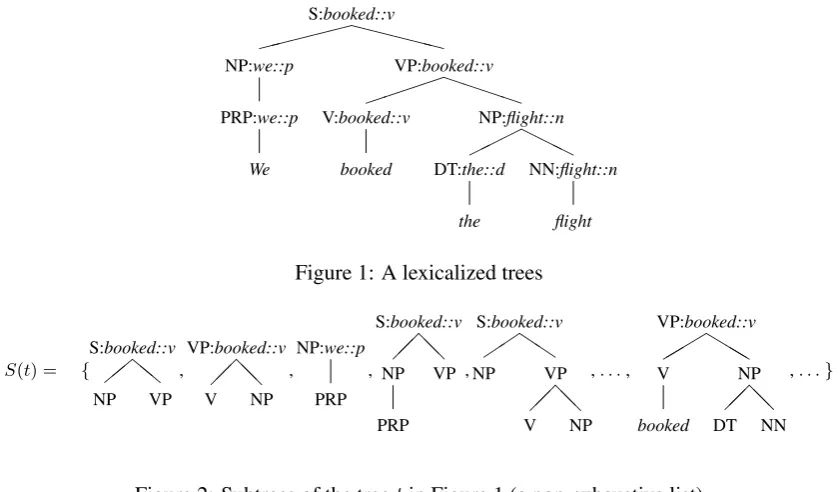
tag. For example, the root node of the tree in Fig.1 has the label S:booked::vwhereS is the syntactic information andbooked::v is the semantic head of the whole tree. Terminal nodes of trees are treated differently, these nodes represent only wordswnwithout any additional information, and their labels thus
only consist of the word itself (see Fig. 1). The structure of a tree is represented as follows: Given a tree t,h(t)is its root node ands(t)is the tree formed fromtbut considering only the syntactic structure (that is, only thesnpart of the labels),ci(n)denotesi-th child of a noden. As usual for constituency-based
parse trees, pre-terminal nodes are nodes that have a single terminal node as child. Finally,s→n ∈ Rm
andw→n∈Rkrepresent respectivelydistributedvectors for node labelssnanddistributionalvectors for
wordswn, whereasTrepresents the matrix of a tree tencoding structure and distributional meaning.
S:booked::v XXXXX NP:we::p PRP:we::p We VP:booked::v PPPP V:booked::v booked NP:flight::n HHH DT:the::d the NN:flight::n flight Figure 1: A lexicalized trees
S(t) = {S:booked::v,,ll
NP VP
,VP:booked::v@@
V NP
[image:3.595.89.509.64.310.2],NP:we::p PRP , S:booked::v @@ NP PRP VP , S:booked::v QQ NP VP @@ V NP ,. . ., VP:booked::v bbb " " " V booked NP @@ DT NN ,. . .}
Figure 2: Subtrees of the treetin Figure 1 (a non-exhaustive list)
3 Distributed Smoothed Trees as Compositional Distributional Semantic Models
We define Distributed Smoothed Trees as recursive functionsDST mapping lexicalized treesttoRm×k
where matrices T = DST(t) encode both syntactic structures and distributional vectors. DSTs are thus compositional distributional models, as they map lexicalized trees to matrices, and they are defined recursively on distributed vectors for syntactic node labels and distributional vectors for words. In the following we introduce DSTs: Section 3.1 gives a rough idea of the method, Section 3.2 describes how to recursively encode structures in vectors by means of distributed trees (Zanzotto and Dell’Arciprete, 2012), and finally Section 3.3 merges distributed trees and distributional semantic vectors in matrices.
3.1 The method in a glance
We describe here the approach in a few sentences. In line with tree kernels over structures (Collins and Duffy, 2002), we introduce the setS(t)of the subtreestiof a given lexicalized treet. A subtreetiis in
the setS(t)ifs(ti)is a subtree ofs(t)and, ifnis a node inti, all the siblings ofnintare inti. For each
node ofti we only consider its syntactic labelsn, except for the headh(ti)for which we also consider
its semantic componentwn. Figure 2 reports a sample for the subtrees of the tree in Fig. 1 The recursive
functions DSTs we define compute the following:
T= X ti∈S(t)
Ti
whereTi is the matrix associated to each subtreeti. The similarity between two text fragmentsaandb
represented as lexicalized treestaandtb can be computed using the Frobenius product between the two
matricesTaandTb, that is:
hTa,Tbi F =
X
ta i∈S(ta)
tb j∈S(tb)
hTa
i,TbjiF (1)
We want to obtain that the producthTa
i,TbjiF approximates the dot product between the distributional
vectors of the head words (hTa
i,TbjiF ≈ h → h(ta
i), → h(tb
j)i) whenever the syntactic structure of the subtrees
is the same (that iss(ta
i) =s(tbj)), andhTai,TbjiF ≈0otherwise. This property is expressed as:
hTa
i,TbjiF ≈δ(s(tai),s(tbj))· h → h(ta
i), → h(tb
3.2 Representing Syntactic Structures with Distributed Trees
Distributed trees(Zanzotto and Dell’Arciprete, 2012) recursively encode syntactic treestin small vectors by means of a recursive function DT. These DTs preserve structural information as the dot product between the DTs of two trees approximates the classical tree kernels T K as defined by Collins and Duffy (2002), that is,T K(ta, tb)≈ hDT(ta), DT(tb)i. To obtain this result, distributed treesDT(t)are
defined as follows:
DT(t) = X ti∈S(t)
p
λ|N(ti)| s(→ti) (3)
whereS(t)is again the set of the subtrees oft,s(→ti)are vectors inRmcorresponding to tree fragmentti
and√λ|N(ti)|is the weight of subtreetiin the final feature space, withλbeing the traditional parameter
used to penalize large subtrees and|N(ti)|being the number of nodes inti. The approximation of tree
kernels is then given by the fact thaths(→ti), →
s(tj)i ≈δ(s(ti),s(tj)). Vectors with this property are called
distributed vectors. A key feature of the distributed vectors of subtreess(→ti)is that these vectors are built
compositionally from a setN ofnearly orthonormal random vectorss→n, that are associated to each node
label. Given a subtrees(ti), the related vector is obtained as: →
s(ti) =s→n1
→
sn2. . .
→
snk =
K
(sn,wn)∈N(ti)
→
sn
where node vectorss→niare ordered according to a depth-first visit of subtreetiandis a vector
composi-tion operacomposi-tion, specifically theshuffled circular convolution1. This function guarantees that two different
subtrees have nearly orthonormal vectors (see (Zanzotto and Dell’Arciprete, 2012) for more details). For example, the fifth treet5of setS(t)in Figure 2 is
→ s(t5) =
→
S(NP→ (V P→ (V→NP→ ))). Thus, DTs in Equation3can be recursively defined as:
DT(t) = X n∈N(t)
σ(n) (4)
whereσ(n)is recursively defined as follows:
σ(n) = (√
λ(s→n→w) ifnis a pre-terminal node
√
λs→n( K
i( →
sci(n)+σ(ci(n)))) ifnis an internal node
(5)
The vectorσ(n)encodes all the subtrees that have root innalong with their penalizing weight√λ|N(ti)|,
that is:
σ(n) = X ti∈S(t)∧h(ti)=n
p
λ|N(ti)| s(→ti)
This is what we need in order to define ourdistributed smoothed trees.
3.3 Representing distributional meaning and distributed structure with matrices
We now move from distributed trees (encoded as small vectors) to distributed smoothed trees (DST) represented as matrices. DST is a function that maps treestto matricesT. In analogy with Equation 4, DST is defined as:
DST(t) = X n∈N(t)
S(n)
whereS(n)is now defined as:
S(n) =σ(n)w→n>
1Theshuffled circular convolutionis defined as→a→b =s1(→a)∗s2(→b)where∗is the circular convolution ands
1and
where σ(n) is the one defined in Equation 5 and(·)> is vector transposition. By combining the two
equations,DST(t)is the sum of the matrices described in Equation 1:
DST(t) = X n∈N(t)
X
ti∈S(t)∧h(ti)=n
p
λ|N(ti)| s(→ti)w→n>= X
ti∈S(t)
→ s(ti)w→n>
where nis h(ti) and Ti = → s(ti)wh→(ti)
>
is the outer product between the distributed vector s(→ti) and
the distributional vectorwh→(ti). There is an important property of the outer product that applies to the
Frobenius product: h→a→w>,→b→v>iF =h→a, →
bi · h→w,→vi. Using this property, we have that Equation 2 is satisfied as:
hTi,TjiF =h → s(ti),
→
s(tj)i · hwh→(ti),
→
wh(tj)i ≈δ(s(ti),s(tj))· h
→
wh(ti),
→
wh(tj)i
We refer to the Frobenius product of two distributed smoothed trees asdistributed smoothed tree kernel (DSTK). These DSTKs are approximating the smoothed tree kernels described in the next section. We propose two versions of our DSTKs according to how we produce distributional vectors for words. We have a plain versionDST K0 when we use distributional vectorsw→nas they are, and a slightly modified
versionDST K+1when we use as distributional vectorsw→n0 =
1 w→n
.
3.4 The Approximated Smoothed Tree Kernels
The two CDSMs we proposed, that is, the two distributed smoothed tree kernelsDST K0andDST K+1, are approximating two specific tree kernels belonging to the smoothed tree kernels class (e.g., (Mehdad et al., 2010; Croce et al., 2011)). These two specific smoothed tree kernels recursively compute (but, the recursive formulation is not given here) the following general equation:
ST K(ta, tb) = X ti∈S(ta)
tj∈S(tb)
ω(ti, tj)
whereω(ti, tj)is the similarity weight between two subtreestiandtj. DT SK0 andDST K+1 approx-imate respectivelyST K0andST K+1where the weights are defined as follows:
ω0(ti, tj) =hwh→(ti),
→
wh(tj)i ·δ(s(ti),s(tj))·
p
λ|N(ti)|+|N(tj)|
ω+1(ti, tj) = (hwh→(ti),
→
wh(tj)i+ 1)·δ(s(ti),s(tj))· p
λ|N(ti)|+|N(tj)|
ST K+1is actually computing a sum betweenST K0and the tree kernel (Collins and Duffy, 2002). 4 Experimental investigation
4.1 Experimental set-up
RTE1 RTE2 RTE3 RTE5 headl FNWN OnWN SMT
STK0vs DSTK0 1024 0.86 0.84 0.90 0.84 0.87 0.65 0.95 0.77 2048 0.87 0.84 0.91 0.84 0.90 0.65 0.96 0.77
STK+1vs DSTK+1 10242048 00..8182 00..7877 00..8483 00..7472 00..9188 00..5653 00..9394 00..6667
Table 1: Spearman’s correlation between Distributed Smoothed Tree Kernels and Smoothed Tree Kernels the English Wikipedia (en.wikipedia.org) and the British National Corpus (www.natcorp.ox.ac.uk), for a total of about 2.8 billion words. We collected a 35K-by-35K matrix by counting co-occurrence of the 30K most frequent content lemmas in the corpus (nouns, adjectives and verbs) and all the content lemmas occurring in the datasets within a 3 word window. The raw count vectors were transformed into positive Pointwise Mutual Information scores and reduced to 300 dimensions by Singular Value Decomposition. This setup was picked without tuning, as we found it effective in previous, unrelated experiments. To build our DTSKs and for the two baseline kernels TK and DTK, we used the implementation of the distributed tree kernels2. We used: 1024 and 2048 as the dimension of the distributed vectors, the weight
λis set to0.4as it is a value generally considered optimal for many applications (see also (Zanzotto and Dell’Arciprete, 2012)). The statistical significance, where reported, is computed according to the sign test.
Direct correlation settings For thedirect correlationexperiments, we used the RTE data sets and the testing sets of the STS dataset (that is,headlines,OnWN,FNWN,SMT). We computed the Spearman’s correlation between values produced by ourDST K0andDST K+1 and produced by the standard ver-sions of the smoothed tree kernel, that is, respectively,ST K0 andST K+1. We obtained text fragment pairs by randomly sampling two text fragments in the selected set. For each set, we produced exactly the number of examples in the set, e.g., we produced 567 pairs for RTE1 dev, etc..
Task-based settings For thetask-basedexperiments, we compared systems using the standard evalua-tion measure and the standard split in the respective challenges. As usual in RTE challenges the measure used is the accuracy, as testing sets have the same number of entailment and non-entailment pairs. For STS, we used MSRpar as training, and we used the 4 test sets as testing. We compared systems using the Pearson’s correlation as the standard evaluation measure for the challenge3. Thus, results can be
compared with the results of the challenge.
As classifier and regression learner, we used the java version of LIBSVM (Chang and Lin, 2011). In the two tasks we used in a different way our DSTs (and the related STKs) within the learners. In the following, we refer to instances in RTE or STS as pairsp = (ta, tb)wheretaandtb are the two parse
trees for the two sentencesaandbfor STS and for the textaand the hypothesisbin RTE.
We will indicate with K(p1, p2) the final kernel used in the learning algorithm, which takes as in-put two training instances, while we will use κ to denote either any of our DSTK (that is, κ(x, y) =
hDST(x), DST(y)i) or any of the standard smoothed tree kernels (that is,κ(x, y) =ST K(x, y)). In STS, we encoded only similarity feature between the two sentences. Thus, we used two classes of kernels: (1) the syntactic/semantic class (SS) with the final kernel defined as K(p1, p2) = (κ(ta1, tb1)· κ(ta
2, tb2) + 1)2; and, (2) the SS class along with token-based similarity (SSTS) where the final kernel is K(p1, p2) = (κ(t1a, tb1)·κ(ta2, t2b) +T S(a1, b1)·T S(a2, b2) + 1)2whereT S(a, b)counts the percent of the common content tokens inaandb.
In RTE, we followed standard approaches (Dagan et al., 2013; Zanzotto et al., 2009), that is, we exploited two models: a model with only a rewrite rule feature space (RR) and a model with the previous space along with a token-level similarity feature (RRTWS). The two models use our DSTs and the standard STKs in the following way as kernel functions: (1)RR(p1, p2) = κ(ta1, ta2) +κ(tb1, tb2); (2) RRT S(p1, p2) = κ(t1a, ta2) +κ(tb1, tb2) + (T W S(a1, b1)·T S(a2, b2) + 1)2 whereT W Sis a weighted token similarity as in Corley and Mihalcea (2005).
SS SSTS
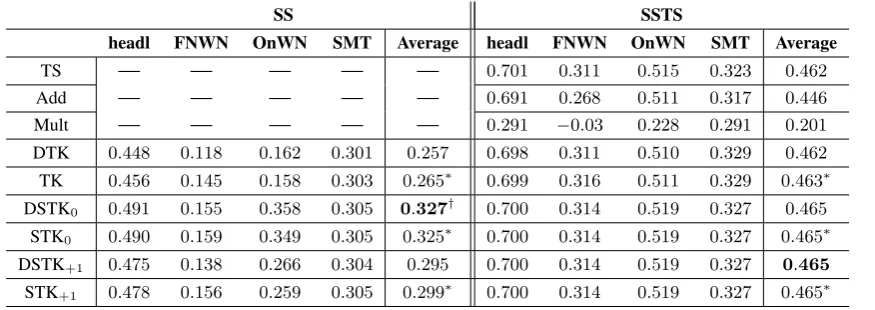
headl FNWN OnWN SMT Average headl FNWN OnWN SMT Average
TS — — — — — 0.701 0.311 0.515 0.323 0.462
Add — — — — — 0.691 0.268 0.511 0.317 0.446
Mult — — — — — 0.291 −0.03 0.228 0.291 0.201
DTK 0.448 0.118 0.162 0.301 0.257 0.698 0.311 0.510 0.329 0.462 TK 0.456 0.145 0.158 0.303 0.265∗ 0.699 0.316 0.511 0.329 0.463∗
[image:7.595.82.520.62.217.2]DSTK0 0.491 0.155 0.358 0.305 0.327† 0.700 0.314 0.519 0.327 0.465 STK0 0.490 0.159 0.349 0.305 0.325∗ 0.700 0.314 0.519 0.327 0.465∗ DSTK+1 0.475 0.138 0.266 0.304 0.295 0.700 0.314 0.519 0.327 0.465 STK+1 0.478 0.156 0.259 0.305 0.299∗ 0.700 0.314 0.519 0.327 0.465∗
Table 2: Task-based analysis: Correlation on Semantic Textual Similarity (†is different from DTK, TK, DSTK+1, and STK+1with a stat.sig. ofp >0.1; ∗the difference between the kernel and its distributed version is not stat.sig.)
We also used two standard and simple CDSMs to compare with: the Additive model (Add) and the Multiplicative model (Mult) as firstly discussed in Mitchell and Lapata (2008). The Additive Model performs a sum of all the distributional vectors of the content words in the text fragment and the Multi-plicative model performs an element-wise product among all the content vectors. These are used in the above models asκ(a, b).
Finally, to investigate whether our DSTKs behave better than purely structural models, we experi-mented with the classical tree kernel (TK) (Collins and Duffy, 2002) and the distributed tree kernel (DTK) (Zanzotto and Dell’Arciprete, 2012). Again, these kernels are used in the above models asκ(ta, tb). 4.2 Results
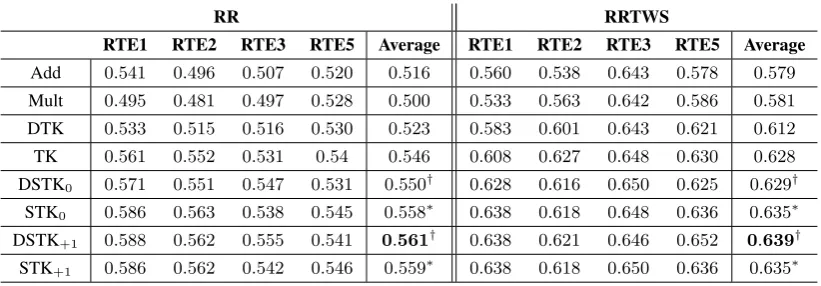
RR RRTWS
[image:8.595.94.505.61.204.2]RTE1 RTE2 RTE3 RTE5 Average RTE1 RTE2 RTE3 RTE5 Average Add 0.541 0.496 0.507 0.520 0.516 0.560 0.538 0.643 0.578 0.579 Mult 0.495 0.481 0.497 0.528 0.500 0.533 0.563 0.642 0.586 0.581 DTK 0.533 0.515 0.516 0.530 0.523 0.583 0.601 0.643 0.621 0.612 TK 0.561 0.552 0.531 0.54 0.546 0.608 0.627 0.648 0.630 0.628 DSTK0 0.571 0.551 0.547 0.531 0.550† 0.628 0.616 0.650 0.625 0.629† STK0 0.586 0.563 0.538 0.545 0.558∗ 0.638 0.618 0.648 0.636 0.635∗ DSTK+1 0.588 0.562 0.555 0.541 0.561† 0.638 0.621 0.646 0.652 0.639† STK+1 0.586 0.562 0.542 0.546 0.559∗ 0.638 0.618 0.650 0.636 0.635∗
Table 3: Task-based analysis: Accuracy on Recognizing Textual Entailment (†is different from DTK and TK wiht a stat.sig. ofp >0.1;∗the difference between the kernel and its distributed counterpart is not statistically significant.)
that is exactly what the token-based similarity is doing. Add slightly decreases the performance of the token-based similarity. TheMult model instead behaves very poorly. Comparing rows in the SS columns, we can discover thatDST K0 andDST K+1 behave significantly better thanDT K and that DST K0 behave better than the standard TK. Thus, our DSTKs are positively exploitng distributional semantic information along with structural information. Moreover, bothDST K0andDST K+1behave similarly to the corresponding models with standard kernels STKs. Results in this task confirm that structural and semantic information are both captured by CDSMs based on DSTs.
Table 3 is organized as follows: columns 2-6 report the accuracy of the RTE systems based on rewrite rules (RR) and columns 7-11 report the accuracies of RR systems along with token similarity (RRTS). Results on RTE are extremely promising as all the models including structural information and distribu-tional semantics have better results than the two baseline models with a statistical significance of93.7%. For RR modelsDT SK0,ST K0,DST K+1, andST K+1 have an average accuracy7.9%higher than Addand11.4%higher thanMultmodel. For RRTS, the same happens with an average accuracy9.58%
higher than Addand9.2%higher than the Mult. This task is more sensible to syntactic information than STS. As expected (Mehdad et al., 2010), STKs behave also better than tree kernels exploiting only syntactic information. But, more importantly, our CDSMs based on the DSTs are behaving similarly to these smoothed tree kernels, in contrast to what reported in (Zanzotto and Dell’Arciprete, 2011). In (Polajnar et al., 2013), it appears that results of the Zanzotto and Dell’Arciprete (2011)’s method are comparable to the results of STKs for STS, but this is mainly due to the flattening of the performance given by the lexical token similarity feature which is extremely relevant in STS. Even if distributed tree kernels do not approximate well tree kernels with distributed vectors dimension of1024, our smoothed versions of the distributed tree kernels approximate correctly the corresponding smoothed tree kernels. Their small difference is not statistically significant (less than70%). The fact that our DSTKs behave significantly better than baseline models in RTE and they approximate the corresponding STKs shows that it is possible to positively exploit structural information in CDSMs.
5 Conclusions and Future Work
Distributed Smoothed Trees (DST) are a novel class of Compositional Distributional Semantics Mod-els (CDSM) that effectively encode structural information and distributional semantics in tractable 2-dimensional tensors, as experiments show. The paper shows that DSTs contribute to close the gap be-tween two apparently different approaches: CDSMs and convolution kernels (Haussler, 1999). This contribute to start a discussion on a deeper understanding of the representation power of structural infor-mation of existing CDSMs.
References
Semantics (*SEM), Volume 1: Proceedings of the Main Conference and the Shared Task: Semantic Textual Similarity, pages 32–43, Atlanta, Georgia, USA, June. Association for Computational Linguistics.
[Aronszajn1950] N. Aronszajn. 1950. Theory of reproducing kernels.Transactions of the American Mathematical Society, 68(3):337–404.
[Baroni and Lenci2010] Marco Baroni and Alessandro Lenci. 2010. Distributional memory: A general framework for corpus-based semantics. Comput. Linguist., 36(4):673–721, December.
[Baroni and Zamparelli2010] Marco Baroni and Roberto Zamparelli. 2010. Nouns are vectors, adjectives are ma-trices: Representing adjective-noun constructions in semantic space. InProceedings of the 2010 Conference on
Empirical Methods in Natural Language Processing, pages 1183–1193, Cambridge, MA, October. Association
for Computational Linguistics.
[Chang and Lin2011] Chih-Chung Chang and Chih-Jen Lin. 2011. LIBSVM: A library for support vector ma-chines. ACM Transactions on Intelligent Systems and Technology, 2:27:1–27:27. Software available at
http://www.csie.ntu.edu.tw/˜cjlin/libsvm.
[Clark et al.2008] Stephen Clark, Bob Coecke, and Mehrnoosh Sadrzadeh. 2008. A compositional distributional model of meaning. Proceedings of the Second Symposium on Quantum Interaction (QI-2008), pages 133–140. [Collins and Duffy2002] Michael Collins and Nigel Duffy. 2002. New ranking algorithms for parsing and tagging:
Kernels over discrete structures, and the voted perceptron. InProceedings of ACL02.
[Corley and Mihalcea2005] Courtney Corley and Rada Mihalcea. 2005. Measuring the semantic similarity of texts.
InProc. of the ACL Workshop on Empirical Modeling of Semantic Equivalence and Entailment, pages 13–18.
Association for Computational Linguistics, Ann Arbor, Michigan, June.
[Cristianini and Shawe-Taylor2000] Nello Cristianini and John Shawe-Taylor. 2000. An Introduction to Support
Vector Machines and Other Kernel-based Learning Methods. Cambridge University Press, March.
[Croce et al.2011] Danilo Croce, Alessandro Moschitti, and Roberto Basili. 2011. Structured lexical similarity via convolution kernels on dependency trees. InProceedings of the Conference on Empirical Methods in Natural
Language Processing, EMNLP ’11, pages 1034–1046, Stroudsburg, PA, USA. Association for Computational
Linguistics.
[Dagan et al.2006] Ido Dagan, Oren Glickman, and Bernardo Magnini. 2006. The pascal recognising textual entailment challenge. In Quionero-Candela et al., editor,LNAI 3944: MLCW 2005, pages 177–190. Springer-Verlag, Milan, Italy.
[Dagan et al.2013] Ido Dagan, Dan Roth, Mark Sammons, and Fabio Massimo Zanzotto. 2013. Recognizing
Textual Entailment: Models and Applications. Synthesis Lectures on Human Language Technologies. Morgan
& Claypool Publishers.
[Dinu et al.2013] Georgiana Dinu, Nghia The Pham, and Marco Baroni. 2013. DISSECT: DIStributional SEman-tics Composition Toolkit. InProceedings of ACL (System Demonstrations), pages 31–36, Sofia, Bulgaria. [Ferrone and Zanzotto2013] Lorenzo Ferrone and Fabio Massimo Zanzotto. 2013. Linear compositional
distribu-tional semantics and structural kernels. InProceedings of the Joint Symposium of Semantic Processing (JSSP), pages –.
[Grefenstette and Sadrzadeh2011] Edward Grefenstette and Mehrnoosh Sadrzadeh. 2011. Experimental support for a categorical compositional distributional model of meaning. InProceedings of the Conference on Empirical
Methods in Natural Language Processing, EMNLP ’11, pages 1394–1404, Stroudsburg, PA, USA. Association
for Computational Linguistics.
[Haussler1999] David Haussler. 1999. Convolution kernels on discrete structures. Technical report, University of California at Santa Cruz.
[Kalchbrenner and Blunsom2013] Nal Kalchbrenner and Phil Blunsom. 2013. Recurrent convolutional neural net-works for discourse compositionality. Proceedings of the 2013 Workshop on Continuous Vector Space Models and their Compositionality.
[Mehdad et al.2010] Yashar Mehdad, Alessandro Moschitti, and Fabio Massimo Zanzotto. 2010. Syntac-tic/semantic structures for textual entailment recognition. InHuman Language Technologies: The 2010 Annual
Conference of the North American Chapter of the Association for Computational Linguistics, HLT ’10, pages
[Mitchell and Lapata2008] Jeff Mitchell and Mirella Lapata. 2008. Vector-based models of semantic composi-tion. InProceedings of ACL-08: HLT, pages 236–244, Columbus, Ohio, June. Association for Computational Linguistics.
[Polajnar et al.2013] Tamara Polajnar, Laura Rimell, and Douwe Kiela. 2013. Ucam-core: Incorporating struc-tured distributional similarity into sts. InSecond Joint Conference on Lexical and Computational Semantics
(*SEM), Volume 1: Proceedings of the Main Conference and the Shared Task: Semantic Textual Similarity,
pages 85–89, Atlanta, Georgia, USA, June. Association for Computational Linguistics.
[Socher et al.2011] Richard Socher, Eric H. Huang, Jeffrey Pennington, Andrew Y. Ng, and Christopher D. Man-ning. 2011. Dynamic pooling and unfolding recursive autoencoders for paraphrase detection. InAdvances in
Neural Information Processing Systems 24.
[Socher et al.2012] Richard Socher, Brody Huval, Christopher D. Manning, and Andrew Y. Ng. 2012. Semantic Compositionality Through Recursive Matrix-Vector Spaces. InProceedings of the 2012 Conference on
Empir-ical Methods in Natural Language Processing (EMNLP).
[Turney and Pantel2010] Peter D. Turney and Patrick Pantel. 2010. From frequency to meaning: Vector space models of semantics. J. Artif. Intell. Res. (JAIR), 37:141–188.
[Zanzotto and Dell’Arciprete2011] Fabio Massimo Zanzotto and Lorenzo Dell’Arciprete. 2011. Distributed struc-tures and distributional meaning. InProceedings of the Workshop on Distributional Semantics and Composi-tionality, pages 10–15, Portland, Oregon, USA, June. Association for Computational Linguistics.
[Zanzotto and Dell’Arciprete2012] F.M. Zanzotto and L. Dell’Arciprete. 2012. Distributed tree kernels. In
Pro-ceedings of International Conference on Machine Learning, pages 193–200.
[Zanzotto et al.2009] Fabio Massimo Zanzotto, Marco Pennacchiotti, and Alessandro Moschitti. 2009. A machine learning approach to textual entailment recognition. NATURAL LANGUAGE ENGINEERING, 15-04:551–582. [Zanzotto et al.2010] Fabio Massimo Zanzotto, Ioannis Korkontzelos, Francesca Fallucchi, and Suresh Manand-har. 2010. Estimating linear models for compositional distributional semantics. In Proceedings of the 23rd