A Separately Passive-Aggressive Training Algorithm for Joint
POS Tagging and Dependency Parsing
Zhenghua Li
1, Min Zhang
2, Wanxiang Che
1, Ting Liu
1∗ (1) Research Center for Social Computing and Information Retrieval,Harbin Institute of Technology, China (2) Institute for Infocomm Research, Singapore
{lzh,car,tliu}@ir.hit.edu.cn, [email protected]
A
BSTRACTRecent study shows that parsing accuracy can be largely improved by the joint optimization of part-of-speech (POS) tagging and dependency parsing. However, the POS tagging task does not benefit much from the joint framework. We argue that the fundamental reason behind is because the POS features are overwhelmed by the syntactic features during the joint optimization, and the joint models only prefer such POS tags that are favourable solely from the parsing viewpoint. To solve this issue, we propose a separately passive-aggressive learning algorithm (SPA), which is designed to separately update the POS features weights and the syntactic feature weights under the joint optimization framework. The proposed SPA is able to take advantage of previous joint optimization strategies to significantly improve the parsing accuracy, but also overcome their shortages to significantly boost the tagging accuracy by effectively solving the syntax-insensitive POS ambiguity issues. Experiments on the Chinese Penn Treebank 5.1 (CTB5) and the English Penn Treebank (PTB) demonstrate the effectiveness of our proposed methodology and empirically verify our observations as discussed above. We achieve the best tagging and parsing accuracies on both datasets, 94.60% in tagging accuracy and 81.67% in parsing accuracy on CTB5, and 97.62% and 93.52% on PTB.
K
EYWORDS:
Part-of-speech Tagging, Dependency Parsing, Joint Models, Separately Passive-aggressive Algorithm.1 Introduction
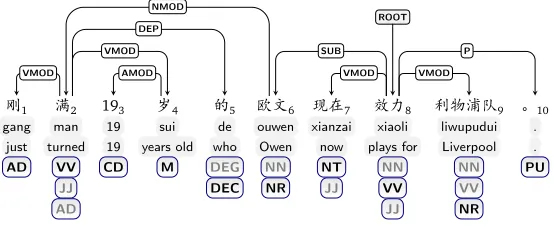
Given an input sentence ofnwords, denoted byx=w1...wn, part-of-speech (POS) tagging aims to find an optimal tag sequencet= t1...tn, where ti ∈ T (1≤ i ≤n) andT is a predefined tag set. POS tags are designed to represent word classes so that words of the same POS tag play a similar role in syntactic structures. The size ofT is usually much less than the vocabulary size. Typically, POS tagging is treated as a sequence labeling problem, and has been previously addressed by machine learning algorithms, such as maximum-entropy (Ratnaparkhi, 1996), conditional random fields (CRF) (Lafferty et al., 2001) and perceptron (Collins, 2002). Figure 1 gives an example sentence from Penn Chinese Treebank 5.1 (CTB5). The lowest three rows present the n-best POS tags for each word, produced by a state-of-the-art CRF model. Looking at the 1-best POS tags, we can see that the CRF model makes four errors, i.e.de/DEC→DEG,ouwen/NR→NN,xiaoli/VV→NN, andliwupudui/NR→NN. In fact,(DEC,DEG)and(NN,VV)ambiguities, which usually require long-distance syntactic knowledge to resolve, are very difficult for the sequential labeling models.
1 á2 193 4 5 '6 °(7 H8 )if9 10
gang man 19 sui de ouwen xianzai xiaoli liwupudui . just turned 19 years old who Owen now plays for Liverpool .
AD VV CD M DEG NN NT NN NN PU
JJ DEC NR JJ VV VV
AD JJ NR
ROOT
VMOD
NMOD
AMOD VMOD
DEP
SUB
VMOD VMOD
[image:2.420.65.342.221.334.2]P
Figure 1: An example from CTB5. The Pinyin transcriptions and English translations are presented in the two rows below the Chinese sentence. We prune out the implausible POS tags according to the marginal probabilities (see Section 4.1) and list the top three candidate POS tags in the lowest three rows (incorrect POS tags in grey color and correct ones in black color).
Dependency Parsing maps a natural language sentence into a structural dependency tree con-forming to a predefined dependency grammar, as depicted in Figure 1. A dependency tree is denoted byd={(h,m,l): 1≤h≤n, 1≤m≤n,l∈ L }, where(h,m,l)means a dependency from thehead word(also calledfather)whto themodifier(also calledchildordependent)wm with a dependency labell, andL is the label set. Dependency labels are used to indicate the syntactic or semantic relation between the two words. For instance, the dependency (8, 6,
SUB) in Figure 1 meansouwenis thesubjectofxiaoli.
dependency parsing (Li et al., 2011; Hatori et al., 2011; Bohnet and Nivre, 2012), motivated by the intuition that the two individual tasks should help each other. Their work demonstrates that the joint models can substantially boost the parsing accuracy. In contrast, the tagging subtask does not benefit much from the joint framework. (Li et al., 2011) show that the graph-based joint models lead to large decrease in the tagging accuracy, whereas (Hatori et al., 2011) and (Bohnet and Nivre, 2012) find small gains in the tagging accuracy with transition-based joint models (see Table 4). This is contradictory to the intuition that better syntactic structure should help POS disambiguation. The detailed error analysis in (Li et al., 2011) show that their joint models are helpful in resolving syntax-sensitive POS ambiguities like{VV,NN}and
{DEC,DEG}, but become very weak in disambiguating{NN,NR}and{NN,JJ}which usually play similar roles in syntactic trees.
We believe that one possible reason is that the graph-based joint models of (Li et al., 2011) is dominated by the syntactic features. Looking deeper into their joint models, we find that on average, the score corresponding to the POS features only is 1/50 of the score of the syntactic features in a returned joint result. In other words, the POS features have little impact on determining the best joint result. Therefore, the joint models prefer such POS tags that are more helpful and discriminative solely from the parsing viewpoint.
To address this issue, this paper proposes a variant of the passive-aggressive (PA) online train-ing algorithm (Crammer et al., 2003), which we name as separately passive-aggressive algo-rithm (SPA). SPA separately updates the POS feature weights and the syntactic feature weights and naturally raises the weights of the POS features under the joint optimization framework. As a result, SPA can make better use of the discriminative power of the POS features in resolv-ing the syntax-insensitive POS ambiguities, leadresolv-ing to a large taggresolv-ing accuracy improvement. On the other hand, the improved tagging accuracy can further help parsing. Specifically, we make the following contributions.
• We propose a separately passive-aggressive training algorithm for joint POS tagging and dependency parsing. Empirically, we compare SPA with averaged perceptron (AP) and PA from the perspective of the model score, showing that SPA is more suitable for the joint models. Experimental results demonstrate that SPA outperforms AP and PA in both the tagging and parsing accuracies. More importantly, SPA significantly improve both the tagging and parsing accuracies over the pipelined baselines.
• We present the first feature-rich graph-based joint model for POS tagging and labeled dependency parsing. We conduct experiments on two versions of CTB5 and achieve the best tagging and parsing accuracies on both datasets. Especially, our joint model trained with SPA achieves a tagging accuracy of 94.7%, largely outperforming the 93.9% of the baseline CRF model.
• We also conduct experiments on PTB to find out the effect of joint modeling on English. Thanks to relatively richer morphologies, English POS tagging achieves much higher accuracy than Chinese (97% vs. 94%). Therefore, English dependency parsing suffers less error propagation problem than Chinese. Nevertheless, we still find significant gains from the joint model. The tagging accuracy and the parsing accuracy increase by about 0.5% and 0.4% respectively. Our joint model achieves the best tagging and parsing accuracies on this dataset as well.
0.6-0.7% on the two Chinese datasets.
2 Related work
This work is most closely related to (Li et al., 2011) who present the first work on joint models for Chinese POS tagging and unlabeled dependency parsing. Similar to us, their joint models are based on graph-based dependency parsing. They find that the joint models largely outper-form the pipeline models in the parsing accuracy but lead to substantial tagging accuracy drop. Compared with their work, we propose a better training algorithm for the joint models that can improve both tagging and parsing accuracies. In addition, our joint model adopts richer features and handles labeled dependency parsing.
(Hatori et al., 2011) propose the first transition-based joint model for Chinese POS tagging and unlabeled dependency parsing and gain large improvement in the parsing accuracy. How-ever, their joint models only slightly improve the tagging accuracy over a sequential tagging model. (Bohnet and Nivre, 2012) propose a transition-based joint model which can handle la-beled non-projective dependency parsing. They conduct experiments on a variety of languages including Chinese, English, Czech, and German. Similarly, their joint model largely improves the parsing accuracy but only slightly increases the tagging accuracy. Differently, we are the first work on joint POS tagging and dependency parsing that achieves large improvement in the tagging accuracy.
(Smith and Eisner, 2008) apply loopy belief propagation (LBP) to dependency parsing and points out that LBP can naturally represent POS tags as latent variables so that the POS tags can be inferred jointly with the parse. (Lee et al., 2011) extend the LBP based approach of (Smith and Eisner, 2008) and study joint morphological disambiguation and dependency pars-ing for morphologically-rich languages includpars-ing Latin, Czech, Ancient Greek, and Hungarian. For these languages, morphological analysis requires the disambiguation of POS tags, gender, case, etc. They show that the joint model can well capture the interaction between morphology and syntax and achieve gains on both subtasks. (Rush et al., 2010) propose dual decomposi-tion (DD) for integrating different NLP subtasks at the test phase. They experiment with two cases, one integrating a phrase-structure parser and a dependency parser, and the other inte-grating a phrase-structure parser and a POS tagger. Both cases show that DD can help the individual subtasks. (Auli and Lopez, 2011) conduct an extensive comparison of LBP and DD for joint CCG supertagging and parsing. They show that LBP and DD achieves similar parsing accuracy improvement but has largely different convergence characteristics. Moreover, their work focuses on integrating two separately-trained sub-models, and they find that training the integrated model on LBP leads to large improvement drops compared with separately-trained models.
3 Pipeline POS tagging and dependency parsing
The pipeline method treats POS tagging and dependency parsing as two cascaded problems. First, an optimal POS tag sequenceˆtis determined.
ˆt=arg max
t Scorepos(x,t) (1)
Then, an optimal dependency treeˆdis determined based onxandˆt. ˆ
d=arg max
h m
(a)single dependency
h s
(b) adjacent sibling
m h m
(c) outermost grandchild g
[image:5.420.135.300.67.107.2]l l l
Figure 2: Three types of scoring subtrees used in our parsing and joint models.
Feature category Atomic features incorporated
Dependency featuresfdep(x,t,h,m,l) l,wh,wm,th,tm,th±1,tm±1,tb,dir(h,m),dist(h,m)
[image:5.420.125.310.420.500.2]Sibling featuresfsib(x,t,h,m,l,s) l,wh,ws,wm,th,tm,ts,th±1,tm±1,ts±1,dir(h,m),dist(h,m) Grandchild featuresfgrd(x,t,h,m,l,g) l,wh,wm,wg,th,tm,tg,th±1,tm±1,tg±1,dir(h,m),dir(m,g)
Table 1: Brief illustration of the syntactic features. bis an index betweenhandm. dir(i,j) anddist(i,j)denote the direction and distance of the dependency(i,j). Please refer to Table 4 of (Bohnet, 2010) for the complete feature list.
CRF-based POS tagging.We adopt the first-order CRF to build our baseline POS tagger. As a
conditional log-linear probabilistic model, CRF defines the probability of a tag sequence as
P(t|x) =exp(Scorepos(x,t))/X
t′
exp(Scorepos(x,t′))
Scorepos(x,t) =wpos·fpos(x,t) = X
1≤i≤n
wpu·fpu(x,ti) +wpb·fpb(x,ti−1,ti) (3)
wherefpos/pu/pb(.)refers to the feature vectors andwpos/pu/pbis the corresponding weight vec-tors. We callfpu(x,ti)thePOS unigram features, andfpb(x,ti−1,ti)thePOS bigram features. For Chinese, we adopt the features proposed by (Zhang and Clark, 2008a). They use Chinese characters contained in a word to compose rich features, which turns out to be helpful for low-frequency words. For English, we adopt the features of (Ratnaparkhi, 1996) which exploit suffixes and prefixes to improve tagging performance over rare words.
Second-order graph-based dependency parsing. The graph-based approach views
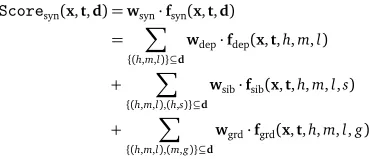
depen-dency parsing as finding a highest scoring tree in a directed graph (McDonald et al., 2005; Carreras, 2007; Koo and Collins, 2010). We adopt the second-order model of (Carreras, 2007) since previous studies show that it leads to best parsing accuracy on a variety of languages (Koo and Collins, 2010; Bohnet, 2010). The score of a dependency tree is factored into scores of the three kinds of subtrees in Figure 2.
Scoresyn(x,t,d) =wsyn·fsyn(x,t,d)
= X
{(h,m,l)}⊆d
wdep·fdep(x,t,h,m,l)
+ X
{(h,m,l),(h,s)}⊆d
wsib·fsib(x,t,h,m,l,s)
+ X
{(h,m,l),(m,g)}⊆d
wgrd·fgrd(x,t,h,m,l,g)
(4)
each feature category in Table 1. For unlabeled parsing and joint models, the labellis omitted. Compared with the syntactic features used in (Li et al., 2011), this feature set explores more context POS tags includingts±1,tg±1. In addition, for Chinese, we use the last character of each word as its lemma, and duplicate each word-related feature by replacing words with lemmas (Che et al., 2012). Experiments on CTB5 show that these lemma-related features can improve our baseline parsing models by 0.3-0.4% in UAS. For English, we use coarse-grained POS tags to duplicate all the feature that depend on POS tags (Koo and Collins, 2010), resulting in a 0.4% UAS gain on PTB.
4 Joint POS tagging and dependency parsing
In the joint framework, we aim to simultaneously solve the two problems.
(ˆt,dˆ) =arg max
t,d Scorejoint(x,t,d) (5)
The score of a tagged dependency tree is the combination of the POS score and the syntactic score that are previously defined in the pipeline models.
Scorejoint(x,t,d) =Scorepos(x,t) +Scoresyn(x,t,d) =wpos·fpos(x,t) +wsyn·fsyn(x,t,d)
=wpos⊕syn·fpos⊕syn(x,t,d) =wjoint·fjoint(x,t,d)
(6)
where⊕denotes vector concatenation. Note that our joint model incorporates the same POS and syntactic features with the pipeline models. Under the joint model, the weights of POS and syntactic features, denoted bywpos⊕synorwjoint, are simultaneously learned. Therefore, they can interact with each other to determine an optimal joint result.
4.1 Decoding
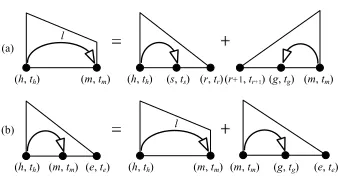
Similar to (Li et al., 2011), we extend the parsing algorithm of (Carreras, 2007) using the idea of (Eisner, 2000) and propose a dynamic programming (DP) based decoding algorithm for our joint model. Figure 3 illustrates the basic DP structures and operations. The key idea is to augment the basic DP structures in the parsing algorithm (namelyspans) with a few POS tags. A span means a partially built structure spanning a sub-sentence. For example, the left-side span in Figure 3(a), which is called anincomplete spanand is denoted by I(h,m,l)(th,tm), represents a partial tree spanningwh...wmwithwhbeing tagged as thandwmastm. The left-side span in Figure 3(b) is a complete span and is denoted byC(e)(te)
(h,m)(th,tm).
The decoding algorithm works in a bottom-up fashion and combines two smaller spans into a larger one at each step. During combination, the newly-introduced features are incorpo-rated and the score of the span is computed accordingly. For example, the operation in Figure 3(a) introduces five feature sets, i.e. fdep(x,th,tm,h,m,l), fsib(x,th,tm,ts,h,m,l,s),
(h, th) (s, ts) (r, tr) (h, th) (m, tm)
l
(r+1, tr+1) (g, tg) (m, tm)
(h, th) (m, tm) (h, th) (e, te)
l
(g, tg) (e, te) (m, tm) (m, tm)
(a)
[image:7.420.132.301.67.155.2](b)
Figure 3: An illustration of the dynamic programming based decoding algorithm for our joint model. We omit the creation of right-headed spans for brevity.
likely POS tags provided by the baseline CRF tagging model following (Li et al., 2011). They find that this approximation substantially improves the efficiency of their joint models without accuracy loss. The time complexity of the algorithm isO(|L |n4q5), and the space complexity isO(|L |n2q2+n3q3)where q is the tag number of each word (≤ |T |).
POS tag pruning. Since the time complexity is high in terms ofq, we follow (Li et al., 2011)
and prune out the lower-probability POS tags for each word based on their marginal probabil-ities provided by our baseline CRF model. After pruning, each word has 1.4 candidate POS tags on average and the oracle tagging accuracy is 99.27% on CTB5. On PTB, each word has 1.2 candidate POS tags and the oracle is 99.71%.
Dependency pruning. The parsing time grows quickly with n. Therefore, we train a
CRF-based first-order dependency parser to eliminate the unlikely dependencies following (Charniak and Johnson, 2005; Petrov and Klein, 2007; Koo and Collins, 2010). After pruning, 31.3% of the dependencies are left and the oracle dependency accuracy (UAS) is 99.77% on CTB5. On PTB, 28.9% of the dependencies are retained and the oracle UAS is 99.91%.
5 A separately passive-aggressive training algorithm
Online training has proven successful in several structured classification problems such as POS tagging (Collins, 2002) and parsing (McDonald et al., 2005; Zhang and Clark, 2011). Algo-rithm 1 shows the generic framework of online training when applied to our joint task. Online training iteratively traverses the entire training dataset and use one instance to update the fea-ture weights at each time. First, the best result for the instance is found based on the current feature weights (line 6). Then, the feature weights are updated by comparing the best result and the gold-standard reference (line 7).
According to the update criterion, three different online training algorithms are widely used in parsing community, i.e. averaged perceptron (AP)(Collins, 2002),passive-aggressive
algorithm (PA) (Crammer et al., 2003), and margin infused relaxed algorithm (MIRA)
Algorithm 1Generic online training for joint POS tagging and dependency parsing 1.Input:Training DataD={(x(j),t(j),d(j))}N
j=1 2.Output: wjoint(≡wpos⊕syn)
3.Initialization: w(0)
joint=0;v=0;k=0 4.fori=1toIdo//iterations
5. forj=1toNdo//traverse the samples
6. (ˆt,dˆ) =arg maxt,dwjoint(k) ·fjoint(x(j),t,d)//decode based on current feature weights. 7. w(k+1)
joint =updatew(
k)
jointwith(x(j),t(j),ˆt,d(j),ˆd)//update weights according to some criterion. 8. v=v+w(k+1)
joint 9. k=k+1
10. end for
11.end for
12.wjoint=v/(I×N)//average the weights
All algorithms adopt the update direction of the distance between the reference feature vector fjoint(x(j),t(j),d(j))and the feature vector of the best resultfjoint(x(j),ˆt,ˆd). However, different strategies are adopted to determine the update step. AP uses a constant update step of 1.
AP n
w(k+1)joint =w(k)joint+fjoint(x(j),t(j),d(j))−fjoint(x(j),ˆt,dˆ) (7)
PA computes the update stepτjointby considering the loss of the best result, the score distance, and the feature vector distance.
PA
τjoint=
Scorejoint(x(j),ˆt,dˆ)−Scorejoint(x(j),t(j),d(j)) +ρpos(t(j),ˆt) +ρsyn(d(j),dˆ) kfjoint(x(j),t(j),d(j))−fjoint(x(j),ˆt,ˆd)k2
w(k+1)joint =w(k)joint+τjoint(fjoint(x(j),t(j),d(j))−fjoint(x(j),ˆt,ˆd))
(8)
whereρpos(t(j),ˆt)is the incorrect POS tag number inˆtaccording tot(j), andρsyn(d(j),dˆ)is the dependency error number inˆdaccording tod(j). Following (Johansson and Nugues, 2008),
ρsyn(d(j),dˆ)increases by 1 for an incorrect dependency and by 0.5 for a correct dependency with a wrong label. Theoretically, Eq. 8 computes the smallest update that makes the correct hypothesis outscores the returned highest-scoring hypothesis by the overall error.
We can see that AP and PA use the same update step for the POS featuresfpos(.)and syntactic featuresfsyn(.). Therefore, the weights of the POS features and the syntactic features are of the same scale after training is completed. We argue that this is problematic since the number of the syntactic features are much larger than the number of the POS features. We find that infjoint(x(j),ˆt,dˆ),fsyn(x(j),ˆt,ˆd)contains more than 3,000 non-zero features, whereasfpos(x(j),ˆt) only has less than 200 non-zero features on average. As a result, the model is dominated by the syntactic features and the POS features would play a very limited role in determining the best joint result. Actually, we find that the POS features contribute a very small part to the score of the best joint results when trained with AP or PA (see Figure 5).
computes two update steps for the POS features and the syntactic features.
SPA
τpos=
Scorepos(x(j),ˆt)−Scorepos(x(j),t(j)) +ρpos(t(j),ˆt) kfpos(x(j),t(j))−fpos(x(j),ˆt)k2
τsyn=
Scoresyn(x(j),ˆt,ˆd)−Scoresyn(x(j),t(j),d(j)) +ρsyn(d(j),dˆ) kfsyn(x(j),t(j),d(j))−fsyn(x(j),ˆt,ˆd)k2
w(k+1)
pos =w(k)pos+τpos(fpos(x(j),t(j))−fpos(x(j),ˆt))
w(k+1)
syn =w(k)syn+τsyn(fsyn(x(j),t(j),d(j))−fsyn(x(j),ˆt,dˆ))
(9)
Analogous to PA, Eq. 9 separately finds the smallest update to the POS feature weights that makes the POS score of the correct hypothesis higher than the POS score of the returned highest-scoring hypothesis by the POS error, and the smallest update to the syntactic feature weights that makes the syntactic score of the correct hypothesis higher than the syntactic score of the returned highest-scoring one by the syntactic error. Note that Eq. 9 sometimes leads to negativeτposorτsyn, because the correct hypothesis already has a POS or syntactic subscore larger than the 1-best one but the deficiency is entirely confined to the other subscore. However, such cases are rare. We just set the update step to zero when it is negative. Sincefpos(.)contains much less non-zero features thanfsyn(.),kfpos(x(j),t(j))−fpos(x(j),ˆt)k2is much smaller thankfsyn(x(j),t(j),d(j))−fsyn(x(j),ˆt,dˆ)k2. Therefore,τposis much larger than
τsyn. Our experiments show thatτposis about 10 times larger thanτsynon average. This means that the POS features are updated in much larger step than the syntactic features. As a result, the POS features play a more important role in the joint models. We find that the POS score becomes much closer to the syntactic score in the best joint results (see Figure 5). As discussed in Section 1, (Li et al., 2011) find that their joint models trained with AP are good at resolving syntax-sensitive POS ambiguities like{VV,NN}, whereas their baseline sequential POS tagging model does well in disambiguating the syntax-insensitive ones like{NN,NR}. We believe that it is because the discriminative power of the POS features in resolving such syntax-insensitive POS ambiguities are suppressed in the joint models when trained with AP or PA. Compared with AP and PA, SPA raises the weight of the POS features and can better utilize the disambiguation power of both the POS and syntactic features, leading to large tagging accuracy boost. On the other hand, better tagging results can further help parsing.
6 Experiments
Data. We conduct experiments on CTB5 (Xue et al., 2005). Following the standard
prac-tice, we adopt the data split of (Duan et al., 2007; Zhang and Clark, 2008b; Huang and Sagae, 2010) and adopt Penn2Malt2for constituent-to-dependency conversion with the head-finding rules of (Zhang and Clark, 2008b).
We also evaluate our models on another version of CTB5 used in (Bohnet and Nivre, 2012) to compare with their joint model. We thank Bernd Bohnet for sharing their dataset. We refer to their dataset as CTB5-Bohnet. We carefully compare CTB5 with CTB5-Bohnet and find that except for the mismatch of about 30 sentence, the datasets differ in both dependency structures and dependency labels. After discussions with Bernd Bohnet, we find out that they adopt Yue Zhang’s constituent-to-dependency conversion tool3whereas we use Penn2Malt for
Corpus Train Dev Test CTB5 16,091 803 1,910 CTB5-Bohnet 16,069 803 1,905 PTB 39,832 1,346 2,416
Table 2: Data used in this work (in sentence number).
82.9 83.1 83.3 94.6 94.7 94.8 81.1 81.3 81.5 81.7 81.9 82.1 82.3 82.5 82.7 82.9 83.1 83.3 U A S 94 94.1 94.2 94.3 94.4 94.5 94.6 94.7 94.8 P O S A cc u ra cy 80.5 80.7 80.9 81.1 81.3
1 3 5 7 9 11 13 15 17 19
Iteration Number
SPA PA AP
93.8 93.9 94 94.1
1 3 5 7 9 111315 1719
Iteration Number
SPA PA AP
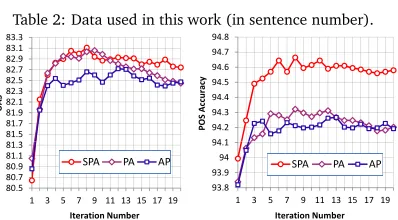
Figure 4: Training curves of UAS and POS tagging accuracy of the unlabeled joint model using SPA/PA/AP on the CTB5 development dataset.
CTB5, although the head-finding rules are the same.
For English, we adopt PTB (sec 02-21 for training, sec 24 for development, sec 23 for test) and convert the original bracketed structures into dependencies using Penn2Malt with its default head-finding rules. Table 2 summarizes the data sets used in the present work.
Evaluation metrics.We use the standardPOS tagging accuracy (POS)to evaluate POS tagging.
For dependency parsing, we useunlabeled attachment score (UAS)andlabeled attachment score (LAS)(all excluding punctuation) (Hajiˇc et al., 2009).
6.1 Experiments on CTB5
6.1.1 Comparison of the three training algorithms
The curves in Figure 4 show the performance of the unlabeled joint model on the development dataset using SPA/PA/AP after each iteration during training. We can see that the PA outper-forms AP in both UAS and tagging accuracy. SPA achieves a slightly higher peak UAS than PA, and substantially outperforms both PA and AP in tagging accuracy. In addition, Figure 4 empirically indicates that SPA can converge as fast as AP and PA. We leave the theoretic proof of the convergence of SPA in the future work.
0 1 2 3 4 5 6 7 8 9 10
1 4 710 13 16 19
lo g10 ( S c o r e ) Iteration Number SPA pos syn 0 1 2 3 4 5 6 7 8 9 10
1 4 7 10 13 16 19
Iteration Number AP pos syn 0 1 2 3 4 5 6 7 8 9 10
1 4 710 13 16 19
Iteration Number PA
[image:11.420.125.310.71.156.2]pos syn
Figure 5: Model score analysis on the CTB5 development dataset. “pos” and “syn” refer to
Scorepos(.)andScoresyn(.)(see Eq. 6).
UAS POS SPA 81.21 94.51
[image:11.420.174.259.195.248.2]PA 80.98 94.18 AP 80.94 94.17 pipeline 80.22 93.88
Table 3: Performance of three training algorithms on the CTB5 test dataset.
As a result, the POS features can make more contributions, and the discriminative power of the syntactic features in resolving the syntax-sensitive ambiguities and the power of the POS features in the syntax-insensitive POS ambiguities can be better balanced. We believe this is the reason behind the improvement in tagging accuracy.
Table 3 reports the results of our unlabeled joint model trained with SPA/PA/AP on the CTB5 test dataset. We adopt the parameters which lead to the best parsing accuracy on the develop-ment dataset as shown in Figure 4. We also present the performance of our pipelined unlabeled parsing model trained with PA. Different to (Li et al., 2011), our joint models trained with AP or PA both outperform our baseline POS tagging model by about 0.3%. We believe that this may be due to the richer syntactic features incorporated in our joint models. Moreover, SPA can outperform both PA and AP in tagging accuracy by more than 0.3%, which is an error re-duction of 5%. Meanwhile, SPA also improves UAS by about 0.2% since better tagging results help parsing. This again demonstrates the effectiveness of the proposed SPA.
6.1.2 Main results
Table 4 shows the final results on the CTB5 test set. Three sets of results are presented. For “gold POS” and “pipeline”, we train the parsing models with PA. For “joint” models, we adopt SPA. For each case, we train our models with two different settings, one labeled and one unlabeled, to study the effect of dependency labels. We can see that we achieve best results on all three cases. Specifically, a few interesting conclusions can be drawn.
• Labeling the dependencies during parsing improves UAS by 0.6%/0.5% in the pipeline and joint cases and by 0.2% when using gold-standard POS tags. Dependency labels also slightly help POS tagging in the joint case.
Models LAS UAS POS
joint
Ours (labeled) 79.01 81.67 94.60
Ours (unlabeled) — 81.21 94.51 (Li et al., 2011) — 80.74 93.08 (Hatori et al., 2011) — 81.33 93.94
pipeline
Ours (labeled) 77.80 80.82 93.88
Ours (unlabeled) — 80.22 (Li et al., 2011) — 79.29 93.51 (Hatori et al., 2011) — 78.04 93.82
gold POS
Ours (labeled) 85.36 86.76
100.0 Ours (unlabeled) — 86.55
[image:12.420.102.302.71.233.2](Li et al., 2011) — 86.18 (Hatori et al., 2011) — 85.96 (Zhang and Nivre, 2011) 84.4 86.0 (Huang and Sagae, 2010) — 85.20
Table 4: Final results on the CTB5 test dataset.
0
50 100 150 200 250 300 350 400 450 500
A
b
s
o
lu
t
e
E
r
r
o
r
N
u
m
b
e
r
POS Error Patterns pipeline
Li et al. (2011)
[image:12.420.109.297.230.351.2]joint (SPA)
Figure 6: Statistics for different POS error patterns on the CTB5 test dataset.
tagging accuracy by 0.6-0.7%, which is an error reduction of 10%.
• Our joint models largely outperforms their pipeline counterparts by 0.9-1.0% in UAS and 1.2% in LAS.
6.1.3 Analysis
CRF-Models LAS UAS POS
joint
Ours (labeled) 80.18 83.14 94.71
Ours (unlabeled) — 82.37 94.65 (Bohnet and Nivre, 2012) 77.91 81.42 93.24
pipeline
Ours (labeled) 79.01 82.07 93.89
[image:13.420.117.317.70.141.2]Ours (unlabeled) — 81.38 (Bohnet and Nivre, 2012) 76.79 80.33 92.81
Table 5: Final results on the CTB5-Bohnet test dataset.
Models LAS UAS POS
joint
Ours (labeled) 92.44 93.52 97.62
Ours (unlabeled) — 93.12 97.62
(Bohnet and Nivre, 2012) 92.44 93.38 97.33 (Bohnet and Nivre, 2012) † 92.68 93.67 97.42
pipeline
Ours (labeled) 92.00 93.14 97.16 Ours (unlabeled) — 92.85 (Bohnet and Nivre, 2012) 91.71 92.79 97.28
(Zhang and Nivre, 2011) — 92.9 — (Martins et al., 2010) — 93.26 — (Koo and Collins, 2010) — 93.04 — (Huang and Sagae, 2010) — 92.1 — (Koo et al., 2008) † — 93.16 — (Carreras et al., 2008) † — 93.5 — (Suzuki et al., 2009) † — 93.79 —
Table 6: Final results on the PTB test dataset. Results marked by † use additional resources and are therefore not directly comparable to the others.
based tagging model on the syntax-insensitive ambiguities and meanwhile similarly to the joint model of (Li et al., 2011) on the syntax-sensitive ambiguities. This demonstrates that SPA can better balance the discriminative power of both the POS and syntactic features.
6.2 Experiments on CTB5-Bohnet
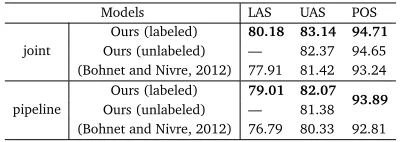
We conduct experiments on CTB5-Bohnet to make comparison with the recent results of (Bohnet and Nivre, 2012). Table 5 presents the results. We can see that our pipeline and joint models largely outperform those of (Bohnet and Nivre, 2012). Moreover, the parsing ac-curacies on this dataset are much higher than those on CTB5 due to the different conversion strategy. We will study the reasons in the future work. Again, we find that labeled parsing can largely improve UAS.
6.3 Experiments on PTB
[image:13.420.116.318.164.312.2]tag-0
20 40 60 80 100 120 140 160
A
b
s
o
lu
t
e
E
r
r
o
r
N
u
m
b
e
r
POS Error Patterns pipeline
[image:14.420.136.270.69.162.2]joint (SPA)
Figure 7: Statistics for different POS error patterns on the PTB test dataset.
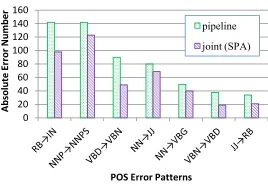
ging accuracy on English is much higher (97% vs. 94%). However, we still find that our joint models can obtain a 0.3-0.4% gain in UAS, a 0.4% gain in LAS, and a 0.5% gain in tagging accuracy. Similar to the findings on the Chinese datasets, we demonstrate that labeled pars-ing can boost UAS by 0.3-0.4% on English. Our labeled joint model outperforms the one of (Bohnet and Nivre, 2012) by 0.1% in UAS and 0.3% in tagging accuracy. Actually, our labeled joint model achieves the best parsing and tagging accuracy on PTB.
We compare the POS tagging results of the unlabeled joint model and the baseline tagging model. Figure 7 shows a few high-frequency error patterns. We can see that the joint model can help resolve a variety of POS ambiguities. For example, the error number ofRB→IN
(adverbs wrongly tagged as prepositions or subordinating conjunctions) are reduced from 142 to 98, which is a 31% error reduction. Also, the ambiguous pair{VBD, VBN}(verbs of past tense, verbs of past participle) are much better disambiguated by the joint model.
Conclusions
This paper presents a separately passive-aggressive training algorithm (SPA) for joint POS tagging and labeled dependency parsing models. We show that SPA can more properly learn the feature weights than the averaged perceptron (AP) and the passive aggressive algorithm (PA) and can better balance the discriminative power of the POS feature in resolving the insensitive POS ambiguities and the power of the syntactic features in resolving the syntax-sensitive ambiguities, leading to large tagging accuracy improvement. On the other hand, better POS tagging can further help parsing.
For future work, we are interested in studying SPA from the theoretic perspective and try to provide more insights and justifications of its effectiveness in training the joint models. Besides, although this paper focuses on graph-based joint models, we believe that SPA can also be applied to transition-based joint models (Hatori et al., 2011; Bohnet and Nivre, 2012).
Acknowledgements
References
Auli, M. and Lopez, A. (2011). A comparison of loopy belief propagation and dual decomposi-tion for integrated ccg supertagging and parsing. InProceedings of the 49th Annual Meeting of the Association for Computational Linguistics: Human Language Technologies, pages 470–480, Portland, Oregon, USA. Association for Computational Linguistics.
Bohnet, B. (2010). Top accuracy and fast dependency parsing is not a contradiction. In Proceedings of the 23rd International Conference on Computational Linguistics (Coling 2010), pages 89–97, Beijing, China. Coling 2010 Organizing Committee.
Bohnet, B. and Nivre, J. (2012). A transition-based system for joint part-of-speech tagging and labeled non-projective dependency parsing. InProceedings of the 2012 Joint Conference on Empirical Methods in Natural Language Processing and Computational Natural Language Learning, pages 1455–1465, Jeju Island, Korea. Association for Computational Linguistics.
Carreras, X. (2007). Experiments with a higher-order projective dependency parser. In Pro-ceedings of EMNLP/CoNLL, pages 141–150.
Carreras, X., Collins, M., and Koo, T. (2008). Tag, dynamic programming, and the perceptron for efficient, feature-rich parsing. InCoNLL 2008: Proceedings of the Twelfth Conference on
Computational Natural Language Learning, pages 9–16, Manchester, England. Coling 2008
Organizing Committee.
Charniak, E. and Johnson, M. (2005). Coarse-to-fine n-best parsing and maxent discrimina-tive reranking. InProceedings of ACL-05, pages 173–180.
Che, W., Spitkovsky, V., and Liu, T. (2012). A comparison of chinese parsers for stanford dependencies. InProceedings of the 50th Annual Meeting of the Association for Computational Linguistics (Volume 2: Short Papers), pages 11–16, Jeju Island, Korea. Association for Compu-tational Linguistics.
Collins, M. (2002). Discriminative training methods for hidden markov models: Theory and experiments with perceptron algorithms. InProceedings of EMNLP 2002.
Crammer, K., Dekel, O., Keshet, J., Shalev-Shwartz, S., and Singer, Y. (2003). Online passive aggressive algorithms. InProcedings of NIPS 2003.
Crammer, K. and Singer, Y. (2001). Ultraconservative online algorithms for multiclass prob-lems.Journal of Machine Learning Research, 3.
Duan, X., Zhao, J., , and Xu, B. (2007). Probabilistic models for action-based Chinese depen-dency parsing. InProceedings of ECML/ECPPKDD.
Eisner, J. (2000). Bilexical grammars and their cubic-time parsing algorithms. InAdvances in Probabilistic and Other Parsing Technologies, pages 29–62.
Hatori, J., Matsuzaki, T., Miyao, Y., and Tsujii, J. (2011). Incremental joint pos tagging and dependency parsing in chinese. InProceedings of 5th International Joint Conference on
Natural Language Processing, pages 1216–1224, Chiang Mai, Thailand. Asian Federation of
Natural Language Processing.
Huang, L. and Sagae, K. (2010). Dynamic programming for linear-time incremental parsing. InProceedings of the 48th Annual Meeting of the Association for Computational Linguistics, pages 1077–1086, Uppsala, Sweden. Association for Computational Linguistics.
Johansson, R. and Nugues, P. (2008). Dependency-based semantic role labeling of PropBank. InEMNLP-2008.
Koo, T., Carreras, X., and Collins, M. (2008). Simple semi-supervised dependency parsing. In
Proceedings of ACL-08: HLT, pages 595–603, Columbus, Ohio. Association for Computational
Linguistics.
Koo, T. and Collins, M. (2010). Efficient third-order dependency parsers. InProceedings of the 48th Annual Meeting of the Association for Computational Linguistics, pages 1–11, Uppsala, Sweden. Association for Computational Linguistics.
Lafferty, J., McCallum, A., and Pereira, F. (2001). Conditional random fields: Probabilistic models for segmenting and labeling sequence data. InProceedings of ICML 2001, pages 282– 289.
Lee, J., Naradowsky, J., and Smith, D. A. (2011). A discriminative model for joint morpho-logical disambiguation and dependency parsing. InProceedings of the 49th Annual Meeting of the Association for Computational Linguistics: Human Language Technologies, pages 885–894, Portland, Oregon, USA. Association for Computational Linguistics.
Li, Z., Zhang, M., Che, W., Liu, T., Chen, W., and Li, H. (2011). Joint models for chinese pos tagging and dependency parsing. InEMNLP 2011, pages 1180–1191.
Martins, A., Smith, N., Xing, E., Aguiar, P., and Figueiredo, M. (2010). Turbo parsers: Depen-dency parsing by approximate variational inference. InProceedings of the 2010 Conference on Empirical Methods in Natural Language Processing, pages 34–44, Cambridge, MA. Association for Computational Linguistics.
McDonald, R., Crammer, K., and Pereira, F. (2005). Online large-margin training of depen-dency parsers. InProceedings of ACL 2005, pages 91–98.
Petrov, S. and Klein, D. (2007). Improved inference for unlexicalized parsing. InProceedings of NAACL 2007.
Ratnaparkhi, A. (1996). A maximum entropy model for part-of-speech tagging. InProceedings of EMNLP 1996.
Rush, A. M., Sontag, D., Collins, M., and Jaakkola, T. (2010). On dual decomposition and linear programming relaxations for natural language processing. InProceedings of the 2010 Conference on Empirical Methods in Natural Language Processing, pages 1–11.
Smith, D. A. and Eisner, J. (2008). Dependency parsing by belief propagation. InProceedings
Suzuki, J., Isozaki, H., Carreras, X., and Collins, M. (2009). An empirical study of semi-supervised structured conditional models for dependency parsing. InProceedings of the 2009 Conference on Empirical Methods in Natural Language Processing, pages 551–560, Singapore. Association for Computational Linguistics.
Xue, N., Xia, F., Chiou, F.-D., and Palmer, M. (2005). The Penn Chinese Treebank: Phrase structure annotation of a large corpus. InNatural Language Engineering, volume 11, pages 207–238.
Zhang, Y. and Clark, S. (2008a). Joint word segmentation and POS tagging using a single perceptron. InProceedings of ACL-08: HLT, pages 888–896.
Zhang, Y. and Clark, S. (2008b). A tale of two parsers: Investigating and combining graph-based and transition-graph-based dependency parsing. InProceedings of the 2008 Conference on Empirical Methods in Natural Language Processing, pages 562–571, Honolulu, Hawaii. Associ-ation for ComputAssoci-ational Linguistics.
Zhang, Y. and Clark, S. (2011). Syntactic processing using the generalized perceptron and beam search.Computational Linguistics, 37(1):105´lC151.
Zhang, Y. and Nivre, J. (2011). Transition-based dependency parsing with rich non-local features. InProceedings of the 49th Annual Meeting of the Association for Computational
Lin-guistics: Human Language Technologies, pages 188–193, Portland, Oregon, USA. Association