Computing Semantic Representation: Towards ACG Abstract Terms as
Derivation Trees
Sylvain Pogodalla
LORIA - Campus Scientifique
BP239
F-54602 Vandœuvre-l`es-Nancy – France
[email protected]
Abstract
This paper proposes a process to build semantic representation for Tree Adjoining Grammars (TAGs) analysis. Being in the derivation tree tradition, it proposes to reconsider derivation trees as abstract terms (λ-terms) of Abstract Categorial Grammars (ACGs). The latter of-fers a flexible tool for expliciting composition-ality and semantic combination. The chosen semantic representation language here is an un-derspecified one. The ACG framework allows to deal both with the semantic language and the derived tree language in an equivalent way: as concrete realizations of the abstract terms. Then, in the semantic part, we can model lin-guistic phenomena usually considered as diffi-cult for the derivation tree approach.
Introduction
When dealing with the computation of semantic repre-sentation for TAG analysis, two main approaches are usu-ally considered. The first one gives the derivation trees a central role for the computation (Schabes and Shieber, 1994; Candito and Kahane, 1998; Kallmeyer, 2002; Joshi et al., 2003), and the second one relies on a direct compu-tation on the derived tree (Frank and van Genabith, 2001; Gardent and Kallmeyer, 2003).
The present article wants to explore the intuition that the two approaches are indeed bound: derivation trees are a specification of the operations that are to be processed, but the derived trees hold the precise descriptions of these operations. We propose to exhibit those operations by separating them from the syntactic trees. Then, under the specifications given by the derivation trees, we show how to build the semantic representations.
The tools we use for this purpose are Abstract Cate-gorial Grammars (ACGs) (de Groote, 2001). The main
feature of an ACG is to generate two languages: an
stract language and an object language. Whereas the
ab-stract language may appear as a set of grammatical or parse structures, the object language may appear as its realization, or the concrete language it generates. For in-stance, (de Groote, 2002) proposes as object language the tree language of TAGs (encoded in linearλ-terms) and, as abstract language, a tree language (also encoded in linearλ-terms) and very close to the derivation tree
lan-guage. In this paper, we use the same abstract language,
and, as object language,λ-terms that encode underspeci-fied semantic representation as in (Bos, 1995; Blackburn and Bos, 2003). Thus, we realize our program to sepa-rate the computation specification and the operation def-inition. As for Montague’s semantics, missing informa-tion is represented by boundλ-variables and replacement and variable catching by application instead of unifica-tion (as in (Frank and van Genabith, 2001; Gardent and Kallmeyer, 2003)).
The next section briefly describes the underlying prin-ciples of ACGs. Then we show how syntactic parts of TAGs are modelled and how we translate, through the abstract terms (our derivation trees), the combination of intial and auxiliary trees to their semantic representations by means of some examples.
1
ACG Principles
An ACGGdefines:
1. two sets of typedλ-terms: Λ1 (based on the typed
constant setC1) andΛ2(based on the typed constant
setC2);
2. a morphismL: Λ1→Λ2;
3. a distinguished typeS.
linear logicA→B = (!A)(B (Girard, 1987; Danos and Cosmo, 1992). We don’t elaborate on that subject in this paper, but it does not change the main properties of ACGs1. Then the abstract languageA(G)and the object languageO(G)are defined as follows:
A(G) ={t∈Λ1|t:S}
O(G) ={t∈Λ2|∃u∈ A(G)t=L(u)}
Note thatLbinds the parse structures inA(G)to the concrete expressions ofO(G). Depending on the choice ofΛ1,Λ2andL, it can map for instance derivation trees
and derived trees for TAGs (de Groote, 2002), derivation trees of context-free grammars and strings of the gener-ated language (de Groote, 2001), derivation trees ofm -linear context-free rewriting systems and strings of the generated language (de Groote and Pogodalla, 2003). Of course, this link between an abstract and a concrete struc-ture can apply not only to syntactical formalisms, but also to semantic formalisms.
The main point here is that ACGs can be mixed in dif-ferent ways: in a transversal way, were two ACGs use the same abstract language, or in a compositional way, were the abstract language of an ACG is the object language of an other one. In this paper, as described in figure 1, we use different ACGs and some composition with G: Λ2is the tree language of TAGs,Λ1the tree language of
our derivation trees. ForG0, we have the same abstract language andΛ02is the underspecified representation lan-guage. In dotted lines is a composition presented in (de Groote, 2001) between strings and derivation trees we do not use here.
Derivation trees
Λ1
Derived trees
Λ2
Λ02
representations Underspecified semantic
Strings
Λ3
[image:2.612.316.539.287.431.2]G0 G
Figure 1: Moving from an object language to another
1
In particular, this means that, provided there is no vacuous abstraction inL(C1)and everyc ∈ L(C1)is such that it has t∈C2as subterm, we can decide if, foru∈Λ2ifu∈ O(G) and what is (are) the antecedent(s) (Pogodalla, 2004).
2
TAGs as ACGs
This section refers to (de Groote, 2002), which proposes to encode TAGs into ACGs. Given a TAGG,Λ1is build
as follows:
• for every non-termninal symbol X, there are two typesXS andXA standing for places where
sub-stitution and adjunction can occur respectively;
• for every elementary treeγ, there is a constantcγ ∈ C1. Moreover, for every non-terminal symbol X,
there is a constantIX :XA.
For instance, given the trees of table 1, we have the con-stants and their types (for concision, we suppress param-eters that are not used in the next examples of this paper, namely nodes where no adjunction occur2):
cevery :NA cdog :NA(NS
cchases :SA(VPA(NS (NS (SS cusually :VPA(VPA
N
every N∗ dog
N S
N VP
chases N
VP
usually VP∗
Table 1: Examples of elementary trees
To completely define the ACGG, we need to define Λ2 andL. The types ofΛ2are made of the single type τ, representing the type of trees. For any non-terminal symbolX, there are constantsX0, . . . , Xiwhereiis the
maximal number of children of theX nodes in the ele-mentary trees. For any terminal symbolX inG, there is a constantX : τ ∈ C2. ThenLis defined by sending
anyXStype to the typeτ, and anyXAtypes to the type τ ( τ. Corresponding to the trees of table 1, we have for instance:
L(IX) =λx.x:τ (τ
L(cevery) =λx.N2(everyx) :τ(τ
L(cdog) =λN.N(N1dog) : (τ(τ)(τ
L(cchases) =λSV.λx.λy.S(S2x(V
(VP2chasesy)))
: (τ (τ)((τ(τ)(τ(τ (τ
Note that in the adjunction operation, the auxiliary tree is a parameter. But it also has a higher-order type, that
2
For instance, the type ofceveryshould beDetA (NA (
[image:2.612.74.296.486.619.2]is a function from trees to trees. We let the reader check that L(cchasesISIVP(cdogcevery)(ccatcsome))correspond the
derived tree associated to every dog chases some cat of figure 2.
S
N VP
every N chases
dog
N
some N
cat
Figure 2: L(cchasesIVP(cdogcevery)(ccatcsome)) = S2(N2every(N1dog))(VP2chases(N2some(N1cat)))
We note two important things. First, the abstract terms, as cchasesISIVP(cdogcevery)(ccatcsome) can be represented
by a tree structure where the children of a node are its arguments. Then erasing theIX arguments, and
direct-ing the edges downward if the argument is of typeXS
and upward if the argument is of type XA, we get the
usual notion of derivation tree. Second, the auxiliary trees are modelled as higher-order function. We use the same approach in our semantic modelling, getting some type raising, as in Montague’s semantics. But let us precise the ACG we use for the semantic representation.
3
Semantic representation for TAGs as
ACGs
The semantic representation language we use is an un-derspecified one presented in (Bos, 1995; Blackburn and Bos, 2003): the predicate logic “unplugged”. The aim of this language, the underspecified representation
lan-guage (URL) is to specify in a single formula the
pos-sible formulas (of the semantic representation language (SRL)) associated to an ambiguous expression. For in-stance, the expression every dog chases a cat has the two possible meanings:
∀x(dog(x)⇒ ∃y(cat(y)∧chases(x, y))) ∃y(cat(y)∧ ∀x(dog(x)⇒chases(x, y)))
To mark the difference between the SRL and the URL, both being first order languages, we translate the usual first order logic symbols of SRL. This translation is straightforward, using boldface symbols (e.g,All,And,
Imp, etc.). In SRL, the two previous formulas are re-stated as follows:
All(x,Imp(dog(x),Some(y,And(cat(y),chases(x, y)))))
Some(y,And(cat(y),All(x,Imp(dog(x),chases(x, y)))))
Both these formulas have the property that:
• they have at leat two subformulas: one quantified by
All, one quantified bySome;
• chases(x, y)is a subformulas of the two quantified subformulas.
The URL relies on the speficication of subformula con-straints that the SRL formulas have to satisfy, and the two SRL formulas above can be described by the following URL formula:
∃h0h1h2l1l2l3l4l5l6l7xy(l1:All(x, l2)
∧l2:Imp(l3, h1)∧l3:dog(x)∧l4:Some(y, l5)
∧l5:And(l6, h2)∧l6:cat(y)
∧l7:chases(x, y)∧h1≥l7∧h2≥l7∧h0≥l1
∧h0≥l4)
illustrated in figure 3. The syntax of URL is basically the same that first-order logic, except that if atomic formu-las remain the same, formuformu-las are built from holes and
labels, the latter being used as place holder for logical
formulas in the underspecified representation language. We use the usual logical symbols (∃,∧), an infix predi-cate≥to specify the constraints and an infix operateur: for URL. The symbolh≥limposes the constraint for a formula that is associated tolto be a subformula of the one associated toh. l : pindicates that a predicatepof SRL is labelled in URL byl.
l1:All(x, l2) l4:Some(y, l5)
l5:And(l6, h2)
l2:Imp(l3, h1)
l3:dog(x) l6:cat(y) h0
l1 l4
l7
[image:3.612.79.305.132.272.2]l7:chases(x, y)
Figure 3: URL formula for every dog chases a cat
We want to underline the difference between URL and SRL because our concern in this paper is not to build and manage SRL formulas, but only URL formulas, that is underspecified representations. So that the object lan-guage of the ACG we are designing is URL.
Coming back to the figure 1, we established in the pre-vious section theGACG to encode TAGs. We know want to rely on the common abstract language,Λ1, the one of
derivation trees, to build theG0 ACG that model the se-mantic behaviour, with URL asΛ02. So let us now define
G0.
• the types we use aree, h, l, p, twhereestands for entities,hfor holes,l for labels,pfor predicate of the logical language andtfor truth values;
• the constants are ≥, :, ∃l, ∃e, ∃h, ∧, Imp, And, Some,Alland the set of the predicate symbols of the logical language (dog,chases, etc. in the ex-amples). Their types are described in table 2.
Note we have three existential quantifiers∃l,∃hand∃e,
but we usually note them only ∃. Moreover, to keep with the usual logical notation we write∃x P instead of ∃(λx.P)wherexis a free variable ofP.
Finally, to define the ACGG0, we need the lexiconL0. It transforms the types fromΛ1as follows:
L0(N
S) = (e→h→l→t)((h→l→t)
L0(N
A) = (e→h→l→t)
((e→h→l→t)((h→l→t) L0(S
S) =h→l→t
L0(SA) = (e→h→l→t)
((e→h→l→t) L0(VP
A) = (h→l→t)((h→l→t)
Contrary to Λ2, that model derived trees and generates
linear terms, we use inΛ02 non-linear terms, as the intu-itionnistic→shows. The definition of L0 on the terms justifies it. We shall introduce this definition in the next sections, illustrating different linguistic phenomena.
3.1 Quantification
We start with the classical example of quantitification. When dealing with quantifiers as adjunct (Abeill´e, 1993), where quantifier is adjoined to the noun, quantifiers are separated from the verb by the noun in the derivation trees. Then the problem of the proposition coming from theVP to be part of the scope of the quantifiers arises. (Kallmeyer, 2002) proposes to enrich the derivation trees with additional links to take this kind of linking into ac-count.
We propose to deal with this kind of problems fol-lowing the Montague’s approach of quantification (Mon-tague, 1974): the subject is an argument of the verb, but it is also a higher order function which has the verb pred-icate as argument. So the lexicon for the ACGG0 could define :
L0(c
dog) =λq.q(λxhl.h≥l∧l:dog(x))
L0(c
cat) =λq.q(λxhl.h≥l∧l:cat(x))
L0(c
chases) =λbaso.s(b(λx.a(o(λyh0l0.h0≥l0
∧l0:chases(x, y))))) L0(c
every) =λrp.λhl.∃h1l1l2l3v1(h≥l2
∧l2:All(v1, l3)∧l3:Imp(l1, h1)
∧h1≥l∧r v1h l1∧p v1h l)
L0(c
some) =λrp.λh0l0.∃h01l01l02l30v10(h0 ≥l02
∧l20 :Ex(v01, l03)∧l30 :And(l01, h01) ∧h01≥l0∧r v01h0l01∧p v10h0l0)
It’s easy to check that the translation from the ab-stract term, or the derivation tree in our sense, t =
cchasesISIVP(cdogcevery)(ccatcsome)byL0 has the expected
form:
L0(c
dogcevery) =λp.λhl.∃h1l1l2l3v1(h≥l2
∧l2:All(v1, l3)∧l3:Imp(l1, h1)
∧h1≥l∧h≥l1∧l1:dog(v1)
∧p v1h l)
L0(c
catcsome) =λp.λh0l0.∃h01l10l02l03v01(h0≥l20
∧l02:Ex(v10, l30)∧l03:And(l10, h01) ∧h01≥l0∧h0≥l01∧l10 :cat(v10) ∧p v01h0l0)
L0(c
chasesISIVP) = λso.s(λx.o(λyh0l0.h0≥l0 ∧l0 :chases(x, y)))
Hence forL0(t)we have:
λhl.∃h1l1l2l3v1(h≥l2∧l2:All(v1, l3)
∧l3:Imp(l1, h1)∧h1≥l∧h≥l1∧l1:dog(v1)
∧∃h01l01l20l03v10(h≥l20 ∧l20 :Ex(v01, l03)
∧l03:And(l10, h01)∧h01≥l∧h≥l10 ∧l01:cat(v01) ∧h≥l∧l:chases(v1, v10)))
recovering the one from the figure 3 (modulo variable renaming). To deal with quantification in this exam-ple, we don’t add any extra-link to the derivation tree (or abstract term) ones, contrary to (Kallmeyer, 2002). Both the subject (the s variable in L0(c
chases)) and the
object parameter (the o variable) are considered as the real functors, applyed to the relation chases as in
s(· · ·(o(· · ·chases(x, y)· · ·))). This implies that Ns
andNPs have higher-order types (see also the semantic term associated to entities in section 3.4). This is remi-niscent to Montague’s approach (Montague, 1974).
A term likeL0(c
chases)also shows the exact
contribu-tion of every node. For instance, thebvariable stands for the semantic contribution of theSnode, whereas thea
variable stands for the semantic contribution of theVP. That is the former can act both on the predicate and its argument (see the type ofL0(S
A)), whereas the latter can
only modify the whole relation. The next sections illus-trate this point, with adverbs and raising verbs. Then, modelling verbs with phrasal arguments, we show how thebvariable can act.
In the sequel of the paper, whenever we introduce a new term which has a similar constrution to a previous one, we don’t give its explicit definition (e.g. loves, simi-lar to chases).
3.2 Adverbs
In the semantic representation we associate tocchasesin
the previous section, we see, between the subjectsand the “VPrelation”, an argumenta. Its type (L0(VP
A) =
(h→ l →t)((h→l →t)) shows it is a verb
≥ :h→l→t specifies the underspecification constraints : :l→p(t labels the logical predicates
∧ :t(t(t conjunct of descriptions
∃l : (l→t)(t existential quantifier on labels
∃h : (l→t)(t existential quantifier on holes
∃e : (e→t)(t existential quantifier on entities
And,Imp :l→h→p conjonction and implication in the embedded logical language
dog,cat :e→p predicates in the embedded logical language
[image:5.612.116.499.71.183.2]chases :e→e→p predicate in the embedded logical language
Table 2: Typing of constants ofΛ02
VPA∈C1. We can associate it, withL0, to the term:
λa.λr.λhl.∃h1l1(r h l∧h≥l1∧l1:U(h1)
∧h1≥l∧a(λh0l0.h0≥l0)h l1)
Its first argument,a, correspond to the verb modifier that could also be adjoined to this node (for instance an other adverb alledgelly). The second argument,r, corresponds to the verb predicate it modifies. Here, it islthat the ad-verbUshould also dominate (h1 ≥l). Then, to express
that usually is an opaque modifier is just indicating that the labell1ofUhas to be the lowest point in the
modifi-cation induced bya. That isl1is also the label argument
ofa.
Socusually(calledgedlyIVP)is mapped to
λr.λhl.∃h1l1(r h l∧h≥l1∧l1:U(h1)
∧h1≥l∧ ∃h10l10(h≥l1∧h≥l10 ∧l01:A(h01)
∧h01≥l1))
where every subformula ofh01is a subformula ofA. Since
h01dominatesl1which is the label ofU,U(h1)is always
a subformula ofA.
As mentionned in (Gardent and Kallmeyer, 2003), there are adverbs that would not have this opaque be-haviour and rather pass the label of the verb predicate to other possibles modifiers. In this case, the argument ofa
is notl1, but simplyl. We illustrate it in the next example,
even if not on adverbs.
3.3 Raising Verbs
Raising verbs like seems have been modelled in TAGs as adverbs. We can use exactly the same semantic encoding as for adverbs, except that this time it is not considered as opaque. Hence its associated term inΛ02is:
λa.λr.λhl.∃h1l1(r h l∧h≥l1∧l1:seems(h1)
∧h1≥l∧a(λh0l0.h0≥l0)h l)
3.4 Verbs with Phrasal Arguments
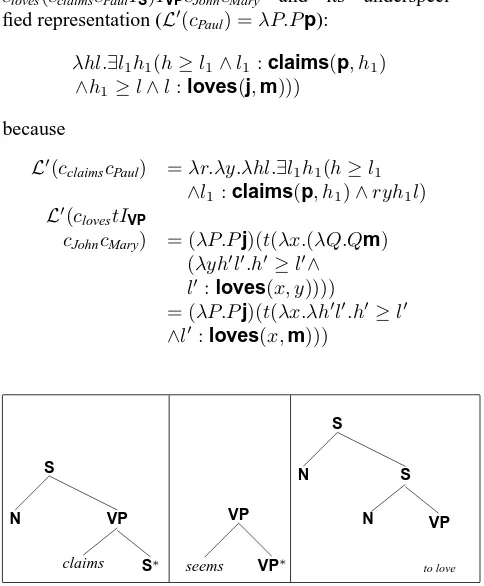
Going upward in the syntactic tree, we can now try to model expressions that act on Snodes like claims (see
table 3). Coming back to our modelling of chases, we had ab argument of typeL0(S
A) = (e → h → l →
t)((e→h→l →t). So we can associate to a term
cclaims:NS(SA(SA∈Λ1a term inΛ02:
λspr.λy.p(s(λxhl.∃l1h1(h≥l1∧ l1:claims(x, h1)∧ryh1l)))
which specifies thatxclaims something, the latter being dominated byh1(henceclaims).
So for instance, an expression Paul claims
John loves Mary would give the abstract term
cloves(cclaimscPaulIS)IVPcJohncMary and its
underspeci-fied representation (L0(c
Paul) =λP.Pp):
λhl.∃l1h1(h≥l1∧l1:claims(p, h1)
∧h1≥l∧l:loves(j,m)))
because
L0(c
claimscPaul) =λr.λy.λhl.∃l1h1(h≥l1
∧l1:claims(p, h1)∧ryh1l)
L0(c lovestIVP
cJohncMary) = (λP.Pj)(t(λx.(λQ.Qm)
(λyh0l0.h0≥l0∧
l0:loves(x, y))))
= (λP.Pj)(t(λx.λh0l0.h0≥l0
∧l0:loves(x,m)))
S
N VP
claims S∗
VP
seems VP∗ S
N S
VP
[image:5.612.312.554.374.667.2]to love N
Table 3: Few more trees
if the syntactic properties of the infinitive to love (see ta-ble 3) really differs from the ones of loves, their semantic counterpart only differs in the order of argument (and an extraL0(SA) whose role should be precised). We can
naturally associate toL0(c
to love)the term:
λbaos.s(b(λx.a(o(λyh0l0.h0≥l0∧l0:loves(x, y)))))
Then analyzing a long distance dependency Mary Paul
claims John seems to love is the same as analyzing the
previous example, except that theIVPterm is replaced by
cseemsand the order of the other arguments is exchanged: cloves(cclaimscPaul)(cseemsIVP)cMarycJohn. The contribution
ofL0(c
seemsIVP)toL0(clove)is just adding the conjonction
of (modulo the variable renaming) ∃h2l2(h1 ≥ l∧l : loves(j,m)∧h1 ≥ l2∧l2 : seems(h2)∧h2 ≥ l)
instead of onlyh1 ≥ l∧l : loves(j,m)))so that we
finally have:
λhl.∃l1h1(h≥l1∧l1:claims(p, h1)
∧∃h2l2(h1≥l∧l:loves(j,m)∧h1≥l2
∧l2:seems(h2)∧h2≥l)
which is the expected result.
3.5 Wh-questions
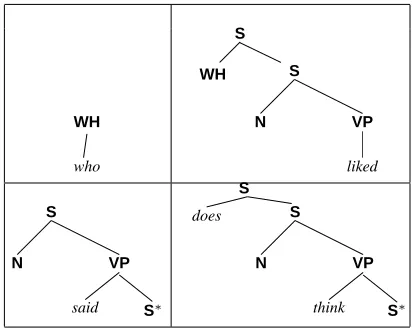
This section provides an example of an adjunction oc-curring on the root node of an auxiliary tree which is itself adjoined to a third tree. The expression who
does Paul think John said Bill liked, can be analyzed
with the constants cwho : WHS ∈ Λ1 and cliked :
SA ( VPA ( WHS ( NS ( SS ∈ Λ1, that
correspond to the trees of figure 4. The two other constants cdoes think and csaid, corresponds to the
auxil-iary trees of the same figure and the derivation tree is
cliked(csaidcJohn(cdoes thinkcPaulIS))IVPcwhocBill.
Then, we can extendL0as follows:
L0(cwho) =λphl.∃v1h001l 00 1(h≥l
00 1
∧l100:W(v1, h001)∧h001≥l∧pv1h001l)
L0(cliked) =λbaos.o(b(λy.a(s(λxh0l0.h0≥l0
∧l0:liked(x, y)))))
L0(csaid) =λsbr.b(λy.s(λxhl.∃h1l1(h≥l1
∧l1:S(x, h1)∧h1≥l∧ryh1l)))
L0(cdoes think) =λsbr0.b(λy.s(λxhl.∃h01l01(h≥l01
∧l10 :T(x, h01)∧h01≥l∧r0yh01l)))
who
WH
S
N VP
S
liked
WH
S
N VP
said S∗
S
N VP
think S∗
S
[image:6.612.323.529.70.234.2]does
Figure 4: Wh-question example
Then, we have :
L0(cdoes thinkcPaulIS) =L0(t0)
=λr0λyhl.∃l01h01(h≥l01
∧l01:T(p, h01)∧h01≥l
∧r0yh01l) L0(csaidcJohnt0IS) =L0(t1)
=λr.λyhl.∃l01h01(h≥l01
∧l01:T(p, h01)∧h01≥l
∧ ∃h1l1(h01≥l1∧l1:S(j, h1)
∧h1≥l∧ryh1l))
This yields the following result:
L0(clikedt1IVPcwhocBill) = (λo.o(λyhl.∃l10h 0 1(h≥l
0 1
∧l01:T(p, h01)∧h01≥l
∧ ∃h1l1(h01≥l1∧l1:S(j, h1)
∧h1≥l∧h1≥l
∧l:liked(b, y)))))L0(cwho)
=λhl.∃v1h001l001(h≥l001
∧l001 :W(v1, h001)∧h001 ≥l
∧ ∃l01h01(h001 ≥l10
∧l01:T(p, h01)∧h01≥l
∧ ∃h1l1(h01≥l1∧l1:S(j, h1)
∧h1≥l∧h1≥l
∧l:liked(b, v1))))
which is the expected one, withWbinding the variablev1
and dominatingT, itself dominatingS, itself dominating
liked(b, v1).
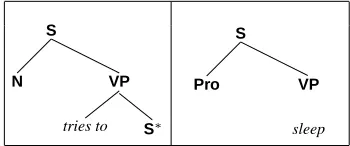
3.6 Control Verbs
adjunc-tion on aSnode (see table 4) to produce an expression like John tries to sleep, with the adjunction of tries to on
sleep, is a problem for our approach.
Indeed, it is build from the term
csleep(ctries toIVPcJohnIS)IVP and the typing discipline makest = ctries toIVPcJohnIS of typeSA, henceL0(t)of
type(e → h → l → t) ( e → h → l → t. If it is clear that the first argument of type(e → h → l → t) concerns the sleep predicate (with something like
λxhl.h ≥ l∧l : sleep(x)), the result should not have anyepossible argument (it has been filled withj).
In other worlds, if we look at adjunctions onSnodes in previous sections, the subtrees always lack anN(John
seems to lovex, or John said Bill liked x) and are al-ways transformed into a subtree lacking anNtoo (Paul
claims John seems to lovex, or does Paul think John said
Bill likedx). This is not the case anymore with control verbs where the subtree forxsleep turns into John tries to sleep.
So control verbs cannot be dealt with directly that way with our techniques. We need for instance to differentiate theSA type into the usual one(e → h → l → t) (
e → h → l → t and another one(e → h → l →
t) ( h → l → t. This could be done with a special
SPronode, or with an extended type system (for instance additives of linear logic to manage disjunctive types). But this requires further investigation and goes beyond this article.
S
N VP
tries to S∗
S
VP
sleep
[image:7.612.97.272.416.489.2]Pro
Table 4: Derived trees for control verbs
Conclusion
We propose to reconsider semantic representation com-putation for TAG from the derivation trees. But deriva-tion trees here are understood as abstract terms of ACGs, even if the informations born by each of the formalism are essentially the same. Whereas they hold the specification of how trees should combine, the locality of computing the meanings held by the different nodes is described in the object vocabulary. It obviates the addition of extra links to manage scoping and shows that derivation trees, by themselves, are enough, even if further investigation are required to handle control verbs.
It also clearly defines the compositional aspects of building semantic representations with a clear and mod-ular distinction between syntax and semantics. The latter
point lacks in the derived tree approaches. Moreover, the mathemetical primitives we use are very simple (if ex-pression not always are) and are the same both on the syntactic and the semantic side, and no external princi-ples need to be added.
So, from the ACG point of view, both syntax and se-mantics are dealt with in an equivalent way: as object languages of the same abstract language. This is interest-ing because the computation engine to go from the object language to the abstract language in an ACG does not de-pend on the object language. So the underlying process remains the same for all that cases:
• to compute a derived tree, then a derivation tree, from a string;
• to compute a derivation tree from a URL formula;
• to compute a derived tree, then a string, from a derivation tree;
• to compute an URL formula from a derivation tree.
So that going from one to the other (parsing or generation, in the usual sense) is as difficult (or as easy) as going the other way. Of course, on the semantic side, it means the initial point is an URL formula, and it gives no hint on how to build it from an SRL formula, nor on how to deal with the logical equivalence (be it on the SRL or on the URL level).
Finally, it underlines the interesting feature of ACG to transport or transmit structures from one language to anoher, illustrated between a syntactic formalism and a semantic formalism for TAGs. As suggested by an anonymous referee, the same approach could be used to provide semantic representations to expressions be-longing tom-linear context-free languages, since abstract terms have already been proposed for them (de Groote and Pogodalla, 2003).
References
Anne Abeill´e. 1993. Les nouvelles syntaxes. Armand Colin ´Editeur, Paris.
Patrick Blackburn and Johan Bos. 2003.
Com-putational semantics for natural language.
http://www.iccs.informatics.ed.ac.
uk/˜jbos/comsem/book1.html. Course Notes
for NASSLLI 2003.
Johan Bos. 1995. Predicate logic unplugged. In
Pro-ceedings of the Tenth Amsterdam Colloquium.
Marie-H´el`ene Candito and Sylvain Kahane. 1998. Can the tag derivation tree represent a semantic graph? an answer in the light of meaning-text theory. In
Proceed-ings of the Fourth International Workshop on Tree Ad-joining Grammars and Related Framework (TAG+4),
Vincent Danos and Roberto Di Cosmo. 1992. The linear
logic primer. http://www.pps.jussieu.fr/
˜dicosmo/CourseNotes/LinLog/. An
intro-ductory course on Linear Logic.
Philippe de Groote and Sylvain Pogodalla. 2003. m -linear context-free rewriting systems as abstract
cat-egorial grammars. In Richard Oehrle and James
Rogers, editors, MOL 8, proceedings of the eighth
Mathematics of Language Conference.
Philippe de Groote. 2001. Towards abstract catego-rial grammars. In Association for Computational
Lin-guistics, 39th Annual Meeting and 10th Conference of the European Chapter, Proceedings of the Conference,
pages 148–155.
Philippe de Groote. 2002. Tree-adjoining grammars as abstract categorial grammars. In TAG+6, Proceedings
of the sixth International Workshop on Tree Adjoining Grammars and Related Frameworks, pages 145–150.
Universit`a di Venezia.
Anette Frank and Josef van Genabith. 2001. Glue
tag: Linear logic based semantics construction for ltag - and what it teaches us about the
rela-tion between lfg and ltag. In Miriam Butt and
Tracy Holloway King, editors, Proceedings of the
LFG ’01 Conference, Online Proceedings. CSLI
Publications. http://cslipublications.
stanford.edu/LFG/6/lfg01.html.
Claire Gardent and Laura Kallmeyer. 2003. Semantic construction in feature-based tag. In Proceedings of
the 10th Meeting of the European Chapter of the Asso-ciation for Computational Linguistics (EACL).
Jean-Yves Girard. 1987. Linear logic. Theoretical
Com-puter Science, 50:1–102.
Aravind K. Joshi, Laura Kallmeyer, and Maribel Romero. 2003. Flexible composition in ltag: Quantifier scope and inverse linking. In Harry Bunt, Ielka van der Sluis, and Roser Morante, editors, Proceedings of the Fifth
International Workshop on Computational Semantics IWCS-5.
Laura Kallmeyer. 2002. Using an enriched tag deriva-tion structure as basis for semantics. In Proceedings
of the Sixth International Workshop on Tree Adjoining Grammar and Related Frameworks (TAG+6).
Richard Montague, 1974. The Proper Treatment of
Quantification in Ordinary English, chapter 1. In
Port-ner and Partee (PortPort-ner and Partee, 2002).
Sylvain Pogodalla. 2004. Using and extending ACG technology: Endowing categorial grammars with an underspecified semantic representation. In
Proceed-ings of Categorial Grammars 2004, Montpellier, June.
Paul Portner and Barbara H. Partee, editors. 2002.
For-mal Semantics: The Essential Readings. Blackwell
Publishers.
Yves Schabes and Stuart M. Shieber. 1994. An alterna-tive conception of tree-adjoining derivation.