ABSTRACT
TALLAMRAJU, SAI RAJESH. Trust Metrics for Cloud Computing. (Under the direction of Dr. Mladen A. Vouk.)
Cloud computing is an emerging technology. This new paradigm eases physical
lim-itations of traditional data centers and brings extensive and powerful computational,
storage and software resources to users who previously could not afford them. Cloud
providers offer information and technology utility services with similar functionalities in
various configurations and different pricing plans. Often the differentiating factor might
be a non-functional property of the system called trust. Trust may be the basis for both
predicting behavior of the provided services and selecting the provider of the services.
But trust is based on information. There is a need to have sufficient information about
providers and their services to establish trust. Since trust is a human perception, its
not just the identified facts about a cloud environment that impact decision making and
trust, but also perceptions of users about these facts. The key question being examined
in this work is “How much and what information can a potential cloud user obtain
di-rectly from provider web-sites, and how can that information impact trust towards that
provider?”.
To discuss metrics, perceptions and components of trust in the context of cloud
com-puting, we first identify elements we believe are needed to build trust. We present a
framework that identifies elements, such as services, components, capabilities and
re-sources, of a “good” cloud. Some of these elements are reliability, availability, security,
privacy, fault-tolerance, virtualization, networking capability, appropriate APIs, data,
demic and industry papers and documents etc., to understand what users might perceive
as principal components of trust in the context of cloud computing. Identified trust
build-ing metrics were then correlated with the framework components and analyzed. We find
that the principal trust components appear to be reliability, availability, security, data
management, cost (potential gains and losses) and competence of the provider. The order
of preference changes with user and the context. We then construct a user-perspective
trust model and use it to compare five major cloud providers against identified trust
met-rics with inputs derived solely from information available to users first-hand from vendor
web-sites. Second hand information (such as third-party reports) is used to discuss the
model and the results. Some metrics are on interval and ratio scale, but more are on
ordinal scale. For example, most of the cloud providers assure security to their customers
or potential customers through certifications or by describing their security processes in
white papers. None appear to provide direct information about security (e.g., number of
security breaches). Some offer auxiliary information regarding their security controls, for
example, by answering Cloud Security Alliance’s Consensus Assessment Initiative
Ques-tionnaire. Results indicate that all major cloud providers seem to have some surprising
gaps either in how they actually operate, or in what information and how much they
provide to potential users first-hand. For example, four out of five providers appear to
lack in their openness about security and in their data management practices. For two
out of five interoperability appears to be an issue. On the other hand, all appear to be
willing to sign SLAs that promise at least 99.9% uptime. Cost of similar services vary
by a factor of two or more among the providers. It is not surprising that surveys of
potential customers (such as those conducted by IDC) and state-of-cloud-security
assess-ments, such as those done by CSA, confirm that security and data management remain
©Copyright 2013 by Sai Rajesh Tallamraju
Trust Metrics for Cloud Computing
by
Sai Rajesh Tallamraju
A thesis submitted to the Graduate Faculty of North Carolina State University
in partial fulfillment of the requirements for the Degree of
Master of Science
Computer Science
Raleigh, North Carolina
2013
APPROVED BY:
Dr. Laurie Williams Dr. Ting yu
DEDICATION
To my beloved parents and brother; without their love, support and encouragement
BIOGRAPHY
Tallamraju Sai Rajesh was born in Hyderabad, Andhra Pradesh in India. He received his
Bachelor’s degree in Computer Science and Engineering from Vasavi College of
Engineer-ing which is affiliated to Osmania University, Hyderabad in May 2008. Upon completion
of Bachelors, he joined a linux mobile start-up Azingo Soft Systems as Software Engineer
in Cloud Services team and worked for almost 3years. Later, he went forward to pursue
his Masters in Computer Science at North Carolina State University from August 2011
to May 2013.
Besides professional life, he likes to read live blogs from industry experts on various
topics related to cloud, mobile. Also enjoys swimming and watching movies. He is
ACKNOWLEDGEMENTS
I would like to thank my parents and my brother for their constant love, faith and
sup-port in me. Without my brother steady encouragement, this would not have happened.
I am immensely grateful to my advisor Dr.Mladen A. Vouk for spending time during
initial days in understanding my interests and helping me to focus my attention onto a
particular topic. I am thankful for all the insightful discussions, guidance, feedback and
the trust he had in me all through the research work. Thank you for being patient in
correcting my writing. I would like to thank Dr.Ting Yu for making his course valuable
and knowledgeable and Dr. Laurie Williams for her valuable help and graciously agreeing
to be in the thesis committee.
This work was supported in part by NSF grant 0910767, the U.S. Army Research Office
(ARO) grant W911NF-08-1-0105 managed by NCSU Science of Security Initiative and
Science of Security Lablet, and IBM Share University Research and Fellowships program
TABLE OF CONTENTS
LIST OF TABLES . . . vii
LIST OF FIGURES . . . viii
Chapter 1 Introduction . . . 1
1.1 Motivation . . . 1
1.2 Cloud Computing . . . 2
1.2.1 Cloud Computing Characteristics . . . 2
1.2.2 Service Models . . . 3
1.2.3 Deployment Models . . . 6
1.3 Trust . . . 7
1.4 Related Work . . . 8
Chapter 2 Trust and its principles . . . 10
2.1 Definition . . . 10
2.2 Principles of Trust . . . 14
2.2.1 Trust is based on information, beliefs and metrics . . . 14
2.2.2 First hand information . . . 15
2.2.3 Third party ratings . . . 15
2.2.4 Provider’s identity . . . 15
2.2.5 User preferences . . . 16
2.2.6 Relationship properties . . . 16
2.2.7 Global and Local score . . . 17
2.2.8 Dynamic nature . . . 17
2.2.9 Deepens over time and with increased reciprocity . . . 17
2.2.10 Risk . . . 18
2.2.11 Error rate . . . 18
2.2.12 Approaches . . . 19
Chapter 3 Trust Metrics for Cloud Computing . . . 20
3.1 Approach . . . 21
3.2 Components/Capabilities . . . 22
3.2.1 Reliability . . . 23
3.2.2 Availability . . . 25
3.2.3 Scalability . . . 26
3.2.4 24/7 Support . . . 27
3.2.5 Performance . . . 27
3.2.6 Pay per Use . . . 28
3.2.8 Virtualization . . . 29
3.2.9 Security . . . 30
3.2.10 Privacy . . . 33
3.2.11 Compliance . . . 34
3.2.12 Data Management . . . 36
3.2.13 API . . . 37
3.2.14 Provenance . . . 37
3.2.15 Tools . . . 38
3.3 Metrics . . . 38
3.3.1 Service trust components . . . 39
3.3.2 Provider trust components . . . 46
Chapter 4 A Trust Evaluation . . . 50
4.1 Evaluation Metrics . . . 51
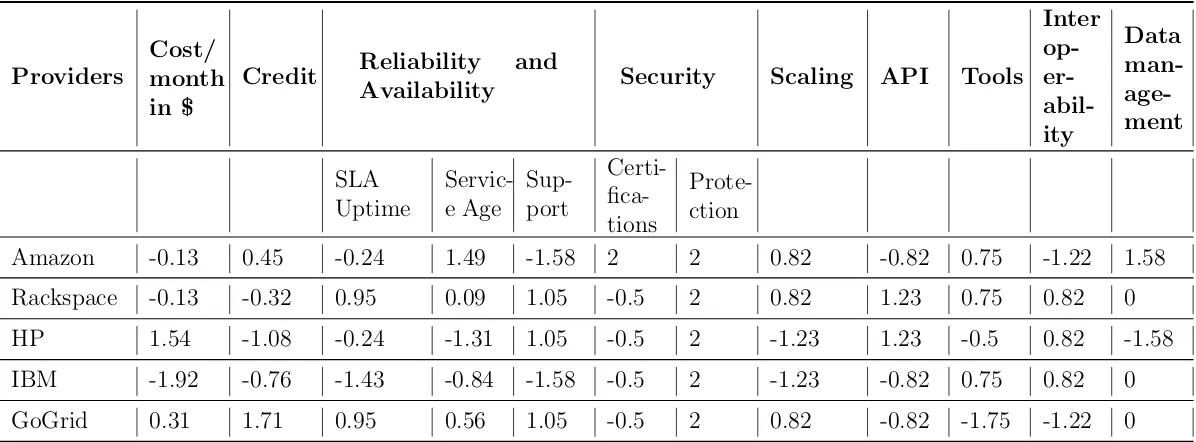
4.2 Results . . . 57
4.2.1 Discussion . . . 59
4.2.2 “Reliability” and “Availability” . . . 69
4.2.3 “Security” . . . 70
4.2.4 “Other” metrics . . . 70
4.2.5 Limitations . . . 74
Chapter 5 Conclusion . . . 77
REFERENCES . . . 79
APPENDIX. . . 90
Appendix A Coding metrics . . . 91
A.1 Cost . . . 91
A.2 Service Age . . . 91
A.3 Support . . . 93
A.4 Certifications . . . 93
A.5 Protection . . . 93
A.6 Scalability . . . 95
A.7 Application Programming Interface (API) . . . 95
A.8 Monitoring Tools . . . 97
A.9 Inter-operability . . . 97
LIST OF TABLES
Table 3.1 Control between provider and clients [42] . . . 32
Table 3.2 Industry standards [97] . . . 35
Table 3.3 Service trust components - how we measure them in this study . . . . 40
Table 3.4 Privacy regulations [97] . . . 44
Table 3.5 Cloud Provider trust components . . . 47
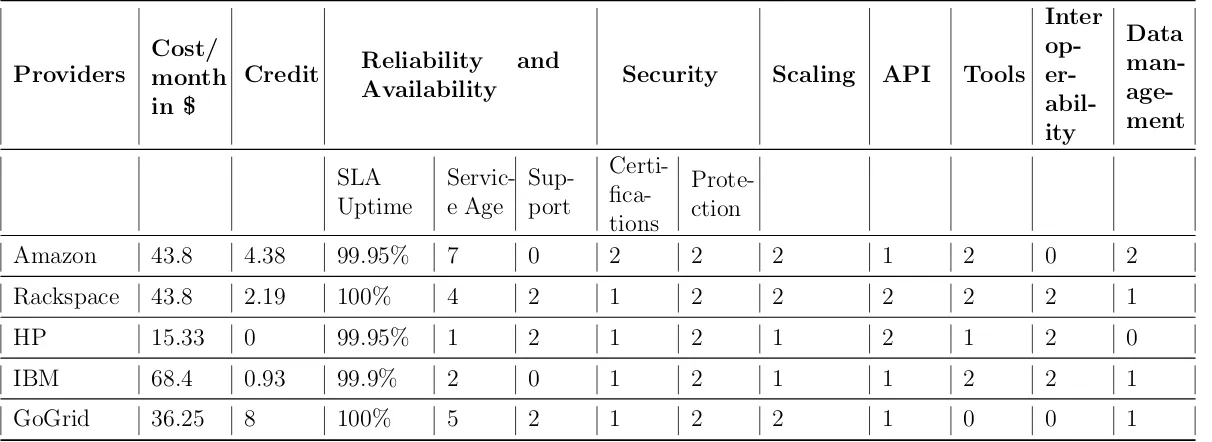
Table 4.1 Trust evaluation parameters for five cloud providers . . . 58
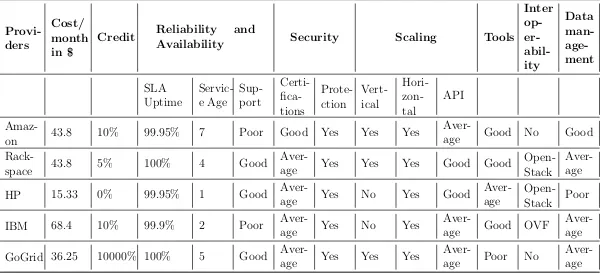
Table 4.2 Trust evaluation parameters for five cloud providers (Service age in years, Support, Security, Scaling, API, Tools, Interoperability, Data Management - 0 is least satisfactory, 2 is most satisfactory . . . 66
Table 4.3 Trust evaluation for cloud providers - normalized . . . 68
Table A.1 Cost . . . 92
Table A.2 Vendor experience . . . 92
Table A.3 Support . . . 93
Table A.4 Certifications . . . 94
Table A.5 Protection . . . 95
Table A.6 Scalability . . . 96
Table A.7 API . . . 96
Table A.8 Monitoring Tools . . . 97
Table A.9 Monitoring Tools . . . 98
LIST OF FIGURES
Figure 1.1 Cloud service architecture [10] . . . 5
Figure 3.1 Bubble Framework [48] . . . 22
Figure 4.1 Reliability & availability comparison . . . 69
Figure 4.2 Security comparison . . . 71
Figure 4.3 Scaling, API, Cost and Credit comparison . . . 72
Chapter 1
Introduction
1.1
Motivation
Increasing demand for new and more cost-effective information technology (IT) utility
services is creating a constant pressure to expand IT infrastructure and meet the demand.
To address this challenge, a new architecture called cloud computing was developed.
Cloud computing is a service oriented paradigm and architecture that optimizes user
overhead, costs and other benefits by offering services at different levels via different
service models, provisions services and its parts from diverse providers. The problem with
this kind of provisioning is that by necessity service oriented architecture may require
hiding of complexity, and thus a certain level of opacity from the end-user experience.
Lack of transparency is not conducive of trust. It may mask the very information needed
to generate the evidence based confidence that leads to trust. At the same time, presence
of many players with different motives and providers with similar services in the market
complicates the issue. On the other hand, new consumers who wish to adopt cloud
comprises trust and how much of that is measurable in a repeatable way remains elusive.
Trust very often has a very large human component.
Under cloud computing paradigm, an organization confers a high level of trust onto
the cloud provider. The challenge is to identify and reliably assess characteristics,
pa-rameters, metrics etc., that are important to a user or an organization and map it onto
the cloud provider and its cloud. The overall goal of this study is to survey and identify
trust metrics that appear to be relevant to cloud computing from consumer perspective.
1.2
Cloud Computing
US National Institute of Standards and Technology (NIST) defines cloud computing as
“Cloud computing is a model for enabling ubiquitous, convenient, on-demand network
access to a shared pool of configurable computing resources (e.g., networks, servers,
stor-age, applications and services) that can be rapidly provisioned and released with minimal
management effort or service provider interaction”. The NIST model is composed of five
essential characteristics, three service models and four deployment models [99].
1.2.1
Cloud Computing Characteristics
Cloud computing has five fundamental characteristics [99]:On-demand self service “A consumer can unilaterally provision computing
capabili-ties, such as server time and network storage, as needed automatically without requiring
human interaction with each service’s provider” [99].
Broad network access “Capabilities are available over network and accessed through
consumers using a multi-tenant model, with different physical and virtual resources
dy-namically assigned and re-assigned according to consumer demand” [99].
Rapid elasticity “Capabilities can be rapidly and elastically provisioned, in some cases
automatically, to quickly scale out and rapidly released to quickly scale in” [99].
Measured service “Cloud systems automatically control and optimize resource use by
leveraging a metering capability at some level of abstraction appropriate to the type
of service. Resource usage can be monitored, controlled and reported, providing
trans-parency for both the provider and consumer of utilized service” [99].
1.2.2
Service Models
Service model to which a cloud conforms dictates an organization’s scope and control
over the computational environment and characterizes the level of abstraction for its use.
Three well-known and often used service models are briefly described below [84]. An
illustration of cloud services architecture is presented in Figure 1.1
• Sofware as a Service: “Software as a Service is a model of service delivery whereby one or more applications and the computational resources to run them are
provided for use on demand. Its main purpose is to reduce the total cost of hardware
and software development, maintenance and operations. The cloud consumer does
not manage or control underlying cloud infrastructure or individual applications,
except for preference selections and application settings” [84].
Examples: Google Docs [71], Salesforce CRM [125]
• Platform as a Service: “Platform as a Service is a model of service delivery whereby computing platform is provided as an on-demand service upon which
and complexity of buying, housing and managing the underlying hardware and
software components of the platform, including any needed program and database
development tools. The development environment is typically special purpose,
de-termined by the cloud provider and tailored to the design and architecture of its
platform” [84].
Examples: Windows Azure [139], Google App Engine [72], Virtual Computing
Lab-oratory (VCL) Desktop Services [80]
• Infrastructure as a Service: “Infrastructure as a Service is a model of service delivery whereby the basic computing infrastructure of server, software and network
equipment provided as an on-demand service upon which a platform to develop and
execute applications can be established. Its main purpose is to avoid purchasing,
housing and managing the basic hardware and software infrastructure components,
and instead obtain those resources as virtualized objects controllable via a service
interface. The cloud consumer has broad freedom to choose the operating system
and development environment to be hosted” [84].
Examples: Amazon EC2 [14], Rackspace Cloud Servers [113], Virtual Computing
Laboratory (VCL) [80]
Overall, cloud computing is not restricted to Infrastructure/Platform/Software as a
Service, it can be further extended to provide variety of service models. Armbrust et al.
[21] coin the phrase “X as a Service (XaaS)”; values of X can be any possible service that
Public
Private
Community
Hybrid
Software as a
Service(SaaS)
Platform as a
Service(PaaS)
Infrastructure as a
Service(IaaS)
On-Demand
service
Broad network
access
Resource
pooling
Rapid Elasticity
Measured Service
Essential
character
istics
Service
models
Deploy
ment
models
1.2.3
Deployment Models
Similar to type of service models cloud may be hosted and deployed in different fashions
depending on use cases. Below are four deployment models for cloud services, with
derivate variations that address specific requirements [10].
• Public Cloud: “The cloud infrastructure is made available to the general public or a large industry group and is owned by an organization selling cloud services”
[10].
• Private Cloud: “The cloud infrastructure is operated solely for a single organi-zation. It may be managed by the organization or a third party, and may exist
on-premises or off-premises” [10].
• Community Cloud: “The cloud infrastructure is shared by several organizations and supports a specific community that has shared concerns (e.g., mission, security
requirements, policy or compliance considerations). It may be managed by the
organizations or third-party and may exist on on-premises or off-premises” [10].
• Hybrid Cloud: “The cloud infrastructure is a composition of two or more clouds (private, public or community) that remains unique entities but are bound together
by standardized or proprietary technology that enables data and application
porta-bility (e.g., cloud bursting for load-balancing between clouds)” [10].
“With customer demand and mature market offerings, we have other derivative cloud
deployment models emerging like virtual private cloud - a way of utilizing a public cloud
1.3
Trust
Trust is a very broad concept that has been investigated for centuries in fields as diverse as
sociology, psychology, economics, politics, philosophy and now computer science. There is
no consensus in literature on what trust is and what constitutes trust decision. Hussain
et al.[76] enumerate various definitions of trust and every definition is accepted and
contested. Trust escapes clear definition despite having many definitions. Yet everybody
recognizes it immediately. “Trust is recognized as an essential element of every social
transaction but it can be hardly found in any written contract and is even less likely to be
enforced. Trust escapes rational judgment yet everybody seems to be expert in judging
trust. Trust is what happens between people or communities, is not easily quantifiable,
takes time and effort to build and can be easily lost. It’s a belief in competence or
expertise of other’s such that you feel you can rely on others to care for your assets” [39].
From technology perspective, trust has always been associated with reliability and
security. In distributed computing systems, trust was effectively managed through
con-structs like trusted domains (several computers trusting each other’s authentication
ca-pabilities), trusted credentials (other’s identities accepted without any proof), trusted
zones (privileged Internet address space) etc. More recently, the recognition of the
fun-damental nature of trust has been addressed in initiatives such as Trusted Computing,
where individual devices are given assurance in their own configuration on the basis of a
highly-protected, hardware-based root of trust [74].
But why is trust very important in research world? With trust, more people and
enterprises enter on-line world and will interact with others. If we establish trust on-line,
attitude towards on-line transactions changes. Trust makes interactions and transactions
one becomes suspicious of their transactions. The same applies to cloud, if a trusted
environment is set up, it attracts more enterprises to adopt cloud which invites new
players into market, healthy competition and enforcement of strong mechanisms that
ensures a healthy cloud.
1.4
Related Work
This work supplements with other industry efforts in ensuring trust among customers
towards cloud computing. Industry works include Cloud Trust Protocol (CTP) 2.0 [44] is
a question and answer protocol that enables clients to ask provider about configuration,
vulnerability, access, authorization, policies, accountability, reliability and operating
sta-tus they are interested in depending on the context and allows provider to prepare and
deliver information in response to requests in best way possible to them. The next version
of this protocol 3.0 with explicit request and response format is still under expert review
and is scheduled to be released for public review in second half of 2013 [8]. Another
trust initiative include, Cloud Security Alliance’s (CSA) Cloud Controls Matrix [12], this
matrix provides fundamental security principles to guide providers and assists customers
in assessing the overall risk of a cloud provider. It includes 100 questions related to 13
domains CSA identified related to security concepts and principles. For providers and
customers interested in yes/no answers, CSA’s Consensus Assessment Initiative
Ques-tionnaire [11] includes 140 questions related to security risks and principles that can
help both provider and customer assess the controls in place. Apart from industry
ef-forts, FedRAMP [5] is a federal government-wide program that provides a standardized
ser-security controls remains effective with new changes in system, environment and against
new exploits and attacks. Apart from US efforts, Asia Cloud Computing Association
(ACCA) [4] has prepared a Cloud Assessment Tool (CAT) [134] to enable prospective
users of cloud computing to objectively access the operational performance and other
critical capabilities offered by different providers based on eight operatioal categories
like security, performance, long-term support, connectivity, certification,
interoperabil-ity, data center basics and access (connectivity). European Commission with help of
DMTF [47], ETSI [57], SNIA [131], ITU [83], IEEE and major industry players like
Mi-crosoft, VMware etc., started an initiative called SIENA (Standards and Interoperability
for eInfrastructure implemeNtation initiAtive) [129] for co-ordinating the effort of
de-veloping inter-operable and standardized cloud standards. Such an initiative enable a
competitive, open and secure environment in public cloud market and provide a common
criteria to assess operational characteristics of different cloud providers. However, EU
initiative is still in road-map phase till end of 2013. All these efforts including this work,
is a step towards ensuring transparency into cloud operations, measuring operational
characteristics and assuring trust.
The rest of this work is organized as follows: In chapter 2, we understand trust by
discussing the concept of trust and its principles. In chapter 3, based on understanding
of trust, we identify trust components in the context of cloud computing with help of an
evaluation framework [48]. In chapter 4, we develop a user-perceivable trust assessment
model based on identified trust components and compare five major cloud providers to
see how much information does a potential customer get from their websites and how
does that information impact the trust decision. And finally in chapter 5, we end this
Chapter 2
Trust and its principles
As more providers offer information utility services with similar functionalities, the task
of which provider and which services to use becomes more interesting and challenging.
The key factor is trust. Trust facilitates interaction in uncertain and risky environments.
Trust makes the uncertainty and complexity tolerable. “Trust also reduces the complexity
in a given scenario because user will have less number of options to consider. Humans, if
faced with a full range of alternatives, if forced to acknowledge and calculate all possible
outcomes of all possible decision nodes, would freeze in uncertainty and indecision. In
this state, we might never be able to act in situations that call for action and decisiveness”
[107]. To identify trust metrics for cloud, we must first understand trust concept and its
components.
2.1
Definition
ex-marketing, e-commerce, etc. There is no common agreement across all disciplines
re-garding definition of trust. Each of these disciplines produced their own definition and
concepts. For example, Hussain et al. in [76] list various definitions of trust from the
literature. All definitions have both supporters and detractors. Corritore et al in [41]
clarifies ’what trust is not’ in order to understand trust. Trust is not cooperation,
trust-worthiness, competence, and faith. “Trust is an act of a trustor(who trusts other entity).
In contrast,
• Cooperation is either a cause or a manifestation of trust rather than trust itself.
• Trustworthiness is a characteristic of someone or something that is the object of
trust.
• Competence is only one of many cognitive cues for trust but trust goes beyond a
belief in the competence of the object.
• Faith involves taking a leap that is not fully supported by reason whereas trust
encompasses a reason.” [41]
On the other hand, for some entities these characteristics may be the key ingredients of
trust and may in fact be a deciding factor in their decisions about trust. We adopted trust
definition from [87] that we believe fits cloud scenario. “ Trust means act of confidence
and reliance in something that’s expected to behave or deliver as promised”. However,
it is important to say that in the context of cyber-security and safety, trust definition
needs to be expanded to include not only expected behavior but also avoidance and
prevention of unexpected behavior. For example, when trust is expressed in terms of
compromise in addition to mentioning of desired features like fault tolerance, redundancy
etc. Establishing trust on-line is important but so is maintaining that on-line trust.
To obtain and maintain trust, one must have an overview of how trust is induced by
understanding different entities (players) involved and different types of interactions:
human-human, human-organization, human-machine, machine-machine. For
human-human trust [94] [104], an entity in general shall try to choose the most reliable partner
from a pool of potential partners and devise a strategy to achieve their utility. There
are number of ways of doing this. Firstly, they could interact with each of the
part-ner and learn about their behavior. Secondly, when direct reach is not possible, entity
could ask others about their perception of the partner. The opinion from a source who
possess similar capabilities as trustor is more important than opinion of the party who
does not have those characteristics. Thirdly, entity could characterize the motivations
of other partners, and form beliefs about their characteristics and reasoning behind the
motivations in order to decide how much to trust them. For example, partner might act
as expected because partner believes that such act would gain him/her business
bene-fits and reputation which further invites good business. Eventually, this should lead to
selection of most reliable and honest partner.
For human-organization trust, disciplines such as law, economics and finance ensure
trust through formal mechanisms like written contracts, legislations and the like. For
example, in credit card purchasing we unknowingly trust the transaction partner because
we are assured that laws and procedures from credit report bureaus, justice system etc.,
will act against defectors who break the laws.
For human-machine and machine-machine trust, there is a vast research to formalize
about behavior of the partner and their tendency to fail in an interaction. From this,
entity can assume sufficient information (strategies, payoffs) and can strategically
re-spond by assessing the best possible move of their opponent. In case of reputation based
trust model, trust is mainly derived from aggregation of opinions and experiences. The
main task in this method, remains in retrieving and propagating the ratings. Singh et al.
[140], [141] proposed methods to disseminate and gather required information through
the network. They show how agents explore the network by contacting the neighbor and
use referrals gathered to gradually build up a social network. However, these models
are computationally expensive when considering all factors affecting trust at component
level. So, set of mechanisms and protocols were developed at system level that force
interaction partners to behave in trustworthy manner. These mechanisms eliminate the
need of developing trust mechanisms at individual component level. One such
mecha-nism include security. Trust is ensured by the fact that a user has to prove their identity
through authentication mechanisms(username and password, digital certificates etc.)
be-fore accessing a service of entity. Ramchurn et al. [122] which internally refers to [111]
proposes a number of security requirements that are necessary to induce trust. The
re-quirements include identity, access permissions, content integrity and content privacy.
These basic requirements can be implemented through public key models (like PGP,
X.509) and certification infrastructure.
To understand how a trust model instills trust among users and motivates them to
click/open a website/email, we conducted a literature survey on “how phishing works”.
Rachna et al [46] summarize malicious strategies and empirically proves that visual
de-ceptions like deceptive text, animated images, trusted third-party logos from entities like
Verisign, TRUST-e, lack of knowledge about security indicators like padlocks, https and
users to believe phishing websites as legitimate ones. To understand nature of trust, we
shall below list principles of trust relevant to this study summarized from [45], [107] and
[41].
2.2
Principles of Trust
2.2.1
Trust is based on information, beliefs and metrics
There must be sufficient information about other entity to establish trust in the context
of beliefs, opinions and metrics of atleast one party. But what information should we use
to build trust? Every entity has many dimensions and depending on trustor requirements
he/she must consider relevant information as each requirement seek different properties.
Also, trust has many dimensions and the challenge remains in mapping trust model of
a trustor(who trusts other entity) to the trust model of a trustee(object of trust). For
example: a customer wants to subscribe to a simple database service. Later customer may
need to scale-up and scale-out and might require a database service that is distributed,
fault-tolerant and highly available. If the customer is aware of his needs ahead of time,
it may affect the trust decision with respect to service provider who has limited scaling
capabilities. If the customer does not know that ahead of time, trust may be warranted
at the time, but perhaps a misplaced one. On other hand, the provider may want the
business of the customer, and may not inform the user of all limitations or may imply
capabilities that may not coincide with the user profile. This may result in miscalculation
2.2.2
First hand information
Information that service providers provide themselves is critical to development of trust.
For example, information about performance, security, privacy and few QoS parameters
(response time, throughput, latency) are being considered by many sites to establish
trust. If this information is directly provided by service provider, trust develops [7].
2.2.3
Third party ratings
Trust is greatly influenced by opinions of the people who had interaction with provider
earlier. Experiences of the person who had similar transaction are highly valued. In
off-line world, we have friends and acquaintances who give personal opinions based on
their experience, whereas in on-line world community forums and trusted third parties
consolidate all user experiences and opinions. These trusted third parties allows an
entity to gather ratings of other entities even without having direct experience. Seals
from trusted third-party organizations like TRUSTe, Verisign, ISO induce trust about
site or transaction. These seals certify that organization or sites conform to the standards
laid [24].
2.2.4
Provider’s identity
Trust depends on identity. Because identity acts as a hash tag that helps in categorizing
all history transactions user(customer) have with the subject (provider). From this
his-tory, we can refer to past experiences that hint trust or betrayal. In off-line world, identity
can be established by visual recognition or authoritative tokens like driver license’s and
passports. But in on-line world, providers may have virtual identities whose mapping to
long as identifying tokens remain constant, they can be used to group all past experiences
[45]. In on-line world, identifying tokens include user names, digital tokens etc.
2.2.5
User preferences
Trust changes with change in user and their preferences. Because every user have their
own preference over other system properties. So, a provider might be assigned a different
trust value depending on user and his/her preference. For example, a financial services
customer might prefer a provider who promises 100% availability against the provider
who offers highly exceptional security controls and comparatively low availability
per-centage. But the choice differs with the change in customer who prefers security over
availability.[7].
2.2.6
Relationship properties
Trust is established between a trustor and a trustee. Trustor trusts trustee with respect
to its ability to perform a specific action within a specific context. In some interactions,
trustor and trustee can be either a single entity or multiple entities, forming different
com-binations of relationship (one-to-one, one-to-many, many-to-one, many-to-many). Trust
may be symmetric or transitive but not always. For example, if user trusts his/her doctor
and doctor trusts a specialist, then user may trust specialist. Degree of trust changes
with change in context. For example, a higher level of trust is needed for executing code
in system owned by other than just writing a new file and writing a new file requires a
2.2.7
Global and Local score
Massa et al. [96] mentions about two different kind of trust metrics: global and local trust
score to measure trustworthiness of trustee. “ Global trust metrics assign to a given user
a unique trust score, the same independently of the user that is evaluating other user’s
trustworthiness. On the other hand, a local trust metric provides personalized trust score
that depends on the point of view of the evaluating user” [96]. In global trust score, score
is based on the opinions or experiences from the general population, which is public and
visible to all the members. But global trust score might be calculated based on some
falsified information provided by anonymous users. While in personalized/local score, the
value is built on the opinions/experiences from a group of members/participants selected
by evaluating user. The local trust score is therefore influenced by user’s social network,
interests, preferences, priorities etc. For example, user considers global trust score while
selecting a weather forecast service, because personalization is not important.
2.2.8
Dynamic nature
Trust is dynamic. Trust increases or decreases with further experiences. Trust also decay
with time. New experiences are more important than old ones since old experiences
may become obsolete or irrelevant as time pass by. So, one must constantly evaluate
trustworthiness of the trustee.
2.2.9
Deepens over time and with increased reciprocity
To establish trust between entities, initial trust formation is very important. A
trans-action involving two parties do not takes place unless any party involved in transtrans-action
is associated with risk and when a trustee realizes that a trustor has taken considerable
risk in trusting them, they tend to be motivated to behave in a trustworthy manner.
Such reciprocity has been found to be key element in trust building” [45]. This is a
crucial stage in any trust relationship. In next phase, both entities tries to stabilize trust
based on interactions and opinions/recommendations from other parties with similar
characteristics.
2.2.10
Risk
Trust is a function of the perception of the risk. Trust only exists in a risky and uncertain
environment. If trustor has a higher control, he/she has less need to trust the trustee.
“Risk is the core of trust in that trust is the degree to which a trustor holds a positive
attitude toward the trustee’s goodwill and reliability in a risky exchange situation” [45].
But Nissenbaum [107] argues that where people are guaranteed safety, where they are
protected from harm via assurances, when the other party act under coercion, trust is
redundant. Also, penalties and rewards are necessary to support trust intention when
something go wrong.
2.2.11
Error rate
Errors have strong effect on trust. Corritore et al. [41] mentions that level of trust fall
is proportional to magnitude of error. If error is not repeated, performance can recover
immediately but regaining trust to level prior to error takes long time. Recovery of trust
can happen if user is able to understand the cause and compensate for the errors but not
2.2.12
Approaches
Different approaches help build and evolve trust. These approaches include direct
ex-perience (builds trust after utilizing services),third party (builds trust after gathering
information like reputation, recommendations through third parties), automated trust
negotiation (builds mutual trust, i.e., through usage of credentials) and hybrid (builds
trust by combination of other approaches) [7]. Degree of trust varies with different
ap-proaches. Trust established through direct experience approach is much valued than
trust formed through other approaches.
Leveraging on different trust interactions between entities, different components of
trust in terms of different words related to trust [85] and trust principles, we obtain an
overview of trust and what factors to be considered while establishing trust. With this
understanding of trust, chapter 3 identifies list of trust components in the context of
Chapter 3
Trust Metrics for Cloud Computing
Customers of cloud service, like all customers in other areas, need a way of differentiating
among similarly presented services from different providers. A differentiating factor might
be trust. Trust is contextual and is based on information, customer may consider. It is
difficult to determine what information should be used. Trust has many dimensions and a
service provider is free to choose any dimension towards instilling trust among customers
or potential customers. For example, a service provider can focus on reliability as its
trust metric. Another provider might use security and compliance to standards as its
trust metric. Of course, requestor (or customer) has his/her own preference of service
properties. For example, a financial services customer may prefer high availability over
exceptionally high security and may consider information appropriate to those aspects
3.1
Approach
In this work, it was decided to focus on information available in the literature, popular
press and academic and industry white papers, reports and documents to understand
what a user and provider might perceive as metrics and components of trust in the
context of cloud computing. We conducted a literature search on materials written in
English.
In order to assess metrics for cloud computing and how they are related to users
and providers, we need an evaluation framework that identifies desirable components/
capabilities/ characteristics that make a “good” cloud. We have identified eight
frame-works of interest. The frameframe-works are SLA-based framework [26], TrustCloud framework
[89], SMICloud [59], Armor framework [90], Control Objectives for Information and
Re-lated Technology (COBIT) [22], NIST SP800-55 [133], SANS Security Metrics [109], and
Bubble Framework [48].
SLA-based framework evaluates trustworthiness of provider using identified
parame-ters from SLA. TrustCloud framework assures trustworthiness of cloud through the use
of detective controls like auditability and accountability. SMICloud proposes a
compar-ison framework which measures quality and prioritize cloud services. Armor framework
assures trustworthiness of cloud by constantly monitoring and evaluating the behavior of
each component using historical data. The above four frameworks were published in
aca-demic papers and lack industry acceptance. SP800-55 framework was specially designed
for US government and might not be universally accepted. SANS Security Metrics
dis-cusses construction of metrics and is security focused. COBIT framework focuses more
on business and aims at ensuring organizations meet business objectives by managing
contribute, they did not cover the full range of measures one may need to have in a cloud.
We therefore decided to use a framework, called Bubble framework [48] that covers all
key characteristics that a “good” cloud needs to have.
3.2
Components/Capabilities
API Network Reliability & Fault tolerance Bare-metal & Virtualized Resources & Services Authentication Authorization Accounting (chargeback) Client - (End-user) portal Privacy, Security, Compliance, Policies Domain Services & Other attributes XaaS & Workflow Composition tools Provenance Meta-data Analytics (Data, process, W/F, System) Import, Export Inter-oper ability HPC/HPD support Data Broker Help-Desk, trainingPrivate vs Public Cloud
The diagram in Figure 3.1 attempts to encapsulate the most desirable properties
of a cloud from both user (customer) and provider perspectives. The degree of each
property/capability, scalability of the solutions and the costs are some of the additional
insights that both users and providers need.
It is hard to argue that a “good” cloud should not have good reliability properties,
good security and privacy properties, good access control and well defined external
in-terfaces, ability to manage compliance well (e.g, with export controls), as well as well
defined and maintained resources and services, and an ability to collect and analyze
ex-tensive provenance information that can then, in turn be used to achieve desired level
of performance and both functional and non-functional quality (such as reliability and
security).
Following sub-sections discuss some of the properties and associated metrics in more
detail.
3.2.1
Reliability
Reliability is the foundation upon which other aspects of customer satisfaction is built.
IEEE Reliability Society defines reliability as “ a design engineering discipline which
applies scientific knowledge to assure that a system will perform its intended function
for the required duration within a given environment, including the ability to test and
support the system through its total life cycle” [132]. Vouk [137] defines reliability for
software as “probability that a system or a system component, will deliver its intended
functionality and quality for a specific period of time and under specified conditions”.
When applying these definitions to cloud, a reliable service must achieve the following
• Maximize service availability to customers“Ensure that customers can access the service and perform the tasks that they need to perform to complete their work”.
• Minimize the impact of any failure on customers“Assume that failures will occur but minimize the impact of failure has on any given customer, minimize the
number of customers impacted by a failure and reduce the number of minutes that
a customer (or customers) cannot use the service in its entirety”.
• Maximize service performance and capacity “Reduce the impact to cus-tomers when there is decreased performance, even if there is no detectable failure”.
• Maximize business continuity “Focus on how an organization responds to fail-ures when they happen. As much as possible, software and the associated services
should be architected to handle large-scale disaster scenarios so that service will be
recovered quickly and protect the integrity of the data where applicable. For
ser-vices that cannot automate recovery, a disaster recovery plan for service restoration
should be developed”.
When it comes to cloud, use of commodity hardware and software latent bugs makes
failure inevitable. The main aim of service providers should be rapid recovery from
failure. Recent outages of AWS [16], Microsoft Azure[103] have shown that even major
cloud vendors can still have glitches that take considerable time to repair. But providers
with their experienced staff mitigate the outage in shortest time that fall within the
3.2.2
Availability
Availability is one of the core capability of cloud systems and also the main reason for
organizations to adopt cloud. Previously, organizations based their operations from
inter-nal data center. Servers are set up in designated areas to host the data and applications
needed by business. But there can be a situation where large number of customers access
applications at a time, there by causing long waiting time for servers to respond and
also requests may fail. So, many organizations tend to adopt cloud for its capability of
automation of processing power. The cloud provider depending on the load, can scale
the processing power up or down with no large upfront cost. Organization only pays for
the amount of computing resources utilized.
On the other hand, availability is also main concern for businesses to remain hesitant
adopting cloud. Having applications and data in cloud, businesses expect high availability
of these resources. Any slightest mishap will have huge impact on client’s workflow, trust
and profits. Recent outages of AWS [16], Microsoft Azure [103] and other cloud failures
delay adoption of cloud services by many organizations. Organizations wish to have
reliable service if they switch to cloud environment from internal IT data centers. IT
outages might occur, let it be cloud environment or internal data center. The goal
of cloud provider should be to recover from an outage rapidly. Customers should also
expect certain level of downtime and should have procedures in place to encounter outage
whenever it happens. To assure high availability of its cloud services for its customers,
providers employ various ways. Some of them are
• RedundancyWith introduction of redundancy for services and data, failures can be masked transparently. Providers should be able to run applications on multiple
• Load Balancing By dividing traffic among servers, data can be sent and received without delay. It maximizes throughput with minimum response time [106].
• TransparencyAvailability can be greatly increased with increase in level of trans-parency. Let the customers know current performance, where is their data and who
controls it, any problems or disruption should they occur. Many cloud providers
offer their customers with this kind of information in their trust sites like [100],
[126] and service dashboards like [101], [15]. This level of transparency will give
customers the necessary information to make better decisions and potentially plan
for high availability.
• Effective SLA SLA should mention uptime availability that user will receive. This makes customer aware of downtime to expect in a given year and let him/her
choose provider that can promise level of availability customer needs. SLA must
also mention compensation credits, had the provider not meet the promised SLA.
3.2.3
Scalability
Scalability is an essential feature of cloud systems. Organizations who adopted cloud
systems can spin up new server without any upfront cost or limitation of fitting in given
space. Cloud spins up requested number of virtual machines and customer needs to
manage virtual environment. Since there is no bound on number of virtual servers to
be launched, a whole new way of scaling infrastructure can be unveiled. Along with
traditional methods of horizontal(scale-out) and vertical(scale-up/down) scaling, in cloud
we can perform scaling in both ways i.e., apply both horizontal and vertical scaling in
up by adding more CPUs, more memory or add faster disks. More CPUs can help
in executing batch jobs faster. More memory can increase size of local cache and
can serve results faster. Faster disks can reduce I/O time and random access time.
With this kind of scaling, individual applications and single-threaded applications
can speed up without worrying about context switching and coordination.
• Horizontal Scaling (scale-out)This is a method where another similar instance of server is instantiated and can act as load-balancing by sharing requests directed
to main server. This kind of scaling invites complexity as it involves communication,
concurrency and careful management of tasks among servers.
Cloud systems can scale infrastructure in a way that fits application. There is no single
infrastructure architecture that fits all scenarios. So, customers has to choose a provider
with desired scalability feature depending on personality of the application.
3.2.4
24/7 Support
Every provider offers 24/7/365 support at various levels. Few providers offers support
only in form of on-line forums, while others offer telephone, chat, email, technical
guid-ance or dedicated support teams at base or premium price. Depending on the criticality
of applications, level of service needed, customers or potential customers need to choose
the provider appropriately.
3.2.5
Performance
Quality of Service is essential for the business services where basic QoS like response
time, throughput, latency, performance must be guaranteed to be met. Reports like
applications in the cloud, customer must have an end-to-end view of request-response
path to guarantee performance. Issues like how far is application and data from
end-user, intra- and inter- network performance in cloud, I/O speed between computational
resources and storage will have high impact on performance.
3.2.6
Pay per Use
Organizations by moving from usual upfront investment model to a model where you
pay to the actual consumption of resources, accelerate their development and adoption
of new innovative technologies. Buyya [25] considers cloud computing as a fifth utility
which can be commoditized and delivered similar to traditional utilities like telephone,
water, gas and electricity. Though the utility pricing most providers offer seem low, lot
of little charges can add up to large amount. PlanforCloud.com [123] is a useful resource
allowing customers to design complete cloud architecture and compare costs from various
providers (currently, this tool supports five providers).
3.2.7
Time to Market
This characteristic is utmost important for small and medium scale enterprises who want
to offer their service quickly by overcoming delays caused by setting up infrastructure that
is comparable to larger enterprises. Even larger enterprises wish to have this characteristic
to publish new services with enhanced capabilities to remain competitive in the market.
Cloud systems can reduce time to market by providing infrastructure support that have
3.2.8
Virtualization
Virtualization is a foundational technology platform improving cloud computing.
Virtu-alization refers to the abstraction of compute resources (CPU, storage, network, memory,
application stack and database) from applications and end users consuming the service.
It hides technological complexity from the user and enhances the flexibility. Following
are the benefits of virtualization that are applied to cloud computing [40].
• Reduction in Infrastructure Costs With virtualization, users do not have to buy computing hardware and maintain it. It helps in consolidating servers into
a single physical server, and reduce usage of hardware and failure points. Server
consolidation also reduces energy bill with reduction in usage of processors and
their peripherals like cooling systems.
• Reduce complexity Virtualization helps in hiding the complexity of underlying infrastructure and promotes interoperability by making code platform independent.
It also helps in reducing number of servers to monitor. With its management
con-sole users can centrally manage, monitor, load-balance servers to achieve optimum
efficiency.
• Adaptability With help of virtualization, users have the ability to rapidly cre-ate, destroy or recreate a sandbox environment. With use of import/export to
a template, users can fastly deploy new instances without having to install basic
components like OS. Such a benefit allows users to try and develop new services
without any upfront costs.
perform efficiently due to load or hardware failure. It also enables all the services
be accessed independent of user location. Critical data can be securely stored on
centralized servers without having it saved on user-machines.
Virtualization plays a major role in provider selection because migration of workload
from internal data center to cloud or between clouds can only happen if underlying
hypervisors match.
3.2.9
Security
Security is one of the most significant barrier for adoption of cloud computing. Because
cloud computing being a new computing model, there is uncertainty about
implemen-tation of security control mechanisms at all components in cloud (like infrastructure,
network, host, application, data). Though the security mechanisms for traditional IT
and cloud computing are almost same but service, deployment models and various
tech-nologies that make up cloud pose different risk than traditional IT. A provider’s security
level is characterized by effectiveness and completeness of security controls implemented
in one or more layers. Mather et al. [97] discusses about security risks and mechanisms
at different layers in cloud. When it comes to cloud, implementation of security
mech-anisms is duty of both provider and customer depending on the type of service model.
If these responsibilities are not properly assigned and understood, wrong and insecure
configurations or vulnerabilities would go unnoticed resulting in exploit, data loss and
compliance issues. For
vir-• PaaS Provider is responsible for security of platform ranging from infrastructure security to operating system security and any extra platform capabilities provided.
The customer is responsible for security of applications, solution stack, interfaces
and data.
• SaaS Provider is responsible for physical, environmental, infrastructure, applica-tions and data. The customer is relieved from operational security responsibility
but is responsible for security of data and a limited application configuration
set-tings if any.
Table 3.1 depicts responsibilities of client and provider for service models with respect
to cloud layers.
Though customers might be attracted to SaaS or PaaS models due to reduced
re-sponsibility for administering environment, they should be aware that these models also
greatly reduce control over environment hosting sensitive data. Contractual agreements
becomes critical where control is outsourced to ensure that required security measures
are being implemented and maintained by provider. Few standards and documents
iden-tify critical areas of focus client must consider to confirm security measures maintained
by provider. Like, Cloud Security Alliance’s security guide [10] identifies twelve
do-mains which provide users with solid foundation for assessing, managing and governing
security in cloud computing environments. Microsoft Azure [98] addresses security by
organizing security knowledge into ten key buckets which are actionable. Azure groups
threats, attacks, and vulnerabilities into these buckets and implements counter-measures
in their cloud solution. These ten buckets include auditing and logging,
authentica-tion, authorizaauthentica-tion, communicaauthentica-tion, configuration management, cryptography, exception
Table 3.1: Control between provider and clients [42]
Client
Provider
Cloud Layer Service Models
IaaS PaaS SaaS Data
Interface (GUIs & APIs)
Applications
Solution Stack
Operating Systems (OS)
Virtual Machines
Virtual network Infrastruc-ture
Hypervisors
Processors and Memory
Data Storage (Disks, back-ups etc.,)
Network (interfaces, com-munication infrastructure)
overview for user what to consider while looking security as a metric. Also NIST [84]
issues security guidelines which provide an overview of security and privacy challenges
related to public cloud computing and considerations organizations should take prior to
outsourcing data, applications and infrastructure to public cloud environment. Gartner
[86] has identified seven security areas customer has to consider before selecting provider.
All these studies identify components of security that must exist in a cloud solution.
3.2.10
Privacy
Privacy is essential in all systems that are potentially dealing with sensitive information
and data. Privacy has no standard definition to be used across countries and jurisdictions.
Mather [97] defines privacy as rights or obligations that are related to the collection, use,
disclosure, storage and destruction of personal data (“ any information relating to an
identified or identifiable individual”). There are no comprehensive frameworks and
stan-dards like NIST security guidelines [84] for organizations to know about privacy and
implement the necessary controls. Against standards, we all have conflicting regulations
and laws on what privacy is and what it requires from organization to protect it. Most of
the cloud providers ensure privacy by participating in safe harbor [58] programs whose
seven principles provide more control to customer over their data. And through
attesta-tion reports like SSAE 16 SOC1 [1] and SOC2 [2], PCI DSS [110] and certificaattesta-tion of ISO
27001, to assure that relevant controls are in place to protect sensitive data. Mechanisms
like encryption/decryption, public keys, digital certificates ensure privacy and integrity
3.2.11
Compliance
Compliance refers to organization’s responsibility to operate in agreement to establish
laws, regulations, standards and specifications. With dynamic nature of cloud, cloud
service providers are finding hard to establish, monitor and demonstrate compliance that
meets customers’ requirements. Also, various types of security and privacy laws and
regulations exist within different countries at national, state and local levels, making
compliance more complex. So providers demonstrate compliance to customer
require-ments by demonstrating compliance to industry standards. Providers employ two basic
methods to demonstrate compliance to customers. One from internal perspective - adopt
a programmatic approach by monitoring, and another from external perspective -
au-dit. These approaches can be employed by either provider or customer depending on
requirement and deployment. Auditing is a one-time or periodic exercise for evaluation
whereas monitoring is an ongoing activity. Continuous monitoring might be considered
important to providers because providers can not take risk of waiting for external audit to
submit report/feedback of relevant controls. Honoring individual customer audits will be
challenging to provider both from resource and confidentiality perspective. So, providers
has to build strong internal monitoring function that fits for all clients along with robust
external audit process. Mather [97] summarizes various industry standards against the
Table 3.2: Industry standards [97] Control environ-ment/ Company Level Controls Informat-ion Secu-rity IT ser-vice delivery/ operation Systems develop-ment Financial reporting systems Incremen-tal re- quire-ments Best practice guidance COBIT COSO COBIT ISO 27002 COBIT ITIL ISO 20000-2 COBIT CMM/ISO COBIT ITGI-SOX ISO vari-ous ANSI vari-ous NIST various
Certification ISO 27001 ISO 20000-1 Regulatory/ Industry requirements FFIEC HIPAA PCI NIST vari-ous ISO 2700X SOX
PCAOB EV SSL
3.2.12
Data Management
Cloud computing paradigm usually requires customers to transfer resources to cloud
which is controlled by third-party. With this, two main changes occurs to customer’s
data. One, data is saved on to someone’s device, other data is moved into multi-tenant
environment. Once private data is moved to someone’s computer, many things can go
wrong. Firstly, location of data is unknown and it is very important for customer to
understand data location because law varies with locations. Secondly, provider
sustain-ability, what happens to the data if provider ran out of business or lease company to
third party or business competitors. Thirdly, unauthorized usage of saved data when
organizations have centralized database which leads to new logistics/views that are not
approved. Participating in safe harbor programs, employing encryption techniques both
at rest and in transit, using only SSL protected end-points upto certain extent assures
customers of their control over data.
Data destruction is another major concern related to data management. Because
data deleted is never actually gone, only file system marks corresponding blocks of file as
usable but contents still remain. As we know, in cloud computing these virtual storage
devices will be reallocated to new users. Personal information or data stored on this
device may now be available to new user violating privacy laws and regulations. The
same issue occurs when storage device reaches end of its life-time, data must have to
be completely destroyed before de-commissioning the device. There are several approved
methods of data destruction like media sanitization, multiple disk overwrites with random
3.2.13
API
Application Programming Interface (APIs) are essential to access cloud features,
infras-tructure and performing operations like provisioning and de-provisioning servers.
Inter-operability APIs ease task of migrating applications or load-balancing across different
providers as it imposes less changes to the application. If an API is widely accepted
by community, it promotes establishment of strong ecosystem with complementary
ser-vices. For example, AWS has strong ecosystem which include tools from third-parties like
RightScale, enStratus. Apart from proprietary API’s, there are open source alternatives
like OpenStack [108] and CloudStack [27].
3.2.14
Provenance
Provenance is meta-data that describes history of an object [105]. For example,
prove-nance include history of the data, resource or object ownership and access, any
transfor-mation applied. Provenance can be found in many places in the system including logs.
Placing lineage information in the logs eases auditors or engineers in finding information
in a single place. Care must be taken to restrict access to logs. Such logging mechanism
can act as psychological obstacle to go against policies and regulations. This can act as
detective control and act as record for any investigations. Provenance of the system is
not a new topic but with advent of cloud computing and importance to the data made
provenance a must have. At the same time, it offers many new challenges than
tradi-tional IT data center. Ko et al. [89] list challenges provenance faces with arrival of cloud
computing. Ko et al recommends logging from a file-centric perspective i.e., the need to
trace data and files from the time they were created to the time they were destroyed.
information to make person or system accountable for any violations if found. There are
few tools in the market like HyTrust [77] which provide monitoring capability to lineage
of data at virtual machine level and operating system level.
3.2.15
Tools
Tools are important to facilitate development, adoption and usage of cloud services.
There are many tools that empower user with real-time monitoring of OS or process
or application performance, set-up alerts to notify when service is down or reach safe
threshold levels, perform analytics, gain insights, collect and track metrics etc.
3.3
Metrics
Various trust components/metrics were identified from [124] [92] [91] [6] [95] [3] [87] [73]
[95] [81] [138] [9]. Thoran Rodrigues article [124] compares cloud providers based on
met-rics like variety of pricing plans, average monthly cost, storage costs, bandwidth costs,
number of data centers, supported operating systems, instance types, APIs, security,
reli-ability, ease of migration and scalability and monitoring capability. Li et al [92] compares
cloud providers based on finishing time and cost to complete each benchmark test, scaling
latency, cost and response time for each storage operation, and intra- and inter- network
latency. Lee et al.[91] and Alhamad et al [6] evaluates cloud applications based on
qual-ity attributes like re-usabilqual-ity, availabilqual-ity, efficiency, reliabilqual-ity and scalabilqual-ity. Abawajy
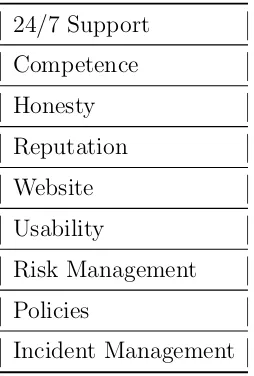
[3] feels that resource provider’s competence, honesty, availability, reliability, security,
capability, quality of service and reputation will influence the selection of cloud provider
mentions that reliability, competence, honesty, timeliness, truthfulness, dependability of
transaction partner influence trust decisions. Manchala et al. [95] considers transaction
cost, transaction history, indemnity, number of intermediaries involved in transaction
towards trust metrics in E-commerce transactions. Apart from above metrics, this study
also considers top concerns/challenges in cloud computing identified in survey reports
like IDC [81], Information Week [138] and CSA [9] towards trust metrics. These survey
reports identifies security, availability, performance, lack of interoperability, data loss and
insecure APIs as few of the top concerns in cloud computing.
These identified components/metrics were then correlated with Bubble framework
[48] to filter out components in the context of cloud computing. Table 4.1 and Table 4.2
show components used to measure trust in this study.
3.3.1
Service trust components
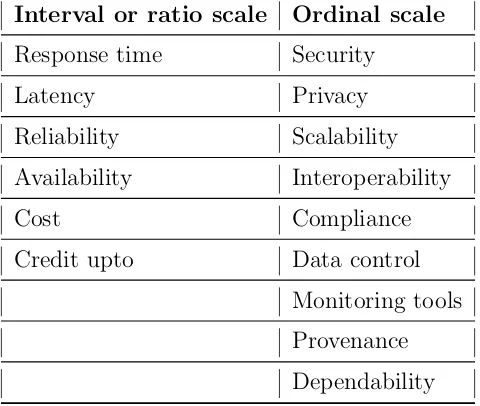
Service trust components are divided into metrics that can be measured on interval or
ratio scale and ordinal scale.
• Response time: It is the time system takes to react to given input. In cloud scenario, it is the time system takes to process and complete the service request.
• Latency: It measures delay between sending the request and receiving the re-sponse. Both response time and latency measure network performance (intra- and
inter-) in cloud and I/O speeds. CloudSleuth’s Global Provider View [38] a third
party monitoring service, measures response time in terms of page delivery time of
major cloud providers by downloading a simple target application web-pages.
![Figure 1.1Cloud service architecture [10] . . . . . . . . . . . . . . . . . . . . . .](https://thumb-us.123doks.com/thumbv2/123dok_us/1767188.1227341/11.612.93.538.106.216/figure-cloud-service-architecture.webp)
![Figure 1.1: Cloud service architecture [10]](https://thumb-us.123doks.com/thumbv2/123dok_us/1767188.1227341/16.612.104.530.142.578/figure-cloud-service-architecture.webp)
![Figure 3.1: Bubble Framework [48]](https://thumb-us.123doks.com/thumbv2/123dok_us/1767188.1227341/33.612.123.481.248.574/figure-bubble-framework.webp)
![Table 3.1: Control between provider and clients [42]](https://thumb-us.123doks.com/thumbv2/123dok_us/1767188.1227341/43.612.156.475.192.570/table-control-between-provider-and-clients.webp)
![Table 3.2: Industry standards [97]](https://thumb-us.123doks.com/thumbv2/123dok_us/1767188.1227341/46.612.148.646.124.476/table-industry-standards.webp)