Efficient Broadcast Encryption Scheme with Log-Key Storage
†Yong Ho Hwang and Pil Joong Lee
Dept. of Electronic and Electrical Eng., POSTECH, Korea.
[email protected],[email protected]
Abstract
In this paper, we present a broadcast encryption scheme with efficient transmission cost under the log-key restriction. Givenn users and r revoked users, our scheme has the transmission cost of O(r) and requires the storage ofO(logn) keys at each receiver. These are optimal complexities in broadcast encryptions using one-way hash functions (or pseudo-random generators.) To achieve these complexities, the stratified subset difference (SSD) scheme and theB1scheme were introduced by Goodrich et al. and Hwang et al. respectively. However, their schemes have the disadvantage that transmission cost increases linearly according to the number of stratifications. By assigning the related keys between stratifications, our scheme remedies the defect and achieves very efficient transmission cost even in an environment where the key storage is restricted. To the best of our knowledge, our scheme has the most efficient transmission cost in the existing schemes withlog-key storage. In addition, our result is comparable to other schemes that allow a large key storage.
1
Introduction
Broadcast encryption is an encryption scheme that enables a center to securely distribute messages to a dynamically changing group of users over an insecure channel, where only predetermined users can obtain available information. The center should efficiently deliver information to the group of legitimate users and prevent the group of revoked users from decrypting transmitted messages. There are various practical applications such as pay-TV, multicast communication, satellite-based commerce, and distribution of copyrighted materials (CD/DVD, etc). In this area, an important requirement is forstateless receivers, which cannot update their original state, i.e., they are not capable of recording the past history of transmission and changing their state accordingly. Hence, each receiver must be able to decrypt the current transmission with only its initial configuration. Actually, in many practical environments most devices should bestateless since it is difficult to keep the receiver constantly on-line and it is very cumbersome for both the receiver and the center to keep the history of every transmission.
With the advent of mobile networks and other digital support services, the need to deliver multi-media data to user’s handheld devices over a wireless network becomes more important. This situation is more intricate since handheld devices such as cellular phones and PDAs have only a small storage capability and low computing power. In addition, the bandwidth of wireless networks is narrower than that of wired networks. Therefore, we need an efficient broadcast encryption scheme to overcome these obstacles.
†This research was supported by University IT Research Center Project, the Brain Korea 21 Project, and grant No.
Related Works. The notion of broadcast encryption was first discussed by Berkovits [5]. Fiat and Naor [11] formalized the basic definitions and proposed a systematic paradigm. However, their scheme is difficult to apply to a practical system because it is highly complex. After the multicast scheme based on a logical tree hierarchy was independently introduced by Wallner et al.[21] and Wong et al.[22], various schemes [1, 2, 19, 15, 12] based on a tree structure were suggested. There are two approaches to construct an efficient tree-based scheme. One is a scheme based on sequential one-way hash functions (or pseudo-random generators)[19, 15, 12] and the other is based on the RSA accumulator [1, 2]. One-way hash function-based schemes have various trade-offs between O(r) transmission cost and O(logn) key storage wherenis the number of users andris the number of revoked users. While RSA accumulator-based schemes can reduce key storage to O(1), their transmission cost depends on n.i
Moreover, these schemes require expensive computations such as modular exponentiation and prime number generation. We deal with one-way function based schemes in this paper.
In 2001, Naor et al.[19] introduced a Subset-Cover framework and designed two broadcast en-cryption schemes for stateless receivers under this framework. One is the CS (Complete Subtree) scheme which requires O(rlogn/r) transmission cost and O(logn) key storage, and the other is the
SD (Subset Difference) scheme which guarantees 2r−1 transmission cost and O(logn) key compu-tation cost, while each user should store O(log2n) keys. The transmission cost of O(r) and the key storage of O(logn) have been regarded as the optimal bounds of tree-based schemes, which use the key assignment technique of sequentially applying a one-way function (or a pseudo-random generator). Afterwards, a number of papers tried to reduce the storage size by sacrificing the transmission cost of theSD scheme. Halevy and Shamir [15] proposed the LSD (Layered Subset Difference) scheme that lowers the key storage to O(log1+n) while maintaining O(r) transmission cost by labelling special layers in a binary tree. In addition, Goodrichet al. [12] presented the SSD (Stratified Subset Differ-ence) scheme that can lower the transmission cost to O(r) with O(logn) key storage by stratifying subtrees between special layers in a binary tree. The SSD scheme seems to be able to achieve the lower bounds of both the transmission cost and the key storage in tree-based schemes using one-way functions. However, theLSD scheme and the SSDscheme linearly increase the transmission cost ac-cording to the number of layers or stratified subtrees, although key storage does approach theO(logn) bound. Other interesting improvements were introduced in [4] and [18]. In [4] the key storage of the
SDscheme and the LSDscheme were slightly reduced by the sequential key derivation method while maintaining their transmission costs. In [18] the system complexity was adjusted by a hybrid structure based on theCS,SD, andLSDschemes. Moreover, other variants related to broadcast encryption have been investigated in [8, 6, 13, 20, 10, 17].
Recently, new broadcast encryption schemes based on a hash-chain [16] were proposed which can reduce the transmission cost belowr by exploiting the tradeoff between the transmission cost and the key storage. In doing so, however, too much secure memory must be sacrificed. For example, the transmission cost of these schemes is similar to that of the SD scheme when key storage is bounded as in the SD scheme. This approach seems useful in practical applications, since the storage size of user’s devices, even in the case of cellular phones or PDAs, seems to no longer be a problem because storage devices have become larger and cheaper. However, to guarantee security, user keys must be securely stored in tamper-proof storage devices, which are still small and expensive. To solve this problem, Hwang et al. [14] introduced a compiler that made scalable broadcast encryption schemes by transforming ones that had impractical computation costs or key storage requirements when there are huge numbers of users. They applied a given broadcast encryption scheme to a relatively small
i
Recently, an RSA accumulator-based scheme with transmission cost independent of n was accepted by Asiacrypt
subset in a hierarchical and independent manner. Their compiler make the computation cost and the key storage reasonable by slightly increasing the transmission cost. However, their compiler also does not achieveO(r) transmission cost when users are holding strictly resource-restricted devices.
In addition, Boneh et al. [7] introduced a public key broadcast encryption scheme with O(1) for both the transmission cost and the private key. Their scheme requires O(n) non-secure key storage andO(n−r) computation cost. To achieve reasonable storage and computation cost, they constructed a general scheme divided into a number of subsets. This scheme has O(√n) transmission cost and O(√n) key storage. Consequently, their complexity is not independent of n.
Our Contribution. In this paper, we focus on stateless receivers which can store at most O(logn) keys since it is actually difficult to store much data in tamper-proof storage. We refer to this as the
log-key restriction. We propose a new broadcast encryption scheme which satisfiesO(r) transmission cost and O(logn) key storage at a reasonable computation cost. Our scheme has the most efficient transmission cost under the log-keyrestriction. Table 1 shows the comparison between schemes with O(logn) key storage per user.
Table 1: Complexity of BE schemes withO(logn) key storage.
Transmission cost (Bound) Key storage Computation cost
CS [19] O(rlogn/r) O(logn) O(log logn)
SSD [12] O(r) 4kr O(logn) O(n1/k)
B1 [14] O(r) 2sr O(logn) O(n1/s)
Our scheme O(r) 2r O(logn) O(n1/d)
(k,s, anddare system parameters which mean the number of stratified subsets to obtain a reasonable computation cost.)
In [14], Hwang et al. introduced theB1 scheme with the computation cost proportional tonand transformed it to theB1scheme, which has a practical computation cost andlog-keystorage, by their compiler. Our scheme is also based on the B1 scheme and extends it in a hierarchical manner to a scheme with at most 2r transmission cost under the log-key restriction. To achieve a transmission cost free of the level of stratification, our scheme additionally assigns the related keys between strati-fications to theB1 scheme. There is a trade-off between the key storage and the computation cost in our scheme. Consequently, while our scheme reduces a upper bound of the transmission cost to 2r, (d+d+12 ·logn) key storage and (d·n1/d) computation cost are required.
Organization of The Paper. The remainder of this paper is organized as follows. In Section 2, we formalize a model for a broadcast encryption scheme based on aSubset-Cover framework. In Section 3, we first introduce our basic scheme and propose the complete scheme based on it. Then we discuss the performance and the properties of our scheme in detail and compare it with various broadcast encryption schemes in Section 4. Finally, we give concluding remarks in Section 5.
2
Model for Broadcast Encryption
2.1 Generic Model
In broadcast encryption the center (or the broadcaster) assigns secret keys to all users and broadcasts a encrypted message with the subset keys. Legitimate users can derive the subset keys from the assigned secret keys and decrypt the ciphertext with them. Let N be the set of all users, R the set of revoked users, and N \R the set of remaining users. We suppose that |N | = n and |R| = r. A
broadcast encryption scheme BEconsists of 3 phases (Setup,Broadcast,Decryption):
- Setup: The center generates secret keys for each user and delivers them to each user over a secure channel.
- Broadcast: In this phase, the center broadcasts a message to users. Given R, the center divides N \R into disjoint subsets S1, . . . , Sm so that N \R = Smi=1Si, and computes a subset key ski
for each subsetSi. At this time,ski is generated by a pre-defined algorithm. The center chooses
a session key K at random and encrypts it mtimes with sk1, . . . , skm. In addition, an “actual”
message M is encrypted with K. The center broadcasts a ciphertexthHdr,EncK(M)i where
Hdr=< I1, . . . , Im, Esk1(K), . . . , Eskm(K)> .
E:{0,1}l → {0,1}l and Enc:{0,1}∗ → {0,1}∗ are symmetric encryptions where l is a security parameter and Ij is the information on the subset Sj. Generally, a fast encryption scheme such
as a stream cipher is used for Enc to encrypt theactual message. We callHdr a Header (or an
enabling block).
- Decryption: After receiving the ciphertext, a user ufirst finds the subset Si including him from
Ii. A legitimate user can then generate a subset key ski from his secret keys. He decrypts
Eski(K) with it and obtains the actualmessage M fromK.
A legitimate user should be included in an arbitrary subset and be able to derive its subset key from his secret keys and the current transmission. In addition, even though all the revoked users collude with one another, it must be impossible for them to obtain any of the subset keys. The important factors for evaluating the broadcast encryption scheme are as follows.
- Transmission cost- the length of the Header for delivering the session key to users inN \R. This depends on the number of subsets covering N \ R; namely, the number of partitions included in a Header.
- Key storage - the number of secret keys which each user should store in his secure device.
- Computation cost - the processing time to compute the subset key from the user’s secret keys.
2.2 Adversarial Model
Our adversarial model follows the security model of Definition 10 in [19]. We briefly review their attack scenario. The attack game between the challenger and the adversary is as follows.
- Setup: The challenger runs the Setupalgorithm and generates secret keys for all users.
- Challenge: The adversary chooses a message M and a set R0 including all the sets of re-voked users selected in Phase 1. The challenger picks a random bit b ∈ {0,1} and sets C =Broadcast(R0, M
b) where M1 isM and M0 is a random message of similar length. Then he
sends it to the adversary.
- Guess: The adversary outputs a guessb0∈ {0,1}.
We say that a broadcast encryption scheme is secure if for any polynomial time adversary, the probability that he distinguishes betweenM0 and M1 is negligible.
3
Proposed Scheme
In this section we propose an efficient broadcast encryption scheme with log-key storage. Our con-struction is based on the B1 scheme by Hwang et al. [14]. While the B1 scheme has at most 2r transmission cost and O(logn) key storage, its computation cost is proportional to n. To achieve a reasonable computation cost, in [14] theB1scheme was constructed from theB1scheme by their com-piler. However, its transmission cost increases in proportion to the number of levels in the hierarchy. While our complete scheme has a similar structure to theB1scheme, it achieves efficient transmission cost by the related keys between each level in the hierarchy. We first introduce the modifiedB1scheme and construct an efficient broadcast encryption scheme from it.
3.1 Basic Scheme
In this section, we slightly modify theB1scheme. Actually, this scheme is identical to the B1scheme except for technique that the informationI on the subset is represented and a user searches a subset including him. In theB1scheme, a non-revoked user first finds two adjacent revoked users and should performs a binary search in an interval of two revoked users. In our scheme, a user can directly search his subset from the indexes and the direction of a hash chain
We define two one-way chains for users between ui and uj (i ≤ j) as OCi→j and OCi←j. Let
f :{0,1}l→ {0,1}l be a one-way function. ThenOC
i→j is a one-way chain from ito j that, given a
labelLi ∈R{0,1}l forui, ha the valuefj−i(Li). On the other hand,OCi←j is a one-way chain from j toithat, given a label Lj ∈R{0,1}l foruj, has the value isfj−i(Lj). Our basic scheme is as follows.
- Setup: The center imagines the number line L with n nodes where each node is numbered i
(i = 1, . . . , n) with level order from left to right. Each user is assigned to each node. Let a user assigned to a node ibe ui. The center randomly selects a label Li ∈ {0,1}l for each node
i (1≤ i ≤ n). We denote a set of users in an interval of i and j as Ii;j. Then fm−i(Li) and
fj−m(L
j) are given to a user um in Ii;j as the secret key. If keys for Ii;j are assigned, Ii;j is
divided into two intervals, Ii;t and It+1;j, where t = bi+2jc. Then secret keys for users in Ii;t
and It+1;j are assigned by the same method. If m < t, it assigns only ft−m(Lt) to a user um
for Ii;t since fm−i(Li) can be used for both Ii;j and Ii;t. If m ≥ t, only fm−t(Lt) is assigned
for It+1;j. Therefore, one additional key is given to a user whenever a new interval is made. It
starts from I1;n and recursively repeats. Consequently, a user should store 1 + logn keys in his
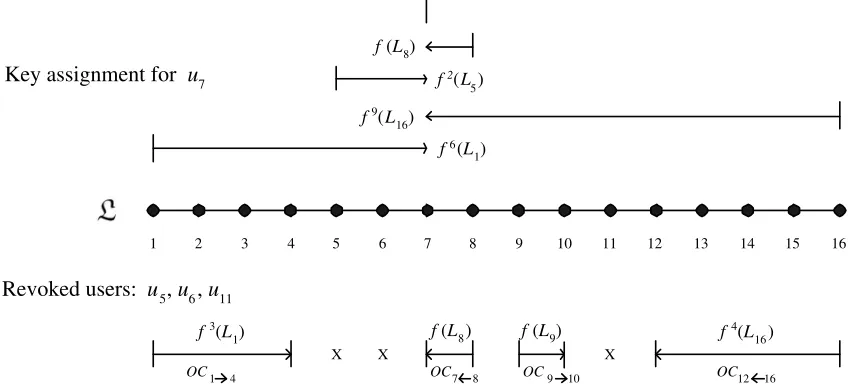
secure storage. For example, assume that there are 16 users in total. Then the secret keys for u7 are f6(L1), f9(L16), f(L8),f2(L5), andL7 as shown in Figure 1.
1 2 3 4 5 6 7 8 9 10 11 12 13 14 15 16 f 6(L
1)
f 9(L 16)
f 2(L 5)
f (L8) L7
X X X
f3(L
1) f (L8) f (L9) f 4(L16)
Key assignment for u7
Revoked users: u5, u6, u11
OC1 4 OC7 8 OC9 10 OC12 16
Figure 1: An example of the basic scheme forn=16.
non-revoked users in Ii;j are covered by two hash chainsOCi←t−1and OCt+1←j. Then, for users
in Ii;j, a session key K is encrypted with the chain values of OCi→t−1 and OCt+1←j, namely ft−1−i(L
i) and fj−(t+1)(Lj). Here, the subset information for two hash chains OCi←t−1 and
OCt+1←j can be [+;i, t−1] and [−;t+ 1, j].
- Decryption: After receiving the ciphertext, a userumfirst finds the subset including him from the
subset information [±;i, j] by checking whetheri≤m≤j. If the direction of his subset is +, then he computes OCi→j by fj−m(fm−i(Li)). Otherwise, he computes OCi←j byfm−i(fj−m(Lj)).
In Figure 1, ifu5,u6 andu11are revoked, the session key is encrypted with f3(L1), f(L8),f(L9),
and f4(L16) respectively. The scheme requires at most 2r transmission cost because at most two
ciphertexts for one revoked user are generated. Its security is provided under the pseudo-randomness off [14].
3.2 Complete Scheme
The basic scheme is not reasonable for practical applications because it has a computation cost propor-tional ton, though it satisfies thelog-keyrestriction and 2rbound of the transmission cost. We extend the basic scheme to a hierarchical structure similar to the generic transformation of [14]. Actually, in all the schemes with hierarchical structure for efficient trade-offs among the transmission cost, the key storage and the computation cost, the transmission cost increases linearly according to the number of hierarchies (or stratifications).ii
However, our construction can maintain the 2r bound of the transmission cost while satisfying the reasonable computation cost and log-key storage requirements. Our scheme achieves it from additional keys and computation cost proportional to the number of the levels in the hierarchy. In addition, our scheme has a trade-off between the key storage and the computation cost under a reasonable bound. The complete scheme is as follows.
iiFor example, the LSD scheme, theSSD scheme, and the B1 scheme have a transmission cost proportional to the
v0
v0c1
v0c3c1
v0c3c1c2
33 34 35 36
v0
v0c3
v0c3c1 v0c2 v0c3 v0c4
. . .
. . .
S S
S
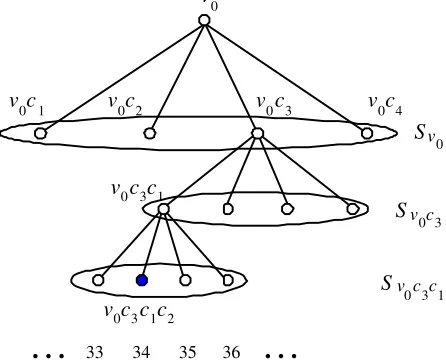
Figure 2: An example of the complete scheme forn=64.
- Setup: We assume thatn is ad. The center imagines a-ary tree T
a with a depth d and assigns
one user to each leaf. Then, each leaf in Ta is numberedi(i= 1, . . . , n) with level ordered from
left to right. Let a root ofTadenotev0andi-th child of a nodevdenotevci. In addition, we call
a set of children of a node v a sibling set Sv. In an example of Figure 2, node 34 is represented
as v0c3c1c2 andSv0c3c1 is{33,34,35,36}.
LetTv be a subtree rooted at a nodev ofTa. The center randomly selects each labelLi for each
node iinTa. Then it generates keys forSv bySetup of the basic scheme. Keys forvctinSv are
given to users assigned to leaves ofTvct. In consequence, a user assigned tov0ct1· · ·ctd has keys
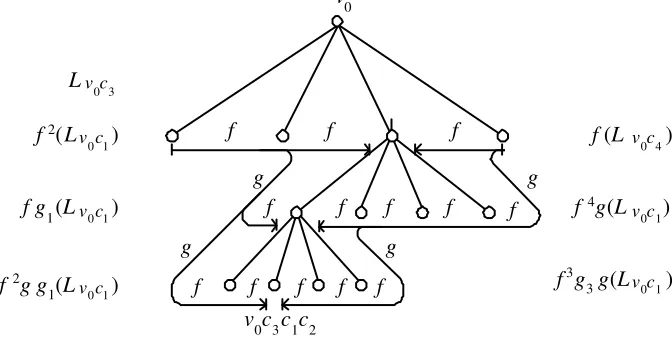
forSv0,Sv0ct1,. . .,Sv0ct1···ctd. Then, in Figure 2, a useru34 has secret keys,f
2(L
v0c1),f(Lv0c4),
Lv0c3 Lv0c3c1,f
3(L
v0c3c4),f(Lv0c3c2) f(L33),f
2(L
36), L34. This assignment is actually identical
to that by the compiler introduced in [14].
In our scheme, to eliminate the transmission cost of the hierarchical structure, users receives additional keys. Let g:{0,1}l→ {0,1}lbe a different one-way function withf. Letf(f(L)) de-notef◦f(L), andg◦fk(L) denoteg
k(L). Theng◦fx◦g◦fy(L) can be represented asgx◦gy(L).
When generating keys for an intervalIvci;vcjofSv, the center additionally computes the following
labels for a user vct1· · ·ctk; For 1< h < k,
Lvci
vct1...cthc1 =f◦gth−1−1(Lvcvcit1···cth−1c1) (1)
Lvcj
vct1...cthca =f ◦ga−th−1(L
vci
vct1···cth−1ca). (2)
A label Lvci
w means the label for a node w generated by Lvci. Secret keys, f
th+1−1(Lvci
vct1...cthc1) and fa−th+1(Lvcj
vct1...cthca) for 1 < h < k, are additionally given to a user vct1. . . ctk. Here,
g−1(Li) =g◦f−1(Li). For example, ifth = 1,Lvcvcit1...cthc1 =f◦g−1(L
vci
vct1...cth−1c1) =f◦g−1◦f◦
gth−1−1−1(L
vci
vct1...cth−2c1) =f◦g◦gth−1−1−1(L
vci
v0
v0c3c1c2
v0c1 f
f 2(L ) f f
f f f f f
g g
g g
f f f f f
v0c4 f (L )
v0c1
f g1(L ) f 4g(L v0c1)
v0c1 f 2g g
1(L ) f v0c1
3g
3 g(L )
v0c3 L
Figure 3: Key assignment to u34 forSv0.
to a user for Sv. A user v0ct1. . . ctd in Ta has all secret keys for Sv0ct1, Sv0ct1ct2, . . . , Sv0ct1...ctd. Therefore, the number of secret keys for a user is d+(d+1)2 ·logn in total;
d X
h=1
1 +hloga=d+ loga·
d X
h=1
h=d+d
2+d
2 ·(loga) =d+
(d+ 1)
2 ·logn.
In the example of Figure 3, the secret keys foru34are given as follows sinceLvv00cc13c1 =f◦g1(Lv0c1), and Lv0c1
v0c3c1c1 =f◦g◦g1(Lv0c1) by (1). Other labels can be easily computed by (2).
Sv0 : f
2(L
v0c1),f ◦g1(Lv0c1),f
2◦g◦g
1(Lv0c1)
f(Lv0c4),f
4◦g(L v0c4), f
3◦g
3◦g(Lv0c4), Lv0c3
Sv0c3 : Lv0c3c1,f
3(L
v0c3c4),f
3◦g
2(Lv0c3c4), f(Lv0c3c2),f
3◦g(L v0c3c2)
Sv0c3c1 : f(L33),f
2(L
36),L34
A user has 15 secret keys in total because d= 3 and n= 26.
- Broadcast: The center imagines the number line L composed by leaves of Ta. Given R, the
center makes the hash chains in the form of OCi→j or OCi←j which cover L as in Broadcast of
the basic scheme. If a least common ancestor of nodes from i to j is v, we denote this chain as OCvi→j( ori←j). Let a node, a child of v and an ancestor of i, be vi and a parent ofj be pj.
And if a node w ispwcm,s(w) meansm. First, we consider OCvi→j. The chain value of OC
v i→j is computed by the following process.
1. If i and j are siblings (namely, v is a parent of i and j), then the chain value of OCvi→j
equals that of OCi→j in the basic scheme.
2. Else ifj is the rightmost leaf in a subtree Tb of Tv.
• Ifvi and bare siblings, then the chain value of OCvi→j is f
s(b)−s(vi)(L
vi).
• Otherwise, the chain value ofOCv
i→j is fs(b)−1(Lvpibc1). 3. Otherwise, the chain value of OCvi→j isfs(j)−1(Lvi
v0
1 . . . 17 18 19 20 . . . 32 33 . . . 57 58 59 60 . . . 64
f (L v0c1 )
v0c2c1c1 L
v0c2c4
v0c2c1c1
f (L v0c3 )
v0c4c1
L58 Lv0c4c4
v0c4c4c1
OCv0
1 18 OC20 32v0c2 OC60 64
v0c4
OCv0
33 56 OC58
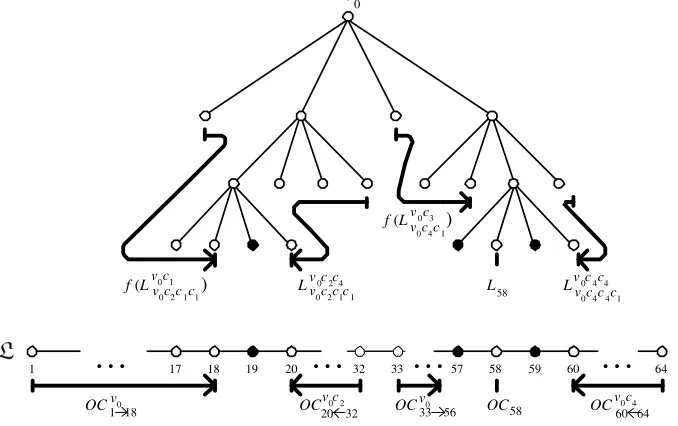
Figure 4: Revocation in the complete scheme.
The chain value of OCvi←j is generated by the opposite operation with the above process. Con-sequently, our scheme has the same transmission cost as the basic scheme.
In Figure 4, we assume that three users u19, u57, and u59 are revoked. Then the following
one-way chains are generated:
OCv0
1→18,OCv200←c232,OCv330→56,OC58←58, and OCv600c←464.
For them, the chain values aref(Lv0c1
v0c2c1c1),L
v0c2c4
v0c2c1c4,f(L
v0c3
v0c4c1),L58, andL
v0c4c4
v0c4c3c4, respectively. For a specific example of a chain value, consider OCv0
33→56. A least common ancestor of 33 and
56 is v0 and 56 is the rightmost leaf of Tv0c4c2. This chain value is f(L
v0c3
v0c4c1) since v0c3 and
v0c4c2 are not siblings, where Lvv00cc34c1 =f◦g(Lv0c3).
- Decryption: After receiving the ciphertext, a useruw finds his subset from [±;i, j]. If i≤w≤j,
uw is included in the subset [±;i, j]. Suppose that the direction is +.
1. Ifiandj are siblings, then he computes a subset keyfj−i(L
i) byfj−w◦fw−i(Li) from his
secret keyfw−i(L i).
2. Else ifj is the rightmost leaf in a subtree Tb of Tv,
• Ifvi and bare siblings, then he computes the chain valuefs(b)−s(vi)(Lvi) forOC
v i→j by
iteratively operating thef function with his secret key. • Otherwise, he computes the chain value fs(b)−1(Lvi
pbc1) for OC
v
i→j using g and f with
his secret key.
3. Otherwise, he computes the chain value fs(j)−1(Lvi
pjc1) for OC
v
i→j using g and f with his
secret key.
ancestor of 33 in the children ofv0isv0c3. Because 56 is a rightmost leaf ofTv0c4c2, a chain value for OCv0
33→56 is f(Lvv00cc34c1). User u34 is also a descendent of v0c3, so he has Lv0c3 as his secret key. Therefore, he can obtain a subset key f(Lv0c3
v0c4c1) by f
2◦g(L
v0cc). Because a revoked user
u57 has secret keysf2(Lvv00cc34c1) and L
v0c3
v0c4c3c1 (=f◦g◦f(L
v0c3
v0c4c1)) generated byLv0c3, he cannot obtain the subset key without inverting f orf◦g.
Efficiency. Transmission cost of the complete scheme is less than 2r because at most two ciphertexts per revoked user are generated, as in the basic scheme. To generate a subset key, a user needs at most d·a computation cost. In addition, a user stores d+ d+12 ·logn keys as shown above. Our scheme achieve the efficient transmission cost from a trade-off with the computation cost and the key storage by the number of stratification in hierarchical structure.
Security. The security of our scheme is provided under the pseudo-randomness of f and g. Actually, because all secret keys given to users are generated by one-way chains, excluded users (i.e. revoked users) by one-way chains cannot compute any subset key without inverting the given one-way functions f andg. However, a more formal security analysis is needed. We show that our scheme is resilient to collusion of any set of revoked users.
Lemma 1 The key assignment of the complete scheme satisfies the key-indistinguishability property under the pseudo-randomness of two functions f and g.
Proof. Let f ◦ g define a function h : {0,1}l → {0,1}l. If an adversary A can break the key-indistinguishability property of our scheme, we show that the pseudo-randomness of f and h is also broken by simulatingA. We assume that our scheme is defined by a collection of subsets S1, . . . , Sw.
For any 1≤i≤w, letSi1, . . . , Sit be all the subsets that are contained inSiandski1, . . . , skit be their
corresponding keys. An adversaryA attempts to distinguish the keysski1, . . . , skit from the random
keysrki1, . . . , rkit. Consider a feasible adversary Athat
1. Selectsi, 1≤i≤w
2. Receives the secret keysKu’s for allu ∈ N \Si
We denote the probability thatAdistinguishes the key from the random key byεas follows.
|Pr[A outputsi|ski]−Pr[Aoutputs i|rki]| ≤ε.
If an adversaryAcan distinguish the key from the random key, we can break the pseudo-randomness of f orh, sinceKu includes an output of the functionf orhon the key. Hence, if the pseudo-randomness
of two one-way functionsf and h is guaranteed,εis negligible.
Also, let Pij be the probability that given the subset keys contained in Si,Aoutputsi, where the
firstj keys are the true keys and the remaining t−j keys are the random keys. Namely,
Pij = Pr[Aoutputsi|ski1, . . . , skij, rkij+1, . . . , rkit].
Then we can obtain the following equation by the standard hybrid argument, since |Pij−Pij+1|< ε for 1≤j < t.
In consequence, our scheme satisfies the key-indistinguishability property under the
pseudo-random-ness of given functionsf and g.
In addition, Naoret al. showed that the key-indistinguishability property is sufficient for a scheme in the subset-cover framework to be secure in the adversarial model of Section 2.2 [19]. By Lemma 1 and Theorem 11 of [19], the security of the complete scheme is provided.
4
Discussions
We analyze the complexities of various broadcast encryption schemes in this section. While the SD
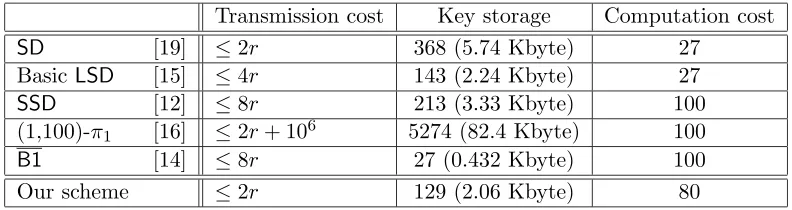
scheme needs at most 2r transmission cost, O(log2n) key storage is required. The LSD scheme, theSSD scheme, the π scheme, and the B1 scheme have trade-offs among the transmission cost, the computation cost and the key storage. Their complexities change depending on the system parameters that define the degree of stratification. Table 2 shows the comparison between our scheme and other efficient schemes. In the transmission cost column of Table 2, ‘≤’ means a upper bound of the transmission cost.
Table 2: Complexity of efficient BE schemes forn= 108
Transmission cost Key storage Computation cost
SD [19] ≤2r 368 (5.74 Kbyte) 27
BasicLSD [15] ≤4r 143 (2.24 Kbyte) 27
SSD [12] ≤8r 213 (3.33 Kbyte) 100
(1,100)-π1 [16] ≤2r+ 106 5274 (82.4 Kbyte) 100
B1 [14] ≤8r 27 (0.432 Kbyte) 100
Our scheme ≤2r 129 (2.06 Kbyte) 80
We assume that the size of keys is 128 bits and n is 108 for a practical instance. While the
computation cost of the SD scheme and the LSD scheme is fixed to O(logn), that of other schemes varies with the system parameters. Hence, we bound the computation cost to 100. This computation cost is reasonable even for low-power devices. If the computation cost of theSSD scheme and the B1
scheme is bounded to 100, their system parametersdand k are 4. Therefore, their transmission cost is 2·(4r).iii In addition, we compare other schemes to the Basic LSD with k = 2 because the LSD
scheme satisfies the most efficient transmission cost when having two layers.
The SSD scheme and the B1 scheme have high transmission cost proportional to the parameters dand k, and the (1,100)-π1 scheme does not have a good transmission cost where the revocation rate
is very small (i.e less than 1%). However, our scheme maintains a low transmission cost regardless of the parameter and revocation rate. For our scheme, we consider the case ofa = 10 and d= 8 to achieve a reasonable computation cost. At this time, the computation cost of our scheme is less than 80. As shown in Table 2, our scheme has the most efficient transmission cost under the reasonable computation cost andlog-key restriction.
Because our scheme possesses low transmission cost and small storage size, it can be efficiently iii
The upper bound of the transmission cost of theSSDscheme should be 16rfrom Table 1 whenk= 4. However, its
used where the computation and the storage are restricted as in a handheld device, or where the transmission is expensive as in a set-top box and CD/DVD. In addition, when a group of malicious users (called traitors) combines their secret keys to produce a pirate decode, the center can trace at least one of the traitors given access to this decoder by a subset tracing procedure introduced in [19] since our scheme is based on a subset-cover framework.
Our scheme is also suitable for broadcast encryption over wireless networks. In a wireless network, the target of messages is a handheld device with small memory and low computing power. Moreover, the bandwidth of wireless networks is narrower than that of wired networks. Therefore, our scheme is of great use for broadcast encryption scheme over wireless networks.
In addition, the key assignment technique used to construct our scheme can be applied to the schemes with a hierarchical structure such as the SSD scheme [12] and the B2 scheme [14]. The transmission cost of the modified schemes would be independent of the number of levels in hierarchy.
5
Concluding Remarks
We have presented a communication-efficient broadcast encryption scheme under the log-key restric-tion. In many practical applications, the systems should be efficiently able to deal with a very large group of users having a wide variety of devices. Our scheme can provide an efficient transmission cost under a reasonable computation cost for a large number of users by requiring key storage proportional to the log of the number of users. It is also a good solution for systems that rely on devices with limited secure storage.
References
[1] T. Asano, “A Revocationn Scheme with Minimal Storage at Receivers,”Advances in Cryptology - ASIACRYPT’02, LNCS vol. 2501, pp. 433-450, 2002.
[2] T. Asano and K. Kamio, “A Tree Based One-Key Broadcast Encryption Scheme with Low Com-putational Overhead,”Information Secrutiy and Privacy - ACISP’05, LNCS vol. 3574, pp. 89-100, 2005.
[3] N. Attrapadung and H. Imai, “Graph-Decomposition-Based Framework for Subset-Cover Broad-cast Encryption and Efficient Instantiations,” Advances in Cryptology - ASIACRYPT’05, (to appear).
[4] N. Attrapadung, K. Kobara, and H. Imai, “Sequential Key Derivation Patterns for Broadcast Encryption and Key Predistribution Schemes,”Advances in Cryptology - ASIACRYPT’03, LNCS vol. 2894, pp. 374-391, 2003.
[5] S. Berkovits, “How to broadcast a secret,” Advances in Cryptology - EUROCRYPT’91, LNCS vol. 547, pp. 535-541, 1991.
[6] C. Blundo, L. A. Frota, and D. R. Stinson, “Trade-off between Communication and Storage in Unconditionally Secure Schemes for Broadcast Encryption and Interactive Key Distribution,”
Advances in Cryptology - CRYPTO’96, LNCS vol.1109, pp. 387-400, 1996.
[8] B. Chor, A. Fiat, and M. Naor, “Tracing traitor,”Advances in Cryptology - CRYPTO’94, LNCS vol. 839, pp. 257-270, 1994.
[9] T. H. Cormen, C. E. Leiserson, R. L. Rivest, and C. Stein, “Introduction to Algorithms,” MIT Press, 2001.
[10] Y. Dodis and N. Fazio, “Public Key Trace and Revoke Scheme Secure Against Adapitive Chosen Ciphertext Attack,” Public Key Cryptography - PKC’03, LNCS vol. 2567, pp. 100-115, 2003.
[11] A. Fiat and M. Naor, “Boradcast Encryption,” Advances in Cryptology - CRYPTO’93, LNCS vol. 773, pp. 480-491, 1993.
[12] M. T. Goodrich, J. Z. Sun, and R. Tamassia, “Efficient Tree-Based Revocation in Groups of Low-State Devices,” Advances in Cryptology - CRYPTO’04, LNCS vol. 3152, pp. 511-527, 2004.
[13] E. Gafni, J. Staddon, and Y. L. Yin, “Efficient Methods for Intergrating Traceability and Broad-cast Encryption,” Advances in Cryptology - CRYPTO’99, LNCS vol. 1666, pp. 372-387, 1999.
[14] J. Y. Hwang, D. H. Lee, and J. Lim, “Generic Transformation for Scalable Broadcast Encryption Scheme,” Advances in Cryptology - CRYPTO’05, LNCS vol. 3621, pp. 276-292, 2005.
[15] D. Halevy and A. Shamir, “The LSD broadcast encryption scheme,” Advances in Cryptology -CRYPTO’02, LNCS vol. 2442, pp. 47-60, 2002.
[16] N.-S. Jho, J. Y. Hwang, J. H. Cheon, M.-H. Kim, D. H. Lee, and E. S. Yoo, “One-Way Chain Based Broadcast Encryption Schemes,” Advances in Cryptology - EUROCRYPT’05, LNCS vol. 3494, pp. 559-574, 2005.
[17] C. H. Kim, Y. H. Hwang, and P. J. Lee, “An Efficient Public Key Trace and Revoke Scheme Secure against Adaptive Chosen Ciphertext Attack,”Advances in Cryptology - ASIACRYPT’03, LNCS vol. 2894, pp. 359-373, 2003.
[18] M. Mihaljevic, “Key Management Schemes for Stateless Receivers Based on Time Varying Het-erogeneous Logical Key Hierarchy,”Advances in Cryptology - ASIACRYPT’03, LNCS vol. 2894, pp. 137-154, 2003.
[19] D. Naor, M. Naor, and J. Lostpiech, “Revocation and tracing schemes for stateless receivers,”
Advances in Cryptology - CRYPTO’01, LNCS vol. 2139, pp. 41-62, 2001.
[20] M. Naor and B. Pinkas, “Efficient Trace and Revoke Schemes,”Financial Cryptography’00, LNCS vol. 1962, pp. 1-20, 2000.
[21] D. M. Wallner, E. J. Harder, and R. C. Agee, “Key management for multicast: Issues and Architectures,” IETF Network Working Group, RFC 2627, 1999.