Efficient Arithmetic on Subfield Elliptic Curves
over Small Odd Characteristics
Keisuke Hakuta1, Hisayoshi Sato1, and Tsuyoshi Takagi2 1 Hitachi, Ltd., Systems Development Laboratory, 1099, Ohzenji, Asao-ku, Kawasaki, 215-0013, Japan
{k-hakuta,hisato}@sdl.hitachi.co.jp 2 Future University - Hakodate, School of Systems Information Science, 116-2, Kamedanakano-cho, Hakodate, 041-8655, Japan
Abstract. In elliptic curve cryptosystems, scalar multiplications per-formed on the curves have much effect on the efficiency of the schemes, and many efficient methods have been proposed. In particular, recod-ing methods of the scalars play an important role in the performance of the algorithm used. For integer radices, non-adjacent form (NAF) and its generalizations (e.g., generalized non-adjacent form (GNAF) and radix-r
non-adjacent form (rNAF) [4, 21]) are proposed for minimizing the non-zero densities in the representations of the scalars. On the other hand, for subfield elliptic curves, Frobenius-adic expansions of the scalars can be used for improving efficiency ([18]). Unfortunately, there are only a few methods apply the techniques of NAF or its analogue to Frobenius-adic expansion, namely τ-adic NAF techniques ([11, 20, 2] and [6]) for Koblitz curves and hyperelliptic Koblitz curves. In this paper, we try to combine these techniques, namely recoding methods for reducing non-zero density and Frobenius-adic expansion, and propose two new efficient recoding methods of scalars for more general family of subfield elliptic curves over odd characteristics. We also prove that the non-zero densities for the new methods are same as those for original GNAF andrNAF. As a result, the speed of the proposed schemes improve between 12.5% and 79% over that for previously known schemes.
Keywords:generalized non-adjacent form (GNAF), radix-rnon-adjacent form (rNAF), Frobenius-adic expansions,τ-adic NAF (τ-NAF),φ-adic NAF (φ-NAF), Elliptic Curve Cryptosystems (ECC)
1
Introduction
for given points on an elliptic curve by large integers. These multiplications have much effect on the efficiency of the schemes, and many efficient methods have been proposed.
As one such method, the use of subfield elliptic curves (i.e. elliptic curves over finite fields which are actually defined over some subfield [3]) is especially attrac-tive because by using the Frobenius maps, which is efficiently calculated, scalar multiplication on subfield elliptic curves can be performed much faster than that on curves over prime fields. Indeed, Smart ([18]) shows that every element d∈Z[φ] can be written asd=i=0−1diφi, wheredi ∈ {0,±1,· · ·,±(q−1)/2}, q is an order of the defining field of an Fq-subfield elliptic curve E, and φ is theq-th power Frobenius map on E. Therefore, we can use not point doubling but Frobenius map when we perform scalar multiplication on a subfield elliptic curve. Note that neither of these methods can be applied in the case of curves over prime fields (the case in which the group of prime field rational points is used to cryptosystem). In [7], the authors proposed efficiently computable en-domorphisms other than Frobenius enen-domorphisms can be used for fast scalar multiplication. Moreover, in [14], the authors proposed two kinds of endomor-phisms in [7] that can be used together for a certain class of curves, and they also presented a new expansion method.
On the other hand, recoding method of the scalars also plays an impor-tant role in the performance. In general, smaller non-zero densities in the rep-resentations of scalars improve the efficiency. Non-adjacent form (NAF) and its generalizations such as generalized non-adjacent form (GNAF [4]) and radix-r non-adjacent form (rNAF [21]), are methods used for minimizing the non-zero densities. So as to achieve further improvement, it has been tried to combine the subfield curve method with the recoding methods. In [20], Solinas proposed an efficient method of scalar multiplication for Koblitz curves, namelyτ-adic NAF (τ-NAF), and [11] proposedτ-adic NAF for some supersingular elliptic curves defined over the prime field of characteristic three using the Frobenius endomor-phism of the curves. In addition, [6] proposed a generalization of τ-adic NAF for hyperelliptic Koblitz curves. Recently, in [2], the authors proposed the radix-τ width-w NAF for every integer in all Euclidean quadratic imaginary fields. However, only a few curves are available for the above methods so far.
1.1 Contribution of this paper
elliptic curves over odd characteristics. For the resulting recoding methods, φ -GNAF andφ-rNAF, if the radix is small (e.g., 3,5), the difference between the computational costs for the precomputation tables of φ-GNAF andφ-rNAF is relatively small (at most, several elliptic additions). But, if the radix is signif-icantly large, the computational cost for the precomputation table of φ-rNAF is quite large compared to that forφ-GNAF. However the non-zero density for φ-rNAF is significantly smaller than that for φ-GNAF. Thus, these two gen-eralizations are used for the most appropriate applications. The speed of the proposed schemes improved between 12.5% and 79% over that for previously known schemes. In this paper, as the first step in the generalizations ofφ-NAF, we concentrate on investigating onlyφ-GNAF andφ-rNAF, and we do not deal with the width-wversions of these.
This paper is organized as follows. Section 2 reviews ordinary GNAF,rNAF, and τ-adic NAF for Koblitz curves. Section 3 shows how to generalize τ-NAF for Koblitz curves to two classes ofφ-adic NAF for a family of subfield elliptic curves and proves some properties ofφ-GNAF andφ-rNAF. Section 4 compares the total computational costs of several previous methods and the proposed methods.
2
Preliminaries
In this paper, in general, for any complex numberψ(= 0), we denotei=0−1ciψi withci∈Zby (c−1,· · · , c0)ψ. Hamming weight of (c−1,· · ·, c0)ψis defined by the number of non-zero ci’s. According to convention, we denote −a by ¯a for any natural numbera.
2.1 GNAF, rNAF
In this section, we review ordinary GNAF andrNAF. Letr, αbe relatively prime positive integers. We denoteDr,α a set defined as follows.
Dr,α:=
{0,±1,· · ·,±α} ifα < r,
{0,±1,· · ·,±α} \ {±r,±2r,· · · ,±α/rr} otherwise.
For an integer radixr≥2, GNAF andrNAF are proposed for minimizing the numbers of non-zero densities in the representations of integer scalars. In [4] and [21], the authors calculate the non-zero densities using Markov chains. In this paper, we regard non-zero densities of some representations as average densities of non-zero digits of the representations (See Section 3 for precise definitions).
Definition 1 [GNAF [4]] A radix-rgeneralized non-adjacent form (GNAF) of a positive integerdis a representationd=i=0−1eiri whereei∈Dr,r
Definition 2 [rNAF [21]] A radix-rnon-adjacent form (rNAF) of a positive integer d is a representation d = i=0−1eiri where ei ∈ Dr,
(r2−1)/2, e−1 = 0
and for eachi, it satisfies ei+1ei = 0where we define e= 0. The length of the rNAF is . For a, b ∈ Dr,(r2−1)/2, if ab = 0, then we call a pair (a, b) radix-r non-adjacent pair, and otherwise, we call (a, b) radix-r adjacent pair.
In the above definitions, note that for the radix r = 2, GNAF and rNAF coincide, and in this case, we call these recoding method “NAF”([21], pp.104). We can see that GNAF and rNAF have some desired properties. For details, consult [4] for GNAF, and [21] forrNAF.
Proposition 1 [Properties of GNAF (resp.rNAF)]
(1) Every positive integerdhas a unique GNAF (resp.rNAF) representation. (2) GNAF (resp. rNAF) representation of dhas the smallest Hamming weight among all signed representations of dwith digit set Dr,r−1 (resp.Dr,(r2−1)/2). (3)The average non-zero density of GNAF (resp.rNAF) is asymptotically (r− 1)/(r+ 1) (resp.(r−1)/(2r−1)).
2.2 Subfield elliptic curves and Frobenius-adic expansion
We briefly review subfield elliptic curves and Frobenius-adic expansion on the curves which we focus on in this paper. For detail, refer [18], [3] and [17].
Definition 3 [Fq-subfield elliptic curves] Let pbe an odd prime, q =pr a power ofp, andFq the finite field withq-elements. An elliptic curve defined over
Fq is called an “Fq-subfield elliptic curve” if for some cryptographic usage, we focus on the group ofFqn-rational pointsE(Fqn)for somen≥2. AnFq-subfield
elliptic curve E is given by a Weierstrass equation y2 = x3 +ax+b, where a, b∈Fq. Let us denoteφthe qth-power Frobenius map on E.
φ:E→E, (x, y)→(xq, yq),
and put tn := qn+ 1−#E(F
qn), whereE(Fqn) means the set of Fqn-rational
points onE. We can regardφas a complex number which satisfies the following characteristic equation : φ2−t1φ+q= 0.
In [18], the authors show that every elementd∈Z[φ] has aφ-adic represen-tation with some digit set. More precisely, they show the followings.
Theorem 1 [Frobenius-adic expansion for subfield elliptic curves] Let E be an elliptic curve over Fq and φ be itsqth-power Frobenius map of E. Let d∈Z[φ], then we can write d=i=0−1ciφi, where ci ∈ {0,±1,· · ·,±(q−1)/2} and2 logq2
2.3 τ-NAF for Koblitz curves and supersingular Koblitz curves
Next, we reviewτ-NAF for Koblitz curves and supersingular Koblitz curves.
Definition 4 [τ-NAF for ordinary Koblitz curves] Let Ea be an elliptic curve defined over F2 with defining equation as follows.
Ea:y2+xy=x3+ax2+ 1, a= 0 or 1.
It can be proven that these curves are ordinary, and we call these “ordinary Koblitz curves”. Let τ be the 2nd power Frobenius map of Ea. A τ-adic NAF representation (τ-NAF) for ordinary Koblitz curves of an elementd∈Z[τ] is a representation d=i=0−1eiτi whereei ∈D
2,1, e−1= 0and no two consecutive digitsei are nonzero. The length of theτ-NAF is.
Theorem 2 [Properties of τ-NAF [20], [1]]
(1) Everyd∈Z[τ]has a uniqueτ-NAF.
(2) τ-NAF ofdhas the smallest Hamming weight with digit set D2,1.
(3)The average non-zero density of τ-NAF is asymptotically1/3and it has the same non-zero density of ordinary NAF.
Koblitz [11] also proposed another possibility of NAF-like recoding method for Frobenius-adic representations on supersingular elliptic curves Ea : y2 = x3−x−(−1)a/F
3, wherea= 0 or 1. Similarly to the case of ordinary Koblitz curves, the uniqueness ofτ-NAF for these curves can be proven. Moreover, it is also proven that the non-zero density for this method is 2/5. See [11] for details. It is unknown any analogues ofτ-NAF representation for another subfield elliptic curves except for Koblitz curves and curves in [2]. But in [2], they proposed only non-adjacent radix-τexpansions for integers in all Euclidean quadratic imaginary fields. In the next section, we will propose two classes ofφ-NAF representation for a family of subfield elliptic curves. In the following, we call two classes of φ-NAF representationφ-GNAF,φ-rNAF, respectively.
3
Proposed Methods (Two classes of
φ
-NAF)
In this section, we investigate how to expand two classes ofφ-NAF for a family of subfield elliptic curves. LetSECt1[Fq] be the set ofFq-subfield elliptic curves with theqth power Frobenius tracet1. In the following, we focus on the case
t1 = 1 and consider a scalar multiplication for a given integer d and for a given point P ∈ E(∈ SEC1[Fq]). Note that although curves of trace one are anomalous, this does not mean the attack on anomalous curves in [19, 15] and [16] applies in this context. For allP ∈E(Fqn), it satisfies that (φn−1)P =O.
3.1 The first φ-NAF (φ-GNAF)
At first, we show how to expand the multiplication bydmap onE(Fqn) in terms ofφ-GNAF and prove some properties of this. We begin with the definition ofφ -GNAF for every subfield elliptic curves, and give an algorithm which calculates theφ-GNAF representation for a givend∈Z[φ], whereq7.
Definition 5 [φ-GNAF] Let E ∈ SECt[Fq] and d ∈ Z[φ]. A φ-adic GNAF representation (φ-GNAF) of d on E is a representation d =i=0−1eiφi where ei∈Dq,q−1 for each i,e−1= 0, and one of the followings holds
(1) ei+1ei= 0,
(2) ifei+1ei>0, then|ei+1+ei|< q, (3) ifei+1ei<0, then|ei+1|>|ei|.
Let a, b ∈ Dq,q−1. If a, b satisfy one of the followings : (1) ab = 0, (2) if ab > 0, then |a+b| < r, (3) if ab < 0, then |a| > |b|, then we call a pair (a, b)φφ-admissible pair follow the lead of [22]. Otherwise, we call(a, b)φ φ -non-admissible pair.
Algorithm 1: φ-GNAF for subfield elliptic curves with Frobenius trace1(q 7)
Input:d∈Z[φ]
Output: φ-GNAF representation ofd 1. Compute d=dmod (φn−1).
2. Compute =2 logq2NZ[φ]/Z(d) + 4.
3. Compute Frobenius-adic expansion (c−1, c−2,· · ·, c1, c0) ofd. 4.b0←c0,b1←c1,b←0,b+1←0.
5.i←0.
6. While ido
6.1. If (bi+1, bi) :φ-admissible pair thenbi+2←ci+2,ei←bi. 6.2. else ifbi>0 thenbi+2←ci+2−1,bi+1←bi+1+ 1,ei←bi−q. 6.3. else (bi<0) thenbi+2←ci+2+ 1,bi+1←bi+1−1,ei←bi+q. 6.4.i←i+ 1.
7. Return (e+1, e,· · ·, e1, e0).
The following lemma and theorem show the correctness of Algorithm 1, thus the existence of φ-GNAF. From the lemma, for any given Frobenius-adic ex-pansion, we can have a sequence with digits in Dq,q−1 such that any adjacent digits areφ-admissible. Moreover, the theorem below gives the finiteness of the sequence (hence φ-GNAF) and evaluates the upper bound of the length of φ -GNAF. For the proof of the lemma, it is easily seen that the proof of Theorem 12.2.3 in [22] can be applied. For details, refer [22].
Lemma 1 Let b ∈ Dq,(q+1)/2, b, e ∈ Dq,(q−1)/2. We assume that (b, e)φ is a φ-admissible pair and(b, b)φ is aφ-non-admissible pair. If we convert
(b, b, e)φ→
(¯1, c, c, e) := (¯1, b+ 1, b−q, e)φ ifb>0, (1, c, c, e) := (1, b−1, b+q, e)φ otherwise,
Theorem 3 [Finiteness of the length of φ-GNAF] Let d∈Z[φ] and be the length of Frobenius-adic expansion ofd. Thendhas aφ-GNAF representation with digit set Dq,q−1 such that the length is at most+ 2.
Proof. Let be the length of φ-GNAF representation of d. In process of Al-gorithm 1, we will have a representation d = (c, b, b, e−4,· · · , e1, e0)φ, where (e−4,· · ·, e1, e0)φ is aφ-GNAF. Now we scan the two digits (b, b)φ. If the pairs (c, b)φ and (b, b)φareφ-admissible, there is nothing to do and =. So we can assume that (b, b)φ isφ-non-admissible. Then we convert
(b, b)φ→(c, c, e−3)φ:=
(c−1, b+ 1, b−q)φ ifb>0, (c+ 1, b−1, b+q)φ otherwise.
If (c, c)φ isφ-admissible, then=. Otherwise, we convert
(c, c)φ→(a, a, e−2)φ:=
(¯1, c+ 1, c−q)φ ifc >0, (1, c−1, c+q)φ otherwise,
then a= 1 or ¯1. If (a, a)φ is φ-admissible, then =+ 1. If (a, a)φ isφ -non-admissible, then by the definition of GNAF, it is obvious thata= 1, a <0 or a= ¯1, a>0. In this case, we convert
(a, a)φ→
(1,0, a+q)φ a<0, (¯1,0, a−q)φ a>0.
Then=+ 2. Therefore the length ofφ-GNAF representation ofd∈Z[φ] is at most 2 more than that of Frobenius-adic expansion ofd.
We can also extend Algorithm 1 in the case ofq= 3 or 5. However, in this case, there is possibility thatbi is a multiple of qandbi= 0. Ifbi is a non-zero multiple ofq, we convert (bi+1, bi)φ→(−bi/q, bi+1+bi/q,0)φ. It is easy to show that ifbi is a non-zero multiple ofq, then it satisfies thatbi=±q. Thus for alli, we always have|bi+1|(q+ 1)/2,|bi|(q+ 3)/2, as Algorithm 1 (or Theorem 3). Remark that it does not occur bi+1modq = 0 except for bi+1 = 0. This shows the correctness of Algorithm 2.
Letφ-GNAFbe the set ofφ-GNAF representations of length. We putA= #φ-GNAF,S=d∈φ-GNAF
(−w(d)), andC= #{d∈φ-GNAF |w(d) =},
where w(d) means the Hamming weight of d. In other words, c is the number of φ-GNAF with length such that all digits are non-zero. Then the non-zero density ofφ-GNAF is defined by
1− lim
→∞S/(A).
Algorithm 2: φ-GNAF for subfield elliptic curves with Frobenius trace1(q= 3or5)
Input:d∈ [φ]
Output:φ-GNAF representation ofd
1. Computed=dmod (φn−1). 2. Compute=2 logq2
N [φ]/(d)+ 4.
3. Compute Frobenius-adic expansion (c−1, c−2,· · ·, c1, c0) ofd. 4.b0←c0,b1←c1,b←0,b+1←0.
5.i←0.
6. Whileido
6.1. Ifbimodq= 0 thenbi+1←bi+1−bi/q,bi+2←ci+2+bi/q,ei←0. 6.2. If (bi+1, bi) :φ-admissible pair thenbi+2←ci+2,ei←bi.
6.3. else ifbi>0 thenbi+2←ci+2−1,bi+1←bi+1+ 1, ei←bi−q.
6.4. else (bi<0) thenbi+2←ci+2+ 1,bi+1←bi+1−1,ei←bi+q. 6.5.i←i+ 1.
7. Return (e+1, e,· · ·, e1, e0).
Proposition 2 [Properties of φ-GNAF]
(1) Everyd∈Z[φ] has a uniqueφ-GNAF representation.
(2) The average number of non-zero digits for digits numbers inZ[φ] is equal to((q−1)/(q+1))+2/(q+1)+O((−1/q)). In particular, the average non-zero density amongφ-GNAF representations of lengthis asymptotically(q−1)/(q+ 1).
The following algorithm calculates the φ-GNAF representation for a given d∈ Z[φ] without the calculation of Frobenius-adic expansion ofd and reduces the memory consumption to calculates theφ-GNAF representation compared to Algorithm 1 and 2. From Theorem 3 (especially the finiteness of the length of φ-GNAF), it is easy to show the correctness of Algorithm 3.
Algorithm 3: φ-GNAF for subfield elliptic curves with Frobenius trace1 Input:d∈Z[φ]
Output: φ-GNAF representation ofd
1. Compute d:=d0+d1φ=dmod (φn−1)(d0, d1∈Z). 2. Compute =2 logq2NZ[φ]/Z(d) + 4.
3. Compute Q, b∈Zsuch thatd0=Qq+b(b∈Dq,(q−1)/2) (see [18]). 4.d0←Q+d1,d1← −Q.
5.i←1.
6. While i+ 1 do
6.1. ComputeQ, a∈Zsuch thatd0=Qq+a(a∈Dq,(q−1)/2). 6.2.d0←Q+d1,d1← −Q.
6.3. If (a, b)φ :φ-admissible pair thenei−1←b,b←a. 6.4. else ifb >0 thenei−1←b−q,b←a+ 1,d0←d0−1. 6.5. elseei−1←b+q,b←a−1,d0←d0+ 1.
3.2 The second φ-NAF (φ-rNAF)
Next, we show how to expand the multiplication bydmap onE(Fqn) in terms of
φ-adicrNAF and prove some properties of this. As with the previous section, we begin with the definition ofφ-rNAF for every subfield elliptic curves, and give an algorithm which calculates theφ-rNAF for a givend∈Z[φ], whereq7.
Definition 6 [φ-rNAF] Let E ∈ SECt[Fq] and d ∈ Z[φ]. A φ-adic rNAF representation (φ-rNAF) ofdonE is a representationd=i=0−1eiφi such that ei ∈Dq,(q2−1)/2, e−1 = 0 and ei+1ei = 0 for each i. Let a, b∈ Dq,(q2−1)/2. If
ab= 0, we call(a, b)φ φ-non-adjacent pair. Otherwise, we call(a, b)φ φ-adjacent pair.
Algorithm 4: φ-rNAF for subfield elliptic curves with Frobenius trace1(q 7)
Input:d∈Z[φ]
Output: φ-rNAF representation of d 1. Compute d=dmod (φn−1).
2. Compute =2 logq2NZ[φ]/Z(d) + 4.
3. Compute Frobenius-adic expansion (c−1, c−2,· · ·, c1, c0) ofd. 4.b0←c0,b1←c1,b←0,b+1←0,b+2←0,b+3←0. 5.i←0.
6. While i+ 2 do
6.1. Ifbi= 0 thenbi+2←ci+2,ei←0,i←i+ 1.
6.2. else if|bi+1q+bi|(q2−1)/2 thenbi+3←ci+3, bi+2 ←ci+2+bi+1, ei+1←0, ei ←bi+1q+bi, i←i+ 2.
6.3. else ifbi+1q+bi<−(q2−1)/2 then bi+3←ci+3+ 1,
bi+2←ci+2+bi+1+ (q−1), ei+1←0, ei←bi+1q+bi+q2,i←i+ 2. 6.4. else (bi+1q+bi>(q2−1)/2) thenbi+3←ci+3−1,
bi+2←ci+2+bi+1−(q−1), ei+1←0, ei←bi+1q+bi−q2,i←i+ 2. 7. Return (e+3, e+2,· · ·, e1, e0).
In the above algorithm, it does not occur the conversion :
(bi+1, bi)φ→
(¯bi, bi+1+bi,0)φ ifbi=biq for somebi∈Z,
(¯bi+1, bi+1,0, bi)φ ifbi+ 1 =bi+1q for somebi+1∈Z. In fact, there is no possibility such thatbimodq≡0, bi= 0 orbi+1modq≡ 0, bi+1= 0 when we scan (bi+1, bi)φ.
The lemma and theorem below show the correctness of Algorithm 4, thus the existence ofφ-rNAF. For the proof of the lemma, consult [21].
Lemma 2 Let c, c, c ∈ Dq,(q−1)/2, b ∈ Dq,(q+1)/2, b ∈ Dq,2q−1. We convert (c, c, c, b, b)φ from right-to-left according to the following rule and we denote the result of the conversion(a, a, e, e, e, e)φ.
(Rule 1) Ifa= 0, b= 0, then convert (a, b)φ
(a, b)φ→ ⎧ ⎨ ⎩
(a,0, aq+b)φ if|aq+b|(q2−1)/2, (1, a+ (q−1),0,(aq+b) +q2)φ else ifaq+b <−(q2−1)/2, (¯1, a−(q−1),0,(aq+b)−q2)φ otherwise.
(Rule 2) If a= 0, b= 0, then skip the 1-digit b. We scan the next consecutive two digits which include a.
(Rule 3) if a = 0, b = 0, then skip the 2-digits a and b. We scan the next consecutive two digits which do not include a.
Then, it always satisfy that a∈Dq,(q+1)/2, a ∈Dq,2q−1 anda ≡0 modq except for a= 0.
Theorem 4 [Finiteness of the length of φ-rNAF] Let d∈Z[φ] and be the length of Frobenius-adic expansion ofd. Thendhas aφ-rNAF representation with digit set Dq,(q2−1)/2 such that the lenght is at most + 4.
Proof. Let be the length of φ-rNAF representation of d. As in the proof of Theorem 3, in process of Algorithm 4, it is easily seen that we will have two cases as follows.
(Case 1) d= (b, b, e−3, e−4,· · · , e1, e0)φ, where (e−3,· · ·, e0)φ is a φ-rNAF. Now we scan the two digits (b, b)φ. We can assume that e−3 = 0 because if e−3= 0, It will be able to reduce this case to the case 2 (See below the details). If (b, b)φ is theφ-non-adjacent pair, then=. Otherwise, we convert the pair (b, b)φ in the following :
(b, b)φ→ ⎧ ⎨ ⎩
(b,0, bq+b)φ |bq+b|(q2−1)/2, (1, b+ (q−1),0, bq+b+q2)φ bq+b<−(q2−1)/2, (¯1, b−(q−1),0, bq+b−q2)φ bq+b>(q2−1)/2,
and we put the result (c, c, e−1, e−2)φ. If|bq+b|(q2−1)/2, then+ 1. Otherwise, since|b|(q+ 1)/2,
|cq+c|=| ±q±(q−1) +b|=| ±(2q−1) +b|(q2−1)/2,
when it satisfies thatq5. We can convert (1, b+ (q−1))φ→(1,0, b+ (2q−1))φ or (¯1, b−(q−1))φ →(¯1,0, b−(2q−1))φ, thus we have=+ 2.
(Case 2) d = (c, b, b, e−4,· · · , e1, e0)φ, where (e−4,· · ·, e1, e0)φ is a φ-rNAF. Now we scan the two digits (b, b)φ. We can assume thatb= 0 because ifb = 0, we can reduce this case to the case 1. Note that e−4 = 0. If b = 0, there is nothing to do and =. So we can also assumeb= 0. Then we convert
(b, b)φ→ ⎧ ⎨ ⎩
and we put the result (a, a, e−2, e−3)φ. If|bq+b|(q2−1)/2, there is nothing to do and . Otherwise, the most significant two digits are (1,(q−1)+b+c)φ or (¯1,−(q−1) +b+c)φ, we convert
|aq+a|=| ±q±(q−1) +b+c|=| ±(2q−1) +b+c|(q2−1)/2,
when it satisfiesq9. We can convert
(1,(q−1) +b+c)φ →(1,0,(2q−1) +b+c)φ, (¯1,−(q−1) +b+c)φ→(¯1,0,−(2q−1) +b+c)φ.
Then we have =+ 2 when it satisfiesq9. If it satisfy that q= 7 and |bq+b|>(q2−1)/2, then we convert
(1, b+c+ (q−1))φ→(¯1,−(q−2),0, b+c−(q−1)2)φ, (¯1, b+c−(q−1))φ→(1, q−2,0, b+c+ (q−1)2)φ.
Note that because of Lemma 2, the following situations do not occur :
(1, b+c+ (q−1))φ →(1, q,0, b+c+ (q−1)2)φ, (¯1, b+c−(q−1))φ →(¯1,q,¯ 0, b+c−(q−1)2)φ.
Here,±q±q−2 =±2(q−1), so| ±2(q−1)|(q2−1)/2. Then=+ 4. Therefore the length of φ-rNAF representation of d ∈Z[φ] is at most 4 more
than that of Frobenius-adic expansion ofd.
We can also extend Algorithm 4 to the case ofq= 3 or 5. However, it does not satisfy Lemma 2 in this case, namely there are possibility thatbiis a multiple ofqandbi= 0. Ifbi is a non-zero multiple ofq, we convert
(bi+1, bi)φ →(−bi/q, bi+1+bi/q,0)φ.
It is easy to show that if bi is a non-zero multiple of q, then it satisfies that bi=±q. Thus for alli, we always have
|bi+1|(q−1)/2,|bi|q−1 or |bi+1|(q+ 1)/2,|bi|2q−1 (|bi| =q),
Algorithm 5: φ-rNAF for subfield elliptic curves with Frobenius trace1(q= 3or5)
Input:d∈Z[φ]
Output: φ-rNAF representation of d 1. Compute d=dmod (φn−1).
2. Compute =2 logq2NZ[φ]/Z(d) + 4.
3. Compute Frobenius-adic expansion (c−1, c−2,· · ·, c1, c0) ofd. 4.b0←c0,b1←c1,b←0,b+1←0,b+2←0,b+3←0. 5.i←0.
6. While i+ 2 do
6.1. Ifbimodq= 0 thenbi+1←bi+1−bi/q,bi+2←ci+2+bi/q,i←i+ 1. 6.2. Ifbi= 0 thenei←0,bi+2←ci+2, i←i+ 1.
6.3. else if|bi+1q+bi|(q2−1)/2 thenbi+3←ci+3,bi+2←ci+2+bi+1, ei+1←0,ei←bi+1q+bi,i←i+ 2.
6.4. elsebi+1q+bi<−(q2−1)/2 thenbi+3←ci+3+ 1,
bi+2←ci+2+bi+1+ (q−1), ei+1←0,ei ←bi+1q+bi+q2,i←i+ 2. 6.5. elsebi+1q+bi>(q2−1)/2 thenbi+3←ci+3−1,
bi+2←ci+2+bi+1−(q−1), ei+1←0,ei ←bi+1q+bi−q2,i←i+ 2. 7. Return (e+3, e+2,· · ·, e1, e0).
Letφ-rNAF be the set of φ-rNAF representation of the length . We put B= #φ-rNAF,T=d∈φ-rNAF
(−w(d)), wherew(d) means the Hamming
weight ofd. Then as is the case withφ-GNAF, the non-zero density ofφ-rNAF is defined by 1−lim→∞T/(B).
Forφ-rNAF, we also have similar properties. For the proof of the following proposition, refer the appendix.
Proposition 3 [Properties of φ-rNAF]
(1) Everyd∈Z[φ] has a uniqueφ-rNAF representation.
(2) The average number of non-zero digits for digits numbers inZ[φ] is equal to((q−1)/(2q−1))+q/(2q−1) +O(((1−q)/q)). In particular, the average non-zero density among φ-rNAF representations of length is asymptotically (q−1)/(2q−1).
Algorithm 6: φ-rNAF for subfield elliptic curves with Frobenius trace1 Input:d∈Z[φ]
Output: φ-rNAF representation of d
1. Compute d:=d0+d1φ=dmod (φn−1)(d0, d1∈Z). 2. Compute =2 logq2NZ[φ]/Z(d) + 4.
3.i←0.
4. While i+ 2 do
4.1. ComputeQ, b∈Zsuch thatd0=Qq+b(b∈Dq,(q−1)/2) (see [18]). 4.2.d0←Q+d1,d1← −Q.
4.3. Ifb= 0 thenei←0,i←i+ 1.
4.4. else computeQ, a∈Zsuch thatd0=Qq+a(a∈Dq,(q−1)/2). d0←Q+d1,d1← −Q.
if|aq+b|(q2−1)/2 thenei ←aq+b, ei+1←0, d0←a, d1← −Q. else ifaq+b <−(q2−1)/2 thenei←aq+b+q2,
ei+1←0, d0←a+ (q−1), d1← −Q+ 1.
elseei←aq+b−q2,ei+1←0, d0←a−(q−1), d1← −Q−1. i←i+ 2.
5. Return (e+3, e+2,· · ·, e1, e0).
Remark. In this paper, we do not discuss about the minimality of Hamming weight ofφ-GNAF andφ-rNAF among various recoding methods with appropri-ate digit sets. Although the property of minimality is desired, we can easily seen that for φ-GNAF, φ-rNAF, conventional proofs (for e.g., GNAF, rNAF, etc.) are not available. It can be considerd that these flaws are caused by the differ-ence between the rational integer ring and quadratic imaginary integer rings or quadratic order, and we will need some deep observation on number theoretical properties of quadratic integer rings. These issues remain to be discussed.
4
Comparisons
We compare several recoding methods for computing scalar multiplication for a point on a subfield elliptic curve with the Frobenius trace 1 using standard Left-to-right method (for details, refer [8]). Letdbe a large positive integer and we focus on the group ofFqn-rational pointsE(Fqn) for sufficient largenwhich
satisfy d≈ qn. Let mq, be the length of q-adic expansion of d, the length of φ-adic expansion ofd0=dmod (φn−1), respectively.
As d ≈ qn, the norm of d will be equal to d2 ≈ q2n and d
0 ≈ qn+1 (for detail, refer [18]). So m = logqd+ 1 ≈ logqqn+ 1 = n+ 1 and 2 logq2
the shift operations are essentially free, thus if we use normal basis forFqn, then
the cost of Frobenius map on subfield elliptic curves are free.
In the below tables, ECADD, ECDBL, and ECFRB stand for the compu-tational cost of the point addition, point doubling, and Frobenius map, respec-tively. Note that when we compute point multiplication byqfor ordinary GNAF orrNAF, we use−(φ2−φ), i.e., the computational cost of point multiplication byqjust one time is ECADD+2ECFRB.
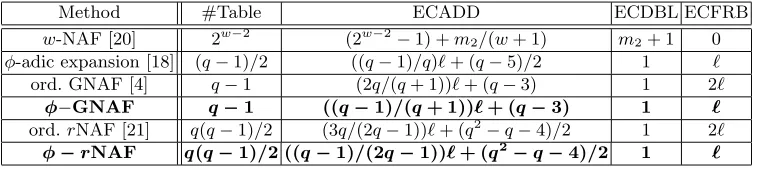
Method #Table ECADD ECDBL ECFRB
w-NAF [20] 2w−2 (2w−2−1) +m2/(w+ 1) m2+ 1 0
φ-adic expansion [18] 1 0.67 0
ord. GNAF [4] 2 1.5 1 2
−GNAF 2 05 1
ord.rNAF [21] 3 1.4 2 2
NAF 3 04 2
Table 1.Computational cost for each recoding method (q= 3)
Method #Table ECADD ECDBL ECFRB
w-NAF [20] 2w−2 (2w−2−1) +m2/(w+ 1) m2+ 1 0
φ-adic expansion [18] (q−1)/2 ((q−1)/q)+ (q−5)/2 1
ord. GNAF [4] q−1 (2q/(q+ 1))+ (q−3) 1 2
−GNAF 1 (( 1)(+ 1))+ ( 3) 1
ord.rNAF [21] q(q−1)/2 (3q/(2q−1))+ (q2−q−4)/2 1 2
NAF ( 1)2 (( 1)(2 1))+ ( 2
4)2 1
Table 2.Computational cost for each recoding method (q 5)
In the second column, the value #Table equals the number of elements, that have to be precomputed and stored.
We assume thatq= 3,5,7. The above table shows that the throughputs of [18], [4] are improved by 12.5∼25%, 57∼60%, respectively, using φ-GNAF and the throughputs of [18], [21] are improved by 40∼46%, 31.5∼71%, respectively, usingφ-rNAF on the above assumption.
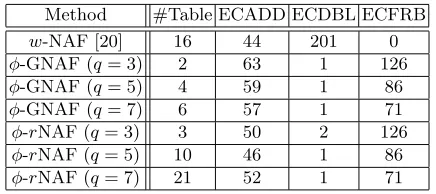
Moreover we assume that the bit length ofd≈200 and the widthw= 6. Then n= 126 (q= 3),86 (q= 5),71 (q= 7), respectively. In this case, computational cost for each recoding method is the following.
The above table shows that the throughputs ofw-NAF are improved by 75% usingφ-GNAF and 79% using φ-rNAF.
5
Conclusion
Method #Table ECADD ECDBL ECFRB
w-NAF [20] 16 44 201 0
φ-GNAF (q= 3) 2 63 1 126
φ-GNAF (q= 5) 4 59 1 86
φ-GNAF (q= 7) 6 57 1 71
φ-rNAF (q= 3) 3 50 2 126
φ-rNAF (q= 5) 10 46 1 86
φ-rNAF (q= 7) 21 52 1 71
Table 3.Computational cost for each recoding method (w= 6,m2= 200) of subfield elliptic curves. Those methods are two classes of φ-NAF (φ-GNAF and φ-rNAF). Our proposed methods can be applied to every subfield elliptic curves with Frobenius trace 1 regardless of whether or not the endomorphism rings are Euclidean. We also prove that these representations have the same non-zero densities as the corresponding original GNAF and rNAF. Because of the high efficinecy in computing Frobenius maps, our proposed methods improve the efficiency of scalar multiplication significantly compared to previous meth-ods. The speed of the proposed schemes improve between 12.5% and 79% over that for previously known schemes.
References
1. R.M. Avanzi,C. Heuberger, andH. Prodinger, “Minimality of the Hamming
Weight of theτ-NAF for Koblitz Curves and Improved Combination with Point Halving,” Cryptology ePrint Archive : Report 2005/225, 2005. available from : http://eprint.iacr.org/2005/225.pdf
2. I.F. Blake, V.K. Murty and G. Xu, “Nonadjacent radix-τ Expansions of
Integers in Euclidean Imaginary Quadratic Number Fields,” GANITA LABO-RATORY, November, 2004. available from : http://www.erin.utoronto.ca/ ~w3ganita/radix_t.pdf
3. I. Blake, G. Seroussi, and N.P. Smart, “Elliptic Curves in Cryptography,”
Cambridge University Press, 1999.
4. W.E. ClarkandJ.J. Liang, “On arithmetic weight for a general radix
represen-tation of integers,”IEEE Transactions on Information Theory, IT-19, pp.823-826, 1973.
5. H. Cohen, “Analysis of the Sliding Window Powering Algorithm,” Journal of
Cryptology 18, pp.63-76, 2005.
6. C. G¨unther,T. LangeandA. Stein, “Speeding up the Arithmetic on Koblitz
Curves of Genus Two,”Selected Areas in Cryptography - SAC 2001,LNCS2012, pp.106-117, 2001.
7. R. Gallant,R. Lambert, andS. Vanstone, “Faster Point Multiplication on
El-liptic Curves with Efficient Endomorphisms,”Advances in Cryptology - CRYPTO 2001,LNCS2139, pp.190-200, 2001.
8. D. Hankerson,A. Menezes, andS. Vanstone, “Guide to Elliptic Curve
Cryp-tography,” Springer-Verlag, 2004.
9. N. Koblitz, “Elliptic curve cryptosystems,” Mathematics of Computation 48,
10. N. Koblitz, “CM-curves with good cryptographic properties,”Advances in
Cryp-tology - CRYPTO 1991,LNCS576, pp.279-287, 1992.
11. N. Koblitz, “An elliptic curve implementation of the finite field digital signature
algorithm,” Advances in Cryptology - CRYPTO 1998,LNCS 1462, pp.327-337, 1998.
12. T. Lange, “Efficient Arithmetic on Hyperelliptic Koblitz Curves,” Ph.D. thesis,
University of Essen, 2001.
13. V. Miller, “Uses of elliptic curves in cryptography,”Advances in Cryptology
-CRYPTO 1985,LNCS218, pp.417-426, 1986.
14. T.J. Park, M.K. Lee and K. Park, “New Frobenius Expansions for Elliptic
Curves with Efficient Endomorphisms,”International Conference on Information Security and Cryptology - ICISC 2002,LNCS2587, pp.264-282, 2003.
15. T. SatohandK. Araki, “Fermat quotients and the polynomial time discrete log
algorithm for anomalous elliptic curves,”Commentarii Mathematici Universitatis Sancti Pauli, 47, pp.81-92, 1998.
16. I.A. Semaev, “Evaluation of discrete logarithms on some elliptic curves,”
Math-ematics of Computation 67, pp.353-356, 1998.
17. J.H. Silverman, “The Arithmetic of Elliptic Curves,” GTM 106,
Springer-Verlag, 1986.
18. N.P. Smart, “Elliptic curve cryptosystems over small fields of odd
characteris-tic,”Journal of Cryptology 12, pp.141-151, 1999.
19. N.P. Smart, “The discrete logarithm problem on elliptic curves of trace one,”
Journal of Cryptology 12, pp.193-196, 1999.
20. J.A. Solinas, “Efficient Arithmetic on Koblitz curves,”Designs, Codes and
Cryp-tography 19, pp.195-249, 2000.
21. T. Takagi,S.M. YenandB.C. Wu, “Radix-r Non-adjacent Form,”Information
Security Conference - ISC 2004,LNCS3225, pp.99-110, 2004.
22. J.H. van Lint, “Introduction to coding theory,” GTM 86, Springer-Verlag, 1982.
A
Several Proofs
In this section we prove several propositions and lemmas described in this paper. Here, we review the following Lemma to prove the uniqueness of φ-GNAF and φ-rNAF. For detail, refer [12].
Lemma 3 Let α=a+bφ∈Z[φ] (a, b∈Z), then we have
φ|α ⇔ q|a.
In particular, for rational integer a∈Z, we haveφ|a⇔q|a.
Proof of Proposition 2.
(1) We suppose that d∈Z[φ] has two such representations
If i0 is the smallest number such thatei=ei for 0ii0−1 and ei0 =ei0,
then we can replace d by (d−ii=00−1eiφi)/φi0 = −1
i=i0eiφi−i0, and we have
representations
d= −1
i=0 eiφi=
−1
i=0
eiφi, e0=e0,
whereis the maximum of length of the two representations. Then from Lemma 3, we haveq|(e0−e0), and by the assumption,|e0|,|e0|q−1, hence it satisfies that |e0−e0| |e0|+|e0| 2q−2. Therefore we have e0−e0 =±q. In the following, we will give a proof for the casee0−e0=q. For another case, we can prove similarly, thus we omit it.
We haveq= (e0−e0) =i=1−1(ei−ei)φiand by the characteristic polynomial ofφ, we haveφ−φ2=i=1−1(ei−ei)φi. Thus we can see
(e1−e1+ 1) = (e2−e2+ 1)φ+ −1
i=3
(ei−ei)φi−1.
Hence, from Lemma 3, we also have q|(e1 −e1+ 1). It follows that e1 ∈ {e1+ 1−q, e1+ 1, e1+ 1 +q}. Then, by the same way as [22], we can easily induce the contradiction (For details, refer [22], pp.177).
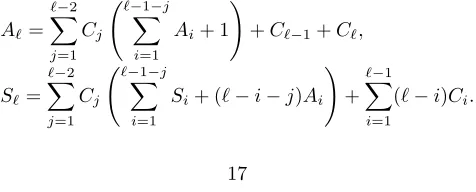
(2) At first, we show thatC+1= (q−2)C,C1= 2(q−1). We fix an element d = (e−1,· · ·, e0)φ of Z[φ] which is aφ-GNAF representation such that each ei = 0. For the fixedd, we count the number ofewhich satisfy 0<|e|< q−1, and (e−1,· · ·, e0, e)φ is aφ-GNAF representation. We can assume thate0>0. Ife0e >0,e satisfy 0< e < q−1−e0 and otherwise 0< e < e0. Thus we have that the number ofeisq−2, hence the recurrence equation for C. It is trivial that C1= 2(q−1).
Next, we show thatAandSsatisfy the recurrence equationsA1= 2(q−1), A2= 2(q−1)2,A+2−(q−1)A+1−qA= 0 (≥1), andS1= 0,S2= 2(q−1),
S+2−(q−1)S+1−qS= 2(q−1)
1 +2(q−1) (q+ 1)
q(q−1) q−1 −
(−1)−1 2
.
In Table 4, the symbol ‘∗’ means a non-zero digit. We explain how to see Table 4. The left column stand for forms ofdigitsφ-GNAF representation, the center column stand for the number of eachφ-GNAF representation correspond to each form of the left column, and the right column stand for each number of 0 digits correspond to each form of the left column. From Table 4, we can derive
A= −2
j=1 Cj
−1−j
i=1
Ai+ 1
+C−1+C,
S= −2
j=1 Cj
−1−j
i=1
Si+ (−i−j)Ai
+ −1
i=1
forms # of representations # of 0 digits (∗0∗ · · · ) C1A−2 C1A−2+C1S−2 (∗00∗ · · · ) C1A−3 2C1A−3+C1S−3 (∗000∗ · · · ) C1A−4 3C1A−4+C1S−4
..
. ... ...
(∗0000 · · ·0∗) C1A2 (−3)C1A2+C1S2 (∗0000 · · ·00∗) C1A1 (−2)C1A1+C1S1 (∗0000 · · ·000) C1 (−1)C1 (∗ ∗0∗ · · · ) C2A−3 C2A−3+C2S−3 (∗ ∗00∗ · · · ) C2A−4 2C2A−4+C2S−4 (∗ ∗000∗ · · · ) C2A−5 3C2A−5+C2S−5
..
. ... ...
(∗ ∗000 · · ·0∗) C2A2 (−4)C2A2+C2S2 (∗ ∗000 · · ·00∗) C2A1 (−3)C2A1+C2S1 (∗ ∗000 · · ·000) C2 (−2)C2
..
. ... ...
(∗ ∗ ∗ · · · ∗0∗) C−2A1 C−2A1+C−2S1 (∗ ∗ ∗ · · · ∗00) C−2 2C−2 (∗ ∗ ∗ · · · ∗ ∗0) C−1 C−1 (∗ ∗ ∗ · · · ∗ ∗∗) C 0
Table 4.Forms ofdigitsφ-GNAF representations
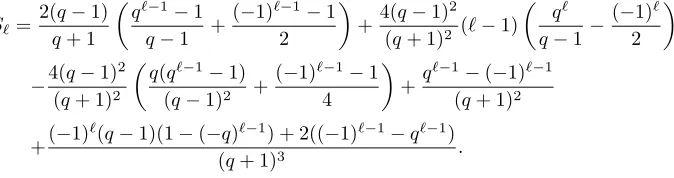
From these equations, we have the desired recurrence equations, and by ele-mentary calculations, we haveA= 2(q−1)q−(−1)/(q+ 1), and
S= 2(q−1) q+ 1
q−1−1 q−1 +
(−1)−1−1
2 +
4(q−1)2 (q+ 1)2 (−1)
q q−1 −
(−1) 2
−4(q−1)2 (q+ 1)2
q(q−1−1) (q−1)2 +
(−1)−1−1
4 +
q−1−(−1)−1 (q+ 1)2 +(−1)
(q−1)(1−(−q)−1) + 2((−1)−1−q−1)
(q+ 1)3 .
Thus lim→∞S/(A) = 2/(q+ 1). Hence we have the desired result.
Proof of Lemma 2.
( , ) = ((1),(2)),((2),(1)),((2),(2)),((3),(2)), where (1) means (Rule 1) in the statement of Lemma 2 and so on. From now on, we investigate each situation.
(Case 1) ( , ) = ((1),(2)). It is easy to show thata=c+c+ (q−1), i.e.c= −c+ 1. We apply the rule to (c, c, c, b, b)φ, We havee= (−c+ 1)q+c+b+q2 and it is easy to show thate>(q2−1)/2. This is contrary to|e|(q2−1)/2. (Case 2) ( , ) = ((2),(1)). It is easy to show thata =c+c+ 1, i.e. c=c = (q−1)/2. We apply the rule to (c, c, c, b, b)φ, We havee =bq+b+q2ande= c+b+(q2+3q−2)/2. It is easy to show thatb=−(q−3)/2,−(q−1)/2,−(q+1)/2. It is also easy to see thatb−q. This is contrary to |b|(q+ 1)/2.
(Case 3) ( , ) = ((2),(2)). It is easy to show thata=c+c+q, i.e.c=−c. We apply the rule to (c, c, c, b, b)φ, We havee=bq+b+q2ande= (−c+ 1)q+ c+b+ (q−1) +q2. It is easy to show thatb=−(q−3)/2,−(q−1)/2,−(q+ 1)/2. It is also easy to see that−cq+c<−(q2−1)/2. This is contrary to the ranges ofc, c.
(Case 4) ( , ) = ((3),(2)). It is easy to show that a = c+c+q−2, i.e. c =−c+ 2. We apply the rule to (c, c, c, b, b)φ, We have e = bq+b−q2 and e = (−c+ 1)q+c+b−(q−1) +q2. It is easy to show that b = (q− 3)/2,(q−1)/2,(q+ 1)/2. It is also easy to see that−cq+c<−(q2−1)/2. This is contrary to the ranges ofc, c.
Therefore it always satisfy thata≡0 modq except fora = 0.
Proof of Proposition 3.
(1) By the same way as Proposition 2, we suppose d ∈ Z[φ] has two such representations
d= −1
i=0 eiφi=
−1
i=0
eiφi, e0=e0.
Then from Lemma 3, we have q|(e0−e0), and by the assumption, |e0|,|e0| (q2−1)/2, hence it satisfies that |e0−e0| |e0|+|e0| q2 −1. Therefore we have e0−e0 = ±q,±2q,· · · ,±(q−1)q. We put e0−e0 = aq, where a ∈ {±1,±2,· · ·,±(q−1)}. We must have e0, e0 = 0. Because if e0 = 0, e0 = −(e0−e0) is divisible byq but e0 ∈Dq,(q2−1)/2, i.e. q e0. This is contrary
toe0= 0. Similarly, we can show thate0= 0. By the definition ofφ-rNAF, we must have e1, e1 = 0. We have aq = (e0−e0) =
−1
i=1(ei−ei)φi and by the characteristic polynomial of φ, we have aφ−aφ2 =i=1−1(ei−ei)φi. Thus we can see
(e1−e1+a) = (e2−e2+a)φ+ −1
i=3
(ei−ei)φi−1.
(2) We will show that B and T satisfy the recurrence equations B1 =B2 = q2−q,B+2−B+1−(q2−q)B= 0 andT1= 0,T2=q2−q,
T+2−T+1−(q2−q)T= (q2−q)
i=1 Bi
.
forms # of representations # of 0 digits (∗0∗ · · · ) B1B−2 B1B−2+B1T−2 (∗00∗ · · · ) B1B−3 2B1B−3+B1T−3 (∗000∗ · · · ) B1B−4 3B1B−4+B1T−4
..
. ... ...
(∗0000· · ·0∗0) B1B2 (−3)B1B2+B1T2 (∗0000· · ·00∗) B1B1 (−2)B1B1+B1T1 (∗0000· · ·000) B1 (−1)B1
Table 5.Forms ofdigitsφ-rNAF representations
In Table 5, the symbol ‘∗’ means a non-zero digit. We explain how to see Table 5. The left column stand for forms ofdigitsφ-rNAF representation, the center column stand for the number of eachφ-rNAF representation correspond to each form of the left column, and the right column stand for each number of 0 digits correspond to each form of the left column. From Table 5, we can derive B=B1
1 +i=1−2Bi
, and
T=B1
1 + −2
i=1 Ti
+B1
−2
i=1
(−1−i)Bi+ (−1)
.
From these equations, we have the desired recurrence equations, and by ele-mentary calculations, we haveB=q(q−1)(q−(1−q))/(2q−1), and
T= q(q−1)(q
−1−(1−q)−1)
2q−1 +
(−1)(q+2(q−1)−(1−q)+2q) (2q−1)2
+ q
(1−q)4+q4(1−q) q(2q−1)2 +
q−1(1−q) 2q−1