Collision Attack on XTR and a Countermeasure with
a Fixed Pattern
?Dong-Guk Han1, Tsuyoshi Takagi1, Tae Hyun Kim2,
Ho Won Kim3, and Kyo Il Chung3
1
FUTURE UNIVERSITY-HAKODATE, JAPAN
{christa,takagi}@fun.ac.jp
2 Center for Information and Security Technologies(CIST),
Korea University, Seoul, KOREA [email protected] 3
Electronics and Telecommunications Research Institute(ETRI), KOREA
{khw,kyoil}@etri.re.kr
Abstract. Public-key cryptosystem (PKC) is one of inevitable key technologies in order to accomplish fruitful security applications in ubiquitous computing sys-tems. The ubiquitous computer only has scarce computational resources (like Smart cards, RFID, Sensor Network), however, so that the light weight PKC is necessary for those miniaturized low-power devices. Recently, XTR is considered as one of good candidates for more energy efficient cryptosystems. Among XTR exponentiation algorithms, the most efficient one is the Improved XTR Single Ex-ponentiation (XTR-ISE) proposed by Stam-Lenstra. Thus among the family of XTR algorithms, XTR-ISE is the most efficient one suitable for ubiquitous com-puter. Even though the security of such devices against side channel attacks is very dangerous, there are few works on side channel attacks against XTR-ISE. In this paper we propose a new collision attack on XTR-ISE, derived from the structural properties of XTR-ISE. The analysis complexity of the proposed one is about 240 where the key size is 160-bit, which is 55% improvement from the previously best known analysis of Page-Stam. We also propose a novel countermeasure using a fixed pattern which is secure against SPA. We deploy a variant of Euclidean al-gorithm whose one of the registers is a monotone decreasing function with odd value. From our estimation of the efficiency of the proposed method, XTR expo-nentiation, computingT r(gn) withT r(g) andn, takes 11.2 log
2nmultiplications inFp2. In the sense of both efficiency and security the proposed countermeasure
is the best one among the previous countermeasures- it is about 30% faster.
Keywords:Ubiquitous computer, XTR public key system, XTR Exponentiation Algorithms, Side Channel Attacks, Collision Attack
1
Introduction
We are standing to the beginning of the ubiquitous computing era. It is expected that we can accomplish lucrative applications by effectively synthesizing the ubiquitous computer with cryptography. The ubiquitous computer only has scarce computational resources (like Smart cards, RFID, Sensor Network), so that we have to make an effort to opti-mize the memory and efficiency of the security system. Our expectation is that secure symmetric encryption will be widely available on the ubiquitous computer of the future, but one of the biggest problems in using secret key algorithms is the protection of the sensitive key material. However, the use of public-key cryptosystem (PKC) facilitates security protocols and has a potential impact on a much wider range of applications.
Furthermore, only the public key would have to be embedded into the target devices. Currently there are a few implementations on ubiquitous environments with PKC. In ESAS 2004 Gaubatz-Kaps-Sunar showed an implementation of Rabin and Ntru in sensor networks [8]. Recently Watro et al. showed RSA (in the case the encryption key is 3) is feasible to the applications of ubiquitous computer, and remarked that XTR is one of good candidates for light weight cryptosystems in SASN 2004 [21].
However, the applications of ubiquitous computer will be carried into and used in hostile environments and often house sensitive information, for example identity related tokens or financial information, the threat of attack is significant. This threat is magnified by both the potential pay-off and level of anonymity that side channel attacks (SCA) allow [12, 13]. The fact that one can attack a device somewhat remotely via timing and power consumption means that most ubiquitous computing devices need to be aware of similar problems in their operational environments.
In Crypto 2000 Lenstra-Verheul introduced XTR, a cryptosystem using a sub-group of the multiplicative group ofFp6 but with a compact representation based on the trace
over Fp2 that allows highly efficient arithmetic [14]. In Crypto 2003, Rubin-Silverberg
proposed torus based public key cryptosystem CEILIDH to provide greater efficiency for the same security [17]. Recently, Dijk et al. proposed an optimal communication technique for torus-based cryptosystem [6, 5]. The common main idea of XTR and CEILIDH is to shorten the bandwidth of transmission data. Even though the efficiency of communication of CEILIDH is better than XTR, unfortunately it was shown that CEILIDH seems bound to be inherently slower than XTR [9]. Given the current state of affairs in breaking the discrete logarithm problems over either finite fields or elliptic curves, XTR can compete with elliptic curve cryptosystems (ECC) in terms of both speed and bandwidth. This makes XTR suitable for deployment on similar sorts of constrained devices such as smart-cards, where computational power and storage capacity are both very limited. Among XTR exponentiation algorithms, the most efficient one is proposed in [18], called as Improved XTR Single Exponentiation (XTR-ISE), and that is on average more than 22% faster than the old method. Thus among the family of XTR algorithms, XTR-ISE is the most efficient one suitable for smart-cards, where computational power and memory capacity are both very limited. Even though the security of such devices against side channel attacks is very dangerous, however, there are few works on side channel attacks against XTR-ISE.
In 2004 Chung-Hasan [2] and Page-Stam [16] proposed simple power analysis (SPA) against XTR-ISE and that it was the first try to analyze it with SCA. Chung-Hasan showed it takes 2100 tries for an attacker until he/she correctly finds the secret key in
XTR-ISE with 160-bits key length. On the other hand, Page-Stam showed it requires 288 tries. It’s more nice result than that of Chung-Hasan, but these results are far worse
than well-known square-root type algorithms (Baby-Step-Giant-Step or Pollards’ Rho methods), i.e., their results are not practically feasible. Page-Stam introduced the in-distinguishable arithmetic formula and the exponent splitting method as SPA and DPA countermeasure. It is considered as the most efficient countermeasure against SPA and DPA among the proposed ones in XTR family.
1.1 Contribution of this paper
From the above previous results about XTR-ISE, we are encouraged to start the following two challenges;
where l is the length of the key. Thus the complexity of XTR collision attack against XTR-ISE is about 240where the key length is 160-bit, which is about 55% improvement
from the result of Page-Stam [16].
(2)Countermeasure -How can we design a secure countermeasure against SCA:In the countermeasure of Page-Stam, the indistinguishable arithmetic formula and exponent splitting as a SPA and DPA countermeasure respectively, there are some controversial points.
– Recently Walter showed that the produced unified code for elliptic addition and dou-bling in order to avoid SPA may still be insecure against SPA if there is sufficient side channel leakage at lower levels [20]. Thus the indistinguishable arithmetic technique is not recommended as a SPA countermeasure.
– If Montgomery arithmetic is used in the proposed indistinguishable arithmetic for-mula then some extra dummy additions have to added to XTR addition routine to make up for this [16]. However, Yen et al. showed that the safe-error attack is applicable to the dummy method [22].
Thus in this paper we propose a novel countermeasure using a fixed pattern which is secure against SPA. As the behavior of XTR-ISE is based on an adaptation of a Euclidean Algorithm we propose a special Euclidean algorithm such that one parameter is always odd integer and monotone decreasing to construct a fixed pattern of XTR additionAand doublingD. In deed we generate an XTRADsequence with the fixed pattern such that
ADDADD. . .ADD. In order to defeat DPA the exponent splitting technique is utilized. From our estimation of the efficiency of the proposed method, XTR exponentiation, computing T r(gn) with T r(g) and n, takes 11.2 log
2n multiplications in Fp2. In the
sense of both efficiency and security the proposed countermeasure is the best one among the previous countermeasures- it is about 30% faster.
The remainder of the paper is structured as follows. After a brief description of XTR public key systems in Section 2, and an introduction into side channel attacks on XTR in Section 3, we will propose a new analysis technique, called as XTR collision attack in Section 4. In Section 5 we explain the proposed countermeasure using a fixed pattern which is secure against SPA.
2
XTR Public Key Cryptosystems
In this section, we review mathematics of XTR including basic parameters and funda-mental algorithms to calculate traces of powers [14, 18].
2.1 XTR Parameters
Letpandqbe primes withp≡2 mod 3 andqdividingp2−p+1, and letgbe a generator
of the orderqsubgroup ofF∗
p6. Suggested lengths to provide adequate levels of security
are log2q≈160 and log2p≈170. Aspis 2 modulo 3, it follows that (X3−1)/(X−1) =
X2+X+ 1 is irreducible overF
p and that two rootsαandαp form an optimal normal
basis for Fp2 over Fp, i.e., Fp2 ∼= {x1α+x2αp : x1, x2 ∈ Fp}. Since αi = αimod 3 it
follows that
Fp2 ∼={x1α+x2α2:α2+α+ 1 = 0 andx1, x2∈Fp}.
For the simplicity, we denotex=x1α+x2α2 as (x1, x2).
Property 1. Asα2=αp it follows thatxp=x
2α+x1α2, so thatp-th powering inFp2 is
For an element h∈F∗
p6 its trace Tr(h) overFp2 is defined as a sum of the conjugates
overFp2 ofh:
Tr(h) =h+hp2+hp4∈Fp2.
2.2 XTR-ElGamal encryption
XTR can be used in any cryptosystem that relies on the discrete logarithm problem. This section contains a description of an application of XTR to ElGamal encryption [14].
Public key data of Alice:p,q, Tr(g), Tr(gk).
Secret key data of Alice:kin [2, q−3].
EncryptionBob can encryption a messageM ∈Fp2 intended for Alice as follows.
1. Select at randomr∈[2, q−3] and compute Tr(gr)∈F p2.
2. Compute Tr(grk)∈F
p2 with rand Tr(gk). LetK= Tr(grn
0
). 3. ComputeE=K·M ∈Fp2.
4. Send (T r(gr), E) to Alice.
DecryptionUsing her knowledge of secret keyk, Alice decrypts the message (Tr(gr), E)
as follows.
1. Compute Tr(gkr)∈F
p2 with kandT r(gr).
2. LetK= Tr(gkr) and findK−1 such thatK·K−1= 1 inF p2.
3. ComputeE·K−1, resulting in message M.
2.3 XTR Exponentiation Algorithm
Throughout this paper,cndenotes Tr(gn)∈Fp2, for some fixedpandgof orderq, where
qdividesp2−p+ 1. Note thatc
0= 3 andc1=c.
An efficient computation ofcnfor givenp, qandcdepends on the recurrence relations
cu+v =cucv−cpvcu−v+cu−2v, (1)
and
c2u=c2u−2cpu, (2)
which is derived from the equation (1) whenu=v.
By using above two formula, we define the following two functions called as XTR addition and XTR doubling respectively;
A[x, y, z, w] =x·y−yp·z+w, D[x] =x2−2xp.
Computation time of the basic operations: LetM uldenote the computation time of modulo multiplication in Fp and x = (x1, x2), y = (y1, y2), z = (z1, z2), and w =
(w1, w2) be elements ofFp2.
The basic operationsD[x] andA[x, y, z, w] in XTR can be calculated like this [14].
D[x] = (x2(x2−2x1−2), x1(x1−2x2−2)), (3)
A[x, y, z, w] = (y1·T1+y2·T2+w1, y1·T3+y2·T4+w2), (4)
whereT1=z1−x2−z2, T2=x2−x1+z2, T3=x1−x2+z1,andT4=z2−x1−z1.
– 2·M ul is required to computeD[·],
– 4·M ul is required to computeA[·].
Remark 1. As usual, the small number of additions and subtractions is not counted because the computation time of that is negligible [14].
By using above defined notations we introduce Improved XTR exponentiation algo-rithms proposed by Stam-Lenstra [18]. The goal of these algoalgo-rithms is to computecn for
givenc1 andn∈Z, i.e. to computeT r(gn) withT r(g) and an integern.
Improved XTR Single Exponentiation (XTR-ISE) [18]
Input: c1and nwhere n >2
Output: cn
1. Initialization:
1.1. Leta=round(3−√5
2 n) andb=n−a(where round(x) is the integer closest tox).
1.2. Letf= 0. As long asaandbare both even, replace (a, b) by (a/2, b/2) andfbyf+ 1. 1.3. Leti= 1 andGi:= (Q0, Q1, Q2, Q3) = (c1, c1,3, cp1).
2. As long asa6=b
2.1. Ifb > a
X1. ifb≤4a, then (a, b)←(b−a, a)
T0←A[Q0, Q1, Q2, Q3], T1←Q0,
T2←Q1, T3←Qp2.
X2. else ifbis even, then (a, b)←(a, b/2)
T0←D[Q0], T1←Q1,
T2←A[Q0, Q2, Q1, Qp3], T3←D[Q2].
X3. else ifais odd, then (a, b)←(a,(b−a)/2)
T0←D[Q0], T1←A[Q0, Q1, Q2, Q3],
T2←Q2, T3←D[Q1]p.
X4. else (ais even), then (a, b)←(b, a/2)
T0←D[Q1], T1←Q0,
T2←Qp3, T3←D[Q2]p.
2.2. Else (ifa > b)
Y1. ifa≤4b, then (a, b)←(a−b, b)
T0←A[Q0, Q1, Q2, Q3], T1←Q1,
T2←Q0, T3←Q2.
Y2. else ifais even, then (a, b)←(b, a/2)
T0←D[Q1], T1←Q0,
T2←Qp3, T3←D[Q2]p.
Y3. else ifbis odd, then (a, b)←(b,(a−b)/2)
T0←D[Q1], T1←A[Q0, Q1, Q2, Q3],
T2←Qp2, T3←D[Q0]p.
Y4. else (bis even), then (a, b)←(a, b/2)
T0←D[Q0], T1←Q1,
T2←A[Q0, Q2, Q1, Qp3], T3←D[Q2]
2.3. i←i+ 1 and setGi= (T0, T1, T2, T3).
3. Compute ˜c=A[Q0, Q1, Q2, Q3] =cu+v.
4. Output ˜c2f.
5. Ifa= 1 then return ˜c2f
else run Improved XTR Single Exponentiation withc= ˜c2f andn=a.
Let Gi := (Q0, Q1, Q2, Q3) be the i-th updated intermediate values of Qi in Step
2 of XTR-ISE for i ≥ 1. G1 = (Q0, Q1, Q2, Q3) denotes the updated values at the
initialization step. Let Gi Ti
−→ Gi+1 denote that Gi+1 is updated from Gi after state
Ti ∈ {Xj, Yj}1≤j≤4. For example, if XTR-ISE is terminated after X1 → X1 → X4 →
Y4 → Y3 →X2 →Y1, then the relation betweenGi andTi is as follows; G1 X1
→ G2 X1
→ G3
X4
→G4 Y4
→G5 Y3
→G6 X2
→G7 Y1
→G8.
XTR-ISE is based on an adaptation of a Euclidean algorithm by Montgomery using Lucas chains. For ease of notation, we will momentarily use ordinary exponentiation in our description instead of the third order XTR recurrence. GivenT r(g) andn, computing T r(gn) takes 6.7 log
2n M ul in XTR-ISE. Note that it is the most efficient one among
3
Side Channel Attacks
Side channel attacks (SCA) are allowed to access the additional information linked to the operations using the secret key, e.g., timings, power consumptions, etc [12, 13]. This type of attack, which includes Simple Power Analysis (SPA) and Differential Power Analysis (DPA), render cryptographic devices such as smart cards vulnerable.
−In SPA, an attacker just needs to monitor the devices power consumption and identify the parts of the power trace that correspond to the difference of operations using the secret key. This gives trivially the secret key.
−DPA observes many power consumptions and analyzes these information together with statistic tools. An adversary should analyze the information of power consumptions with statistic tools per every target bit, however, he/she does not need re-observe new power consumptions to detect a next target bit because he/she can use the same obtained information.
3.1 Side Channel Attacks on XTR and Their Countermeasures
We summarize the previous related results about side channel attacks on XTR and countermeasures. According to target algorithms the proposed analysis techniques and countermeasures are as follows:
XTR Single Exponentiation Method (XTR-SE)4: Several side channel attacks
such as DPA, the doubling attack, the refined power analysis, and the zero value at-tack, were proposed by Han et al. [10, 11]. But, it is secure against SPA without any countermeasures. In ICICS 2004, Ciet-Giraud showed that it can be also analyzed by the transient fault induction attacks [1]. As countermeasures against DPA, the exponent ran-domization, the exponent splitting, the base ranran-domization, and the field randomization techniques were proposed in [10, 11, 16].
Improved XTR Single Exponentiation Method (XTR-ISE): Chung-Hasan [2]
and Page-Stam [16] proposed SPA to XTR-ISE and that it was the first try to analyze it with SCA. Chung-Hasan showed it takes 2100tries for an attacker until he/she correctly
finds the secret key in XTR-ISE with 160-bits key length. On the other hand, Page-Stam showed it requires 288tries. As countermeasures against SPA and DPA, the
indistinguish-able arithmetic formula and the exponent splitting, were proposed and recommended as an efficient and adequate SPA and DPA countermeasure respectively [16]. It is the most efficient countermeasure against SPA and DPA among the proposed ones.
3.2 Challenges of This Paper
From the above previous results about XTR-ISE, we are encouraged to start the following two challenges;
(1) Analysis - How can we reduce the complexity of analysis: The analysis result of Page-Stam is more nice than that of Chung-Hasan, but these results are far worse than well-known square-root type algorithms (Baby-Step-Giant-Step or Pollards’ Rho methods), i.e., their results are not practically feasible. In this paper we find new analysis technique, called as XTR collision attack, derived from the structural properties of XTR-ISE. The complexity of XTR collision attack against XTR-ISE is about 240 where the
key length is 160-bit, which is about 55% improvement from the result of Page-Stam [16]. The description of it is contained Section 4.
4
(2) Countermeasure - How can we design a secure countermeasure against SCA: Even though Page-Stam’s method, the indistinguishable arithmetic formula and exponent splitting as an SPA and DPA countermeasure respectively, is the most efficient counter-measure against SPA and DPA among the proposed ones, there are some controversial points in their method.
– Recently Walter showed that the produced unified code for elliptic addition and dou-bling in order to avoid SPA may still be insecure against SPA if there is sufficient side channel leakage at lower levels [20]. Thus the indistinguishable arithmetic technique is not recommended as a SPA countermeasure.
– If Montgomery arithmetic is used in the proposed indistinguishable arithmetic for-mula then some extra dummy additions have to added toA[·] routine to make up for this [16]. However, Yen et al. showed that the safe-error attack is applicable to the dummy method [22].
Thus in this paper we propose a novel countermeasure using a fixed pattern which is secure against SPA. In order to defeat DPA the exponent splitting technique is utilized. In Section 5 we describe the proposed countermeasure.
4
New Collision Attack on XTR
In this section we find new analysis technique, called as XTR collision attack, derived from the structural properties of XTR-ISE.
4.1 Some Properties of XTR-ISE
In XTR-ISE, Step 2 consists of eight states Xi and Yi where 1 ≤ i ≤ 4. One state is
only determined by the condition of a and b. The following properties give us useful information to determine the next state, and their proof can be found in the appendix.
Proposition 1. In XTR-ISE, the following relations are satisfied;
1. X1 is followed by Xi and onlyY1 where1≤i≤4.
2. X2 is followed by Xi where1≤i≤4.
3. X3 is followed by Xi where1≤i≤3.
4. X4 is followed by only Y3 or Y4.
5. Y1 is followed byXi and only Y1 where 1≤i≤4.
6. Y2 is followed byXi where1≤i≤4.
7. Y3 is followed byXi where1≤i≤3.
8. Y4 is followed by onlyY3 orY4.
9. The last step is either X1 or Y1.
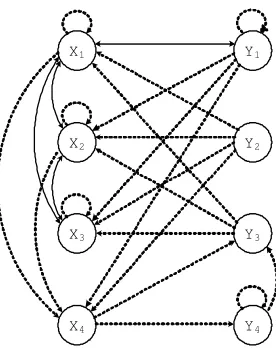
The results of Proposition 1 give some useful information of the relation of executing consecutive two states. For example, Y4 always follows either Y3 or by oneself. From
Proposition 1 we can see another property,
Property 2. StateY2 never occurs in the process of XTR-ISE except the first time.
Thus, there is no state which can actually leads to Y2’s precondition. Thus Y2 can
X1
X2
X4 X3
Y1
Y2
Y4 Y3
Fig. 1.The finite Markov chain associated with XTR-ISE
4.2 Assumptions and Notations
We first introduce some reasonable assumptions which is used in a new attack.
1. A[x, y, z, w] andD[x] are distinguishable by a single measurement of power consump-tion, whereasD[x]pandD[x], andA[x, y, z, wp] andA[x, y, z, w] are indistinguishable,
respectively. Here,x, y, z, w∈Fp2.
2. When{A[·], D[·], D[·]}are all operated, e.g. in the case ofX3in XTR-ISE, we assume
these three functions are operated according to the following order A[·]D[·]D[·]. In more detail, statesXi andYi are updated according to the following orders;
(a) InX2andY4: the computation order isT2→T0→T3→T1,
(b) InX3andY3: the computation order isT1→T0→T3→T2.
3. IfD[cu] andD[cv] are computed, the attacker is not able to guess the value ofcunor
cv but he/she is able to check ifcu=cv.
As the required computing time ofA[·] is two times of that ofD[·] andp-th powering is free (refer to Section 2) in XTR, the above Assumption 1 is reasonable. Assumption 3 is also reasonable since this kind of computation usually takes many clock cycles and depends greatly on the value of the operand. This kind assumption has been used in a stronger variant and validated by Schramm et al. [19] who are able to distinguish collisions during one DES round computation. It was extended to ECC by Fouque at al [7].
Notations:For simplicity,A[x, y, z, w] andD[x] are referred to asAandD, respectively. LetS[c1, n] be an AD sequence when the inputs arec1 andnin XTR-ISE, i.e.AandD
are elements ofS[c1, n], which are written with time-increasing from left to right. Due
to the above Assumption 1,AandDalso denoteA[x, y, z, wp] andD[x]p, respectively.
As described in Section 2.3 Gi = (Q0, Q1, Q2, Q3) is the i-th updated intermediate
values of {Qj}0≤j≤3 in Step 2 of XTR-ISE for i ≥ 1. For Gi Ti
−→ Gi+1 where Ti ∈
{Xj, Yj}1≤j≤4, if Ti is one of {X2, X3, X4, Y3, Y4}, then DD is computed. We denote
these twoDDas D1 iD
2 i (D
1 iD
2
i are carried along for expository purposely only). For example, with inputc1 andn, the utilized operations are
G1 X1
→G2 X4
→G3 Y3
→G4 X2
→G5 X1
→G6 Y1
→G7. . . ,
4.3 Attacker’s Goal
In XTR-ISE, Step 2 consists of eight statesXi andYi where 1≤i≤4. One state is only
determined by the condition of two integersaandb. However, if an attacker can decide the states executed during the computation then the secret key can be easily reconstructed from the recovered state. Note that from the properties of XTR-ISE described in Section 4.1, we do not consider stateY2in this attack any more.
Under Assumption 1, an attacker is able to distinguish A, DD, and ADD. With this information he/she can categorize seven states of XTR-ISE into the following three groups;
-Ais corresponding toX1 orY1,
-DDis corresponding toX4,
-ADDis corresponding toX2,X3,Y3 orY4.
However, there are some ambiguity decisions such as (1) X1 and Y1 are not
distin-guished, (2) if ADDis observed in AD sequence then there are two possibilities;ADD
andA|DD. Using a brute force search technique, one might test around 6 candidates; i.e.ADDis corresponding to one of{X2, X3, Y3, Y4, X1|X4, Y1|X4}.
Thus the attacker needs to check the possible candidates until he/she has found the correct one, so in order to improve the efficiency of the attack we want to minimize the number of candidates.
4.4 Analysis based on the Finite Markov Chain
First we consider the following three types of AD sequences;
– ADD|DD.
–
m−times
z }| {
ADD|ADD|. . .|ADD, briefly it is denoted as{ADD}m.
– ADD|
m−times
z }| {
A. . .A|ADD, denoted asADD|{A}m|ADD.
When ADD|DD is observed in AD sequence we can decideADD
| {z }
X2
DD
|{z}
X4
. Because
the last two DD originates from X4 and the possible preconditions of X4 are X1, X2,
andY1. ThusADDimpliesX2
When {ADD}m is observed in AD sequence there are 6m possible combinations
from{X2, X3, Y3, Y4, X1|X4, Y1|X4}. However, if we consider the finite markov chain (Fig.
1) then we can reduce the possible number of combinations such as 15, 39, 102, and 243 combinations when m is 2,3,4, and 5, respectively. If m ≥ 4 then the number of all possible combinations from the finite markov chain is
# [{ADD}m] = (39m+ 48)·2m−5. (5)
The proof of it is contained in Appendix.
When ADD|{A}m|ADD is observed in AD sequence there are 6·2m·6 = 9·2m+2
X2
X3
Y3
| {z }
ADD
×[X1]×
X1
Y1
m−1
| {z }
{A}m
×
X2
X3
X1X4
Y1X4
| {z }
ADD
(6)
Thus the number of possible combinations is 3·2m+1. Furthermore, we propose the
following decision rule derived from Proposition 1.
Property 3. If AADDAA is observed in AD sequence then we can decide A
ADD
| {z }
X2 or X3
A
|{z}
X1
A.
Proof. ADD can be one of{X2, X3, Y3, Y4, X1|X4, Y1|X4}. AsY3 andY4’s precondition
is one of {X4, Y4}, Y3 and Y4 are discarded in candidates. As X1|X4 and Y1|X4 are
followed byX3 orY4 these two are also discarded. ThusADD impliesX2 orX3. AsY1
can not be followed byX2or X3,Aplaced afterADDisX1. ut
4.5 XTR Collision Attack
At the previous section, the number of possible combinations for {ADD}m and
ADD|{A}m|ADD is decreased by using the finite markov chain of XTR-ISE. In this section, in order to reduce the search space from the finite markov chain we introduce a new attack mainly based on the above assumptions, especially Assumption 3, described in 4.2.
Key Observation:If we focus onDoperation, we notice that some of them manipulate the same operand. We consider two AD sequencesS[c1, n] andS[c2, n].
In the case of{ADD}m: For simplicity, we assumem= 2, i.e.ADDADDis consid-ered. Note that there are 15 combinations of states.
S[c1, n] =. . .AD1iD 2 iAD
1 jD
2 j . . . S[c2, n] =. . .AD1iD
2 iAD
1 jD
2 j . . .
Depending on the combination type, we can observe the following results;
CASE I: D1
j ofS[c1, n] is same toD1i ofS[c2, n],
CASE II: D2
j ofS[c1, n] is same toD1i ofS[c2, n].
According to the above observation, the 15 combination pairs are categorized as
CASE I: (X2, X2),(X2, X3),(X3, X2),(X3, X3),(X1, X4, Y4),(Y1, X4, Y4),(Y3, X2),
(Y3, X3),(Y4, Y4),(X2, X1, X4),(X3, X1, X4),(Y3, X1, X4),
CASE II: (X1, X4, Y3),(Y1, X4, Y3),(Y4, Y3).
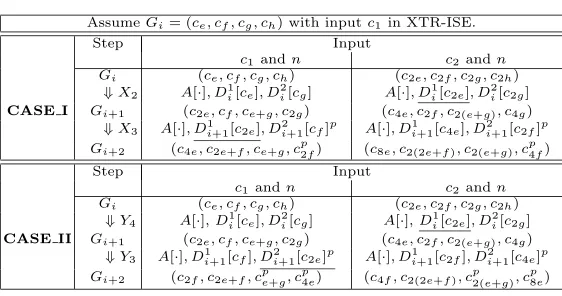
In order to confirm the validity of this categorization, we consider two examples. Assume that two cases (X2, X3) and (Y4, Y3). Table 1 shows that in the case of (X2, X3)
CASE I collision is occurred and CASE II collision is detected in (Y4, Y3). Similarly, other
pairs are also categorized into two cases.
With this collision information, an attacker is required to test on average 10.2 (=
122+32
15 ) in order to find the precise combination pair corresponding to the target
Table 1.Some examples forCASE IandCASE II.
AssumeGi= (ce, cf, cg, ch) with inputc1in XTR-ISE.
Step Input
c1andn c2andn
Gi (ce, cf, cg, ch) (c2e, c2f, c2g, c2h)
⇓X2 A[·], D1i[ce], D2i[cg] A[·], D1i[c2e], D2i[c2g]
CASE I Gi+1 (c2e, cf, ce+g, c2g) (c4e, c2f, c2(e+g), c4g)
⇓X3 A[·], Di1+1[c2e], Di2+1[cf]p A[·], D1i+1[c4e], D2i+1[c2f]p Gi+2 (c4e, c2e+f, ce+g, cp2f) (c8e, c2(2e+f), c2(e+g), cp4f)
Step Input
c1andn c2andn
Gi (ce, cf, cg, ch) (c2e, c2f, c2g, c2h)
⇓Y4 A[·],D1i[ce], D2i[cg] A[·],Di1[c2e], D2i[c2g]
CASE II Gi+1 (c2e, cf, ce+g, c2g) (c4e, c2f, c2(e+g), c4g)
⇓Y3 A[·], Di1+1[cf], D2i+1[c2e]p A[·], D1i+1[c2f], D2i+1[c4e]p Gi+2 (c2f, c2e+f, cpe+g, c
p
4e) (c4f, c2(2e+f), cp2(e+g), c p 8e)
CASE(II,I) denote that the firstADDADDhas Case I, Case I, and Case II collision and the lastADDADDhas Case I, Case II, and Case I collision. Thus on average 17.77 tests are required to detect the precise combination pair corresponding to{ADD}3.
# of all possible combinations
mFrom Exhaustive Search From the Finite Markov Chain From Collision Attack
1 6 6 6
2 36 15 10.2
3 216 39 17.77
4 1296 102 31.59
5 7776 243 45.4
..
. ... ... ...
From the results of the above table we can see that the average number of trial tests with collision information is drastically decreased compared to that of the finite markov chain. For example, ifm= 5 then the required number of trial tests is only 18% of that of the finite markov chain.
In the case of ADD|{A}m|ADD: Consider
S[c1, n] =. . .AD1iD 2 i{A}
mAD1 jD
2 j . . . S[c2, n] =. . .AD1iD
2 i{A}
mAD1 jD
2 j . . .
Similar to the previous analysis, we can observe the following results depending on the combination type;
CASE 0:There is no relation between Doperation ofS[c1, n] andS[c2, n],
CASE I: D1
j ofS[c1, n] is same toD 1
i ofS[c1, n],
CASE II: D2
j ofS[c1, n] is same toD1i ofS[c2, n].
For example, whenm= 1
X1
X3
Y3
×[X1]×[Y1X4]∈CASE I,
X1
X3
Y3
×[X1]×
X1X4
X3
With this collision information, an attacker is required to test on average 4.5 (=
32+32+62
12 ) in order to find the precise combination pair corresponding to the target
ADDAADD. The results of the following table show the improvement of analysis com-plexity.
# of all possible combinations
mFrom Exhaustive Search From the Finite Markov Chain From Collision Attack
1 72 12 4.5
2 144 24 9.75
3 288 48 28.87
4 576 96 74.43
5 1152 192 169.21
..
. ... ... ...
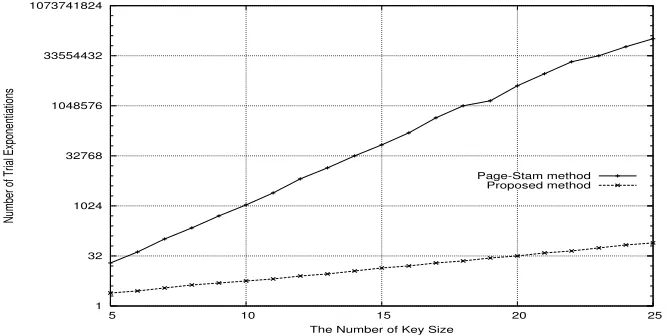
Implementation Results: From these classifications, we can reduce the search space order required to detect the whole secret value. The graph of results in Fig. 2 shows that the average number of trial XTR exponentiations is roughly given by 20.25·lwherelis the
length of the exponents. Thus the complexity of XTR collision attack against XTR-ISE is about 240 where the key length is 160-bit, which is about 55% improvement from the
result of Page-Stam [16].
1073741824
33554432
1048576
32768
1024
32
1
5 10 15 20 25
Number of Trial Exponentiations
The Number of Key Size
Page-Stam method Proposed method
Fig. 2.Comparison of analysis complexity between the proposed attack and Page-Stam’s one
5
Proposed Countermeasure
In this section we explain the proposed algorithm. We modify XTR-ISE to be secure against SCA. The main idea is same to that of Okeya-Takagi scheme [15] for elliptic curve cryptosystems. In XTR-ISE there are three different patterns,A, DD,ADD. For example, ifX1,Y1, andX4are consecutively operated then the sequence is “AAADD”,
which is no longer the fixed pattern.
Fixed Pattern XTR Single Exponentiation (XTR-FSE)
Input: c1and nwhere n >2
Output: cn
1. Initialization:
1.1. Select a random numberain [1, n−1] andb=n−a. Ifais even, then leta←a+ 1,b←b−1. 1.2. LetQ0=c,Q1=c,Q2= 3, andQ3=cp.
2. As long asa6=b
2.1. Ifb > a
X1. ifbis even, then (a, b)←(a, b/2)
T0←D[Q0], T1←Q1,
T2←A[Q0, Q2, Q1, Qp3], T3←D[Q2].
X2. else (bis odd), then (a, b)←(a,(b−a)/2)
T0←D[Q0], T1←A[Q0, Q1, Q2, Q3],
T2←Q2, T3←D[Q1]p.
2.2. Else (ifa > b)
Y1. ifbis odd, then (a, b)←(b,(a−b)/2)
T0←D[Q1], T1←A[Q0, Q1, Q2, Q3],
T2←Qp2, T3←D[Q0]p.
Y2. else (bis even), then (a, b)←(a, b/2)
T0←D[Q0], T1←Q1,
T2←A[Q0, Q2, Q1, Qp3], T3←D[Q2]
2.3. SetQ0←T0,Q1←T1,Q2←T2,Q3←T3.
3. Compute ˜c=A[Q0, Q1, Q2, Q3] =cu+v.
4. Ifa= 1 then return ˜c,
else goto Step 1. withc= ˜candn=a.
In order to make “ADD” fixed pattern, first we eliminateX1, X4, Y1, Y2 from
XTR-ISE and then change the condition of inputaandbin the initialization step such that the integer ais always odd. For easy explanation of the properties of XTR-FSE, we define some notations;
Notations:LetSi := (Ai,Bi) be thei-th updated values ofaandb in Step 2 of
XTR-FSE fori ≥0.S0 = (A0,B0) denotes the updated values at the initialization step, i.e.
A0=aandB0=b.Si−→X1 Si+1 denotesSi+1 is updated byX1 fromSi.
We derive some properties of XTR-FSE, and their proofs can be found in the ap-pendix.
Lemma 1. With input integer n, XTR-FSE has the following properties;
(1) Ai is always odd integer,
(2) Ai is a monotone decreasing function,
(3) Ai=Ai−1 andBi≤ Bi2−1 atX1,X2, andY2,
(4) Ai+Bi= Ai−1+2Bi−1 atX2 andY1,
(5) Ai+Bi=t(Ai−1+Bi−1)atX1 andY2, where1/2< t <1,
(6) Ai+Bi is a strictly decreasing function,
(7) #{X2,Y1} ≤log2n.
Proof. The proof of (1),(2),(3),(4), and (5) are immediate and (6) follows from (4) and (5). Suppose (a, b) = S0
W1
→ S1 W2
→ S2 W3
→ . . . Wt
→ St. . . for Wi ∈ {X2,Y1}. From (4) it
follows thatAt+Bt= 12 t
(a+b) = 12tnfor anyt. AsAi andBi are positive integers
the minimum ofAi+Bi is 2, thus t≤log2(n)−1, which proves (7). ut
Lemma 2. Assume Si−1
Y1
−→Si.
(1) IfAi−1>3Bi−1 then
a. Ai<Ai−1,Bi>Bi−1, andBi< Ai2−1,
b. the next state isX1 or X2.
a. Ai<Ai−1 andBi≤ Bi−1,
b. ifAi−1<3Bi−1 then the next state isY1 orY2, otherwise goto Step 3.
The proof of Lemma 2 follows from a straightforward computation. Let Ya>3b
1 and
Y1a≤3b be the states such thatY1 with inputsSi−1 such thatAi−1>3Bi−1andAi−1≤
3Bi−1, respectively.
5.1 Average-case Analysis of Fixed Pattern XTR Single Exponentiation
In this section we will analyze the average number of states of the proposed algorithm. First we prove that the proposed algorithm is polynomial time algorithm, i.e. it is ter-minated inO(log2n) with the input integernin XTR-FSE.
XTR-FSE is a Polynomial Time Algorithm:LetS =S0S1S2· · · be the sequence
ofSi updated by one of{X1,X2,Y1,Y2}. From Lemma 2, we can separateSinto several
sub-sequences withY1a>3b like as
S=S0S1· · ·Sk1−1
| {z }
P1
Sk1
Sk1+1· · ·Sk2−1
| {z }
P2
Sk2
· · ·Skt
−1 Skt
−1+1· · ·Skt−1
| {z }
Pt
SktSkt+1· · ·
, whereSki is updated by stateY a>3b
1 . ThusSj in each separated partPi is updated
by one of{X1,X2,Y1a≤3b,Y2}. LetLi and Mi be the total number of{X1,X2,Y2} and
Y1a≤3b utilized in part Pi, respectively. LetN be the total number of Y1a>3b used inS.
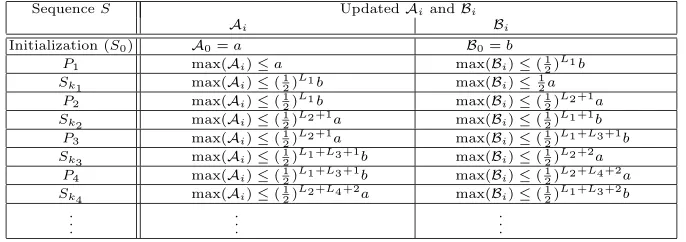
From Lemma 1 -(3) and Lemma 2, the maximum values of the updatedAi andBi are
described in Table 2.
Table 2.The maximum values of the updatedAiandBi
SequenceS UpdatedAiandBi
Ai Bi
Initialization (S0) A0=a B0=b
P1 max(Ai)≤a max(Bi)≤(12)
L1b
Sk1 max(Ai)≤(12)
L1b max(Bi)≤1
2a
P2 max(Ai)≤(12)
L1b max(Bi)≤(1
2)
L2+1a
Sk2 max(Ai)≤(12)
L2+1a max(Bi)≤(1
2)
L1+1b
P3 max(Ai)≤(12)
L2+1a max(Bi)≤(1
2)
L1+L3+1b
Sk3 max(Ai)≤(12)
L1+L3+1b max(Bi)≤(1
2)
L2+2a
P4 max(Ai)≤(12)
L1+L3+1b max(Bi)≤(1
2)
L2+L4+2a
Sk4 max(Ai)≤(12)L2+L4+2a max(Bi)≤(12)L1+L3+2b
. . .
. . .
. . .
As max(Ai) and max(Bi) are positive integers,Pi=1L2i≤log2aand
P
i=1L2i−1≤
log2b. Thus
P
i=1Li ≤ 2 log2n because a, b < n. From the result of Lemma 1 -(7),
N+Pi=1Mi ≤log2n. Thus
X
i=1
(Li+Mi) +N ≤3 log2n,
so that we have proved:
Proposition 2. For a given integer n, the proposed algorithm takes at most 3 log2n
iterations in Step 2. This implies that it is a polynomial time algorithm.
Assume Pr[X1] =Pr[X2] =Pr[Y1] =Pr[Y2] =m/4. From the result of (4)-(6) in Lemma
1, we can derive the following equation:
Am+Bm= 2 =
1
2
m/2
·(t)m/2·(A0+B0)
=1 2
m/2
·(t)m/2·n
where 1/2< t <1.
Lett= 3/4. Then the iteration numbermis asymptotically logarithmic,
m≈1.41 log2n.
In order to confirm our estimation result above we show simulation results. We ran-domly generate one million integers n with bit length 160,200,500,1000,5000,10000, respectively. Table 3 demonstrates that our estimation result matches the simulation results (SR) for the large input integern.
Table 3.Experiment for the proposed algorithm
Size ofn 160 bits 200 bits 500 bits 1000 bits 5000 bits 10000 bits
# of iterations 222 279 703 1409 7057 14117
SR 1.39 log2n1.39 log2n1.40 log2n1.40 log2n1.41 log2n1.41 log2n
5.2 Security Analysis
In this section we discuss the security of the proposed scheme against SPA and DPA.
SPA: As we mentioned previous section, the proposed method compute XTR single exponentiation through the fixed pattern |ADD|ADD|. . .|ADD|. The attacker could distinguish XTR operations D[·] and A[·] in XTR-FSE by measurement of the power consumption, but he/she obtains only the identicalADD sequence for any inputc and n. Therefore, he/she cannot detect the secret scalarnby using SPA.
DPA: The use of scalar randomization such as exponent splitting [3] prevents against DPA. Note that the idea of splitting the data was already abstracted in [4] as a general countermeasure against DPA. The proposed method is using exponent splitting technique as a DPA countermeasure, i.e. we split the input integer ninto two parts by picking a randoma∈[1, n−1] and rewriting the integernasa+ (n−a). Thus XTR-FSE is secure against DPA.
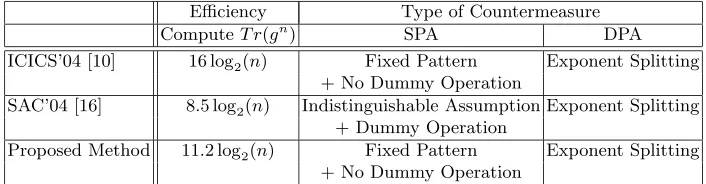
5.3 Comparison of empirical performance and type of countermeasure
In this section we compare the computational cost and the type of countermeasures between the proposed countermeasure and the previous ones.
Table 4.Comparison of empirical performance and type of countermeasure
Efficiency Type of Countermeasure
ComputeT r(gn) SPA DPA
ICICS’04 [10] 16 log2(n) Fixed Pattern Exponent Splitting + No Dummy Operation
SAC’04 [16] 8.5 log2(n) Indistinguishable Assumption Exponent Splitting + Dummy Operation
Proposed Method 11.2 log2(n) Fixed Pattern Exponent Splitting + No Dummy Operation
Acknowledgements
Dong-Guk Han was supported by the Korea Research Foundation Grant. (KRF-2005-214-C00016) and Tae Hyun Kim was supported in part by the MIC(Ministry of Infor-mation and Communication), Korea, under the ITRC(InforInfor-mation Technology Research Center) support program supervised by the IITA(Institute of Information Technology Assessment).
References
1. M. Ciet and C. Giraud,Transient Fault Induction Attacks on XTR, Information and Communications Security (ICICS 2004), LNCS 3269, (2004), 440-451.
2. J. Chung and A. Hasan,Security Analysis of XTR Exponentiation Algorithms against Simple Power Analysis Attack, Preprint of CACR, Univ. of Waterloo, CACR 2004-05. 3. C. Clavier and M. Joye, Univeral Exponentiation Algorithm A First Step to-wards Provable SPA-Resistance, Cryptographic Hardware and Embedded Systems (CHES’01), LNCS2162, (2001), 300-308.
4. S. Chari, C.S. Jutla, J.R. Rao, and P. Rohatgi,Towards sound approaches to coun-teract power-analysis attacks, Advances in Cryptology - CRYPTO ’99, LNCS1666, (1999), 398-412.
5. Dijk, M.v., Granger, R., Page, D., Rubin, K., Silverberg, A., Stam, M., Woodruff, D.,Practical Cryptography in High Dimensional Tori, to be appeared in Eurocrypt 2005.
6. Dijk, M.v., Woodruff, D.,Asymptotically Optimal Communication for Torus-Based Cryptography, Advances in Cryptology - CRYPTO ’04, LNCS 3152, (2004), 157-178. 7. P.-A. Fouque and F. Valette,The Doubling Attack Why Upwards is better than Down-wards, Workshop on Cryptographic Hardware and Embedded Systems 2003 (CHES 2003), LNCS 2779, (2003), 269-280.
8. G. Gaubatz, J.-P. Kaps, and B. Sunar,Public Key Cryptography in Sensor Networks-Revisited, 1st European Workshop on Security in Ad-Hoc and Sensor Networks, (ESAS 2004), LNCS3313, (2004), 2-18.
9. R. Granger, D. Page, and M. Stam,A Comparison of CEILIDH and XTR, Algorith-mic Number Theory, (ANTS 2004), LNCS 3076, (2004), 235-249.
10. D.-G. Han, T. Izu, J. Lim, and K. Sakurai,Modified Power-Analysis Attacks on XTR and An Efficient Countermeasure, Information and Communications Security (ICICS 2004), LNCS 3269, (2004), 305-317.
11. D.-G. Han, J. Lim, and K. Sakurai, On security of XTR public key cryptosystems against Side Channel Attacks, The 9th Australasian Conference in Information Se-curity and Privacy, (ACISP 2004), LNCS 3108, (2004), 454-465.
12. Kocher, C.,Timing Attacks on Implementations of Diffie-Hellman, RSA, DSS, and Other Systems, Advances in Cryptology - CRYPTO ’96, LNCS 1109, (1996), 104-113. 13. Kocher, C., Jaffe, J., Jun, B.,Differential Power Analysis, Advances in Cryptology
- CRYPTO ’99, LNCS1666, (1999), 388-397.
15. K. Okeya and T. Takagi, The Width-w NAF Method Provides Small Memory and Fast Elliptic Scalar Multiplications Secure against Side Channel Attacks, CT-RSA 2003, LNCS 2612, (2003), 328-342, 2003.
16. D. Page and M. Stam,On XTR and Side-Channel Analysis, Pre-proceedings of SAC 2004, 67-81.
17. K. Rubin and A. Silverberg,Torus-Based Cryptography, Advances in Cryptology -CRYPTO ’03, LNCS2729, (2003), 349-365.
18. M. Stam and A.K. Lenstra, Speeding Up XTR, Proceedings of Asiacrypt 2001, LNCS2248, (2001), 125-143.
19. K. Schramm, T. Wollinger, and C. Paar,A New Class of Collision Attacks and its Application to DES, Proceedings of FSE 2003, LNCS2887, (2003), 206-222.
20. C.D. Walter,Simple Power Analysis of Unified Code for ECC Double and Add, Work-shop on Cryptographic Hardware and Embedded Systems 2004 (CHES 2004), LNCS 3156, (2004), 191-204.
21. R. Watro, D. Kong, S-f. Cuti, C. Gardiner, C. Lynn, and P. Kruus,TinyPK: Securing Sensor Networks with Public Key Technology, ACM Workshop on Security of Ad Hoc and Sensor Networks 2004 (SASN 2004), 59-64.
22. S.-M. Yen, S. Kim, S. Lim, and S. Moon, A Countermeasure against One Physical Cryptanalysis May Benefit Another Attack, Information Security and Cryptology 2001 (ICISC 2001), LNCS 2288, (2001), 414-427.
A
Proof of Proposition 1
We will give a proof of Proposition 1.
1. X1 has a condition that a < b ≤4a. And the updating rule is (a0, b0)← (b−a, a)
where a0, b0 can be even or odd. Thus 0 < a0 ≤3b0. If 0 < a0 < b0, then casesX
1
through X4 will occur because b0 ≤ 4a0 or b0 > 4a0 can be satisfied depending on
givena0, b0. Ifb0 < a0 ≤3b0, then caseY
1 will occur becausea0 > b0 anda0≤4b0. So
X1 is followed byX1 throughX4or Y1.
2. X2has conditions that 4a < bandbis even. And the updating rule is (a0, b0)←(a,b2)
wherea0, b0 can be even or odd. 4a < bimplies 2a0 < b0. If 2a0< b0 ≤4a0, then cases X1 will occur. Ifb0>4a0, then casesX2throughX4will occur. SoX2 is followed by
X1 through X4.
3. X3 has conditions that 4a < band b is odd anda is odd. And the updating rule is
(a0, b0)← (a,b−a
2 ) wherea0 is odd. 4a < b implies 3a0
2 < b0. If 3a0
2 < b0 ≤4a0, then
casesX1 will occur. If b0 >4a0, then casesX2 throughX4 will occur. Asa0 is odd,
however,X4 can not be occurred. SoX3 is followed byX1 throughX3.
4. X4 has conditions that 4a < band bis odd anda is even. And the updating rule is
(a0, b0)←(b,a
2) wherea0 is odd. 4a < bimplies 8b0< a0. Sincea0 is odd and 4b0 < a0,
Y3andY4 will occur. SoX4is followed by Y3 andY4.
5. Y1 has a condition that b < a ≤ 4b. And the updating rule is (a0, b0) ← (a−b, b)
where a0, b0 can be even or odd. Thus 0 < a0 ≤3b0. If 0 < a0 < b0, then casesX
1
through X4 will occur because b0 ≤ 4a0 or b0 > 4a0 can be satisfied depending on
givena0, b0. Ifb0 < a0 ≤3b0, then caseY
1 will occur becausea0 > b0 anda0≤4b0. So
Y1is followed by X1 throughX4 orY1.
6. Y2has conditions that 4b < aandais even. And the updating rule is (a0, b0)←(b,a2)
wherea0, b0 can be even or odd. 4b < aimplies 2a0 < b0. If 2a0< b0 ≤4a0, then cases X1 will occur. Ifb0>4a0, then casesX2through X4 will occur. SoY2is followed by
X1 through X4.
7. Y3 has conditions that 4b < a and ais odd and b is odd. And the updating rule is
(a0, b0)← (b,a−b
2 ) where a0 is odd. 4b < a implies 3a0
2 < b0. If 3a0
2 < b0 ≤4a0, then
casesX1 will occur. If b0 >4a0, then casesX2 throughX4 will occur. Asa0 is odd,
8. Y4 has conditions that 4b < aand ais odd and b is even. And the updating rule is
(a0, b0)←(a,b
2) wherea
0 is odd. 4b < aimplies 8b0< a0. Sincea0 is odd and 4b0 < a0, Y3andY4 will occur. SoY4 is followed byY3andY4.
9. In the steps of {X2, X3, X4, Y2, Y3, Y4}, one of a, b is fourth times bigger than the
other. In the case of 4a < b,X2,X3,X4are occur. IfX2occurs, (a0, b0) is updated by
(a,b
2). Since 2a
0 < b0,a0 =b0can not be happened. IfX
3occurs, (a0, b0) is updated by
(a,b−a 2 ). Since
3a0
2 < b
0,a0=b0 can not be happened. IfX
4 occurs, (a0, b0) is updated
by (b,a
2). Since 8b
0 < a0, a0 =b0 can not be happened. The cases of {Y
2, Y3, Y4} are
similar with{X2, X3, X4}. Therefore the last step is eitherX1 orY1.
u t
B
Proof of Equation (5)
LetA:=
X2
X3
X1X4
andB:=
Y3
Y4
. Then all possible combinations ofADDADDare
[X2]× A, [X3]× A, [Y3]× A
[Y4]× B, [X1X4]× B, [Y1X4]× B
Ifm= 3 then all possible combinations of{ADD}3are
[X2]×
X2×
A X3×
A X1X4×
B
, [X3]×
X2×
A X3×
A X1X4×
B
, [Y3]×
X2×
A X3×
A X1X4×
B
,
[Y4]×
Y3×A
Y4×B
, [X1X4]×
Y3×A
Y4×B
, [Y1X4]×
Y3×[A]
Y4×[B]
.
Thus #{ADD}3= 3∗(8 + 5).
Ifm= 4 then all possible combinations of{ADD}4are
[X2]×
X2×
X2×[A]
X3×[A]
X1X4×[B]
X3×
X2×[A]
X3×[A]
X1X4×[B]
X1X4×
Y3×[A]
Y4×[B]
, [X3]×
X2×
X2×[A]
X3×[A]
X1X4×[B]
X3×
X2×[A]
X3×[A]
X1X4×[B]
X1X4×
Y3×[A]
Y4×[B]
, [Y3]×
X2×
X2×[A]
X3×[A]
X1X4×[B]
X3×
X2×[A]
X3×[A]
X1X4×[B]
X1X4×
Y3×[A]
Y4×[B]
[Y4]×
Y3×
X2×[A]
X3×[A]
X1X4×[B]
Y4×
Y3×[A]
Y4×[B]
, [X1X4]×
Y3×
X2×[A]
X3×[A]
X1X4×[B]
Y4×
Y3×[A]
Y4×[B]
, [Y1X4]×
Y3×
X2×[A]
X3×[A]
X1X4×[B]
Y4×
Y3×[A]
Y4×[B] .
Thus #{ADD}4= 3∗(2∗8 + 5 + 8 + 5). From above observations, we can derive the following equation form≥4