Exploitation
The most important goal of our action is the destruction of the enemy to the last limit of possibility
Field Marshal Prince Mikhail!. Kutuzov
Exploitation is a type of offensive operation that usually follows a suc-cessful attack and is designed to disorganize the enemy in depth (FM 3-0). Commanders at all echelons exploit successful offensive actions. Attacks that succeed in annihilating a defending enemy are rare. Failure to aggressively exploit success at every turn may give the enemy time to reconstitute an effective defense by shifting his forces or by regaining the initiative through a counterattack. Therefore, every offensive operation not restricted by higher authority or lack of resources should be followed without delay by bold exploitation. The commander designs his exploita-tion to maintain pressure on the enemy, compound and take advantage of his disorganization, shatter his will to resist, and seize decisive or key terrain.
6-1. Exploitation is the primary means of trans-lating tactical success into operational advan-tage. It reinforces enemy force disorganization and confusion in the enemy's command and control (C2) system caused by tactical defeat. It is an in-tegral part of the concept of the offense. The psych-ological effect of tactical defeat creates confusion and apprehension
throughout the enemy C2 structure and reduces the enemy's ability to react. Exploitation takes advantage of this reduction in enemy capabilities to make permanent what would be only a temporary tactical effect if exploitation were not conducted. Exploitation may be decisive.
6-2. Those plan, prepare, and execute concepts introduced previously con-tinue to apply during an exploitation. Assessment concepts described in FM 6-0 and FM 6-22 also apply. The commander modifies these concepts as necessary to reflect the specific existing factors ofMETT-TC.
CONTENTS
Organization of Forces 6-2
Reconnaissance and Security 6-4
Combat Support and Combat Service
Support 6-4
Control Measures 6-5
Planning an Exploitation 6-6
Executing an Exploitation 6-10
Gain and Maintain Enemy Contact 6-12
Disrupt the Enemy 6-12
Fix the Enemy 6-13
Maneuver 6-13
6-3. Local exploitation by the committed force follows a successful attack. A unit conducts a local exploitation when it capitalizes on whatever tactical op-portunities it creates in the course of accomplishing its assigned offensive mission. Whenever possible, the lead attacking unit transitions directly to the exploitation after accomplishing its mission in a local exploitation. If this is not feasible, the commander can pass fresh forces (follow and assume) into the lead. The commander acts quickly to capitalize on local successes. Al-though such local exploitations may appear insignificant, their cumulative ef-fects can be decisive. Subordinate commanders, working within a higher com-mander's intent, can use their initiative to launch an exploitation. When a commander initiates a local exploitation, he informs his higher headquarters to keep that commander informed of his intentions. This prevents the inad-vertent disruption of the higher echelon's battle or campaign and allows the higher headquarters to assess the possibility of general collapse and to direct the initiation of pursuit operations.
6-4. Conduct of a major exploitation is a specific contingency mission as-signed to a large unit in anticipation of offensive success by another unit of equivalent size. Divisions and brigades are the echelons that conduct a major exploitation although a corps can conduct a major exploitation as part of a multicorps operation.
ORGANIZATION OF FORCES
6-5. The forces conducting an attack are also the forces that initially exploit that attack's success. Typically, the commander does not assign a subordinate unit the mission of exploitation before starting a movement to contact (MTC) or an attack. The commander reorganizes his unit internally to reflect the existing factors of METT-TC when the opportunity to exploit success occurs. He uses fragmentary orders (FRAGOs) to conduct actions on contact. (See Chapter 4 for a discussion of actions on contact.) If a commander needs addi-tional resources to support the exploitation, he requests them from the appro-priate headquarters. The additional resources may include intelligence, sur-veillance, and reconnaissance (ISR) assets to help identify targets for attack, as well as attack helicopters and controlled munitions, such as the Army tac-tical missile system, to attack identified targets. Each exploitation force should be large enough to protect itself from those enemy forces it expects to encounter. It should also be a reasonably self-sufficient combined arms force capable of operations beyond the supporting range of the main body.
6-7. The exploitation may be more effective if the commander can commit ad-ditional forces and assign them the task of either follow and support or follow and assume. The commander assigns follow and support missions to units designated to assist exploiting forces by relieving them of tasks that would slow their advances. The lead unit and any follow and assume or follow and support units exchange liaison teams to facilitate the transfer of responsibili-ties. Units designated to follow and assume conduct a forward passage of lines and replace the initial exploiting forces when they approach their culmi-nating point. Normally, the next higher commander retains control of the forces performing the tasks of follow and support or follow and assume. (Ap-pendix B expands the discussion of these tasks.) When possible, units as-signed these tasks should possess mobility equal to that of the exploiting unit or receive additional engineers and transportation assets to provide the nec-essary mobility. Once organized, they are committed forces and should re-ceive habitually associated artillery, air defense, engineer, and other combat support (CS) and combat service support (CSS) forces in accordance with the factors of METT-TC. In an exploitation operation projected to cross signifi-cant distances, the commander may attach elements of a follow and support unit to the exploiting force to ensure unity of command and effort.
6-8. Since an exploitation operation typically covers a wider front than an at-tacking force, fire support assets may find their supported elements operating outside normal supporting ranges. They must displace forward to ensure the continued provision of fires on and beyond enemy formations, which may cause some difficulty in supporting the exploiting force's flank elements. To provide the required support, these fire support units, as well as independ-ently operating assets, can be attached to subordinate elements of the exploit-ing force. Otherwise, the commander can move additional reinforcing fire support units and systems forward to fill the void.
6-9. Responsive air defense coverage provides rapid transition to an exploita-tion without the loss of momentum. The commander plans on repositioning his air defense artillery assets to ensure this responsiveness. Adequate mo-bile air defense units should accompany exploiting forces. Air defense ar-rangements for the initial attack are likely to remain effective throughout the exploitation. However, when the commander extends his formations and as-sets to cover more area, the air defense coverage becomes less effective. The commander needs to consider the risks associated with moving out from under his air defense artillery umbrella. Alternatively, he can request adjust-ments in the air defense coverage of higher echelons. Counter air operations by the other services (USAF, USN, and USMC) may provide the desired de-gree of air defense protection. The commander can use available air interdic-tion and close air support by fixed-wing aircraft to augment or replace Army fire support assets during an exploitation.
and through the enemy's rear area. The commander integrates combat engi-neers into the exploiting force to help breach obstacles; keep ground forces maneuvering, and provide counter mobility protection to the flanks. Typical, problems that degrade an exploiting force's mobility are minefields and other obstacles. The commander also uses engineers to keep his supply routes open.
6-11. The commander retains only those reserves necessary to ensure his flexibility of operation, continued momentum in the advance, and likely ene-my responses to the exploitation. (Chapter 5 discusses employment considera-tions for the reserve.)
RECONNAISSANCE AND SECURITY
6-12. When a commander initiates an exploitation operation, the exact ene-my situation may not be clearly known or understood. The commander estab-lishes a reconnaissance force to gain and maintain enemy contact. He comple-ments his reconnaissance effort with sensors and surveillance assets and intelligence products produced by adjacent, higher, and lower echelons to maintain his situational understanding of the strength, dispositions, capabili-ties, and intentions of all significant enemy elements within his area of inter-est. The commander normally emphasizes reconnaissance more than security operations when conducting an exploitation. Nevertheless, since the exploit-ing force moves independently, he addresses the security needs of that force.
6-13. The commander assigns the appropriate security missions to his desig-nated security forces the same way he would for an MTC. (See Chapter 4.) An exploiting corps or division commander typically organizes his forward-most security element into a covering force to protect the main body's movement and develop the situation before he commits his main body. These security elements respond directly to him.
6-14. If an exploiting force is unable to resource a covering force for indepen-dent operations, it may use an advance guard in place of a covering force. This is typical for a brigade conducting an exploitation on its own. In some cases when the higher echelon (corps or division) creates a covering force, a brigade may still push out an advance guard behind the covering force. This normally occurs when subordinate units in an exploitation advance in multi-ple parallel columns.
COMBAT SUPPORT AND COMBAT SERVICE SUPPORT
be limited more by vehicle mechanical failures and the need for fuel than by combat losses or a lack of ammunition. Therefore, direct support maintenance support teams accompany the exploiting force to assess the problem and re-pair disabled vehicles within a limited time period or evacuate them to main-tenance collection points for repair by general support maintenance units. The commander should consider using his utility and cargo helicopters to move critical supplies forward during the exploitation.
CONTROL MEASURES
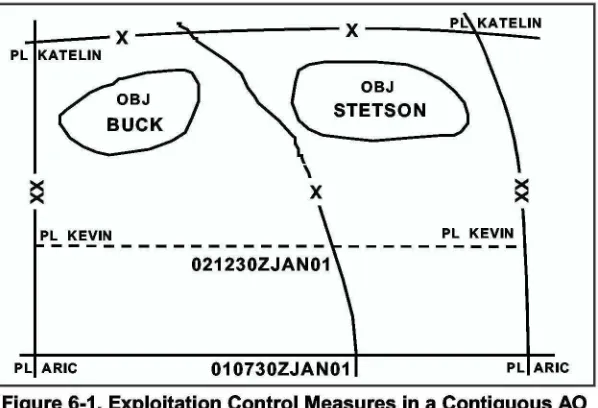
6-16. An exploitation uses fewer control measures than many other opera-tions because of the uncertain enemy situation and the need to provide subordinate commanders with the maximum possible flexibility to take ad-vantage of fleeting opportunities. (See Figure 6-1.) Planners develop graphic control measures as part of the planning process. The commander issues these control measures as part of the attack order to facilitate C2 when the force transitions to an exploitation.
x
x
PL KATELIN
~
~
OBJ STETSON
~
\X~
---
PL KEVINPL KEVIN
---PL ARIC 010730ZJAN01 PL ARIC
Figure 6-1. Exploitation Control Measures in a Contiguous AO
point or some other restriction, such as political considerations regarding an international border, which requires its establishment.
6-18. A commander normally employs permissive fire support control meas-ures during an exploitation. A coordinated fire line (CFL) ensures rapid re-sponse. Movement of the CFL is particularly important to provide adequate support as the force continues to advance. Even if the culmination of the ex-ploitation is not anticipated, establishing a forward boundary is important to facilitate operations beyond that boundary by a higher headquarters. The commander can use additional control measures, such as targets and check-points, as required.
PLANNING AN EXPLOITATION
6-19. The commander's ability to deny the enemy options by proactive use of his battlefield operating systems is critical to a successful exploitation. He does this by arranging his battlefield operating systems within his opponent's time and space relationship in accordance with the factors ofMETT-TC.
6-20. The commander must plan for the decentralized execution of an exploi-tation. His commander's intent is especially important because subordinates must be able to exercise initiative in a rapidly changing, fluid situation. The commander must state the purpose of the exploitation, which may be to force the retrograde of enemy forces from an area, encircle enemy forces so they cannot withdraw, or destroy enemy artillery and other fire support systems. The intent must describe the desired end state. That intent will also deter-mine his decisive and shaping operations and guide the designation of his main effort at any given point.
6-21. A clear commander's intent provides subordinates with guidance on how to integrate their operations into the overall operations of the higher headquarters. Only subordinates who can act quickly can seize all opportuni-ties to damage the enemy or accelerate the tempo of operations. A command-er should place minimal restrictions on his subordinates. These may include clear instructions regarding the seizure of key terrain and the size of enemy forces that may be bypassed. Reliable, secure communications between the exploiting force, the follow and support force, and the commander facilitate coordination that can maximize the impact of the exploitation. However, all subordinates should have a clear picture of the desired end state to conduct operations that support it, even if communications are lost.
6-22. Planning for an exploitation begins during the preparation phase of all offensive operations. To avoid losing critical time during the transition from an MTC or an attack to an exploitation, the commander tentatively identifies forces, objectives, and AOs for subordinate units before the offensive opera-tion begins. When the opportunity to exploit occurs, brigade and higher-echelon commanders should initiate the exploitation, either as a branch of or a sequel to the existing operation. The commander's plan should attempt to avoid driving the enemy back in the direction of his own sustaining base.
The commander must be careful not to allow an exploiting force to move out-side of his main body's supporting distance. Determining the supporting dis-tance requires some knowledge of the enemy's remaining capabilities. Gener-ally, the commander should approach exploitation planning with a sense of guarded optimism. It is an excellent opportunity to shatter enemy cohesion and gain a position of advantage over the enemy. However, the commander cannot allow the exploiting force to fall into an enemy trap where it could be drawn into a salient and destroyed in detail.
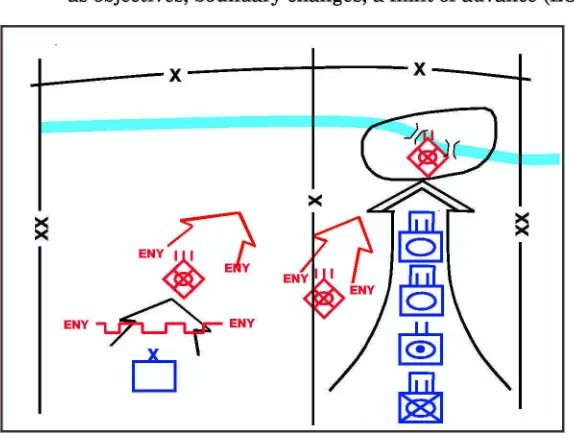
6-24. The exploitation may take the form of an MTC with a series of hasty at-tacks. The commander usually issues a series of FRAGOs that
designate-.
Movement formation..
The position of each major element of the exploiting force within that formation..
Any required modifications to task organization..
Bypass criteria..
Revised or new control measures that assist with the maneuver, such as objectives, boundary changes, a limit of advance (LOA), and FSCM.x
x
><
~
..vi}
ENY
~
ENY0
~
Figure 6-2. Brigade Exploitation: Battalions in Column Formation
6-26. In exceptional circumstances, when the enemy is clearly incapable of
ef-fectively resisting, the commander can choose temporarily not to retain a re-serve but commit all his forces to the exploitation. He may employ a line formation with two or more elements abreast without a reserve when the ap-proach to the objective must be made on as wide a front as possible. For ex-ample, a commander could use this formation when attempting to secure
crossing sites over a major river. (See Figure 6-3.) He could also employ this
formation against sporadic and weakening resistance when the enemy lacks a significant counterattack capability or when the counterattack can be blocked by means other than employing the reserve. Despite the lack of a constituted reserve, other actions, such as the effective employment of massed indirect fires, can provide the commander with the flexibility usually provided by the reserve for influencing actions during an exploitation.
a
I
Figure 6-3. Division Exploitation: Brigades Abreast, No Reserve
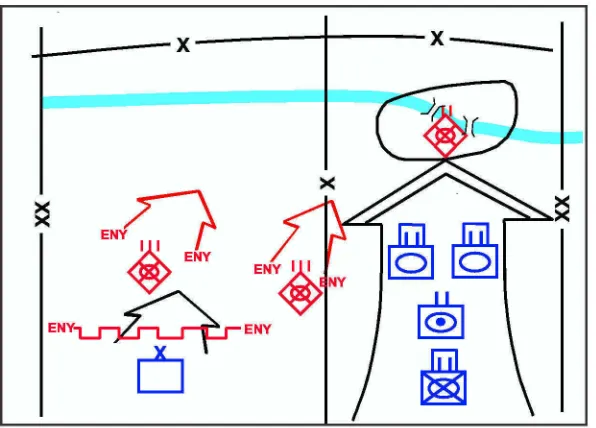
6-27. A vee formation with two or more elements abreast and a reserve al-lows the unit to advance on a reasonably wide front with the bulk of the unit's direct firepower oriented forward. This configuration helps when creating gaps in the enemy's defenses. While the bulk of the unit is committed, the re-serve is available to exploit the success of the attacking elements, assume the mission of the attacking elements, or counter enemy threats as they develop. (SeeFigure 6-4.)
into exploitation. The exploiting force templates known enemy locations with-in its AO as danger areas and targets them.
x
x-
-~
ENY.r\(R
r
~
E"" E""~
....E"~m
0
~
Figure 6-4. Brigade Exploitation: Two Battalions Forward, One in Reserve
6-29. The fire support plan includes allocating support for meeting engage-ments or hasty attacks that occur during the exploitation. The fire support co-ordinator plans targets beyond the projected locations of the exploiting ma-neuver force to shield the force from enemy counterattacks. He then addresses how to provide fire support to the force in its movement to the LOA and targets locations beyond the LOA to interdict the enemy's lines of com-munication (LOCs).
6-30. The commander plans for artillery displacement as an integral part of the exploitation. Artillery assets must displace at a pace that exceeds normal offensive operations, while maintaining the capability to provide accurate and lethal fires. The commander can normally plan on his forces using less am-munition during an exploitation than in an attack because fleeing enemy forces are normally not in prepared positions, and thus more vulnerable. The commander should also consider using close air support in the exploitation, especially to support those units moving beyond supporting range of the main body. Airborne forward air controllers can help identify and track high-payoff targets forward of the exploiting force.
6-31. The commander plans situational obstacles for each phase of the opera-tion. For example, he plans in accordance with his rules of engagement to em-place scatter able minefields in those areas that could be used by an enemy counterattack force as his forces move forward.
attack, thereby allowing his es and ess elements to keep pace with the oper-ation. Planning must address how to rapidly resupply air defense missiles as they are used. It must also allow for adjustments in the priority of protection assigned to different elements during the exploitation.
6-33. The commander must anticipate the exploitation and ensure that his logistics plan supports the force all the way to the LOA. Planning for ess in the exploitation includes designating future MSRs, logistics release points, unit maintenance collection points, casualty collection points, medical treat-ment facilities, ambulance exchange points, and the depositing of enemy prisoners of war. In sustaining the exploitation, petroleum, oil, and lubricants (POL) consumption and vehicle maintenance are primary concerns of ess planners. A significant factor is that an exploiting force tends to travel on a broad front, which may necessitate designating one or more lateral MSRs to handle the dispersion. Logistics operations must be prepared to bound their ess assets farther forward and move them more often than in an attack.
6-34. Selecting a flexible MSR is critical because it must be able to respond to changes in the direction of the exploitation. Maintaining the MSR is a respon-sibility of the force engineer. During planning, the commander must specifi-cally address the control of logistics units and convoys. He calls them forward and redirects them as needed. He may have to plan for guides to assist their movement around bypassed enemy positions and obstacles. He may assign some combat elements from the reserve an "on-order" mission to conduct rear area security to help protect ess elements or secure the MSR. The command-er must also ensure adequate plans exist for controlling displaced civilians on the battlefield so that they do not interfere with follow-on maneuver, es, and ess assets. This is a critical function of civil-military operations.
EXECUTING AN EXPLOITATION
6-35. Exploitation requires physical and mental aggressiveness to combat the friction of limited visibility, fatigue, bad weather, dangers of fratricide, and extended operations. It requires bold and aggressive reconnaissance, prompt use of firepower, and rapid employment of previously uncommitted units. Ex-ploiting forces maneuver swiftly toward their objectives, sever escape routes, and strike at enemy command posts, communications nodes, reserves, artillery, and es units to prevent the enemy from reorganizing an effective defense. Well supported by tactical air support, air cavalry, and attack heli-copters, exploiting forces should be able to change direction on short notice.
6-36. To maintain sufficient forces to conduct an exploitation, the commander must ensure that his subordinates focus on his intent. They should not dissi-pate his combat power by seeking minor tactical successes or reducing incon-sequential enemy forces. His aim is to reach the final objective with the maximum possible strength as rapidly as possible. The commander must provide his exploiting forces with mobile support, including air resupply, to move emergency lifts of POL and ammunition.
occurs after the force secures its objective. With adequate support, the com-mander can launch the exploitation with his initial assault or at any time after that, depending on the effects of the fires and his desires.
6-38. Since the exploitation takes advantage of previous success, forces previously allocated toward attacking enemy forces normally continue their ongoing activities. These activities
include-.
Attrition or defeat of enemy reserves prior to their commitment..
Destruction of enemy countermobility assets prior to their employment on a friendly avenue of advance for the exploiting force..
Disruption of enemy units attempting to reestablish a coherent de-fense..
Disruption of enemy sustaining operations.This assumes the commander has accurate intelligence data to target these enemy actions.
6-39. Generally, as one part of the attacking force finishes clearing an objec-tive, the commander orders the remaining elements to exploit that success. To accomplish this with minimal confusion, the commander must know where each of his elements is and what combat formation each has adopted. If the commander has previously trained and rehearsed his force to change rapidly from one combat formation to another, to change missions, and to change the direction of advance, he can time the execution of such changes to maintain the initiative over an enemy.
6-40. The commander can also initiate an exploitation when he realizes that the enemy force is having difficulty maintaining its position or cohesion. Up-dated intelligence is crucial to the commander since it is difficult to accu-rately predict the exact conditions required to transition from an attack to an exploitation. Therefore, the commander and his subordinates watch the enemy's defenses for indications of disintegration that may signal the oppor-tunity to transition to exploitation. Such indicators
include-.
The threat or use of weapons of mass destruction by enemy forces, de-spite the probable US retaliation, may signal impending enemy col-lapse..
Enemy reconnaissance intensifies..
Rearward movement increases, especially by fire support and reserves..
The enemy prepares to demolish or destroy his facilities, installations,equipment, and supply stockpiles.
.
Various units intermix their vehicles and personnel in combat forma-tions or march columns..
Number of prisoners captured increases significantly..
Enemy fire decreases in intensity and effectiveness..
Fires increase in one or more individual sectors of the front that do not appear to be synchronized with the developing situation and at a time when the amount of defensive fires appears to be decreasing..
Enemy resistance decreases considerably, or the enemy lacks any type of organized defense..
Reports confirm the capture or absence of enemy leaders..
Friendly forces overrun enemy artillery, C2 facilities, and supply points..
Enemy units disintegrate and friendly companies and battalions can defeat enemy battalion- and brigade-size units, respectively.In any case, the commander ruthlessly exploits vulnerable enemy forces after weighing and accommodating the risks.
GAIN AND MAINTAIN ENEMY CONTACT
6-41. The exploiting force must gain and maintain contact with the enemy. This is a critical aspect of the exploitation since the enemy may be trying to break contact and distance himself from the friendly force to give him time to recover. Mter a successful attack, the exploiting force must perform aggres-sive reconnaissance to both its front and flanks. Mission and intent of exploi-tation determine how much enemy contact is required to maintain pressure on him, compound his disorganization, shatter his will, and seize key or deci-sive terrain. As discussed in Chapter 5, this reconnaissance effort must start almost immediately after an attacking unit secures its objective. If the com-mander has dedicated reconnaissance assets, he uses them to maintain ene-my contact, observe the enemy's movements, and search for weakly defended enemy positions. If those assets are not available, other maneuver units per-form those reconnaissance tasks. While maintaining contact with the enemy, the reconnaissance force tries to locate enemy reserves, uncommitted forces, and blocking positions. This effort helps the exploiting force avoid being led into ambushes as the enemy seeks to recover the initiative by counter-attacking.
6-42. When the previously assigned offensive mission is accomplished, units at all echelons push out their reconnaissance and security forces to discover whether the opportunity exists to initiate an exploitation. At brigade and bat-talion echelons, these reconnaissance and security forces must gain and maintain enemy contact while remaining within the supporting range of their parent brigade or battalion.
6-43. The commander uses air reconnaissance to augment his ground recon-naissance. He can employ aerial sensors, such as JSTARS, air cavalry, and unmanned aerial vehicles in advance of ground maneuver reconnaissance. This allows aerial observation of named and targeted areas of interest that facilitate the unit's movement and cue the attack of high-payoff targets. Scout and attack helicopters can locate enemy positions and engage the enemy to disrupt his movement and preparations. Aviation assets surge to maintain constant contact with the enemy and keep pressure on him.
DISRUPT THE ENEMY
FIX THE ENEMY
MANEUVER
helicopters can maneuver in front of exploiting ground maneuver forces to destroy high-payoff targets. The commander integrates available fIxed-wing aircraft into his plan for attacking these targets. Rapid advances by the exploiting force keep the enemy force off balance and degrade his intelligence and surveillance capabilities, thus providing some security from attack. The commander uses all available resources to maintain pressure on the enemy, using both overwhelming combat power and asymmetric weapon systems. The commander never allows the enemy an opportunity to recover from the initial blow. The exploiting force's fire support system must deliver massed fires quickly to respond to any contingencies that arise during the exploitation.
6-45. An exploiting force has three goals in fIxing an enemy force. First, it tries to break down the enemy's combined arms organization by fIxing enemy units in positions out of supporting distance of each other. This allows the ex-ploiting force to defeat the enemy in detail. Second, the commander attacks out-of-contact enemy forces before they can adversely affect the exploitation. By attacking these enemy forces, the commander seeks to fIx them in their current positions or force them to move to locations where they can be harm-lessly contained until the exploiting force or a follow and support force can engage and defeat them. Third, it achieves a specific targeting effect-such as causing 15-percent casualties-that disrupts the enemy commander's plan.
6-46. During an exploitation, the exploiting force maneuvers to maintain pressure on the enemy. The commander can use any heavy and mobile light forces, such as airborne and air assault elements, to secure terrain objectives or choke points critical to the advance and to cut enemy lines of escape. The commander takes advantage of available vertical envelopment capabilities. The exploiting force clears only enough of its AO to permit its advance. It cuts through enemy logistics units and LaCs to seize objectives vital to the enemy's defense. It attacks from the march to overrun weak enemy forma-tions. In accordance with the bypass criteria, the exploiting force can contain and bypass those enemy pockets of resistance too small to jeopardize the mission while its commander reports these enemy forces to adjacent units, following units, and higher headquarters.
6-47. If an enemy unit is too strong for the leading elements of the exploiting force to overrun and destroy, succeeding elements of the force conduct a hasty attack based on the combat information provided by its leading elements. Such enemy forces are rarely attacked frontally. In almost all cases, the com-mander uses another form of maneuver to produce faster and better results with fewer casualties. While the exploiting force is seeking one or more as-sailable flanks, available fire support systems continue to engage the enemy to divert attention from the attempted envelopment and destroy as much ene-my combat power as possible.
can settle into his subsequent or supplemental positions. The more rapidly this can be done, the less likely it is that succeeding defensive lines will be fully prepared and the less effort it will take to penetrate each successive de-fensive position. The exploiting force repeats this process as many times as necessary until it breaks completely through the enemy's defenses.
6-49. The commander's primary concern when initiating an exploitation re-sulting from a successful attack is to shift his force into the appropriate com-bat formation and task-organize it with additional capabilities and resources to take advantage of a short window of opportunity. Assuming that the force accomplishes this with relative ease, he must control the formation as it moves and prevent its overextension. The commander must anticipate the enemy's reaction to his actions. The real danger to the exploiting force is not the immediate enemy but the enemy not yet engaged. Overextension is a risk inherent in exploitation. While the commander must be concerned with this, he must also guard against being overcautious.
6-50. Surrender appeals and ultimatums are particularly effective when di-rected against enemy units that have been surrounded, isolated, or bypassed. JP 3-53 and FM 3-05.30 detail the techniques for communicating with the enemy.
6-51. While the exploiting force is conducting its operations, the follow and support force, if
available-.
Widens or secures the shoulders of a penetration..
Destroys bypassed enemy units..
Relieves supported units that have halted to contain enemy forces..
Blocks the movement of enemy reinforcements..
Opens and secures lines of communications..
Guards prisoners, key areas, installations, and lines of communication..
Controls dislocated civilians.FOLLOW THROUGH
6-52. Once the exploitation begins, forces move to attack enemy forces with-out any operational pauses. Exploitation continues around the clock so the enemy cannot escape the relentless offensive pressure. The exploiting force retains terrain only as necessary to accomplish its mission. The commander must be careful not to dissipate combat power to achieve minor tactical suc-cesses or to reduce small enemy forces. Once he reaches the LOA, the com-mander quickly shifts his attention to survivability and countermobility be-cause of the possibility of an enemy counterattack.
Pursuit
In pursuit you must always stretch possibilities to the limit. Troops having beaten the enemy will want to rest. They must be given as ob-jectives, not those that you think they will reach, but the farthest they
could possibly reach.
Field Marshal Viscount Allenby of Meggido, Order to XXI Corps, 1917
A pursuit is an offensive operation designed to catch or cut off a hostile force attempting to escape, with the aim of destroying it (JP 1-02). Pur-suit operations begin when an enemy force attempts to conduct retro-grade operations. At that point, it becomes most vulnerable to the loss of internal cohesion and complete destruction. A pursuit aggressively exe-cuted leaves the enemy trapped, unprepared, and unable to defend, faced with the options of surrendering or complete destruction. The rapid shifting of units, continuous day and night movements, hasty attacks, containment of bypassed enemy forces, large numbers of prisoners, and a willingness to forego some synchronization to maintain contact with and pressure on a fleeing enemy characterize this type of offensive operation. Pursuit requires swift maneuver and attacks by forces to strike the ene-my's most vulnerable areas. A successful pursuit requires flexible forces, initiative by commanders at all levels, and the maintenance of a high op-erational tempo during execution.
7-1. The enemy may con-duct a retrograde when successful friendly offen-sive operations have shat-tered his defense. In ad-dition, the enemy may deliberately conduct a retrograde
when-.
He is reacting to a threat of envelop-ment..
He is adjusting his battlefield disposi-tions to meet changing situations..
He is attempting to draw the friendly force into fire sacks, kill zones, or engagement areas..
He is planning to employ weapons of mass destruction.CONTENTS
Organization of Forces 7-2
Frontal 7-3
Combination 7-4
Control Measures 7-5
Planning a Pursuit 7-7
Executing a Pursuit 7-8
Gain and Maintain Enemy Contact 7-9
Disrupt the Enemy 7-10
Fix the Enemy 7-10
Maneuver 7-10
Therefore, the friendly force must always consider the enemy's actions when-ever it sees an opportunity to conduct a pursuit.
7-2. Division is the lowest echelon equipped with the intelligence assets to determine if the enemy is conducting a retrograde under Army of Excellence tables of organization and equipment. When faced with enemy attempts to break contact, lower echelons act to maintain contact until a division or corps commander directs them to initiate a pursuit operation.
7-3. Unlike an exploitation, which may focus on seizing key or decisive ter-rain instead of the enemy force, the pursuit always focuses on destroying the fleeing enemy force. This is seldom accomplished by directly pushing back the hostile forces on their lines of communication (LOCs). The commander in a pursuit tries to combine direct pressure against the retreating forces with an enveloping or encircling maneuver to place friendly troops across the enemy's lines of retreat. This fIxes the enemy in positions where he can be defeated in detail. If it becomes apparent that enemy resistance has broken down entirely and the enemy is fleeing the battlefIeld, any type of offensive operation can transition to a pursuit.
7-4. Conducting a pursuit is a calculated risk. Once the pursuit begins, the commander maintains contact with the enemy and pursues retreating enemy forces without further orders. The commander maintains the pursuit as long as the enemy appears disorganized and friendly forces continue to advance. Like exploitation, pursuit tests the audacity and endurance of soldiers and leaders. In both operations, the attacker risks becoming disorganized. Extra-ordinary physical and mental effort is necessary to sustain the pursuit, tran-sition to other operations, and translate tactical success into operational or strategic victory.
7-5. The commander must be aware of any approaching culmination point. The enemy is usually falling back on his supply base, and potentially on fresh units, while friendly forces become less effective as they expend resources faster than they can be replaced. Reasons to discontinue the pursuit include the presence of fresh enemy forces, greatly increased resistance, fatigue, dwindling supplies, diversion of friendly units to security missions, and the need to contain bypassed enemy units.
7-6. Those plan, prepare, and execute concepts introduced previously con-tinue to apply during a pursuit. Assessment concepts described in FM 6-0 and FM 6-22 also apply. The commander modifIes them as necessary to account for the specifIc existing factors ofMETT-TC.
ORGANIZATION OF FORCES
support, and reserve forces. The commander can employ available airborne and air assault units as part of his encircling force because of their ability to conduct vertical envelopments. Given sufficient resources, there can be more than one encircling force. The follow and support force polices the battlefield to prevent the dissipation of the direct-pressure force's combat power. Appen-dix B addresses the duties of a follow and support force. The reserve allows the commander to take advantage of unforeseen opportunities or respond to enemy counterattacks.
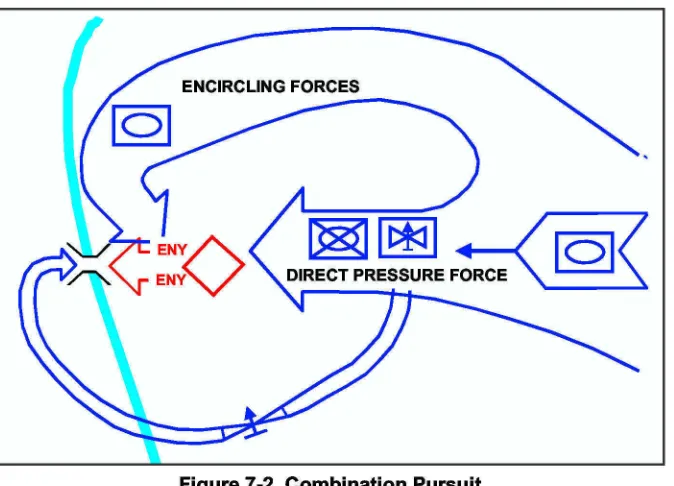
7-8. There are two basic organizational options in conducting a pursuit; each involves a direct-pressure force. The first is a frontal pursuit that employs only a direct-pressure force. The second is a combination that uses a direct-pressure force and an encircling force. The combination pursuit is generally more effective. Either the direct-pressure force or the encircling force can conduct the decisive operation in a combination pursuit.
FRONTAL
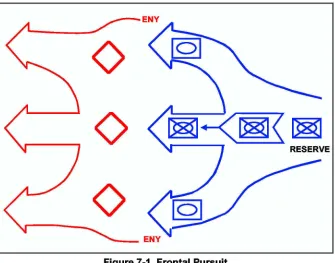
7-9. In a frontal pursuit, the commander employs only a direct-pressure force to conduct operations along the same retrograde routes used by the enemy. (See Figure 7-1.) The commander chooses this option in two situations. The first is when he cannot create an encircling force with enough mobility to get behind the enemy force. The second is when he cannot create an encircling force capable of sustaining itself until it links up with the direct-pressure force. Either situation can occur because of restrictive terrain or because an enemy withdraws in a disciplined, cohesive formation and still has significant available combat power.
0
0
0
ENY
COMBINATION
7-10. In the pursuit, the most decisive effects result from combining the fron-tal pursuit with encirclement. (See Figure 7-2.) In the combination pursuit, the direct-pressure force initiates a frontal pursuit immediately on discover-ing the enemy's initiation of a retrograde operation. This slows the tempo of the enemy's withdrawal (or fIxes him in his current position if possible), and may destroy his rear security force. The direct-pressure force's actions help to set the conditions necessary for the success of the encircling force's operation by maintaining constant pressure. The encircling force conducts an envelop-ment or a turning movement to position itself where it can block the enemy's escape and trap him between the two forces, which leads to complete annihi-lation.
DI~~F~RCE
<
101<
Figure 7-2. Combination Pursuit
7-11. The direct-pressure force conducts hasty attacks to maintain contact and apply unrelenting pressure until it destroys the enemy force. The direct-pressure force prevents enemy disengagement and subsequent reconstitution of the defense and inflicts maximum casualties. It forces the enemy to deploy frequently to delay the direct-pressure force and restricts his ability to disen-gage and rapidly move away. The direct-pressure force must be at least as mobile as the enemy. Heavy forces are ideally suited to this role, but the com-mander can employ light forces if the enemy is also foot-mobile. The direct-pressure force organizes to conduct a movement to contact and must be able to conduct a series of hasty attacks. It must be powerful enough to defeat ene-my rear guard actions and maintain pressure on the enemy's main body.
enhance, and sometimes create, this mobility advantage by conducting counter mobility operations against the enemy, specifically targeting locations such as choke points or bridges that will hinder the fleeing enemy's withdrawal. Heavy, air assault, and airborne forces are well suited for this mission. Attack helicopters are also effective when used as part of the encircling force. The encircling force must be strong enough to protect itself from the enemy's main body and slow or stop it until the friendly direct-pressure force can combine with the encircling force to destroy the enemy. It must be capable of mounting a hasty defense without placing itself at risk of annihilation. The encircling force must be self-contained since it normally operates out of supporting range of friendly indirect-fire systems. Therefore, it frequently has its supporting artillery attached. The primary mission of the encircling force is to prevent the enemy's escape by trapping him between the encircling force and the direct-pressure force. The commander can assign other missions to the encircling force, such
as-.
Destroying the enemy's weapons of mass destruction and their delivery means..
Linking up with airborne or air assault forces in their airheads..
Reporting terrain conditions and other combat information beyond that normally addressed in the unit standing operating procedures.The commander can assign the encirclement mission, wholly or in part, to available airborne or air assault units because their vertical envelopment capabilities allow friendly forces to be inserted deeper into enemy-controlled territory than would be possible with ground operations. The time required to plan airborne operations and stage airlift platforms impacts on the utility of airborne forces in small-scale pursuit operations.
7-13. The direct-pressure and encircling forces require engineer support to create lanes through obstacles, which enables them to move rapidly and con-tinuously. The commander should place his engineers well forward in his movement formations to quickly breach any obstacles that cannot be by-passed. Engineers accompanying the encircling force must also be prepared to conduct countermobility and survivability tasks.
CONTROL MEASURES
7-14. The commander uses control measures to retain his tactical options to converge on the most important axis or to redirect his pursuit effort on a new axis. These control measures should be flexible and capable of rapid adjust-ments to reflect changing conditions. This flexibility is also necessary when engaging advancing enemy reserves or counterattack forces.
X
,
,
C,
,
0 0
2A~ 81D
:E:
en
~PLWOLFE
of any responsibility beyond the forward boundary. It also gives the higher headquarters flexibility to deal with the encircling force and enemy elements located beyond that forward boundary. The rear boundary becomes the boundary between the direct-pressure force and the follow and support force.
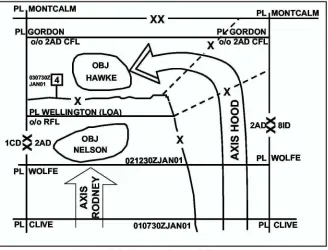
7-16. If the encircling force is a ground element, the control measures are almost identical to those of an envelopment. The commander must designate a route, an axis of advance, or an AO adjacent to that of the direct-pressure force to allow the encircling force to move parallel to and eventually get ahead of the fleeing enemy force. He designates a terrain objective as a guide for the encircling force. (See Objective HAWKE in Figure 7-3.) However, he may change this objective rapidly and frequently, based on the progress of the encircling force and the enemy. The objective should be a piece of ground that provides the encircling force good, defensible terrain that the enemy can-not easily bypass. The commander often selects choke points, such as defiles and bridges, as objectives for his encircling force.
PL MONTCALM PL MONTCALM
xx
/Pit GORDON
X 010 2AD CFL
PL GORDON
010 2AD CFL
::J;1OZ 4
1CD~ 2AD
PL CLIVE 010730ZJAN01 P CLIVE
Figure 7-3. Pursuit Control Measures
PLANNING A PURSUIT
7-18. The commander anticipates an enemy retrograde operation as either a branch or a sequel to the plan. The plan should identify possible direct- pres-sure, encircling, follow and support, and reserve forces and issue on-order or be-prepared missions to these forces. The commander should employ the maximum number of available combat troops in the pursuit. He bases the de-tails of his plan on the enemy's anticipated actions, the combat formation of the attacking troops, and the amount of planning time available. The com-mander also
considers-.
Possible routes the enemy might use to conduct his retrograde opera-tions..
Availability of his intelligence, surveillance, and reconnaissance assets to detect enemy forces and acquire targets in depth..
Scheme of maneuver..
Availability and condition of pursuit routes..
Availability of forces to keep the pressure on the enemy until his de-struction is complete..
Critical terrain features..
Use of reconnaissance and security forces..
Allocation of precision-guided munitions and aviation support..
Availability of CS and CSS resources.Pursuit planning must address the possibility of defending temporarily during operational pauses while making preparations to continue the pursuit or to consolidate gains. However, the use of an operational pause generally results in the abandonment of the pursuit because the enemy is able to use that time to organize a coherent defense.
7-19. The commander must specifically address how to detect the enemy retrograde operations; otherwise, the enemy may succeed in breaking contact. The commander relies on active reconnaissance, an understanding of enemy tactics, and knowledge of the current tactical situation. He must watch for signs that indicate the enemy is preparing to conduct a retrograde, such as when the
enemy-.
Lacks the capability to maintain his position or cohesion..
Conducts limited local counterattacks..
Intensifies his reconnaissance and intelligence efforts..
Increases the amount of rearward movements and changes the type of elements conducting them, especially by fire support and reserves..
Prepares his facilities, installations, equipment, and supply stock-pilesfor demolition and destruction.
.
Decreases fire in intensity and effectiveness through the AO.7-20. When the commander initiates a pursuit, he often creates the encircling force from uncommitted or reserve elements. Normally, these forces do not have fire support assets allocated to them. The commander must plan how to redistribute his fire support assets to properly support the encircling force. Attack helicopters and close air support are well suited to support the encir-cling force.
7-21. Engineer mobility and countermobility assets are instrumental in sus-taining the rate of advance and hindering the enemy's withdrawal. Engineers prepare the route of advance and support the lateral dispersion of units tran-sitioning to the pursuit and the movement of the reserve. During the pursuit, the commander must plan for his engineers to provide assault bridging and emergency road repairs to sustain the tempo of the pursuit. The commander also plans to use his engineer assets to block any bypassed enemy's with-drawal routes by using antitank and command-operated mines, demolitions, and obstacles.
7-22. Logistics units should plan for increases in the demand for fuel and maintenance as the tempo of operations increases. In the pursuit, priority of logistics normally goes to units having the greatest success. Logistics plan-ners need to anticipate success since the depth of the pursuit depends on the capability of logistics assets to support the operation. The logistics elements supporting the pursuing force should be as mobile as possible. Logistics plan-ners are particularly concerned with supporting the encircling force, such as casualty evacuation over possibly unsecured LaCs. The commander may need aerial resupply or heavily guarded convoys to support this force. Secur-ity for logistics convoys and LaCs are major planning considerations.
7-23. The commander uses all available logistics assets to provide essential support to the force pursuing the enemy. His pursuit plan must result in a force prepared to conduct wide-ranging operations using all available maneu-ver assets throughout his AO to complete the destruction and morale collapse of the enemy force.
EXECUTING A PURSUIT
7-24. The decisive operation in a pursuit destroys the withdrawing enemy. This generally occurs as a result of encircling the enemy between the direct-pressure and the encircling forces or a major geographic barrier-such as an unfordable river-and his defeat in detail. The timely and correct decision to initiate a pursuit is critical to its success. If the enemy begins a retrograde undetected, he avoids the constant pressure that results in disrupting that operation. The commander expects the enemy forces to conduct retrograde operations at times advantageous to them-usually at night or during bad weather.
provided such actions do not interfere with its primary mission of maintaining constant pressure on the enemy's main body. The direct-pressure force can bypass large enemy forces if it can hand them off to follow and support units, or if they do not pose a risk to the direct-pressure force.
7-26. As soon as the commander designates a unit as the encircling force and directs its actions, the force moves as swiftly as possible by the most advan-tageous routes to cut off the enemy's retreat. If the encircling force cannot move farther and faster than the enemy, it attacks the enemy's main body from the flank. When this occurs, the commander should constitute and dis-patch a new encircling force.
GAIN AND MAINTAIN ENEMY CONTACT
7-27. At the first indication of an enemy retrograde, the brigade or lower-echelon commander who discovers the enemy's rearward movement acts to maintain contact with the enemy across a wide area without waiting for orders from higher headquarters. This ensures that the enemy does not break contact and conduct an orderly retirement. These forces in contact constitute the nucleus of the direct-pressure force. As the situation permits, they reform into a movement column with reconnaissance and security elements in the lead and, if necessary, to the flank.
7-28. During a pursuit, the reconnaissance effort is intensive. Reconnais-sance elements concentrate on all routes the enemy could use when conduct-ing a retrograde operation. These elements provide information on the dispo-sition of retreating enemy formations and on the forward movement of his reserves as the pursuit develops. The tactical situation during a pursuit may become obscure because of its potential depth. Much of the combat informa-tion needed during a pursuit is located behind the fleeing enemy force. There-fore, air reconnaissance, backed by technical intelligence systems, is vital to the overall reconnaissance effort. It can
determine-.
The beginning of the rearward movement of enemy sustainment forces..
The composition of retrograding forces and their direction ofmove-ment.
.
The composition and direction of enemy reserve forces moving forward..
The nature of obstacles and intermediate defensive positions.Information about fresh enemy reserves and prepared positions is vital at the stage when a pursuit force may be approaching a culminating point; it may be the basis for terminating the pursuit.
small enemy pockets of resistance. If they encounter strongly held enemy positions, they attempt to find routes around or through these positions. The encircling force can then avoid these enemy positions and occupy blocking po-sitions before withdrawing enemy forces can reach them. If necessary, the en-circling force organizes a hasty defense behind the enemy to block his retreat.
DISRUPT THE ENEMY
7-30. Keeping the enemy from reconstituting an effective defense is critical to success. Constant pressure by direct-pressure forces and echelon fire support systems disrupts and weakens the enemy. The commander uses lethal and nonlethal direct and indirect fires to keep pressure on the enemy. The enemy commander must not be allowed to freely adjust his dispositions to counter the actions of the friendly force. Artillery fire and air strikes harass and dis-rupt the enemy's attempts to move engaged forces to the rear or bring pre-viously uncommitted forces into action. In a pursuit, decisive operations may include the ground maneuver of the direct-pressure or the encircling force. Fire support targets in a pursuit include fires on enemy columns and troop or vehicle concentrations at road junctions, defiles, bridges, and river crossings. They also include the repulsion of enemy counterattacks, destruction or delay of enemy reserves, and destruction of the enemy's fire support means. The commander conducts offensive information operations against the enemy's command and control (C2) system as an integral part of this disruption pro-cess, with emphasis on destroying or degrading the enemy's capability to re-constitute and synchronize an effective defense.
FIX THE ENEMY
7-31. Using movement and fire effects or fire potential, the commander fixes a withdrawing enemy. If the direct-pressure force disrupts the enemy's C2 system, his ability to counter friendly efforts is significantly degraded, and the goal of fixing the enemy is much easier to accomplish.
7-32. The enemy attempts to use his reserves to restore the integrity of his defenses or prevent his withdrawing force from being overrun. Fixing enemy reserves is essential to the pursuit's success and is normally the focus of eche-lon shaping operations. The direct-pressure force fixes enemy reserves in place or slows them down so that they remain outside supporting distance until the withdrawing enemy force is completely annihilated.
MANEUVER
7-34. The actions of the direct-pressure force should facilitate the
commit-ment of an encircling force that moves parallel to the rearward-moving ene-my. The depth of the pursuit depends on the size of the forces involved. It takes a division-level or higher commander to make the decision to initiate a pursuit because of the resources necessary to conduct a pursuit. The com-mander directing the initiation of a pursuit informs his higher commander of his intentions. This allows even greater resources to be devoted to the pursuit and avoids de synchronizing the higher headquarters' major operation or cam-paIgn.
7-35. The direct-pressure force normally employs an advance guard to pre-vent the enemy from ambushing the main body of the direct-pressure force and to overrun or bypass small enemy forces. The security element moves on multiple avenues of advance. If it encounters enemy units beyond its capacity to defeat, it conducts actions on contact to develop the situation. The com-mander uses combat information provided by these actions on contact to guide the main body of the direct-pressure force to destroy withdrawing ene-my forces. These actions of the direct-pressure force mayor may not be in conjunction with the actions of any encircling force.
7-36. The commander does everything possible to place his encircling force behind the withdrawing enemy and trap the bulk of that enemy force be-tween the encircling force and the direct-pressure force. The direct-pressure force maintains enough pressure on the withdrawing enemy force so the en-circling force can envelop it. To perform this task, the direct-pressure force must be strong enough to overcome any enemy rear guard before the enemy's main body can make a successful withdrawal. Once in position, the encircling force defends or attacks as necessary, responding to the enemy's actions and those of the direct-pressure force to complete the enemy's encirclement.
7-37. The pursuing force must not give the enemy time to reorganize for an all-around defense after it is encircled. If the enemy forms a perimeter, the pursuing commander must repeatedly split it into smaller elements until he destroys the encircled enemy force. If time is not critical, the commander can keep the encirclement closed, defeat enemy breakout attempts, and weaken the enemy by fires alone. He can greatly accelerate the collapse of a large, en-circled enemy force by using psychological operations, precision-guided wea-pons, and improved conventional munitions in mass. (Appendix D addresses the reduction of an encircled enemy force.) If the resulting encirclement does not destroy the withdrawing enemy force, the commander conducts additional pursuit operations until the enemy is destroyed.
FOLLOW THROUGH
7-38. Oncethe commander initiates a pursuit, he continues pursuing the
ene-my until a higher commander terminates the pursuit. Conditions under which a higher commander may terminate a pursuit include the
following-.
The pursuing force annihilates or captures the enemy and resistance ceases..
The pursuing force fixes the enemy for follow-on forces.7-39. A pursuit often transitions into other types of offensive and defensive