An Asymptotically Optimal RFID Authentication
Protocol Against Relay Attacks
Gildas Avoine†and Aslan Tchamkerten‡ †
Universit´e Catholique de Louvain ‡
TELECOM ParisTech
Abstract. Relay attacks are a major concern for RFID systems: during an au-thentication process an adversary transparently relays messages between a veri-fier and a remote legitimate prover.
We present an authentication protocol suited for RFID systems. Our solution is the first that prevents relay attacks without degrading the authentication security level: it minimizes the probability that the verifier accepts a fake proof of identity, whether or not a relay attack occurs.
Keywords:authentication protocol, proximity check, relay attack, RFID
1
Introduction
Radio Frequency Identification (RFID) allows to identify objects or subjects without any physical nor optical contact, using transponders — micro-circuits with an antenna — queried by readers through a radio frequency channel. This technology is one of the most promising of this decade and is already widely used in applications such as access cards, transportation passes, payment cards, and passports. This success is partly due to the steadily decrease in both size and cost of passive transponders calledtags.
Therelay attack1exhibited by Desmedt, Goutier, and Bengio [5] recently became a major issue of concern for RFID authentication protocols. The adversary pretends to be the legitimate prover by relaying the messages that are exchanged during the execution of the protocol. This is illustrated through the following example.
Consider an RFID-based ticket selling machine in a theater. To buy a ticket, the customer is not required to show his theater pass, an RFID tag. The customer needs to be close enough to the machine (verifier) so that the pass (prover) can communicate with it. The pass can be kept in the customer’s pocket during the transaction. Assume there is a line of customers waiting for a ticket. Bob and Charlie masterminded the attack. Charlie is in front of the machine while Bob is far in the queue, close to Alice, the victim. When the machine initiates the transaction with Charlie’s card, Charlie forwards the received signal to Bob who transmits it to Alice. The victim’s tag automatically answers since a passive RFID tag — commonly used for such applications — responds without requiring the agreement of its holder. The answer is then transmitted back from Alice
to the machine through Bob and Charlie who act as relays. The whole communication is transparently relayed and the attack eventually succeeds: Alice pays Charlie’s ticket. When it was first introduced in the late eighties, the relay attack appeared unrealis-tic. Nowadays, the relay attack is one of the most effective and feared attacks against RFID systems; it can be easily implemented since the reader and the tag communi-cate wirelessly, and it is not easily detectable by the victim because queried (passive) tags automatically answer to the requests without agreement of their bearers. Recently, Halv´aˇc and Rosa [6] noticed that the standard ISO 14443, related to proximity cards and widely deployed in biometric passports, can easily be abused by a relay attack due to the untight timeouts in the communication.
All current authentication protocols that prevent relay attacks perform rather poorly against an adversary that does not relay messages. They guarantee the same security level regardless of the adversary’s ability to relay messages. This may be considered as a weakness, in particular in situations where relay attacks are hard to perform.
We introduce a new authentication protocol suited for RFID systems with the prop-erty that it minimizes the false-acceptance probability whether or not a relay attack occurs. In Section 2 we present our protocol. Section 3 is devoted to the security anal-ysis. Section 4 addresses the optimality of our solution. In Section 5 we compare our protocol with related authentication protocols.
2
Protocol
2.1 Protocol requirements and assumptions
In the presence of the legitimate prover, the authentication protocol must guarantee that the verifier always accepts his proof of identity. The protocol must also prevent an adversary of being falsely identified assuming she can participate either passively or actively in protocol executions with either or both the prover and the verifier. This means that the adversary can1)eavesdrop protocol executions between the legitimate prover and the verifier (passive attack);2)be involved in protocol executions with the verifier and the legitimate prover separately or simultaneously (active attack). We assume that neither the prover nor the verifier colludes with the adversary, i.e., the only information the adversary can obtain is through protocol executions. Finally, we assume that the legitimate prover and the adversary never want to get simultaneously authenticated.
Given an integerN ≥1, we consider that the adversary is successful if she is able to impersonate the legitimate prover withinNprotocol executions involving either passive or active attacks. Throughout the paper,Nis considered as a fixed constant and, in the RFID context, may be interpreted as the typical number of authentications the tag can support during its life.
2.2 Protocol description
Prior to the protocol execution, the legitimate prover and the verifier agree on a common secret keykin the form of a binary string of length
for some integern≥1. The protocol consists of three parts: initialization, authentica-tion, and proximity check. The initialization and the authentication parts are executed during a “slow phase” where no time measure takes place. The proximity check, in-stead, involves time measure and is often referred to as the “fast phase.”
In addition to`k, the protocol involves two positive integers`aand`bwhose values
will be specified in Section 3.
Initialization. The prover sends a random`a-bit stringato the verifier and, similarly,
the prover sends a random`b-bit stringbto the verifier. Witha,b, and their common
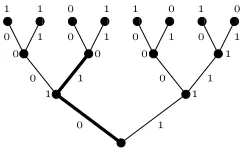
secret keyk, the verifier and the prover generate a full binary treeτ(a, b, k)of depth n+ 1as follows (see Fig. 1 for an example). The left and the right edges are labeled0 and1, respectively, and each node (except the root) takes the value0or1depending on a,b, andk.
The “tree valued” functionτ(a, b, k)is a one-to-one function whenever two of the three variablesa,b,kare kept fixed. (For this to be possible,`aand`bmust be at most
equal to`k since the total number of complete binary trees of depthn+ 1is equal to
22n+2−2
= 2`k.)
00
11 0011 0011 0011 0011 0011 0011 0011
0 1
0 1 0 1
1 1
0 0 0 1
0 1 0 1 0 1 0 1 1 1 0 1 1 0 1 0
Fig. 1.Decision tree withn= 2and`k = 14. The thick line path in the tree corresponds to the
verifier’s challenges0,1and the prover’s replies1,0.
Authentication. The prover transmits the m bits corresponding to the m leftmost leaves, starting from the left. The value ofmwill be specified in Section 3. For now,m is some value smaller than2n+1, the total number of leaves.
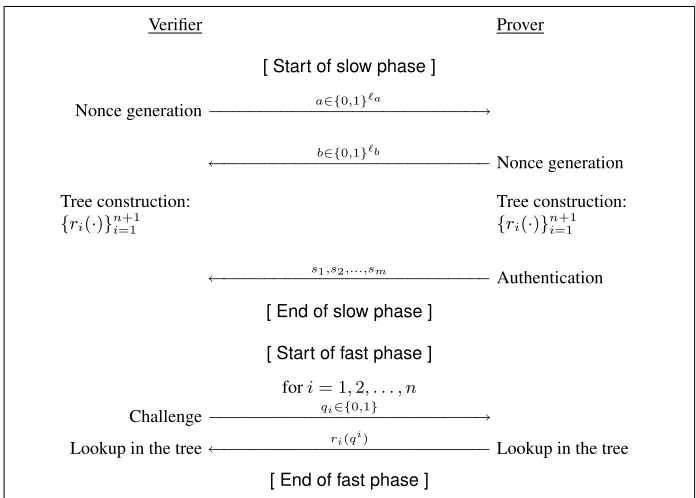
Proximity check. Ann-round fast bit exchange between the verifier and the prover pro-ceeds using the tree. The edge and the node values represent the “verifier’s challenges” and the “prover’s replies,” respectively. At each stepi∈ {1,2, . . . , n}the verifier gen-erates a challenge in the form of a random bitqiand sends it to the prover. The prover
replies by sending the value of the node in the tree whose edge path from the root is qi=q
1, q2, . . . , qi. This reply is denoted byri(qi).
i∈ {1,2, . . . , n}, the verifier measures the time interval between the instantqi is sent
untilri(qi)is received.
The round-trip time for each challenge-response round guarantees that the prover is close from the verifier. Hence, a typical threshold is a value close to2d/cwhered denotes the distance from the verifier to the expected position of the prover and where cdenotes the speed of light.
Verifier Prover
[ Start of slow phase ]
Nonce generation−−−−−−−−−−−−−−−−−−−−−−−−−−→a∈{0,1}`a
b∈{0,1}`b
←−−−−−−−−−−−−−−−−−−−−−−−−−−Nonce generation Tree construction:
{ri(·)}ni=1+1
Tree construction:
{ri(·)}ni=1+1
s1,s2,...,sm
←−−−−−−−−−−−−−−−−−−−−−−−−−−Authentication
[ End of slow phase ]
[ Start of fast phase ]
fori= 1,2, . . . , n
Challenge−−−−−−−−−−−−−−−−−−−−−−−−−−→qi∈{0,1}
Lookup in the tree ri(q i)
←−−−−−−−−−−−−−−−−−−−−−−−−−−Lookup in the tree
[ End of fast phase ]
Fig. 2.Two-phase distance bounding protocol.
Final decision. The verifier accepts the prover’s identity only if themauthentication bits are correct and if the n replies of the fast phase are correct while meeting the challenge-response time constraint. The protocol is given in Fig. 2.
3
Security analysis
At first, the above assumption may rise some doubts since themauthentication bits and the nbits sent during the fast phase by the prover depend on the secret key. In practice, however, this assumption may be justified by arguing that ifm+nis much smaller that the size of the key,`k = 2n+2−2, one protocol execution reveals almost
no information about the secret key. To be consistent with our assumption, from now on we assume thatm=m(n) =o(`k), i.e., thatmgrows sub-exponentially withn.
To compute the probability of false-authentication, we distinguish two cases de-pending on whether during theN protocol executions the adversary acts alone — i.e., without interacting either passively or actively with the legitimate prover — or not.
3.1 Attack without involving the legitimate prover
We upper and lower bound the probability of false-acceptance (f-a) as
Pr(f-a|E) Pr(E)≤Pr(f-a)≤Pr(f-a|E) + Pr(Ec) (2)
whereE denotes the event “overN protocol executions all trees are different” and whereEc denotes the complement ofE. Conditioned onE, the adversary maintains
a uniform prior on the secret keyk on each protocol execution. Therefore, for each protocol execution the adversary achieves a probability of success (at best) equal to 2−(m+n), corresponding to random guesses. It follows that
Pr(f-a|E) =N·2−(m+n)+o(2−(m+n)) (n→ ∞). (3)
The computation ofPr(Ec)refers to the birthday paradox. By letting`a = m+n, a
standard calculation reveals that2
Pr(Ec)≤ N(N−1)
2m+n+1 +O(2
−2(m+n)) (n→ ∞). (4)
From (2),(3), and (4) we get
Pr(f-a) =Θ(2−(m+n)) (n→ ∞). (5)
3.2 Attack involving the legitimate prover
We distinguish two sub-cases, depending on whether the adversary can or cannot relay messages.
With relay. In this case, the adversary can execute man-in-the-middle attacks to pass the authentication step for each of the N protocol executions; the adversary initiates the protocol with the verifier and relays the noncesa,b, and the authentication string s1, s2, . . . , sm. However, to succeed the adversary must pass the proximity check. We
compute the probability of false-acceptance (f-a) assuming the adversary passed the 2The bound (4) is achieved if`
authentication step. Similarly as in (2), we upper and lower bound the probability of false-acceptance as
Pr(f-a|Eb) Pr(Eb)≤Pr(f-a)≤Pr(f-a|Eb) + Pr(Ebc) (6)
whereEbdenotes the event “overNprotocol executions allbnonces are different.”
We first computePr(f-a|Eb). Because of the time constraint, the adversary cannot
relay information between the verifier and the prover during the fast phase. This means that the adversary’s reply at timeimust be independent of the verifier’s challenge at timei, for anyi∈ {1,2, . . . , n}. However, because there is no time measure before the fast phase, the adversary can query the legitimate prover with a sequence of challenges ˜
qn, hoping these will correspond to the challengesqnprovided by the verifier during the
fast phase. Becauseqnandq˜nare independently chosen, the probability of passing the
proximity check is the same for anyq˜n. Hence, without loss of generality, we assume
that the adversary has access to theri(˜qi)’s forq˜n = (0,0, . . . ,0),0n. The adversary
is then successful only if ri(0i) = ri(qi)for all i ∈ {1,2, . . . , n}. For conciseness,
from now on we writeriforri(qi)and˜riforri(˜qi).
Letting t be the first time i ≥ 1 when qi = 1, we have that r˜i = ri for i ∈ {1,2, . . . , t−1}, and˜ri =riwith probability1/2fori∈ {t, t+ 1, . . . , n}. Therefore,
lettingrn
, r1, r2, . . . , rn, the probability of a successful attack over one particular
protocol execution can be computed as
Pr(˜rn=rn) =
n
X
i=1
Pr(˜rn =rn|t=i) Pr(t=i)
+ Pr(˜rn=rn|qn = 0n) Pr(qn = 0n)
=
n
X
i=1
2−(n−i+1)2−i+ 2−n
= 2−n(n/2 + 1)
and we get
Pr(f-a|Eb) = 2−n+o(1) (n→ ∞). (7)
Similarly as in (4) we have
Pr(Ebc)≤
N(N−1) 2`b+1 +O(2
−2·`b) (`
b → ∞). (8)
By taking`b≥n, from (6), (7), and (8) the highest probability of false-acceptance that
can be attained by an adversary who can relay messages satisfies
Pr(f-a) = 2−n(1+o(1)) (n→ ∞). (9)
nonceband the corresponding authentication string from the legitimate prover, then by presenting those to the verifier. The security is then based only on the proximity check. Instead, with a noncea, this attack is less likely to succeed. Indeed, one can readily see that with`a =m+nas in Section 3.1, the probability of false-acceptance is as small
as in the case of attacks without legitimate prover and is given by (5).
4
Optimality of the proposed protocol
We discuss the optimality of the proposed protocol by restricting our attention to bit exchange protocols that satisfy the following general properties:
• The verifier and the legitimate prover share a common secret in the form of a bit string of length`k.
• The verifier always accepts the proof of identity of a legitimate prover.
• Neither the verifier nor the legitimate prover collude with the adversary.
Consider an authentication protocol that satisfies the above conditions. Among the bits sent by the prover during the execution of the protocol, some depend on the com-mon secret, and some do not. Ifm+ndenotes the number of secret dependent bits, the false-acceptance probability (per adversary trial) of the protocol is at best
2−(m+n)
regardless of the type of attack.
To overcome relay attacks, it is necessary that the verifier has a means to determine whether the prover is close to him — in our case the time measure. Ifndenotes the number of key dependent bits sent by the prover upon which the verifier evaluates his proximity, the probability of false-acceptance (per adversary trial) in the presence of relay attacks is at best
2−n.
In light of (5) and (9), our protocol is asymptotically optimal in the sense that the exponential rate at which the false-acceptance probability goes to zero asmandntend to infinity is the best one can achieve among all protocols with the same parameters.
5
Discussion
Brands and Chaum [2] were the first to propose an authentication protocol using the idea of a proximity check (or distance bounding) between the prover and the verifier.3 This protocol, similarly to ours, uses a proximity check in the form of rapid exchanges of challenges and responses between the verifier and the prover. After this phase, the prover authenticates himself by sending anmbit signature of all sent and received bits — the value ofmis not specified.
There are two possible attacks. The adversary can first query the legitimate prover with a particular sequence of challenges. Whenever the verifier picks the same sequence
of challenges, the adversary succeeds. The other attack consists in guessing the final sig-nature. The probability of false-acceptance overNprotocol executions is thus approx-imativelyN·2−min{m,n},nbeing the number of responses provided during the fast phase. Since the only key dependent bits are themones of the signature, this protocol is optimal ifm≤nand suboptimal otherwise.
Note that, although Brands and Chaum’s protocol may be optimal, depending on the choice of the parametersmandn, once the number of fast phase rounds is fixed, our protocol achieves a much lower probability of false-authentication in the non-relay case — and the same in the relay case.
All the subsequently published protocols [3,4,7–12] that prevent relay attacks, while having other features in terms of their complexity (computations, memory, amount of information exchanged) and their functionalities (mutual authentication, resistance to noise, resistance to colluding attacks), attain a probability of false-acceptance at best equal to the one of Brands and Chaum in both the cases with and without relay. Part of the reason is because authentication and proximity check are performed on the basis of the same bits. In our case instead, the bits sent during the authentication and during the proximity check differ. This main feature allows us to dramatically reduce the proba-bility of false-acceptance in situations where relays are not implementable, yet active attacks are possible.
We now compare our protocol with Hancke and Kuhn’s [7] since the structures of the fast phases are related. In Hancke and Kuhn’s protocol, two registersx1, x2, . . . , xn
andy1, y2, . . . , ynare generated according to the secret keykand the random noncesa
andb. For each roundiof the fast phase, the legitimate prover repliesxioryidepending
on whether the verifier’s challengeqi is equal to zero or one. The difference with our
protocol is that the response at timeidepends only on thecurrentchallengeqiand not
on thepastchallenges(q1, q2, . . . , qi−1), i.e.,ri(qi) =ri(qi).4Because the adversary
can query the prover during the slow phase, she can obtain the equivalent of an entire register. As a consequence, the probability of false-acceptance overN protocol execu-tions is approximativelyN·(3
4)
n, which is significantly higher than for our protocol —
both with and without relay.
We end this section with a practical consideration on our protocol. Interestingly per-haps, even if it gets interrupted during the fast phase, the verifier may still provide some reliable decision on whether to accept or to reject the prover’s identity. (Of course, the probability of false-acceptance will depend on how many replies the verifier obtained.) This may be useful in situations where fast authentications are required — e.g., for toll gates on highways — since it allows the verifier to take a decision even if the protocol did not end properly.
6
Concluding remarks
The main contribution of this paper consists in a an authentication protocol that is asymptotically optimal in terms of probability of false-acceptance both in the relay and non-relay cases, in contrast with previous protocols.
4
The performance of the protocol, however, comes at the expense of additional stor-age capabilities in order to compute the entire decision tree before executing the fast phase. This makes the protocol mostly suitable in applications where the number of fast phase rounds can be made small — for instance, in situations where relay attacks are expected to occur rarely. Numerically, takingn= 11for instance, requires a1KByte memory. Most RFID tags devoted to secure applications offer this value — the common NXP Mifare Classic Standard tag provides a 1KByte memory and ICAO-compliant electronic passports embed an at least 30KByte memory tag.
Finally, we note that several other optimality criteria may be considered in addition to the one proposed in Section 4. An interesting direction to pursue might be, given the size of the secret key, to seek the tradeoff between the probabilities of false-acceptance with and without relay.
References
1. Thomas Beth and Yvo Desmedt. Identification tokens – or: Solving the chess grandmas-ter problem. In Alfred Menezes and Scott Vanstone, editors, Advances in Cryptology – CRYPTO’90, volume 537 ofLecture Notes in Computer Science, pages 169–176, Santa Bar-bara, California, USA, August 1990. IACR, Springer-Verlag.
2. Stefan Brands and David Chaum. Distance-bounding protocols. In Tor Helleseth, editor, Ad-vances in Cryptology – EUROCRYPT’93, volume 765 ofLecture Notes in Computer Science, pages 344–359, Lofthus, Norway, May 1993. IACR, Springer-Verlag.
3. Srdjan Capkun, Levente Butty´an, and Jean-Pierre Hubaux. SECTOR: secure tracking of node encounters in multi-hop wireless networks. InACM Workshop on Security of Ad Hoc and Sensor Networks – SASN’03, pages 21–32, Fairfax, Virginia, USA, October 2003. ACM. 4. Srdjan Capkun and Jean-Pierre Hubaux. Secure positioning in wireless networks. IEEE Journal on Selected Areas in Communications: Special Issue on Security in Wireless Ad Hoc Networks, 24(2):221–232, February 2006.
5. Yvo Desmedt, Claude Goutier, and Samy Bengio. Special uses and abuses of the fiat-shamir passport protocol. In Carl Pomerance, editor,Advances in Cryptology – CRYPTO’87, volume 293 ofLecture Notes in Computer Science, pages 21–39, Santa Barbara, California, USA, August 1988. IACR, Springer-Verlag.
6. Martin Halv´aˇc and Tom´aˇc Rosa. A note on the relay attacks on e-passports: The case of czech e-passports. Cryptology ePrint Archive, Report 2007/244, 2007.
7. Gerhard Hancke and Markus Kuhn. An RFID distance bounding protocol. InConference on Security and Privacy for Emerging Areas in Communication Networks – SecureComm 2005, pages 67–73, Athens, Greece, September 2005. IEEE, IEEE Computer Society.
8. Catherine Meadows, Radha Poovendran, Dusko Pavlovic, LiWu Chang, and Paul Syver-son. Distance Bounding Protocols: Authentication Logic Analysis and Collusion Attacks, volume 30 ofAdvances in Information Security series, Secure Localization and Time Syn-chronization for Wireless Sensor and Ad Hoc Networks, chapter 2, pages 279–298. Springer-Verlag, 2007.
9. Jorge Munilla, Andres Ortiz, and Alberto Peinado. Distance bounding protocols with void-challenges for RFID. Printed handout of Workshop on RFID Security – RFIDSec 06, July 2006.
11. Dave Singel´ee and Bart Preneel. Distance bounding in noisy environments. In Srdjan Cap-kun, Catherine Meadows, and Frank Stajano, editors,Security and Privacy in Ad hoc and Sensor Networks – ESAS’07, volume 4572 ofLecture Notes in Computer Science, pages 101–115, Cambridge, UK, July 2007. Springer-Verlag.