Key points
} Regardless of how conscientiously or appropriately preventive screening is undertaken, it is inevitable that some patients will suffer harm owing to the heterogeneous nature of disease progression, the inherent limitations of screening tests, and unnecessary treatment.
} In screening for many conditions, adverse outcomes occur in large numbers of patients owing to frequent false positives and overdiagnosis. Adverse outcomes of screening can be emotionally and clinically challenging for both patients and physicians. Physicians need to be aware of the potential for adverse outcomes when making decisions with patients about screening.
} Strategies to mitigate the harms of screening include shared decision making with patients, supported by knowledge translation tools that describe the balance between benefits and harms.
} A decision not to screen is rarely followed by the detection of disease. When it is, this adverse outcome is more emotionally and clinically challenging for patients and physicians than a screening decision that resulted in unnecessary tests or treatments.
} Legal medical concerns surrounding adverse outcomes of screening or not screening are mitigated by shared decision making between physicians and patients that includes discussion of the harms and benefits associated with screening decisions. Physicians should document these discussions.
Screening: when things go wrong
James A. Dickinson MB BS PhD CCFP FRACGP Nicholas Pimlott MD CCFP FCFP Roland Grad MD CM MSc CCFP FCFP
Harminder Singh MD MPH FRCPC Olga Szafran MHSA Brenda J. Wilson MB ChB MSc MRCP(UK) FFPH
Stéphane Groulx MD CCFP FCFP Guylène Thériault MD CCFP Neil R. Bell MD SM CCFP FCFP
P
reventive screening has the potential to makeoth-erwise healthy people sick.1 Every day in practice, family physicians perform interventions intended to benefit patients, but which might also cause harm. This concept is well understood for surgery and other inva-sive procedures, where risks are formally explained to patients beforehand; however, it is less obvious in family medicine, where risks are seldom so clear. Benefits from many screening maneuvers are uncommon and modest, and they must be balanced against the potential harms to help patients decide whether to proceed with testing.2
To manage and mitigate potential harms for patients, family physicians must understand how adverse out-comes can occur and know the possible strategies that can reduce the potential for harms. Patients who experi-ence adverse outcomes might experiexperi-ence regret, anger, or despair, while others might be unaware that they have experienced harm from screening.
As part of an ongoing series of articles on screening from the Canadian Task Force on Preventive Health Care (CTFPHC), this article focuses on helping family physicians understand how harms can occur and supports the devel-opment of skills and strategies to mitigate them. We use examples mainly from cancer screening, but the issues apply to screening for most diseases. For each patient case, names and identifying details have been changed.
Patient case scenarios
Case 1. Mr Brown, aged 71, was visiting his wife in the hospital. She was receiving palliative care for metastatic
colorectal cancer that presented at an advanced stage 2 years previously. He underwent a screening colonoscopy shortly after she was diagnosed and was told he was “clear.” While at the hospital, he suddenly felt faint, had an overwhelming urge to have a bowel movement, and had an episode of bloody diarrhea. He was taken to the emergency department where investigations revealed a cancer of the hepatic flexure with direct invasion of the liver. After stabilization and discharge with plans for fur-ther follow-up and treatment, he returns to see you, very upset. Why did he get a late-stage cancer after he had an “all clear” on screening? What can you say?
Case 2. Mr Smith, a healthy and active 56-year-old man, comes in to see you for his periodic health assessment. He is at average risk of prostate cancer, but is influenced by a colleague at work who was recently diagnosed with the disease and by powerful messages from groups who advocate screening. After discussing CTFPHC recommen-dations for prostate cancer screening with the prostate- specific antigen test and using the tools provided,3 he decides to undergo screening. His test result is posi-tive and you refer him to a urologist for further assess-ment. He undergoes a biopsy that does not find cancer. Unfortunately, 24 hours after the biopsy, he develops a serious infection and requires a 3-day admission to hos-pital. He returns to see you, regretful that he took the test.
health assessment. At that time, she had a Papanicolaou test. Together you discussed screening mammography. In that discussion, you used the CTFPHC guidelines and
patient educational materials,4 which demonstrate the
benefits and harms of that screening. Weighing that information, she decided not to do the test. She returns to see you for another Pap test, but mentions she has a lump in her left breast. On examination, you confirm the finding that she has a 2-cm fixed mass in her breast and a palpable axillary lymph node. As you discuss the diagnostic possibilities, Mrs Jones becomes understand-ably upset and wonders whether she could have been diagnosed earlier if she had had a mammogram. You wonder how to handle this situation, and on reflection whether you would have advised her differently.
How can screening for disease
cause adverse outcomes?
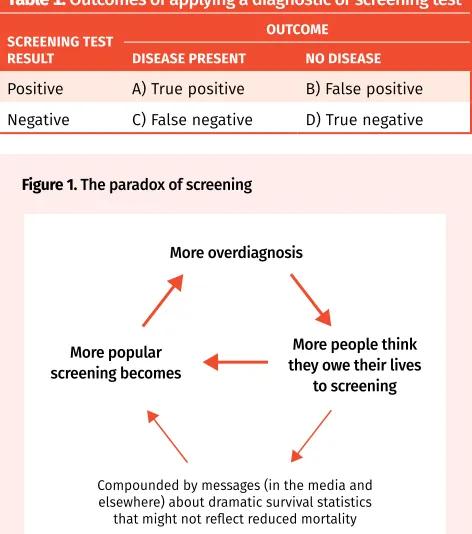
Table 1 shows what happens in the common situation of a diagnostic or screening test. Most people who are screened are grateful; if disease is detected, they are thankful that it was found, enabling treatment. We can-not know who among the diagnosed group benefited. Most assume they did, as do those found to have a false-positive result after investigation. This has been called the
popularity paradox of screening, as shown in Figure 1.5,6 People who have a negative result feel even better.
Taking a different view, Calonge7 describes that
in any screening intervention there are 5 potential
outcomes—4 of which are bad. Table 2 illustrates these
5 outcomes of applying a screening test and the order of magnitude of each possibility for prostate cancer screening.8-10 Taking this contrary viewpoint, only 1 man in 1000 benefits from the prostate-specific antigen test; all other results either cause harm or represent wasted effort. Because many of the diagnoses occur shortly after screening, many men who do not benefit are diag-nosed earlier than they otherwise would be, so are “sick” for longer than if they had waited until they presented clinically—the lead-time bias.11
Understanding the detection of
disease in relation to screening
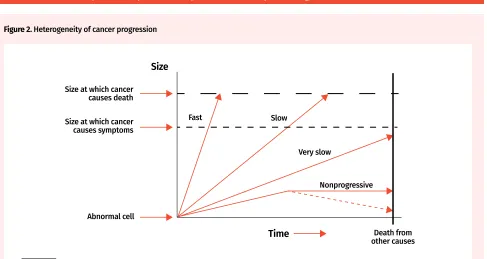
To detect disease earlier in its course, a screening test is usually set with a threshold more sensitive than a diag-nostic test, but it consequently often picks up changes that would never go on to cause trouble. This is dem-onstrated in Figure 2,6 illustrating the varied natural history of pathology that causes positive screening test results. “Fast” disease advances rapidly, so people might present clinically before screening tests can detect dis-ease. Such disease is often rapidly fatal, so not helped by screening. Screening can detect “slow” disease early, so treatment can improve the outcome for at least a proportion of patients. “Very slow” disease does not need to be detected, as it will not be fatal before some other disease kills the person. “Nonprogressive” disease has a different natural history and does not progress or might even regress, so never needed detection, much less treatment. While it might be surprising that some cancers regress, there is increasing evidence for this phenomenon. These concepts can be applied not only to cancer, but also to metabolic diseases, such as renal failure or diabetes, and cardiovascular disease.
The proportion of each type of disease and outcome varies with the disease and potentially the circumstances of the person—the development of early changes in younger people might vastly differ from those detected in older people. These differences in the stages of diseases detected and variation in their natural history mean that many “cases” detected by screening tests are
overdiag-nosed. Overdiagnosis is defined as the detection of an
asymptomatic “abnormality” or “condition” that would
ultimately not go on to cause symptoms or death.2 The
difficulty is that individual overdiagnosed cases (“very slow” or “nonprogressive”) cannot be distinguished from “slow” diseases. The number of overdiagnosed cases can only be estimated through long-term follow-up in ran-domized trials.2,6
Outcomes of screening
Let’s consider each outcome in Table 2 in more detail.8-10
A1) True positive. If disease is present, the favourable out-come is early detection for which treatment leads to the prolongation of life. This occurs rarely, as most diseases we
Figure 1. The paradox of screening
More popular screening becomes
More people think they owe their lives
to screening
Compounded by messages (in the media and elsewhere) about dramatic survival statistics
that might not reflect reduced mortality More overdiagnosis
Table 1. Outcomes of applying a diagnostic or screening test
SCREENING TEST RESULT
OUTCOME DISEASE PRESENT NO DISEASE
screen for affect only a fraction of the population and few treatments are totally effective, so at least some patients detected by screening do not benefit from treatment.
A2) Overdiagnosis. By screening, we diagnose people who would not otherwise have been diagnosed. Some of the positive test results are caused by overdiagno-sis—that is, true disease (based on our current criteria) is detected, but it would not have affected the person in his or her lifetime. For many screening procedures, overdiagnosis is frequent among true-positive results, especially in low-risk groups.2,12
B) False positive. The proportion of false-positive labo-ratory and other test results is often several times greater
than that of true-positive results.13 People with positive screening test results must be further investigated with more invasive or expensive testing before being reas-sured that they do not have disease. The process of wait-ing, then testwait-ing, is very stressful for many people.
Many people with false-positive results are grate-ful that they have been investigated and found to be clear of disease. Again, consistent with the popular-ity paradox, they are relieved, even though some have been harmed psychologically. Some patients develop a
heightened sense of vulnerability afterward.14,15 Some
have been harmed physically as well. For example, open breast biopsy can leave painful scars, while colonoscopy can cause bowel perforation and other complications.
Figure 2. Heterogeneity of cancer progression
Reproduced from Welch and Black with permission.6
Nonprogressive Very slow
Slow Fast
Size
Size at which cancer causes death
Size at which cancer causes symptoms
Abnormal cell
Death from other causes
Time
Table 2. Outcomes of prostate-specific antigen testing among 1000 men aged 55 to 69 y, confirmed with further diagnostic tests
SCREENING TEST RESULT AND TOTAL
OUTCOME
TOTAL
DISEASE PRESENT NO DISEASE
Positive A1) True positive
• 1 has life prolonged, 5 men still die
• 45 to 62 others are diagnosed, treated, and live the rest of their lives with that history
A2) Overdiagnosis
• 33 to 50 men are overdiagnosed.8 Many are also overtreated
B) False positive
• 178 men are investigated and found not to have cancer
279
Negative C) False negative
• 1 man has disease diagnosed clinically afterward D) True negative• 720 did not benefit from the test 721
Total 102 898 1000
C) False negative. Usually only a very small group of patients have negative test results despite harbouring disease. False-negative results occur because screen-ing tests are imperfect, with sensitivity less than 100%, meaning they are unable to detect all disease pres-ent, especially early disease. These people are initially pleased the test result was negative.
“Interval disease” that presents clinically between rounds of screening tests comprises both false nega-tives and some infrequent rapidly advancing disease that developed after the screening test and hence genu-inely was not detectable at the time of screening. When the diagnosis occurs soon after a negative test result, it is more likely due to a false-negative result. For exam-ple, if in Mr Brown’s case, a large tumour were found within a month of the initial “normal” colonoscopy find-ings, that would most likely be a false negative; whereas, if it were a couple of years afterward, it could well have been interval disease.
D) True negative. All physicians hope our patients fit in this group. Screening tests with high specificity leave a large proportion of people in this category. Most are reassured, but some who have had their anxiety raised enough to encourage them to have the test remain anx-ious. We have all had patients who are not reassured by negative screening test results and request the test be repeated before they are due again. Either way, they have had the cost and anxiety of screening to no benefit, when that effort could have been directed toward some-thing more useful, so this is still a harm.
Availability of evidence on harms
To assess the harms of screening requires evidence on false positives, overdiagnosis, and complications
of diagnostic investigations and treatment6,12,16;
how-ever, obtaining accurate estimates can be challenging. Investigators, evaluators, and program managers sel-dom systematically collect evidence on harms. A sys-tematic review of 57 cancer screening trials found that the harms from overdiagnosis were reported in 4 and those from false positives in 2 of the trials evaluated.16 A review of US cancer screening guidelines found that
69% did not quantify benefits and harms or presented them in an asymmetric manner that favoured the ben-efits.17 Not surprisingly physicians and patients rarely have accurate expectations of the outcomes of treat-ments, screening, and tests, generally overestimating benefits and underestimating harms.18,19
Application to the cases
Mr Brown had an interval cancer and he might have developed colorectal cancer after the colonoscopy. Alternatively, he might have had a false-negative result (ie, disease that was missed at his colonoscopy). There will always be a small error rate in endoscopy, which
varies with operator skill and attention to detail.20,21 In an ideal world, family physicians would like to know the error rates for the specialists or teams we refer to, but those data are only analyzed and returned in a few Canadian centres. Most colonoscopists do not know their own error and complication rates or those of sur-rogate markers (adenomatous polyp detection rate, rates of colonoscopy completed to the cecum, average
time taken to do the examination).22 Even when
col-lected, these data are usually only made available to the providers doing the procedures, without consideration of possible benefits from sharing the information with the family physicians or patients.
Patients have emotional responses of regret or even anger; physicians have such responses too. Mr Brown was very angry, asserting that something must have failed in the screening process. When he learned that a single colonoscopy screening reduces death from colon cancer by perhaps only 40% to 65%,23 he felt there was misrepresentation, as the information given to him implied that screening would prevent deaths due to colon cancers, without providing clear information that it has only partial effect. His wrath encompassed his family physician, as well as the rest of the “system” that he believed had failed him.
Mr Smith was following the widespread messages about the value of prostate cancer screening, which sel-dom mention the potential for harm. He took the risk of being screened, perhaps swayed by emotion, and was diagnosed as not having cancer, but he sustained the seri-ous harm of infection. This is a recognized complication of biopsy, occurring in at least 1% of men, and more recently
3.6%, with 1 in 1000 biopsied men dying as a result.24
Transperineal biopsies have a lower complication rate than transrectal biopsies do, so while MRI-guided prostate biopsies might have a greater probability of finding can-cer, their complication rate appears to be related to the access route.24 By comparison, the optimistic estimate of living longer from prostate screening is around 1 per 1000 over 10 to 15 years,25 while the risk of overdiagnosis is estimated as 33 to 50 out of 1000 men screened after the same period,8 with many of these receiving overtreatment. This was discussed with Mr Smith. He was aware that he chose to be screened anyway and he regretted that deci-sion, but was grateful that his family physician had at least taken the time to discuss his choices.
Deciding not to screen. Despite popular enthusiasm to screen,26 it is important to inform patients about the pros and cons of screening. Physicians and patients can then engage in shared decision making with consid-eration of patients’ values and preferences and decide whether to screen based on the balance of benefits
and harms.27 Most people who make the choice not to
screen will continue their lives and suffer no harms
A small proportion will unfortunately develop the dis-ease that the screening test detects. Both patients and physicians react emotionally to such events, and Mrs Jones’ situation is an example.
When screening is not performed, some disease will still be treatable when it presents. Some will not. The question is whether the outcome is better for disease detected by screening; this might be true for a subset of patients, but not all. For example, while thyroid can-cer incidence has escalated owing to early detection by ultrasound,29 it is not clear that concurrent small reduc-tions in death rates are due to early detection or to bet-ter treatment of the few potentially fatal cancers.
Mrs Jones made a probability decision about mam-mography screening based on the best information available. While she might regret this decision, we need to reassure her that it was reasonable in terms of the balance of uncommon benefit against the common harms.28,30 It is quite likely that most of the reduced mor-tality from breast cancer is due to better treatment in recent years. She can still benefit from that improved treatment. We need to be empathetic with Mrs Jones’ understandable emotion but not consider her origi-nal choice, nor our advice, to have been wrong. Many women make the same decision. Dr Fiona Godlee,
the Editor in Chief of the BMJ, publicly stated at the
Preventing Overdiagnosis conference (September 15, 2014) that she will not have a screening mammogram, believing that she is more likely to be harmed than helped by this test.
Many physicians are anxious that not screening could
lead to legal consequences. For situations where there is a justified body of opinion that screening is a choice, it is unlikely that such a case would succeed, espe-cially if there is a record of the discussion. In a world of probabilities rather than certainties, it is most impor-tant that we describe the risk of making a decision that might be “right” but still have a bad outcome. Some physicians might be frightened by such “bad outcomes” and, thereafter, become screening “zealots” (insisting on all patients being screened). This has been termed the availability error—that is, recent or more vivid bad experiences impress us and colour our thinking while
most go well and are barely noticed.31,32 This is the
wrong reaction, as such practice will replace the harm of missed detection of disease with a large set of other harms, such as those brought about by false-positive test results and overdiagnosis.
How can the family physician mitigate
the harms associated with screening?
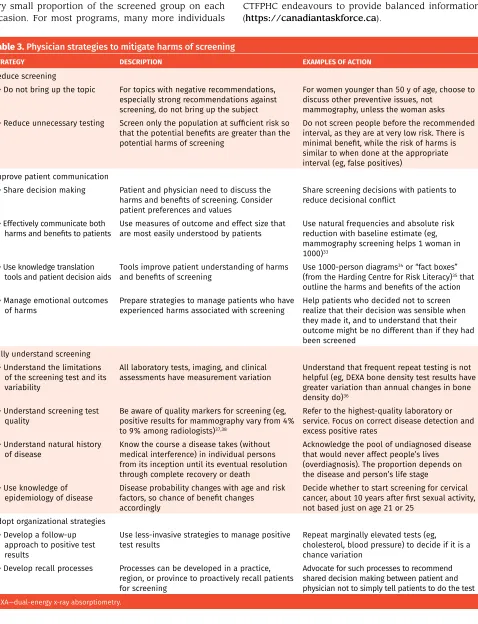
Because of the inherent potential for harms after decid-ing to screen or not, family physicians must consider how best to limit or mitigate them. To reduce the adverse outcomes, several possible strategies can be employed. These are listed in Table 3.33-38
Screening is generally performed in “low-risk popula-tions,” but extending screening tests into populations with very low prevalence of disease has low possibility of bene-fit. Therefore, most positive results are false positives. Such populations include, for example, people below the recom-mended age for screening or those for whom the test is repeated at a shorter interval than recommended. In the extreme case, when there is no true disease in the popu-lation, all positive results are overdiagnosis or false posi-tives. For the 5% of screening mammograms performed in Canada on women younger than age 5031 and for those get-ting annual breast or cervical screening or cervical screen-ing before age 25, these are the most likely outcomes. As many of these people have concerns raised but investiga-tion subsequently shows no disease, they are grateful to be given the “all clear”—again, the popularity paradox.
Quality of screening
In any judgment-based tests, such as pathology slide and x-ray scan readings or observing abnormalities in the mucosa of internal organs, there is variation in the ability to detect disease. Such variability is generally highest when trying to discriminate small changes in early disease. Therefore, reading screening results is difficult and quality needs to be regularly checked. It is hard for family physicians to assess the quality of spe-cialists’ performance—still greater for screening tests. However, it is reasonable to ask what quality improve-ment processes they participate in and whether they perform to accepted standards.
While we all would like more sensitive tests to detect every cancer, generally tests are more sensitive at the cost of lesser specificity, thus causing many more false positives with associated harm. Thus, we must be cau-tious about services that offer more sensitive tests, with-out informing both referring physicians and patients about the concomitant potential harms caused by false positives and overdiagnosis. Examples include new tech-nologies for breast screening and human papillomavirus testing for cervical screening, and lowering the thresh-olds for diagnosing renal failure or essential hypertension.
Conclusion
The widespread promotion of the idea that early detec-tion and treatment of disease is the most effective way to reduce premature deaths from cancer, diabetes, or heart disease, for example, has been very powerful in spite of research revealing that the potential harms associated with early detection of many diseases might be greater than the benefits.1,2,5,6,18,25 The message has been so effective that some have asked the question “Can we un-ring the bell?” on the message that “early
detection is the best protection.”39
Table 3. Physician strategies to mitigate harms of screening
STRATEGY DESCRIPTION EXAMPLES OF ACTION
Reduce screening
• Do not bring up the topic For topics with negative recommendations, especially strong recommendations against screening, do not bring up the subject
For women younger than 50 y of age, choose to discuss other preventive issues, not
mammography, unless the woman asks • Reduce unnecessary testing Screen only the population at sufficient risk so
that the potential benefits are greater than the potential harms of screening
Do not screen people before the recommended interval, as they are at very low risk. There is minimal benefit, while the risk of harms is similar to when done at the appropriate interval (eg, false positives)
Improve patient communication
• Share decision making Patient and physician need to discuss the harms and benefits of screening. Consider patient preferences and values
Share screening decisions with patients to reduce decisional conflict
• Effectively communicate both
harms and benefits to patients Use measures of outcome and effect size that are most easily understood by patients Use natural frequencies and absolute risk reduction with baseline estimate (eg, mammography screening helps 1 woman in 1000)33
• Use knowledge translation
tools and patient decision aids Tools improve patient understanding of harms and benefits of screening Use 1000-person diagrams
34 or “fact boxes” (from the Harding Centre for Risk Literacy)35 that outline the harms and benefits of the action • Manage emotional outcomes
of harms Prepare strategies to manage patients who have experienced harms associated with screening Help patients who decided not to screen realize that their decision was sensible when they made it, and to understand that their outcome might be no different than if they had been screened
Fully understand screening • Understand the limitations
of the screening test and its variability
All laboratory tests, imaging, and clinical
assessments have measurement variation Understand that frequent repeat testing is not helpful (eg, DEXA bone density test results have greater variation than annual changes in bone density do)36
• Understand screening test
quality Be aware of quality markers for screening (eg, positive results for mammography vary from 4% to 9% among radiologists)37,38
Refer to the highest-quality laboratory or service. Focus on correct disease detection and excess positive rates
• Understand natural history
of disease Know the course a disease takes (without medical interference) in individual persons from its inception until its eventual resolution through complete recovery or death
Acknowledge the pool of undiagnosed disease that would never affect people’s lives (overdiagnosis). The proportion depends on the disease and person’s life stage
• Use knowledge of
epidemiology of disease Disease probability changes with age and risk factors, so chance of benefit changes accordingly
Decide whether to start screening for cervical cancer, about 10 years after first sexual activity, not based just on age 21 or 25
Adopt organizational strategies • Develop a follow-up
approach to positive test results
Use less-invasive strategies to manage positive
test results Repeat marginally elevated tests (eg, cholesterol, blood pressure) to decide if it is a chance variation
• Develop recall processes Processes can be developed in a practice, region, or province to proactively recall patients for screening
Advocate for such processes to recommend shared decision making between patient and physician not to simply tell patients to do the test
DEXA—dual-energy x-ray absorptiometry.
like nearly all medical interventions, screening often causes harm. When the potential gain is large and fre-quent, as often happens in treatment situations, the bal-ance of benefit favours the action. However, in screening healthy people, the benefit will improve outcomes for a very small proportion of the screened group on each occasion. For most programs, many more individuals
Screening provides choice about whether and how to change small probabilities, but cannot eliminate risk of the disease. Whatever decision is taken, there is always potential for an unwanted outcome. Patients and fam-ily physicians need to become more aware of this, be able to discuss it meaningfully, and develop strategies to
cope with any bad outcomes.
Dr Dickinson is Professor in the Department of Family Medicine and the Department of Community Health Sciences at the University of Calgary in Alberta. Dr Pimlott is Professor in the Department of Family and Community Medicine at the University of Toronto in Ontario and Scientific Editor of Canadian Family Physician. Dr Grad
is Associate Professor in the Department of Family Medicine at McGill University in Montreal, Que. Dr Singh is Associate Professor in the Department of Internal Medicine and the Department of Community Health Sciences at the University of Manitoba in Winnipeg and in the Department of Hematology and Oncology for CancerCare Manitoba. Ms Szafran is Associate Director of Research in the Department of Family Medicine at the University of Alberta in Edmonton. Dr Wilson is Associate Dean and Professor in the Division of Community Health and Humanities at Memorial University of Newfoundland in St John’s. Dr Groulx is Assistant Clinical Professor in the Department of Community Health Sciences at the University of Sherbrooke and Associate Researcher at the Charles-Le Moyne Hospital Research Centre in Sherbrooke, Que. Dr Thériault is Associate Vice Dean of Distributed Medical Education and the Academic Lead for the Physicianship Component at Outaouais Medical Campus in the Faculty of Medicine at McGill University. Dr Bell is Professor in the Department of Family Medicine at the University of Alberta.
Competing interests
All authors have completed the International Committee of Medical Journal Editors’ Unified Competing Interest form (available on request from the corresponding author).
Dr Singh reports grants from Merck Canada, personal fees from Pendopharm, and personal fees from Ferring Canada, outside the submitted work. The other authors declare that they have no competing interests.
Correspondence
Dr James A. Dickinson; e-mail [email protected] References
1. Welch HG, Schwartz LM, Woloshin S. Overdiagnosed. Making people sick in the pursuit of health. Boston, MA: Beacon Press; 2011.
2. Bell NR, Grad R, Dickinson JA, Singh H, Moore AE, Kasperavicius D, et al. Better deci-sion making in preventive health screening. Balancing benefits and harms. Can Fam Physician 2017;63:521-4 (Eng), 525-8 (Fr).
3. Canadian Task Force on Preventive Health. Tools & resources. Prostate cancer. Calgary, AB: Canadian Task Force on Preventive Health. Available from:
https://canadiantaskforce.ca/prostate-cancer-tools. Accessed 2018 Apr 29. 4. Canadian Task Force on Preventive Health. Tools & resources. Breast cancer. Calgary,
AB: Canadian Task Force on Preventive Health. Available from: https://canadian taskforce.ca/tools-resources/breast-cancer-2. Accessed 2018 Apr 29. 5. Raffle AE, Muir Gray JA. Screening. Evidence and practice. New York, NY: Oxford
University Press; 2007.
6. Welch HG, Black WC. Overdiagnosis in cancer. J Natl Cancer Inst 2010;102(9):605-13. Epub 2010 Apr 22.
7. Calonge N. The challenge of communicating overdiagnosis. Presented at: Preventing Overdiagnosis; 2015 Sep 1-3; Bethesda, MD. Available from: www.preventingover diagnosis.net/?page_id=1089. Accessed 2018 Apr 16.
8. Fenton J, Weyrich M, Durbin S, Liu Y, Bang H, Melnikow J. Evidence synthesis number 154. Prostate-specific antigen-based screening for prostate cancer: a systematic evidence review for the U.S. Preventive Services Task Force. Rockville, MD: Agency for Healthcare Research and Quality, US Department of Health and Human Services; 2017. 9. Schröder FH, Hugosson J, Roobol MJ, Tammela TL, Ciatto S, Nelen V, et al.
Prostate-cancer mortality at 11 years of follow-up. N Engl J Med 2012;366(11):981-90. Erratum in: N Engl J Med 2012;366(22):2137.
10. Schröder FH, Hugosson J, Roobol MJ, Tammela TL, Zappa M, Nelen V, et al. Screening and prostate cancer mortality: results of the European Randomised Study of Screening for Prostate Cancer (ERSPC) at 13 years of follow-up. Lancet
2014;384(9959):2027-35.
11. Kramer BS, Crosswell JM. Cancer screening: the clash of science and intuition. Annu Rev Med 2009;60:125-37.
12. Harris R, Sawaya GF, Moyer VA, Calonge N. Reconsidering the criteria for evaluating proposed screening programs: reflections from 4 current and former members of the U.S. Preventive Services Task Force. Epidemiol Rev 2011;33(1):20-35. Epub 2011 Jun 10. 13. Naugler C, Ma I. More than half of abnormal results from laboratory tests ordered
by family physicians could be false-positive. Can Fam Physician 2018;64:202-3. 14. Marteau TM. Psychological costs of screening. BMJ 1989;299(6698):527. 15. Brodersen J, Siersma VD. Long-term psychosocial consequences of false-positive
screening mammography. Ann Fam Med 2013;11(2):106-15.
16. Heleno B, Thomsen MF, Rodrigues DS, Jorgensen K, Brodersen J. Quantification of harms in cancer screening trails: literature review. BMJ 2013;347:f5334.
17. Caverly TJ, Hayward RA, Reamer E, Zikmund-Fisher BJ, Connochie D, Heisler M, et al. Presentation of benefits and harms in US cancer screening and prevention guide-lines: systematic review. J Natl Cancer Inst 2016;108(6):djv436.
18. Hoffmann TC, Del Mar C. Patients’ expectations of the benefits and harms of treat-ments, screening, and tests: a systematic review. JAMA Intern Med 2015;175(2):274-86. 19. Hoffmann TC, Del Mar C. Clinicians’ expectations of the benefits and harms of treat-ments, screening, and tests: a systematic review. JAMA Intern Med 2017;177(3):407-19. 20. Hilsden RJ, Dube C, Heitman SJ, Bridges R, McGregor SE, Rostom A. The association
of colonoscopy quality indicators with the detection of screen-relevant lesions, ad-verse events, and postcolonoscopy cancers in an asymptomatic Canadian colorectal cancer screening population. Gastrointest Endosc 2015;82(5):887-94. Epub 2015 May 5. 21. Singh H, Kaita L, Taylor G, Nugent Z, Bernstein C. Practice and documentation of
performance of colonoscopy in a central Canadian health region. Can J Gastroen-terol Hepatol 2014;28(4):185-90.
22. Tinmouth J, Patel J, Hilsden RJ, Ivers N, Llovet D. Audit and feedback interventions to improve endoscopist performance: principles and effectiveness. Best Pract Res Clin Gastroenterol 2016;30(3):473-85. Epub 2016 Apr 16.
23. Knudsen AB, Zauber AG, Rutter CM, Naber SK, Doria-Rose VP, Pabiniak C, et al. Estimation of benefits, burden, and harms of colorectal cancer screening strategies: modeling study for the US Preventive Services Task Force. JAMA 2016;315(23):2595-609. 24. Borghesi M, Ahmed H, Nam R, Schaeffer E, Schiavina R, Taneja S, et al.
Compli-cations after systematic, random, and image-guided prostate biopsy. Eur Urol
2017;71(3):353-65. Epub 2016 Aug 17.
25. Bell N, Connor Gorber S, Shane A, Joffres M, Singh H, Dickinson J, et al. Recommen-dations on screening for prostate cancer with the prostate-specific antigen test.
CMAJ 2014;186(16):1225-34. Epub 2014 Oct 27.
26. Woloshin S, Schwartz LM, Black WC, Kramer BS. Cancer screening campaigns—get-ting past uninformative persuasion. N Engl J Med 2012;367(18):1677-9.
27. Grad R, Légaré F, Bell NR, Dickinson JA, Singh H, Moore AE, et al. Shared decision making in preventive health care. What it is; what it is not. Can Fam Physician
2017;63:682-84 (Eng), e377-80 (Fr).
28. Hancock J. Lazris & Rifkin’s risk-benefit characterization theater [video].
Menlo Park, CA: Kaiser Health News; 2016. Available from: www.youtube.com/ watch?v=UZlY6Q4m-MM&feature=youtu.be. Accessed 2018 Apr 29.
29. Topstad D, Dickinson JA. Thyroid cancer incidence in Canada: a national cancer registry analysis. CMAJ Open 2017;5(3):e612-6.
30. Tonelli M, Connor Gorber S, Joffres M, Dickinson J, Singh H, Lewin G, et al. Recom-mendations on screening for breast cancer in average-risk women aged 40-74 years.
CMAJ 2011;183(17):1991-2001. Erratum in: CMAJ 2011;183(18):2147.
31. Croskerry P. The importance of cognitive errors in diagnosis and strategies to mini-mize them. Acad Med 2003;78(8):775-80.
32. Groopman J, Hartzban P. The power of regret. N Engl J Med 2017;377(16):1507-9. 33. Gigerenzer G. What are natural frequencies? BMJ 2011;343:d6386.
34. Canadian Task Force on Preventive Health Care. Tools & resources. Prostate cancer— 1000-person tool. Calgary, AB: Canadian Task Force on Preventive Health Care; 2018. Available from: https://canadiantaskforce.ca/tools-resources/prostate-cancer-harms-and-benefits. Accessed 2018 Apr 29.
35. Harding Center for Risk Literacy. Fact boxes. Berlin, Germany: Harding Center for Risk Literacy. Available from: www.harding-center.mpg.de/en/fact-boxes. Accessed 2018 Apr 29.
36. US Preventive Services Task Force. Draft recommendation statement. Osteoporosis to prevent fractures: screening. Rockville, MD: US Preventive Services Task Force; 2017. Available from: www.uspreventiveservicestaskforce.org/Page/Document/ draft-recommendation-statement/osteoporosis-screening1. Accessed 2018 Apr 29. 37. Le MT, Mothersill CE, Seymour CB, McNeill FE. Is the false-positive rate in mammogra-phy in North America too high? Br J Radiol 2016;89(1065):20160045. Epub 2016 Jun 8. 38. Canadian Partnership Against Cancer. Breast cancer screening in Canada.
Monitor-ing & evaluation of quality indicators. Results report, January 2011 to December 2012. Toronto, ON: Canadian Partnership Against Cancer; 2017. Available from: https:// content.cancerview.ca/download/cv/prevention_and_screening/screening_and_ early_diagnosis/documents/breast_cancer_screening_canada_monitoring_ evaluating_report_2011_12p?attachment=0. Accessed 2018 Apr 16.
39. Driedger SM, Annable G, Brouwers M, Turner D, Maier R. Can you un-ring the bell? A qualitative study of how affect influences cancer screening decisions. BMC Cancer
2017;17(1):647.
This article is eligible for Mainpro+ certified Self-Learning credits. To earn credits, go to www.cfp.ca and click on the Mainpro+ link.