DOI: http://dx.doi.org/10.26483/ijarcs.v8i9.5043
Volume 8, No. 9, November-December 2017
International Journal of Advanced Research in Computer Science
RESEARCH PAPER
Available Online at www.ijarcs.info
ISSN No. 0976-5697
A NOVEL APPROACH OF VECTOR QUANTIZATION USING MODIFIED
PARTICLE SWARM OPTIMIZATION ALGORITHM FOR GENERATING
EFFICIENT CODEBOOK
M.Mary Shanthi Rani
Dept. of Computer Science and Applications The Gandhigram Rural Institute - Deemed University
Dindigul, India
P.Chitra
Dept. of Computer Science and Applications The Gandhigram Rural Institute - Deemed University
Dindigul, India
K.Mahalakshmi
Dept. of Computer Science and Applications The Gandhigram Rural Institute - Deemed University
Dindigul, India
Abstract: The objective of this proposed work is to develop an efficient compression algorithm without compromising image quality. Mostly vector quantization designs a local optimal codebook for compressing images effectively. In recent days, several optimization algorithms are used to generate global codebook. Particle swarm optimization algorithm is one of the efficient evolutionary computing algorithms which helps to reduce the computation time and generates an efficient codebook as well. This paper presents a novel approach of Modified Particle Swarm Optimization(MPSO) technique using vector quantization technique. The initial swarm is formed out of image blocks with high variance. Furthermore the random values for updating the gbest and pbest in velocity update equation has been replaced with optimal values which has significantly improved the image quality. Experimental results on test images show that MPSO suits well for all types of images, yielding very high PSNR values compared to Standard PSO and K-means algorithms.
Keywords: Image Compression, Particle Swarm Optimization, Vector Quantization, Soft Computing, Evolutionary Computing
I. INTRODUCTION
[image:1.595.326.518.549.696.2]The rapid growth of science and technology needs extra storage for transmitting the data efficiently. Image compression plays an essential part in multimedia applications for storing and transmitting a huge range of digital image data. There is a big challenge to improve the image compression techniques to yield excellent reconstructed image quality. Basically, Image compression is used to reduce the redundancy and irrelevant information from the image content [1-2]. The process of image compression is depicted in Figure 1.
Figure 1. Process of Image Compression
Image compression coding is used to store the image into bit-stream as compressed as possible and to show the decoded image in the monitor as precise as possible. When the encoder obtains the original image file, the image file will be transformed into a series of binary data, which is called the bit-stream[3-4].
The decoder then obtains the encoded bit-stream and decodes it to form the decoded image. Image compression techniques are classified into lossy and lossless compression.
Vector Quantization(VQ) is a kind of effective lossy compression method. It helps to create a codebook for compressing data [5].
A. Vector Quantization
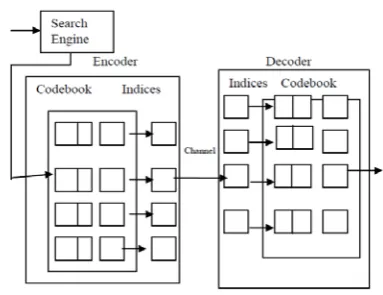
Vector Quantization (VQ) is a block-coding technique that quantizes blocks of data instead of single sample[6]. VQ exploits the relationship between neighboring signal samples by quantizing them together. VQ Compression contains two components: VQ encoder and decoder as displayed in Fig.2.
Figure 2. The Encoder and Decoder of Vector Quantization
[image:1.595.58.280.565.671.2]that has the least squared Euclidean distance from the input block.
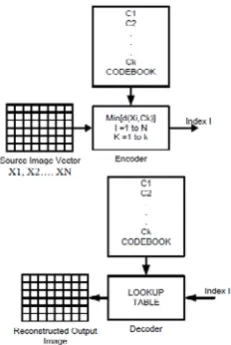
[image:2.595.105.221.182.355.2]Vector quantization is a conventional quantization technique for signal processing and image compression which allows the modeling of the prospect of density functions by the distribution of prototype vectors[6]. It works by dividing a large set of values (vectors) into groups having approximately the same number of points closest to them. Each group is signified by its centroid value, as in k-means algorithm and some other algorithms. The process of vector quantization is visually shown in Fig.3.
Figure 3. Basic Block Diagram of Vector Quantization
Various methods have been proposed using vector quantization method [7-11].
B. Particle Swarm Optimization(PSO)
Particle Swarm Optimization(PSO) is one of the efficient evolutionary computing algorithm. It is a nature inspired algorithm originally proposed by Kennedy and Eberhart. It is a population based stochastic optimization technique similar to the evolutionary computing Genetic Algorithm(GA).It is stochastic algorithm which produces the optimum solution space. The standard particle swarm optimization process is presented in Fig.4.
Figure 4. The Standard Particle Swarm Optimization
The above process represents a particle flying in the search space and moving towards the global optimum.
A particle in PSO can be defined as ϵ [a, b] where i=1, 2, 3… D and a, b ϵ R, D is for dimensions and R is for real numbers. Each particle has its own velocity and position which is randomly initialized in the start. Each particle have to
preserve its positions pbest known as local best position and the Gbest known as global best position among all the particles. Following equations are used to appraise the position and velocity of the particle. PSO have been effectively used across a wide range of applications, for example, Telecommunications, Combinatorial optimization, signal processing, Network training, System control, Data mining , Power systems design, and many other areas.
C. Related Work
This section presents a study of existing image compression methods based on Particle Swarm Optimization algorithm.
Andrew Stacey et al. [12]described about particle swarm optimization with mutation. The main advantage of mutation is speed up convergence and escape local minima. It compares the effectiveness of the basic particle swarm optimization scheme (BPSO) with each of BPSO with mutation, constriction particle swarm optimization (CPSO) with mutation, and CPSO without mutation. Alberto Moraglio and Julian Togelius [13] proposed an extension of Geometric Particle Swarm Optimization (GPSO), the inertial GPSO (IGPSO), that generalizes the traditional PSO endowed with the full equation of motion of particles to generic search spaces. Yongfang Chu and Zhihua Cui [14] developed an algorithm based on Neighborhood Sharing Particle Swarm Optimization which replaces the individual experience by the neighbor sharing information of current state and proposes the neighbourhood sharing particle swarm algorithm. Yanduo Zhang and Yunchang Zhu[15] proposed a modified centre particle swarm optimization algorithm which the tournament selection operator is introduced to select the evolved particles. James M. Hereford [16]described adistributed particle swarm optimization algorithm for swarm robotic applications which is used for “search” type operations and allows each robot to calculate its new position based on its present position and present measurement. Zhang Xiao-hua et al. [17] proposed a Intelligent Particle Swarm Optimization in Multi-objective Optimization which is based on AER (Agent-Environment-Rules) model. This is mainly used in competition operator and clone selection operator are designed to provide an appropriate selection pressure to propel the swarm population towards the Pareto-optimal front. Shuyuan Yang, Min Wang and Licheng Jiao [18] proposed a new discrete particle swarm optimization algorithm based on quantum individual. Yuhui Shi [19] described about a fuzzy system is implemented to dynamically adapt the inertia weight of the particle swarm optimization algorithm . A. Muruganandham and R.S.D. Wahida Banu [20] proposed a fast fractal encoding system using particle swarm optimization (PSO) to reduce the encoding time. Qian Chen et al. [21] proposed Particle Swarm Optimization (PSO) cluster method to build high quality codebook for compressing images. There are various methods have been proposed using PSO technique.
The rest of the paper organized as follows: Section II describes about the proposed work, Section III examines the results and discussion using various medical test images and finally, Section IV concludes the merits and demerits of the proposed work with future enhancement.
II. PROPOSEDMETHOD
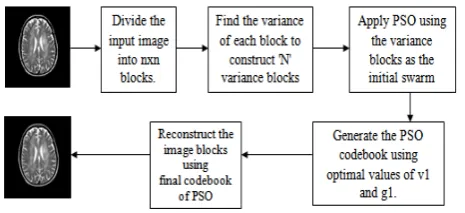
[image:2.595.52.255.535.685.2]stochastic optimization method. The proposed method is based on Particle Swarm Optimization(PSO) algorithm for compressing images with less computation complexity. PSO is used for generating the codebook in vector quantization. The input image is divided into nxn blocks which constitute the training set. To generate the codebook generally the initial cluster centers are chosen randomly. In the proposed method, blocks with high variance are chosen as the initial cluster centroids. The initial cluster centroids are taken as the initial particles for PSO. The fitness function is the minimization of Euclidean distance between each block and its respective cluster centroid. The algorithm then searches for optimal centroids through a series of iterations. During each iteration, the value of pbest and gbest are found out for updating the position and velocity of each particle, using (1).
(
1)
( )
1*1(
( )
)
2* 2(
( )
)
i i best i best i
V t+ =V t +C r P −n b +C r g −x t (1)
In normal PSO, r1 and r2 are random numbers in the range [0,1]. In the proposed method, the random values r1 and r2 are substituted with optimal values v1(0.1) and g1 as given in (3) which are found out through several trial.
g
1= +
v
12
(2)( )
1( )
1* 1(
( )
)
2* 1(
( )
)
i i best i best i
V t+ =V t +C v P −n b +C g g −x t (3)
This novel substitution has resulted in a huge PSNR gain of novel PSO over random method.
The algorithm of the proposed method is outlined as follows. Step 1: Divide the input image into n*n blocks. Step 2: Find the variance of each block. Step 3: Find ‘N’ blocks having high variance.
Step 4:Apply PSO with above ‘N’ blocks as the initial set of particles(swarm) and generate the PSO codebook using optimal values of v1 and g1.
Step 5: Repeat steps 1 to 4 for different block sizes.
A. Proposed Flow Diagram
The detailed process of the proposed method is pictorially represented in Figure 5.
Figure 5. Proposed Flow Diagram
III. RESULTS AND DISSCUSSION
The performance analysis of the proposed method has been examined by compressing five different medical images such as MRI_Brain, Mammogram Image, MRI_Knee, MRI_Spine and X-Ray Chest Image. The evaluation of the experimental
results using the compression performance metrics such as Peak Signal to Noise Ratio(PSNR), Compression Ratio(CR), Bit Rate(BR) and Computation Time(CT). Additionally, the proposed method is compared with similar existing methods which proves that the proposed method achieves high PSNR with an acceptable compression ratio.
The performance of the proposed method is compared with two algorithms standard PSO and K-means algorithm, in terms of standard compression metrics like Mean Square Error (MSE), Peak Signal to Noise Ratio (PSNR), Compression Ratio (CR), and Computation Time (CT).
Peak Signal Noise ratio (PSNR) - Peak Signal Noise Ratio(PSNR) is used to evaluate the quality between the compressed and the original image. Generally, it is measured in decibels using (4).
10 255 20 log
PSNR
MSE
= (4)
Structural Similarity (SSIM) - SSIM is an effective metric for measuring the image quality using mean, standard deviation and correlation of the pixels in the original image and the reconstructed image using (5)
(
2 2xy)(
x 2y 2)
x y x y
4
μ
σ
μ
Q
σ µ
σ
µ
=
(5)Compression Ratio(CR) - Compression Ratio finds the compressed range of the reconstructed image, which defines the achievement of compression by the proposed method.
Original Image size CR
Compressed Image Size
= (6)
Bit- Rate (BR) - Bit rate is used to find the minimum bits required for storing one pixel.
Original Image Size in Pixels Bpp
Total number of bits in Compressed image
= (7)
Computation Time (CT) - Computation time is used to evaluate the efficiency of the proposed method which could be minimal value.
[image:3.595.46.279.576.682.2]Experimental results are carried out on several test medical images with different dimension to evaluate the performance of standard PSO and proposed Novel MPSO. The performance of both the methods in terms of standard metrics is tabulated in Table I for different test medical images.
Table I. Performance Analysis of the Proposed Method
Image Quality Metrics Compression Metrics
PSNR SSIM CR BR
MRI_Brain 40.80 0.424 6.095 1.312 7.424
MRI_Knee 40.59 0.696 6.235 1.283 13.205
MRI_Spine 44.44 0.999 6.263 1.277 13.646 Mammogram 33.75 0.913 6.026 1.327 4.703
X-ray Image 36.77 0.997 6.052 1.321 5.569
Table I clearly reveals the superior performance of the proposed method yielding high PSNR values for medical test images. It is also obvious that the proposed method achieves a PSNR range between 33 and 44 , which is acceptable and good range for diagnosing the medical image.
The comparison of compression metrics of proposed method and standard methods are depicted in Table II.
TableII. Comparative Analysis between the Proposed and Existing Methods[22]
Methods File Size CR MSE PSNR
SBC 507540 0.9982 4.7579 41.3566
LDT 507544 0.9966 0.0395 62.1626
SVD 507544 0.9966 26.5623 33.8882
DCT 507544 0.9966 33.3463 32.9003
SPHIT 507540 0.9982 6.1109 40.2698
NN 507544 0.9966 12.4824 37.1678
VQ 507408 0.9984 45.7102 31.5307
BTC 507452 0.9983 11.961 37.3531
Proposed Method (MPSO)
[image:4.595.31.281.54.183.2]524288 6.0952 5.451 40.800
Table II shows that the proposed method outperforms standard methods yielding high Compression Ratio and PSNR [21]. Thus, the proposed method is an ideal choice for effective storage and transmission of medical images without compromise in the quality.
The comparative analysis of the proposed and existing method is graphically represented in Fig.6.
0 5 10 15 20 25 30 35 40 45 50 55 60 65 70
SBC LDT SVD DC
T
SP
H
IT NN VQ BTC
M
PS
O
PS
NR &
C
R
Method
CR PSNR
Figure 6. Comparative Analysis between the Proposed and Existing Methods
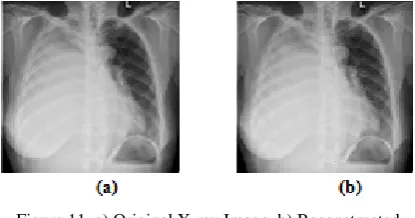
The proposed method is tested using five different medical test images such as MRI_Brain, MRI_Knee, MRI_Spine, Mammogram Image and X-ray Image. The performance of proposed method is visually represented in Fig.7,8,9,10 and 11. This results shows the quality of the reconstructed image using (MPSO) proposed method over the input image.
Figure 7. a) Original MRI_Brain Image, b) Reconstructed MRI_Brain Image using proposed method
Figure 8. a) Original MRI_Knee Image, b) Reconstructed MRI_Knee Image using proposed method
[image:4.595.310.523.57.196.2] [image:4.595.29.290.326.507.2] [image:4.595.332.532.487.604.2] [image:4.595.331.536.634.752.2]Figure 10. a) Original MRI_Spine Image, b) Reconstructed MRI_Spine Image using proposed method
Figure 11. a) Original X-ray Image, b) Reconstructed X-ray Image using proposed method
IV. CONCLUSIONS
In this paper, a Novel Approach of Particle Swarm Optimization has been proposed for compressing medical images. Experimental results have demonstrated superior performance of the proposed method over similar algorithms. The proposed method would be a good choice for compressing medical and biometric images where high image quality is mandatory.
V. ACKNOWLEDGEMENT
I express my sincere thanks to my supervisor Dr. M.Mary Shanthi Rani for her constant support to all my endeavor and complete this paper successfully. I dedicate my thanks to UGC-RGNF who have supporting my research work through their fund.
VI. REFERENCES
[1] K.Somasundaram and M. Mary Shanthi Rani, “Novel K-means algorithm for compressing images”, International Journal of Computer Applications, 18(8), pp. 9-13 , 2011.
[2] K.Somasundaram and M.Mary Shanthi Rani, “Eigen Value based K-means Clustering for Image Compression”, International Journal of Applied Information Systems (IJAIS) ,Foundation of Computer Science (FCS), New York, USA, 3(7), 2012.
[3] M.Mary Shanthi Rani, “A Genetic Algorithm Based K-Means Algorithm For Compressing Images”, International Journal Of Engineering And Computer Science ISSN: 2319-7242,Volume 4 Issue 9 Sep 2015, Page No. 14359-14362
[4] A. Alarabeyyat , S. Al-Hashemi , T. Khdour , M. Hjouj Btoush, S. Bani-Ahmad and R. Al-Hashemi, “Lossless Image Compression Technique Using Combination Methods”, Journal of Software Engineering and Applications,5, pp.752-763, 2012.
[5] Manjari Singh, “Various Image Compression Techniques: Lossy and Lossless”, International Journal of Computer Applications , 142(6) , pp. 0975 – 8887, 2016.
[6] Prarthana Bhattacharyya, Aritra Mitra and Amitava Chatterjee, “Vector Quantization based Image Compression using Generalized Improved Fuzzy Clustering”, International Conference on Control, Instrumentation, Energy & Communication(CIEC), pp. 662-666, 2014.
[7] M.Mary Shanthi Rani, “Adaptive Classified Pattern Matching Vector Quantization Approach for compressing images”, The 2009 International Conference on Image Processing, Computer Vision & Pattern Recognition Proceedings, Las Vegas, USA., pp.532-538, 2009.
[8] M.Mary Shanthi Rani and P.Chitra, “Region of Interest based Compression of Medical Images using Vector Quantization”, International Journal of Computational Science and Information Technology (IJCSITY), 4, pp.29-37, 2016.
[9] M. Mary Shanthi Rani and P. Chitra, “Novel Hybrid Method of Haar-Wavelet and Residual Vector Quantization for Compressing Medical Images”, 2016 IEEE Conference on Advances in Computer Applications(ICACA), organized by Bharathiyar University, Coimbatore, 1,pp.321-326, 2016. [10] M. Mary Shanthi Rani, “Mode Based K-Means Algorithm with
Residual Vector Quantization for Compressing Images”, International Conference on “Control, Computation and Information Systems” (Springer-Verlag CCIS 140), pp.105-112, 2011.
[11] M.Mary Shanthi Rani, “Residual Vector Quantization Based Iris Image Compression”, International Journal of Computational Intelligence Studies, Inderscience Publishers, 3(4), pp.329-334, 2014.
[12] Andrew Stacey, Mirjana Jancic and Ian Grundy, “Particle Swarm Optimization with Mutation”, IEEE, pp. 1425-1430,2003.
[13] Alberto Moraglio and Julian Togelius, “Inertial Geometric Particle Swarm Optimization”, IEEE Congress on Evolutionary Computation (CEC 2009), IEEE, pp.1974-1980,2009.
[14] Yongfang Chu and Zhihua Cui, “Neighborhood Sharing Particle Swarm Optimization”, Proc. 8th IEEE Int. Conf. on Cognitive Informatics, IEEE, pp.521-526,2009.
[15] Yanduo Zhang and Yunchang Zhu, “A Modified Centre Particle Swarm Optimization Algorithm”, Proceedings of the 7th World Congress on Intelligent Control and Automation, Chongqing, China, IEEE, pp. 6164-6167, 2008.
[16] James M. Hereford, “A Distributed Particle Swarm Optimization Algorithm for Swarm Robotic Applications”, IEEE Congress on Evolutionary Computation, Canada, pp. 1678-1685,2006. [17] Zhang Xiao-hua, Meng Hong-yun, Jiao Li -cheng, “Intelligent
Particle Swarm Optimization in Multi-objective Optimization”, IEEE, pp. 714-719, 2005.
[18] Shuyuan Yang, Min Wang and Licheng Jiao, “A Quantum Particle Swarm Optimization”, IEEE, pp.320-324, 2004.
[19] Yuhui Shi and Russell C. Eberhart, “Fuzzy Adaptive Particle Swarm Optimization”,IEEE, pp. 101-106, 2001.
[20] A.Muruganandham, R.S.D. Wahida Banu, “Adaptive Fractal Image Compression using PSO”, Procedia Computer Science, Elsevier, 2, pp.338–344, 2010.
[21] Qian Chen, Jiangang Yang, and Jin Gou, “Image Compression Method Using Improved PSO Vector Quantization”, ICNC, @Springer-Verlag Berlin Heidelberg, pp. 490 – 495, 2005. [22] J. Papitha, G. Merlin Nancy and D. Nedumaran, “Compression
[image:5.595.58.266.220.329.2]