Volume 4, No. 2, Jan-Feb 2013
International Journal of Advanced Research in Computer Science
RESEARCH PAPER
Available Online at www.ijarcs.info
ISSN No. 0976-5697
Some Steganographic Techniques using Bit Plane Slicing with their Embedding capacity
H. Faheem Ahmed
Department of Computer Science
Islamiah College, Vaniyambadi Tamil Nadu, India [email protected]
U. Rizwan*
Department of Mathematics
Islamiah College, Vaniyambadi Tamil Nadu, India [email protected]
Abstract: In this paper, a new steganographic technique using the bit plane slicing is proposed. The actual image and the data embedded
stego-images using the techniques are given. The Mean Square Error (MSE) and Peak to Signal Noise Ratio (PSNR) values have been determined. Histograms for the computed values of MSE and PSNR indices and embedding capacity are drawn.
Keywords: Steganography, MSE, PSNR, LSB, Bit Planes.
I. INTRODUCTION
Gray scale images can be transformed into a sequence of binary images by breaking them up into their bit-planes. If we consider the grey value of each pixel of an bit image as an 8-bit binary word, then the 0th 8-bit plane consists of the last 8-bit of each grey value. Since this bit has the least effect in terms of the magnitude of the value, it is called the least significant bit, and the plane consisting of those bits the least significant bit plane. Similarly the 7th bit plane consists of the first bit in each value. This bit has the greatest effect in terms of the magnitude of the value, so it is called the most significant bit and the plane consisting of those bits the most significant bit plane.
Faheem Ahmed and Rizwan [2] have introduced a new concept in data embedding. The authors have embedded text message and digital image in audio files. They have also presented a technique for embedding text message and/or digital image in another image. A lot of examples have been presented. Fridrich etal. [3] have studied quantitative stegnanalysis of digital images. They have estimated the length of the secret message. Rizwan and Faheem Ahmed [5] have made a comprehensive study on various types of steganographic schemes. Faheem Ahmed and Rizwan [6] have introduced and studied seven different steganographic techniques applying randomization concept. They have also computed the MSE and PSNR indices for these techniques. Structural similarity indices have also been determined.
Let A be the 5x7 image.
167 133 111 210 34 56 78 211
87 144 140 135 44 88 34 123
A = 159 154 148 87 45 88 12 242
34 89 77 123 87 36 90 91
78 123 98 156 189 187 20 201 The image A in its binary equivalent is
Let the message to be embedded is Hello Welcome to Steganography
If 1st bit (LSB) position of each element in each row is used we can embed 5 characters Hello. Then matrix A becomes
166 133 110 210 35 56 78 210 86 145 141 134 44 89 34 123
158 155 149 86 45 89 12 242
34 89 77 122 87 37 90 90
78 123 99 156 189 187 21 201
If 1st bit (LSB) and 2nd bit positions of each element in each row are used we can embed 10 characters Hello Welc. Then matrix A becomes
164 133 110 208 33 56 76 208 84 147 141 134 44 91 34 123
156 155 151 84 45 91 12 242
32 91 79 120 87 39 88 88
76 123 99 156 189 185 23 203
If 1st bit (LSB), 2nd bit and 3rd bit positions of each element in each row are used we can embed 15 characters Hello Welcome t. Then matrix A becomes
160 133 110 208 37 60 76 212 80 151 141 130 44 95 34 127
152 159 151 80 41 95 8 246
32 91 79 120 83 35 88 88
72 127 103 156 185 189 19 203
If 1st bit (LSB), 2nd bit and 3rd bit ,4th bit positions of each element in each row are used we can embed 20 characters Hello Welcome to Ste. Then matrix A becomes
160 141 110 208 45 60 76 220 80 151 141 130 36 87 34 119
144 159 151 88 33 87 8 254
32 91 79 120 83 43 80 80
If 1st bit (LSB), 2nd bit and 3rd bit ,4th bit,5th bit positions of each element in each row are used we can embed 25 characters Hello Welcome to Steganog. Then matrix A becomes
160 157 126 192 45 60 92 220 64 151 157 130 36 71 34 119
128 159 151 72 49 87 24 238
32 91 91 104 83 59 80 80
64 127 127 132 161 189 19 219 and so on.
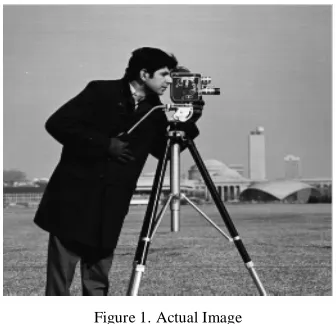
[image:2.612.78.246.206.368.2]We use the cameraman.tif 256 x 256 gray scale image shown in fig 1.
Figure 1. Actual Image
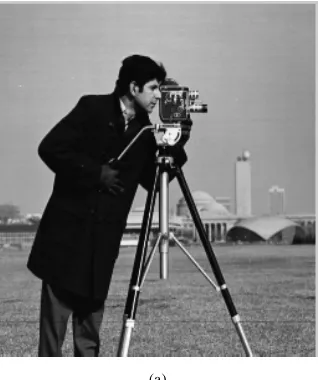
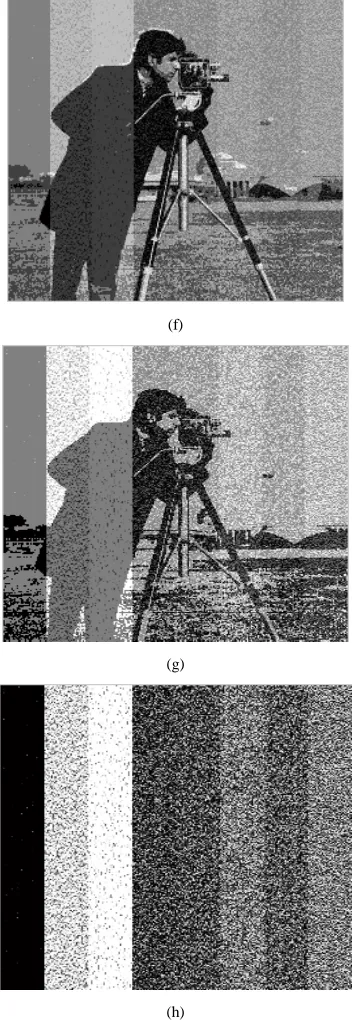
The actual image in figure 1, is sliced into 8 distinct figures in their bit planes 0 to 7 and are shown in figures 2 (a) to (h).
(a)
(b)
(c)
(d)
(e)
(g)
[image:3.612.83.242.544.734.2](h)
Figure 2. The bit planes of an 8-bit greyscale image. (a) Bit 0 (LSB), (b) Bit-1, (c) Bit-2 ,(d) Bit-3, (e) Bit-4, (f) Bit-5, (g) Bit-6, (h) Bit(7)(MSB)
Now we take a 256 x 256 gray scale cameraman.tif image and shall embed using each bit planes. The resulting figure with number of characters embedded in each bit plane is given in figures 3 (a) to (h).
(a)
(b)
(c)
(d)
(f)
(g)
[image:4.612.74.251.62.572.2](h)
Figure 3. The bit planes of an 8-bit greyscale image after embedding text. (a) Bit 0 (LSB), (b) Bit-1, (c) Bit-2 ,(d) Bit-3, (e) Bit-4, (f) Bit-5, (g) Bit-6, (h)
Bit(7) (MSB)
The Peak Signal to Noise Ratio (PSNR), Mean Square Error (MSE) are performance parameters to measure the quality of image.[6]
a. MSE: It is defined as square of error between cover stego-image. The error indicates the distortion in an image.MSE can be calculated by using two dimensional mathematical equation described as follows:
where Xij = the value of pixel in cover image and =the value of pixel in stego-image and N is the size of image.
b. PSNR: It is a measure of quality of image. PSNR can be
[image:4.612.333.568.166.347.2]calculated by using the mathematical formula given below:
Table 1. The computed values of PSNR , MSE and Embedded capacity
S.No Number of Bits Used
PSNR MSE Embedded Capacity
1. 1st Bit (LSB) 54.50900 0.23024 8192
2. 1st , 2nd Bits 47.10310 1.26698 16384
3. 1st ,2nd , 3rd Bits 40.65414 5.59328 24576
4. 1st ,2nd ,3rd, 4th Bits 34.94929 20.80423 32768
5. 1st ,2nd ,3rd, 4th ,
5th Bits
29.89638 66.59515 40960
6. 1st ,2nd ,3rd, 4th ,5th
, 6th Bits
28.79762 85.76668 49152
7. 1st ,2nd ,3rd, 4th,5th
,6th, 7thBits
27.09164 127.03297 57344
8. 1st ,2nd ,3rd, 4th,5th ,
6th, 7th,8th
(MSB)Bits
27.74600 109.26486 65536
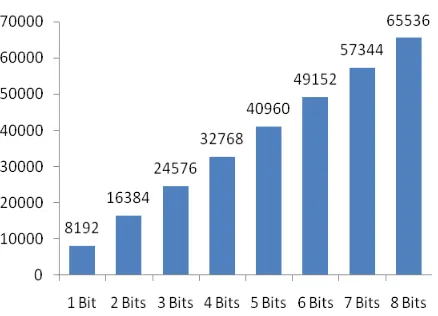
The histograms for the computed values of PSNR and MSE indices and embedding capacity for each of the bit planes are presented in figure 4.
PSNR Values
MSE Values
Figure 4. Histograms for PSNR, MSE indices and embedding capacity
II. CONCLUSION
In this article, a new steganographic technique using the bit plane slicing is introduced and studied. Considering the cameraman.tif image in 256 x 256 gray scale, the data embedded stego-images using the proposed technique of slicing the 8 different bit planes are shown explicitly. The MSE and PSNR indices with their respective maximum embedding capacity are presented. Statistical analysis has been carried out.
III. REFERENCES
[1] Cachin. C., An information-theoretic model for steganography, Information and Computation, Vol. 192 (1), Ed. Academic, USA, pp. 41 – 56, 2004.
[2] Faheem Ahmed, H and Rizwan. U, An Alternative Technique in Data Embedding, Advanced Materials in Physics, pp 233 – 242, 2012
[3] Fridrich, J, M. Goljan, D. Hogea and D. Soukal, Quantitative steganalysis of digital images: estimating the secret message length, Multimedia Systems Journal - Special issue on Multimedia Security, Vol. 9 (3), pp. 288 – 302, 2003.
[4] Rafael Gonzalez and Richard E. Woods, Digital Image Processing, Addison-Wesley, second edition, 2002.
[5] Rizwan. U and Faheem Ahmed. H, Comprehensive study on various types of steganographic schemes and possible steganalysis methods for various cover carrier like image, text, audio and video, International Journal of Scientific and Engineering Research, Volume 3 (11), November 2012, pp 151 – 154.
[6] Rizwan. U and Faheem Ahmed. H, A New Approach in Steganography using different Algorithms and Applying Randomization Concept, International Journal of Advanced Research in Computer and Communication Engineering, Vol.1
(9), November 2012, pp 233 – 242.
Short Bio Data for the Author
H. Faheem Ahmed earned his M.Tech. degree in Information Technology from Punjabi University and M.Phil. degree course in Computer Science from Manonmaniam Sundaranar University. He is pursuing Ph.D. in Computer Science. He has guided 50 M.Phil. research scholars in Computer Science. He is currently the Head of the Department of Computer Science and Applications, Islamiah College, Vaniyambadi and is serving the institution for the past 28 years. His research interest includes Steganography and Image processing. He has published 8 research articles and authored one book.