Jari Bj¨orne1, Filip Ginter1, Juho Heimonen2, Sampo Pyysalo3 and Tapio Salakoski1,2 1Department of IT, University of Turku
2Turku Centre for Computer Science (TUCS)
Joukahaisenkatu 3-5, 20520 Turku, Finland [email protected]
3Department of Computer Science, University of Tokyo
7-3-1 Hongo, Bunkyo-ku, 113-0033 Tokyo, Japan [email protected]
Abstract
While the overwhelming majority of infor-mation extraction efforts in the biomedical domain have focused on the extraction of simple binary interactions between named entity pairs, some recently published cor-pora provide complex, nested and typed event annotations that aim to accurately capture the diversity of biological rela-tionships. We present the first machine learning approach for extracting such re-lationships, utilizing both a graph kernel and a novel, task-specific feature set. We show that relationships can be predicted with 77% F-score, or 83% if their type and direction is disregarded. Using both gold standard and generated parses, we determine the impact of parsing on ex-traction performance. Finally, we convert our predicted complex relationships to bi-nary interactions, recovering bibi-nary anno-tation with 62% F-score, relating the new method to the large body of work available on binary interactions.
1 Introduction
The previous decade has brought about an ever-increasing interest in the application of natural language processing methods to address informa-tion overload challenges in the biomedical domain (see, e.g., the recent review by Zweigenbaum et al. (2007)). Most domain information extraction (IE) efforts have focused on relationships between biologically interesting molecules. Among these, the most prominent IE target are protein-protein interactions (PPIs). The overwhelming majority of proposed approaches cast the task as determin-ing which pairs of co-occurrdetermin-ing entities are re-lated (binary interactions). Many methods fur-ther specify the nature of these relationships by
assigning them types or specifying the roles (e.g. agent/patient) that the entities play. While this extraction model has supported considerable ad-vances in biomedical IE and has served as the basis for real-world applications for e.g. assisted database curation (Alex et al., 2008), its limita-tions, such as the restriction to events between en-tity pairs commonly referred to as binary interac-tions in the domain literature, are increasingly rec-ognized by the biomedical NLP community. In this paper, we argue for an alternate model and present the first machine-learning approach to the extraction of structured, complex events and rela-tionships among bioentities.
Protein
Figure 1: A.An example sentence that shows the dependency parse and the relationship graph, whose edges we aim to predict.B.Relationship edges can exist between any of the annotated entities and events. For each pair, there can be one undirected or two directed relationships.
In this paper we first introduce the corpora used and their conversion to examples usable for ma-chine learning, then the criteria used for evaluating the system followed by our results. The distinct task of binarization is discussed in its own section. Finally we provide an overview of the related work in this field followed by conclusions.
2 Methods
2.1 Corpora and the Extraction Task
BioInfer consists of 1100 sentences with both se-mantic and syntactic annotation. For GENIA, we use the 1968 sentence intersection of the GENIA Treebank (syntactic annotation) and GENIA Event corpus (semantic annotation). For developing our system, we used half of each corpus. The other half alone was used for the final experiments to avoid overfitting our system to the data.
In order to use the two corpora for IE, their an-notations have to be cast in a single, consistent representation (Figure 1A). Here we follow Bj¨orne et al. (2008) and Heimonen et al. (2008) in repre-senting the semantic annotations as graphs whose nodes correspond to entities and events, and la-beled directed edges to their relationships. The relationship edges describethemesand causesof events, structural relations between physical enti-ties such assubstructure and also non-biological relations such as coreferences. These graphs cap-ture the several distinct forms of annotation in the corpora in a unified, yet expressive format.
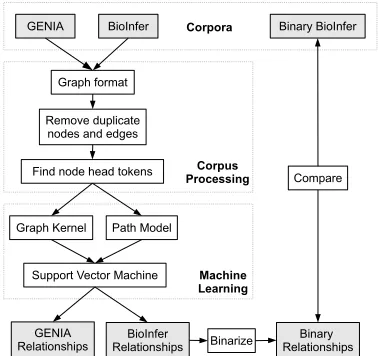
The corpora are further processed for our IE task (Figure 2). All entities and events must be represented by a trigger in the text, a constraint im-posed to assure that they can be recognized using regular text tagging methods. Some event nodes, like the semantic equality in actin A (ActA) that
GENIA BioInfer
Graph format
Remove duplicate nodes and edges
Find node head tokens
Graph Kernel
Figure 2: Outline of the experiments. Corpora are converted to a shared graph representation from which the edges are learned. Binarization of pre-dicted BioInfer relationships allows comparison with a binary version of the corpus.
defines a relationship between actin A and ActA do not have an explicit trigger word. This type of node and its participant edges are collapsed into an equivalent relationship edge.
resembles the relationship graph. Roughly 60% of BioInfer and GENIA relationship edges corre-spond to a single dependency (Bj¨orne et al., 2008). While the nodes of the dependency graph are tokens, the nodes of the relationship graph are en-tities and events whose triggers can span multi-ple tokens. To align the graphs, the trigger of each entity or event is associated with one token, its semantic head. This mapping produces a text-bound semantic graph representation (relationship graph) that is largely equivalent in information content to the original corpus annotations.
We note that multiple entities or events can oc-casionally have the same trigger. Since IE systems start from a trigger, producing multiple events or entities of the same type is a non-trivial task which is outside the scope of this study. We repre-sent these cases with one node in the relationship graph. Especially in the case of events, this can lead to some loss of information. In situations like A and B bind C and D, respectively, there are two distinct events with the same triggerbind.
To summarize, we cast our IE task as one of generating the edges of the relationship graph (Figure 1B) given its nodes, i.e. events and enti-ties. Here we follow the standard division of IE research into identification of entities and subse-quent extraction of their relationships, focusing on the subtask of relationship extraction. This defi-nition was chosen as it most resembles the related task of extracting binary protein-protein interac-tions, which can be viewed as a special case of re-lationship edges. This allows the straightforward application of already existing methods.
Note that both GENIA and BioInfer only an-notate events with explicitly stated participants. Therefore an event with no participants in the rel-evant span of text (a sentence in BioInfer and a document in GENIA) are not annotated and thus will not be considered for potential relationships.
We perform two main information extraction experiments. First, we extractuntyped undirected relationships, i.e. detect whether a pair of nodes has a relationship of any type or direction. Second, we extracttyped directedrelationships, where we determine if two nodes have a relationship, in which direction it is defined, and what its type is.
2.2 Defining examples
If a single pair has several relationships of the same direction but different types , these would
re-sult in identical examples. To be able to use stan-dard classifiers that give one classification per ex-ample, we merge the types of such examples into one compound type. As seen in Tables 2 and 3 this is extremely rare. We define one example per pair per direction for the typed directed task and one example per pair for the untyped undirected task (Figure 1B). Pairs with an annotated relationship are the positive examples and, as per the closed world assumption, those with no relationship are the negative examples.
For machine learning, each example is repre-sented as a set of features. We compare two fea-ture generation methods (Figure 2). The graph kernel was chosen as we represent the complex relationships in a graph format. For an overview of this recent state-of-the-art method and its use in the extraction of binary interactions we refer to Airola et al. (2008) and Miwa et al. (2008). Since the graph kernel has high memory and process-ing time requirements, we also developed a new, smaller feature set specifically targeting complex relationships.
2.3 Path Model
The Path Model feature set was developed to be highly specific for the extraction of complex re-lationships. For each pair of nodes, a number of features are generated. Most of these are based on the shortest path in the syntactic dependency graph (Figure 1A). While the graph kernel uses weights to emphasize tokens and dependencies on the shortest path, our path model aims to capture their relations explicitly.
The shortest path is defined as the shortest undi-rected path in the dependency graph that connects the head tokens of the two nodes (entities/events) of the example pair. Since multiple paths can exist between tokens in the Stanford dependency scheme, there can be several shortest paths. In such cases, all of them are used to generate fea-tures. If no path exists, only the head tokens of the node pair are used for generating features.
place-holder to prevent the system from making predic-tions based on the frequency of relapredic-tionships be-tween specific names. The attributes of a depen-dency are its type (e.g.subject) and direction rel-ative to its surrounding dependencies. Unless oth-erwise stated, all features are binary, that is, they have a value of1or0(present/absent).
N-grams For each shortest path, a number ofn -grams are generated by merging the attributes of 2-4 consecutive tokens. Similarly,n-grams are built from the types and directions of consecutive de-pendencies. For each token (resp. dependency), an additional 3-gram merging its attributes with the attributes of its two flanking dependencies (resp. tokens) is defined. Finally, a 2-gram is defined for each pair of consecutive tokens, arranged in the or-der of their governor-dependent relationship. All of thesen-grams aim to explicitly state the struc-tural relations that the graph kernel defines only indirectly.
Hanging Dependency Features Tokens imme-diately outside the path connected by dependen-cies to the terminal tokens of the path contain in-formation about the context of the two nodes of the example pair. These dependencies ”hanging” at the ends of the path are used to define features, as are the tokens they link to.
Individual Component Features For all of the tokens and dependencies on the shortest paths, features are also defined based only on their at-tributes in isolation of their context. Tokens within the triggers of the two nodes of the example pair are tagged to explicitly state this role. Additional features are defined for each token stating its po-sition at either the terminus or the interior of the path.
Frequency Features The number of tokens in the shortest path is defined as the value of the length-feature, as well as explicitly as alength n feature. The number of occurrences of each en-tity/event type (such asproteinorbind) in the sen-tence are defined as values of specific features.
Relationship Graph Node Features For the two nodes of each example, features are defined from the combination of their categories (entityor event) as well as their types (such as protein or bind). If the triggers of both nodes have the same head token, a feature is defined explicitly repre-senting this potential self-loop.
2.4 Machine Learning
For classification, we use the support vector ma-chine as implemented in SVMlight (for the un-typed undirected task) and SVMmulticlass(for the typed directed task) by Joachims (1999). All experiments are performed using ten-fold cross-validation. Examples are divided into ten sets on the basis of articles, avoiding the information leak between training and testing described by Sætre et al. (2007). For each of the ten folds, the classifier is trained on the union of eight of the sets. One set is used for a grid search for the optimal SVM regularization parameterC and the remaining set is the test set, separating parameter selection from testing.
2.5 Evaluation Criteria
We use two measures to evaluate our results: the standard F-score metric (the harmonic mean of precision and recall) and AUC.
F-score is a common metric for evaluating rela-tionship extraction, but is sensitive to the class dis-tribution of the data. For binary classification (un-typed undirected relationships), the true/false pos-itives/negatives from which F-score is calculated are easily defined. For multiclass classification (typed directed relationships), we have a negative class (i.e. no relationship) and a number of posi-tive classes (the relationship types). F-scores are micro-averaged to take into account the number of instances in each class. For the micro-average, correctly classified non-negative examples are true positives, examples incorrectly classified as in-stances of a non-negative class are false positives and non-negative examples incorrectly classified as negatives are false negatives.
AUC, or area under the receiver operating char-acteristic curve, is a class distribution invariant bi-nary performance measure (Hanley and McNeil, 1982). This and other advantages have led to AUC becoming widely adopted in machine learning.
3 Results and Discussion
untyped undirected typed directed
corpus parse features P R F AUC P R F
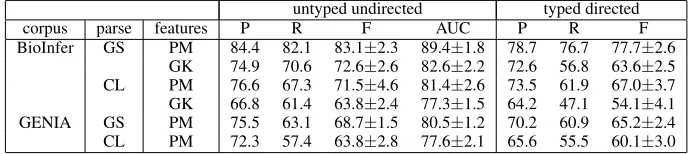
BioInfer GS PM 84.4 82.1 83.1±2.3 89.4±1.8 78.7 76.7 77.7±2.6 GK 74.9 70.6 72.6±2.6 82.6±2.2 72.6 56.8 63.6±2.5 CL PM 76.6 67.3 71.5±4.6 81.4±2.6 73.5 61.9 67.0±3.7 GK 66.8 61.4 63.8±2.4 77.3±1.5 64.2 47.1 54.1±4.1 GENIA GS PM 75.5 63.1 68.7±1.5 80.5±1.2 70.2 60.9 65.2±2.4 CL PM 72.3 57.4 63.8±2.8 77.6±2.1 65.6 55.5 60.1±3.0
Table 1: Performance of relationship extraction using gold standard (GS) and Charniak-Lease (CL) parses. Examples are classified based on either the path model (PM) or features produced by the graph-kernel (GK). (P)recision, (R)ecall, (F)-score and AUC are shown with standard deviations for F and AUC. For thetyped directedtask, all scores are micro-averaged. The all-positive baseline F-score for the untyped undirectedtask is 31% for BioInfer and 17.1% for GENIA.
by the Charniak-Lease parser (71% on BioInfer), showing the extent to which the parser limits ex-traction performance.
The path model outperforms the graph kernel for both untyped undirected and typed directed ex-traction. Despite weighting the shortest path, the graph kernel produces features from the entire sen-tence for each example, thus resulting in a large number of potentially misleading features. The graph kernel also lacks all explicitn-grams of the path model. Due to its excessive computational re-quirements, we only apply the graph kernel to the smaller BioInfer dataset.
Predicting types and directions turns the prob-lem into a multi-class classification task. The micro-averages in Table 1 show that this does not notably decrease performance. Compared to the untyped undirected task, F-scores are 3-6 percent-age points lower with the path model and 9-10 per-centage points lower with the graph kernel. This relatively small difference is promising for future work, as type and direction are important for defin-ing meandefin-ingful complex relationships.
Information extraction performance for individ-ual BioInfer relationship edge types is shown in Table 2. Promisingly the most important group for defining biologically interesting relationships, the event-group, shows high precision and recall for all of its types. Many static relationships, e.g. edges of typeidentity,possessorandsub (we re-fer to Heimonen (2008) for definitions) can be ex-tracted with even higher reliability, perhaps due in part to a close correspondence to specific syntactic structures, such as prepositional phrases. On the other hand, edges representing complex syntactic structures, such as coreferences (corefer) are re-covered with lower accuracy, as can be expected since coreference resolution is best addressed
us-group type count P R F
event participant 836 80.0 77.2 78.6 patient 655 79.7 77.4 78.5
agent 428 75.5 66.8 70.9
static identity 289 86.5 88.9 87.7
sub 134 85.5 79.1 82.2
possessor 119 83.2 83.2 83.2 member 105 64.8 43.8 52.3
super 59 78.2 72.9 75.4
nesting 20 66.7 50.0 57.1 non-biol. equal 120 60.5 60.0 60.3 corefer 66 55.6 22.7 32.3
rel-ent 22 0.0 0.0 0.0
merged contain+sub 20 0.0 0.0 0.0
member+agent 3 0.0 0.0 0.0
agent+patient 3 0.0 0.0 0.0 f-contain+sub 2 0.0 0.0 0.0
Table 2: Per-type results of extraction oftyped di-rectedrelationships from BioInfer using gold stan-dard parses and the path model. Count shows the number of examples of a given type from a total of 31674 including negatives.
ing a specialized method. Merged edges are a re-sult of having one edge per pair of nodes per di-rection (see Section 2.2). These very rare cases are not recovered by the learning-based approach. Performance per GENIA edge type is shown in Table 3. Non-biological relationships, such as coreferences, are syntactically diverse struc-tures and have unsurprisingly a low performance. Causeand themetypes define the participants of events and roughly correspond to the agent and patienttypes of BioInfer, respectively. The partic-ipanttype of BioInfer describes relationships that can be thought of as eitheragentorpatient. GE-NIA uses thethemetype for such cases.
group type count P R F
event theme 3164 73.6 65.1 69.1
cause 1202 65.3 54.7 59.5 non-biol. coref 252 51.2 25.4 34.0 scatter 169 40.0 17.8 24.6 merged cause+theme 1 0.0 0.0 0.0
Table 3: Per-type results of extraction oftyped di-rectedrelationships from GENIA using gold stan-dard parses and the path model. Count shows the number of examples of a given type from a total of 104198 including negatives.
Profilin
actin
cofilin
causes
bind
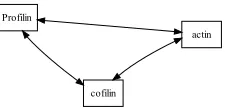
Figure 3: Untyped undirected binary relation-ships. Compare with Figure 1B. In this example, all possible binary relationships exist.
positive/negative ratio is about 0.03. The most common BioInfer type,participant, has 836 pos-itives vs. 30838 negatives (Table 2). For GENIA, the most common type,theme, has 3164 positives vs. 101034 negatives (Table 3).
We tested the impact of the feature groups de-fined in Section 2.3 by disabling one group at a time. F-score decreased at most less than 2 per-centage points, indicating a substantial overlap of information between the groups. We also tried defining the features without entity/event types, which reduced F-score by 4.4 percentage points, indicating that this information is important but not critical for the system.
4 Binarization
The prevailing approach in the domain is to ex-tract binary interactions, that is, relationships re-stricted to occurring between pairs of physical en-tities (most often proteins). To compare the perfor-mance of the proposed approach to these existing extraction systems, the semantically rich relation-ship graphs must be reduced into a less-expressive, binarized form. Examples of binary relationships are shown in Figure 3.
The transformation from a complex to a binary relationship graph has been shown to be possible for BioInfer (Heimonen et al., 2008). This bina-rization process aims to express as binary relation-ships the biologically relevant information present
corpus parse P R F
BioInfer GS 74.2 53.7 62.3 CL 70.7 42.9 53.4
Table 4: Performance of binary relationship ex-traction measured against the binarized gold stan-dard BioInfer relationship annotation for which the F-score of the all-positive baseline is 40.8%.
in complex relationships, while minimizing the in-evitable loss of information. Consider, for exam-ple, the sentencePhosphorylation of cofilin reg-ulates actin polymerization, which expresses the eventsregulation, phosphorylation and polymer-izationamong the proteinscofilinandactin. It can be summarized with a binary relationship regula-tionwhile the information regarding phosphoryla-tionandpolymerizationis lost.
The predicted typed directed complex relation-ship graphs for BioInfer were binarized using the software of Heimonen et al. (2008). The out-put was evaluated against the binarized gold stan-dard BioInfer relationship annotation. To compare with previously published results on this dataset, we treat the relationships as untyped undirected. The results of the evaluation are presented in Ta-ble 4. The F-score of 53.4% for the Charniak-Lease parsed data should be related to the F-score of 61.3% reported by Airola et al. (2008). This difference can be partly explained by the fact that the binarizer was developed for hand-annotated data rather than noisy, automatically generated data. Also, the precision of 70.7% suggests that complex relationships recovered by the system to the point that they could be binarized were often correct. We have thus shown that the output of an IE system targeting complex relationship graphs can be binarized, although this process currently results in lower performance than extraction meth-ods directly targeting binary interactions.
5 Related Work
Extraction of protein relationships is a key task in biomedical NLP, and has been widely studied in the simple setting of recognizing pairs of re-lated co-occurring entities. The problem has been considered in recent shared tasks (Ned´ellec, 2005; Krallinger et al., 2008) as well as in dozens of studies employing a variety of different corpora for training and evaluation (Pyysalo et al., 2008).
make use of dependency representations of syntax (Kim et al., 2008b; Miwa et al., 2008), including the Stanford dependency representation (Airola et al., 2008; Van Landeghem et al., 2008; Katrenko and Adriaans, 2008). Many of the features we ap-ply are standard in relation extraction studies; for a recent study of “ACE-style” feature sets see the study by Buyko et al. (2008).
By contrast to the wealth of IE studies focus-ing on pairs of related entities, has received much less attention. While hand-written systems capa-ble of extracting structured events (Friedman et al., 2001) have been proposed, the present study is to the best of our knowledge the first to consider the task of learning to extract events as represented in the BioInfer and GENIA corpora. Further, while task settings similar to ours have been widely con-sidered in the MUC and ACE evaluations and part of the task setting shares many characteristics with semantic role labeling as considered e.g. in the re-cent CoNLL evaluation (Surdeanu et al., 2008), meaningful comparison across domains and re-sources would be difficult to establish. In relating our results to those of previously proposed meth-ods, we will thus only consider biomedical rela-tionship extraction results as they relate to our re-sults for binarized relation extraction.
Due to the difficulty of meaningful comparison of reported results across different corpora (Airola et al., 2008; Van Landeghem et al., 2008), we will consider our results in comparison with recently proposed methods evaluated on the AIMed cor-pus (Bunescu et al., 2005), which is frequently used in domain studies (Bunescu et al., 2005; Giu-liano et al., 2006; Airola et al., 2008; Van Lan-deghem et al., 2008; Miyao et al., 2008; Miwa et al., 2008) and can be seen as an emergingde factostandard for biomedical relationship extrac-tion method evaluaextrac-tion. Among these compara-ble studies, the best results are reported by Miwa et al. (2008) using the graph kernel of Airola et al. (2008), considered also in the present study. We note that Airola et al. (2008) report an F-score of 61% on the BioInfer corpus for the binary re-lationship extraction task. Given that our method is not primarily intended for this type of binary PPI extraction and that our binarization method was not originally developed to deal with noisy in-put, we find our result of 53% F-score on BioInfer (62% with gold standard parses) encouraging.
The system described in this paper formed the
basis for the best-performing system in the pri-mary task of the BioNLP’09 Shared Task on Event Extraction,1 further validating the presented ap-proach and results (Bj¨orne et al., 2009).
6 Conclusions
We provide the first system designed for extracting complex relationships as defined in the BioInfer and GENIA Event corpora, using the complex se-mantic annotation they provide that allows interac-tion extracinterac-tion between a broader set of biological concepts than only named molecules. The unified graph format abstracts from the various informa-tion extracinforma-tion tasks and defines a shared represen-tation for the layers of annorepresen-tation in both BioIn-fer and the GENIA Event corpus. This abstrac-tion provides a representaabstrac-tion approachable for the general NLP community lacking extensive knowl-edge of the biological details.
Classification performance of the system, even on typed and directed data, was good, and having a system that predicts typed events (e.g. binding or phosphorylation) provides valuable data when ex-tracting specific information about a defined bio-logical issue. By binarizing our predicted ship graphs, we have shown that complex relation-ship extraction need not be a completely separate problem from binary interaction extraction.
As a contribution to the emerging field of com-plex relationship extraction, we will publish the software used to convert GENIA and BioInfer to the shared graph format, the extraction system and the software used for binarizing the extracted com-plex relationships.
Acknowledgments
This work was funded by the Academy of Finland. We thank CSC - IT Center for Science Ltd. for providing computational resources.
References
A. Airola, S. Pyysalo, J. Bj¨orne, T. Pahikkala, F. Gin-ter, and T. Salakoski. 2008. All-paths graph kernel for protein-protein interaction extraction with
eval-uation of cross-corpus learning. BMC
Bioinformat-ics, 9(Suppl 11):S2.
B. Alex, C. Grover, B. Haddow, M. Kabadjov, E. Klein, M. Matthews, S. Roebuck, R. Tobin, and X. Wang. 2008. Assisted curation: Does text mining really
help? InProc. of PSB’08.
J. Bj¨orne, S. Pyysalo, F. Ginter, and T. Salakoski. 2008. How complex are complex protein-protein
interac-tions? InProc. of SMBM’08, pages 125–128.
J. Bj¨orne, J. Heimonen, F. Ginter, A. Airola,
T. Pahikkala, and T. Salakoski. 2009.
Extract-ing complex biological events with rich graph-based
features sets. InProc. of the BioNLP’09 Workshop
at NAACL-HLT 2009. To appear.
R. Bunescu, R. Ge, R. Kate, E. Marcotte, R. Mooney,
A. Ramani, and Y. Wong. 2005. Comparative
experiments on learning information extractors for
proteins and their interactions.Artificial Intelligence
in Medicine, 33(2):139–155.
E. Buyko, E. Beisswanger, and U. Hahn. 2008. Testing different ACE-style feature sets for the extraction of gene regulation relations from MEDLINE abstracts. InProc. of SMBM’08, pages 21–28.
G. Doddington, A. Mitchell, M. Przybocki,
L. Ramshaw, S. Strassel, and R. Weischedel.
2004. The Automatic Content Extraction (ACE)
program: Tasks, data, and evaluation. InProc. of
LREC’04, pages 837–840.
C. Friedman, P. Kra, H. Yu, M. Krauthammer, and A. Rzhetsky. 2001. GENIES: A natural-language processing system for the extraction of
molecu-lar pathways from journal articles. Bioinformatics,
17(Suppl. 1):S74–S82.
C. Giuliano, A. Lavelli, and L. Romano. 2006. Ex-ploiting shallow linguistic information for relation
extraction from biomedical literature. In Proc. of
EACL’06, pages 401–408.
J. A. Hanley and B. J. McNeil. 1982. The meaning and use of the area under a receiver operating
character-istic (ROC) curve.Radiology, 143(1):29–36.
J. Heimonen, S. Pyysalo, F. Ginter, and T. Salakoski. 2008. Complex-to-pairwise mapping of biological relationships using a semantic network
representa-tion. InProc. of SMBM’08.
T. Joachims, 1999.Advances in Kernel Methods -
Sup-port Vector Learning, chapter Making large-Scale SVM Learning Practical. MIT-Press.
S. Katrenko and P. Adriaans. 2008. A local alignment
kernel in the context of nlp. InProc. of Coling’08.
J-D. Kim, T. Ohta, and Tsujii J. 2008a. Corpus anno-tation for mining biomedical events from literature.
BMC Bioinformatics, 9(1):10.
S. Kim, J. Yoon, and J. Yang. 2008b. Kernel
ap-proaches for genic interaction extraction.
Bioinfor-matics, 24(1):118–126.
M. Krallinger, F. Leitner, C. Rodriguez-Penagos, and A. Valencia. 2008. Overview of the protein-protein interaction annotation extraction task of BioCreative II.Genome Biology, 9(Suppl 2):S4.
M. Lease and E. Charniak. 2005. Parsing
biomedi-cal literature. InProc. of the Second International
Joint Conference on Natural Language Processing, Lecture notes in computer science, pages 58–69.
M.-C. de Marneffe, B. MacCartney, and C. D. Man-ning. 2006. Generating typed dependency parses
from phrase structure parses. InProc. of LREC’06,
pages 449–454.
M. Miwa, R. Sætre, Y. Miyao, T. Ohta, and J. Tsujii. 2008. Combining multiple layers of syntactic infor-mation for protein-protein interaction extraction. In
Proc. of SMBM’08.
Y. Miyao, R. Sætre, K. Sagae, T. Matsuzaki, and J. Tsujii. 2008. Task-oriented evaluation of
syn-tactic parsers and their representations. InProc. of
ACL’08, pages 46–54.
C. Ned´ellec. 2005. Learning Language in Logic –
genic interaction extraction challenge. InProc. of
the 4th ICML Workshop on Learning Language in Logic, pages 31–37, Aug.
S. Pyysalo, F. Ginter, J. Heimonen, J. Bj¨orne,
J. Boberg, J. J¨arvinen, and T. Salakoski. 2007a.
BioInfer: A corpus for information extraction in the
biomedical domain.BMC Bioinformatics, 8(1):50.
S. Pyysalo, F. Ginter, V. Laippala, K. Haverinen, J. Hei-monen, and T. Salakoski. 2007b. On the unification of syntactic annotations under the stanford depen-dency scheme: A case study on BioInfer and
GE-NIA. InProc. of BioNLP’07, pages 25–32.
S. Pyysalo, A. Airola, J. Heimonen, J. Bj¨orne, F. Gin-ter, and T. Salakoski. 2008. Comparative analysis of
five protein-protein interaction corpora.BMC
Bioin-formatics, 9(Suppl 3):S6.
R. Sætre, K. Sagae, and J. Tsujii. 2007. Syntactic fea-tures for protein-protein interaction extraction. In
Second International Symposium on Languages in Biology and Medicine short papers.
B. M. Sundheim. 1995. Overview of results of the
MUC-6 evaluation. InProc. of MUC-6, pages 13–
31.
M. Surdeanu, R. Johansson, A. Meyers, L. M`arquez, and J. Nivre. 2008. The CoNLL-2008 shared task on joint parsing of syntactic and semantic
dependen-cies. InProc. of CoNLL’08, pages 159–177.
S. Van Landeghem, Y. Saeys, B. De Baets, and Y. Van de Peer. 2008. Extracting protein-protein interactions from text using rich feature vectors and
feature selection. InProc. of SMBM’08.
P. Zweigenbaum, D. Demner-Fushman, H. Yu, and K. B. Cohen. 2007. Frontiers of biomedical text
mining: current progress. Briefings in