Victoria Ros´en
University of Bergen and Unifob [email protected]
Koenraad de Smedt University of Bergen and Unifob
Abstract
The question of grammar coverage in a treebank is addressed from the perspec-tive of language description, not corpus description. We argue that a treebanking methodology based on parsing a corpus does not necessarily imply worse cover-age than grammar induction based on a manually annotated corpus.
1 Introduction
The need for treebanks as an empirical basis for re-search on the grammar of a language is well estab-lished. While it is often stated that treebanks are useful for linguistic research as well as for language technology (Nivre et al., 2005), linguistic research with treebanks seems underrepresented in the litera-ture (Nivre, 2005). Despite extensive research on the relation between treebanks and grammars, we think that theoretical issues in the relation between tree-bank annotation and grammar coverage have been underexposed.
Automatic grammar induction from manually an-notated treebanks has been explored for over a decade (Krotov et al., 1994; Charniak, 1996; Burke et al., 2004; Cahill et al., 2004). Often, the quality of these grammars is discussed mainly as the per-centage of coverage of the corpus by the grammar. There are, however, two obvious problems for in-ducing grammars from treebanks: one is the exis-tence of annotation errors in the treebank (Dickin-son and Meurers, 2005), and the other is the large
number of rules that are obtained. For the Wall Street Journalpart of the Penn Treebank “approx-imately 17,500 rules are required to analyze just un-der 50,000 sentences — or about one distinct rule for every three sentences” (Gaizauskas, 1995). Ac-cording to Gaizauskas, one “possible explanation for the large number of rules is that in contexts where the annotators were unsure of the syntactic structure they created long rules that avoided issues of the in-ternal structure of constituents.” Such rules have lit-tle empirical content. Even if the number of rules can be dramatically decreased by means of com-paction (Dickinson, 2006), the question remains to what extent an induced grammar captures linguis-tic generalizations about the language or rather de-scribes a particular annotation in a particular corpus. Grammar induction approaches evaluate the ac-curacy of the grammar by “measuring the degree to which parser output replicates the analyses assigned to sentences in a manually annotated test corpus” (Carroll et al., 2003), which is thereby treated as a gold standard. Even if some annotation errors can be detected and corrected (Dickinson and Meurers, 2005; Dickinson, 2006), any natural corpus will un-doubtedly also include typos and other errors. From the viewpoint of theoretical linguistics, it is unde-sirable to end up with a grammar that overgenerates (Charniak, 1996) while not capturing the necessary linguistic generalizations.
Parsebanking (a term we heard first from Ron Ka-plan) is an approach to treebanking by parsing a corpus with a wide coverage grammar which has been advocated and practiced in recent years. In this paradigm, the question of coverage in the re-lation between the grammar and the treebank must be explicitly addressed. Treebanks as parsed cor-pora can be used to evaluate the performance of a parser or track its performance over different ver-sions (Van der Beek et al., 2002; Oepen et al., 2004b).
In the context of the TREPIL project, we are de-veloping a tool called LFG PARSEBANKER for in-cremental and interactive parsebanking (Ros´en et al., 2005b; Ros´en et al., 2005a; Ros´en et al., 2006) which is compatible with any LFG grammar (Bres-nan, 2001) implemented in XLE (Maxwell and Ka-plan, 1993). We are therefore not committed to any particular grammar, although we are committed to the LFG formalism. In our approach, manual anno-tation is still necessary if the correct analysis has to be chosen among a number of possibilities. Much of our current research effort is in fact aimed at maxi-mizing the efficiency of the disambiguation process. Not every item that is passed to the parser as a ‘sentence’ can be expected to obtain an analysis (let alone a correct analysis). There may however be several reasons for this. In the following we will examine various coverage issues. It is useful to distinguish clearly between different types of non-coverage. In the first place we draw a distinction between input that one may not expect the gram-mar to cover and input that one would expect it to cover. The former is treated under sections 2 and 3. Input that ideally should be covered is discussed in sections 4 and 5. The examples given here will be mainly from the Norwegian grammar NorGram (Butt et al., 2002) but the points made are of a more general nature.
2 Non-syntactic input
Not everything in a corpus that typographically looks like a sentence (starts with an uppercase letter, ends with a period) is necessarily actually a sentence in the grammatical sense. Especially in corpus ma-terial such as newspaper text, many text chunks will be headlines, headers, lists, etc.
The PARC 700 Dependency Bank (King et al., 2003) contains dependency structures for 700 sen-tences randomly extracted from section 23 of the UPennWall Street Journaltreebank (Marcus et al., 1994). The sentences were parsed with PARC’s LFG grammar for English and the f-structures were converted into dependency structures. Many of the sentences received more than one parse, and exam-ple (1) is cited as an examexam-ple of a sentence for which “the best parse was far from the desired parse” (King et al., 2003).
(1) 8 13/16% to 8 11/16% one month; 8 13/16% to 8 11/16% two months; 8 13/16% to 8 11/16% three months; 8 3/4% to 8 5/8% four months; 8 11/16% to 8 9/16% five months; 8 5/8% to 8 1/2% six months.
It is not surprising that the grammar did not pro-duce the desired parse for this item, since it doesn’t have the structure of an English sentence. An al-ternative view would be to consider this a non-sentential item of some sort. It is in fact far from clear how it should be analyzed, if at all. It seems to be a list of some sort, and the readers of the Wall Street Journal may know how to process it. But grammatical analysis is not obviously appropriate for sundry lists. Although the Wall Street Journal may have a standard way of listing this information, it is clear that this is not a part of the grammar of the English language. We argue that items that have no true syntactic structure should not be annotated as such (but see the possibility of fragment parsing discussed below).
3 Performance phenomena
Performance errors are particularly salient in spoken language corpora, but they are also a feature of writ-ten language corpora which cannot be ignored. We will examine these in turn.
3.1 Spoken language corpora
Johannessen and Jørgensen (2006) discuss differ-ent strategies that various researchers have taken to the syntactic annotation of spoken language, rang-ing from ignorrang-ing any performance features in spo-ken language to including all of them, for instance speech repairs, in the annotation. The example in (2) from Sampson (2003), here in labeled bracket notation, illustrates the latter strategy.
(2) and that [N omCl[N P any bonus [RelClhe] #
anything [RelClhe getsobj[P P over that]]] is [N P a bonus]]
Sampson discusses the difficulties involved in in-dicating “what is going on in a ‘speech repair’”. In this case, he says that “a speaker embarks on a rela-tive clause modifyingany bonusand then decides in-stead to useanythingas the head of the phrase and to makebonusthe predicate”. He uses the crosshatch symbol to indicate the point at which there is an interruption. He states that “we need rules for de-ciding how to fit that symbol, and the words before and after it, into a coherent structure[. . . ]” and sub-sequently asks the question “Where in the tree do we attach the interruption symbol?” He doesn’t go into detail on how such questions are answered, but says: “[This analysis] is based on explicit decisions about these and related questions, and the variety of speech management phenomena found in real-life sponta-neous speech is such that these guidelines have had to grow quite complex; but only by virtue of them can thousands of individual speech repairs be anno-tated in a predictable, consistent fashion.”
A consistent method of annotating speech repairs is certainly a good thing if one is interested in study-ing speech repairs. At the same time, it is not nec-essarily a good choice to mix this annotation with the annotation of syntactic structure. A phrase struc-ture tree is normally used to indicate the constituent structure of a phrase or sentence, but the noun phrase indicated in this tree is not a recognizable pattern for a well-formed noun phrase. A better approach would be to let the dysfluency annotation and the syntactic annotation be done on separate levels.
In our approach to syntactic annotation of spo-ken language, only parts of utterances that have clear constituent structure will be annotated syntactically. For the example in (2), this would be the noun phrase any bonusand the clauseanything he gets over that
is a bonus. The rest of the utterance could of course be part of speech tagged, but a syntactic analysis in addition to tagging does not seem warranted when the syntactic structure is unclear.
Even though the problem of identifying grammat-ical and nongrammatgrammat-ical parts of spoken utterances is nontrivial, it is possible, with the help of the LFG PARSEBANKER, to achieve as good and rich an an-notation for the grammatical parts of spoken lan-guage as for written lanlan-guage (Ros´en, submitted).
3.2 Written language corpora
Performance errors are common in all text types. They are especially frequent in certain types of texts, such as newspapers, which are quickly written and typically proofread cursorily or not at all. For this reason it is somewhat surprising that so many cor-pora are heavily based on newspaper texts. This question seems to have been given little attention in the literature, although Becker et al. (2003) de-veloped an error typology for a German newspaper corpus.
If one is interested in robustness, performance er-rors should not be corrected. Since our focus is on grammar, we are, however, not interested in try-ing to treat ungrammatical input as if it were gram-matical. In contrast to some automatically induced grammars, we want to avoid building a grammar that covers ungrammatical input. There are then several possibilities for dealing with ungrammatical input. While one possibility consists of simply rejecting such items, another consists of correcting the errors but retaining information about what actually oc-curred in the corpus, and a third of assigning partial parsing, which is basically the same approach we adopt for speech performance phenomena, as dis-cussed above.
It is however not always easy to determine what kind of performance errors should be corrected if this approach is chosen. Clear typographical errors like misspellings are unproblematic. Grammatical performance errors are more difficult to decide on. What would a careful copy editor do with the sen-tence in (3)?
(3) He wants to among other things to go fishing.
Most editors would probably consider this an un-intentional repetition of the infinitival marker, and would delete one of them. In the LFG PARSE-BANKER, we can comment out one (or the other) and get a parse, retaining the information on what was actually in the corpus. Consider however the partial sentence in (4) from the LOGON develop-ment corpus.
(4) [. . . ] [. . . ]
med with
innlagt included
solnedgang sunset
og and flott
beautiful utsyn view
mot towards
Nesjøen, Nesjøen, Nordskardsfjellet
Nordskardsfjellet og and
ikke not
minst least
opp up mot
towards
Sylmassivet. Sylmassivet.
“[. . . ] including a sunset and beautiful view out over Nesjøen, Nordskardsfjellet and of course up toward the Syl massif.”
The problem in (4) is that there is a coordination of unlike constituents, a PP, an NP and another PP. Note that the professional idiomatic translation ex-hibits a parallel construction in English. A really careful copy editor would have corrected this, for instance by adding the prepositionmotbefore Nord-skardsfjellet, thus making a phrase of three coordi-nated PPs. This kind of construction, on the bor-derline of grammaticality, is a difficult problem, but not only for us. What do manually constructed tree-banks do with this kind of sentence? Perhaps such language use is one reason why there are so many once-only rules in hand-annotated treebanks.
Some may want to consider the language in (4) more or less acceptable, whereas others do not want to include in the grammar. It is of course possible to maintain different versions of the grammar, one that includes it (for instance for robust parsing) and
one that does not (for instance for generation). Our point is that providing an analysis or not for such an example must be a conscious choice. One should not contrive an analysis for a single example (thereby raising it from instance to type) if it is not motivated in terms of a linguistic generalization.
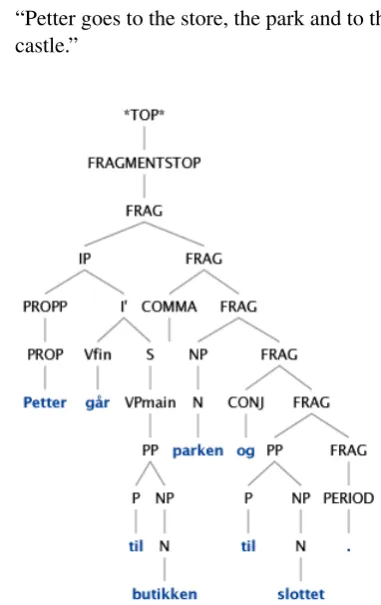
If one chooses to exclude borderline constructions from the grammar, one may still obtain fragment analyses for the parts that are covered. The simpler example in (5), with a similar pattern, may serve as an illustration. The Norwegian grammar produces the fragment analysis in Figure 1.
(5) Petter Petter
g˚ar goes
til to
butikken, store-the,
parken park-the
og and
til to slottet.
castle-the
“Petter goes to the store, the park and to the castle.”
Figure 1: Fragment analysis for (5).
parse a corrected version of an item. In other appli-cations that prioritize robustness over grammatical correctness, a more tolerant grammar may be used. If one doesn’t want to alter the sentence and doesn’t want to include the construction in the grammar, there is the option of producing a fragment analysis. Fragment analyses have proved useful for machine translation in the LOGON project.
4 Open-endedness of language
A handwritten grammar will always miss some con-structions, not only by accidental omissions, but also because language is creative and open-ended. As an example of this class of coverage issues, we may consider resultatives, as in (6).
(6) a. He wiped the table clean. b.She hammered the metal flat.
A resultative analysis presupposes that the verb subcategorizes for a predicate adjective comple-ment, in addition to a subject and an object. This is not a problem for verbs like those in the examples in (6), where it is well known that they take such complements. Common resultative verbs may be ex-pected to be present in the lexicon with the appro-priate subcategorization frame. The problem with this construction is that it is quite creative. Exam-ple (7) from a Norwegian newspaper article about a man who threw garbage into his neighbor’s yard illustrates this creativity well.
(7) Det
“This attracts large quantities of birds who subsequently poop the property full.”
If the appropriate subcategorization frame for the verbskiteis added to the lexicon, the sentence will get the intended analysis. This particular resultative use of this verb is impossible to predict, but with an interactive and incremental approach to parsebank-ing, it is not difficult to incorporate even such un-expected usages into the grammar and lexicon and thereby include them in the treebank.
Some constructions on the borderline of gram-maticality were initially kept outside our Norwe-gian grammar, but were later included based on in-sights derived from the LOGON corpus. Example (8) consists of two independent clauses separated by a comma. In school teacher jargon, it would be called a run-on sentence.
(8) Her
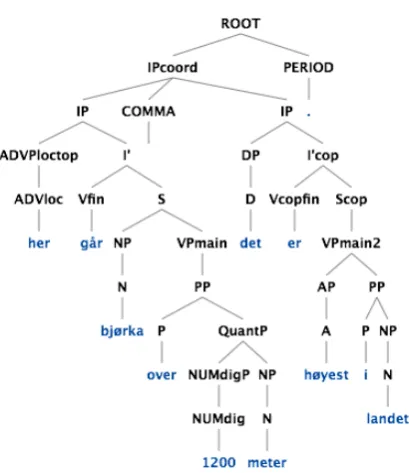
“Here birches grow over 1200 meters, that is the highest in the country.”
According to the normative rules of writing, both in Norwegian and English, independent clauses in the same sentence must be conjoined by a conjunc-tion or a semicolon, not just a comma.
If this type of sentence is to be considered outside of the scope of the grammar, a high quality fragment analysis may still be produced. The c-structure rep-resentation of a fragment analysis for (8) is provided in Figure 2.
Our corpus work so far suggests however that au-thors quite often write sentences like this. Therefore the grammar has been modified to allow the comma to function in the same way as a conjunction in the grammar rules. In that case the sentence may be fully analyzed, as in Figure 3.
Parsebanking is a suitable methodology for tack-ling these coverage issues due to its incremental nature, so that the treebank is a gradually refined product of testing in the grammar construction pro-cess. The parsebanking approach benefits from ad-vanced tools for supporting the communication be-tween annotators and grammar developers (Ros´en et al., 2006), for regression testing (Oepen et al., 2004b), etc.
5 Difficult syntactic problems
Figure 2: Fragment analysis for (8).
This is not to say that there are not real coverage problems for a handwritten grammar. There are gen-uinely difficult syntactic problems for all approaches to syntactic annotation.
A construction that has been the subject of much debate is the so-called “the more the merrier” con-struction (also called the “covariational conditional construction” (Goldberg and Casenhiser, 2006) and “correlative the-clauses”), examples of which are given in (9)–(11).
(9) The more the merrier.
(10) The more chips you eat, the more you want.
(11) The bigger they come, the harder they fall.
Among other issues, it has been debated how the definite article should be analyzed here, since it is not clear that it is a determiner in this construction. In the Penn Treebank II’s Bracketing Guidelines (Bies et al., 1995), we find an overview of bracket labels for annotating phrases. This explanation is
Figure 3: Full analysis for (8).
provided for how the label X is to be used: “Un-known, uncertain or unbracketable. X is often used for bracketing typos and in bracketing the. . . the-constructions (see section 10 [Subordinate Clauses] and section 25 [Correlative the-Clauses]).” In sec-tion 10.7 we read: “There is no definitive policy for handling these cases. Most analyses involve the use of SBAR.” Then some sample analyses are provided for this construction. The analysis of the sentence in (12) is given in (13).
(12) The more he muzzles his colleagues, the more leaks will pop up all around Washington.
(13) (S (SBAR-ADV (X the more) (S (NP-SBJ he)
(VP muzzles (NP his
colleagues)))) ,
(X the more) (NP-SBJ leaks) (VP will
(VP pop (PRT up)
(PP-LOC all around
(NP Washington)))))
sense a tree has been drawn, it’s a bit paradoxical to bracket a constituent with a label that means “un-known, uncertain or unbracketable”. Furthermore, it is strange that the same annotation is used for both typos and challenging constructions. The question is whether this can be considered meaningful cover-age. An alternative view would be that this is anal-ogous to our fragment parsing, and that it only par-tially provides an analysis for the sentence.
If the treebank were to consist only of trees, it would be possible to construct a tool which would allow an annotator to edit a fragment analysis, eras-ing all the fragment nodes and createras-ing new nodes and branches. However, manipulating the output of the grammar would mean that the treebank no longer was in sync with the grammar. Rather than devising ad hoc structures, we think it is fairer to admit that certain constructions are simply not covered yet.
Moreover, in our multilevel framework based on LFG, manual editing is not a desirable solution, since the c-structure is co-described by the grammar with the f-structure and the mrs-structure. Thus, ma-nipulation of one structure would cause the different levels to no longer correspond, and since this corre-spondence is grammar dependent, it is not possible to make a tool that assures these correspondences for items that fall outside of the grammar.
6 Conclusion
In our work on treebanking as automatic parsing of a corpus, we have met criticism that not every-thing in the corpus is analyzed, or even can be ana-lyzed. It might however be counterproductive to an-alyze everything just for the sake of the analysis. We have suggested that building a treebank is not just a matter of assigning some analysis to everything, but also of making grammaticality judgments. Analyses that contribute nothing to a linguistically motivated grammatical description are at best superfluous and increase grammar size. For items outside of the cov-erage of the grammar, a fragment analysis will of-ten be useful. The parser then assigns structures to the largest chunks that it can analyze. This makes it easy for annotators and grammar developers to see what is covered and what is not. Legitimate anal-yses that are missing will be detected in our incre-mental and interactive approach linking treebanking
to grammar development (Ros´en et al., 2006), and their detection will lead to better coverage after re-vision of the grammar. Our aim is to develop tree-banking methods that provide a correct and theoret-ically motivated account of alanguage, not of a cor-pus. With this aim, automatic parsing yields better quality by avoiding inconsistencies and other errors associated with a manual approach and eliminates complicated postprocessing steps for error detection and compaction.
References
Markus Becker, Andrew Bredenkamp, Berthold Crys-mann, and Judith Klein. 2003. Annotation of er-ror types for German Newsgroup Corpus. In Anne Abeill´e, editor,Treebanks: Building and Using Parsed Corpora, chapter 6, pages 89–100. Kluwer Academic Publishers.
Ann Bies, Mark Ferguson, Karen Katz, Robert Mac-Intyre, Victoria Tredennick, Grace Kim, Mary Ann Marcinkiewicz, and Britta Schasberger. 1995. Brack-eting guidelines for Treebank II style Penn Treebank Project. Technical report, University of Pennsylvania.
Joan Bresnan. 2001. Lexical-Functional Syntax. Black-well, Malden, MA.
Michael Burke, Aoife Cahill, Ruth O’ Donovan, Josef Van Genabith, and Andy Way. 2004. Treebank-based acquisition of wide-coverage, probabilistic LFG resources: Project overview, results and evaluation. In The First International Joint Conference on Nat-ural Language Processing (IJCNLP-04), Workshop “Beyond shallow analyses – Formalisms and statisti-cal modeling for deep analyses”, March 22-24, 2004 Sanya City, Hainan Island, China.
Miriam Butt, Helge Dyvik, Tracy Holloway King, Hi-roshi Masuichi, and Christian Rohrer. 2002. The Par-allel Grammar project. In Proceedings of COLING-2002 Workshop on Grammar Engineering and Evalu-ation, Taipei, Taiwan.
Aoife Cahill, Michael Burke, Ruth O’Donovan, Josef Van Genabith, and Andy Way. 2004. Long-distance dependency resolution in automatically acquired wide-coverage PCFG-based LFG approximations. In Pro-ceedings of the 42nd Meeting of the Association for Computational Linguistics.
Eugene Charniak. 1996. Tree-bank grammars. Tech-nical Report CS-96-02, Dept. of Computer Science, Brown University, Providence, Rhode Island, January.
Markus Dickinson and W. Detmar Meurers. 2005. Prune diseased branches to get healthy trees! InProceedings of the Fourth Workshop on Treebanks and Linguistic Theories (TLT 2005).
Markus Dickinson. 2006. Rule equivalence for error de-tection. In Jan Hajiˇc and Joakim Nivre, editors, Pro-ceedings of the Fifth Workshop on Treebanks and Lin-guistic Theories.
Robert Gaizauskas. 1995. Investigations into the gram-mar underlying the Penn Treebank II. Technical Re-port Research Memorandum CS-95-25, University of Sheffield.
Adele E. Goldberg and Devin Casenhiser. 2006. English constructions. In Bas Aarts and April McMahon, edi-tors,The Handbook of English Linguistics, Blackwell Handbooks in Linguistics, chapter 15. Blackwell.
Janne Bondi Johannessen and Fredrik Jørgensen. 2006. Annotating and parsing spoken language. In Pe-ter Juel Henrichsen and PePe-ter Rossen Skadhauge, edi-tors,Treebanking for Discourse and Speech: Proceed-ings of the NODALIDA 2005 Special Session on Tree-banks for Spoken Language and Discourse, pages 83– 104, Copenhagen. Samfundslitteratur.
Tracy Holloway King, Richard Crouch, Stefan Riezler, Mary Dalrymple, and Ronald M. Kaplan. 2003. The PARC 700 dependency bank. InProceedings of the 4th International Workshop on Linguistically Inter-preted Corpora, held at the 10th Conference of the Eu-ropean Chapter of the Association for Computational Linguistics (EACL’03), Budapest.
Alexander Krotov, Robert Gaizauskas, and Yorick Wilks. 1994. Acquiring a stochastic context-free grammar from the Penn Treebank. InProceedings of Third Con-ference on the Cognitive Science of Natural Language Processing, pages 79–86.
Mitchell Marcus, Grace Kim, Mary Ann Marcinkiewicz, Robert MacIntyre, Ann Bies, Mark Ferguson, Karen Katz, and Britta Schasberger. 1994. The Penn Tree-bank: Annotating predicate argument structure. In
Proceedings of the ARPA Human Language Technol-ogy Workshop.
John Maxwell and Ronald M. Kaplan. 1993. The inter-face between phrasal and functional constraints. Com-putational Linguistics, 19(4):571–589.
Joakim Nivre, Koenraad De Smedt, and Martin Volk. 2005. Treebanking in Northern Europe: A white pa-per. In Henrik Holmboe, editor, Nordisk Sprogte-knologi 2004. ˚Arbog for Nordisk Sprogteknologisk
Forskningsprogram 2000-2004, pages 97–112. Mu-seum Tusculanums Forlag, Copenhagen.
Joakim Nivre. 2005. Book review of Anne Abeill´e, ed-itor, Treebanks: Building and using parsed corpora, Kluwer AP, 2003. Machine Translation, 18:373–376.
Stephan Oepen, Helge Dyvik, Jan Tore Lønning, Erik Velldal, Dorothee Beermann, John Carroll, Dan Flickinger, Lars Hellan, Janne Bondi Johannessen, Paul Meurer, Torbjørn Nordg˚ard, and Victoria Ros´en. 2004a. Som ˚a kapp-ete med trollet? Towards MRS-based Norwegian–English Machine Translation. In
Proceedings of the 10th International Conference on Theoretical and Methodological Issues in Machine Translation, Baltimore, MD, October.
Stephan Oepen, Dan Flickinger, Kristina Toutanova, and Christopher D. Manning. 2004b. LinGO Redwoods, a rich and dynamic treebank for HPSG. Research on Language & Computation, 2(4):575–596, December.
Victoria Ros´en, Koenraad De Smedt, Helge Dyvik, and Paul Meurer. 2005a. TREPIL: Developing meth-ods and tools for multilevel treebank construction. In Montserrat Civit, Sandra K¨ubler, and Ma. Ant`onia Mart´ı, editors,Proceedings of the Fourth Workshop on Treebanks and Linguistic Theories (TLT 2005), pages 161–172.
Victoria Ros´en, Paul Meurer, and Koenraad De Smedt. 2005b. Constructing a parsed corpus with a large LFG grammar. InProceedings of LFG’05, pages 371–387. CSLI Publications.
Victoria Ros´en, Koenraad De Smedt, and Paul Meurer. 2006. Towards a toolkit linking treebanking to gram-mar development. In Proceedings of the Fifth Work-shop on Treebanks and Linguistic Theories, pages 55– 66.
Victoria Ros´en. submitted. Mot en trebank for talespr˚ak. In Janne Bondi Johannessen and Kristin Hagen, ed-itors, Spr˚ak i Oslo. Ny forskning omkring talespr˚ak. Novus forlag, Oslo.
Geoffrey Sampson. 2003. Thoughts on two decades of drawing trees. In Anne Abeill´e, editor, Treebanks: Building and Using Parsed Corpora, chapter 2, pages 23–41. Kluwer Academic Publishers.