3245
A Quick Review on Features and Classification
Techniques in Online Recognition of Handwritten
Dravidian Scripts
Baiju.K.B
1, Sabeerath.K
2, Lajish.V.L
3Department of computer Science 1,2,3
NMSM Govt College Kalpetta1 , JDT Islam Arts & Science College Calicut2 , University of Calicut,3 [email protected]1 , [email protected]2 , [email protected]3
Abstract-Sustainability of traditional script input methods needs attention in the preservation of naturality of languages. Automatic recognition of handwritings contributes a lot in preserving these essential aspects. In Indian context, accurate Online Handwriting Character Recognition (OHCR) engines for various scripts are still a research problem. The paper is intended for familiarizing the works in OHCR of Dravidian scripts. Various features and classification techniques used with recognition accuracies were listed from existing literature. This will be beneficial for the quality selection of features and classification techniques in future works.
Keywords - OHCR, Dravidian, Malayalam, Features, Classifiers.
1. INTRODUCTION
The widespread modern technologies have greater impact in the language and linguistics of India, where multiple languages and multiple scripts persist in diversity. The thrust of any technology can only be evaluated on the availability of them to the common. In India the localization of technologies can only be achieved through regional languages. The researches were aligned towards language localisation to deliver the expected objective of technology for the people. As human communication is bound on communication languages, a man machine interaction is evolved through the technologies and languages.
One of the finest approaches is to preserve traditional methods in communication and integrate them with modern technologies. Technologies try to eliminate the gap created among machines and humane through continuous research. These are clearly visible in Computer Science and its allied areas like Computer Vision, Artificial Intelligence and Pattern Recognition etc. Works are in progress to dispel the gap in humane machine coalesce. Inputting script in one’s own language is a complexity associated with data processing machines. This will be a cumbersome task in India, a multi script-language country. An easy way to input regional languages in a traditional way as inputs for data processing is needed. OHCR system can be used in such situations.
The rest of the paper is arranged as follows. Section 2 describes Online Handwriting Recognition. In section 3, different Dravidian scripts are described. A review of various works in Dravidian scripts are analysed in section 4 with emphasis on features and classification methods. Section 5 concludes the paper with findings from various works and an insight to future directions.
2. ONLINE HANDWRITING RECOGNITION
Online Handwriting Recognition involves writing on digital touch pads using stylus, writing in paper using digital pen or writing in touch screen displays using fingers and automatically recognized by an OHCR engine. The strokes corresponding to each character includes co-ordinate points along the path, pressure information, pen up, pen down information, time sequence and structural information [1]. Thespecialty of Online Handwriting Recognition is the preservation of traditional styles followed in the past era. Even if the writer is ignorant of technologies, he can enter the scripts in the data processing machine.
Online handwriting replaces keyboard, which is the commonly used input device for data entry. The complexity of using various Indian Scripts [2] in keyboards can be eliminated through Online Handwriting Recognition. Nowadays this is a popular method in mobile devices, which shows the wide admissibility of the technique.
2.1. Steps in Online Handwriting Recognition
Charles C.Tappert , Suen, C. Y. and Wakahara, T [3]
3246 The data collection is a critical task in Online
Handwriting and certain issues pertaining to them is to be addressed. Data collected from the users may be affected with lot of noises and must be cleansed before analysis. Pre-processing varies in different scripts and usually involves duplicate point elimination, de-hooking, smoothing, re-sampling and normalization
[4].
The features are the essential structural and statistical properties which describe the character and the features extracted from the pre-processed co-ordinate values are used in the classifiers. Quality selection of feature affects classification rate [5],
hence the features must be selected based on the classification technique to be employed. Some of the commonly used features are slope angles, co-ordinate positions, crossings, bumps, cusps, loops, directions, angles and aspect ratios [6]. Classification involves the problem of identifying to which of the available classes a new class member belong. Commonly used classifiers are Support Vector Machines (SVM), Hidden Markov Models (HMM), K Nearest Neighbor Classifier (k-NN), Neural Networks, Dynamic Time Warping (DTW), Fourier Descriptors and Daubachies Wavelet Transform (DWT) [7]. Post processing is done after classification for the alphanumeric code matching of characters and any un-ambiguity in confusing pairs and applying language specific constructs to refine the recognition phase.
3. DRAVIDIAN SCRIPT
Dravidian languages are a family of languages mostly used in the southern parts of India [8]. The major languages coming under the category are Tamil, Malayalam, Kannada and Telugu. All of them have their own scripts and derived from the Brahmi script of the 5th century BC. Some of the Dravidian scripts are used in various parts of the world with official status.
The entire Dravidian language group has Classical status as per Indian constitution. Dravidian languages are agglutinative in nature [9], with separate units of different meaning in a single word. The writing direction of all the Dravidian languages is from left to right. In similarity Malayalam, Tamil forms a group and Kannada, Telugu forms another group. The following sections describe the characteristics of Dravidian scripts.
3.1.Tamil Script
Tamil is the popular Dravidian language spoken in the state of Tamil Nadu. It is also an official language in Malaysia, Sri Lanka and Singapore. The Tamil script includes 12 vowel and 18 consonants. Fig. 1 shows the
vowels and consonants in Tamil with IPA notation .It is the only Dravidian script having official status in other Asian countries.
3.2. Telugu Script
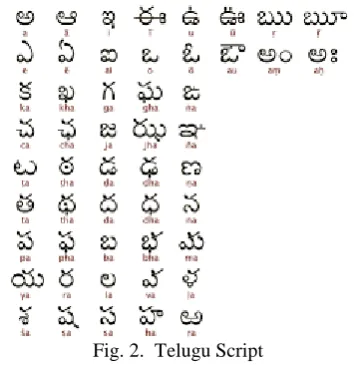
Telugu is the third popular language in India and the official language of Andhra Pradesh and Telungaana state. The script largely resembles with Kannada script. Telugu script has 16 vowels and 36 consonants as shown in Fig. 2 with their IPA.
3.3. Kannada Script
[image:2.595.340.504.147.321.2]Around 50 million south Indian people from Karnataka and neighboring states speak Kannada, an ancient Dravidian language also Official language of Karnataka state. Kannada and Telugu have structural similarities. The Kannada script consists of 16 vowels and 36 consonants. A sample vowel-consonant set with IPA is shown in Fig. 3.
Fig. 1. Tamil Script
[image:2.595.337.518.424.607.2]3247
3.4. Malayalam Script
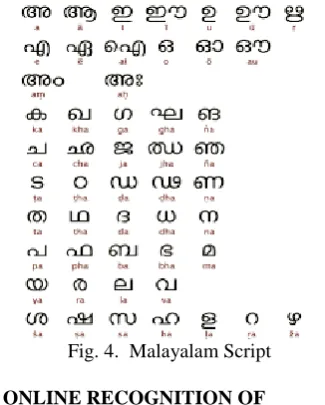
Malayalam is the official language of the state of Kerala. Malayalam is spoken by 30 million people in India with a span among Kerala, Karnataka, Tamil Nadu and Lakshadweep. Malayalam script has 15 vowels and 36 consonants as listed in Fig. 4.
4. ONLINE RECOGNITION OF DRAVIDIAN SCRIPTS
The recognition accuracy of scripts depends strongly on selection of quality features .It can be observed that Dravidian scripts are highly vulnerable towards the feature selection. And the structural similarity of the scripts is also challenging. Hence the selection of appropriate features is essential in order to attain expected recognition rate. Many works have been reported in Online Handwriting Recognition for the last few years in Dravidian Languages [10].
4.1. Tamil Online Handwriting Recognition
Majority of the work in Dravidian scripts have been reported in Tamil. Ramakrishnan, A. G et al. [11]
obtained an accuracy of 98% using (x, y) co-ordinates, DFT and DCT with SVM. In the work, Niranjan Joshi et al. [12] demonstrated a template based elastic matching technique. The features used are (x, y) ordinates, quantized slopes and dominant point co-ordinates. The system combined different features and formed seven different schemes. The work describes recognition accuracy, recognition speed and number training templates with dynamic time warping distance measure. The system achieved a maximum of 95.90% accuracy with a speed of 32.6 characters per second.
A novel approach has been described by Aparna, K. H et al. [13] with a string of shape features. Using this string representation, an unknown stroke is identified by comparing it with a database of strokes using a flexible string matching procedure and finite state automation. A recognition rate of 77.84% has been achieved by the system. Neural networks has been adopted in Ishwarya and Kannan, R.J [14] with multilayer perceptron. The feature used is Fourier descriptor. Test results indicate that Fourier descriptors with back propagation network provide a recognition accuracy of 97%. Shashikiran, K et al.
[15] analysed the performance of Tamil Scripts with HMM and Statistical Dynamic Time Warping (SDTW).The results show that the best result of 85% for HMM is possible using a simpler SDTW model.
The work of Murthy and Venkatesh N [16]
involves two stage recognition with PCA and NN classifier adopted at the first stage followed by combined feature combination and DTW. The system uses (x, y) co-ordinates, quantised slope, co-ordinates of accurate dominant points and Quartile Features. Based on the primary classifier output and prior knowledge, a classifier is chosen for the second phase. The system achieved 90.20% recognition accuracy for Tamil Scripts. Rituraj Kanwar and Ramakrishnan.A.G
[17] has projected a fractal coding method with features as fractal dimensions. This technique exploits the redundancy in data, thereby achieving better compression and usage of lesser memory. The fractal code features were applied in separate classifiers (HMM, SVM, SDTW).The recognition achieved an accuracy of 90% with SDTW.
4.2. Telugu Online Handwriting Recognition
[image:3.595.85.260.127.314.2]Swethalakshmi,H et al. [18] developed a system for online HCR of Telugu and Devanagari writing using Support Vector Machine(SVM). Each stroke is represented as an n-dimensional feature vector depending on the choice of the number of points for stroke representation. The features chosen to represent Fig. 3. Kannada Script
[image:3.595.85.248.418.621.2]3248 the curve are the co-ordinates of points in the
pre-processed stroke. The stroke is then classified using SVM with 73.30% of accuracy. V. Jagadeesh Babu et al. [19] presented an online handwritten symbol recognition system for Telugu based on Hidden Markov Model (HMM). Normalized (x, y) co-ordinates, normalized first derivatives, normalized second derivatives, curvature and aspect ratio are used as the features. The system achieved an accuracy of 98.7% on a dataset containing 29,158 training samples and 9,235 test samples.
Prasanth et al. [20] described character based elastic matching using local features for recognizing online Telugu handwritten data. Dynamic Time Warping (DTW) has been used with four different feature sets: x-y features, Shape Context (SC) and Tangent Angle (TA) features, Generalized Shape Context feature (GSC) and the fourth set containing x-y, normalized first and second derivatives and curvature features. Nearest neighborhood classifier with DTW distance was used as the classifier with a recognition accuracy of 89.77%. The work by Kinjarapu, A.K, Yelavarti, K.C and Valurouthu, K.P
[21] achieved 90% recognition in SVM when the Legendre-Sobolev series coefficients for each of the x and y co-ordinates with degree 12 augmented with the sine and cosine angles of the third and first-to-last vectors are used as features. In a recent work, GS, Rao and Rajeswara, Rao [22] achieved 98% recognition with combinations of various geometrical features using ANN.
4.3.Kannada Online Handwriting Recognition
Wavelet feature of the Kannada script is used in the recognition method proposed by Srinivasa Rao Kunte et al. [23]. The system achieved a recognition accuracy of 95% for basic Kannada characters. The structural and spatio-temporal features are employed in a work of M Mahadeva Prasad et al. [24] in the recognition of Kannada Scripts. The strategy used here is Divide and Conquer. A character is segmented into three strokes units and recognized separately. The method is proposed to overcome the complexity of huge number compound characters. The segmented units are preprocessed and the extracted features are mapped to sub-space using PCA. The system achieved an accuracy of 81% with KNN classifier. Rituraj Kanwar et al. [25] presented an unrestricted recognizer using a smoothed first derivatives of (x, y) co-ordinates and SDTW as the classifier. The system achieved 88% of recognition accuracy with faster recognition time compared to the recognition time of DTW.
A recognizer for mobile devices has been suggested by Keerthi Prasad G et al. [26] using two approaches PCA and DTW. The reported recognition
accuracy is 88% for the PCA and 64% for DTW. The recognition time of PCA approach is 0.8 seconds which is fairly better compared to DTW with a recognition time of 55 seconds. Venkatesh N and A G Ramakrishnan [27] proposed a novel method with two stage classifiers. The features used are quartile features, pre-processed (x, y) co-ordinates, quantized slopes and accurate dominant points. The primary classifier used is DTW. Based on the result of primary classifier and prior knowledge, secondary classifier is applied to obtain a recognition rate of 92.60% for Kannada characters. The study of Swetha.D and Remya [28], used various smoothing techniques and achieved a recognition rate of 92.50% using KNN and 94.35% using SVM. In a recent work by Chaithra.D, Indira.K [29] achieved an accuracy of 73.47% using KNN on derivatives and (x,y) co-ordinates.
4.4.Malayalam Online Handwriting Recognition
As one of the initial work in Malayalam Sreeraj et al. [30] proposed an OHCR system with normalised (x, y) co-ordinates and context bit map features. The classification technique used is kohonen networks. The system exhibited a recognition accuracy 88.75% with a recognition time of 15-32 milliseconds. A combination of time domain features and dynamic representation of writing direction and curvature is proposed by Sreeraj et al. [31] in another work. The features used are writing directions, normalised (x, y) co-ordinates and aspect ratio. By using KNN classifier, the system achieved an accuracy of 98.125% even with a small sample size.
A recognition engine using wavelet transform is presented by Prime kumar et al. [32].Time domain features of the strokes are used with wavelet transform. The classification algorithm used is simplified fuzzy ARTMAP network, which requires comparatively very less time for training. An accuracy of 97.81% is reported in the work.
Indhu T.R et al. [33] presented an online handwriting recognition system using simplified fuzzy ARTMAP technique. Enormous features are used in the work which includes, (x, y) co-ordinates, start quadrant, end quadrant, horizontal and vertical point density, loop, cusp and stroke length, The system achieved 98.26% recognition accuracy with simplified fuzzy ARTMAP classification technique. Primekumar et al. [34] extended their work using HMM and SVM. They achieved an improved accuracy of 97.97% for SVM using Gaussian kernel. But the recognition rate dropped to 95.24% for HMM and recognition time was also increased compared to SVM.
3249 division point features. A recent work of Stephy Maria
et al. [36] achieved a recognition accuracy of 90% using SVM. The directional and curvature features are extracted and trained in LIBSVM tool available in Matlab. Four features ADP, octants, intersections and aspect ratio have been identified in the work of Baiju.K.B, Sabeerath.K and Lajish VL [37]. An accuracy of 90.40% has been obtained using MLP in the work. In a recent work, Stephy Maria et al. [38]
obtained a recognition rate of 97.73 using SVM. Amritha Sampath et al. [39] presented a Neural Network based model for handwritten recognition. The direction information of the written character is recorded based on the 8 connected Freeman chain code. The direction of the pen movement is recorded as feature vector. Back propagation Neural Network is used for classifying characters. Additional dis-ambiguation technique is used in post processing stage to identify confusing pairs.
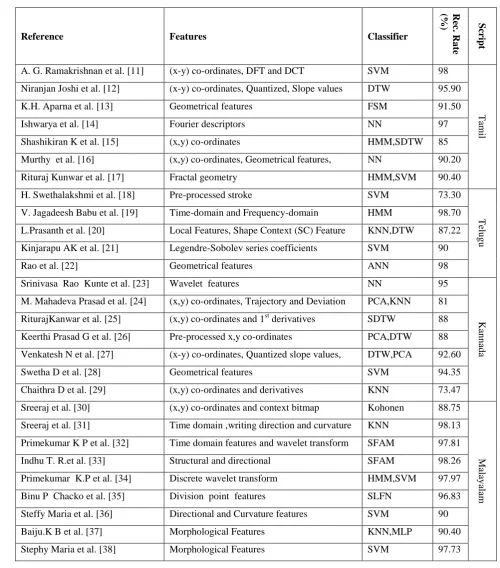
A comparison of various features and classification techniques used in OHCR of Dravidian scripts are summarised in Table 1. The study couldn’t consider recognition time, class size and feature dimensions because of large variance among different OHCR engines.
5. CONCLUSION AND FUTURE WORK
The work presented a comparison of different recognition techniques used in OHCR of Dravidian scripts. Highest recognition rate of 98% is reported with DFT, DCT and SVM classifier in Tamil script. In Malayalam, structural and directional features on SFAM method produced a recognition rate of
98.26%.The available literature in Telugu reported a recognition rate of 98.70% with HMM classifier and frequency, time domain features. An accuracy of 95%
is reported for Kannada characters with wavelet features and Neural Networks.
The maximum recognition rate attained in various Dravidian scripts uses different methods. Most of the classifiers used structural features or its refined form extensively. No similarity in the recognition scheme is visible in maximum recognition rate. But majority of the work employs DTW and SVM. Lack of a Bench mark database for OHCR in Dravidian scripts is severe in establishing standards and achieving higher recognition rates. The comparison of various recognition schemes reveals that feature selection has a major role in recognition accuracy in Dravidian scripts. A method used in one of the script gives lesser recognition rate than in another script, is also observed.
The study suggests that even better recognition methods are needed to attain more promising recognition rate with minimum time for both writer
independent and dependent OHCR methods in Dravidian scripts. The future works in OHCR of Dravidian scripts may be focused on feature dimensions, class size and recognition time with optimum standards and bench mark databases.
REFERENCES
[1] Plamondon, R.; Srihari, S. (2000). Online and off-line handwriting recognition: a comprehensive survey. In Pattern Analysis and Machine. 22, pp. 63–84.
[2] Bhaskarabhatla, A. S, ; Madhvanath, S. (2005). Experiences in Collection of Handwriting Data for Online Handwriting Recognition in Indic Scripts ,pp. 26–28.
[3] Tappert, C. C. ; Suen, C. Y. ; Wakahara, T. (1990). The state of the art in online handwriting recognition
[4] Huang, B. Q. ; Zhang, Y. B ; Kechadi, M. T. (2007). Preprocessing Techniques for Online Handwriting Recognition. Seventh ISDA ,793– 800.
[5] Kc, S., ; Nattee, C. (2010). A Comprehensive Survey on On-line Handwriting Recognition Technology and its Real Application to the Nepalese Natural Handwriting. In Kathmandu University Journal of Science, Engineering and Technology, 5, pp. 31–55.
[6] Bharath, A., ; Madhvanath, S. (2008). Online Handwriting Recognition for Indic Scripts [7] Anitha Mary M.O Chacko, D (2014). Handwritten
Character Recognition in Malayalam Scripts - A Review. In International Journal of Artificial Intelligence & Applications (IJAIA) , 5, pp. 79– 89.
[8] Winters, C. (2012). Dravidian is the language of the Indus writing. In Current Science, Vol. 103. [9] Antony, P. J, ; Soman, K. P (2012).
Computational Morphology & Natural Language Parsing for Indian Languages :A Literature Survey.IJCSET ,3,pp. 136–146.
[10] Krishnamurti ; Bhadriraju. (2003). The Dravidian Languages. The Dravidian Languages, pp. 1–545. [11] Ramakrishnan, A. G. (2013). Global and Local Features for Recognition of Online Handwritten Numerals and Tamil Characters. 4th International Workshop on Multilingual OCR, Article No. 16. [12] Joshi, N ; Sita, G ; Ramakrishnan, A. G., ;
Madhvanath, S. (2004). Comparison of Elastic Matching Algorithms for Online Tamil Handwritten Character Recognition. 444–449. [13] Aparna, K. H. ; Subramanian, V. ; Kasirajan, M. ;
Prakash, G. V. ; Chakravarthy, V. S. (2004). Online Handwriting Recognition for Tamil.
Frontiers in Handwriting Recognition, 2004. IWFHR-9 2004. pp 438 – 443
3250 [15] Shashikiran, K. ; Prasad, K. ; Kunwar, R., ;
Ramakrishnan, A. (2010). Comparison of HMM and SDTW for Tamil Handwritten Character Recognition. 2010 International Conference on Signal Processing and Communications (SPCOM), pp 1–4.
[16] Murthy, V. N. (2011). Choice of Classifiers in Hierarchical Recognition of Online Handwritten Kannada and Tamil Aksharas. Journal of Universal Computer Science, 17(1), pp. 94–106. [17] Kunwar, R. ; Ramakrishnan, A. G. (2011). Online
Handwriting Recognition of Tamil Script Using Fractal Geometry. 2011 International Conference on Document Analysis and Recognition, pp. 1389–1393
[18] Swethalakshmi, H. (2006). Online handwritten character recognition of Devanagari and Telugu Characters using support vector machines.
Frontiers in Handwriting, pp. 1–6.
[19] Babu, V. J. ; Prasanth, L. ; Sharma, R. R. ; Bharath, A. (2007). HMM-Based Online Handwriting Recognition System for Telugu Symbols, pp. 1–4
[20] Mandalapu, D. ; Prasanth, L. ; Babu, V. J. ; Sharma, R. R. ; Rao, G. V. P. (2007). Elastic Matching of Online Handwritten Tamil and Telugu Scripts Using Local Features , pp. 23–26 [21] Kinjarapu AK ; Yelavarti KC ; Valurouthu KP
(2016). Online recognition of handwritten Telugu script characters. Int Conf Signal Process Commun Power Embed Syst SCOPES, pp. 426-432.
[22] Rao GS (2018). The Performance of Online Telugu Character Recognition using Multilayer Feed forward Neural Network ( MFNNs ). Int J Pure Appl Math , 119(15), pp. 1119-1125
[23] Samuel, R. D. S. (2006). Wavelet Features based Recognition of Handwritten Kannada Characters ,SJ College of Engineering, pp. 417–420
[24] Prasad, M. M., Sukumar, M., & Ramakrishnan, A. G. (2009). Divide and conquer technique in online handwritten Kannada character recognition. Proceedings of the International Workshop on Multilingual OCR - MOCR ’09, 1. [25] Kunwar, R. ; Mohan, P. ; Shashikiran, K. ;
Ramakrishnan, A. G. (2010). Unrestricted Kannada online handwritten akshara recognition using SDTW. (SPCOM), pp. 1–5.
[26] Keerthi Prasad ; Imran Khan ; Naveen R Chanukotimath (2012). On-line Hindi Handwritten Character Recognition for Mobile Devices, In Proc. ICCACI-12, pp. 1074-1078 [27] V. N. Murthy (2011), Choice of Classifiers in
Hierarchical Recognition of Online Handwritten Kannada and Tamil Aksharas, J. Univers. Comput. Sci., 17(1), pp. 94–106.
[28] Shwetha D ; Ramya S (2014). Comparison of smoothing techniques and recognition methods for online Kannada character recognition system.
,Int Conf Adv Eng Technol Res ICAETR,pp.0-4. [29] Chaithra D (2017). Handwritten Online Character
Recognition for Single Stroke Kannada
Characters. IEEE Int Conf Recent Trends Electron Inf Commun Technol (RTEICT).
[30] M. Sreeraj & S. M. Idicula (2009), On-line handwritten character recognition using kohonen networks. 2009 World Congr. Nat. Biol. Inspired Comput. NABIC 2009 - Proc., pp. 1425–1430. [31] Sreeraj, M ; Idicula, S. (2010). k-NN Based
On-Line Handwritten Character Recognition System.
Integrated Intelligent Computing (ICIIC), pp. 171–176.
[32] Primekumar, K. P. ; Idiculla, S. M. (2011). On-Line Malayalam Handwritten Character Recognition Using Wavelet Transform and SFAM. 2011 3rd International Conference on Electronics Computer Technology, pp. 49–53. [33] Indhu TR ; Bhadran VK (2012). Malayalam
online handwriting recognition system: A simplified fuzzy ARTMAP approach. Annu IEEE India Conf INDICON 2012. pp. 613-618.
[34] Primekumar, K. P. ; Idiculla, S. M. (2013). On-line Malayalam Handwritten Character Recognition using HMM and SVM ,ICSIPR, pp. 1–5.
[35] Chacko, B. P. ; Babu, A P. (2011). Online sequential extreme learning machine based handwritten character recognition. IEEE Technology Students’ Symposium, pp. 142–147. [36] S. M. Joseph ; Hameed A (2014). Online
handwritten malayalam character recognition using LIBSVM in matlab. IEEE Natl Conf Commun Signal Process Networking, NCCSN,pp. 1-5.
[37] K. B. Baiju ; K. Sabeerath ; V. L. Lajish (2016), Online Recognition of Malayalam Scripts with Minimized Feature Dimensions , IJARCCE, 5, pp. 472–476.
[38] S. M. Joseph ; V. A. Rahiman ; K. M. Abdul Hameed (2015). SVM based feature set analysis in dynamic Malyalam character recognition,IEEE Conf on Signal Image Processing, 15,pp. 238-243.
3251 Table 1. Comparison of various OHCR works in Dravidian scripts
Reference Features Classifier
Rec
. Ra
te
(%)
Script
A. G. Ramakrishnan et al. [11] (x-y) co-ordinates, DFT and DCT SVM 98
T
am
il
Niranjan Joshi et al. [12] (x-y) co-ordinates, Quantized, Slope values DTW 95.90
K.H. Aparna et al. [13] Geometrical features FSM 91.50
Ishwarya et al. [14] Fourier descriptors NN 97
Shashikiran K et al. [15] (x,y) co-ordinates HMM,SDTW 85
Murthy et al. [16] (x,y) co-ordinates, Geometrical features, NN 90.20 Rituraj Kunwar et al. [17] Fractal geometry HMM,SVM 90.40
H. Swethalakshmi et al. [18] Pre-processed stroke SVM 73.30
T
elu
g
u
V. Jagadeesh Babu et al. [19] Time-domain and Frequency-domain HMM 98.70
L.Prasanth et al. [20] Local Features, Shape Context (SC) Feature KNN,DTW 87.22
Kinjarapu AK et al. [21] Legendre-Sobolev series coefficients SVM 90
Rao et al. [22] Geometrical features ANN 98
Srinivasa Rao Kunte et al. [23] Wavelet features NN 95
Kan
n
ad
a
M. Mahadeva Prasad et al. [24] (x,y) co-ordinates, Trajectory and Deviation PCA,KNN 81 RiturajKanwar et al. [25] (x,y) co-ordinates and 1st derivatives SDTW 88
Keerthi Prasad G et al. [26] Pre-processed x,y co-ordinates PCA,DTW 88 Venkatesh N et al. [27] (x-y) co-ordinates, Quantized slope values, DTW,PCA 92.60
Swetha D et al. [28] Geometrical features SVM 94.35
Chaithra D et al. [29] (x,y) co-ordinates and derivatives KNN 73.47 Sreeraj et al. [30] (x,y) co-ordinates and context bitmap Kohonen 88.75
Ma
lay
alam
Sreeraj et al. [31] Time domain ,writing direction and curvature KNN 98.13
Primekumar K P et al. [32] Time domain features and wavelet transform SFAM 97.81 Indhu T. R.et al. [33] Structural and directional SFAM 98.26
Primekumar K.P et al. [34] Discrete wavelet transform HMM,SVM 97.97 Binu P Chacko et al. [35] Division point features SLFN 96.83
Steffy Maria et al. [36] Directional and Curvature features SVM 90