
2125
Viscosity and Excess Molar Volume of Binary Ionic
Liquid Mixture at Temperature 298.15 K
Ankit Gupta, Vikas Singh Gangwar and Rajeev K.Shukla
*Department of Chemistry VSSD College, Kanpur-208002, India email* [email protected]
Abstract- Densities and viscosities of 1-butyl-3-methylimidazolium tetrafluoroborate [Bmim][BF4] ionic
liquid with methyl formate, methyl acetate, ethyl formate and acetone were measured over the whole concentration range at 298.15 K and atmospheric pressure. Viscosity were also computed from Grunberg-Nissan and Kendall and Monroe models and compared with the experimental results. The excess molar volume VEand the viscosity deviations ∆η for the binary mixture have been calculated and were fitted to the Redlich-Kister polynomials. A fair agreement was achieved when compared the experimental viscosities with the theoretical viscosities and they are within the experimental limits. Interactions involved in the liquid mixture were studied from the values of VE and ∆η which are negative over the whole composition range. The minimum deviations for excess molar volume and viscosity are observed at about mole fraction of the ionic liquid, x ≈ 0.2-0.3and x ≈ 0.55-0.65
Index Terms - Ionic liquid, Grunberg-Nissan, Kendall-Monroe, viscosity and excess molar volume
1. INTRODUCTION
Ionic liquids (ILs) are entirely constituted by ions with melting points below 1000C [1]. Due to the importance and interest of Ionic liquids, they are now being used in all areas of chemistry, as solvents for organic and inorganic synthesis, as electrolytes in batteries and solar cells, as new types of energetic materials, as stationary phases in chromatography, and in a variety of other analytical applications, as well as being the subject of fundamental study in physical chemistry [2]. Physical properties including viscosity and density[4], areessential for designing any process involving ionic liquids on an industrial scale. Moreover, the magnitude and extent of interactions involved in the process can be studied by understanding the excess properties. I onic liquids study has sufficient scope for further research modelling and correlations [5]. In this work, we measured, density and viscosity of mixtures consisting of methyl formate, methyl acetate, ethyl formate, and acetone with 1-butyl-3-methylimidazolium tetrafluoroborate ([Bmim] [BF4]) ionic liquid over the entire composition range at 298.15 K and atmospheric pressure. The studies of excess properties such as deviation in viscosity, excess molar volume, excess Gibbs free energy of activation of viscous flow and Grunberg-Nissan interaction constant of binary mixtures are useful in understanding the nature and extent of intermolecular interactions between two liquids [6-10 8-12]. Deviation in viscosity (Δη), excess molar volume (VE) and excess Gibbs free energy of activation of viscous flow (ΔG*E)
have been calculated from the density (ρ), and viscosity (η), data and the excess molar volume VE
and the viscosity deviations ∆η for the binary mixture have been calculated and were fitted to the Redlich-Kister polynomials. Grunberg-Nissan (G-N) and Kendall-Monroe(K-M) equations with no parameters, have been used in correlating viscosity data of the binary mixtures.
2. EXPERIMENTAL
2.1 Materials
High purity and AR grade samples of methyl formate, methyl acetate, ethyl formate, and acetoneused in this experiment were obtained from Merck Co. Inc., Germany and purified by distillation in which the middle fraction was collected. The liquids were stored in dark bottles over 0.4nm molecular sieves to reduce water content and were partially degassed with a vacuum pump. The purity of each compound was checked by gas chromatography and the results indicated that the mole fraction purity was higher than 0.99. All the materials were used without further purification. 1-butyl-3-methylimidazolium
2126
by comparing the densities and viscosities with those reported in the literature as shown in table 1.
2.2 Apparatus and Procedure
Before each series of experiments, we calibrated the instrument at atmospheric pressure with doubly distilled water. The calibration was accepted if the measurements were within ± 3×10 -4g.cm-3 and 6×10⁻³ m Pa.s of the published values.
The densities of the pure components and their mixtures were measured with the bicapillary pyknometer The uncertainty in the density measurements was better than ± 3×10⁻⁴ g.cm-3 and reproducible to ± 1.31×10⁻² g.cm-3 The liquid mixtures were prepared by mass in a air tight stopped bottle using a electronic balance model Shimadzuax-200 accurate to within ±0.1mg.The average uncertainty in the composition of the mixtures was estimated to be less than ±0.0001. The viscosities of pure liquids and the mixtures were measured at atmosphere pressure and at different temperatures using Canon Ubbelohde
suspended-level viscometer. The viscometer was immersed in a well stirred water bath (Raga Industries) with temperature control to ±0.01 K. The flow time was recorded with a digital stopwatch capable of measuring time to within ±0.01s.Each experiment was repeated four times at each temperature for all composition and results were averaged. The viscosity η of the liquid was then calculated from the following relationship
ν = η /ρ =k (t-ө) (1) where η is the absolute viscosity is the density is the flow time ,ν is the kinematic viscosity, and k
and ө are the viscometer constant and the Hagen Bach correction factor respectively. The calibration of the viscometer was carried out with doubly distilled water and doubly distilled benzene .Care was taken to reduce evaporation during the measurements. The estimated uncertainty in viscosity measurements was within ± 0.006 m Pa.s and reproducible to ± 3.3 m Pa.s.
3. TABLES AND FIGURES
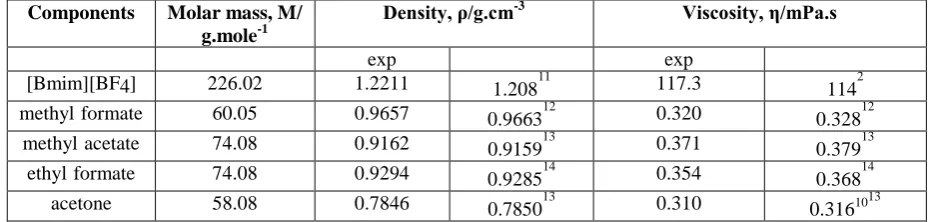
Table 1. Comparison of experimental densities (ρ) and viscosities (η) with literature values
Components Molar mass, M/
g.mole-1
Density, ρ/g.cm-3 Viscosity, η/mPa.s
exp exp
[Bmim][BF4] 226.02 1.2211 1.20811 117.3 1142
methyl formate 60.05 0.9657 0.966312 0.320 0.32812
methyl acetate 74.08 0.9162 0.915913 0.371 0.37913
ethyl formate 74.08 0.9294 0.928514 0.354 0.36814
acetone 58.08 0.7846 0.785013 0.310 0.3161013
Table 2. Redlich-Kister coefficients and their Standard Deviations (SD) for the Excess Molar Volumes and Viscosity Deviations at 298.15 K
[Bmim][BF4] + Methyl Formate
B0 B1 B2 B3 SD
VE/cm3mole-1 -4.53 6.58 -3.18 4.63 0.08
Δη/mPa.s -178.84 106.68 -73.27 44.98 0.30
[Bmim][BF4] + Methyl Acetate
VE/ cm3mole-1 -6.23 7.31 4.78 11.18 0.04
Δη/ mPa.s -178.81 112.46 -107.94 81.77 0.55
[Bmim][BF4]+EthylFormate
VE/cm3mole-1 3.74 5.55 3.09 6.46 0.04
Δη/ mPa.s -179.72 113.80 -68.82 29.68 0.24
[Bmim][BF4] + Acetone
[image:2.595.63.530.440.551.2]2127
[image:3.595.66.491.206.755.2]Δη/ mPa.s -186.03 127.42 -84.78 51.19 0.16
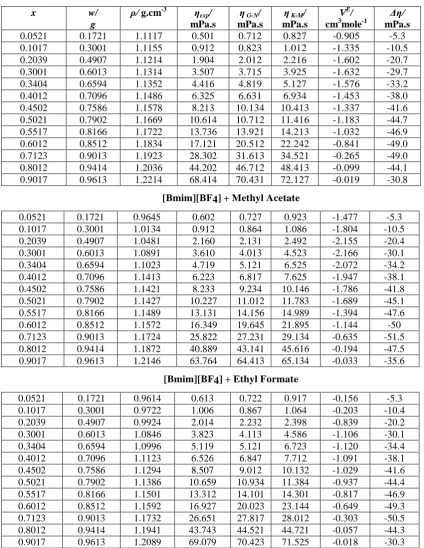
Table 3. Mole fraction(x), mass fraction(w) , e xperimental density (ρ), experimental and theoretical viscosity (ηexp,ηG-N,ηK-M), Excess Molar Volume (VE), and Viscosity Deviations (∆η) for binary systems
at 298.15 K
[Bmim][BF4] + Methyl Formate
x w/
g
ρ/ g.cm-3 ηexp/ mPa.s
η G-N/ mPa.s
η K-M/ mPa.s
VE/
cm3mole-1
Δη/
mPa.s
0.0521 0.1721 1.1117 0.501 0.712 0.827 -0.905 -5.3
0.1017 0.3001 1.1155 0.912 0.823 1.012 -1.335 -10.5
0.2039 0.4907 1.1214 1.904 2.012 2.216 -1.602 -20.7
0.3001 0.6013 1.1314 3.507 3.715 3.925 -1.632 -29.7
0.3404 0.6594 1.1352 4.416 4.819 5.127 -1.576 -33.2
0.4012 0.7096 1.1486 6.325 6.631 6.934 -1.453 -38.0
0.4502 0.7586 1.1578 8.213 10.134 10.413 -1.337 -41.6
0.5021 0.7902 1.1669 10.614 10.712 11.416 -1.183 -44.7
0.5517 0.8166 1.1722 13.736 13.921 14.213 -1.032 -46.9
0.6012 0.8512 1.1834 17.121 20.512 22.242 -0.841 -49.0
0.7123 0.9013 1.1923 28.302 31.613 34.521 -0.265 -49.0
0.8012 0.9414 1.2036 44.202 46.712 48.413 -0.099 -44.1
0.9017 0.9613 1.2214 68.414 70.431 72.127 -0.019 -30.8
[Bmim][BF4] + Methyl Acetate
0.0521 0.1721 0.9645 0.602 0.727 0.923 -1.477 -5.3
0.1017 0.3001 1.0134 0.912 0.864 1.086 -1.804 -10.5
0.2039 0.4907 1.0481 2.160 2.131 2.492 -2.155 -20.4
0.3001 0.6013 1.0891 3.610 4.013 4.523 -2.166 -30.1
0.3404 0.6594 1.1023 4.719 5.121 6.525 -2.072 -34.2
0.4012 0.7096 1.1413 6.223 6.817 7.625 -1.947 -38.1
0.4502 0.7586 1.1421 8.233 9.234 10.146 -1.786 -41.8
0.5021 0.7902 1.1427 10.227 11.012 11.783 -1.689 -45.1 0.5517 0.8166 1.1489 13.131 14.156 14.989 -1.394 -47.6
0.6012 0.8512 1.1572 16.349 19.645 21.895 -1.144 -50
0.7123 0.9013 1.1724 25.822 27.231 29.134 -0.635 -51.5 0.8012 0.9414 1.1872 40.889 43.141 45.616 -0.194 -47.5 0.9017 0.9613 1.2146 63.764 64.413 65.134 -0.033 -35.6
[Bmim][BF4] + Ethyl Formate
0.0521 0.1721 0.9614 0.613 0.722 0.917 -0.156 -5.3
0.1017 0.3001 0.9722 1.006 0.867 1.064 -0.203 -10.4
0.2039 0.4907 0.9924 2.014 2.232 2.398 -0.839 -20.2
0.3001 0.6013 1.0846 3.823 4.113 4.586 -1.106 -30.1
0.3404 0.6594 1.0996 5.119 5.121 6.723 -1.120 -34.4
0.4012 0.7096 1.1123 6.526 6.847 7.712 -1.091 -38.1
0.4502 0.7586 1.1294 8.507 9.012 10.132 -1.029 -41.6
0.5021 0.7902 1.1386 10.659 10.934 11.384 -0.937 -44.4
0.5517 0.8166 1.1501 13.312 14.101 14.301 -0.817 -46.9
0.6012 0.8512 1.1592 16.927 20.023 23.144 -0.649 -49.3
0.7123 0.9013 1.1732 26.651 27.817 28.012 -0.303 -50.5
0.8012 0.9414 1.1941 43.743 44.521 44.721 -0.057 -44.3
2128
[Bmim][BF4] + Acetone
0.0521 0.1721 0.8460 0.551 0.601 0.667 -0.958 -5.3
0.1017 0.3001 0.8923 0.716 0.791 0.805 -1.461 -10.6
0.2039 0.4907 0.9737 1.529 1.579 1.601 -1.942 -20.6
0.3001 0.6013 1.0293 3.004 3.132 3.467 -2.033 -30.8
0.3404 0.6594 1.0572 4.072 4.186 4.230 -1.976 -35.5
0.4012 0.7096 1.0741 5.224 5.444 5.526 -1.887 -39.4
0.4502 0.7586 1.0942 6.927 7.103 7.411 -1.616 -43.1
0.5021 0.7902 1.1151 9.035 10.112 11.413 -1.584 -46.0
0.5517 0.8166 1.1267 12.067 13.131 13.567 -1.384 -48.1
0.6012 0.8512 1.1413 15.149 19.899 21.123 -1.169 -51.1
0.7123 0.9013 1.1629 25.517 26.413 26.894 -0.679 -51.5
0.8012 0.9414 1.1852 40.189 41.012 42.613 -0.284 -47.9
0.9017 0.9613 1.2054 64.791 65.147 65.618 -0.131 -34.6
Fig. 1 Excess molar volumes, VE for the mixtures of x[Bmim][BF4]+(1-x) organic solutes at 298.15 K.; [Bmim][BF4] + MethylFormate,; [Bmim][BF4] + Methyl Acetate,▲; [Bmim] [BF4] + Ethyl Formate, ×;[Bmim][BF4] +
Acetone
Fig. 2 Viscosity deviation, ∆η for the mixtures of x[Bmim][BF4]+(1-x) organic solutes at 298.15 K.; [Bmim] [BF4] + MethylFormate, ; [Bmim][BF4] +Methyl Acetate,▲; [Bmim] [BF4] + Ethyl Formate, ×;[Bmim][BF4] +
Acetone -2.5
-2 -1.5 -1 -0.5 0
0 0.2 0.4 0.6 0.8 1
V
E
/ cm 3m
o
le
-1
x1 -60
-50 -40 -30 -20 -10 0
0 0.2 0.4 0.6 0.8 1
Δη/m
Pa.
s
[image:4.595.66.490.121.280.2] [image:4.595.314.560.347.617.2]2129
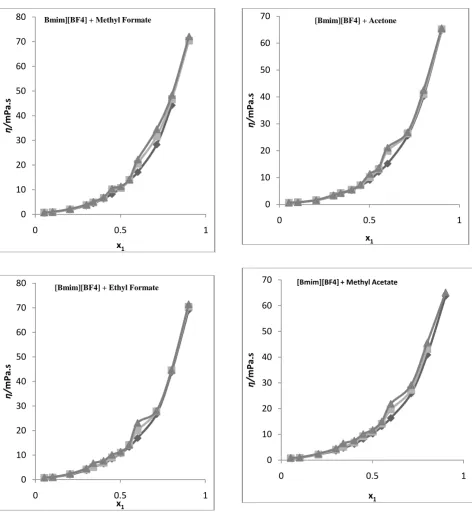
Fig. 3 Plot of experimental and theoretical viscosities of binary liquid mixture with mole fraction of ionic liquid. ;Experimental viscosity,;viscosity calculated from Grunberg-Nissan equation and▲; viscosity calculated from Kendall and Monroe
3. RESULTS AND DISCUSSION
A comparison is made for the pure components ([Bmim][BF4], methyl formate, methyl acetate, ethyl formate and acetone) in Table 1 between the 0
10 20 30 40 50 60 70 80
0 0.5 1
η/
m
Pa.
s
x1 Bmim][BF4] + Methyl Formate
0 10 20 30 40 50 60 70 80
0 0.5 1
η/
m
Pa.
s
x1
[Bmim][BF4] + Ethyl Formate
0 10 20 30 40 50 60 70
0 0.5 1
η/
m
Pa.
s
x1 [Bmim][BF4] + Acetone
0 10 20 30 40 50 60 70
0 0.5 1
η/
m
Pa.
s
x1
2130
experimental density and viscosity determined in this work and those reported in the literature. It can be seen that the values for [Bmim][BF4] and organic solvents agree well with those reported in the literature. The excess molar volumes, VE and the viscosity deviations, Δη of the mixture showed that the values are negative over the whole concentration range. To investigate the molecular interaction between [Bmim][BF4] and organic solvents, viscosity deviation, Δη, excess molar volumes VE and excess Gibbs free energy of activation of viscous flow, ΔG*E, have been evaluated from experimental density and viscosity using the following equations as below;
1 1 1 2 2 2
2 2 1
1M xM / xM / xM /
x
VE
(2)
) ( 1
1 2
2
x x (3)
where x1and x2are the mole fractions calculated from mass fractions. M1 and M2 are molar masses, ρ1 and ρ2 are densities, η1 and η2 are the viscosities of pure components 1 and 2 respectively. The excess Gibbs free energy of activation of viscous flow was obtained from Eq.( 3).
)]
ln
ln
(
[ln
1 1 1 2 2 2*
V
x
V
x
V
RT
G
E
(4)
where R is the universal constant of gases, T is the absolute temperature, V1and V2 are the molar volumes of component 1 and 2, x1 and x2
represents the mole fraction of component 1 and 2.
η1, η2 and η are the viscosity of component 1 and 2 and mixture respectively.
Molar volume is obtained from the relation as;
/
2 2 1 1M
x
M
x
V
(5) The values of VE and ∆η were correlated by a Redlich-Kister [15] type polynomial as;
]
)
1
2
(
)
1
2
(
)
1
2
(
)
1
2
(
[
4 1 43 1 3 2 1 2 1 1 1 0 2
1
Y
Ex
x
A
A
x
A
x
A
x
A
x
(6)
1 1 1
2
1 (2 1)
kK n k E x A x x
Y (7)
The values of the parameters Ak, are obtained by fitting the equation to the experimental values with the least-squares method. The correlated results for excess molar volume, and viscosity deviation are presented in table 2. The standard deviation σ(ΔY) is calculated from equation as;
2 / 1 2
exp ) / ]
( [ )
(Y Y Ycal n
(8)
where ΔY is the excess volume, VE and deviation in viscosity Δη, The subscript exp and calc represents the experimental and calculated values respectively. N and n are the number of experimental data points and the number of coefficients in the Redlich-Kister polynomial equation.
Kendall and Monroe [16] derived the equation for analyzing the viscosity of binary mixtures based on zero adjustable parameter as;
3 3 / 1 2 2 3 / 1 1 1
)
(
x
x
(9) 3 3 / 1 2 2 3 / 1 1 1 2
1 (
)
xx x xE (10)
where Eη is a modified Kendall-Monroe equation.
Grunberg and Nissan [17] formulated equation to determine the molecular interactions leading to viscosity changes with one parameter to estimate the dynamic viscosity of binary liquid as;
d x x x
x1ln 1 2ln 2 1 2
ln
(11) (11)where dʹ is an interaction which is a function of the composition and temperature of binary liquid mixture.
Mixture data was collected in Table 3. A careful perusal of the Table 3 clearly shows that values of experimental and computed viscosity (from two equations) increases with the increase of the amount of [Bmim][BF4] in binary liquid systems. Fig. 1 shows the variation of VE as a
function of mole fraction of the ionic liquid. It can be seen that the values of VE are negative in all the ranges of composition, indicating negative deviations from ideal behavior. Similar results have been reported for the mixtures of [Bmim] [BF4] + acetonitrile, dichloromethane,2-butanone,andN,N-dimethyl formamide [18] for 4-methyl-N-butylpyridinium tetra fluoroborate + methanol[19] and for 1-butyl-3-methylimidazolium hexafluoro phosphate [Bmim][PF6] + organic compounds. It is more interesting that all the VE in every [Bmim][BF4] +
organic solute system have minimum values at about x ≈ 0.2-0.3. The molecular dynamics
2131
VE[20]Methyl formate, methyl acetate, ethyl formate, and acetone as normal polar molecules are with dipole-dipole interaction. Ionic liquids [Bmim][BF4] are with electrostatic attractions between the [BF4]
-anion and[Bmim]+ cation[]17.The positive contribution to VE would be due to the breaking of two kinds of interactions::electrostatic attractions between the [BF4]-anion and [Bmim]+ cation and
dipole-dipole interaction in the organic polar molecules in the mixing process. Wang and co-worker’s studies of the ionic liquids [Bmim][BF4]and[Bmim][PF6] withorganicpolar
compounds revealed that the filling effect of organic compounds in the interstices of ionic liquids and the ion-dipole interactions between organicpolarcompound and theimidazoliumring of the ionic liquids are the main contributitors to the negative values of the molar excess volumes. The actual value of VE would depend on the balance of the two opposite contributions[18]. According to these investigations, it seems possible to suggest that the filling effect and the ion-dipole interactions predominate for the experimental VE values when methyl formate, methyl acetate,ethylformate, or acetoneis mixed with[Bmim][BF4]. The viscosity deviations ∆η for
the mixtures in Fig. 2 show a cleartrend:allvalues are negative andvery large values due tothe big differences between the ionic liquid’s and the other compounds viscosityinthe studiedrangesof compositionfor everybinarymixture.Theminium valuesareobservedatabout x≈0.55-0.65.
As far as the viscosity of the mixtures is plotted against mole fraction of the organic solutes, it is found that the organic solutes appear to have a surprisingly similar effect on the viscosity of the ionic liquids, as shown in Fig. 3.Therefore, the viscosity of the mixture of a binary system can be predicted as a function of the composition ofthe organic solutesorthe ionic liquid,at given temperature. As shown in Fig. 3, it is clear that the viscosities of the mixtures decrease rapidly when organic compounds are added to the ionic liquid.Thisdecreaseisparticularly strongindilute solutionsoforganiccompoundsintheionicliquid. The strong coulomb interactions between the [BF4]- anion and [Bmim]+ cation are weakened
upon mixing with the neutral organic compounds,whichleadstoahighermobilityofthe ions and a lower viscosity of the mixtures.Simmilar results can be explained when we look
4. CONCLUSIONS
The values of VE are negative in all the
ranges of compositions,and allthe VE values in every [Bmim][BF4] + organicsolute systemhave
minimum values at about x ≈ 0.2-0.3.The filling effect and the ion-dipole interactions are suggested topredominate for the experimental VE
values when methyl formate, methyl acetate, ethyl formate, or acetone is mixed with [Bmim][BF4]. The viscosity deviations ∆η are
negative and very large values due to the big differences between ionic liquid’s and other compounds viscosity. The minium values are observed at about mole fraction of the ionic liquid,x≈0.55-0.65.
REFERENCES
[1]. Rogers, R. D.; Seddon, K. R.(2003): Ionic liquids as solvents of the future, Science, 302, pp.792–793.
[2]. Jin, H.; O’Hare, B.; Dong, J.(2008): Arzhantsev, S.; Baker, G. A.; Wishart, J. F.; Benesi, A. J.; Maroncelli, M. Physical Properties of Ionic Liquids Consisting of the 1-Butyl-3-methylimidazolium Cation with Various Anions and the Bis (triflouro methylsulfonyl) imide Anion with Various Cations. J. Phys. Chem. B, 112, pp. 81–92.
[3]. Najdanovic-Visak, V.; Esperanca, J. M. S. S.; Rebelo, L. P. N.(2002): Nunes da Ponte, M.; Guedes, H. J. R.; Seddon, K. R.; Szydlowski, J. Phase behaviour of room temperature ionic liquid solutions: an unusually large co-solvent effect in (water + ethanol). Phys. Chem. Chem. Phys.,4, pp.1701–1703.
[4]. Gomez, E.; Gonzalez, B.; Calvar, N; Tojo, E.; Dominguez, A.(2006): Physical Properties of Pure 1-Ethyl-3-methylimidazolium Ethyl sulfate and Its Binary Mixtures with Ethanol and Water at Several Temperatures. J. Chem. Eng. Data, 51, pp.2096–2102.
[5]. Arce, A.; Rodil, E.; Soto, A.(2006): Volumetric and Viscosity Study for the Mixtures of 2-Ethoxy-2- methylpropane, Ethanol, and 1-Ethyl-3- methylimidazolium Ethyl Sulfate Ionic Liquid. J. Chem. Eng. Data, 51, pp.1453–1457.
[6]. Bhatia, S. C; Sangwan, J; Bhatia, R. (2011): Densities, speeds of sound and viscosities of binary liquid mixtures of octan-2-ol with benzene and halobenzenes at 298.15 and 303.15 K,J. Mol. Liq. 161 , pp.95-102.
2132
21.
[8]. Baskaran, R.; Kubendran, T. R. (2010): Refractive Indices and Surface Tension of Diacetone Alcohol + Benzene or Chlorobenzene at 303.15, 313.15 K and 323.15 K,Int. J. Appl. Sci. Eng. 8(2), pp.149-154. [9]. Patil, S. S.; Mirgane, S. R. (2011):
Volumetric and viscometric properties of binary liquid mixtures of acrylic esters with heptane-2-ol at 298.15 and 308.15 k temperatures, Rasayan J. Chem.,4(2), pp.445-4 [10]. Zivkovic, E. M.; Kijevcanin, M. L.; Radovic, I R.; Serbanovic, S. P.; Djordjevic, B. D. (2010): Viscosity of the binary systems 2-methyl-2-propanol with n-alkanes at
T = (303.15, 308.15, 313.15, 318.15 and 323.15) K: Prediction and correlation – New UNIFAC–VISCO interaction parameters, Fluid Phase Equilib. 299 , pp.191-197. [11]. Ye, C. F.; Shreeve, J. M.(2007): Rapid and
Accurate Estimation of Densities of Room- Temperature Ion Liquids and Salts. J. Phys. Chem. A, 111, pp.1456–1461.
[12]. Salomon, M.(1993): Conductance of solutions of lithium bis(trifl sulfone)imide in water, propylene carbonate, acetonitrile and methyl formate at 25o C. J. Solution Chem., 22, pp.715–725.
[13] Lu, H.; Wang, J. J.; Zhao, Y.; Xuan, X. P.; Zhuo, K. L.(2001): Excess molar volumes and viscosities for binary mixtures of γ-butyrolactone with methyl formate, ethyl formate, methyl acetate, ethyl acetate, and acetonitrile at 298.15 K. J. Chem. Eng. Data ,
46, pp.631–634.
[14]. Aralaguppi, M. I.; Jadar, C. V.; Aminabhavi, T. M.(1999): Density, Viscosity,Refractive Index, and Speed of Sound in Binary Mixtures of 2-Chloroethanol with Methyl Acetate, Ethyl Acetate Propyl Acetate, and n-Butyl Acetate. J. Chem. Eng. Data, 44, pp.441–445.
[15]. Redlich, O.; Kister, A. T. (1948): Algebraic Representation of Thermodynamic Properties and the Classification of Solutions, Ind. Eng. Chem. 40(2), 345-348.
[16]. Kendall, J.; Monroe, K. P. (1917):The viscosity of liquids. Ii. The viscosity-composition curve for ideal liquid mixtures J. Am. Chem. Soc.
39(9), pp.1787-1802.
[17]. Grunberg, L. Nissan, A. H. (1949): Mixture Law for Viscosity, Nature, 164, pp.799-800. [18]. Wang, J. J.; Zhu, A. L.; Zhao, Y.; Zhuo, K.
L.(2005): Excess Molar Volumes and Excess Logarithm Viscosities for Binary Mixtures of the Ionic Liquid 1-Butyl-3- methylimidazolium Hexaflurophosphate with
Some Organic Compounds. J. Solution Chem. ,34, pp.585–596.
[19]. Heintz, A.; Klasen, D.; Lehmann, J. K.(2002): Excess Molar Volumes and Viscosities of Binary Mixtures of Methanol and the Ionic Liquid 4-Methyl-N-butylpyridinium Tetrafluoroborate at 25, 40, and 50oC. J. Solution Chem., 31, pp. 467–476.
[20]. Amigo, A.; Bravo, R.; Pintos, M.(1993): Excess volume of binary mixtures containing cyclic ethers + alkanols at 298.15 K. J. Chem. Eng. Data, 38, pp. 141–142.
![Fig. 2 Viscosity deviation, ∆η for the mixtures of x[Bmim][BF4]+(1-x) organic solutes at 298.15 K.; [Bmim] [BF4] + MethylFormate, ; [Bmim][BF4] +Methyl Acetate,▲; [Bmim] [BF4] + Ethyl Formate, ×;[Bmim][BF4] + Acetone](https://thumb-us.123doks.com/thumbv2/123dok_us/738723.1083881/4.595.314.560.347.617/viscosity-deviation-mixtures-solutes-methylformate-acetate-formate-acetone.webp)
![Excess Volume of Binary Mixtures of Water (Methanol or Ethanol) with an Ionic Liquid [EEIM][DEP] or [BEIM][DEP] at 1 atm and (293.15 to 333.15) K](data:image/gif;base64,R0lGODlhAQABAIAAAP///wAAACH5BAEAAAAALAAAAAABAAEAAAICRAEAOw==)