!
"!" # $ $"
% & ''' (
Performance Analysis of Energy Efficient and QOS Routing Protocol for WSN
Ravi Teja B*
SCSE, VIT University Vellore, India [email protected]
Prof. Manikandan K
SCSE, VIT University Vellore, India [email protected]
Prof. T.Purusotham
Govt. College of Technology Coimbatore, Tamilnadu [email protected]
Abstract: The demand for real-time applications in WSN is increasing day by day. For the different WSN a based QoS requirement (e.g. bandwidth and delay constraints) raises significant challenges. Designing a data gathering algorithm in WSN for the needs of application/users raises an issue of energy at sensor node. While providing precise QoS guarantee, the networking protocols need to cope up with energy constraints. In many applications such as multimedia applications, or real-time and mission critical applications, the network traffic is mixed of delay sensitive and delay tolerant traffic. Enabling QoS in sensor networks requires energy and QoS awareness in different layers of the protocol stack. Energy Efficient and QoS aware multipath routing protocol(EQSR) that maximizes the network life time through balancing energy consumption across multiple nodes, uses the concept of service differentiation to allow delay sensitive traffic to reach the sink node within an acceptable delay, reduces the end to end delay through spreading out the traffic across multiple paths, and increases the throughput through introducing data redundancy.
Keywords: Wireless Sensor Networks, Quality of Service (QOS), Routing protocol
I.INTRODUCTION
A sensor is a device that produces a measurable response to a change in physical condition. Temperature or chemical condition such as concentration etc. Wireless sensor networks consist of a large-number of sensor nodes which are spatially distributed autonomously to cooperate monitor physical or environmental conditions, such as temperature, sound, vibration, pressure, motion, chemical condition such as concentration or pollutants. The development of wireless sensor networks was motivated by military applications such as battlefield surveillance and is now used in many industrial and civilian application areas, including industrial process monitoring and control, machine health monitoring, environment and habitat monitoring, healthcare applications, home automation, and traffic control. In addition to one or more sensors, each node in a sensor network is typically equipped with a radio transceiver or other wireless communications device, a small microcontroller, and an energy source, usually a battery. A sensor node might vary in size from that of a shoebox down to the size of a grain of dust, although functioning "motes" of genuine microscopic dimensions have yet to be created. The cost of sensor nodes is similarly variable, ranging from hundreds of dollars to a few pennies, depending on the size of the sensor network and the complexity required of individual sensor nodes. Size and cost constraints on sensor nodes result in corresponding constraints on resources such as energy, memory, computational speed and bandwidth. A sensor network normally that each sensor supports a multi-hop routing algorithm where nodes function as forwarders, relaying data packets to a base station. The applications for WSNs are varied, typically involving some kind of monitoring, tracking, or controlling. Specific
applications include habitat monitoring, object tracking, fire detection, land slide detection and traffic monitoring. In a typical application, a WSN is scattered in a region where it is meant to collect data through its sensor nodes and has to achieve lower average delay and more energy savings.
II.ARCHITECTURE
Each node in a sensor network is typically equipped with a radio transceiver or other wireless communications device, a small microcontroller, and an energy source, usually a battery. A sensor node might vary in size resulting constraints on resources such as energy, memory, computational speed and bandwidth. The general architecture of WSN is given in the fig.1 as below
Figure 1: General architecture of wsn
In wireless sensor networks, the sensor node resources are limited in terms of processing capability, wireless bandwidth, battery power and storage space, which distinguishes wireless sensor networks from traditional ad hoc networks. In most applications, each sensor node is usually powered by a battery and expected to work for several months to one year without
POWER
Sensor
AD C
CP U
recharging. For a sensor node, energy consumption includes three parts: data sensing, data processing, and data transmission/reception, amongst which, the energy consumed for communication is the most critical. Reducing the amount of communication by eliminating or aggregating redundant sensed data and using the energy-saving link would save large amount of energy, thus prolonging the lifetime of the WSNs. There has been much work on “power-aware” routing protocols for wireless networks. In these protocols, optimal routes are chosen based on the energy at each node along the route. Routes that are longer, but which use nodes with more energy than the nodes along the shorter routes. In a typical application, a WSN is scattered in a region where it is meant to collect data through its sensor nodes. The hardware and software structure of the sensor network is described below. A. Hardware
Sensor network is a network of many tiny disposable low power devices, called nodes, which are spatially distributed in order to perform an application-oriented global task. These nodes form and ADC (Analog to Digital Converter). The sensor unit is responsible for collecting information as the ADC requests, and returning the analog data it sensed. ADC is a translator that tells the CPU what the sensor unit has sensed, and also informs the sensor unit what to do. Communication unit is tasked to receive command or query from and transmit the data from CPU to the outside world. CPU is the most complex unit. It interprets the command or query to ADC, monitors and controls power if necessary, processes received data, computes the next hop to the sink, etc. Power unit supplies power to sensor unit, processing unit and communication unit. Also inherent to sensor network adoption is the availability of a very low power method for acquiring sensor data wirelessly.
B. Software
Energy is the scarcest resource of WSN nodes, and it determines the lifetime of WSNs. WSNs is meant to be deployed in large numbers in various environments, including remote and hostile regions, with ad-hoc communications as key. For this reason, algorithms and protocols need to address the following issues: distinguishes wireless sensor networks from traditional ad hoc networks. In most applications, each sensor node is usually powered by a battery and expected to work for several months to one year without recharging. For a sensor node, energy consumption includes three parts: data sensing, data processing, and data transmission/reception, amongst which, the energy consumed for communication is the most critical. Reducing the amount of communication by eliminating or aggregating redundant sensed data and using the energy-saving link would save large amount of energy, thus prolonging the lifetime of the WSNs.
For a sensor node, energy consumption includes three parts: data sensing, data processing, and data transmission/reception, amongst which, the energy consumed for communication is the most critical. Reducing the number of communication by eliminating or aggregating redundant sensed data and using the energy-saving link would save large
amount of energy, and then prolonging the life-time of the WSN.
Data gathering is a typical operation in many applications of WSNs, where data aggregation in a hierarchical manner is widely used for prolonging network life-time. Data aggregation can eliminate data redundancy and reduce the communication load. The main task of data gathering application is to forward the sensed data gathered by sensor nodes to the sink node. One simple approach to the fulfilment of this task is direct data transmission.
III.NETWORK PROTOCOLS
When designing network protocols for wireless sensor networks, several factors should be considered. First and foremost, because of the scarce energy resources, routing decisions should be guided by some awareness of the energy resources in the network. Communication in sensor networks is typically referred to as 7data-centric, rather than address-centric, and data may be aggregated locally rather than having all raw data sent to the sink(s). These unique features of sensor networks have implications in the network layer and thus require are-thinking of protocols for data routing. Classifications of wireless networks are done based on different criteria. Routing protocols can be broadly classified into four categories based on
• Routing update information
• Use of temporal information for routing • Routing protocol
• Utilization of specific resources
Again these wireless network routing protocols are classified majorly into three based on routing information update mechanism. They are:
• Proactive or table driven approach – In this proactive it will first compute all routes and is maintained in tables at each node which is flodded in the whole network and route according to the computed route; • Reactive – In this reactive it will not maintain any
network topology information and compute routes on demand. Hence they don’t exchange information periodically.
• Hybrid – In this hybrid it will First Compute all Routes in a region or zone using table-driven approach and nodes beyond this region are computed on demand while Routing.
A. Leach
Low Energy Adaptive Clustering Hierarchy
heads comprising 5% of total nodes. It uses Time Division Multiple Access (TDMA) as a scheduling mechanism which makes it prone to long delays when applied to large sensor networks. In-network processing can greatly reduce the overall power consumption of a sensor network when large amounts of redundancy exist between nearby nodes. Rather than requiring all sensors’ data to be forwarded to a base station that is monitoring the environment, nodes within a region can collaborate and send only a single summarization packet for the region. This use of clustering was first introduced in the Low Energy Adaptive Clustering Hierarchy (LEACH) protocol. In LEACH, nodes are divided into clusters, each containing a cluster head whose role is considerably more energy intensive than the rest of the nodes; for this reason, nodes rotate roles between clusters Head and ordinary sensor throughout the lifetime of the network.
S. Lindsey proposed an algorithm related to LEACH, called PEGASIS. In this approach, for a node, within a range of some distance, the energy consumed for receiving or sending circuits is higher than that consumed for amplifying circuits. In order to reduce the energy consumption of sensor nodes, PEGASIS uses the GREED algorithm to form all the sensor nodes in the system into a chain. According to its simulation results, the performance of PEGASIS is better than that of LEACH especially when the distance between sensor network and base station is far away. In LEACH, to deal with the heterogeneous energy circumstance, the node with higher energy should have larger probability to become the cluster head. In their study, each node must have an estimate of the total energy of all nodes in the network to compute for the probability of becoming a cluster head. As a result, each node cannot make a decision to become a cluster head only by its local information.
B. Deeg
Distributed and energy-efficient protocol, called DEEG for data gathering and aggregation in WSNs. A node with high ratio of residual energy to the average residual energy of its cluster range will have a large probability to become the cluster head. This can better handle heterogeneous energy circumstances than existing clustering algorithms, which elect the cluster head only based only on the node’s residual energy. After the cluster formation phase, DEEG constructs a spanning tree over the set of cluster nodes. Only the root node of this tree can communicate with the sink node by single-hop communication. Because the energy consumed for all communications in in-network communications can be computed by the free space model, the energy will be extremely saved and thus lead to sensor network longevity. Also, DEEG utilizes a simple but efficient approach to solve the area coverage problem. With the increase in node density, using this approach, the network lifetime can be made linear in the number of deployed nodes.
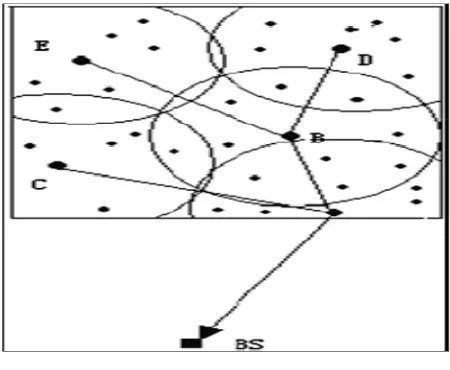
LEACH, the nodes organize themselves into local clusters, with one node acting as the cluster head. All non-cluster head nodes transmit their data to the non-cluster head, while the cluster head node receives the data from all the cluster members, performs signal processing functions on the data (e.g., data aggregation), and transmits data to the remote BS (Base Station) as shown in the fig.2 below.
Therefore, being a cluster head is more energy intensive than being a non-cluster head node. If the cluster heads were chosen a priori, and fixed throughout the system lifetime, these nodes would quickly use up their limited energy. Once the cluster head runs out of energy, it is no longer operational. In other words, it is dead.
Figure.2: illustration of DEEG protocol
The simulation of the formation of cluster in the protocol is done in ns2 environment and is given in fig.3 below:
Figure 3: Simulation showing cluster formation
Thus all the nodes that belong to the cluster lose communication ability. Thus, LEACH incorporates randomized rotation of the high-energy cluster head position among the sensors to avoid draining the battery of any one sensor in the network. In this way, the energy load of being a cluster head is evenly distributed among the nodes.
On the other hand, in DEEG, after the cluster formation phase,
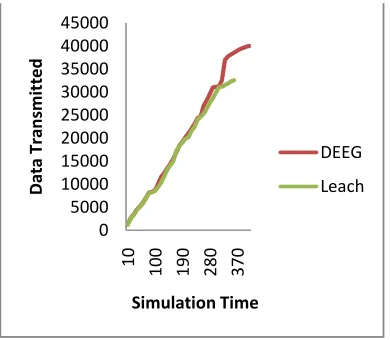
head. The comparison of total data received with respect to the time can be observed in the fig.6. Thus, the energy that is
spent in data aggregation, by the cluster heads is minimized in this approach.
Figure.4: Simulation showing non-cluster node sending data to cluster head
Figure 5: Comparison of Number of nodes alive with Time
Simulation is done in ns-2 environment and results are analyzed with tracegragh.
Figre 6: Comparison of Total data received with time
IV.CONCLUSION
If protocol use the residual energy, node available buffer size, and signal-to noise ratio to predict the next hop through the paths construction phase which splits up the transmitted message into number of segments of equal size, adds correction codes, and then transmits it over multiple paths simultaneously to increase the probability that an essential portion of the packet is received at the destination without incurring excessive delay where protocol handles both real-time and non-real-real-time traffic efficiently, by employing a queuing model that provides service differentiation. The Protocol achieves lower average delay and more energy savings.
V.REFERENCES
[1] Shio Kumar Singh, M P Singh, D K Singh, Routing Protocols in Wireless Sensor Networks – A Survey, International Journal of Computer Science & Engineering Survey (IJCSES) Vol.1, No.2, November 2010
[2] Kemal Akkaya, Mohamed Younis, A survey on routing protocols for wireless sensor networks, Journal of Ad Hoc Networks3 (3) (2005) 325-349.
[3] David B. Johnson, The Dynamic Source Routing Protocol for Mobile Ad Hoc Networks (DSR) 2004 [4] Ming Liu , Jiannong Cao, An Energy-Aware Routing Protocol in Wireless Sensor Networks January 2009 445-446.
[5] K. Khamforoosh, and H. Khamforoush, “A new rounting Algorithm for Energy Reduction in Wireless Sensor Networks”, IEEE, 2009
[6] J.N Al-Karaki, and A.E. Kamal, “Routing techniques in wireless sensor networks: a survey”, IEEE Wireless Communications, Vol. 11, No. 6, pp.6-28, December 2004.
[7] M. Younis, M. Youssef and K. Arisha, “Energy-Aware Routing in Cluster-Based Sensor Networks”, in the Proceedings of the 10th IEEE/ACM(MASCOTS2002), Fort Worth, TX, October 2002
[8] S. Lindsay and C. Raghavendra, “PEGASIS: Power-Efficient Gathering in Sensor Information Systems”, international Conf. on Communications, 2001. Anew routing
[10] W. Heinzelman, A. Chandrakasan, and H. Balakrishnan, “Energy-efficient routing protocols for wireless microsensor networks,” in Proc. 33rd Hawaii Int. Conf. Sys tem Sciences (HICSS),Maui,HI,Jan.2000.
[11] K. Khamforoosh, and H. Khamforoush, “A new rounting Algorithm for Energy Reduction in Wireless Sensor Networks”, IEEE, 2009
[12 ] R. V. Biradar, V. C. Patil, Dr. S. Sawant, and Dr. R. R. Mudholkar, “Classification and comparison of routing protocols in wireless sensor networks”, UbiCC Journal,Vol4.
[13] S.K. Singh, M.P. Singh, and D.K. Singh, “A survey of Energy-Efficient Hierarchical Cluster-based Routing in Wireless Sensor Networks”, International Journal of Advanced Networking and Application (IJANA), Sept.– Oct. 2010, vol. 02, issue 02, pp. 570–580.
[14] S.K. Singh, M.P. Singh, and D.K. Singh, "Energy- efficient Homogeneous Clustering Algorithm for Wireless Sensor Network", International Journal of Wireless & Mobile Networks (IJWMN), Aug. 2010, vol. 2, no. 3, pp. 49-61.
[16] S. Misra et al. (eds.), Guide to Wireless Sensor Networks, Computer Communications and Networks, DOI:
10.1007/978-1-84882-218-4 4, Springer-Verlag London