Can We Translate Letters?
David Vilar, Jan-T. Peter and Hermann Ney
Lehrstuhl f¨ur Informatik 6 RWTH Aachen University D-52056 Aachen, Germany
{vilar,peter,ney}@cs.rwth-aachen.de
Abstract
Current statistical machine translation sys-tems handle the translation process as the transformation of a string of symbols into another string of symbols. Normally the symbols dealt with are the words in differ-ent languages, sometimes with some addi-tional information included, like morpho-logical data. In this work we try to push the approach to the limit, working not on the level of words, but treating both the source and target sentences as a string of letters. We try to find out if a nearly unmodified state-of-the-art translation system is able to cope with the problem and whether it is ca-pable to further generalize translation rules, for example at the level of word suffixes and translation of unseen words. Experiments are carried out for the translation of Catalan to Spanish.
1 Introduction
Most current statistical machine translation systems handle the translation process as a “blind” transfor-mation of a sequence of symbols, which represent the words in a source language, to another sequence of symbols, which represent words in a target lan-guage. This approach allows for a relative simplic-ity of the models, but also has drawbacks, as re-lated word forms, like different verb tenses or plural-singular word pairs, are treated as completely differ-ent differ-entities.
Some efforts have been made e.g. to integrate more information about the words in the form of Part
Of Speech tags (Popovi´c and Ney, 2005), using addi-tional information about stems and suffixes (Popovi´c and Ney, 2004) or to reduce the morphological vari-ability of the words (de Gispert, 2006). State of the art decoders provide the ability of handling different word forms directly in what has been called factored translation models (Shen et al., 2006).
In this work, we try to go a step further and treat the words (and thus whole sentences) as sequences of letters, which have to be translated into a new se-quence of letters. We try to find out if the trans-lation models can generalize and generate correct words out of the stream of letters. For this approach to work we need to translate between two related languages, in which a correspondence between the structure of the words can be found.
For this experiment we chose a Catalan-Spanish corpus. Catalan is a romance language spoken in the north-east of Spain and Andorra and is considered by some authors as a transitional language between the Iberian Romance languages (e.g. Spanish) and Gallo-Romance languages (e.g. French). A common origin and geographic proximity result in a similar-ity between Spanish and Catalan, albeit with enough differences to be considered different languages. In particular, the sentence structure is quite similar in both languages and many times a nearly monotoni-cal word to word correspondence between sentences can be found. An example of Catalan and Spanish sentences is given in Figure 1.
The structure of the paper is as follows: In Sec-tion 2 we review the statistical approach to machine translation and consider how the usual techniques can be adapted to the letter translation task. In
Catalan Perqu`e a mi m’agradaria estar-hi dues, una o dues setmanes, m´es o menys, depenent del preu i cada hotel.
Spanish Porque a m´ı me gustar´ıa quedarme dos, una o dos semanas, m´as o menos, dependiendo del precio y cada hotel.
English Because I would like to be there two, one or two weeks, more or less, depending on the price of each hotel.
Catalan Si baixa aqu´ı tenim una guia de la ciutat que li podem facilitar en la que surt informaci´o sobre els llocs m´es interessants de la ciutat.
Spanish Si baja aqu´ı tenemos una gu´ıa de la ciudad que le podemos facilitar en la que sale infor-maci´on sobre los sitios m´as interesantes de la ciudad.
English If you come down here we have a guide book of the city that you can use, in there is information about the most interesting places in the city.
Figure 1: Example Spanish and Catalan sentences (the English translation is provided for clarity).
tion 3 we present the results of the letter-based trans-lation and show how to use it for improving transla-tion quality. Although the interest of this work is more academical, in Section 4 we discuss possible practical applications for this approach. The paper concludes in Section 5.
2 From Words To Letters
In the standard approach to statistical machine trans-lation we are given a sentence (sequence of words) f1J =f1. . . fJ in a source language which is to be translated into a sentenceeˆI1 = ˆe1. . .eIˆ in a target language. Bayes decision rule states that we should choose the sentence which maximizes the posterior probability
ˆ
eI1 = argmax
eI
1
p(eI1|f1J), (1)
where theargmaxoperator denotes the search pro-cess. In the original work (Brown et al., 1993) the posterior probability p(eI
1|f
J
1) is decomposed
fol-lowing a noisy-channel approach, but current state-of-the-art systems model the translation probabil-ity directly using a log-linear model(Och and Ney, 2002):
p(eI1|f1J) =
expPM
m=1λmhm(e I
1, f
J
1)
X
˜
eI
1
expPM
m=1λmhm(˜e I
1, f
J
1)
,
(2) with hm different models, λm scaling factors and the denominator a normalization factor that can be
ignored in the maximization process. Theλm are usually chosen by optimizing a performance mea-sure over a development corpus using a numerical optimization algorithm like the downhill simplex al-gorithm (Press et al., 2002).
The most widely used models in the log lin-ear combination are phrase-based models in source-to-target and target-to-source directions, ibm1-like scores computed at phrase level, also in source-to-target and source-to-target-to-source directions, a source-to-target lan-guage model and different penalties, like phrase penalty and word penalty.
This same approach can be directly adapted to the letter-based translation framework. In this case we are given a sequence of letters FJ
1 corresponding
to a source (word) stringfJ
1, which is to be
trans-lated into a sequence of lettersEI
1 corresponding to
a stringeI
1in a target language. Note that in this case
whitespaces are also part of the vocabulary and have to be generated as any other letter. It is also impor-tant to remark that, without any further restrictions, the word sequenceseI
1 corresponding to a generated
letter sequenceEI
1 are not even composed of actual
words.
2.1 Details of the Letter-Based System
whitespace and punctuation marks, while the vocab-ulary size of a word-based system like the ones used in current evaluation campaigns is in the range of tens or hundreds of thousands words. In a normal situation there are no unknowns when carrying out the actual translation of a given test corpus. The sit-uation can be very different if we consider languages like Chinese or Japanese.
This small vocabulary size allows us to deal with a larger context in the models used. For the phrase-based models we extract all phrases that can be used when translating a given test corpus, without any restriction on the length of the source or the tar-get part1. For the language model we were able to use a high-order n-gram model. In fact in our ex-periments a 16-gram letter-based language model is used, while state-of-the-art translation systems nor-mally use 3 or 4-grams (word-based).
In order to better try to generate “actual words” in the letter-based system, a new model was added in the log-linear combination, namely the count of words generated that have been seen in the training corpus, normalized with the length of the input sen-tence. Note however that this models enters as an ad-ditional feature function in the model and it does not constitute a restriction of the generalization capabil-ities the model can have in creating “new words”. Somehow surprisingly, an additional word language model did not help.
While the vocabulary size is reduced, the average sentence length increases, as we consider each let-ter to be a unit by itself. This has a negative impact in the running time of the actual implementation of the algorithms, specially for the alignment process. In order to alleviate this, the alignment process was split into two passes. In the first part, a word align-ment was computed (using the GIZA++ toolkit (Och and Ney, 2003)). Then the training sentences were split according to this alignment (in a similar way to the standard phrase extraction algorithm), so that the length of the source and target part is around thirty letters. Then, a letter-based alignment is computed.
2.2 Efficiency Issues
Somewhat counter-intuitively, the reduced vocabu-lary size does not necessarily imply a reduced
mem-1For the word-based system this is also the case.
ory footprint, at least not without a dedicated pro-gram optimization. As in a sensible implementa-tions of nearly all natural language processing tools, the words are mapped to integers and handled as such. A typical implementation of a phrase table is then a prefix-tree, which is accessed through these word indices. In the case of the letter-based transla-tion, the phrases extracted are much larger than the word-based ones, in terms of elements. Thus the to-tal size of the phrase table increases.
The size of the search graph is also larger for the letter-based system. In most current systems the generation algorithm is a beam search algorithm with a “source synchronous” search organization. As the length of the source sentence is dramatically increased when considering letters instead of words, the total size of the search graph is also increased, as is the running time of the translation process.
The memory usage for the letter system can ac-tually be optimized, in the sense that the letters can act as “indices” themselves for addressing the phrase table and the auxiliary mapping structure is not nec-essary any more. Furthermore the characters can be stored in only one byte, which provides a signifi-cant memory gain over the word based system where normally four bytes are used for storing the indices. These gains however are not expected to counteract the other issues presented in this section.
3 Experimental Results
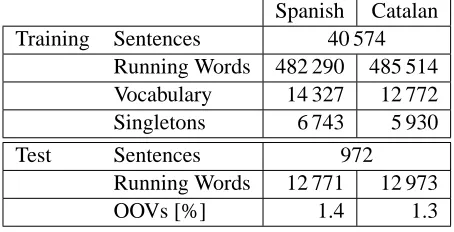
The corpus used for our experiment was built in the framework of the LC-STAR project (Conejero et al., 2003). It consists of spontaneous dialogues in Span-ish, Catalan and English2 in the tourism and travel-ling domain. The test corpus (and an additional de-velopment corpus for parameter optimization) was randomly extracted, the rest of the sentences were used as training data. Statistics for the corpus can be seen in Table 1. Details of the translation system used can be found in (Mauser et al., 2006).
The results of the word-based and letter-based approaches can be seen in Table 2 (rows with la-bel “Full Corpus”). The high BLEU scores (up to nearly 80%) denote that the quality of the trans-lation is quite good for both systems. The
word-2The English part of the corpus was not used in our
Spanish Catalan Training Sentences 40 574
Running Words 482 290 485 514 Vocabulary 14 327 12 772 Singletons 6 743 5 930
Test Sentences 972
Running Words 12 771 12 973
[image:4.612.72.299.59.175.2]OOVs [%] 1.4 1.3
Table 1: Corpus Statistics
based system outperforms the letter-based one, as expected, but the letter-based system also achieves quite a good translation quality. Example transla-tions for both systems can be found in Figure 2. It can be observed that most of the words generated by the letter based system are correct words, and in many cases the “false” words that the system gen-erates are very close to actual words (e.g. “elos” in-stead of “los” in the second example of Figure 2).
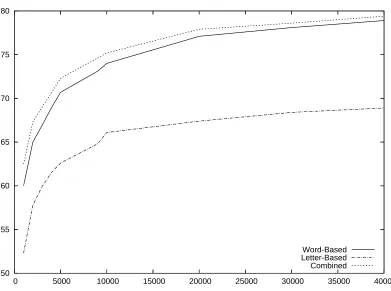
We also investigated the generalization capabili-ties of both systems under scarce training data con-ditions. It was expected that the greater flexibility of the letter-based system would provide an advan-tage of the approach when compared to the word-based approach. We randomly selected subsets of the training corpus of different sizes ranging from 1 000 sentences to 40 000 (i.e. the full corpus) and computed the translation quality on the same test corpus as before. Contrary to our hopes, however, the difference in BLEU score between the word-based and the letter-word-based system remained fairly constant, as can be seen in Figure 3, and Table 2 for representative training corpus sizes.
Nevertheless, the second example in Figure 2 pro-vides an interesting insight into one of the possi-ble practical applications of this approach. In the example translation of the word-based system, the word “centreamericans” was not known to the sys-tem (and has been explicitly marked as unknown in Figure 2). The letter-based system, however, was able to correctly learn the translation from “centre-” to “centro-” and that the ending “-ans” in Catalan is often translated as “-anos” in Spanish, and thus a correct translation has been found. We thus chose to combine both systems, the word-based system do-ing most of the translation work, but usdo-ing the
letter-based system for the translation of unknown words. The results of this combined approach can be found in Table 2 under the label “Combined System”. The combination of both approaches leads to a 0.5% in-crease in BLEU using the full corpus as training ma-terial. This increase is not very big, but is it over a quite strong baseline and the percentage of out-of-vocabulary words in this corpus is around 1% of the total words (see Table 1). When the corpus size is reduced, the gain in BLEU score becomes more im-portant, and for the small corpus size of 1 000 sen-tences the gain is 2.5% BLEU. Table 2 and Figure 3 show more details.
4 Practical Applications
The approach described in this paper is mainly of academical interest. We have shown that letter-based translation is in principle possible between similar languages, in our case between Catalan and Spanish, but can be applied to other closely related language pairs like Spanish and Portuguese or Ger-man and Dutch. The approach can be interesting for languages where very few parallel training data is available.
The idea of translating unknown words in a letter-based fashion can also have applications to state-of-the-art translation systems. Nowadays most auto-matic translation projects and evaluations deal with translation from Chinese or Arabic to English. For these language pairs the translation of named en-tities poses an additional problem, as many times they were not previously seen in the training data and they are actually one of the most informative words in the texts. The “translation” of these enti-ties is in most cases actually a (more or less pho-netic) transliteration, see for example (Al-Onaizan and Knight, 2002). Using the proposed approach for the translation of these words can provide a tighter integration in the translation process and hopefully increase the translation performance, in the same way as it helps for the case of the Catalan-Spanish translation for unseen words.
BLEU WER PER Word-Based System Full Corpus 78.9 11.4 10.6
10k 74.0 13.9 13.2
1k 60.0 21.3 20.1
Letter-Based System Full Corpus 72.9 14.7 13.5
10k 69.8 16.5 15.1
1k 55.8 24.3 22.8
Combined System Full Corpus 79.4 11.2 10.4
10k 75.2 13.4 12.6
[image:5.612.168.447.96.244.2]1k 62.5 20.2 19.0
Table 2: Translation results for selected corpus sizes. All measures are percentages.
Source (Cat) B´e, en principi seria per a les vacances de Setmana Santa que s´on les seg¨uents que tenim ara, entrant a juliol.
Word-Based Bueno, en principio ser´ıa para las vacaciones de Semana Santa que son las siguientes que tenemos ahora, entrando en julio.
Letter-Based Bueno, en principio ser´ıa para las vacaciones de Semana Santa que son las siguientes que tenemos ahora, entrando bamos en julio .
Reference Bueno, en principio ser´ıa para las vacaciones de Semana Santa que son las siguientes que tenemos ahora, entrando julio.
Source (Cat) Jo li recomanaria per exemple que intent´es apropar-se a algun pa´ıs ve´ı tamb´e com poden ser els pa¨ısos centreamericans, una mica m´es al nord Panam´a.
Word-Based Yo le recomendar´ıa por ejemplo que intentase acercarse a alg´un pa´ıs vecino tambi´en como pueden ser los pa´ıses UNKNOWN centreamericans, un poco m´as al norte Panam´a.
Letter-Based Yo le recomendar´ıa por ejemplo que intentaseo acercarse a alg´un pa´ıs ve´ı tambi´en como pueden ser elos pa´ıses centroamericanos, un poco m´as al norte Panam´a.
Combined Yo le recomendar´ıa por ejemplo que intentase acercarse a alg´un pa´ıs vecino tambi´en como pueden ser los pa´ıses centroamericanos, un poco m´as al norte Panam´a.
Reference Yo le recomendar´ıa por ejemplo que intentase acercarse a alg´un pa´ıs vecino tambi´en como pueden ser los pa´ıses centroamericanos, un poco m´as al norte Panam´a.
[image:5.612.69.553.357.629.2]50 55 60 65 70 75 80
0 5000 10000 15000 20000 25000 30000 35000 40000
[image:6.612.114.505.57.348.2]Word-Based Letter-Based Combined
Figure 3: Translation quality depending of the corpus size.
acoustic data. The problem can be formulated as a translation from graphemes (“letters”) to a sequence of graphones (“pronunciations”), see for example (Bisani and Ney, 2002). The proposed letter-based approach can also be adapted to this task.
Lastly, a combination of both, word-based and letter-based models, working in parallel and perhaps taking into account additional information like base forms, can be helpful when translating from or into rich inflexional languages, like for example Spanish.
5 Conclusions
We have investigated the possibility of building a letter-based system for translation between related languages. The performance of the approach is quite acceptable, although, as expected, the quality of the word-based approach is superior. The combination of both techniques, however, allows the system to translate words not seen in the training corpus and thus increase the translation quality. The gain is spe-cially important when the training material is scarce. While the experiments carried out in this work are more interesting from an academical point of view,
several practical applications has been discussed and will be the object of future work.
Acknowledgements
This work was partly funded by the Deutsche Forschungsgemeinschaft (DFG) under the project “Statistische Text¨ubersetzung” (NE 572/5-3).
References
Yaser Al-Onaizan and Kevin Knight. 2002. Machine transliteration of names in arabic text. In
Proceed-ings of the ACL-02 workshop on Computational ap-proaches to semitic languages, pages 1–13,
Morris-town, NJ, USA. Association for Computational Lin-guistics.
Max Bisani and Hermann Ney. 2002. Investigations
on joint-multigram models for grapheme-to-phoneme conversion. In Proceedings of the 7th International
Conference on Spoken Language Processing,
vol-ume 1, pages 105–108, Denver, CO, September.
esti-mation. Computational Linguistics, 19(2):263–311,
June.
D. Conejero, J. Gimnez, V. Arranz, A. Bonafonte, N. Pas-cual, N. Castell, and A. Moreno. 2003. Lexica and corpora for speech-to-speech translation: A trilingual
approach. In European Conf. on Speech
Commu-nication and Technology, pages 1593–1596, Geneva,
Switzerland, September.
Adri`a de Gispert. 2006. Introducing Linguistic
Knowl-edge into Statistical Machine Translation. Ph.D.
the-sis, Universitat Polit`ecnica de Catalunya, Barcelona, October.
Arne Mauser, Richard Zens, Evgeny Matusov, Saˇsa Hasan, and Hermann Ney. 2006. The RWTH Statisti-cal Machine Translation System for the IWSLT 2006 Evaluation. In Proc. of the International Workshop on
Spoken Language Translation, pages 103–110, Kyoto,
Japan.
Franz Josef Och and Hermann Ney. 2002. Discrimina-tive training and maximum entropy models for statis-tical machine translation. In Proc. of the 40th Annual
Meeting of the Association for Computational Linguis-tics (ACL), pages 295–302, Philadelphia, PA, July.
Franz Josef Och and Hermann Ney. 2003. A system-atic comparison of various statistical alignment mod-els. Computational Linguistics, 29(1):19–51, March.
Maja Popovi´c and Hermann Ney. 2004. Towards the Use of Word Stems and Suffixes for Statistical Ma-chine Translation. In 4th International Conference on
Language Resources and Evaluation (LREC), pages
1585–1588, Lisbon, Portugal, May.
Maja Popovi´c and Hermann Ney. 2005. Exploiting
Phrasal Lexica and Additional Morpho-syntactic Lan-guage Resources for Statistical Machine Translation with Scarce Training Data. In 10th Annual Conference
of the European Association for Machine Translation (EAMT), pages 212–218, Budapest, Hungary, May.
William H. Press, Saul A. Teukolsky, William T. Vetter-ling, and Brian P. Flannery. 2002. Numerical Recipes
in C++. Cambridge University Press, Cambridge, UK.
Wade Shen, Richard Zens, Nicola Bertoldi, and Marcello Federico. 2006. The JHU Workshop 2006 IWSLT System. In Proc. of the International Workshop on
Spoken Language Translation, pages 59–63, Kyoto,