Available Online atwww.ijcsmc.com
International Journal of Computer Science and Mobile Computing
A Monthly Journal of Computer Science and Information Technology
ISSN 2320–088X
IJCSMC, Vol. 4, Issue. 6, June 2015, pg.562 – 569
RESEARCH ARTICLE
Secure Method for AODV Routing By Detection and
Prevention of Collaborative Blackhole Attack in MANET
Priya Jeejo Payyappilly
1, Pinaki A. Ghosh
2¹Atmiya Institute of Technology and Science, Rajkot, Gujarat, India
²Atmiya Institute of Technology and Science, Rajkot, Gujarat, India 1 [email protected], 2 [email protected]
Abstract— Mobile Ad Hoc networks (MANETS) are self configuring, decentralized networks in which the nodes communicate without the need of infrastructure. The nodes work in an environment in which mutual trust between the nodes form an important part of the communication. This property of the network is exploited to launch a blackhole attack. Blackhole attack is a network layer denial of service attack in which an adversary node attracts the data traffic towards itself by advertising a short route to the destination and instead of forwarding, it simply drops the packets. When multiple malicious nodes launch a simultaneous attack, it degrades the performance of the network considerably. This research aims at purging the network of collaborative blackhole nodes by use of trust values to distinguish malicious node from a genuine node. Simulation results show a better performance of the network under the collaborative blackhole attack.
Keywords— MANETs, Blackhole attack, Collaborative blackhole attack, selfish node, trust value, denial of service, AODV.
I.
I
NTRODUCTIONThe rapid proliferation of wireless networks and devices has brought us to a new age of information storage, sharing
and retrieval. Easy availability of wireless devices renders a promising environment of flawless communication
without the need of wires in the near future. One such development in the field is the Ad Hoc Network. It is a
budding field of research and deployment which focuses on minimizing the use of base stations [2] or access points
used in conventional wireless networks for communication. „Ad Hoc‟ is a Latin word meaning „for a specific
purpose‟. Ad hoc networks are formed by autonomous systems communicating to each other mostly through wireless
links. Each device in the network is known as a node. The nodes are peers; having similar privileges and functioning
as a client and server interchangeably during the course of communication period. The concept of Ad Hoc Networks
has been further extended to incorporate the nodes when they are moving. This concept is known as Mobile Ad Hoc
Network [1] [2] also known by the acronym MANET. MANETs do not rely on any base stations or access points for its
functioning. Nodes co-operate to forward data to each other in the network [1] [2] assuming the nodes to be trustworthy.
This property of MANETs is abused by adversaries to launch blackhole attack [3] [4]. It is a network layer denial of
performance of the network to a great extent. Further harm is done when a number of nodes carry out this attack
simultaneously. This is known as collaborative blackhole attack [4]. The purview of this research is to study the
harmful effects of collaborative blackhole attack on MANET performance using the AODV protocol and propose a
solution to mitigate this attack.
The rest of this paper is organized as follow: Section II explains the protocols used for MANETs emphasizing on the
AODV protocol. Then attacks on MANETs are explained highlighting blackhole and collaborative blackhole attacks.
Section III explains the literature survey carried out for mitigation of blackhole and collaborative blackhole attacks.
Section IV explains the proposed approach and its followed by conclusion and references.
II.
Routing Protocols and Security Vulnerabilities of MANETs
A. Protocols in MANETs:
Routing Protocols help in assigning an optimal and efficient path for the data packet to reach from the sender to the
receiver. They help in discovery of route from sender to receiver, forwarding data from sender to receiver and
maintenance of the found route. Routing protocols in MANETs are categorized as proactive, reactive and hybrid
routing protocols. Proactive Routing protocols are also known as table driven routing protocols [6] [2]. That is because,
the method is to periodically store the data about the neighbouring nodes in their respective routing tables and then
propagate this information to other nodes in the network. The main constraint of this method is that limited
bandwidth is wasted during this propagation phase. The protocols using this approach include Destination Sequenced
Distance Vector (DSDV) protocol and Wireless Routing Protocol (WRP). Reactive protocols are also known as
On-Demand routing protocols. These protocols discover routes by sending control messages to neighbouring nodes
requesting route information and the nodes which have the information about the route reply by generating control
messages. This approach is better than proactive approach as it saves overhead upto some extent. Protocols using this
method are Dynamic Source Routing (DSR) protocol, Signal Stability-based Adaptive routing (SSA), Ad hoc On
demand Distance Vector Routing (AODV) protocol and Temporally Ordered Routing Algorithm (TORA). To
combine the advantages of proactive and reactive approaches, a hybrid approach is proposed [4]. This mechanism is
useful for larger networks and frequent topology changes. It functions by dividing the network into zones. Routing
inside the zone is done by proactive approach and outside the zone is done by reactive approach [4]. The hybrid
routing protocol is the Zone Routing Protocol (ZRP).
B. Ad hoc On demand Distance Vector (AODV) Routing Protocol:
Any reactive protocol does three functions in the network viz. a) Route Discovery, b) Data Forwarding and c) Route
Maintenance. AODV performs these functions by using three control packets i.e. Route_Request (RREQ) packet,
Route_Reply (RREP) packet and Route_Error (RERR) packet [1] [2] [3].A node disseminates route requests (RREQ) [2]
when it is determined that it needs a route to the destination but doesn‟t have one available or the previous route to a
destination is marked invalid o it no longer exists. When any intermediate node receives the RREQ it checks whether
the RREQ has been repeated, if yes then the RREQ is discarded, otherwise, it is processed and rebroadcasted. A route
generates an RREP if it itself is a destination node or it has a route existing towards the destination node. When the
specified amount of time, it broadcasts the RERR packet to the nodes in its precursor list. The RERR packet is sent
when the link break causes one or more of the destinations to become unreachable from some of the node‟s
neighbours. Thus the network information is maintained in this way by AODV protocol.
C. Security Vulnerabilities of MANET:
The environment of mutual trust between the nodes gives rise to many security vulnerabilities. An attack can be
described as a breach of security mechanism in order to fulfill some malevolent purposes. The nodes so not foresee
the latent presence of an attacker and therefore any node; either from among the nodes of the network or a node
joining the network remotely can launch attacks on the network. The nodes which launch any attack are termed as
selfish or misbehaving node. This corrupts the performance of the network. The messages cannot be relayed and
sensitive information can be modified or lost. Many attacks affect the networks [3]. These attacks can be categorized
on the basis of the layers of the OSI model which they attack as: Physical Layer attacks: Jamming, Interception,
Eavesdropping, Active interference, Data Link Layer attacks: Monitoring, Traffic Analysis, Disruption of MAC,
Network Layer Attack: Black hole Attack, Grayhole Attack, Wormhole Attack, Flooding, Transport Layer Attack:
Session Hijacking, SYN Flooding, Application Layer Attack: Repudiation, Data Corruption, Malicious code.
D. Blackhole Attack :
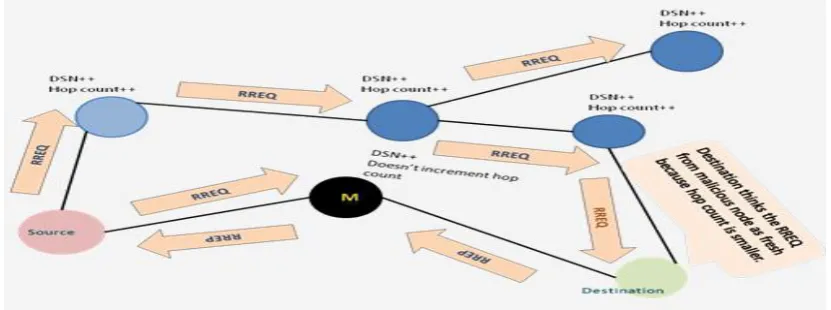
A blackhole [5] node in the network attracts all the data packets towards itself by advertising a fresh enough route to
the destination to the other nodes in the network. This attack can be launched by the fabrication of the control
messages i.e. RREP or RREQ. RREQ falsification is the process in which the RREQ is modified where the malicious
node increases the destination sequence number of the RREQ received from the source but doesn‟t increment the hop
count. When the destination or the intermediate node receives the RREQ with smaller hop count but higher sequence
number, it chooses the route via the malicious node and then, the malicious node launches the blackhole attack. The
blackhole attack by RREP falsification is much simpler. The malicious node replies to the RREQ message
immediately when it receives the RREQ. The source node thinks it as the fresh enough route and replies to it
immediately and disregards the legitimate RREP received from the genuine node.
Figure 2. Blackhole Attack by RREP fabrication
E. Collaborative Blackhole Attack:
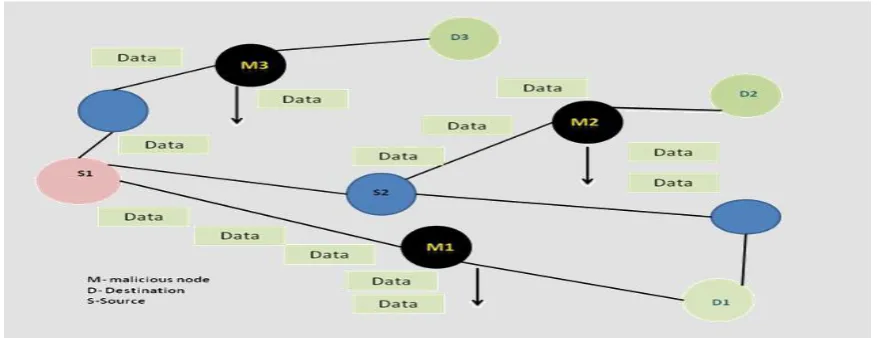
Collaborative blackhole attack [5] is the phenomena in which a number of nodes launch a blackhole attack together.
The timing of the launch of attack may vary, if the nodes launch attack at the same time, the performance of the
network is reduced to nothing.
Figure 3. Collaborative Blackhole Attack
III.
Literature Survey
This section explains the existing works done to mitigate the blackhole and collaborative blackhole attack.
Jin-Ming Chang et al. [8] proposed a bait detection approach in DSR based MANETs. In this approach, a node is
first initialized as bait for the blackhole node by mutual co-operation among nodes. The selection of node is done
stochastically. The node will send a false RREQ named as „Bait RREQ‟. The „Bait RREQ‟ is sent to the nodes in
the networks and after analysis and reverse tracing, the blackhole node is discovered. The protocol used is DSR.
Tarun et al. [9] proposed the implementation of watchdog mechanism in AODV by enhancing the protocol as
W-AODV to detect malicious nodes. This mechanism functions by using special nodes called watchdogs which
promiscuously hear the other nodes in the network to ensure that the nodes forward the packets to the next node.
header and consumption of energy. Also, they have listed in their conclusion that the watchdog method is
challenging to deploy in an environment where collaborative black hole attack is launched because it can only
monitor its neighbour node.
S.Sankara et al. [10] proposed a mechanism known as Secure AODV in which AODV protocol is enhanced by
using a secure routing mechanism. The destination is identified by the use of a unique identification termed as
MRREP the MRREP is a hashed identification number to enhance the security. When the destination node
receives the RREQ, it responds by generating MRREP and sends it through different nodes. Now the malevolent
node doesn‟t know about the MRREP. It sends an RREP with highest sequence number. Now, the sender gets
RREP through different nodes and stores it in a Reply Collect Table (RCT) [10] and matches the Unique
Identification Number by comparing with the other entries in the table. The blackhole node is the one which
doesn‟t contain unique identification number. The source discards such nodes and arranges the value of other
nodes in descending order.
IV.
Proposed Approach
A. Explanation of proposed approach:
The basis of the proposed approach is formed by the fact that the attacker node may either change hop count of
RREQ or reply first to an RREP. The proposed approach performs two functions namely: 1) Detection of
collaborative blackhole attack and prevention of collaborative blackhole attack. A value called trust value is
computed for each node. Initially, each node is treated equally and trusted completely. The node in due course
increases or decreases the trust of the neighbour. Trust is based on RREQ and RREP sent and received as well as
the data packets received. Trust is increased when RREQ is sent, data packets received and decreased when
RREP is received before a predefined time. Trust value is like a counter which is increased and decreased. Here,
DSN (DESTINATION SEQUENCE NUMBER) is used for identification of blackhole nodes. Intermediate
nodes verify whether sent RREQ- DSN >>> received RREP-DSN then node is identified as blackhole. This is
the detection part. This process of verification is done when trust value becomes 0 because comparing DSN
every time consumes power. For the prevention part, each node just removes the node from its routing table. The
schematic representation of the proposed work is shown below:
Figure 6. Proposed approach flowchart
B. Simulation Results:
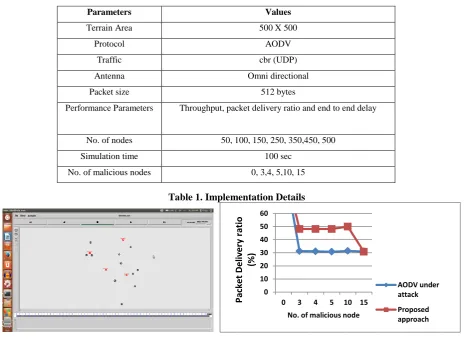
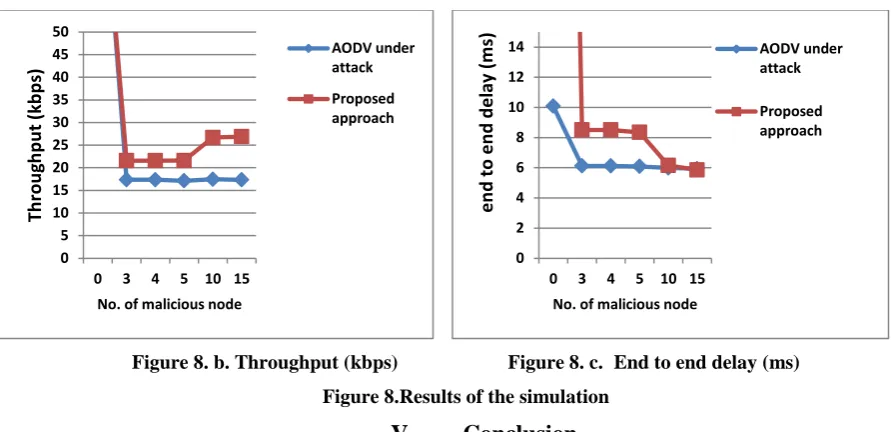
Simulation results show better performance in terms of packet delivery ratio and throughput by the proposed
approach. The simulation was done in ns-2 discrete event simulator. The details and results are given below:
Performance metrics:
Throughput: The difference between the sent and received packets in a given unit of time is called
throughput. Here the throughput is measured in kilobits per second (kbps).
Packet delivery ratio or packet delivery fraction (pdr / pdf): The number of data packets delivered to the
destination.
End to end delay: Average time taken by data packet to arrive to the destination.
Table 1. Implementation Details
10 20 30 40 50 60
e
t
D
e
liv
e
ry
r
atio
(%
)
AODV under
Parameters Values
Terrain Area 500 X 500
Protocol AODV
Traffic cbr (UDP)
Antenna Omni directional
Packet size 512 bytes
Performance Parameters Throughput, packet delivery ratio and end to end delay
No. of nodes 50, 100, 150, 250, 350,450, 500
Simulation time 100 sec
Figure 8. b. Throughput (kbps) Figure 8. c. End to end delay (ms)
Figure 8.Results of the simulation
V.
Conclusion
Mobile Ad hoc networks are formed by moving independent nodes communicating with each other with the help of
wireless links. The nodes communicate by mutual co-operation among themselves assuming a trustworthy
environment. This feature is exploited to launch blackhole and collaborative blackhole attacks in MANETs. The
purpose of this attack is to capture data packets by advertising itself to have the shortest route to the destination and
then drop the packets. This affects the performance of the network considerably. A method is proposed to mitigate
this attack by use of trust values and comparison of sent RREQ-DSN and received RREP-DSN numbers. The
blackhole attack with multiple malicious nodes has been deployed and the simulation results show the improvement
in throughput, end to end delay and packet delivery ratio through this approach. The simulation results show the
effective prevention of the attacks. The future course of study in this direction can be to further increase its working
by taking into account the removal of blackhole nodes from the network dynamically.
References
1.
Ivan Stojmenovic, Handbook of Wireless Networks and Mobile Computing; 5th Edition; Wiley
India Edition, New Delhi, 2001, pp 536.
2.
Priyanka Goyal, Vinti Parmar, Rahul Rishi, “MANET: Vulnerabilities, Challenges, Attacks and
Applications”, International Journal of Computational Engineering and Management, vol. 11,
January 2011, pp. 32-37.
3.
Hoang Lan Nguyen and Uyen Tang Nguyen, “Study of different types of attacks on Multicast
Mobile Ad Hoc Networks”, Proceedings of the International Conference on Networking,
International Conference on Systems and International Conference on Mobile Communications and
Learning Technologies, IEEE, 2006.
4.
Praveen Joshi, “Security Issues in routing protocols in MANET at network layer”, Procedia
Computer Science , vol 3, 2011, pp. 954-960.
0 5 10 15 20 25 30 35 40 45 50
0 3 4 5 10 15
Th ro u gh p u t (k b p s)
No. of malicious node
AODV under attack Proposed approach 0 2 4 6 8 10 12 14
0 3 4 5 10 15
en d to e n d d el ay (m s)
No. of malicious node
AODV under attack