© 2015, IJCSMC All Rights Reserved
789
Available Online atwww.ijcsmc.com
International Journal of Computer Science and Mobile Computing
A Monthly Journal of Computer Science and Information Technology
ISSN 2320–088X
IJCSMC, Vol. 4, Issue. 6, June 2015, pg.789 – 793
RESEARCH ARTICLE
A Study on Feature Extraction
Model and Approaches
Anupama
1, Kavita
2Student, CSE Deptt, Shri Baba Mastnath College of Engineering
Asstt. Prof, CSE Deptt,Shri Baba Mastnath College of Engineering
Abstract: The first stage of Image Processing is to present it in an organized way. When the primary
image is collected, the image is having impurities, incompleteness and irrelevancy to the domain and
application. To provide the effective image decision, there is the requirement of some Feature
extraction model and method. The paper has presented a study based work on various issues of
image extraction and provided the solutions in terms of approaches and the model. The paper has
described some of the common approaches to represent the image in a descriptive form.
Keywords – Clustering, Extraction, Filteration, Density Based.
1.
Introduction
© 2015, IJCSMC All Rights Reserved
790
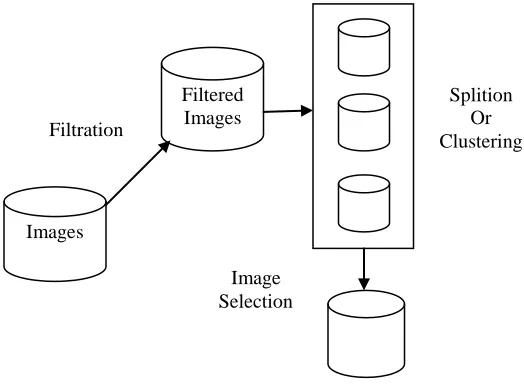
Figure 1: Feature Extraction ModelAs shown in the figure, as the Extraction process is performed on a raw large images. This images can have number of impurities in the form of missing image or invalid image. To process on this images, the first requirement is to filter this images and remove these all impurities over the images. After this filtration stage, the meaningful image will be obtained from the images. This meaningful image will be processed under segmentation or clustering process to divide it in smaller subsets. This sub-images will be processed to acquire the Feature from it. This images division is performed based on the similarity analysis based of different image features and characteristics. The distance measures are apply to perform image clustering. Once the image is divided in N sub-images, the next work is to select the appropriate sub images for further Image Processing. The selection process is based on the application, domain and feature analysis. This whole Feature Extraction model will present the most effective image part that is having the most relevant image respective to the domain or the application.
A) Clustering
Clustering is one of the major Image Processing activity that is been used as part of feature extraction algorithm and statistical analysis methods to divide the images in different groups called clusters. Clustering process is defined on various associated parameters and to perform the dimension effective Image Processing so that more simple and easy form of image representation will be obtained from the images. This Image Processing is based on the various criteria specified to represent the image more effectively. In the raw form, complete images is represented in the form of single cluster. Later on images is divided in various clusters based on similarity analysis. The intelligent clustering process is also able to identify the outlier or the abnormal image from the images. These various criterions defined over the images includes the clustering process that divides the image in sub segments. The clustering can be performed on different types of image including the numerical image, textual image, descriptive image etc. There are number of approaches available to perform image clustering which are described in later section of this paper.
The Feature Extraction is always considered as the model to identify the meaningful image or image over the images. This Image Processing stages is here defined to extract the image features. In this paper, an exploration to the clustering approaches is defined. In this section, the basic model of image Extraction is presented. The section also defined an overview to the clustering process. In section II, the work defined by the earlier researchers on clustering and image Extraction is defined. In section III, different approaches presented by earlier researchers are discussed for image extraction. In section IV, the conclusion obtained from the work is presented.
Images
Filtered Images Filtration
Splition Or Clustering
© 2015, IJCSMC All Rights Reserved
791
2.
RELATED WORK
Lot of work is already defined by different researchers to process on available images and perform image extraction using clustering approaches. Some of the work defined by earlier researchers on Image Processing is discussed in this section. Lei Jiang[1] has defined a work on optimization of clustering approaches using adaptive PSO approach. Author defined an improved clustering mechanism under fitness function specification to improve the clustering process. Author defined an adaptive niche approach based on comparative analysis so that effective image division will be performed. Author presented the dimension reduction approach with large difference analysis under cluster specification and obtained the effective image clustering. Shuai Li[2] has defined a work to improve the clustering process using spatial characteristics analysis and PSO approach. Author provided the estimation on available clusters and provide the unification to the PSO approach and Bayesian image criterion analysis and provided the numeric clustering algorithm. Author provided the characteristics idea analysis and provided the local optimal problem identification based on the analysis. Author provided the effective image estimation and achieve good performance and resolved most of the clustering errors. Rehab F[3] has defined a work to improve the clustering processing using improved PSO approach. Author provided a hybrid two phase approach with integration of PSO, genetics and k-means algorithm. Author avoided the premature local optima and provided the heuristic search mechanism to extract the image accurately. The parameters considered by the author include velocity and position updation based on rule analysis. Author defined an improved process for improving the selection, mutation and crossover options over the genetic approach. Author provided the solution space for initial cluster formation and centroid updation based on the globalized features over the images. Author provided the work benchmark imagess so that the effective Image Processing and image convergence will be obtained. Author also defined a comparative study on various optimization algorithms
Surat Srinoy[4] has presented an improvement to clustering for network security modeling using ACO integrated clustering approach. Author presented the work on raw clusters formed using Kmeans and PSO approach. Later on the identification of partitions is done to reduce the complications and complexities over the images. Author presented the clustering mechanism to reduce the images suspicious activities so that attack resolvement over the images will be obtained. Author presented the experimental view to represent the images more effectively.
Shafiq Alam[5] has defined an improvement to the clustering mechanism using swarm intelligence approach. Author implemented the work in decentralized environment. Author also presented the comparative analysis on benchmark imagess and using standard approaches. Author provided the evidence of the image effectiveness so that more effective Image Processing will be done. Alireza Ahmadyfard[6] has defined a hybrid approach using PSO and Kmeans algorithms for generating the clusters over the imagess/ Author defined the convergence over the initial stage and provided the global search so that Image Processing over the images will be obtained. Author defined a group division approach and analyzed it on various sub imagess and proved the reliability of work under experimentation.
Merwe et.al[7] defined a work on clustering approaches PSO approach. Author defined work in two main stages. In first
stage, the identification of cluster centers is done based on image analysis and later on cluster elements are identified using PSO approach. Author defined the work on six different imagess and provided the comparative analysis between these approaches to show the work effeteness. Kenyon et. Al.[8] has defined tag based suvey analysis on gene expression to cover the problem identification for infection based disease. Author provided the characterization study for the work under the specification of disease and relative patterns. Pudilo et.. al[9] has presented an improvement to the clustering approach using multi objective optimizer. Author provided an extension to heuristic search mechanism called PSO. Author presented the extension to the problem based on directional analysis and generated the sub swarms over the images to cover the images and to perform the image exchange effectively over the images. Author provided the a validated method to test the function under evolutionary function specification and respective to the images so that the effective Image Processing will be done. Yang et. al.[10] has defined a work to improve the quantum concept using particle swarm optimization. Author provided the methodology in evolutionary computation and provided the extremely effective Image Processing so that image exchange will be performed for discrete problems. Author provided the powerful tool to analyze the images and provided the equalized check over the images and provided the image transition effectively.
3.
FEATURE EXTRACTION APPRAOCHES
© 2015, IJCSMC All Rights Reserved
792
will decide the parameters for the group selection and to perform the images division in these group. The number of clusters identification is based on the application or the domain. In this section, some of the significant approaches for image Extraction are explored.
A) Partitioning Methods
The partitioning is having the significance to reduce the images and to divide in smaller groups with m objects. This partitioning method is called clustering. It is defined with the specification of number of clusters and sometimes initial centers are also specified in these approaches. Once the cluster centers are obtained, the next work is to take the distance measurement on these cluster centers and identify the relative cluster to the image value. The strength of this method is the parametric specification. Generally, the distance measures are considered for election of cluster for specific images. The specification of these clusters is defined by analyzing the variant to the image values and by expecting the image updation specific to the image centers. The expectation maximization is here performed with specification of image models and provided the object clusters for the image values. These partitioning methods includes PAM, CLARA, CLARANS.
B) Hierarchical Methods
This method of image extraction is more innovative and intelligent. This method does not require any specification to the number of clusters before specification. This method itself identifies the need and start from the raw form. With each iteration it decides the clusters and the cluster members. The specification of this clustering is here done using tree view. This method uses the tree based approach for Image Processing called Agglomerative Method and Divisive Method. Agglomerative method starts from raw image and moves upward to form the clusters. During this the cluster merging is performed and the group formation based on the clustering process is defined. Divisive method is defined based on the splition approach. In this approach, the cluster is divided to smaller clusters with each iteration. This image Extraction method includes the clustering algorithm like BIRCH, CURE, CHAMELEON, ROCK etc.
C) Density Based Method
In this method, the arbitrary shapes of clusters are analyzed to improve the clustering process. Here local criteria for cluster member and cluster selection are defined. Based on these constraints, the density connected points are defined to generate the clusters. There are some effective clustering methods comes in this category called DBSCAN, CLIQUE, OPTICS etc.
D) Grid Based Method
This methods are effective for multi resolution image structure and provide the clustering operations based on grid structure. It provides the quantization to the object space and provide the equalize cell based image distribution. This method includes fast Image Processing based on quantization methods and provides the cell division based on independent and dependent vectors. The dimension specific processing is done to handle different grid segments. These methods include TING, WaveCluser, CLIQUE and GRIDCLUST.
E) Model Based Methods
These methods are based on the certain specification of existing models and model parameters with available results. The image optimization is done using some training method that can fetch these existing methods and take the further decision to process on new image elements. These optimization methods include machine learning method, neural network approach, SVM etc. These methods use the self organizing maps to generate the analysis mapping on existing imagess. These methods take the analysis on the available images and generate the descriptive table on statistics. Once the statistics is obtained, the next work is to map the images with image group based on the probabilistic map. These methods also provide the image switching based on group. As the Image Processing is done, the result updation and final result modification is common in these methods.
© 2015, IJCSMC All Rights Reserved
793
4.
CONCLUSION
In this paper, an exploration to the Feature extraction and processing model is defined. The paper has explored the significance of image Extraction and presented it as the model without specification of application domain and images. The paper also presented some of the common methods adapted to present the image effectively.
References
[1] Lei Jiang Lixin Ding, “Hybrid Adaptive Niche to Improve Particle Swarm Optimization Clustering Algorithm”, 978-1-4244-9953-3/11 ©2011 IEEE
[2] Shuai Li, Xin-Jun Wang, “X-SPA: Spatial Characteristic PSO Clustering Algorithm with Efficient Estimation of the Number of Cluster”, Fifth International Conference on Fuzzy Systems and Feature Discovery, 978-0-7695-3305-6/08 © 2008 IEEE
[3] Rehab F. Abdel-Kader, “Genetically Improved PSO Algorithm for Efficient Image Clustering”, 2010 Second International Conference on Machine Learning and Computing, 978-0-7695-3977-5/10 © 2010 IEEE
[4] Surat Srinoy, “Combination Artificial Ant Clustering and K-PSO Clustering Approach to Network Security Model”, IEEE 2006
[5] Shafiq Alam, Gillian Dobbie, Patricia Riddle, M. Asif Naeem,” Particle Swarm Optimization Based Hierarchical Agglomerative Clustering “,2010 IEEE/WIC/ACM International Conference on Web Intelligence and Intelligent Agent Technology
[6] Alireza Ahmadyfard, Hamidreza Modares ,” Combining PSO and k-means to Enhance Image Clustering “,2008 Internatioal Symposium on Telecommunications, 978-1-4244-2751-2/08 ©2008 IEEE
[7] DW van der Merwe, 2003, “Image Clustering using Particle Swarm Optimization”, 0-7803-7804-0 103AI 7.00 0 IEEE, pp. 215-220
[8] F. Kenyon, 2003, “Expressed sequence tag Study of gene expression in the scab mite Psoroptes ovis – allergens, proteases and free-radical scavengers”. pp. 451-460
[9] Pudilo, 2005, “Bayesian Hierarchical Clustering”, Proceedings of the 22nd International Conference on Machine Learning, Bonn, Germany.