CLOUD COMPUTING AND ITS APPLICATION IN TUTORIAL MANAGEMENT: AN ACTION RESEARCH APPROACH
Henry O. Ayot Kenyatta University [email protected]
John K. Thuku Kenyatta University [email protected]
Samson R. Ondigi Kenyatta University
Cloud computing is a recent technology that help organizations use third party internet-based servers and computing services to manage their operations without necessarily building and maintaining the networking infrastructure. Universities in Europe, America and Asia have gradually migrated some of their systems to cloud computing with great success. Indeed research show that where cloud computing has been adopted there exists many opportunities that improve teaching, learning and management at Universities. Unfortunately many
educational institutions particularly in Kenya are not able to take full advantage despite the low costs involved, flexibility in access points and ease to integrate a wide range of devices such as ipads, phones and laptops that are accessible to students and tutors. To this end, there is need for research that identifies the potential areas of application and also on the systems that work in education process. This paper explores the need for action research in integrating cloud computing in tutorial administration and group discussions as a strategy to enhance interactivity and participatory in learning. It gives an overview of functionalities of E-learning systems and how group tutorials are suitable prototypes. Finally the paper explores how Kenya, as nation in the region, is ready to embrace cloud computing in e-learning systems.
Keywords: Group Tutorial Management, Cloud Computing, Learning Management Systems
Introduction
Cloud computing is fairly recent technology that help organizations use third party internet-based servers and computing services to manage their operations without necessarily building and maintaining the networking infrastructure. Learning institutions are able to deliver courses without necessarily worrying about the underlying architecture and technical issues. It offers a cost effective, scalable and flexible system for both students and education service providers (Sandhu & Sood, 2015).
The potential for adopting cloud computing in learning systems is so attractive that learning institutions do not have any justification to be left behind. At any operational level it is important to understand about the underlying opportunities and benefits. Institutions should take research initiatives to identify requirements and explore on the best approach towards implementing cloud computing. There are a number of tasks involved in the process of developing information systems from the time it is first studied to its completion (Morley & Parker, 2011). Therefore a formal study is useful to implement potentially large systems such as e-learning systems that involve different kinds of users. Any kind of conversion to a new ICT-based would take one or a combination of the following approaches:
1. Direct conversion. The old system is replaced with the other.
2. Parallel conversion. The old and new system run concurrently until sufficient confidence is gained then the old is phased out.
4. Pilot conversion. Is where one location within the organization such a campus is identified for implementation. After successful operation then other locations are converted.
Some important research questions arise on the approach to be used, requirements and other uncertainties that emerge during the implementation process. These questions include:
1. Is tutorial management a suitable prototype for e-learning system? 2. What are the requirements for the implementing e-learning systems?
3. Is action research a suitable approach to study and deployment-learning systems that are based in cloud computing?
4. Is the ICT infrastructure in the country ready enough for cloud computing? 5. How ready is the population for embracing cloud computing in learning systems?
What is Cloud Computing?
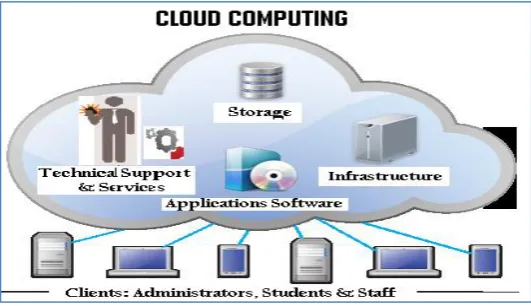
Cloud computing is defined as an “Internet-based facility that allows users to access shared computer applications, storage and other resources through a network of remote servers as a service” This means that users will not to buy, install nor manage the computer facility and software but rather rent to store, manage and process data. Users of the service access through the Internet using devices such as personal computers, laptops or mobile phones.
Figure 1: Cloud Computing - Learning Management System
In cloud computing, there are three principle concepts: scalability, flexibility and resource provision as a service.
Scalability
This means the resources such as storage, computer processing power and software functionalities can be scale up or down depending with the customer demands or capability. This factor distinguishes cloud computing with other kind of computing service.
Flexibility and Accessibility
Flexibility is the ability to meet user demands quickly. Cloud computing enable users to access and process data from remote location using any device that connects to the Internet. For example, when a student or an instructor accesses course data from home or from an off-site location, at any time. This certainly enhances flexibility and effectiveness in business.
Resource Provision as a Service
Business Model for Cloud Computing
The business model for cloud computing has been discussed by various writers. Three categories are identifiable (Diamadi & Pleasance, 2011)., (Taylor, Julisch, & Hall, 2010), (Tan & Kim, 2011):
Infrastructure as a Service (IaaS). Offers computing infrastructure, such as storage, networks, and servers as a service.
Platform as a Service (PaaS). Provides application development tools such as
Application Programming Interface (API) and a runtime environment as a service. Computer programmers and web designer use the service to program their own applications.
Software as a Service (SaaS). This model application software is provided as a service. For example, Microsoft Office and Google Docs. The customer will not bother with
installation, maintenance or license renewals.
Education systems can save on capital investment and technical support if they hire infrastructure such as computer servers as a service. Other costs and headache in licensing of software, upgrades, storage and security procedures are substantially reduced under the cloud computing business model.
Models of Cloud Computing in Learning Systems
There are three models of cloud computing (Diamadi & Pleasance, 2011) (Bora & Ahmed, 2013)
Private Cloud. Is operated for single organization.
Public Cloud. The service is available to the public and is share by many clients
Hybrid Cloud. Combine private as well as public cloud services though the services distinguishable.
ICT-Based Education Systems
ICT-based educational systems have gradually expanded their scope from a basic content delivery system to big and complex systems that handle numerous functions in learning and teaching process. These kinds of educational/learning management systems are now referred to as electronic learning management systems, or simply e-learning system. Some of the functionalities include:
Student’s management - registration and enrollment. Course management – courses outlines, syllabus. Learning material storage and delivery.
Content production tools.
Assessment- tutor programmed and self-assessment quizzes. Communication; emails, chats, forum and teleconferencing. Feedback and performance tracking.
Integration with human resources and quality assurance modules. Administration.
Reporting.
E-Learning Systems
A Learning Management System (or LMS) is a software package that enables the management and delivery of learning content and resources to students. A basic e-learning system will allow students to register for courses, access to the course and content, and interact with their instructors. More complex systems will have additional tools such as competency management, skills-gap analysis, succession planning, certifications, virtual classes, and resource allocation. A student’s page or portal, that allows learners to access to self-service processes such as enrollment, quizzes, grades and calendar.
and efficient systems in delivering their learning programmes. Despite the gradual falling of the cost of hardware and software, it has not been easy for many institutions to get it right. This is largely because of the many challenges faced during the deployment process. Some of the challenges include insufficient knowledge on available systems and functionalities, poor project management and conversion skills, and lack of technical support. To get around this, institutions desiring to implement e-learning system should apply the formal process used in information system development. The formal process for system development and
implementation involves stakeholder such as administrators, instructors, students and
technical experts for guidance and research. This process is referred to as system development life cycle.
System Development Life Cycle
Systems development life cycle (SDLC) is the formal project management process that has a number of stages or phases starting with feasibility study, through system analysis and design, system acquisition, implementation and maintenance. An expert, usually a system analyst or one who is conversant the present system and has ICT knowledge, is involved in all stages.
In the initial stage, the analyst briefly studies the system, identifies the scope and suggests solutions. Also lists benefits and approximate costs. This follows a detailed analysis of the user needs and requirements before a new model for the system is designed. Thereafter acquisition of necessary equipment, hardware and software is done. The next phase is system implementations where the necessary tasks to make the system operational are done. A lot of tests are done at this stage then data conversion, training and plan for system conversion made. Then the final stage is system maintenance, which is an ongoing process.
The entire process of system development is a rigorous exercise that involves all
stakeholders. In educational system action research is suitable approach to convert or develop to new systems because it empowers all those involved systems.
Action Research in Deployment E-Learning System
The primary objective of action research is to “identify a specific practice-based problem, and then to undertake research in order to identify the means through which to resolve it” (Henn, Weinstein, & Foard, 2009, p. 66). Action research promotes change, thinking and understanding change by involving those directly affected in altering current practice or developing new practice. In action research, a researcher can isolate a process, function or method that represents areas that need change. E-Learning systems has many functions/ processes; among the key functions are student enrollment, course management, learning material development and delivery, communication and feedback. Group tutorial as a method in learning is a suitable prototype in e-learning implementation.
Group Tutorial Management as a E-Learning System
Group tutorial can represent most functionalities of e-learning system because it covers most of the processes and functionalities. Some of the functions are registration/enrollment to the group, communication, content production and delivery, assessment, grading and
feedback. While considering deployment system, tutorial administration is a perfect choice for a prototype approach. There is heavy interaction between primary users who are the students and lecturers all through the process. Therefore any deployment or testing a new system all stakeholders are involved and action research is best approach.
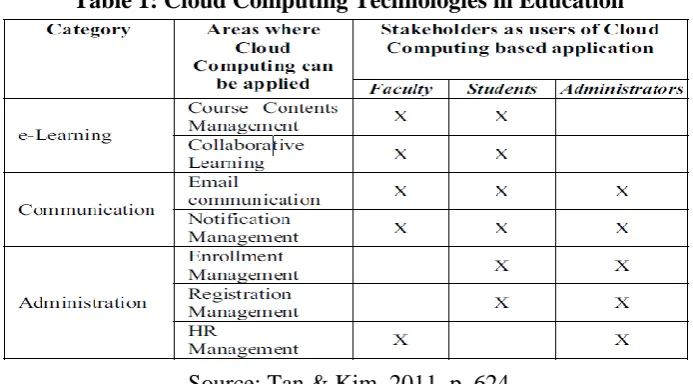
Table 1: Cloud Computing Technologies in Education
Source: Tan & Kim, 2011, p. 624
Considering the process and activities while conducting learning through group tutorials it is clear that just as in e-learning systems all stakeholders i.e. students, faculty and
administrators are involved. The key areas where cloud computing can be used i.e. course content management, communication, enrollment and registration applies also for tutorials. Thus group tutorial is suitable prototype for action research in e-learning deployment. In this study the costs to be incurred can be seen and weighed against benefits and will lead to informed decisions.
Barriers Faced in Implementing E-Learning in Kenya
A recent study by Murage (2013) on the status of e-learning as course delivery in Kenyan public universities listed several barriers that are faced or likely to be faced by public
Table 2: Major Constraints in E-Learning Application in Kenyan Universities
Source: Murage, 2013, p. 128.
Ten out of fifteen barriers listed related to infrastructure challenges, maintenance and costs. The benefits of cloud computing include scalability (using resources that you need), no costs for computing equipment apart from end user devices, minimal costs for software and service upgrades(Pocatilu, Alecu, & Vetrici, 2010), no maintenance cost as infrastructure is offered as a service(Tan & Kim, 2011).
Access to Internet and Mobile Phone Service in Kenya
Mobile phones are increasing becoming part of life in Kenya for communication and access to the Internet. According to data from recent quarterly reports for Communications Authority of Kenya there is a general increase in mobile phone subscription and Internet use in Kenya as shown in the table below. For example from January 2013 to December 2014, the mobile subscription rose from 29.8 million to 33.6 million. At the end of the year the mobile penetration was 82.6% of the 40.7 million Kenyans. In the same period the number of Internet users rose to 26.1 million from 23.2 million. This increase placed the Internet penetration at 64.3% of the population.
Table 3: Internet and Mobile Access in Kenya
Service
Jan-Mar 2013 Apr-Jun 2013 Jul-Sept 2013 Oct-Dec 2013 Jan-Mar 2014 Apr-Jun 2014 Jul-Sept 2014 Oct-Dec 2014 Mobile Subscriptions (million)
29.8 30.5 31.3 31.3 31.8 32.2 32.8 33.6
Mobile penetration percent
75.8 77.3 76.9 76.9 78.2 79.2 80.5 82.6
Local Short Messaging Service (SMS) billion
4.08 4.37 5.05 628 6.22 6.89 6.97 7.29
Data/Internet
Subscriptions (million)
9.6 12.4 13.1 13.3 14.0 14.8 16.4
Internet users, estimate (million)
16.4 19.6 19.2 21.3 21.6 22.3 23.2 26.1
Population with Internet Access (%)
41.6 49.7 47.1 52.3 53.3 54.8 57.1 64.3
International internet bandwidth available in the country (Mbps)
Total International Internet Bandwidth Used (Mbps)
307307 356875 360900 365413 447064 436016 478074 498121
Benefits of Cloud Computing in Tutorial Management
There are many advantages in using cloud computing (Sharma, Goyal, & Singh, 2014): 1. Low cost.
2. Scalability. Thus one accesses resources needed as it is quiet easy to upscale or down scale ICT resources as when it is necessary.
3. Improved Availability
4. Improved Updates of Software.
5. Reduced Maintenance. Systems are maintained by the provider. 6. Participation among students
7. Better communication to student. 8. Security of Data
Challenges of Using Cloud Computing
A few challenges in cloud computing include:
1. Privacy and security of data and information stored offsite. 2. Reliability of bandwidth
3. Rivalry and Malicious Interferences
Conclusion
Cloud computing is an important technology that enable all kinds of organizations, big or small, to scale down on their requirements in adopting ICT, save on infrastructure and
technical costs and access to the modern ICT applications and tools. However, educational institutions often face challenges to migrate from older systems to cloud based mainly due to uncertainties. This paper advocates that for action research in guiding successful migration process for educational institutions from old to new system. Considering that cloud
computing is a recent technology it is worthwhile to isolate certain procedures or functions that are representative enough for a pilot. Tutorials adequately represent e-learning system as most of key functions are covered; these are student enrollment, course management,
development and delivery of learning materials, communication and feedback. Cloud computing has its niche is renting rather than capital investment so it is critical that local infrastructure and Internet access can support the model. Data available about Kenya indicates that the country is ready and learning institutions can adopt cloud computing.
References
Bora, U. J., & Ahmed, M. (2013). E-Learning using Cloud Computing, (2), 9–13.
Diamadi, Z., & Pleasance, D. (2011). Winning in the SMB Cloud : Charting a path to success, (July). Henn, M., Weinstein, M., & Foard, N. (2009). A Critical Introduction to Social Research (Vol. 18). SAGE
Publications.
Morley, D., & Parker, C. S. (2011). Understanding computers: today and tommorow (13th ed.). Cengage Learning.
Murage, M. N. (2013). Assessment Of The Status Of E-Learning As Course Delivery Method In Public
Universities In Kenya. Kenyatta University.
Pocatilu, P., Alecu, F., & Vetrici, M. (2010). Using Cloud Computing for E-learning Systems. In 8th WSEAS
International Conference on DATA NETWORKS, COMMUNICATIONS, COMPUTERS (Vol. 9, pp. 54–59).
Sandhu, R., & Sood, S. K. (2015). A commercial, benefit driven and secure framework for elearning in cloud computing. Computer Applications in Engineering Education, n/a–n/a. doi:10.1002/cae.21621
Tan, X., & Kim, Y. (2011). Cloud Computing for Education: A Case of Using Google Docs in MBA Group Projects - 4464a641.pdf. In 2011 International Conference on Business Computing and Global
Informatization. IEEE Computer Society. doi:10.1109/BCGIn.2011.169
Taylor, P., Julisch, K., & Hall, M. (2010). Security and Control in the Cloud. Information Security Journal: A