Available Online at www.ijcsmc.com
International Journal of Computer Science and Mobile Computing
A Monthly Journal of Computer Science and Information Technology
ISSN 2320–088X
IJCSMC, Vol. 3, Issue. 12, December 2014, pg.482 – 491
RESEARCH ARTICLE
Cartoon Image Object Extraction
Mustafa M. Abd Zaid¹, Loay E. George², Ghadah Al-Khafaji³
¹’²’³ College of Science, University of Baghdad, Iraq
¹[email protected], ² [email protected], ³ Ghadah Al-Khafaji [email protected]
Abstract— Since the user for cartoon images retrieval system targets to get relevant images to query image from database within same object (i.e. a user has cartoon image with object ―Dora‖, in this case the user will target to get all relevant image with ―Dora‖ character), therefore An important step in cartoon image retrieval is defining the object within cartoon image .In this paper, an efficient method for objects extraction from cartoon images is introduced; it is based on general assumptions related to color and locations of objects in cartoon images, the objects are generally drawn near the center of the image, the background colors is the more frequently drawn near the edges of cartoon image, and the object colors is less touch for the edges. The processes of color quantization, seed filling and found the object ghost have been used. The results of conducted tests indicated that the system have promising efficiency for extracting both single or multi object(s) lay in simple and complex backgrounds of cartoon images.
Keywords: Objects Extraction, Cartoon images, Cartoon Image Retrieval, k-Means applications.
I. Introduction
Cartoon images play essential roles in our everyday lives especially in entertainment, education, and
advertisement, that become an increasingly intensive research in the field of multimedia and computer graphics [1-2]. The automatically cartoon object extraction is very useful in many applications; one of the most importantly is the cartoon images retrieval, where the user for cartoon images retrieval system targets to get similar images to query image from database in character (i.e., a user has cartoon image with object Dora, so the user will target to get all relevant image with Dora character).Some of the automatic methods, which discriminate the region(s) of interest from the other less useful regions in an image, have been adapted to retrieve cartoon characters [7-8]; they use partial features for recognizing regions and/or aspects which are suitable for cartoon characterization or gesture recognition. Some efforts go beyond extracting central objects [3], others used Salient Object Detection (SOD) [9-12].
In this paper, a simple automatic method for objects extraction from cartoon image is proposed; it is based on the assumption that the wanted object is founded within or close to the central part of image. The reset of this paper is organized as follows; section (II) is devoted to describe the suggested cartoon object extraction scheme in details, while in section (III) some of the tests' results are given.
II. The Proposed System
In the design phase of the introduced simple extraction system the following main concerns were taken into account:
Get the benefit of quantization process. In general, the cartoon image may contain many colors, and it is difficult to deals with all these colors at a time, so color quantization process is adopted to represent the image color content in terms of few dominant colors, and indexing these colors to facilitate the deal with quantized color image.
Using seed filling algorithm to segment the quantized image and to remove the background (unwanted) segments.
Find the ghost area of the object.
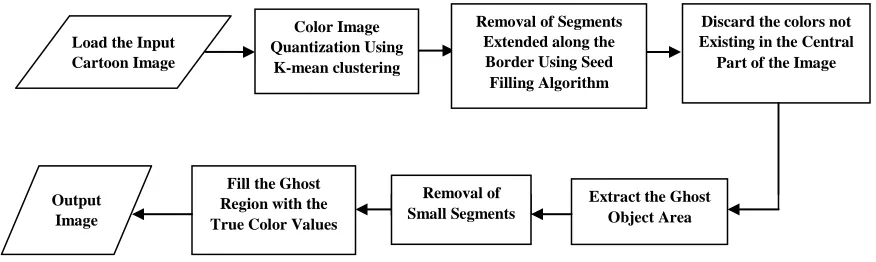
The layout of the proposed system is given in figure (1). The system stages are explained in the following:
Figure (1): The layout of proposed system
Step-1: Load the color cartoon input image, I, of size W×H.
Step-2: Reduce the number of colors in I using the K-Means clustering algorithm using the color components of the input color image. The mean (m) and standard deviation (σ) values of each color band (R,G,B) are determined and, then, used to determine initial centroid values of each cluster. Here 8 clusters have been used to initially representing the color contents of the input image, such that:
Where CRGB is initial cluster vector, mRGB is the mean vector of the color bands of whole image, σRGB is the Extract the Ghost
Object Area
Removal of
Small
Segments
Fill the Ghost Region with the True Color Values Output
Image
Discard the colors not Existing in the Central Part of the Image
Removal of Small Segments Color Image
Quantization Using K-mean clustering
Removal of Segments Extended along the
Border Using Seed Filling Algorithm Load the Input
TABLE (1) Initial clusters of three bands.
Cluster #
C
redC
GreenC
Blue0
m
Red- σ
Redm
Green- σ
Greenm
Blue– σ
Blue1
m
Red- σ
Redm
Green- σ
Greenm
Blue+ σ
Blue2
m
Red- σ
Redm
Green+ σ
Greenm
Blue– σ
Blue3
m
Red- σ
Redm
Green+ σ
Greenm
Blue+ σ
Blue4
m
Red+ σ
Redm
Green- σ
Greenm
Blue– σ
Blue5
m
Red+ σ
Redm
Green- σ
Greenm
Blue+ σ
Blue6
m
Red+ σ
Redm
Green+ σ
Greenm
Blue– σ
Blue7
m
Red+ σ
Redm
Green+ σ
Greenm
Blue+ σ
BlueK-Means clustering algorithm attempts to minimize the squared error for all elements in all clusters, where the error (E) equation is:
∑ | |
Here E is the sum of the absolute errors for all pixels (p) belong to the image, I, data set; and Ci is the
centroid value of ith cluster. The steps of k-means algorithm have been repeated five times to reach the convergence state.
The outcome of applying k-mean is the index map array, M(W,H), each element represent the color index value of certain image pixel; this index value is the cluster index value whose color is the closest one to the pixel color.
Step3: To do Removal of Segments Extended along the Border Using Seed Filling Algorithm, the following steps are applied:
A. Apply the seed filling method on the produced index map array, All connected index of same value without any cutting for connecting of the current index would be considered as a segment. The index value will be considered as attribute, because each index value in the index map array refers to different color (i.e., index (1) refer to the index value which content the cluster index whose color is red in quantization image). Figure (2) presents an example for an index map array and its segments after applying the seed filling algorithm on that index map array.
B. A result segment would be checked if this segment is satisfied the condition to remove or not, the choosing threshold for up, lift and right borders is (0.4) and for below border of image is (0.8). Equation (3) shows the method of checking a result segment from seed filling algorithm to remove this segment (background segment) or not (object segment)
{
C. Repeat steps (A) and (B) until no segments are found to check.
Figure (2): An index map array, (a) the original index array before segmentation, (b) the resulted segments from the index array after applying the seed filling segmentation.
Step4: To discard the colors not existing in the central part of image, the following steps are applied:
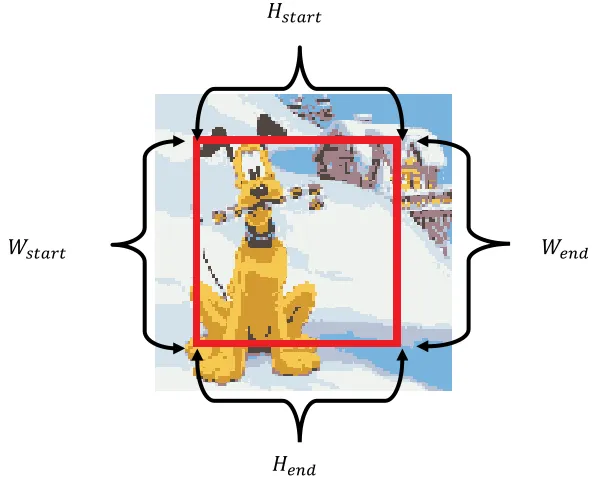
A. Find the new dimensions for the centre of image, see figure (3): explains the extracted centre of image.
Figure (3): The centre of image and the four new extracted dimensions.
(4)
–
(6)
(7)
Where ( and ) are the start of centre of image width and height, ( and ) the end of centre of image width and height, (W and H) are the original image width and height, and (Th) is the ratio which remove from the original dimension to find the centre of image, here the suitable threshold to be used = 0.15.
B. Compute the frequency of each index value in the full index map array (quantized image).
C. Find the frequency of an each index value in centre of image.
D. Subtract the frequency of the index value in the full index map array to frequency of that index value in centre of index map array in order to find the frequency of index value out of centre.
E. Compare the frequency of index value in out of centre of array with frequency of index value in centre, if the frequency of index of color out of centre more than the centre, then this color in that indexing can be consider as background colors and removing from image, as shows in equation (8).
{ (8) Where Th is threshold value add to an index value out of centre in this work chooses Th=2.3. F. Repeat steps B, C, D and E for all index values.
Step5: Find the ghost for the extracted character from previous steps, where the following steps are applied:
A. Create binary image object by converting the resultant index value of map array from previous steps to binary image, using the following equation:
{
(9)
Where is the obtained binary image contain 255 for pixel classified as being part of background pixel, others it will contain 0 for pixel classified as part of object, will be in the same size of the download image, and is the index map array.
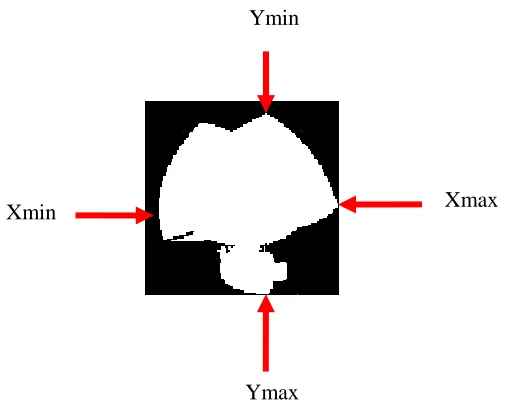
B. Fill the Holes of the cartoon character: The goal of this step is to fill the holes that may be found in the cartoon object and finds the ghost for cartoon character. Seed filling in the binary image apply, the attribute used for segmenting the binary image is the black pixel, Then find the four edges for the resultant segment from seed filling algorithm (Xmax, Xmin, Ymax and Ymin) shows figure(4) explain the four edges of result segment.
Figure (4): The four edges value for a result segment.
then check if this segment is hole or background by checking the edges of segment if they are fail on the edges of image or not.
If they fail in edges of image then it is considered background segment and it is corresponding locations in binary image not filled by white pixels else it is object segment and it is corresponding locations in binary image fill by white pixels
Step6: Remove the small segments from the previous step, because these segments always cannot be considered as an object and maybe belongs to the background.
Step7: Fill the ghost region with true color values: each white pixels location in binary image filled by the original color to find the object of cartoon image because the white pixels are the ghost of object.
III. Experimental and Results
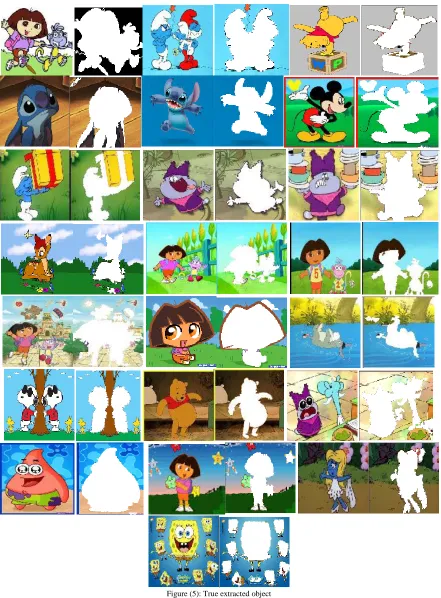
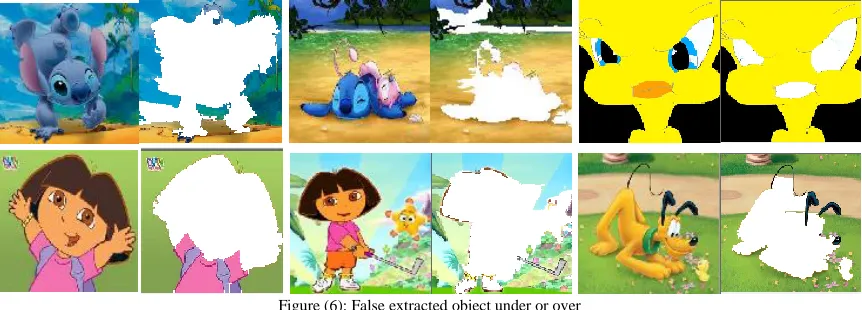
The performance of proposed object extraction method was tested on a data set of cartoon images contains more than 3000 cartoon images for 40 different objects (characters); such as Dora, Sniffer and Pluto, which are calculated from web and cartoon-11k [4]. Figure (5) shows some examples of cartoon objects which are extracted well from the cartoon images samples have simple or complex background. Figure (6) shows some of failed results; for example the Sniffer object is extracted well, but the background extraction was failed, this is due to the similarity colored regions. While, on the other hand, the extraction of Dora object was failed, because the object is too extended and hit the image boundaries with high hit rate. Also, the Tweety object was wrongly extracted because the object is spreading at all parts of the image. Lastly, the Dora and Pluto over extracted object because the wrong extracted region is found in the centre of image with object and nor the distribution neither touch in borders. Table (2) shows some true extracted rate for some choosing cartoon images within different objects.
Xmax
Xmin
Table (2) True extracted ratio of some tested images
Character Name
Test Images #
True Ratio
Eeyore
92
93.4%
Dora
113
92.9%
Pluto
92
94.5%
Rabbit
44
95.4%
Spongebob
79
89.8
Winnie
88
90%%
Mr. incredible
20
86.9%
Kayu
53
94.3%
Donald duck
100
96%
Fanatics
76
92.1%
Tweety
100
90%
Figure (6): False extracted object under or over
IV. Conclusions
This paper presented an efficient method for extracted cartoon objects. The test results show that the developed method could extract meaningful objects well in different characters and backgrounds. The extracted cartoon objects expect to be effectively used in cartoon image retrieval because they can represent the color-characteristics of cartoon objects well.
References
[1] Yi Yang, Yueting Zhuang, Dacheng Tao, Dong Xu, Jun Yu, and Jiebo Luo; "Recognizing Cartoon Image Gestures for Retrieval and Interactive Cartoon Clip Synthesis", IEEE Transactions On Circuits And Systems For Video Technology, Vol. 20, No. 12, Pp. 1745-1756,December 2010
[2] Zhang Liang,Yueting Zhuang , Yi Yang and Jun Xiao; "Retrieval-Based Cartoon Gesture Recognition and Applications Via Semi-Supervised Heterogeneous Classifiers Learning ", Pattern Recognition, 2013
[3] Sungyoung Kim, Soyoun Park, and Minhwan Kim; "Central Object Extraction for Object-Based Image Retrieval", E. M. Bakker et al. (Eds.): CIVR 2003, LNCS 2728, Pp. 39-49, 2003.
[4] Yi Yang, Yueting Zhuang, Dong Xu, Yunhe Pan, Dacheng Tao and Steve Maybank; " Retrieval Based Interactive Cartoon Synthesis via Unsupervised Bi-Distance Metric Learning", MM’09, Beijing, China, Pp. 311-320, 2009.
[5] Savitha Sivan and Thusnavis Bella Mary; "An Optimized Feature Extraction Technique for Content Based Image Retrieval", International Journal of Image Processing and Vision Sciences (IJIPVS), Pp. 35-40, 2013
[6] Saikrishna, Yesubabu, Anandarao, Sudha Rani; "A Novel Image Retrieval Method Using Segmentation and Color Moments", Advanced Computing: An International Journal (ACIJ), Vol.3, No.1, Pp. 75-80, 2012.
[7] Miki Haseyama and Atsushi Matsumura; "A Trainable Retrieval System For Cartoon Character Images", in Proc. ICME, Pp. 393–396, Jul. 2003.
[8] Miki Haseyama and Atsushi Matsumura; "A Cartoon Character Retrieval System Including Trainable Scheme", in Proc. ICIP, Pp. 37–40, Sep. 2003.
[10] RuggeroMilanese; "Detecting Salient Regions in an Image: from Biological Evidence to Computer Implementation", Ph.D. Thesis, University of Geneva, 1993.
[11] Jun Yu and Seah; "Fuzzy Diffusion Distance Learning for Cartoon Similarity Estimation", Journal of Computer Science and Technology, Vol. 26, No. 2, Pp. 203-216, 2011.