Scholarship@Western
Scholarship@Western
Electronic Thesis and Dissertation Repository
5-20-2015 12:00 AM
An Exploration of the Influence of Nursing Education Culture on
An Exploration of the Influence of Nursing Education Culture on
the Integration of Nursing Informatics Competencies Into a
the Integration of Nursing Informatics Competencies Into a
Collaborative Nursing Program Curriculum
Collaborative Nursing Program Curriculum
Stephanie L. Atthill
The University of Western Ontario
Supervisor Dr. Carroll Iwasiw
The University of Western Ontario Joint Supervisor Dr. Lorie Donelle
The University of Western Ontario Graduate Program in Nursing
A thesis submitted in partial fulfillment of the requirements for the degree in Doctor of Philosophy
© Stephanie L. Atthill 2015
Follow this and additional works at: https://ir.lib.uwo.ca/etd
Part of the Curriculum and Instruction Commons
Recommended Citation Recommended Citation
Atthill, Stephanie L., "An Exploration of the Influence of Nursing Education Culture on the Integration of Nursing Informatics Competencies Into a Collaborative Nursing Program Curriculum" (2015). Electronic Thesis and Dissertation Repository. 2886.
https://ir.lib.uwo.ca/etd/2886
This Dissertation/Thesis is brought to you for free and open access by Scholarship@Western. It has been accepted for inclusion in Electronic Thesis and Dissertation Repository by an authorized administrator of
AN EXPLORATION OF THE INFLUENCE OF NURSING EDUCATION CULTURE
ON THE INTEGRATION OF NURSING INFORMATICS COMPETENCIES INTO A
COLLABORATIVE NURSING PROGRAM CURRICULUM
(Thesis format: Integrated Article)
by
Stephanie Atthill
Graduate Program in Nursing
A thesis submitted in partial fulfillment
of the requirements for the degree of
Doctor of Philosophy
The School of Graduate and Postdoctoral Studies
The University of Western Ontario
London, Ontario, Canada
ii
Abstract
Information communication technologies are becoming a customary part of the
way in which nurses provide care. Consequently, it makes good sense to ensure that
nursing informatics competencies are integrated into nursing curricula to prepare
graduates for practice. However, few schools of nursing within Canada have fully
integrated nursing informatics competencies into their curricula. Nursing education
culture appears to influence decision-making, and the development of organizational
priorities. Nonetheless, there are no known studies examining how nursing education
culture impacts nursing informatics curriculum development endeavours. Therefore, this
study aimed to address the following research questions: 1) In what ways does a nursing
education culture (the shared values, assumptions and behaviours of two schools of
nursing) and the practices and policies within the two schools of nursing affect the
incorporation of nursing informatics competencies in a collaborative undergraduate
nursing program curriculum? 2) How is the incorporation of competencies related to
nursing informatics in the collaborative program curriculum influenced by the systems
and subsystems within two schools of nursing? 3) How do the subsystems within the two
schools of nursing interact to affect the incorporation of nursing informatics
competencies in the undergraduate nursing curriculum? and 4) In what ways do resources
within these two schools influence the curriculum development process and incorporation
of nursing informatics competencies within the curriculum? These questions were
explored using a focused ethnography framed with a systems theory perspective. Data
iii
through a partnership between a University and College. Findings identified external
and internal systems and subsystems had a significant influence on how values, beliefs,
and priorities within the collaborative program were determined and this ultimately
influenced the selection of curricular content. Subsequently, findings suggest that
commitment and priority for the topic of nursing informatics need to be established
within the nursing education culture. Until faculty value the use of information
communication technologies to support nursing practice, nursing informatics as a topic
area will be undervalued and its incorporation within the curriculum will remain limited.
Key words: Nursing education, nursing informatics, nursing students, curriculum
iv
Stephanie Atthill performed the work of this thesis under the supervision of Dr.
Carroll Iwasiw, Dr. Lorie Donelle, and Dr. Elizabeth Borycki who will be co-authors on
v
I am very thankful and appreciative to my committee Dr. Carroll Iwasiw, Dr.
Lorie Donelle, and Dr. Elizabeth Borycki for their continued support and guidance. Each
committee member has provided feedback and support which has pushed me to extend
my knowledge and encouraged me to remain committed to my personal and professional
goals. Dr. Carroll Iwasiw has an incredible passion and commitment to nursing
education and teaching. She has mentored me since I began as a research assistant, and
through her wise counsel has contributed to the completion of my Doctoral dissertation.
Carroll has always been encouraging and readily available to answer my questions. She
also provided clarity when the process became overwhelming; inspiring me to stay
focused and committed to my goals. Dr. Lorie Donelle has always been friendly and
welcoming, inspiring me to set high standards for myself. She has stimulated my
thinking and has inspired me to strive for a deeper sense of clarity. Dr. Elizabeth Borycki
has been an exceptional collaborative partner, someone who has contributed immensely
to this research. Although she is far away, she has always been a familiar and
encouraging mentor. These three individuals have been a brilliant network of individuals
who have supported and carried me through to the completion of this project. Lastly, I
would like to thank the faculty, staff, and students who kindly participated in interviews,
document collection, as well as invited me into their classrooms. The enthusiasm these
individuals demonstrated towards my research provided an enjoyable and enriching
vi
This dissertation is dedicated to my family whose love and unwavering support
has been fundamental to my success. Also to Zoey who has been my faithful companion
vii
Abstract ... ii
Co-Authorship Statement ... iv
Acknowledgments ... v
Dedication ... vi
Table of Contents ... vii
List of Appendices ... xii
Appendix A: Nursing Informatics Entry-to-Practice Competencies for Registered Nurses ... xii
Appendix B: Ethics Approval ... xii
Appendix C: Letters of Information ... xii
Appendix D: Consent Form ... xii
Appendix E: Interview Guides... xii
Appendix F: Demographics Questionnaires ... xii
Appendix G: Description of the Systems of Culture, Human Infrastructure, and Resources ... xii
List of Figures ... xiii
Figure 1: Integrative Review Search Strategy ... xiii
Figure 2: The Interaction Amongst Systems and Subsystems Which Impact the Integration of Nursing Informatics Competencies into the Collaborative Nursing Program Curriculum... xiii
Chapter 1 - Introduction ... 1
Background and Significance of the Study ... 3
Study Purpose... 8
Key Terms... 9
viii
Methods ... 13
Study Design. ... 13
Setting.... 14
Data Collection. ... 14
Data Analysis. ... 15
Chapter Summary ... 15
Overview of Chapters ... 16
References ... 18
Chapter 2 – Nursing Education Culture and Nursing Informatics Competencies within Undergraduate Nursing Curricula: Is there a link? ... 23
Purpose and Research Questions ... 25
Search Strategy ... 25
Findings ... 27
Assessment of Nursing Education Culture ... 27
Curriculum and Course Development and the Incorporation of Nursing Informatics Competencies ... 31
Conceptual Links between Nursing Education Culture and the Incorporation of Nursing Informatics Competencies into an Undergraduate Nursing Curriculum ... 37
Discussion... 39
Conclusion ... 41
References ... 43
Chapter 3 – A Focused Ethnography of a School of Nursing: A Methological Review ... 48
Study Purpose... 50
ix
Methods ... 56
Design 56 Sample ... 57
Data Collection ... 58
Data Analysis ... 60
Findings and Recommendations ... 62
Discussion... 63
Study Limitations ... 71
Conclusion ... 72
Chapter 4 – How Attributes of Nursing Education Culture Influence the Inclusion of Nursing Informatics into a Collaborative Nursing Program Curriculum ... 78
Literature Review ... 79
Purpose... 85
Theoretical Framework ... 85
Methods ... 86
Design 86 Setting... 87
Data Collection Procedures and Data Sources ... 89
Data Analysis ... 92
Rigour... 94
Findings ... 95
Discussion... 109
x
Curriculum ... 123
Literature Review ... 124
Theoretical Framework ... 127
Study Purpose... 127
Methods ... 128
Study Design ... 128
Setting... 129
Procedures and Data Sources ... 130
Data Analysis ... 133
Rigour... 134
Findings ... 135
Discussion... 151
Conclusion ... 155
References ... 157
Chapter 6 - Discussion and Conclusions ... 161
Summary of the Study ... 161
Study Purpose... 161
Theoretical Framework ... 162
Methods ... 162
Data Analysis ... 163
Findings and Discussion ... 164
Study Implications ... 173
Recommendations ... 177
xi
Appendices ... 186
xii
Appendix A: Nursing Informatics Entry-to-Practice Competencies for Registered Nurses
Appendix B: Ethics Approval
Appendix C: Letters of Information
Appendix D: Consent Form
Appendix E: Interview Guides
Appendix F: Demographics Questionnaires
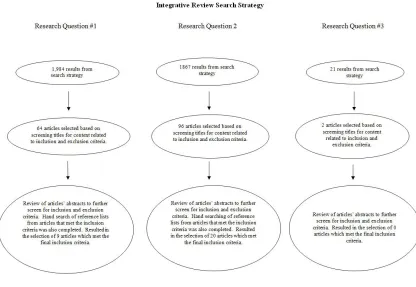
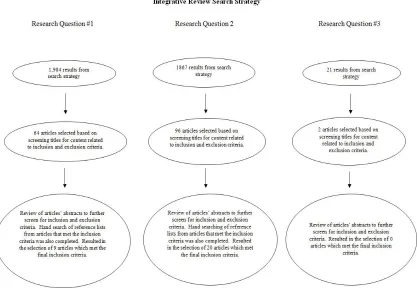
xiii Figure 1: Integrative Review Search Strategy
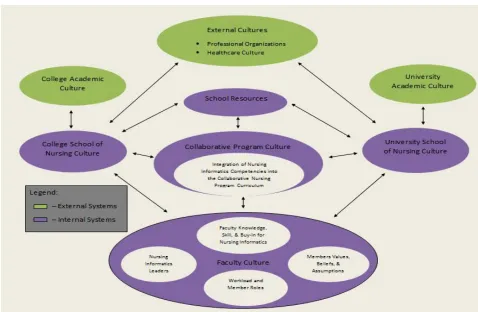
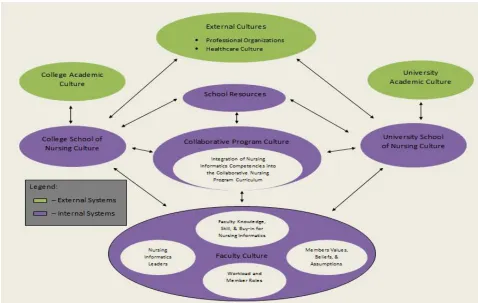
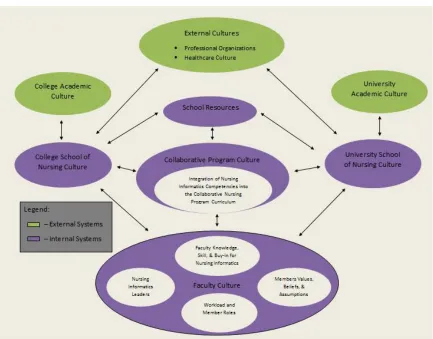
Figure 2: The Interaction Amongst Systems and Subsystems Which Impact the
Integration of Nursing Informatics Competencies into the Collaborative Nursing Program
Curriculum.
Chapter 1 - Introduction
The use of information communication technologies (ICT) within healthcare is
quickly becoming an integral aspect of providing quality patient care. These
technologies, in particular the electronic health record (EHR) and social media
technologies, are revolutionizing the ways in which healthcare practitioners and patients
communicate, document, and retrieve health-related information. In Canada, Canada
Health Infoway (CHI) is the organization working jointly with the provinces and
territories to implement a nation-wide system to manage health-related information in
every region (CHI, 2012). Although a nation-wide EHR system is not yet realized within
Canadian healthcare, such a system will enable healthcare patients and providers to
access patient and health-related information, 24 hours a day, 7 days a week, from any
location with computer and internet access. Once fully implemented, functions within
the nation-wide EHR will offer access to an updated computerized patient record to
provide practitioners with the resources and information they need to critically evaluate
care decisions, such that they are able to meet the needs of patients most effectively.
Patients and their families will also see the benefits of ICTs, as these systems should
promote more effective patient-provider communication, as well as offer patients access
to important health information which will assist them to manage and engage in
self-monitoring (Harrison & Lee, 2006).
The implementation of the pan-Canadian EHR will make ICT a customary
part of patient care; therefore, students entering the practice of nursing must learn to
stakeholders within healthcare and their ongoing support for the implementation of
the EHR and other ICTs (e.g., social media technologies, electronic medication
administration records, glucometers) is critical to the successful development and
adoption of informatics technology within the healthcare environment (Harrison &
Lee, 2006). This highlights the importance of incorporating nursing informatics
competencies within the undergraduate curriculum which prepares nurses for
practice. If nurse graduates are expected to enter technology-enabled practice
settings, their understanding of the benefits and skills required to utilize ICTs is
crucial. In addition, if students learn to utilize ICTs when beginning to develop basic
nursing competencies, the use of these technologies will become better integrated into
the workflow of their nursing practice. Experts suggest that if students at the very
least learn to document with and utilize the electronic health record, they will build
greater familiarity with this form of documentation and patient information retrieval
that will foster acceptance of this documentation format (Ash & Bates, 2004).
Integration of nursing informatics competencies within nursing curricula will foster
an environment which supports and promotes nurses’ use of these technological
advancements.
Despite the importance of preparing nursing students to practice using ICTs,
Canadian undergraduate nursing education programs struggle to integrate nursing
informatics content within nursing curricula. The limited nursing informatics content
within undergraduate curricula creates a situation where expertise of health ICT
within the professional practice environment may surpass that of academia, as
Clarke, 2004). Nursing educational curricula appear to lack sufficient attention to
many basic competencies that promote knowledge and skill development in the area
of nursing informatics. In particular, graduate nurses in Canada and the United
States, are entering the workforce with low levels of knowledge and skills in relation
to utilizing ICTs to document within electronic applications, create electronic nursing
care plans, and perform data entry (Fetter, 2008, 2009a; Nagle & Clarke, 2004). As
many healthcare environments currently rely heavily on ICTs to document and
retrieve patient information, lack of student knowledge and skill in the use of these
technologies will make them ill-prepared to practice within technology-enabled
practice settings (Nagle & Clarke, 2004). Nursing education culture appears to
influence decision-making, and the development of organizational priorities within
nursing education. Consequently, understanding the culture of a school of nursing
and nursing program as it relates to nursing informatics and the use of ICTs is an
important step in identifying why this area of student development appears to be
infrequently addressed within nursing curricula. In the remainder of this chapter,
presented are a brief background and significance of the study, the study purpose and
research questions, a summary of the theoretical framework which guided this
research, an overview of study methods, as well as a description of this integrated
article format dissertation.
Background and Significance of the Study
The importance of nursing informatics to the current healthcare arena and to
United States (Aktan, Bareford, & Tracy, 2011; Williamson, Fineout-Overholt, Kent, &
Hutchinson, 2011).
Although experts have discussed the importance of preparing nurses who can
utilize these technologies, a survey of faculty at Canadian Schools of Nursing (SON)
revealed that only 33% of nursing programs offered a credit course in nursing informatics
and that nursing students’ primary access to the EHR applications occurred in their acute
care placement settings (Nagle & Clarke, 2004). Of those members of schools of nursing
surveyed, only 33% believed that students and faculty have adequate nursing informatics
competencies and computer skills (Nagle & Clarke, 2004). These findings are similar to
those reported in the United States where researchers have identified that students are
graduating with low levels of knowledge and skill in relation to health information
technology use, particularly related to using electronic applications to document, create a
nursing care plan, and perform data entry (Fetter, 2008, 2009a).
In response to the limited integration of nursing informatics content within
undergraduate nursing education programs within Canada, the Canadian Association
Schools of Nursing (CASN) in collaboration with CHI, has developed a number of
documents to support nurse educators. These documents include the: 1) Nursing
Informatics Entry-to-Practice Competencies for Registered Nurses (CASN, 2012a), 2)
Nursing Informatics Inventory (CASN, 2012b), and 3) Nursing Informatics Teaching
Toolkit (CASN, 2013). Through publishing the Nursing Informatics Entry-to-Practice
Competencies for Registered Nurses (CASN, 2012a) members of CASN aim to support
nurse educators to identify nursing informatics competencies required for
direct nurse educators to available nursing informatics teaching and learning resources.
Finally, the Nursing Informatics Teaching Toolkit supports nurse educators to integrate
the nursing informatics competencies identified in the CASN Nursing Informatics
Entry-to-Practice Competencies for Registered Nurses (CASN, 2012a) within their
undergraduate nursing curricula. The development of these three documents for
Canadian Schools of Nursing, highlights the need for nurse educators to consider nursing
informatics competencies as an important part of their undergraduate nursing curricula.
Barriers identified as influencing whether nursing informatics competencies are
incorporated within the undergraduate nursing curriculum are lack of: 1) human and
material infrastructure to support health informatics training, 2) faculty knowledge, skill,
and ‘buy-in’ to use this technology to support nursing care, and 3) a fully integrated
EHR/electronic medical record (EMR) system within some professional practice settings
or restricted student access to the EMR and other ICT systems (Curran, 2008; Fetter,
2009a 2009b; Griffen-Sobel et al., 2010; Kushniruk, Borycki, Armstrong, Joe, & Otto,
2009; Melo & Carlton, 2008; Nagle & Clarke, 2004; Nickitas et al., 2010; Taylor,
Hudson, Vazzano, Naumann, & Neal, 2010). Facilitators described in the literature
which assist in promoting the success of nursing informatics curriculum development
efforts include: 1) development of a clear plan to guide the implementation process, 2)
allocation of resources (e.g., release time for faculty to engage in faculty development in
informatics, monies to support the purchasing of ICTs for teaching purposes, etc.) to
support integration, 3) development of academic partnerships between a school and a
clinical agency or an EHR technology vendor (Curran, 2008; Fetter, 2009a;
standards that focus on nursing informatics competencies in nursing graduates (CASN,
2012).
It is evident from the description of barriers and facilitators that integration of
nursing informatics competencies within undergraduate nursing curricula is a difficult
process which requires commitment from the school to provide the necessary conditions
(e.g., resources - human and financial) to ensure success. In addition, it requires a group
of nursing faculty, who embrace the use of technology and ‘buy-in’ to the importance of
educating nursing students who are able to practice within technology-enabled practice
settings. In many case study exemplars described in the literature, the presence of a
champion or leader skilled in the area of nursing informatics was identified as imperative
to curricular integration success. Champions were instrumental to forming a curriculum
development project group, developing research proposals and grants to support
integration, and negotiating with the school for release time to allow faculty to participate
in curriculum development (Griffen-Sobel et al., 2010; Nickitas et al., 2010).
Additionally, champions worked with other nursing faculty to educate them in the use of
ICTs and to assist them to explore where within the curriculum this content could be
addressed (Gloe, 2010; Griffen-Sobel et al., 2010; Johnson & Bushey, 2011).
Champions in the area of nursing informatics have provided nurse educators with
direction as to what core competencies nurses must possess in order to effectively assume
their role. The available literature suggests that educational programs focus student
learning first on developing computer, information literacy, and information management
knowledge and skills (CASN, 2012a; Fetter, 2009b; Technology Informatics Guiding
becoming proficient users of ICTs. Additionally, the CASN document, Nursing
Informatics Entry-to-Practice Competencies for Registered Nurses (CASN, 2012a)
specifies that faculty members in nursing academia consider incorporating competencies
which assist students to use: 1) basic ICT devices and applications to communicate, 2)
relevant information and knowledge to support the delivery of evidence-informed patient
care, 3) ICTs in accordance with professional and regulatory standards and workplace
policies, and 4) ICTs in the delivery of patient care (CASN, 2012a). What is also useful
about the CASN nursing informatics entry-to-practice competencies, is that embedded
within each of the competencies described above, are indicators which nurse educators
can use to evaluate student acquisition of these particular skills (Appendix A). The
development of these competencies is an important achievement in the area of nursing
informatics within Canada as this confirms the commitment that this national accrediting
body has to student development in this area. In addition, the document serves as a
contextually relevant guide to direct faculty involved in curriculum development in the
area of nursing informatics.
Although there are a number of articles which provide valuable insight into the
process of integrating nursing informatics content within nursing curricula, the literature
continues to lack empirical studies which have evaluated nursing informatics educational
initiatives. Most literature in this area is comprised of case study descriptions from U.S.
schools of nursing that have incorporated these competencies into their nursing curricula
either as stand-alone courses or integrated within existing nursing courses. The lack of
studies based in Canadian schools of nursing may suggest that there has been little
curricula. As the Nagle and Clarke (2004) study is the most recent account of nursing
informatics competencies within Canadian undergraduate curricula, there is a need to
again evaluate nursing education and its progress toward developing graduates with
competence in nursing informatics. In addition, there is a need to understand further how
to best educate future nursing professionals in Canada to develop knowledge and skill in
relation to nursing informatics, particularly the use of ICTs such as the EHR.
Further exploration of Canadian schools of nursing curricula is necessary in order
to identify what competencies Canadian nurse graduates are obtaining in relation to
nursing informatics. However, more importantly, closer examination of the facilitators
and barriers to incorporating nursing informatics competency within Canadian schools of
nursing is necessary and will offer insight into how policies and procedures embedded
within a school structure serve to impact the curriculum development process. Through
an examination of the culture of a collaborative nursing program, this research project
aimed to understand how the systems and subsystems of two schools of nursing influence
what was taught in the nursing curriculum in relation to nursing informatics. In addition,
through conducting this analysis, the researcher identified what nursing informatics
competencies these nursing graduates possessed upon graduation from the program.
Study Purpose
This dissertation study examined a collaborative nursing program culture, to
understand how the practices and policies that are inherent within two schools of nursing
influence the inclusion of nursing informatics competencies into an undergraduate
nursing curriculum. This collaborative program was offered as a 4-year BScN degree
collaborative nursing program culture provided a means to answer the following research
questions:
1. In what ways does a nursing education culture (the shared values, assumptions,
and behaviours of two schools of nursing) and the practices and policies within
the two schools of nursing affect the incorporation of nursing informatics
competencies in a collaborative nursing program curriculum?
2. How is the incorporation of competencies related to nursing informatics in the
collaborative program curriculum influenced by the systems and subsystems
within the two schools of nursing?
3. How do the subsystems within the two schools of nursing interact to affect the
incorporation of nursing informatics competencies in the undergraduate nursing
curriculum?
4. In what ways do resources within these two schools influence the curriculum
development process and incorporation of nursing informatics competencies
within the curriculum?
Key Terms
Curriculum was defined as being comprised of the “philosophical approaches,
curriculum outcome statements, (the) overall design, courses, teaching-learning
strategies, delivery methods, interactions, learning climate, evaluation methods,
curriculum policies, and resources” (Iwasiw, Goldenberg, & Andrusyszyn, 2009, p. 5), as
described in curriculum documents and by faculty and students. For this study, the
researcher examined the espoused and enacted curriculum. The espoused curriculum is
is how the espoused nursing curriculum becomes enacted and taught to students through
individual faculty members teaching and learning practices. Additionally, for the
purpose of this research, curriculum was considered to be developed and revised such
that it remains context-relevant. A context-relevant curriculum is “responsive to learners;
current and projected societal, health, and community situations; and current and
projected imperatives of the nursing profession; [is] consistent with the mission,
philosophy, and goals of the educational institution and school of nursing; [and] feasible
within the realities of the school and community” (Iwasiw & Goldenberg, 2015, p. 7).
Nursing Informatics in this study is defined as the “science and practice [which]
integrates nursing, its information and knowledge, and their management, with
information and communication technology to promote the health of people, families and
communities worldwide” (International Medical Informatics Association, 2010).
Embedded within the concept of nursing informatics is the term information
communication technology (ICT). ICTs are “information and communication
technologies used to handle information and facilitate communications” (Canadian
Nurses Association [CAN], 2006). Specifically, for this study, the researcher was
interested in ICTs which enable nurses in their practice (research, education, and
client-focused practice) to communicate and utilize patient and other health-related information.
Therefore, in order for novice nurses to develop the knowledge and skill to utilize ICTs,
nursing informatics competenciesmust be addressed within nursing curricula.
Nursing Informatics Competencies are those learning competencies that are
foundational to the development and use of ICT. The competencies used to guide data
Competencies for Registered Nurses, developed by the Canadian Association of Schools
of Nursing (CASN, 2012a) through funding that was provided by Canada Health Infoway
(Appendix A). The purpose for developing these educational competencies was to
develop “a culture within nursing education in Canada that embraces the integration of
nursing informatics in curricula and professional practice” (CASN, 2012a, p. 1). These
competencies were chosen to guide this study as they are the most recently published
nursing informatics competencies that are specifically aimed at providing information to
assist nursing educators in Canada to prepare new graduates for practice.
Culture, for this study was defined as a system of learned behaviour which was
characteristic of the shared norms and values that are held by a group of individuals
(Schein, 2004). A culture was something that every member brought with them and was
influenced by a plethora of other cultures and subcultures (Straub, Loch, Evaristo,
Karahanna, & Srite; 2002). As a result, organizational culture was defined as an
amalgamation of each member’s culture, a combination of cultures which came together
to create and shape an overall organizational culture for the school of nursing.
Within the study of this collaborative program culture, the researcher studied the
practices and policies inherent within the program which impacted the integration of
nursing informatics within the curriculum. These encompassed those practices that
structure the school to function in a specific way. Practices and policies impact all
aspects of the two schools, particularly the implementation and execution of teaching and
learning activities. In addition, practices and policies impact the structure, the imposed or
hidden hierarchy of members, and the development and management of decision making
Theoretical Framework
Systems theory was the theoretical framework which guided this study. This
theory influenced the study design, research questions, and data collection and analysis
strategies.
Systems Theory.
Systems theory was developed by Ludwig von Bertalanffy to study the interaction
of a system with its environment (Walonick, 1993). A system is a structure that is made
of interrelated and interdependent elements which influence one another to maintain a
state of homeostatsis within the system. As a system exchanges information with the
environment in which it is situated, systems theory is driven by a number of basic tenets:
1) a system is open to its environments; 2) behaviour within a system is purposeful and
occurs to move a system towards its goals; 3) a system is made up of a set of interrelated
subsystems that interact; 4) there is always a constant exchange of inputs and outputs
between a system and its environment;5) feedback loops are in place within a system to
assist the system to obtain a ‘steady’ state or its goal of dynamic equilibrium; and 6)
lastly, a system goal is to reach homeostatsis. This means that a system reacts in a way
that assists it to achieve optimum potential (Walonick, 1993). Embedded within a system
are subsystems. Subsystems follow the same tenets as a system and interact with one
another to shape the larger system within which they are situated.
Using systems theory, one can explore the complex set of interrelationship
amongst subsystems, as a system is constantly exchanging information with its
the subsystems of culture, human infrastructure, and resources could impact the
curriculum development process and inclusion of nursing informatics competencies
within the collaborative program curriculum. These subsystems influence the position of
schools of nursing within the larger systems of educational institutions and the social
world, shaping what knowledge and skill students have obtained as they graduate from
their program. Identification of these systems served as a beginning framework to guide
study procedures. A systems perspective within this study provided a lens with which to
deconstruct the greater educational system into smaller more understandable subsystems.
In addition, systems theory guided the development of the semi-structured interview
guides, as well as the data analysis procedures.
Methods
Study Design.
A focused ethnography was used to examine how the values, assumptions, and
behaviours embedded within the culture of one collaborative nursing program impacted
the curriculum development process and the incorporation of competencies specific to
developing student knowledge and skill in nursing informatics. A focused ethnography is
characterized by short field visits in collaboration with intensive data-collection through
interviews, document analysis, and observation (Knoblauch, 2005). When conducting a
focused ethnography, the researcher enters into the study setting with a thorough
understanding of the study field, in order to focus the analysis on aspects of the culture
2002). This methodology was chosen to focus the analysis on aspects of the culture
related to nursing informatics and curriculum development.
Setting.
The culture of a collaborative nursing program was the unit of analysis for this
study. This collaborative program was offered as a 4-year BScN degree through a
partnership between a university and college. The two program sites (two Schools) were
located in the same city in Ontario, had their own administrative structure, and offered
other nursing programs in addition to the collaborative program under investigation. The
collaborative BScN curriculum offered was undergoing curriculum development during
the data collection period. New first-year courses were being implemented and course
design and development for years 2-4 of the revised curriculum were ongoing during this
time.
Data Collection.
Data were obtained through semi-structured interviews, document review, and
observations. Twenty-six in-depth individual interviews were conducted with faculty
members, support staff, and students from the collaborative nursing program. Interviews
lasted approximately one hour, took place at a convenient location for each participant,
and were guided by a semi-structured, researcher-developed interview guide. Documents
were obtained through communication with faculty at both sites, and in consultation with
administrative staff. Documents included: the college and university mission and vision
statements, the nursing mission and vision statements, curriculum and course
and curricular documents such as: program year goals, a curriculum overview, course
syllabi, and course descriptions. Additionally, information from the college and
university school of nursing web sites was acquired. Fifteen observations were
completed. Observations were conducted during classes (15 hours), committee and
course development meetings (15 hours), and research presentations (4 hours). During
the observation sessions, field notes related to the observations were made.
Data Analysis.
All data from interviews and field notes were transcribed concurrently. The
researcher conducted an in-depth analysis focusing on aspects of the culture of the
collaborative program which were within the aims of the identified research questions. A
thematic analysis of the interview transcripts, observation data, and documents was
conducted. Data collection and analysis occurred concurrently to enhance the integrity of
study findings (Polit & Beck, 2008).
Chapter Summary
As nurses in their daily practice are required to manage and integrate many forms
of patient data, having the knowledge to effectively use ICTs has become an important
aspect to providing quality patient care. Within healthcare nurses’ ongoing support with
the implementation of ICTs is critical to the successful development and adoption of this
technology (Harrison & Lee, 2006). Developing knowledge and skill in the use of ICTs
within nursing will assist graduates to view the use of these technologies as an integral
part of their nursing practice (Ash & Bates, 2004). Through careful consideration and
create an educational environment which supports and promotes use of these
technologies.
Despite the importance of student learning in the area of nursing informatics,
many nursing curricula within Canada lack student learning activities which develop the
knowledge and skill required for students to become proficient users of ICTs. Students
are completing their nursing programs and entering into practice limited in the skills to
document within electronic applications, create electronic nursing care plans, and
perform data entry (Fetter, 2008, 2009a; Nagle & Clarke, 2004). Therefore, this study
aimed to understand how a collaborative nursing program culture, and the practices and
policies inherent within two schools of nursing, influence the inclusion of nursing
informatics competencies within the undergraduate nursing curriculum. Systems theory
was the theoretical framework which was used to guide the study design, research
questions, and data collection and analysis strategies. This is the first study to the
researcher’s knowledge to examine nursing education culture in relation to the integration
of nursing informatics curricular initiatives.
Overview of Chapters
This thesis will follow the integrated-article format outlined by School of
Graduate and Postdoctoral Studies at Western University. Chapters 2, 3, 4, and 5 are
considered stand-alone chapters which will be submitted for publication. Consequently,
there is some repetition within these chapters related to background, literature review,
and methodology components. Chapter 2 consists of an integrated review, aimed to
provide the reader within an understanding of the available literature which has
competencies into an undergraduate nursing curriculum. Chapter 3 provides an overview
of systems theory as the guiding framework of this research and outlines focused
ethnography as the methodology of this study. Specifically, this paper addresses the
challenges encountered when employing this methodology to study a nursing education
environment. Chapters 4 and 5 present the study findings. Chapter 4 describes the
facilitators and barriers which influence the successful integration of nursing informatics
content within undergraduate nursing curriculum, and chapter 5 outlines how attributes of
the collaborative nursing program culture shape and influence the inclusion of nursing
informatics content within the curriculum. Chapter 6 presents a general discussion and
References
Aktan, N., Bareford, C., & Tracy, J. (2011) Computerized documentation and community
health nursing students. Journal of Nursing Education and Practice, 1, 25-31.
doi: 10.5430/jnep.v1n1p25
Ansari, S. (2004). Systems Theory and Management Control. Retrieved from
http://faculty.darden.virginia.edu/ansaris/systems%20theory%20and%20mcs-tn.pdf
Ash, J., & Bates, D. (2005). Factors and forces affecting EHR system adoption: Report of
a 2004 ACMI discussion. Journal of American Medical Informatics Association,
12, 8-12 doi: 10.1197/jamia.M1684.
Canadian Nurses Association. (2006). Position statement: Nursing information and
knowledge management. Retrieved from http://www.cna-
aiic.ca/CNA/documents/pdf/publications/PS87-Nursing-info-knowledge-e.pdf
CASN. (2012a). Nursing informatics entry-to-practice competencies for registered
nurses. Retrieved from.
http://www.casn.ca/en/Whats_new_at_CASN_108/items/123.html
CASN. (2012b). Nursing informatics inventory exisiting teaching and learning resources.
Retrieved from.
https://www.google.com/url?q=https://www.infoway-
inforoute.ca/index.php/component/docman/doc_download/2153-nursing-
informatics-inventory-a-report-of-existing-teaching-and-learning-
resources&sa=U&ei=Wu-
CASN. (2013). Nursing informatics teaching toolkit: Supporting the integration of the
CASN nursing informatics competencies into nursing curricula. Retrieved from.
https://www.google.com/url?q=https://www.infoway-
inforoute.ca/index.php/component/docman/doc_download/2154-nursing-
informatics-teaching-toolkit&sa=U&ei=Wu-
qVJrSLsX_yQSEuYGgAw&ved=0CAgQFjAD&client=internal-uds-cse&usg=AFQjCNHJjoq47HKobqzdoR_97zvBHkNOlQ
CHI. (2012). What we do. Retrieved from.
https://www.infoway-inforoute.ca/index.php/about-infoway/what-we-do
Curran, C. (2008). Faculty development initiatives for the integration of informatics
competencies and point-of-care technologies in undergraduate nursing education.
The Nursing Clinics of North America, 43, 523-533.
doi:10.1016/j.cnur.2008.06.001
Fetter, M. (2008). Graduating nurses’ self-evaluation of information technology
competencies. Journal of Nursing Education, 48, 86-90.
Fetter, M. (2009a). Improving information technology competencies: Implications for
psychiatric mental health nursing. Issues in Mental Health Nursing, 30, 3-13. doi:
10.1080/01612840802555208
Fetter, M. (2009b). Graduating nurses’ self-evaluation of information technology
competencies. Journal of Nursing Education, 48, 86-90.
Gloe, D. (2010). Selecting an academic electronic health record. Nurse Educator, 35,
156-161. doi: 10.1097/NNE.0b013e3181e337d3
Dornbaum, M. (2010). A transdisciplinary approach to faculty development in
nursing education technology. Nursing Education Perspectives, 31, 41-44.
Harrison, J., & Lee, A. (2006). The role of e-health in the changing health care
environment. Nursing Economics, 24, 283-288, p. 284.
International Medical Informatics Association. (2009) The nursing informatics special
interestgroup –definition. Retrieved from:
http:www.imiani.orgindex.phpoption=com_content&task=view&id=27&Itemid=
5
Iwasiw, C., Goldenberg, D., & Andrusyszyn, M. (2009). Curriculum development in
nursing education (2nd ed.). Sudbury, MA: Jones and Bartlett.
Johnson, D., & Bushney, T. (2011). Integrating the Academic Electronic Health Record
into Nursing Curriculum: Preparing Student Nurses for Practice. Computers,
Informatics, Nursing, 29, 133-137. doi: 10.1097/NCN.0b013e3182121ed8
Knoblauch, H. (2005). Focused ethnography. Forum: Qualitative Social Research, 6, 1-
11.
Kushniruk, A., Borycki, E., Armstrong, B., Joe, R., & Otto, T. (2009). Bring electronic
patient records into health professional education: Towards an integrative
framework. Medical Informatics in a United and Heathy Europe, 150, 883-887.
Melo, D., & Carlton, K. (2008). A collaborative model to ensure graduating nurses are
ready to use electronic health records. Computers, Informatics, Nursing, 26, 8-12.
Morse, J., & Richards, L. (2002). Read Me First for a Users Guide to Qualitative
Nagle, L., & Clarke, H. (2004). Assessing Informatics in Canadian Schools of Nursing.
Retrieved from
http://cmbi.bjmu.edu.cn/news/report/2004/medinfo2004/pdffiles/papers/4284Nagl
e.pdf
Nickitas, D., Nokes, K., Caroselli, C., Mahon, P., Colucci, D., & Lester, R. (2010).
Increasing nursing student communication skills through electronic health record
system documentation. Plastic Surgical Nursing, 30, 103-107. doi:
10.1097/01.NCN.0000336491.11726.4e
Polit, D.F., & Beck, C.T. (2008). Nursing research: generating and assessing evidence
for nursing practice (8th ed.). Philadelphia: Lippincott.
Schein, E (2004). Organizational culture and leadership (3rd edition). Retrieved from.
http://books.google.ca/books?hl=en&lr=&id=xhmezDokfnYC&oi=fnd&pg=PR11
&dq=organizational+culture+definition&ots=m5KV2Sk6pL&sig=7kF9ZyS1SO0
xROm6xyTgzG0Yytg#v=onepage&q=organizational%20culture%20definition&f
=false
Straub, D., Loch, K., Evaristo, R., Karahanna, E., & Srite, M. (2002). Towards a theory
based measurement for culture. Journal of Global Information Management, 10,
13-23
Taylor, L., Hudson, K., Vazzano, J., Naumann, P., & Neal, M. (2010). The electronic
health records meets baccalaureate nursing curriculum: Stories from the
battlefield. Nurse Leader, 8, 40-44.
TIGER. (2010). The tiger imitative: Evidence and informatics transforming nursing.
Walonick, D. (1993). General Systems theory. Retrieve from.
http://statpac.org/walonick/systems-theory.htm
Williamson, Fineout-Overholt, Kent & Hutchinson, (2011). Teaching EBP: Integrating
technology into academic curricula to facilitate evidence-based decision-making.
Chapter 2 – Nursing Education Culture and Nursing
Informatics Competencies within Undergraduate Nursing
Curricula: Is there a link?
Faculty teaching in undergraduate nursing programs must prepare graduates to
enter into technology-enabled practice environments. As a result, knowledge and skill in
the use of information communication technologies (ICTs) has become an essential part
of the nursing role and a way of enhancing the quality of care provided to patients
(Canadian Nurses Association, 2006; Canada Health Infoway (CHI), 2009). Despite the
importance of ICTs within the healthcare environment, content which prepares graduates
to practice nursing utilizing ICTs remains limited within undergraduate nursing
curriculum (Nagle & Clarke, 2004). Graduates from schools of nursing in Canada and
the United States have reported low levels of knowledge and skills in relation to using
ICTs to document within electronic applications, create electronic nursing care plans, and
perform data entry (Fetter, 2009, 2009b; Nagle & Clarke, 2004). Faculty knowledge and
skill in relation to nursing informatics competencies is also lacking and nursing
informatics educational initiatives have been met with resistance (Fetter 2009).
Progressively ICTs , in particular electronic health records (EHR) and social media
technologies, are being incorporated into healthcare practice settings, and it is predicted
that the lack of planned initiatives to incorporate nursing informatics competencies into
nursing curricula will result in technology use within the professional practice
environment surpassing that of academia (Nagle & Clarke, 2004). Understanding the
to curriculum development in the area of nursing informatics is an area of research which
could lead to the identification of facilitators and barriers that have impacted the
curriculum development process.
Currently there are a limited number of publications in which researchers have
examined the culture of a school of nursing in relation to the incorporation of nursing
informatics competecnies as part of curriculum development. Consequently, an
integrative literature review offered a systematic approach to explore and evaluate
available quantitative, qualitative, and case study articles written in this area
(LoBiondo-Wood, 2013). An integrative review is a systematic method for exploring and evaluating
literature related to a focused research question (LoBiondo-Wood, 2013). This review
method includes not only quantitative research studies; consequently statistical analysis
of research findings is not conducted. Rather, the researcher conducts an in-depth
synthesis and evaluation of all available literature which meets specific inclusion criteria
(Armstrong, 2011; LoBiondo-Wood, 2013). An integrative review was chosen in order
to consider all quantitative, qualitative, and case study literature, and to focus the review
on the conceptual link between nursing education culture and the integration of nursing
informatics competencies within undergraduate nursing curricula.
Central to the focus of this review is the concept of culture,which is defined as a
system of learned behaviour which is characteristic of the shared norms and values that
are held by a group of individuals (Schein, 2004). A culture is something that every
member brings with them and that is influenced by a plethora of other cultures and
subcultures (Straub, Loch, Evaristo, Karahanna, & Srite; 2002). As a result, an
cultures which have come together to create and shape an overall organizational culture
for the school of nursing. Through conducting a cultural assessment one can uncover the
way that culture is intertwined with and influences decision-making, affects the
development of organizational priorities, and shapes the organizational and structural
processes embedded within the structure of an organization.
Purpose and Research Questions
The purpose of this integrative literature review was to understand how nursing
education culture impacts the curriculum development process, particularly in relation to
incorporating nursing informatics competencies within it. The following research
questions guided this review:
1. What is the current state of knowledge regarding nursing education culture?
2. What is the current state of knowledge regarding curriculum development and
course design which incorporates nursing informatics competencies?
3. What is the current state of knowledge regarding the relationship between
nursing education culture and the incorporation of nursing informatics
competencies into an undergraduate nursing curriculum?
Search Strategy
A comprehensive search of Cumulative Index for Nursing and Allied Health
Literature (CINAHL), Scopus, Medline, and Educational Resources Information Center
(ERIC) databases was conducted. Search terms consisted of: culture, values, buy-in,
nursing informatics, information communication technology, nursing education, school
individually before being combined with other search terms. The inclusion criteria were
that articles: be research based or case studies; published in English between 2000 and
2014 in Canada or the United States; focus on a school of nursing that offers an
undergraduate nursing degree; and be pertinent to the research questions. Publication
after the year 2000 ensured that nursing informatics curriculum development endeavours
were current with emerging healthcare trends. Specifically, the aim of the first research
question was to locate articles in which the culture of a school of nursing is assessed in
some way. Articles written about teaching of culturally competent nursing care and/or
culture shock were excluded from this review. Research question two was used to
identify articles that addressed the process of incorporating nursing informatics content
within an undergraduate nursing curriculum. Of particular interest were those articles
that considered what nursing informatics competencies should be taught to students and
articles where researchers described how curriculum was refined to incorporate this area
of student learning. Articles where researchers reported the use of technology (e.g.,
simulation technology, clickers, etc.) solely for teaching other nursing content were
excluded from this review. The third research question was used to determine if there
was a conceptual link between nursing education culture and the inclusion of nursing
informatics competencies within an undergraduate nursing curriculum (See Figure 1 for
Figure 1.
This article is arranged into three sections. First, an examination of research
exploring nursing education culture is presented. This is followed by an assessment of
literature where researchers have described the process of incorporating nursing
informatics content within an undergraduate nursing curriculum. Finally, research
literature that examines the conceptual links between nursing education culture and
nursing informatics educational initiatives is addressed.
Findings
Assessment of Nursing Education Culture
Nine articles were reviewed in which a school of nursing culture was assessed
Organizational Culture on School Members, 2) Culture of Successful Nursing Programs,
and 3) Cultural Change.
Effect of Organizational Culture on School Members.
Of the nine articles reviewed, there were 5 articles where researchers examined
the influence of nursing education culture on school members. Two examined nursing
organizational culture and the influence it has on empowering students and faculty to
assume their nursing role (Bosley, 2005; Johnson, 2009). In these quantitative studies,
researchers identified a weak, positive relationship between students’ perceptions of
organizational culture in their nursing program, and their self-perceived rating of
empowerment (r= 0.249, p<0.01) (Bosley, 2005) and a moderate impact between
organizational culture and faculty empowerment (F= 43.86, P< 0.01) (Johnson, 2009).
Curriculum revision was a program factor that significantly influenced faculty
empowerment (F=5.53, P<0.01) (Johnson, 2009). These findings suggest that faculty
should be involved with curriculum refinement as well as have input into the functioning
of the organization as this will promote an organizational culture that empowers nursing
faculty to effectively assume their role.
In addition to faculty empowerment, one quantitative study explored the
relationship between organizational climate and organizational commitment (Gormley &
Kennerly, 2010). The authors conclude that organizational commitment can be fostered
through creating friendly faculty social relations, promoting physical and psychological
health of members, as well as providing socialization into the academic role (Gormley &
Kennerly, 2010). Another study used a phenomenological method of ethnographic
faculty role (Schriner, 2004). New faculty experience a sense of cultural dissonance
which creates conflict as they transition from the world of practice into academia, thus
suggesting that socialization into the faculty role is essential (Schriner, 2004).
The final area of research that has considered the impact of culture on school of
nursing members was a descriptive qualitative study which explored the impact of
nursing education culture and teaching and learning practices on the success of minority
(defined as people with diverse ethnicities and national origins) nursing students
(Kossman, 2003). Within the minority students’ nursing educational experience, there
was a universal perception of struggle. Minority students struggled with coping with the
demands of a challenging program; dealing with a lack of social support from friends and
family; and managing the financial stress of juggling a work/school balance. Nursing
education culture has a large impact on all members, particularly nursing students.
Faculty values and ways of being with students can impact students’ success and their
ability to have a positive learning experience (Kossman, 2003).
Culture of Successful Nursing Programs.
In two studies, researchers assessed the culture of a school of nursing that they
identified as a successful nursing program (Leiker, 2011). Successful nursing programs
were those with a strong structure, supported through strong leadership, management
processes, and well-defined professional and internal values (Leiker, 2011). In addition,
values such as trust, respect, collegiality, open communication, and integrity among
members support a school in achieving excellence (Leiker, 2011; McNish, 2003).
promoting their transition into the practice area were other important cultural values
(Leiker, 2011; McNish, 2003).
Cultural Change.
The final two articles related to educational culture examined cultural change.
Springer, Clarke, Strohfus, & Belcheir (2012) used Kotter’s eight-stage process for
transformational change (Kotter, 1996) to direct and improve their school culture. This
approach fostered the development of a new shared governance model, strategic plan,
vision, and behavioural norms. Faculty concerns in relation to poor communication and
ineffective leadership were improved using this change model (Springer et al., 2012).
Cultural change is attainable if there is a designated plan and support from all members.
Change is a time-consuming and slow process (Springer et al., 2012).
Similarly, Porter & Bean (2004) examined the cultural change of a school of
nursing during the years in which a program of nursing was offered (1954-1994). This
school was affiliated with a Methodist church and was one of the first 4-year collegiate
schools in the United States. A shift in cultural values from those of career preparation
and religious influence towards values which encompassed an appreciation for academic
excellence had an overall negative effect on the functioning of the school. Researchers
also identified that the school of nursing failed to adapt to the rural and religious
environment which was comprised of a mature student population with part-time work
requirements. Failing to tailor the culture of the school to the individuals which it serves
(students) was a contributing factor to the breakdown of the school system.
In response to Research Question 1 (examining the current states of research
articles that have examined nursing education culture. Findings appear to support that the
cultural values of a school of nursing are important to the success of the program and its
members. Researchers have suggested values need to include respect, trust, integrity, and
a strong sense of collaboration and communication among members; as this will promote
empowerment, trust, and equal opportunity (McNish, 2009; Gormley & Kennerley, 2010;
Kossman, 2003). In addition, the culture of the school of nursing must align with the
external environment, which includes that of practice, and meet the needs of the students
they serve (Schriner, 2004; Porter & Bean, 2004). The limited number of published
research articles which have examined nursing education culture does not provide a clear
depiction of the extent to which nursing education culture influences education, practice,
and nursing curriculum. Additional studies in these areas will further validate the
existing research findings, as well as offer a new and expanded understanding of nursing
education culture in general and the influence that aspects of culture have on the
functioning of a school of nursing and its programs. In particular, research which
examines the influence of nursing education culture on aspects of organizational structure
and the process of curriculum development is needed.
Curriculum and Course Development and the Incorporation of Nursing Informatics
Competencies
Twenty articles that met the inclusion criteria for the second research question
(See table 2). Twelve of the articles included were case studies, four were mixed
methods studies, two were quantitative studies, and two were qualitative studies. The
Teaching and Learning Strategies, and 4) Informatics Curricular Content. Each theme
will be discussed followed by a review and critique of the existing literature.
Barriers.
Integrating nursing informatics competencies within an undergraduate nursing
curriculum was described as a process which required a significant investment from
faculty and the school of nursing. The main barriers identified were lack of: funding,
faculty time, and faculty knowledge, skills, and motivation (Fetter, 2009; McNeil et al.,
2003; McNeil et al., 2006; Meyer, Sternberger, & Toscos, 2011; Weber, 2004).
Specifically, nursing faculty appear to be knowledgeable in teaching information and
computer literacy skills; however, they require assistance and faculty development
initiatives in order to teach higher level nursing informatics competencies (Fauchald,
2008; McNeil et al., 2003). Faculty from programs of nursing in the United States were
rated at the advanced beginner level, with only two schools of nursing identifying faculty
abilities to teach and use information technology at the expert level (McNeil et al., 2003).
Similarly, in a study of Canadian Schools of Nursing, faculty stated that nursing
informatics content had been integrated throughout the curriculum; however, they were
unsure of exactly where it was integrated or how many hours were devoted to this content
(Nagle & Clarke, 2004).
This suggests that nursing faculty need to develop knowledge and skill in the area
of nursing informatics in order to be adequately prepared to teach this content (Curran,
2008; Fauchald, 2008; Meyer, Sternberger, & Toscos, 2011). What is concerning
however, is that many nursing programs in the United States had no plans or resources to
opportunities to work hands-on with ICTs was described as an effective faculty
development initiative (Curran, 2008). Faculty should also be encouraged to design and
develop assignments, case studies, and evaluation strategies which foster student learning
about ICTs (Curran, 2008). These educational strategies build faculty confidence in their
ability to try out new ideas and get creative with available technology (Curran, 2008).
In addition, the time necessary to orientate students to the system, establish
passwords, and acquire access were barriers described as negatively impacting student
engagement with electronic records within their professional practice experiences
(Mahon et al., 2010). The extensive time required to train students to be users of clinical
EHR systems takes a large amounts of time away from students’ clinical learning. Yet,
despite lengthy hospital training sessions, strict institutional policies continue to limit
students from having their own access codes to the EHR system, resulting in limited
learning opportunities with ICTs (Mahon et al., 2010).
Curriculum Development Strategies.
Authors of case study reports describe successful nursing informatics educational
initiatives. Faculty need to consider identifying student learning needs, selecting courses
to include nursing informatics competencies within, and mapping nursing informatics
competencies throughout the curriculum (Barton & Skiba, 2009; Curran, 2008; Fetter,
2009). The Nursing Informatics: Scope and Standards of Practice (Staggers, Gassert, &
Curran, 2002) (nursing informatics competencies developed for four different levels of
practice - beginning nurse, experienced nurse, informatics specialist, and informatics
innovator) have frequently been used to guide nursing informatics educational initiatives.
and determine whether the school has the technical capacity and support staff necessary
to manage the project (Connors et al., 2007). An evaluation plan was described as useful
for monitoring project success (Fetter, 2009). In addition to careful planning, a project
manager is necessary to assist with technical skill development, supply a vision to
transform the learning environment, as well as support faculty to develop and utilize
teaching strategies which incorporate ICTs (e.g., an academic electronic record (AEHR))
(Connors et al., 2007).
Another strategy to assist in lessening the cost associated with purchasing and
accessing ICTs, in particular an AEHR, was the development of an academic/vendor or
agency partnership. An academic/vendor or agency partnership can provide access to an
academic record which faculty can tailor to suit the needs of the learning environment
(Bowers, Kavanagh, Gregorich, Shumway, Campbell, & Stafford, 2011; Connors,
Warren, & Weaver, 2007; Fauchald, 2008; Kennedy, Pallikkathayil, & Warren, 2009;
Weber, 2004).
Teaching and Learning Strategies.
The primary teaching and learning strategy described within the literature was the
use of a case study (Fauchald, 2008; Kennedy, Pallikkathayil, & Warren, 2009; Loftus,
2013; Meyer et al., 2011; Weber, 2004). Case study learning approaches were integrated
within lecture and lab courses and provided a safe environment for students to access
real-life data from a variety of patient situations (Fauchald, 2008; Kennedy et al., (2009).
In one teaching approach, AEHR screen shots were projected onto a wall so that the
instructor could “monitor and comment on individual progress, call attention to
Authors suggest that a case study teaching approach can be used not only to facilitate
student development in the area of nursing informatics, but also to develop other key
nursing competencies such as students’ ability to understand the nursing process and
evidence-based practice (Fauchald, 2008; Kennedy et al., 2009; Weber, 2004). Feedback
suggested that students appreciated the case study learning strategy, identifying it as
hands-on and assisting them to link theory to their practice (Kennedy et al., 2009). In
order to promote an effective teaching and learning environment with the use of ICTs,
faculty must ensure they are: 1) using the right equipment, 2) having a balanced
instructor-to-student ratio, 3) focusing on longer training periods without distractions, 4)
supporting student troubleshooting concerns, and 5) assisting students to experience the
benefits of using the technology in the professional practice environment (Elfrink et al.,
2000).
In addition to a case study method, faculty have developed student learning in the
area of nursing informatics through: (1) encouraging student electronic documentation
following professional practice experiences (Meyer et al., 2011), (2) developing
stand-alone nursing informatics courses to target specific learning needs (Bowers, Kavanagh,
Gregorich, Shumway, Campbell, & Stafford, 2011; Perry & King, 2009), and (3) working
one-on-one with students through ICT documentation demonstrations (Mahon, Nickitas,
& Noken, 2010). Overall, students embraced the use of ICTs seeing these systems as an
organizing framework for planning and documenting the care they were providing
(Connors et al., 2007; Elfrink et al., 2000). Students’ negative comments reflected
technical issues that students encountered (Meyers et al., 2011).