Scholarship@Western
Scholarship@Western
Electronic Thesis and Dissertation Repository
8-2-2017 12:00 AM
Popular Music-Evoked Autobiographical Memories - Developing a
Popular Music-Evoked Autobiographical Memories - Developing a
Database of Songs and Studying the Role of Cue Emotionality and
Database of Songs and Studying the Role of Cue Emotionality and
Relevance on Recalled Memories
Relevance on Recalled Memories
Krysten ZatorThe University of Western Ontario
Supervisor Dr. Albert N. Katz
The University of Western Ontario Graduate Program in Psychology
A thesis submitted in partial fulfillment of the requirements for the degree in Master of Science © Krysten Zator 2017
Follow this and additional works at: https://ir.lib.uwo.ca/etd
Part of the Cognition and Perception Commons, and the Cognitive Psychology Commons
Recommended Citation Recommended Citation
Zator, Krysten, "Popular Music-Evoked Autobiographical Memories - Developing a Database of Songs and Studying the Role of Cue Emotionality and Relevance on Recalled Memories" (2017). Electronic Thesis and Dissertation Repository. 4701.
https://ir.lib.uwo.ca/etd/4701
This Dissertation/Thesis is brought to you for free and open access by Scholarship@Western. It has been accepted for inclusion in Electronic Thesis and Dissertation Repository by an authorized administrator of
i
Abstract
In Study 1, undergraduate students rated popular music songs on several factors. A database of knowledge was created for popular music autobiographical memory (AM) cueing research. Study 2 examined the role of emotional experience and relevance associated with a popular music AM cue on recalled AMs. In Phase 1, undergraduate participants described AMs to short music clips or a blank computer screen (control). In Phase 2, participants answered questions about these AMs. In Phase 3, participants rated musical clips (including Phase 1 stimuli). Unexpectedly, music-cued memories were less salient and did not differ emotionally from control-cued, but contained more perceptual and leisure content. When examining only participants cued by music, the emotional experience associated with listening to the cue was congruent with that of the produced memory. In addition, memories evoked to highly relevant music were rated as more salient and emotional than those evoked to less personally relevant music.
ii
Acknowledgments
Western: I would like to thank my supervisor, Dr. Albert Katz, for his continued
guidance, insight, and support over the past four years and particularly, his interesting stories and caring nature. I feel privileged to have worked with such a fascinating and compassionate mentor who possesses a blend of genuine care for his students, both personally and academically, and thoughtful research expertise. I will sincerely miss most, our meetings that turned into long chats about traveling and life. Academically, thank you for pushing me to go beyond what was expected of me and for helping me improve my writing skills. I will try to remember that “firstly” is not an appropriate word choice.
I would also like to thank the other wonderful, unique people in the Katz lab who have also always provided both a comfortable, nurturing environment and just plain good company. Especially, I thank Nick Reid for his support both academically and personally. Most importantly, I thank him for being a great karate partner and an even better friend. I also thank Hamad Al-Azary for sharing my love of coffee and exuding a contagious passion for research. His dedication and professionalism towards his research is inspiring. I thank James Boylan for his help with both my memory program and statistical analyses during my honors thesis. This assistance has been instrumental throughout my continued memory research. Finally, I wish to thank our lab mother hen, Dr. Karen Hussey for her toughness, advice, and feedback during my time in the Katz lab. I will think of her every time I consume large quantities of vegetables in one sitting. To my other friends in the psychology department that I have grown close to: particularly Matt, Bryan, Nick A., Mikayla, Alex, and others, I thank them for their friendship, expertise, advice, and encouragement throughout these past two years.
Finally, I wish to also thank my examination committee for reviewing my long thesis document and for their insightful comments and suggestions.
Family and Friends: I would especially like to thank my family: my parents Todd and
iii
to thank both my Dad for inadvertently sparking my interest in popular music-evoked memories by playing many Motown songs in the car when I was a child, and my Mom, for constantly providing an ear. To Alasdair, I thank him for his unconditional
iv
Table of Contents
Abstract ... i
Table of Contents ... iv
List of Tables ... vii
List of Appendices ... xiv
Chapter 1 ... 1
1 Introduction ... 1
1.1 Autobiographical memory ... 3
1.1.1 Emotion and retrieval ... 4
1.1.2 Cueing autobiographical memory ... 5
1.2 Emotion and autobiographical memory: Measurement ... 6
1.3 Music-cued autobiographical memory studies ... 8
1.3.1 Music and emotion: Classical music ... 8
1.3.2 Popular music and autobiographical memory ... 10
1.4 Summary of purpose of thesis ... 14
Chapter 2 ... 15
2 Study 1 ... 15
2.1 Method ... 16
2.1.1 Participants ... 16
2.1.2 Materials ... 17
2.1.3 Procedure ... 18
2.2 Results and discussion ... 21
2.2.1 Demographic questions ... 21
2.2.2 Memory – Relevant measures ... 23
v
2.2.4 What predicts AM recall? ... 31
2.2.5 The database ... 33
Chapter 3 ... 35
3 Study 2 ... 35
3.1 Method ... 37
3.1.1 Participants ... 37
3.1.2 Materials ... 38
3.1.3 Procedure ... 40
3.2 Results and discussion ... 48
3.2.1 Preliminary analyses: Recall statistics, information on the dependent measures and manipulation checks ... 49
3.2.2 The main analyses: Emotion, cue emotionality, relevance ... 62
3.2.3 Results summary ... 92
Chapter 4 ... 93
4 General Discussion ... 93
4.1 Music versus non-music cueing effects ... 97
4.2 The role of emotionality ... 98
4.3 The effect of the emotional aspects of a cue on non-emotional AM characteristics ... 101
4.4 Personal relevance ... 103
4.5 Access to specific event AMs ... 104
4.6 Replication of Zator and Katz (2017) ... 105
4.7 Limitations, future directions, and a speculation ... 106
4.7.1 Event cueing ... 106
4.7.2 Instruction manipulation ... 107
vi
4.7.4 Attribution of effect directionality (What came first? The chicken or
the egg) ... 107
4.7.5 Nostalgia and mixed emotional responses ... 109
4.7.6 Aspects of the popular music cue not accounted for: Thematic and lyrical content ... 110
4.7.7 Broader age range ... 111
4.7.8 A concluding speculation ... 112
Chapter 5 ... 114
5 Conclusion ... 114
References ... 116
Appendices ... 122
vii
List of Tables
Table 1. Study 1:Group demographics. ... 19
Table 2. Study 1: Items. ... 20
Table 3. Study 1:Reported means of access to popular music. ... 22
Table 4. Study 1:Genre preference of participants. ... 23
Table 5. Study 1: Music experience means overall and by aggregated track. ... 25
Table 6. Study 1:Inter-correlations of all Likert-scale ratings as well as likelihood of evoking an AM. ... 26
Table 7. Study 1:Open-ended emotional response categorized. ... 27
Table 8. Study 1:LIWC analyses of open-ended responses. ... 29
Table 9. Study 1:Nostalgia themes. ... 31
Table 10. Study 1:Regression analysis: Ability to evoke a specific event autobiographical memory with popular music rating measures as predictor variables. ... 32
Table 11. Study 2: Group demographics. ... 38
Table 12. Study 2: Phase 2 (Memory-Rating) items. ... 44
Table 13. Study 2: Phase 3 (Music Cue-Rating) items. ... 47
Table 14. Study 2:Example memory descriptions. ... 50
Table 15. Study 2: Thematic analyses of responses to the role the music played in the memory itself (if any). ... 52
viii
Table 17. Study 2: Comparisons of LIWC word use in popular music-cued memory
reports to Zator and Katz (2017) and LIWC 2015 grand mean. ... 55
Table 18: Study 2: General ANOVA: Social, personal, perceptual, and cognitive process LIWC categories (Phase 1 Memory-Generation). ... 57
Table 19: Study 2: Phase 2 memory ratings of all participants. ... 58
Table 20. Study 2:Music cue rating manipulation check. ... 60
Table 21. Study 2:Musical cue ratings by experimental group. ... 61
Table 22. Study 2:General ANOVA emotional analyses. ... 63
Table 23. Study 2:General ANOVA additional analyses. ... 65
Table 24. Study 2: Correlations between Phase 1 and 2 memory rating measures and Phase 3 music rating variables in popular music-cued participants. ... 68
Table 25. Study 2: Memory intensity (Phase 2) regression model using Phase 3 (Music Cue-Rating) ratings as predictor variables. ... 71
Table 26. Study 2: Memory valence (Phase 2) regression model using Phase 3 (Music-Rating) ratings as predictor variables. ... 72
Table 27. Study 2: Number of memories reported to each category of music cue valence and music cue intensity and number of memories reported to each category of memory valence and intensity. ... 74
Table 28. Study 2:Chi-square analyses of emotional valence and emotional intensity music cue and memory ratings. ... 75
ix
Table 30. Study 2: ANOVAs: Emotional aspects of musical cue and reported saliency
and recency of evoked memory (Phase 2 Memory-Rating). ... 80
Table 31. Study 2: ANOVAs: Cue emotionality effects on response time and content of
memory descriptions. ... 83
Table 32. Study 2: Comparison of memory qualities (subjective and objective) cued to
high (6 or 7) or low (1 to 5) relevance music cues (n=49). ... 87
Table 33. Comparisons of Phase 2 subjective participant ratings of memories cued to
high and low relevance music cues to control cued-memories. ... 89
Table 34. Study 2: Comparisons of Phase 1 (Memory-Generation Phase) objective
measures of memories evoked to high and low relevance music cues to control
cued-memories. ... 90
Table 35. Study 1: Inter-correlations between music cue experience ratings, knowledge,
if an AM was evoked, if an emotional elaboration was given, and emotional elaboration
qualities (Part 1 of 2). ... 132
Table 36. Study 1: Inter-correlations between music cue experience ratings, knowledge,
if an AM was evoked, if an emotional elaboration was given, and emotional elaboration
qualities (Part 2 of 2). ... 133
Table 37. Study 1 Database: 1996 (Part 1 of 2: Emotion measures, enjoyment, and
relevance). ... 135
Table 38. Study 1 Database: 1996 (Part 2 of 2: Familiarity and knowledge measures). 136
Table 39. Study 1 Database: 1997 (Part 1 of 2: Emotion measures, enjoyment, and
relevance). ... 137
Table 40. Study 1 Database: 1997 (Part 2 of 2: Familiarity and knowledge measures). 138
Table 41. Study 1 Database: 1998 (Part 1 of 2: Emotion measures, enjoyment, and
x
Table 42. Study 1 Database: 1998 (Part 2 of 2: Familiarity and knowledge measures). 140
Table 43. Study 1 Database: 1999 (Part 1 of 2: Emotion measures, enjoyment, and
relevance). ... 141
Table 44. Study 1 Database: 1999 (Part 2 of 2: Familiarity and knowledge measures). 142
Table 45. Study 1 Database: 2000 (Part 1 of 2: Emotion measures, enjoyment, and
relevance). ... 143
Table 46. Study 1 Database: 2000 (Part 2 of 2: Familiarity and knowledge measures). 144
Table 47. Study 1 Database: 2001 (Part 1 of 2: Emotion measures, enjoyment, and
relevance). ... 145
Table 48. Study 1 Database: 2001 (Part 2 of 2: Familiarity and knowledge measures). 146
Table 49. Study 1 Database: 2002 (Part 1 of 2: Emotion measures, enjoyment, and
relevance). ... 147
Table 50. Study 1 Database: 2002 (Part 2 of 2: Familiarity and knowledge measures). 148
Table 51. Study 1 Database: 2003 (Part 1 of 2: Emotion measures, enjoyment, and
relevance). ... 149
Table 52. Study 1 Database: 2003 (Part 2 of 2: Familiarity and knowledge measures). 150
Table 53. Study 1 Database: 2004 (Part 1 of 2: Emotion measures, enjoyment, and
relevance). ... 151
Table 54. Study 1 Database: 2004 (Part 2 of 2: Familiarity and knowledge measures). 152
Table 55. Study 1 Database: 2005 (Part 1 of 2: Emotion measures, enjoyment, and
relevance). ... 153
xi
Table 57. Study 1 Database: 2006 (Part 1 of 2: Emotion measures, enjoyment, and
relevance). ... 155
Table 58. Study 1 Database: 2006 (Part 2 of 2: Familiarity and accuracy measures). .. 156
Table 59. Study 1 Database: 2007 (Part 1 of 2: Emotion measures, enjoyment, and
relevance). ... 157
Table 60. Study 1 Database: 2007 (Part 2 of 2: Familiarity and accuracy measures). .. 158
Table 61. Study 1 Database: 2008 (Part 1 of 2: Emotion measures, enjoyment, and
relevance). ... 159
Table 62. Study 1 Database: 2008 (Part 2 of 2: Familiarity and accuracy measures). .. 160
Table 63. Study 1 Database: 2009 (Part 1 of 2: Emotion measures, enjoyment, and
relevance). ... 161
Table 64. Study 1 Database: 2009 (Part 2 of 2: Familiarity and accuracy measures). .. 162
Table 65. Study 1 Database: 2010 (Part 1 of 2: Emotion measures, enjoyment, and
relevance). ... 163
Table 66. Study 1 Database: 2010 (Part 2 of 2: Familiarity and accuracy measures). .. 164
Table 67. Study 1 Database: 2011 (Part 1 of 2: Emotion measures, enjoyment, and
relevance). ... 165
Table 68. Study 1 Database: 2011 (Part 2 of 2: Familiarity and accuracy measures). .. 166
Table 69. Study 1 Database: 2012 (Part 1 of 2: Emotion measures, enjoyment, and
relevance). ... 167
Table 70. Study 1 Database: 2012 (Part 2 of 2: Familiarity and accuracy measures). .. 168
Table 71. Study 1 Database: 2013 (Part 1 of 2: Emotion measures, enjoyment, and
xii
Table 72. Study 1 Database: 2013 (Part 2 of 2: Familiarity and accuracy measures). .. 170
Table 73. Study 1 Database: 2014 (Part 1 of 2: Emotion measures, enjoyment, and
relevance). ... 171
Table 74. Study 1 Database: 2014 (Part 2 of 2: Familiarity and accuracy measures). .. 172
Table 75. Study 1 Database: 2015 (Part 1 of 2: Emotion measures, enjoyment, and
relevance). ... 173
Table 76. Study 1 Database: 2015 (Part 2 of 2: Familiarity and accuracy measures). .. 174
Table 77. Study 1: Database of music cues rated highest on relevance (Top 25). Part 1 of
2... 176
Table 78. Study 1: Database of music cues rated highest on relevance (Top 25). Part 2 of
2... 177
Table 79. Study 2: Supplementary Analyses. ... 186
Table 80. Study 2: Popular music-cued participants only: Inter-correlations between
Phase 2 (Memory-Rating) measures and Phase 1 (Memory-Generation) measures (Part 1
of 2). ... 187
Table 81. Study 2: Popular music-cued participants only: Inter-correlations between
Phase 2 (Memory-Rating) measures and Phase 1 (Memory-Generation) measures (Part 2
of 2). ... 188
Table 82. Memory frequency ratings regression model using Phase 3 (Music Cue-
Rating) ratings as predictor variables. ... 190
Table 83. Memory importance ratings regression model using Phase 3 (Music-Rating)
ratings as predictor variables. ... 191
Table 84. Memory vividness ratings regression model using Phase 3 (Music-Rating)
xiii
List of Figures
Figure 1. Phase 1 (Memory-Generation Phase). ... 42
Figure 2. Phase 2 (Memory-Rating Phase). Procedure and example item presentation. . 44
Figure 3.Phase 3 (Music Cue-Rating Task): Procedure and example item presentation.46
xiv
List of Appendices
Appendix A: Study 1 Demographic Questions ... 123
Appendix B: Study 1 Stimuli List by Year ... 124
Appendix C: Study 1 Song Lists ... 128
Appendix D: Study 1 Large Correlation Matrix ... 132
Appendix E: Study 1 The Database ... 134
Appendix F: Study 2 Song Stimuli (Selected from Study 1 Database) ... 175
Appendix G: Study 2 High Relevance Song List – Top 25 ... 176
Appendix H: Study 2 Demographic Questions ... 178
Appendix I: Study 2 Practice Trial and Phase 1 (Memory-Generation Phase) Instructions ... 179
Appendix J: Study 2 Phase 2 (Memory-Rating Phase) Instructions and Questions ... 184
Appendix K: Study 2 Phase 3 (Music Cue-Rating Phase) Instructions and Questions .. 185
Appendix L: Study 2 Cue Type X 2 Instruction Type Supplementary Analyses ... 186
Appendix M: Study 2 Phase 1 and 2 Correlations: Popular Music-Cued Participants ... 187
Appendix N: Study 2 Additional Multiple Regression Models on Non-Emotional Memory Qualities ... 189
Appendix O: Study 1 Ethics Approval ... 193
Chapter 1
1
Introduction
Both in public and private, popular music is heavily intertwined with our lives. In fact, we spend about a third of our waking day encountering music (Juslin, Liljeström, Västfjäll, Barradas, & Silva, 2008). In stores, at the gym, in our cars, popular music is difficult to avoid. Beyond this public exposure, the increase in personal music technology and accessibility (e.g. listening-enabled cellular phones) in recent years arguably allows for a more individualized, mobile, and private listening experience. Substantial
proportions of adults report either sometimes or often listening to music during normal day to day activities including bathing, exercising, relaxing, eating, and socializing (with proportions ranging between .42 and .94, Juslin & Laukka, 2004). Because of this presence in everyday life, one can ask: How is music tied to other aspects of our lives? Here we ask how music is associated with our memories of our past.
Anecdotally, individuals often claim that a specific song transports them to a different time and place. This could be as broad as a specific era from their past (e.g. high school) or as specific as a meaningful past event (e.g. high school prom). Experimentally, it has been shown that popular music successfully cues personal event memories
(autobiographical memories, AMs, e.g. Janata, Tomic, & Rakowski, 2007; Zator & Katz, 2017), though we know very little about what role the music itself plays in evoking these memories.
One possible hypothesis is that a link between music and the evocation of
autobiographical memories is related to the emotional functions that popular music serves in our lives. These functions are hypothesized to include evoking, regulating,
Lippman and Greenwood (2012) found that when asked to comment on why a self-selected memorable song was meaningful, about one third of surveyed undergraduate students responded with some reference to a positive event memory. Thus, emotional significance and personal relevance are important factors in music listening in young adults that deserve further study. These factors will be examined in Study 2 in this thesis.
Empirical research demonstrates that popular music can both convey and induce emotions in listeners (e.g. Juslin et al. 2008; Song, Dixon, Pearce, & Halpern, 2016), though to our knowledge this relationship’s connection to evoked personal memories has yet to be examined experimentally. In one naturalistic survey study of young adults, an emotional response (typically positive) was reported for about two thirds of music encountered in day-to-day life and one in seven of these instances was attributed to a specific AM by the participant (Juslin et al., 2008). Additionally, of encountered music, 76% was familiar and 62% was specifically participant-chosen (Juslin et al., 2008). A more recent neurobiological study by Pereira et al. (2011) also demonstrated that
listening to familiar music activated emotion and reward centers in the brain to a greater degree than unfamiliar music. Thus, the personal relevance of a piece of music might be of special importance to AM given first the prevalence of emotions evoked to familiar and chosen music and second, the association of personal relevance to the emotional functions of music in young adults. The role played by music relevance in AM will be directly studied in Study 2.
The general aim of this thesis will be to examine in more depth the relations between popular music and the evocation of autobiographical memories, examining in particular, the role played by emotional valence (the degree of positive or negative affect
future research projects, some initial analyses of the stimulus list will be provided. Using a cueing task, Study 2 addresses how both emotionality and relevance of a cue are related to the evoked personal memories.
A brief overview of the autobiographical memory (AM) literature, including emotion retrieval models, and popular music cueing history are reviewed below, followed by a more detailed review of the current studies.
1.1 Autobiographical memory
Autobiographical memory (AM) refers both to information about the self and to the re-experiencing of our past (Baddeley, 1992; Brewer, 1986; Williams, Conway, & Cohen, 2008). Specific event autobiographical memories, sometimes referred to as personal memories, are the type of AM of interest to the current study. These memories involve re-experiencing specific events from our past that occurred over a short period of time in a specific place (Brewer, 1986; Brewer, 1994; Conway & Pleydell-Pearce, 2000;
Williams et al., 2008). Autobiographical memory shares some functions with music: identity creation, understanding, and stability of the self (Addis & Tippet, 2008; Baddeley, 1992; Bluck & Alea, 2008; Brewer, 1994; Williams et al., 2008).
Autobiographical memories allow us to situate our past events across our lifespan and it is claimed that, through this lens, we understand who we are (Conway, Singer, & Tagini, 2004; Williams et al., 2008). It is because of this identity function that deterioration of AM contributes to the debilitating and disorienting symptoms of memory disorders such as seen with Alzheimer’s disease (e.g. Addis & Tippett, 2004).
Unlike a computer document, saved and then retrieved unchanged whenever needed, AM theorists propose that personal memories are not statically stored as whole recollections (e.g. Conway & Pleydell-Pearce, 2000). In contrast, they are reconstructed at recall from pieces of autobiographical information stored in long-term memory (Conway & Pleydell-Pearce, 2000). Thus, the context in which a memory is retrieved should affect its
Pleydell-Pearce, 2000). The autobiographical knowledge base (AKB) is the storage system of AM information, whereas the “working self” is a transitory representation of a person’s current goals and state (Conway, 2005; Conway & Pleydell-Pearce, 2000). The SMS strives to maintain a stable sense of self (Conway, 2005). When processing an event, the current “working self” influences what information is encoded in the AKB for later use, as well as what can be extracted from that information in the AKB at retrieval (Conway & Pleydell-Pearce, 2000). Thus, the retrieving working self may prevent access to specific AKB information if conflicting with the goals and state of the encoding working self (Conway, 2005; Conway & Pleydell-Pearce, 2000).
We argue here that music could, in principle, influence both the encoding and retrieving of memories through the working self. Here we examine the role played by emotion evoked to music. As popular music can induce a felt emotion (e.g. Juslin et al., 2008; Song et al., 2016), emotion may be a salient factor in the organization of memories associated with popular music songs. In this thesis, we will examine the role played by popular music in the evocation and nature of elicited AMs, and whether emotional factors are central both in eliciting memories and in the nature of the memories evoked. The role of emotion in AM retrieval is discussed below, followed by a review of the literature on popular-music cued AM.
1.1.1
Emotion and retrieval
Based on Conway and Pleydell-Pearce’s (2000) Self-Memory System, current felt emotion would be expected to affect AM retrieval via influence on the working self’s access to autobiographical information in the AKB. Given that the working self regulates retrieval based on a given person’s self-concept and current goals, it is difficult to predict how emotion may affect retrieval. One proposal is that a felt emotion may lead to an AM of similar emotional quality. The empirical data are supportive of this proposition
1981). On the other hand, Conway and Pleydell-Pearce’s (2000) more recent model is more nuanced than Bower’s (1981). For instance, Conway and Pleydell-Pearce (2000) argue that one goal of the working self is to avoid experiencing intense and negative emotions and thus the AMs typically induced in the laboratory tend not to be highly emotional and when emotional, tend to be mildly positive memories. However, in regulating a negative stimulus one can, in principle elicit a positive memory (Conway et al., 2004). Although this thesis is not a test of a theory per se, nonetheless, in examining the role of emotional aspects of a song and how this is associated with autobiographical memory, one can see whether the data obtained here is consistent with either model. Bower (1981) argues for strong congruency effects wherein, for instance a sad song would induce a sad memory and a positive song would induce a positive memory. Conway and Pleydell-Pearce’s (2000) model makes the same prediction for positive songs (e.g. evoke a positive AM to maintain a positive mood) but suggests that with negative songs, different results might obtain; this model also predicts that the emotions evoked will not be overly intense. These models are not necessarily incompatible, but instead suggest that emotion-congruent AM retrieval may be stronger for positive musical cues (as seen in non-music emotion-congruency AM literature, e.g. Levine & Pizarro, 2004) and musical cues experienced as less intense.
Descriptions of how emotion is measured in AM studies are described after a brief description of AM cueing methods.
1.1.2
Cueing autobiographical memory
al., 2008), and finally, an auditory stimulus may include instrumental music or sound (e.g. Foster & Valentine, 1998; Foster & Valentine, 2001; Sheldon & Donahue, 2017) or popular music (e.g. Zator & Katz, 2017). The current study uses the latter, popular music (an external auditory stimulus) though we recognize that music may also internally cue music via evoking an emotion. There is no established control condition with which to contrast the effects of popular music cueing. In Study 2 of this thesis we use a no-music control condition in which, when looking at a computer screen, participants produce an AM as soon as possible after a blank screen appears.
Aside from emotion, which is described below in detail, the participant experience of the recalled memory can be measured by obtaining subjective ratings of the memories evoked. The subjective measures of interest may include some variation of one or many of the following variables: vividness (clarity of recalled event), frequency (how often a memory is thought of in everyday life), age in memory (how old the participant was in the recalled event), and importance (e.g. Brewer, 1996; Cady et al., 2008; Ford, Addis, & Giovanello, 2012; Holland, 1992; Rubin & Schulkind, 1997; Sheldon & Donahue, 2017; Talarico, LaBar, & Rubin, 2004). Frequency has been associated with vividness (e.g. Holland, 1992), and importance with both frequency and vividness (e.g. in self-defining memories, McLean & Thorne, 2003) and thus, we will refer to these three variables as the “memory saliency” measures throughout. Except for the “age in memory” variable, these measures are typically indexed with Likert type rating scales. In the current study,
subjective participant ratings of memory saliency (importance, frequency, and vividness) and recency (age in memory) were assessed.
1.2 Emotion and autobiographical memory: Measurement
(Holland & Kensinger, 2011). Both characteristics independently contribute to how emotion affects reported qualities (e.g. vividness) of recalled memories (Ford et al., 2012). Arousal is referred to as “intensity” in the current thesis to be consistent with the wording in our experimental questions. In the music-cueing literature, positive valence has been associated with higher specificity and vividness of recalled memory, whereas negative valence has been associated with greater specificity (e.g. Ford et al., 2012). Additionally, participant-rated higher emotional arousal of a recalled memory has been associated with higher reported vividness of reported music-cued memories (e.g. Ford et al., 2012; Sheldon & Donahue, 2017).
Objectively, emotional content can be measured via analysis of written reports of the remembered event. The LIWC program (Pennebaker, Francis, & Booth, 2001) is used here, as it has in a few other studies (e.g. Bohanek, Fivush, & Walker, 2005; Kahn, Tobin, Massey, & Anderson, 2007; Zator & Katz, 2017). This program reports proportions of total words in a text sample that are composed of a given category of words (e.g. positive emotion words). The LIWC uniquely allows for objective measurement of the information evoked by the cues, minimizing response bias (i.e. participant ability to present the memories to reflect a desired image). In the current thesis, Study 2 employs the most recent version of the program: LIWC 2015
(Pennebaker, Booth, Boyd, & Francis, 2015). Interpretations of LIWC word categories are provided in Tausczik and Pennebaker (2010) and updated information for new and altered categories in the 2015 version, in Pennebaker, Boyd, Jordan, and Blackburn (2015).
In the non-music cueing AM literature, both Bohanek, Fivush, and Walker (2005) and Kahn, Tobin, Massey, and Anderson (2007) examined word use using the LIWC, analyzing positive and negative memory event descriptions. Both studies found a congruency effect for negative and positive events between event valence and word use (greater use of negative and positive word use, respectively). Bohanek et al. (2005) also reported that highly intense and negative memory events were described with more words than less intense and positive memory events, respectively, and that negative events were described with greater use of cognitive process words.
In the music-cueing clinical literature, El Haj, Postal, and Allain (2012) found that memories cued to familiar music contained greater use of positive, and lower use of negative words than those cued in silence in a population with Alzheimer’s Disease. In a healthy young adult population, Zator and Katz (2017) found no evidence for greater use of positive words used to describe events cued to popular music relative to those cued to words, but they did find a lower use of negative words compared to memories cued to words directly referencing a past life-time period. We conclude there is some evidence of less negative emotion in those memories cued to popular music, and, when observed, is an effect seen both in clinical and healthy populations. We examine this further in Study 2 as a function of participant experience and interaction with a cue.
1.3 Music-cued autobiographical memory studies
1.3.1
Music and emotion: Classical music
information (e.g. knowledge, familiarity, etc.) of potential interest to popular music researchers. Relevant experimental studies are described next.
Schulkind and Woldorf (2005) had both young and old adults recall AMs to classical music normed on emotional valence (negative or positive) and arousal (high or low; again, analogous to our “intensity” measure). Schulkind and Woldorf found a congruency effect only for cue valence. Additionally, they found that cue valence influenced many aspects of the recalled memories, concluding that valence, not arousal was the main AM organizational factor of emotion. Cues experienced positively led to quicker recall, and specifically, were more likely to lead to highly arousing memories compared to negative cues. They did however, find that highly arousing cues evoked memory events more quickly than low arousal cues.
Though we see clear effects of emotional aspects of classical music cues in the above studies, participants tend to be less familiar with this genre than with popular music (Song et al., 2016). Further, both Schulkind and Woldorf (2005) and Sheldon and
Donahue (2017) used classical music that was purposely novel to the participants tested.
The use of popular music permits one to extend the understanding of the effects of music on AMs from that based on classical music in several ways. The first is familiarity with a cue. The unfamiliarity of the music employed in the studies cited above might have obscured the importance of cue familiarity in evoking AMs. As such, use of more familiar musical cues, in this case popular music, could provide insights into the role of musical familiarity and AM. Thus, the effect of music familiarity requires examination, and will be a factor studied in this thesis. Second, for most people, popular music is experienced in day-to-day situations and as such might acquire personal relevance to a greater degree than found with classical music. Music tastes differ and reactions to music are quite idiosyncratic (to anticipate slightly we find large individual differences in Study 1). It should be noted that both studies described above were unable to examine
individual variability in the personal relevance of their music cues because of the limitation of the normed data they employed. In Study 2 of this thesis, we will examine the individualized personal relevance of the music cues by choosing from the Study 1 database, music with sufficient variability that subjective reports on the relevance of a cue to the individual can be assessed. We will then examine the role that personal relevance plays in the memories produced, examining, for instance, whether especially salient and emotional memories obtain with highly relevant music.
1.3.2
Popular music and autobiographical memory
familiarity with a cue was associated with such information (Bartlett & Snelus, 1980; Schulkind, 1999).
In Study 1 we will provide data on identifying attributes of popular music songs (e.g. title) in a sample of young adults using music that covers their entire lifetime, to contact this earlier literature with an aim of providing information for use by other researchers. Study 1 should thus be useful in item selection for future research in which memory is cued by popular music. To date, there is a limited literature examining the nature of autobiographical memories elicited by popular musical cues (e.g. Belfi et al., 2016; Cady et al., 2008; Janata et al., 2007), though two distinct threads of research have emerged. The second thread, the study of popular music cueing in healthy populations will be discussed in more detail as it is the focus of Study 2.
The first thread of AM-popular music research is the use of popular music to study AM deficiencies in clinical populations. The bulk of this research samples participants with Alzheimer’s Disease. Several studies find support for improvement of AM deficits in the presence of music (e.g. enhanced recall overall, AM specificity, etc., see Foster &
Valentine, 1998; El Haj, Antoine, Nandrino, Gély-Nargeot, & Raffard, 2015; El Haj, Fasotti, & Allain, 2012; El Haj, Postal, & Allain, 2012). Some effects are greater for music chosen by the participant based on familiarity or importance (e.g. El Haj et al., 2015; El Haj, Fasotti, & Allain, 2012; El Haj, Postal, & Allain, 2012). The role of personal relevance of the music will be examined here with a sample of young healthy individuals in Study 2.
The second thread refers to the use of popular music cueing in healthy populations. Most of this work is behavioural though there is the odd brain imaging study (e.g. Ford, Addis, & Giovanello, 2011; Janata, 2009). We situate the research to-be-reported in the
behavioural tradition. Platz, Kopiez, Hasselhorn, and Wolf (2015) discovered that
al., 2016; Cady et al., 2008; Zator & Katz, 2017) explore unique aspects of these memories. This literature is reviewed below.
One of the earliest studies of popular music-cued memories by Janata, Tomic, and Rakowski (2007) found low evocation of AMs (successful in only about 30% of presented cues) using experimenter-selected Top 40-style music. Familiarity and emotional significance (especially positivity) of the cue was related to higher recall (Janata et al., 2007). Janata et al. also found that the most common emotions reported when listening to a song that evoked a memory were: “happiness”, “youthful”, and “nostalgic”.
In recent years, the study of popular music-cued memories has evolved to compare events cued to popular music to other methods of cueing. For example, Cady, Harris, and
Knappenberger (2008) examined popular music-cued memories relative to music-related cues of other modalities (i.e. visual album cover, typed lyrics) over childhood and adolescent periods. In contrast to Janata et al. (2007), Cady et al. (2008) had participants select cues from a pre-piloted list. They found no evidence for especially different memories cued to music (i.e. specificity, emotionality, vividness). Unfortunately, this study is marred in several ways: although they did include a control condition, they noted a limitation in the chronological presentation of the cues. Additionally, participants pre-selected music cues based on a strong positive memory, which limited the research to positive memories and also confounded the AM retrieval process.
no evidence that hypothesized emotional effects of music-cueing seep into the descriptions of recalled events.
In recognition of music’s ability to evoke emotions, Belfi, Karlan, and Tranel (2016) compared memory event descriptions cued to popular music to those cued to familiar faces (e.g. politicians) from the same time period as the musical cues, in an adult sample (M = 55.1 years old), concluding that popular music evokes more vivid memories. In contrast to a subjective rating of vividness, Belfi et al. examined memory descriptions for internal details (i.e. those that reference central events and re-experiencing) and external details (i.e. those that reference details unrelated to central events) of the event. They also focused on one subtype of internal details, perceptual details, which refers to sensory aspects of the memory and are thought to correlate with vividness of re-experiencing. Belfi et al. found that memory descriptions evoked to popular music contained both a greater ratio of internal to overall details and more perceptual details, whereas those evoked to faces contained more of the less relevant external details. Noted here is the similar finding to Zator and Katz (2017) of greater perceptual detail in music-cued memories versus those cued to words. We investigate in Study 2 whether perceptual features are especially associated with music-cued memories, both as measured by objective analysis of the memory report, and by subjective measures (such as rated vividness).
In Study 2, similar to Sheldon and Donahue (2017)’s examination of emotional aspects of an AM cue, rather than only exploring simply the nature of the memory events or
comparing music-cued memories to those evoked by other cue methods, the main aims of this thesis are instead on understanding facets of the cue itself and the relation of these facets to the characteristics of the memories produced. We offer a few novel aspects. First, we examine cue effects both objectively (as in Zator & Katz, 2017) and
presence of music or the presence of the word cue or facial cue. In Sheldon and Donahue (2017), no comparison cue was examined and hence there is no baseline with which to compare any unique aspects of the AMs produced. Here we opt for an unrestricted control condition in which upon a neutral cue (onset of a blank screen) participants are asked to provide a specific AM as a means of examining AMs especially induced by popular music.
Finally, a related paper has some relevance to the current study. Michels-Ratiff and Ennis (2016) studied which aspects of popular music cues evoked a nostalgic listening
experience in young adults (M = 23 years old). Using multiple regression, Michels-Ratliff and Ennis found that participant ratings of familiarity, meaning, positive affect, and the extent to which a participant felt an AM connection to the song, most significantly predicted a nostalgic response to the song. Negative affect, how much a participant liked the song, and how emotionally arousing the song was experienced, were less associated with reported nostalgia. The current study uses similar methodology to predict aspects of a recalled memory evoked to popular music, rather than nostalgic listening experience.
1.4 Summary of purpose of thesis
This thesis aims to address two gaps in the literature. First, we will address a lacuna in the literature and, in Study 1, create a database of popular music. We envision this database will be of use for the research community. For this thesis, selected stimuli from this database will be used in Study 2 to examine whether AMs cued to popular music are especially emotional and which (if any) aspects of the music cue affect the AMs
Chapter 2
2
Study 1
As noted in the general introduction, there is no standard method to choosing appropriate music-cueing stimuli. This lack of standardization has been variously addressed in the extant literature by choosing music cues chosen as relevant to the participant (Cady et al., 2008; to some extent, Michels-Ratliff & Ennis, 2016) or chosen by the experimenter assuming they should be known to most of their test sample (e.g. Janata et al., 2007; Zator & Katz, 2017).
Unique advantages and disadvantages are present when choosing to use either
participant- or experimenter-selected stimuli. Participant-selected cues (e.g. Cady et al., 2008) ensure that the popular music is familiar and important to the participants (factors associated with enhanced recall, e.g. El Haj et al., 2015; El Haj, Fasotti, & Allain, 2012; El Haj, Postal, & Allain, 2012; Janata et al., 2007), but with such cues, AM recall is non-spontaneous and potentially confounded with expectations. In contrast, experimenter-selected cues offer this missing spontaneity but, given that popular music exposure and preference is so varied in individuals, do so potentially at the expense of individual variability in familiarity and personal relevance.
Experimenter-selected stimuli are usually chosen from mainstream Billboard Top charts as this source is assumed to offer greater chance of familiarity for a larger audience (e.g. Belfi et al., 2016; Janata et al., 2007; Zator & Katz, 2017). However, this method is not consistent in evoking a high number of AMs, with reports ranging from AMs evoked to only approximately 30% of experimenter-chosen cues (e.g. Belfi et al., 2016; Janata et al., 2007) to nearly 100% of cues (Zator & Katz, 2017). Recently, in recognition of the limitations of this method, online musical services have been used to select stimuli based on specific factors. For example, in studying if emotions can be both conveyed and
evoked, Song et al. (2016) selected songs based on user emotion tags on the Last.FM1
1
online music service. The most promising use of online databases has been
Michels-Ratliff and Ennis’s (2016) use of Pandora2, an online service that uses participant-selected songs to generate a selection of songs that are similar (e.g. in genre and theme), an advance that, unfortunately, does not maximize personal familiarity. While these online services may provide a benefit above simply using Billboard charts, these methods have not been rigorously tested.
In response to this literature gap, Study 1 provides a large database that experimentally marries the strengths of the experimenter- and participant-chosen approaches through a large-scale norming study of Top 40 music from the past 20 years (as in experimenter-based approaches) but assesses in addition, factors important in the participant-experimenter-based approach (e.g. by measuring qualities such as emotional valence and personal relevance). Thus, the database can help guide choice of popular music from archival sources
containing information about individual variability.
Given the need for a database of popular music cueing stimuli, a large-scale study of 149 popular music songs was conducted. Several variables that may be of interest to future researchers were examined via Likert scale: emotional valence, emotional intensity, negative emotion, positive emotion, relevance, familiarity, and enjoyment. Text-box questions about knowledge of the music information (e.g. title, as seen in studies such as Schulkind, Hennis, & Rubin, 1999) were also surveyed.
2.1 Method
Recall the aim of this study was to create a database of popular music stimuli for use in Study 2 and in future research.
2.1.1
Participants
Two hundred and forty-seven participants (145 female) were recruited and tested from the University of Western Ontario psychology undergraduate participant pool. Each
2
participant received a one-hour credit in compensation for his or her participation. The mean age of participants was 18.59 years (SD = 0.88). One participant did not report their age.
Participants were asked to provide their age, gender, and first language before the experiment (see Appendix A). Only participants aged 18 to 25 years old were eligible to participate. Given that the aim of this study was to create a database of stimuli for future study of memories cued by music (e.g. to target specific lifetime periods from an
individual’s past), this age range was chosen so that for each participant, music cues were from well-matched time periods and so that across participants, approximately the same amount of time had gone by since these ages. Additionally, only participants raised in North America in an area that would have exposed participants to popular music at the time it was popular, could participate. This criterion ensured that the music could have been experienced at the time it was originally popular and was also motivated by the goal to use the songs as cueing stimuli to target past life periods. Finally, only participants without a diagnosed hearing disability could participate. No participants were excluded from analyses based on these criteria.
Each participant was assigned to one of six song lists (as described below). Participants were tested individually in lab rooms in the psychology department at the University of Western Ontario from February to April 2016.
2.1.2
Materials
2.1.2.1
Musical cues
Given a lack of database for popular music-cueing, a large sample of popular music songs from the years of 1996-2015 was selected for norming (see Appendix B for a list of the songs employed). From the Billboard charts for the years 1996-2015, 7 or 8 songs
were chosen for the study, creating a database of 149 songs total.3 As noted above, the
3
primary aim was to provide a database for use in cueing autobiographical memories. A secondary aim was to permit the creation of a database for future use by researchers interested in popular music more generally. The reported analyses below address both aims.
The stimuli were selected from the Billboard Top 100 charts for the years of interest (1996-2015). Additional criteria were employed to ensure diversity in music selection and acknowledge the increasing presence of technology: YouTube view counts, iTunes top sellers for each year (when available), and varying genres. According to the fair use of commercial properties and sections 29, 29.1, and 29.2 of the Copyright Act of Canada, commercial music may be used for research and education purposes. Consistent with the Copyright Act and the archival literature (e.g. Janata, 2009), the song clips presented to participants were 30 seconds or less in length and created from the iTunes preview track available for customer listening without purchase. To achieve the highest likelihood of being recognized, the chorus of each song was used. This portion of the song is
commonly repeated. The song clips presented to participants from all songs containing explicit vulgar content were created using the “clean” iTunes version, eliminating such language.
2.1.3
Procedure
The computer-based task was run using E-prime software (Schneider, Eschman, & Zuccolotto, 2002). Six song lists were created, each with 24 to 27 song clips. A separate program was constructed for each list. Upon arrival to the lab, participants reviewed the
Letter of Information, were provided with the opportunity to ask questions, and provided an informed consent form to read and complete. Upon completion of study documents, participants were randomly assigned to one of the song lists. Each song clip was rated by
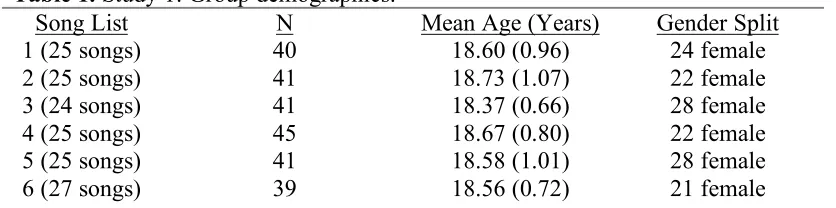
38 to 85 participants.4 Demographic information for each list is presented in Table 1.
Participants were seated individually in front of a computer and keyboard in separate laboratory testing rooms. Participants were instructed to follow all instructions on the screen and ask for clarification as necessary throughout the experiment. Prior to listening to the musical clips, participants completed demographic questions, which were followed by visually presented instructions in which each participant was told they would listen to short clips of 24 to 27 songs (see Appendix C for song lists) and answer a few questions about their knowledge (e.g. title) and experience of the song (e.g. familiarity, personal relevance). Participants were then presented two practice tasks where they listened to two musical cues (“Say Something” by the musical group A Great Big World featuring Christina Aguilera and “Wake Me Up” by Avicii), and completed a practice question.
After the practice task, participants were provided the opportunity to ask questions with a prompt on screen before continuing onto the experimental task. For each of the musical clips, participants first saw a fixation (“*”) point in the center of the computer screen followed by the 30-second musical clip. Participants were instructed to listen to the entire clip after which they were asked to press the space bar to continue onto the questions. The full list of questions is provided in Table 2 below. Similar questions were addressed
4
Most song clips were rated by 39 to 45 participants. Two song clips were rated by two groups.
Table 1. Study 1:Group demographics.
Song List N Mean Age (Years) Gender Split
1 (25 songs) 40 18.60 (0.96) 24 female
2 (25 songs) 41 18.73 (1.07) 22 female
3 (24 songs) 41 18.37 (0.66) 28 female
4 (25 songs) 45 18.67 (0.80) 22 female
5 (25 songs) 41 18.58 (1.01) 28 female
6 (27 songs) 39 18.56 (0.72) 21 female
in various previous work on popular music and AM (Bartlett & Snelus, 1980; Schulkind et al., 1999; Ford, Rubin, & Gianovello, 2016; Platz, Kopiez, Hasselhorn, & Wolf, 2015). Some of these questions were presented in a 9-point Likert scale format (e.g. familiarity), and some were answered in a text box (typed, e.g. artist of song, emotional response elaboration). For the text box questions, participants pressed the space bar to open a text box. Participants then typed their response in the box, and pressed enter when they were finished, which moved the program onto the next question. For Likert-scale questions, the numbers at the top of the keyboard were used to input an answer and the response “0” was offered for “not sure or prefer not to answer” when applicable. When all questions were answered for each song, the program advanced to the next song. Within each program, the songs were presented by E-prime randomly one at a time. At the end of presentation of all songs, participants were asked whether any songs evoked a nostalgic response. A definition of nostalgia was provided and participants were asked to briefly describe any songs that may have evoked this response.
2.2 Results and discussion
Recall that the major aim of the study was to identify items to use in cueing
autobiographical memories (AMs) with short clips of popular music. To provide context to meet this aim, some demographic variables will be presented first followed by analyses of the memory-relevant variables.
2.2.1
Demographic questions
2.2.1.1
Listening habits and preferences of young adults
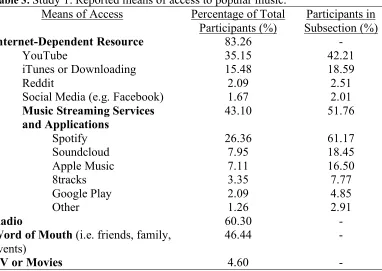
As seen, 83.26% of participants reported accessing new music through an dependent resource (e.g. music application or streaming service). Within the internet-dependent resources, just over a third of participants accessed music commonly through YouTube and almost half through some sort of music streaming service. Spotify was listed most frequently, reported by just over one quarter of participants and over 60% of participants reporting using a music application or streaming service. The next two most common means of access were radio (60.30%) and word of mouth (e.g. family, friends, 46.44%). A small group of participants reported accessing new music through television or movies (4.60%, e.g. “Grey’s Anatomy”).
2.2.1.2
Genre preferences
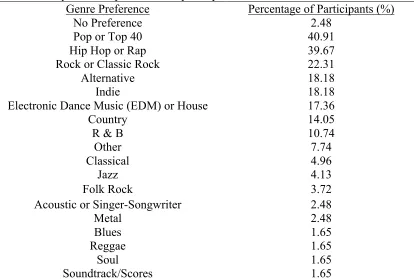
As seen in Table 4, only 2.48% of participants reported no genre preference. For other participants, a wide range of genres were listed as one’s favourites. The top 3 preferred genres (of the 30 reported) were: popular music or Top 40 endorsed by 40.91% of
Table 3. Study 1:Reported means of access to popular music.
Means of Access Percentage of Total
Participants (%) Subsection (%) Participants in
Internet-Dependent Resource 83.26 -
YouTube 35.15 42.21
iTunes or Downloading 15.48 18.59
Reddit 2.09 2.51
Social Media (e.g. Facebook) 1.67 2.01
Music Streaming Services
and Applications 43.10 51.76
Spotify 26.36 61.17
Soundcloud 7.95 18.45
Apple Music 7.11 16.50
8tracks 3.35 7.77
Google Play 2.09 4.85
Other 1.26 2.91
Radio 60.30 -
Word of Mouth (i.e. friends, family,
events)
46.44 -
TV or Movies 4.60 -
Note 1. Participants could report as many means of access as they wished.
respondents, hip hop or rap (39.67% of participants), and rock or classic rock (22.31% of respondents).
Table 4. Study 1:Genre preference of participants.
Genre Preference Percentage of Participants (%)
No Preference 2.48
Pop or Top 40 40.91
Hip Hop or Rap 39.67
Rock or Classic Rock 22.31
Alternative 18.18
Indie 18.18
Electronic Dance Music (EDM) or House 17.36
Country 14.05
R & B 10.74
Other 7.74
Classical 4.96
Jazz 4.13
Folk Rock 3.72
Acoustic or Singer-Songwriter 2.48
Metal 2.48
Blues 1.65
Reggae 1.65
Soul 1.65
Soundtrack/Scores 1.65
Note. All genres endorsed by 1.5% or less of participants were grouped into other. These included:
religious, pop punk, Korean pop, Doo-wop, Disco, Chinese pop, Bollywood, Punjabi, punk rock, psychedelic, soundtrack/scores, tropical, folk, and dance.
2.2.2
Memory – Relevant measures
2.2.2.1
Knowledge of the musical clip
In this section, data relevant to how much information the sample could recall about the music is provided. Participants were also asked about their knowledge of the music: title, artist, and year the song was released. These questions were responded to in text-box format. The title and artist data were analyzed by quantifying the response as either 2
(completely correct), 1 (partially correct, e.g. part of title or artist name), or 0 (incorrect).
below, but these data were also used for correlational analyses presented in Appendix D. An additional variable was computed and included in the correlational analyses. This variable, “song recency” was computed as the year of popularity subtracted from the current year to index how old a song stimulus was.
For title accuracy, 57.2% of participants were correct, 9.0% were partially correct, and 33.7% were entirely incorrect across all songs. For artist accuracy, 56.4% of participants were correct, 1.4% were partially correct, and 42.1% were entirely incorrect. Finally, on average, participants guessed that a song was released 2.52 years (SD = 2.96) from the actual release year. Participants who did not report a year for this response were excluded from these analyses (16.96%) and thus, this value is only reflective of those providing a response.
2.2.2.2
Experience of the musical clip
A central question of interest in Study 2 is the relation of affective reactions on hearing the musical clip and the emotional aspects of the memory cued. Participant experience of the music was indexed by the following 9-point Likert-scale variables: familiarity, personal relevance, emotional valence, negative emotion, positive emotion, enjoyment, and emotional intensity. Participants were also given the option to elaborate on emotional experience (open-ended), and, if an autobiographical memory was evoked, to briefly elaborate. For these open-ended items, not all participants responded. For these analyses, data from participants who did not respond to a given item for any of the songs provided were not included in the analyses for that question. Recall that except the emotional valence question, which was rated from 1 (very negative) to 9 (very positive), all Likert-scale questions were answered on a Likert-scale of 1 (low) to 9 (high). The data for the Likert scales variables are presented next followed by data on reports of the autobiographical memory evoked.
music clips. Data for every song clip listened to for 2 seconds or less were eliminated from analyses, resulting in the elimination of data associated with 27 individual song clips. As a result, the number of participants rating a given song range from 38 to 85.
Note 1. Likert scale questions ranged from 1 (very low) to 9 (very high) in all cases except emotional
valence that ranged from 1 (very negative) to 9 (very positive).
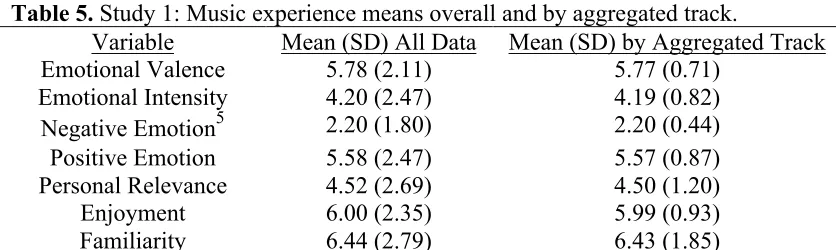
Note 2. Column 1 presents the M(SD) of all data. The point of this is to show how the data varies over all participants. Column 2 presents the M(SD) of songs aggregated by track. This accounts for the variance in number of participants ranking each song, but eliminates the participant variance data.
As seen in Table 5, the music clips are rated as generally albeit on average, moderately positive, familiar, enjoyable, only moderately emotionally intense, and moderately personally relevant. The fairly large standard deviations indicate considerable variability. Thus, the database contains stimuli that can be orthogonally varied in experimental studies.
If participants reported that the music evoked a specific AM, answers were first coded as
1 (specific event AM evoked) or 0 (non-specific AM or no memory evoked) based on the
quality of the memory response provided and the experimenter’s knowledge of a specific event autobiographical memory (i.e. describes a distinct event occurring over a short period of time). Caution should be taken in interpreting these responses and subsequent analyses as only about a third of responses indicated a specific event AM. Of the 6185 instances of listening to one song, 2214 songs led to a specific event memory evoked (35.8%).
5
Negative emotion and positive emotion responses may be of use to those interested in Nostalgia. Further data on these variables are presented in correlational analyses below.
Table 5. Study 1: Music experience means overall and by aggregated track.
Variable Mean (SD) All Data Mean (SD) by Aggregated Track
Emotional Valence 5.78 (2.11) 5.77 (0.71)
Emotional Intensity 4.20 (2.47) 4.19 (0.82)
Negative Emotion5 2.20 (1.80) 2.20 (0.44)
Positive Emotion 5.58 (2.47) 5.57 (0.87)
Personal Relevance 4.52 (2.69) 4.50 (1.20)
Enjoyment 6.00 (2.35) 5.99 (0.93)
The inter-correlations of the Likert-scale variables and the likelihood a song evoked an autobiographical memory are presented in Table 6. Recall that most Likert scale
questions ranged from 1 (low) to 9 (high) and that emotional valence ranged from 1 (very
negative) to 9 (very positive). Recall also, that the AM variable was dichotomized: 0
(non-specific AM or no memory evoked) and 1 (specific event AM evoked). The
correlation matrix of all the variables analyzed in Study 1 is provided in Appendix D with only select relations discussed here.
The reactions to the music tend to be moderately inter-correlated, with highest
associations between familiarity and personal relevance (r = .66, p < .01), and personal relevance and having an enjoyable and positive reaction (r = .63 and .57, respectively, both p < .01). Moreover, evocation of a specific event AM is associated with positive valence, higher familiarity, music experienced as intense, higher personal relevance, and higher enjoyment of a song, with rs ranging from .17 to .38 (all p < .01) but is not associated with negative emotion (r = - .02). Platz et al. (2015) found similar, though weaker, positive associations between recall of specific memories and familiarity and positive valence of the musical cue in their sample of older adults.
These data (consistent with the past literature, e.g. Janata et al., 2007; El Haj et al., 2015) indicate that familiar and relevant music tend to lead to higher recall of AMs. Thus, these variables were incorporated into choosing the stimuli for use in Study 2.
Table 6. Study 1:Inter-correlations of all Likert-scale ratings as well as
likelihood of evoking an AM.
VAL FAM INT AM NEG POS REL ENJ
VAL - .48** .30** .28** -.28** .72** .57** .73**
FAM - .26** .38** -.05** .51** .66** .59**
INT - .17** .05** .31** .36** .29**
AM - -.02 .28** .37** .29**
NEG - -.28** -.04** -.25**
POS - .57** .76**
REL - .63**
ENJ -
Note 1. VAL – emotional valence, FAM – familiarity, INT – emotional intensity, AM – likelihood of evoking a specific autobiographical memory, NEG – negative emotion, POS – positive emotion, REL – relevance, ENJ – enjoyment.
2.2.3
Supplementary analyses
In addition to reporting whether or not the music evoked an autobiographical memory, participants were provided with the option to elaborate on any emotional experience engendered and, if an autobiographical memory was evoked, comment upon it. A similar option was provided when people elaborated on emotional reactions and nostalgic
reactions in listening to the music. Because this option was completely voluntary, it is important to note that only a subset of participants responded.
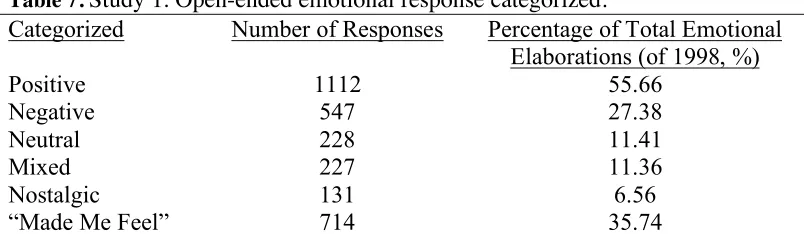
Of the 4462 emotional elaboration responses, 1998 responses (44.78% of elaborations; 32.30% of all song responses) described a felt emotion. These responses were categorized into positive (e.g. happy), negative (e.g. sad), neutral, nostalgic, or mixed (e.g. both positive and negative, “weird”, includes nostalgic). Many participants referred
specifically to music’s ability to evoke emotions (e.g. “made me feel”). All responses were separately tallied. The frequencies and percentage of comments out of 1998 that endorsed various emotional responses are provided in Table 7. Consistent with the literature (e.g. Song et al., 2016), these data suggest that music can evoke emotions.
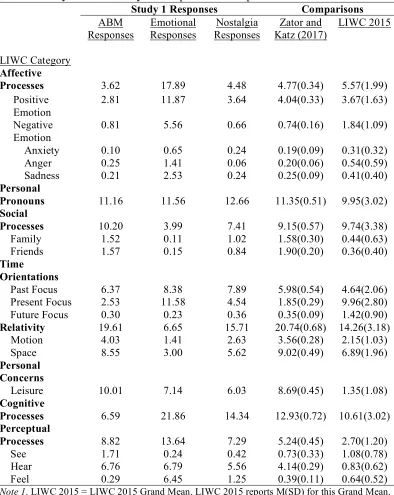
The content of the reported elaboration was also examined with the Linguistic Inquiry and Word Count (LIWC) 2015 program (Pennebaker, Booth, et al., 2015). As mentioned previously, the LIWC reports proportions of words in different categories (e.g. affective, cognitive, etc.) of total words in a text sample, and the reports are taken as reactions to text relatively free of self-presentational characteristics. The following categories of interest are reported on for each question: affective processes, personal pronouns,
cognitive processes, social processes, relativity, time orientations, leisure, and perceptual
Table 7. Study 1:Open-ended emotional response categorized.
Categorized Number of Responses Percentage of Total Emotional
Elaborations (of 1998, %)
Positive 1112 55.66
Negative 547 27.38
Neutral 228 11.41
Mixed 227 11.36
Nostalgic 131 6.56
“Made Me Feel” 714 35.74
processes. Most of these categories were examined in Zator and Katz (2017). The social processes and leisure categories were added in recognition of the social functions and social contexts in which music is typically encountered in day to day life (e.g. Hargreaves & North, 1999; Juslin et al., 2008) and because Sheldon and Donahue (2017) reported that classical music-cued memories differed in social content depending on the
emotionality of the cue. Additionally, increased perceptual (especially hearing) words found in music-cued memories may indicate an interaction with the popular music in a given memory and increased vividness of recall (Belfi et al., 2016). We find increased use of these features in memory descriptions in past work (Belfi et al., 2016; Zator & Katz, 2017).
LIWC analyses of these three open-ended response items relative to the means of all memories in Zator and Katz (2017) and the “grand mean” of the text samples used to generate the LIWC 2015 category data (Pennebaker, Boyd, et al., 2015) are presented in Table 8. Before text analysis, all text samples were edited for spelling and grammar.
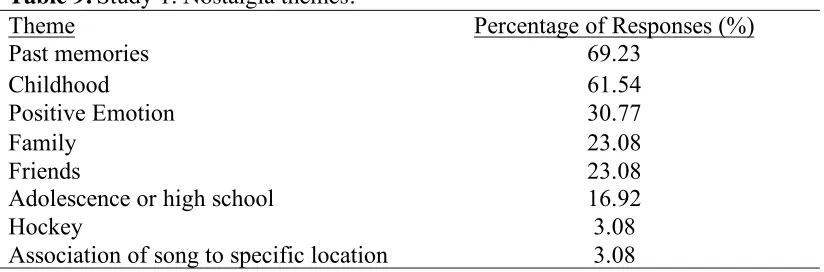
Relative to the LIWC 2015 library, a larger proportion of affective words were produced in the participants’ elaborative emotional responses, with roughly twice as many positive words used than were negative words. Within negative words, a higher abundance of sadness words was seen. This combination of increased positive and sadness words may provide evidence for some nostalgic responses (see Barrett et al., 2010; Michels-Ratliff & Ennis, 2016). Analysis of nostalgia is presented in the next section. Additionally, a larger proportion of present-oriented words were seen, possibly reflective of the fact that most people respond about emotions that they are currently feeling, which is also reflected in the large proportion of feeling words seen. This also supports the assertion that popular music can not only convey, but evoke emotions (Song et al., 2016). Similarly, a large proportion of cognitive and perceptual process words and a lower proportion of social words were seen. This may all be due to the reflective nature of the emotional responses, many focusing on feeling a particular way when listening to a song and reflecting on the nature of that feeling, with less emphasis on the context where the music was
Table 8. Study 1:LIWC analyses of open-ended responses.
Study 1 Responses Comparisons
LIWC Category
ABM
Responses Emotional Responses Responses Nostalgia Katz (2017) Zator and LIWC 2015
Affective
Processes 3.62 17.89 4.48 4.77(0.34) 5.57(1.99)
Positive Emotion
2.81 11.87 3.64 4.04(0.33) 3.67(1.63)
Negative Emotion
0.81 5.56 0.66 0.74(0.16) 1.84(1.09)
Anxiety 0.10 0.65 0.24 0.19(0.09) 0.31(0.32)
Anger 0.25 1.41 0.06 0.20(0.06) 0.54(0.59)
Sadness 0.21 2.53 0.24 0.25(0.09) 0.41(0.40) Personal
Pronouns 11.16 11.56 12.66 11.35(0.51) 9.95(3.02)
Social
Processes 10.20 3.99 7.41 9.15(0.57) 9.74(3.38)
Family 1.52 0.11 1.02 1.58(0.30) 0.44(0.63)
Friends 1.57 0.15 0.84 1.90(0.20) 0.36(0.40)
Time
Orientations
Past Focus 6.37 8.38 7.89 5.98(0.54) 4.64(2.06)
Present Focus 2.53 11.58 4.54 1.85(0.29) 9.96(2.80) Future Focus 0.30 0.23 0.36 0.35(0.09) 1.42(0.90)
Relativity 19.61 6.65 15.71 20.74(0.68) 14.26(3.18)
Motion 4.03 1.41 2.63 3.56(0.28) 2.15(1.03)
Space 8.55 3.00 5.62 9.02(0.49) 6.89(1.96)
Personal Concerns
Leisure 10.01 7.14 6.03 8.69(0.45) 1.35(1.08)
Cognitive
Processes 6.59 21.86 14.34 12.93(0.72) 10.61(3.02)
Perceptual
Processes 8.82 13.64 7.29 5.24(0.45) 2.70(1.20)
See 1.71 0.24 0.42 0.73(0.33) 1.08(0.78)
Hear 6.76 6.79 5.56 4.14(0.29) 0.83(0.62)
Feel 0.29 6.45 1.25 0.39(0.11) 0.64(0.52)
Note 1. LIWC 2015 = LIWC 2015 Grand Mean. LIWC 2015 reports M(SD) for this Grand Mean.
Note 2. The LIWC program does not give standard deviation measurements for analyzed text samples. Zator and Katz (2017) reported M(SE) resulting from aggregated means of individual memory LIWC reports.