R E S E A R C H
Open Access
Complementary tensor-driven image coherence
diffusion for oriented structure enhancement
Zhang Hong-mei, Wan Ming-xi
*and Bian Zheng-zhong
Abstract
Oriented structure enhancement plays important role in computer vision tasks, where the diffusion is encouraged along the preferred direction instead of perpendicular to it. By analyzing the differential geometric property of the oriented structure, a complementary tensor is proposed by combining the first and the second-order structure tensors as complementary descriptors, which can precisely analyze not only the step edges, but also the weak edges such as narrow peak or ridge-like structures. Complementary diffusion tensor is constructed from the new structure tensor, which steers coherence diffusion for oriented structure enhancement. Furthermore, fast algorithm based on additive operator splitting scheme is used for numerical solution, which is much faster than usual approach. The experimental results on several images are provided. Experiments show that the image diffusion process steered by the new complementary tensor can strengthen the oriented structures and also close the interrupted lines as well. Both strong and weak edges are enhanced while noise is removed. Our approach is very promising and could be applied to many other images.
Keywords:tensor driven, image diffusion, coherence-enhancing, structure tensor, diffusion tensor, second-order directional derivative, AOS scheme
1. Introduction
Image enhancement is an important preprocessing step that removes noise while preserving semantically impor-tant structures such as edges and oriented structures. This may give great help for simplifying subsequent image ana-lysis like segmentation and understanding. In recent years, nonlinear PDE-based diffusion for image enhancement has attracted much attention for its adaptive behavior in a purely data-driven way that is flexible enough to cope with the rich image structures [1].
Image diffusion by nonlinear partial differential equation (PDE) approach was first introduced by Perona and Malik [2], followed by their study, numerous nonlinear diffusion filters have been proposed [3-8]. However, most of them use a scalar diffusivity thus the diffusion flux is along gradient direction, which may blur edges. Besides that, such isotropic diffusion cannot preserve the oriented structures precisely [1,7].
With the increasing appearance of oriented structures in many computer vision and image processing problems, for instance pulmonary vessels, trabecular bone, finger-print, paintings, wood texture, etc. Many attempts on oriented patterns enhancement have been made [9-12]. PDE-based coherence-enhancing diffusion has proved to be an attractive tool, which is an anisotropic diffusion steered by the diffusion tensor that allows a more flexible orientation-dependent filtering [10,11].
There are two important steps for coherence-enhancing diffusion: first analyze coherent structures and second enhance it. Structure tensor is an important descriptor for coherence analyzing, whose eigenvectors and eigenvalues can provide coherent direction and measurement, respec-tively. From the structure tensor, the diffusion tensor is constructed such that its eigenvalues encourage the diffu-sion along the coherent direction than across to it, which steers the coherent diffusion.
Precise coherence analysis is crucial to the diffusion behavior. The original structure tensor was proposed by Cottete and Germain [13], i.e., the tensor product of the gradient: J0=∇uσ⊗ ∇uTσ, where us = Gs *u is the
slightly smooth version image by convolving u with
* Correspondence: [email protected]
Key Laboratory of Biomedical Information Engineering, Ministry of Education, Department of Biomedical Engineering, School of Life Science and Technology, Xi’an Jiaotong University, Xi’an city, Shannxi Province, 710049, P. R. China
Gauss kernelGs. The eigenvalues ofJ0provide coherent
measurement and one of the eigenvectors provides the coherent direction. However, the simple structure tensor fails in analyzing corners or parallel structures. To solve this problem, Weickert [10,11] proposed the structure tensor: Jρ=Gρ∗(∇uσ⊗ ∇uTσ). The eigenvalues of Jr measure the variation of the gray values within a win-dow size of order r. This structure tensor is useful to analyze strong edges, corners, and T-junctions. Brox and Weickert [14] proposed a nonlinear structure tensor by diffusingJ0under the image gradient field∇u, which
may bring much computational cost. However, the above structure tensors are essentially linear smoothing of J0, and use only the local average of the first-order
differential information. Many image features such as narrow peaks, ridge-like edges could not accurately be described byJrfor the gradient is close to zero on these structures.
By analyzing the first- and second-order directional deri-vatives of the different edges, we propose a new structure tensor which is a desirable descriptor for analyzing not only strong edges, but also weak edges such as narrow peaks or ridge-like structures. The proposed structure tensor combines the first- and the second-order structure tensors as complementary descriptors that play important roles on detecting different kind of edges. The comple-mentary diffusion tensor is constructed from the new structure tensors, which can steer the coherence diffusion controlled by a switch parameter. The diffusion can pre-serve not only strong edges, but also weak edges precisely while removing the noise. Furthermore, numerical imple-mentation is solved by the additive operator splitting (AOS) scheme, resulting in fast convergence rate.
The remainder of the article is organized as follows. In Section 2, mathematical background of the coherence diffusion is outlined. In Section 3, edge structure tensor is proposed by combing the first- and the second-order structure tensors as complementary pairs. In Section 4, a complementary diffusion tensor is constructed from the new structure tensor. In Section 5, efficient numerical implementation of the diffusion PDE by fast AOS scheme is provided, and in Section 6, experimental results are provided and compared with that of the other methods. Finally, in Section 7, conclusions are reported.
2. Coherence diffusion
In image processing, the anisotropic diffusion process is equivalent to minimizing the following energy variational:
E(u) =
[β(u−f)
2
+tr(ψ(∇u· ∇uT))]dxdy (1)
where fdenotes the original image defined on the
image domainΩanduthe diffusion image.bis a small
positive. ψ(s2) denotes a penalizing function that is dif-ferential in its argument and convex ins.
From variational method, we can derive the following Euler Lagrange equations of anisotropic diffusion [15]:
β(u−f) =div(ψ(∇u· ∇uT)· ∇u) (2)
The detailed derivative can be found in [16].
Itψ(∇u· ∇uT)=D(∇u· ∇uT), then Equation 2 is the steady-state solution of the following PDE with the reflecting boundary condition and the original fas the initial condition:
⎧ ⎪ ⎪ ⎪ ⎨ ⎪ ⎪ ⎪ ⎩
∂u
∂t = div(D• ∇u)−β(u−f) on
<D· ∇u,n>|∂= 0 on∂ u(·0) =f(·)
(3)
where D(·) is the diffusion tensor and is a positive definite symmetric matrix. In the coherence diffusion case, it is desirable to rotate the diffusion tensor such that the diffusion is encouraged along the orientation of interesting features instead of perpendicular to it. The desired oriented direction is called coherent direction along which the diffusion performs more sufficient.
Designing diffusion tensorDis crucial to the diffusion process. To steer the coherence diffusion, the differential geometry property of oriented structure must be ana-lyzed so as to detect the oriented structure and the coherent direction precisely.
3. Edge structure and its differential geometric property
The edge in image is defined as the position where the gray value changed suddenly. This kind of edge always refers to either step edge or the strong edge. The strong edge can easily be detected from the extreme of its first derivative. However, there are many oriented structures such as narrow peaks, ridge-like, or flow-like patterns in images. However, their first derivative is zero. We called them weak edges. These patterns play very important role as the strong edge did. Therefore, finding out the method for detecting and enhancing these oriented struc-ture is also in great need.
Let us denote the intensity image by u(x, y). The directional derivative ofU at point (x, y) in the direc-tion, a = (cosθ, sinθ)T is denoted by ua(x, y). It is defined as:
uα(x,y)=∂u
∂x cosθ +
∂u
∂ysinθ =<∇u,α > (4)
The second-order directional derivative of u along
uα(x,y) = ∂
∂α( ∂u
∂α) =<u
α,α >=<<∇u,α >,α >
= ∂
2u ∂x2cos
2θ+ 2∂2u
∂x∂ysinθcosθ+
∂2u ∂y2sin
2θ
= (cosθsinθ)
⎛ ⎜ ⎜ ⎜ ⎝
∂2u ∂x2
∂2u ∂x∂y
∂2u ∂x∂y
∂2u ∂y2
⎞ ⎟ ⎟ ⎟ ⎠
cosθ sinθ
=αTHα
(5)
whereHis the Hessian matrix ofu.
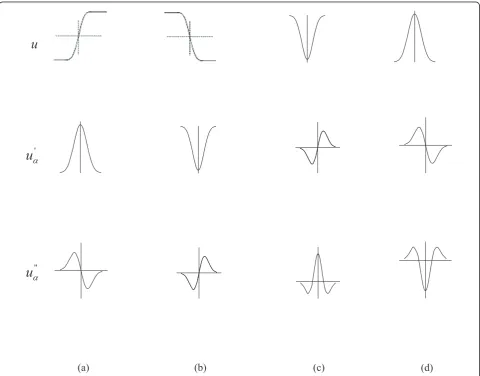
Figure 1 shows the Edge structure and its differential geometric property. Figure 1a, b shows the step edges and its first- and second-order derivatives. We could see that its first-order derivative can reach its extreme. Therefore, the strong edge can be detected by its first derivative.
In the following, we could see that the geometry prop-erty of the strong edge can by analyzed by the structure tensor:J0=∇uσ⊗ ∇uσT, whereus= Gs*uis the slightly
smooth version image by convolvinguwith Gauss
ker-nelGs. We callJ0the first-order structure tensor.
From linear algebra, we can derive that the two eigen-values ofJ0 areμ1=|∇uσ|2,μ2= 0, and the correspond-ing eigenvectors are e1= ∇uσ
|∇uσ|, e2= ∇u⊥σ
|∇uσ|, where∇u ⊥ σ
denotes the vector that is perpendicular to ∇us. We know that the direction of∇usis perpendicular to the edge. Therefore, we can conclude that the coherent direction ise2∇u⊥σ, because the desired diffusion direc-tion is along the edge but not across ro it.
Figure 1c, d shows the weak edge, whose first-order directional differential is zero. However, we could see that the ridge-like structure has the extremum on its
u
' D
u
'' D
u
(a) (b) (c) (d)
Figure 1Edge structures and its first- and second-order directional derivatives.(a)Step edge-I structure,(b)step edge-II structure,(c)
second-order directional differential. Letμ1, μ2(μ1≥ μ2)
denote the eigenvalues ofHande1,e2the corresponding
eigenvectors. From Rayleigh’s quotient [17], we can derive that
μ2≤αTHα=u
α≤μ1
So, the eigenvalues of the Hessian matrix are exactly the two extreme ofuαand the corresponding eigenvec-tors are the directions along which the second direc-tional derivative reaches its extreme.
Since the Hessian matrix can describe the second-order structure of the local intensity variations along the eigenvectors, we call it second-order structure tensor
and denote it as JH = Hs, where Hs is the Hessian
matrix ofus.
From Figure 1c, d, we can see that when there are dark (bright) narrow long structures in the image, uα
reaches its maximum (minimum) along eigenvectorse1
(e2). As a result, the coherent direction is along e2 (e1),
respectively.
From above, we can conclude that the first- and the sec-ond-order structure tensors play complementary role in detecting different kinds of edges. Let us useJr= Gr*J0,
where Gris the Gauss kernel, to replaceJ0. The first-order
structure tensorJris useful to analyze strong edges such as step edge, corners, and T-junctions, while fails in detecting weak edges precisely. However, the second-order structure tensorJHcan capture weak edges as narrow peaks and ridge-like structures while fails in detecting strong edges. Therefore, the two structure tensorsJrand
JHcan be complementary to each other and provide reli-able coherence estimation on different structures.
4. Complementary diffusion tensor
A natural way to construct diffusion tensorDis from structure tensorJsuch thatDhas the same eigenvectors asJ and its eigenvalues prefer the diffusion along the coherent direction than across to it.
Letμ1,μ2(μ1≥μ2) denote the eigenvalues ofJande1,e2
the corresponding eigenvectors. The coherent direction estimated fromJis denoted bye(co)and the orthogonal
direction bye⊥(co).
Whenμ1>>μ2, it corresponds to anisotropic-oriented
structure. Whenμ1≈μ2, it corresponds to isotropic
struc-tures. The coherence measurement is given byK= (μ1 -μ2)2. To encourage coherent diffusion, the eigenvalues of
Dcan be chosen as follows [10,11]:
λ(co)= ⎧ ⎨ ⎩
c, ifμ1=μ2
c+ (1−c) exp
− γ
(μ1−μ2)2
, else
λ⊥
(co)=c
(6)
where l(co) and λ⊥(co)are the diffusivity along the
direction e(co) ande⊥(co), respectively. g > 0 serves as a threshold parameter. We can see thatl(co)is an
increas-ing function with respect to the coherence measurement
K. when (μ1 -μ2)2> >g,l(co)≈1. Otherwise, it leads tol (co)≈c, where cÎ(0, 1) is small positive parameter that
guarantees that Dis positive definite. It means that the more coherent the structure is, the more diffusion along the coherent directione(co)is. Whereas the diffusion is
not preferred at the direction ofe⊥(co)as the diffusivity is very small there.
Therefore,Dcan be obtained by
D=P
λ
(co) λ⊥
(co)
PT (7)
whereP=e(co),e⊥(co)
is the eigenvector matrix.
A switch parameter T is introduced to control the
roles of the two structure tensors in detecting different coherent structures. When|∇uσ| ≥T, Jris available to detect strong edges. Whereas|∇uσ|<T, JHis more reli-able to detect weak edges.
Let Dr, DH denote the diffusion tensor constructed fromJrandJH, respectively. Therefore, the diffusion ten-sor is given by
D=
Dρ if |∇uσ| ≥T DH else
(8)
when|∇uσ| ≥T, the coherent direction of Dis always along∇u⊥σ; Otherwise, it is alonge(H)(co)that is the coher-ent direction estimated from JH. It is noted that the
coherent direction estimated from JH can be divided
into the following two cases. When there are dark curvi-linear structures in the bright background, the coherent direction is along e2. Otherwise there are bright
curvi-linear structures in the dark background, the coherent direction is alonge1.
Substitute (8) into Equation 3, we can obtain the fol-lowing partial differential diffusion equation:
⎧ ⎪ ⎪ ⎪ ⎨ ⎪ ⎪ ⎪ ⎩
∂u
∂t =
div(Dρ• ∇u) +β(f−u) if |∇uσ| ≥T div(DH• ∇u) +β(f−u) else on <D• ∇u,n>|∂= 0 on∂
u(·0) =f(·) on
(9)
5. Numerical implementation by parallel AOS algorithm
The numerical solution of the diffusion equation (9) can be implemented by the semi-implicit discretization and AOS scheme [10,18]. It is a parallel algorithm and has fast algorithm for inverse matrix. Therefore, it is 10 times faster than usual numerical method.
As the diffusion tensor Dis a positive definite sym-metric matrix, letD=
d11d12
d12d22
, then
div(D· ∇u) =
m
i,j=1
∂xi(dij∂xju) (10)
To facilitate the expression, we denote D=
a b b c
,
then we obtain
div(D• ∇u) =div
a b b c
∂xu ∂yu
=∂xa∂xu+b∂yu+∂yb∂xu+c∂yu
=∂x(a∂xu)+∂x
b∂yu
+∂y(b∂xu)+∂y
c∂yu
(11)
Using central differential discretization, we obtain:
∂x(a∂xu)=
1
h1 ((a∂xu)
i+1 2,j
−(a∂xu)
i−1 2,j
) =1
h1
⎛ ⎝a
i+1 2,j
ui+1,j−uij h1 −
a i−1
2,j
ui,j−ui,j−1 h1
⎞
⎠ (12)
Similarly,
∂yc∂yuij=
1
h2
c∂yu
i,j+1 2
−c∂yu i,j−1
2
⎞ ⎠=1
h2
⎛ ⎝c
i,j+1 2
ui,j+1−ui,j h2 −
c i,j−1
2
ui,j−ui,j−1 h2
⎞
⎠ (13)
Using central differential discretization, we obtain
∂x
b∂yu
ij=
1 2h1
b∂yu
i+1,j−
b∂yu
i−1,j
= 1 2h1
bi+1,j
ui+1,j+1−ui+1,j−1 2h2 −bi−1,j
ui−1,j+1−ui−1,j−1 2h2
(14)
Similarly,
∂y(b∂xu)= 1 2h2
bi,j+1
ui+1,j+1−ui−1,j+1
2h1 −
bi,j−1
ui+1,j−1−ui−1,j−1
2h1
(15)
Let Lij denote a central difference approximation to the operator∂xi(dij∂xj). Then
div(D∇u) =
m
i,j=1
Liju (16)
where mis the dimension of the image. In our case,
m= 2.
The discretization of Equation 9 is given by the finite difference scheme:
uk+1−uk
τ =
m
i,j=1
∂xi(dij∂xju) +β(f−u) (17)
Represent the whole image of size [M,N] as a vector of size [MN,1]. In this vector-matrix notation and use the semi-implicit discretization, we obtain
Uk+1−Uk
τ =
m
l=1
LkiiUk+1+ m
i=1
j=i
LkijUk+β(f−Uk+1) (18)
Therefore,
Uk+1= (I− τ
1 +β·τ
m
l=1 Lkll)−1·
(I+τ
m
i=1
j=i
Lk
ij)Uk+β·f·τ
1 +β·τ
(19)
Let Vk=
⎛ ⎝I+τ
m
i=1
j=i
Lkij
⎞
⎠Uk, and denote
Wk= V
k+τβf
1 +βτ ,W
k= Vk+τβf
1 +βτ
Then
Uk+1=
I−ττ
l
Lkll
−1
Wk (20)
It is noted thatLllis tri-diagonal and diagonally domi-nant, and use AOS scheme [18], we can obtain
Uk+1=1 m
m
l=1
(I−m·ττ·Lk ll)
−1 Wk= 1
m
m
l=1
I−1 +mτβτLk ll
−1Vk+τβf
1 +βτ (21)
AOS scheme is based on the fact that Equation 21 has the same first-order Taylor expansion in ττas that of (20). In this way, the complex matrix inverse problem in (20) can be simplified to the matrix inverse in (21). The central difference approximation ofLll, (l= 1, 2) guaran-tees that it is diagonally dominant tri-diagonal. There-fore, the diffusion equation (21) converts to solving a diagonally dominant tri-diagonal system of linear equa-tion, which can be easily solved by Thomas algorithm [19]. By the AOS algorithm, the numerical implementa-tion is 10 times faster than the usual numerical method.
The AOS algorithm of the PDE (9) is given as follows InputU=Uk
1) Calculate structure tensorJ for each point and cal-culate the corresponding eigenvalues and eigenvectors;
2) Construct diffusion tensorDusing (6) and (7);
3) CalculateVk=
I+τ
m i=1
j=i
Lkij
Uk ;
4) Forl= 1:m
Calculate Wlk+1=
I− mτ
1 +βτL
k ll
−1
Vk+τβf
1 +βτ by
Thomas algorithm. End
5) CalculateUk+1= 1 m
m l=1
OutputU=Uk+1
6. Experiments
Selection of parameters is important for the diffusion process and the detailed discussion can be found in [15]. In the following experiments, we chooseb= 0.1, c
= 0.001, and g the 90% quantile of the histogram for
(μ1-μ2)2. In the semi-implicit discretization case, the
recommendation of time stepτ is not more than 5. In
the experiments, we set τ = 2.5. The iteration time is related to the spatial scale [15]. In another word, the bigger the iteration time is, the more the diffusion is closer to its steady state.
ParameterT is crucial to switch the two diffusion pro-cesses. IfTis chosen too small, some narrow long
struc-tures cannot be captured precisely. However if T is
selected too large, some gradient information may lose and computational cost increases as more pixels are involved in second-order differential computing. Because
setting of T is to recognize the weak edge where the
gradient is very small. WhenT is setting to bex% quan-tile of the histogram for|∇uσ|2, it means that x% of the gradients are smaller than T. The small portion of x% has small gradients that are the potential weak edge and the second-order directional differential needs to be cal-culated there. Experiments show that settingT to be 5-10% quantile of the histogram for|∇uσ|2is sufficient for wide categories of images. In the experiments, we setT to be 10% quantile of|∇uσ|2. The noise scale s and integration scalerare given for each case.
We design three groups of experiments as follows: 1) Complementary diffusion for image coherence-enhancing. The diffusion equation is give by (9).
2) Weickert’s coherence-enhancing diffusion [11]. It corresponds to the case thatD≡Dr.
3) Isotropic diffusion by P-M equation for image enhancement [2]. It corresponds to the case that Dis a scalar diffusivity.D=g(|∇uσ|2) = 1
1 +|∇uσ|2λ2 where
l is the contrast parameter that can be chosen as the 90% quantile of the histogram for| ∇f |.
The numerical solutions that are implemented by
the AOS scheme are described in Section 5. When D
is scalar diffusivity, it can be considered as the special
case that D is single element matrix. Then
div(D∇u) = div(g(|∇uσ|2)∇u) =
m i=1
∂xi(g(|∇uσ|
2)∂ xiu=
m i=1
Liiu,
where Lii is the central difference approximation to the operator∂xi(g(|∇uσ|
2)∂
xi). In this case,V k=Uk.
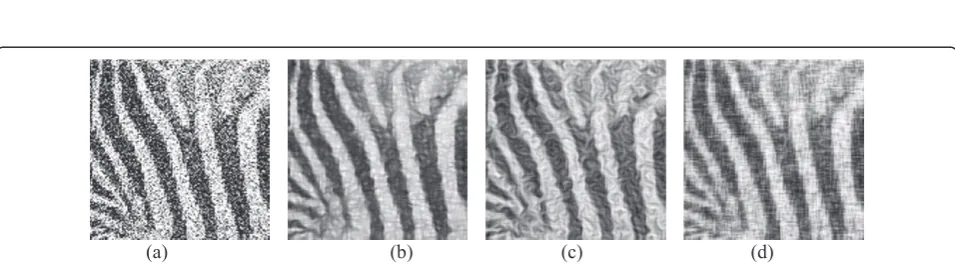
The experimental results are shown in Figures 2, 3, and 4. The first columns are the original images. The second columns are the results by the proposed comple-mentary diffusion tensor-driven approach. The third
columns are the results by Weickert’s coherence-diffu-sion method. The fourth columns are the results by P-M-diffusion equation.
Figure 2 is a noisy tree texture image, where the growth ring is corresponding to ridge-like peaks. From Figure 2b, we can see that the growth ring of tree is preserved pre-cisely and some interrupted line is closed as well. The growth ring in Figure 2b is more straight and smooth than that of Figure 2c. Moreover, the noise is removed better by our approach. Figure 2c shows that the noise is magnified somewhere and some flow-like artifacts appear in the interior area. In Figure 2d, the edge is blurred and the growth ring could not be seen clearly.
Figure 3 is a noisy wood texture image, where texture lines are corresponding to narrow peaks. Figure 3b shows that the important image features as line structures are preserved perfectly whereas Figure 3c severely blurs and twists some lines, and some flow-like artifacts appear in the interior area in Figure 3c. Figure 3d blurs the edge and also could not remove the scattered noise.
Figure 4 is a zebra texture image, where the stripe corresponds to ridge-like structures. Figure 4b precisely preserve these structures while removing the noise and the enhanced stripe is smooth and natural. Figure 4c, however, shows some heterogeneous in the interior of the stripe and deforms the edge in some degree. Figure 4d could not obtain the oriented structure and fails in removing the noise.
Experiments show that by our approach the diffusion is preferred along the desired coherent direction for the image features that are precisely described by the pro-posed complementary structure tensor. Therefore, impor-tant features are preserved and enhanced while the noise
is removed very well. However, Weickert’s approach
deforms some narrow peak and ridge-like-oriented struc-tures because the local average of the first-order structure tensor cannot recognize these patterns precisely [10]. As to the isotropic diffusion by P-M equation, it cannot close the interrupted line structures and also blurs the edge [2]. The proposed switch diffusion is robust and reliable for enhancing-oriented structures.
7. Conclusions
constructed from the new structure tensor, which can pre-serve many important edges, corners, T-junctions as well as narrow peaks and ridge-like structures while removing the noise. Furthermore, fast parallel AOS algorithm was applied to numerical implementation that is very efficient. Experiments by our approach were provided and com-pared with that of other methods, which were very pro-mising. Our approach is reliable and could be applied to oriented structure coherence enhancement.
Acknowledgements
This study was supported by the National Basic Research Program 973 under Grant Nos. 2010CB732603 and 2011CB707903, and the National Natural Science Foundation of China under Grant (No. 60801057).
Competing interests
The authors declare that they have no competing interests.
Received: 8 December 2010 Accepted: 21 September 2011 Published: 21 September 2011
References
1. J Weickert,A Review of Nonlinear Diffusion Filtering. Scale-Space Theory in Computer Vision, vol. 1252. (Springer, Berlin, 1997), pp. 3–28
2. P Perona, J Malik, Scale-space and edge detection using anisotropic diffusion. IEEE Trans Mach Intell.12(7), 629–639 (1990). doi:10.1109/34.56205 3. L Alvarez, P-L Lions, J-M Morel, Image selective smoothing and edge
detection by nonlinear diffusion. II SIAM J Numer Anal.29, 845–866 (1992). doi:10.1137/0729052
4. G Sapiro, A Tannenbaum, Affine invariant scale-space. Int J Comput Vis.11, 25–44 (1993)
5. L Rudin, S Osher, E Fatemi, Nonlinear total variation based noise removal algorithms, inModeliz Mat Traitement d’Images, (INRIA), pp. 149–179 (1992) 6. S Osher, LI Rudin, Feature-oriented image enhancement using shock filters.
SIAM J Numer Anal.27, 919–940 (1990). doi:10.1137/0727053 7. HM Salinas, D Cabrera Fernández, Comparison of PDE-based nonlinear
diffusion approaches for image enhancement and denoising in optical coherence tomography. IEEE Trans Med Imag.26(6), 761–771 (2007) 8. D Fang, Z Nanning, X Jianru, Image smoothing and sharpening based on
nonlinear diffusion equation. Signal Process.88(11), 2850–2855 (2008). doi:10.1016/j.sigpro.2008.05.008
9. Y Chen, SE Levine, Image recovery via diffusion tensor and time-delay regularization. J Vis Commun Image Rep.13, 156–175 (2002). doi:10.1006/ jvci.2001.0497
(a) (b) (c) (d)
Figure 2Diffusion for tree texture.(a)Original tree texture,(b)complementary diffusion by our approachs= 0.1,r= 1.2, iteration time = 6,
(c)coherence-enhancing method by Weickerts= 0.1,r= 1.2 iteration time = 6, and(d)diffusion by P-M equations= 0.1, iteration time = 3.
(a) (b) (c) (d)
Figure 3Diffusion for wood texture.(a)Original wood image,(b)complementary diffusion by our approachs= 0.05,r= 2, iteration time = 6,(c)coherence-enhancing method by Weickerts= 0.05,r= 2 iteration time = 6,(d)diffusion by P-M equations= 0.05, iteration time = 3.
(a) (b) (c) (d)
10. J Weickert, Coherence-enhancing diffusion filtering. Int J Comput Vis.
31(2-3), 111–127 (1999)
11. J Weickert, Coherence-enhancing diffusion of colour images. Image Vis Comput.17, 201–212 (1999)
12. SA Bakalexis, YS Boutalis, BG Mertzios, Edge detection and image segmentation based on nonlinear anisotropic diffusion, in14th International Conference on Digital Signal Processing 2002.2, 1203–1206 (July 2002) 13. G-H Cottet, L Germain, Image processing through reaction combined with
nonlinear diffusion. Math Comput.61, 659–673 (1993). doi:10.1090/S0025-5718-1993-1195422-2
14. T Brox, J Weickert, inNonlinear Matrix Diffusion For Optic Flow Estimation, ed. by Van Gool L. DAGM 2002, LNCS 2449, 446–453 (2002)
15. J Weickert, Nonlinear diffusion filtering, inHandbook on Computer Vision and Applications, ed. by Jähne B, Haußecker H, Geißler P, Vol. 2 (Signal Processing and Pattern Recognition, 1999)
16. Z Hongmei, Study on medical image segmentation based on variational method. PhD, Xi an JiaoTong University. (2004)
17. E Kreyszig,Differential Geometry, (Dover Publications, 1991) 18. J Weickert, BM ter Haar Romeny, MA Viergever, Efficient and reliable
schemes for nonlinear diffusion filtering. IEEE Trans Image Process.7(3), 398–410 (1998). doi:10.1109/83.661190
19. HR Schwarz,Numerische Mathematik, (Teubner, Stuttgart, Germany, 1988)
doi:10.1186/1687-6180-2011-70
Cite this article as:Hong-meiet al.:Complementary tensor-driven image coherence diffusion for oriented structure enhancement.EURASIP
Journal on Advances in Signal Processing20112011:70.
Submit your manuscript to a
journal and benefi t from:
7Convenient online submission 7Rigorous peer review
7Immediate publication on acceptance 7Open access: articles freely available online 7High visibility within the fi eld
7Retaining the copyright to your article